Horse Senses

If a horse can be made a senator, surely an ass can be made a president.  History can be unkind to those who think too highly of themselves.  It’s a horse of a different color than Incitatus that’s on my mind today.  This past week I read a news story in the Washington Post about Justice (there may be some double-meanings here, so hold onto your horses).  Justice used to be called Shadow, and Shadow was an abused horse.  Justice is now suing his former owner.  The story explores the question of whether animals can sue.  As a vegan for moral reasons I can see the point, but I also have to wonder how you defend those who have no voice to be heard, kinda like the electorate in the sham of a democracy.  How do we know what a horse really wants?

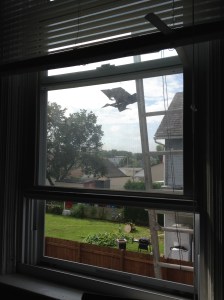
If horses could draw or sculpt, Xenophanes quipped, their gods would look like horses.  Asses, it stands to reason, worship one of their own.  Animals should have rights, but the difficult question falls onto our species—how do we know what they want?  Anyone whose spent time with animals knows that they think.  I can see a cat in a neighbor’s yard from my window.  Separated by a flimsy-looking hurricane fence is the next yard over where two large dogs often prowl.  If the cat and dogs happen to be out at the same time, there will be barking and braying but the cat will not appear to show concern.  The way my heart hammers at those barks, however, I have to suppose my feline friend also feels a bit of fear at the threat.  The cat must decide how to act, but it also must know that a barely visible fence keeps the canines at bay.

What does Justice want?  It’s a loaded question, for sure.  As much as we wish there might be, there is no Lorax to speak for the trees.  Or horses.  Nevertheless it’s obvious that horses think.  Perhaps like Job, Justice wondered why he was being punished after being a good horse.  The church magnanimously grants that animals cannot sin, after all.  One must wonder, however, about breeds developed by human engineering to be destructive, but that’s another parable.  While Justice might be given a day in court, and might win a cozy stall and protection from the elements, those of use bound by language will never know if justice has been served.  The limitation is our own.  Just ask Balaam.


Pretty as a Prayerbook

Stolidity.  Canons all across this deck are known for it.  Visions of unchanging texts, however, tend to be false perceptions.  Even the canon of the Bible differs, depending on who you talk to.  So it is to be applauded, I suspect, that the Episcopal Church is planning to revise the Book of Common Prayer.  The last revision was 1979, and before that, 1928.  This schedule should be telling you something—the BCP, or simply “Prayerbook” as it’s commonly called, was never a changeless canon.  We mere mortals rely on experts to change the words by which the Almighty is approached, and although Episcopalians are thin on the ground in this country, world-wide they’re a formidable sect.  They’re united mainly by their commitment to the BCP.  And with good reason.

The days of the British Empire are long gone, but when it ruled the waves (and even before) this island state contributed a number of religious elements to the world.  The Prayerbook was born out of struggles with Rome for secular power disguised as sacred.  We try to live with a fiction of separation, but churches and states have always had mutual influence—just consider the way secular Trump has changed Christianity and you’ll see.  The BCP was to define English Christianity and in doing so became a Scripture in its own right (or rite).  Phrases from the Book of Common Prayer pepper the English language so as to rival the Good Book itself.  When church attendance was an expectation, you couldn’t help but internalize it.

A certain seminary, nameless here forevermore, will not be pleased with such change.  When I taught there many still clung to the 1928, claiming the church had erred (a strange position for someone in a voluntary organization and who vows to support its decisions) by adding “inclusive language” in the ’79.  This, they averred, was a man’s religion.  And they meant biological males.  Stolid.  Or perhaps stale.  Like the fiction of unchanging canons, the myth of the rational male hierarchy exists only to be exploded.  The two longest reigning British monarchs have been queens, after all.  World wars tend to be the legacy of male rulers.  So, although a tiny seminary in the woods of Wisconsin will likely rage, the BCP could use a bit of a makeover.  The world has changed substantially since the 1970s.  Mainline churches have been steadily shrinking and redefinition with a declining financial base makes good sense.  “This is another day, O Lord. I know not what it will bring forth, but make me ready, Lord, for whatever it may be.”  Even if it be changing canons.


Forever Jung

A funny thing about aging is that you recollect your youth, but you find yourself less able to do the things that seemed so easy when you were more spry.  We live in a world where the elderly are coming to outnumber the young, and that means a lot of memories of “the time when.”  This thought confronted me when reading a story about two missing patients from a nursing home in Germany.  Authorities were frantic to find them until they were spotted at Wacken Open Air, the largest heavy metal fest in the world.  The news stories seemed bemused—it was cute, in a way, wasn’t it?  Two old guys trying to recapture their youth, like salmon swimming upstream where they were born.  I’ve got to wonder if there’s more to it than that.

Music has a way of touching us deeply.  While I prefer my rock on the harder side, I’m not exactly a metal-head.  There’s something, however, in the rage of metal that resonates with some of us when we get older.  It’s almost religious.  You see, I recall hearing the music from my brother’s room when I was growing up.  As a naive fundamentalist, I sometimes went downstairs shaken, as if my virginal soul had seen some image it shouldn’t have.  Some teens reach a level of maturity before others, and metal speaks to them.  Let’s face it—life is unfair.  We see that every single day.  Music can help us cope with such unfairness and there are times when John Denver and James Taylor seem downright gullible.  Ask the elderly.

Our society harbors many myths.  One of them is that evolution doesn’t occur.  Not only is it a biological fact among species, but it’s also, on a macro-level, something that happens as we age.  Perspectives shift.  We come to see the wisdom of Heraclitus—no one steps into the same river twice.  Especially when it’s Styx.  Technology keeps us alive longer now, and sometimes it seems that it does so just to tell us what we can no longer do.  I’ve got, I hope, a number of miles left on the odometer, but my focus is on the car’s stereo system.  When driving to Wacken Open Air to pick up two men trying to plug into either the rage or the euphoria that heavy metal means to the elderly what comes through your speakers?  What would the “sweet Psalmist of Israel” have wanted to hear when not even Abishag could keep him warm?  Yes, Herman, there is a wisdom that is woe.  And banging your head may not be the worst option at such times as these.


Special Delivery

Apotropaic is a word that can be translated as “turning away evil.”  For all that, it’s a perfectly good English word, although seldom used outside realms such as religious studies and anthropology.  Although the word itself may be unfamiliar, the concept is one that everyone recognizes—the charm that wards off evil is the most common example.  The rabbit’s foot means good luck (except for the rabbit) because it’s an apotropaic device.  In perhaps one of the oddest twists in Christianity’s somewhat lengthy history is the fact that the Bible itself has become an apotropaic device.  You’ll see this quite a lot in horror films, and if you read Holy Horror when it comes out you’ll see it quite a bit, although I don’t use the technical term for it.  Apotropaic outlooks also pervade society as a whole.  A recent article on Mysterious Universe proves the point.

Pennsylvania is a weird state.  Having grown up here, I know that to be the case.  In Wilkes-Barre (which itself is a strange name) a ghost-hunter was arrested for breaking into a haunted house bearing a sword, shotgun, and Bible.  That should cover your bases.  Of course, I couldn’t help but notice the odd equivalence of these three weapons.  One is intended for close combat (the sword), one for a reasonable distance (the shotgun), and one for an enemy so close that they might get inside (the Bible).  Make no mistake about it; the Bible is indeed a weapon.  Probably intended as an apotropaic device in this context, it was nevertheless an object to defend the ghost hunter from evil.  The sword and shotgun, however, seem to betray a lack of trust in Holy Writ.

The Bible has been used for offensive purposes ever since people figured out that it can be used to control others.  Coercion, in whatever form, is a kind of violence.  Interestingly, reading the Good Book would seem to indicate that such usage of holy things is inappropriate.  Then again, the Bible doesn’t refer to the Bible.  The idea of Scripture as a powerful object developed only after the Good Book had become an iconic object.  The final authority.  Who can argue with what is claimed to be the word of God?  That idea has become more important than what the Bible actually says, as any “Bible-believing” Trump follower will prove.  Against ghosts, however, it might serve as an apotropaic device, but it won’t prevent you from being arrested, it seems.  A lesson worth pondering.


Trending Horror

It’s not often that I can claim to be ahead of the curve.  A “late bloomer,” I was a timid child whose reaction to most of the world was a species of phobia.  It probably didn’t help that I watched monster movies and was an early fan of the original Dark Shadows.  As I learned to relate to others and take consolation in religion, these more macabre interests became latent rather than obvious, only to come out into the open when working at a Gothic seminary in the woods of Wisconsin and then being fired from said seminary, casting me into the outer darkness.  I found myself being interested in horror again although I’d put it aside from bachelor’s to doctorate.  Now it started to feel therapeutic.

My wife sent me an NPR story by Ruthanna Emrys titled “Reading Horror Can Arm Us Against A Horrifying World.”  The premise is one I’d read before—we find horror compelling because it gives us skills that we need to survive.  It teaches us how to separate evil from mere shadow and how to (or not to) fight such evil.  In other words, horror can be heuristic.  Those who know me as a generally calm, quiet—shy even—individual express surprise when I confess to my secret fascination.  One of the most common responses is the question of “why?”  Why would anyone want to watch such stuff?  My observation is that those who ask haven’t tried.  Horror is not often what it seems.  Or perhaps they have better coping mechanisms than I have already in place.

The names of many writers of what might be considered horror have gained mainstream respectability.  Stephen King’s name alone is enough to assure the success of a novel.  These days you can mention the name Lovecraft and a fair number of people will have at least heard of it (him) before.  Jorge Luis Borges has respectability for having been Argentine.  Joyce Carol Oates for being both an academic and a woman.  If you’ve read their works, however, there’s no doubt that something scary is going on here.  As Emrys points out, with our world becoming a more polarized and frightened place, horror may be ready to hang out its shingle saying “the mad doctor is in.”  In fact, it may become even more popular than it is already.  We human beings set ourselves up for horror constantly and repeatedly.  I’m seldom ahead of the curve.  I hang back to see what might happen to those out in front.  Call it a survival technique.


Soggy Symbols

House-buying is perhaps best left for the young.  Flexibility is, unfortunately, something that effaces with age, and house-buying is a rough transition at best.  For anyone following this blog over the past month, the theme of moving is familiar.  How we hired a moving company that didn’t get us in our new place until after 2:30 in the morning.  How torrential rains came later and flooded our worldly goods temporarily stored in the garage.  How mowing the lawn caused me to question my faith—wait—I haven’t told that one yet!  Well, you get the picture.  Suffice it to say that although I didn’t think moving would be easy, it’s been a lot more difficult than I could’ve possibly imagined.  In the midst of it came a dove.

At times, I must confess, I’m tempted toward superstition.  A strange significance between events that are, in actual fact, random.  We’ve all read of people who buy a house and discover some secret treasure left stashed away in the attic.  The former owners of our house only left undisclosed defects that become clear in periods of prolonged rain.  Even so, as I was feeling as miserable as one of Ray Bradbury’s astronauts on Venus—yes, the precipitation does begin to drive you insane after a while!—I decided to try an impose some order on the chaos that is our garage (we haven’t had a dry weekend since moving in to transfer the soggy stuff to our house) I looked down.  There, amid the screws and other little detritus left behind in the way of treasure, I found a dove charm.  A dove sent after a flood.

The symbolism of the dove with hope is ancient indeed.  It predates the Bible when it comes to a symbol that the flood is nearly over.  The Mesopotamians also had a dove sent out from the ark, and I’m given to believe this is something ancient mariners, whether they rhymed or not, regularly did to assess if land was near.  Unlike our heavy, wingless species, birds can soar over chaos.  At least for a while.  They are a symbol of hope.  Was that dove sent to me on purpose at a time when I needed it, or was it just a random find, one of those too much stuff in a small world moments?  There’s no way to assess that, I suppose.  For me, on yet another rainy day, it’s a symbol of hope.  The only other choice, it seems, would be to build an ark.


Shepherding Lies

They’re going to look pretty ridiculous when this is all over.  Like sheep without a shepherd.  Evangelicals, I mean.  The fact is they’ve jettisoned everything they stood for to support a pseudo-president constitutionally incapable of telling the truth and now they must be wondering about what they’ve lost along the way.  Stories in “liberal” sources such as The Washington Post, The New York Times, and The Atlantic have raised the question repeatedly—why don’t Evangelicals hold Trump to the same standard they hold all other people?  His backing and filling have been obvious to anyone capable of thought, and yet the bestselling books in America for the past two weeks have been tomes about how the liberals are lying.  What’s an Evangelical to do when truth has lost its meaning?

While I was still an Evangelical, in college, we debated endlessly how to get at Truth with a capital “T.”  No matter how you sliced it, diced it, or even julienned it, Truth had to come from the Bible somehow.  Two things the Good Book was against unequivocally were lying and adultery.  Who’d have thought Southern Baptists would be standing in line to change divine law, by their own definition?  And for what purpose?  To support a man who clearly doesn’t share their values, and shows it daily.  These former Communist-haters now cozy up to Russia with a familiarity that suggests Trump isn’t the only one sleeping around.  As a former Evangelical, I have to wonder whatever happened to the concept of the double standard.  This was never considered right or fair or biblical.  Now it’s all three.

Just this past week the Washington Post ran a story about an Evangelical pastor preaching a series of sermons on the Ten Commandments.  Somehow they’ve made their way from courthouse lawns into churches, it seems.  The week he reached adultery, he didn’t know what to say to his Trump-supporting flock.  He himself supports a leader whose told an average of hundreds of lies per day since January of last year.  Among them allegations that he didn’t commit adultery.  Or pay to have it covered up.  Or know that his lawyer had paid to cover it up.  But when said lawyer realizes that the shepherd doesn’t care about sheep—can’t even find one in a paddock—he suddenly remembers that there is Truth with a capital “T.”  But Evangelicals don’t have to listen to anyone named Cohen.  After all, they have wool in their ears.  Just don’t read what the Good Book says about hearing what you want to hear.  What’ve they lost?  Not just their shepherd, but their very souls.


Childhood’s End?

Writers are agents against chaos.  Those of you who read this blog frequently know that chaos has been one of my themes lately.  Moving, which is a process that takes months and months of time, is pure chaos.  Whenever I settle down to write, yet another moving-related task comes to me—this box needs to be unpacked, that gap in the fence must be mended, where did I put the toolbox?  Mundane things.  Writers like to think the world conforms, somehow, to their inner lives.  In reality, things are far more complex than that and don’t seem to be getting any easier.  Starting to learn about house ownership is something best left for the young, I suspect.  Every question (where should we put the television?) leads to a daisy-chain of other issues (but first we need to move that hutch, but it’s too heavy for either of us to lift, etc.).

In ancient times water symbolized chaos.  Before we left on vacation, the main issue was to get all boxes off the floor in the garage.  We haven’t had time to move them safely inside yet, what with planning for vacation and all, so plastic became the order of the day.  We do need, however, to get things inside eventually.  A slow process for two middle-aged people with full-time jobs, even without jet lag.  Writing feels like a luxury item, for what is most required is time—time to move things to their proper places.  Time to figure out what those proper places are.  Time to go to work again.

Had we thought this through, we might’ve used vacation this year to unpack.  We bought our plane tickets, however, before we bought the house.  This latter transaction is one of chaos embodied.  Who knew, for example, that the grass had to be cut so often?  That all roofs leak?  That chaos is constant, and not intermittent?  In biblical times, one of the signs of God’s greatness was the ability of the Almighty to hold chaos in constant check.  The waters were always lurking, looking for any opening—except when you need rain and it just won’t come.  Sitting here writing feels like the giddy irresponsibility of childhood where there’s so much to get done and so little time in which to do it.  And neighbors don’t appreciate the lawn being mowed before the sun is properly out of bed.  The renter pays a price for living with, for at least some stretches of time, chaos-free maintenance.  The home-owner quickly learns that any time left over for writing feels like being irresponsible, and a little bit divine.


Chaoskampf

It’s a poignant thing to hold a dying book in your hands.  What was once, straight, flat, and dry, now dissolves into a pulpy mess that, if it ever recovers, will be warped and distorted out of shape forever.  The loss of dozens of books hit me hard.  I think one of the many reasons for this is that books represent, for me, order.  They stand at attention all in a row, many on shelves I built lovingly for them.  I remember where I purchased them, the thoughts and feelings of that time.  In a world that’s far too bumpy and lumpy, books represented the ultimate in orderly array.  Now The Golden Bough is melting in my palm, smearing my fingers royal blue.  The forecast for the week—more rain.

The story of creation in the Bible—more properly, stories, for there are many—is not creation out of nothing.  Creation is the making of order out of chaos.  Ancient people, including the Israelites, believed that water was chaos, if not an actual dragon, that constantly worked against order.  You can’t build on water, it attacks the shoreline, it drowns those who fall in.  Never a seafaring people, Israel equated big water with evil.  God, then, fought constantly this unruly foe.  Whether it was with word or sword, the Almighty vanquished that sloshing, thrashing element that tries to tear apart everything we build.  Read Genesis 1 closely; the water is already there when the creating starts.

Life has a way of getting out of control.  It’s not without irony, however.  A person buys a house to store their books, and before the books can be moved in, they’re destroyed.  It’s rather like a parable, don’t you think?  If that person unfortunately thinks of him or herself as a summation of the books s/he’s read then the loss is like losing a limb or two in that endless battle against the forces of confusion that attempt to overcome our world.  When this happens some of us turn to books for comfort.  The books, however, are disintegrating in our hands.  My Amazon account, it seems, is mocking me at the moment with it’s mover’s discount.  Why buy something that will only hurt me when the water gets in once again?  The people of ancient times knew that the waters of chaos had to be held in check constantly.  They look for any opportunity to get in and destroy.  Ancient writers knew that in order to defeat them, only the most powerful gods will do.  


Written Resistance

Power isn’t what you think it is.  That’s something autocrats never really learn.  Tod Davies explores this tale of our times in Report to Megalopolis, the fourth book of the History of Arcadia series.  The world is taken over by a single-minded dictator who discovers power isn’t what it seems to be.  Assuming power will bring fulfillment, the antagonist gets what he wants, but he doesn’t know what he wants.  (Like a certain rich fool whose name we can’t help but hear daily.)  Wanting for wanting’s sake, and refusing to be denied.  In that sense it’s a simple tale, but as with all of Davies’ stories, it’s more complex than it seems.  The message of resistance comes through loud and clear.

Laying out the groundwork for the tale, she describes, among other things, the religion of Arcadia.  Writers unafraid of reality will note that people have religious beliefs, no matter whether the narrator—or author—shares them.  Worlds without religion are fantasy worlds, or those of cyborgs; they’re difficult to accept.  To be human is to believe.  Not just that, however, but to believe in something more than one’s own wants.  There’s a basic morality to it.  And Report to Megalopolis is a kind of morality play in that it has a lesson that should be learned.  For those who won’t or can’t read, having the humility to admit your own insecurity might well save the world from nuclear holocaust.  If, like Pavo Vale, the antagonist, you insist that your own desire is entitlement, then the only option for all others is to resist.

Back when the harsh reality of Trump’s lackluster “win” became clear, among the artistic community there was discussion of how, from now on, creative expressions of the truth would take on a new urgency.  Songwriters, poets, painters, and novelists have been able to see what the feeble eyes of the GOP cannot—we are in trouble.  Deep trouble.  Elected leaders, caring more about their own wants than the wishes of those who elected them, power ahead to destroy the democracy that gave them power.  As Davies suggests, they have mistaken power for right.  We reach the end of Report to Megalopolis not knowing the end of the story.  We know that things are bad and they have the potential to tip either way.  We, the readers have a choice to make—remain silent and allow all that our founders worked to achieve pass away, or, as even as the cover states directly, resist.


Prelude to Chaos

Liquids are the enemy.  Don’t let the cuteness of this little guy fool you—there’s collusion here.  For as well as creating life, and being necessary to sustain it, water destroys.  Creator, annihilator.  We moved during a time when neither of us had vacation and we told the over-tired movers that it was okay to put our boxes in the garage.  We planned to move them soon, but, you know, work.  Then the rains came.  Not just sprinkles, but downpours.  The garage isn’t water-tight.  Boxes were soaked.  Many books were damaged.  This wasn’t a flood that can be claimed on insurance, it was simply rain pooling where people usually park their (normally waterproof) cars.  In their place sat our books.

We both worked the day after the rains.  When we discovered the damage the next evening, it looked manageable.  I had to work the next day, of course, and a few breaks sufficed to get the many, many boxes of damaged books out into the sun.  It was carnage.  We don’t have much in the way of material goods; we spend a bit of money on books, however.  Now they’ve become the victims laid out on this altar of home ownership which, at the time, seemed like a good idea.  We needed a house for our books.  We needed time to move them from the garage to the house.  Yes, old friend Morpheus, “Time is always against us.”  

Job sat upon his ash-heap and pondered why he’d paid the movers so much only to have his moved goods destroyed.  And in a manner in which insurance assessors are trained to point to the fine print.  Those who store their goods in the garage reap the wrath of liquid.  You see, when water reaches cardboard, or paper, the wood pulp sucks it up.  Carefully dried, the paper remembers the compelling nature of water.  Too little, and you die.  Too much, and you die.  No wonder the ancients thought that water was a deity.  It claims all—tries to get in through your roof.  Lays insouciantly on your basement floor.  And the garage—yes, who thought of the garage when the immediate concern was to shut the windows to keep Leviathan out of the house?  I spent weeks carefully packing those books against shipping damage.  Used up my vacation days doing so.  Chaos has claimed them.  I would weep, but that would be collusion with the enemy, even if nobody sees.


Fair Weather

“I just saw God up on your ridge.”  (Kudos to anyone who can name the source of that quote!)  Many years ago I read Stewart Guthrie’s remarkable Faces in the Clouds.  The idea that he presents is that pareidolia—seeing faces or people where they don’t actually exist—may account for the belief in God.  Early people, not knowing any way to interpret such obvious examples of humans writ everywhere thought they were gods or spirits.  Since reading this book, I’ve taken to trying to capture incidents of pareidolia where I can.  The other day as I was working away in my home office, I noticed a literal face in the clouds.  I thought “I just saw God outside my window.”

Now I know this isn’t really what I saw.  I know matrixing (mistaking noise for signal) when I experience it.  I hope.  Nevertheless, the resemblance was detailed—brow ridge, nose, distinct lips, chin.  The lighting in the fair weather cumulus will likely make this difficult for you to make out, and you might see a face other than the one I saw.  Not everyone thinks of the Almighty in the same way.  Looking at the picture I snapped I can see at least two faces stacked on top of one another—the council of the gods?  Who am I to tell deities what they can or can’t do?   Or to prevent imagination from going where it will?  Religion seems to be an evolved characteristic of our biological makeup—our eyes show us what to believe about the world around us.  The rest is hermeneutics.

Gods and the skies naturally go together.  We can’t reach the heavens nor can we control them.  We can increase greenhouse gases in them, though, threatening the very illusion we see in the clouds.  The glimpse of the divine we once saw there can easily dissolve into acid rain.  Heaven and Hell, according to the story of Dives and Lazarus, aren’t very far apart.  Even as we gaze into the cerulean sky seeking serenity, others are bending laws to allow them to destroy it for profit.  There’s a reason Dives is simply called “the rich man.”  Does Scripture defend the practice of environmental destruction?  Dives’ friends claim the planet was given to us to use and use up and Jesus will swoop out of those clouds we’re manipulating at the last minute and rescue us from the mess we’ve made.  Looking into God’s face in the clouds, I interpret this all as a mere excuse.  To destroy the environment is to side with Dives as he makes his flaming bed of nails in Hell. This is why windows in an office are divine.


Not Final Words

When death’s not the final word, it’s hard to argue.  This is such a basic level of disagreement between religions and culture that it may be impossible to avoid conflict.  Not that I condone it, but a couple in Oregon, members of the Followers of Christ Church, let their newborn die rather than seek medical attention, according to a Washington Post article.  I have to admit that the Followers of Christ is a sect of which I’d never heard—there are thousands of such groups—but I’m guessing that at the base of their refusal to seek help was a deeply held belief in the afterlife.  Almost impossible to comprehend unless you’ve accepted it profoundly yourself, this single teaching is a game changer.  The child who dies, although tragic from our perspective, has not, in the eyes of a religion transcending death, lost anything.

It’s sometimes difficult for us to to realize just how radical a teaching Christianity was in its early days.  The myth of the martyrs may well have been overblown, but the fact is here was a sect that didn’t fear death like the vast majority of people do.  Resurrection is a powerful concept.  Those who truly believe in it have nothing to fear.  Modern-day sects that take this seriously may respond quite differently to crises than “normal” religions.  In a situation Niebuhr would’ve recognized, this “Christ against culture” outlook is never easily resolved.  True believers will accept punishment on the part of secular authorities as a form of martyrdom.  The fear of death on the part of the vast majority of people outweighs, I suspect, professed belief in the afterlife.

Place the current political climate into the mix and the colors will become even more vivid.  Extremism is the flavor of the day.  Mainstream Christianity, for all of its problems, has sought a balance between accepting the benefits of medical science—the social acknowledgment that taking an infant’s life is inherently unfair and unjust—and an official belief in an afterlife.  It allows for a fairly comfortable existence of accepting belief without becoming the radical threat to a materialistic society that more extreme sects represent.  In a nation where no controls exist because of the power of office favors those who believe in nothing so much as themselves, and even the rhetoric of right to life becomes meaningless.  Sects and violence, to go back to my roots, sleep peacefully side by side.  And when awakened, the right to be conceived can’t be extended to life beyond the womb for those who believe death’s not the final word.


Not Quite Eschatology

Realized eschatology, if you’ll pardon my French, is a term that describes the “already/not yet” aspect of the “end of the world.”  In other words, some theologians suggest that the eschaton—the end—has elements of both the present and the future in it.  The term came back to me yesterday as we returned to our old apartment to take care of things the movers left behind.  (And “left behind,” I realize, isn’t really a biblical eschatological concept at all.)  Joined by our daughter, I felt a bit resentful of her time being taken from our new home to spend in the old.  I felt an almost adulterous desire to leave the old and cleave to the new—hadn’t we already paid, and overpaid, for that apartment many times over?  The house, on the other hand, is new (to us) and still requires much attention.

As we organized the remaining items, broke down boxes we didn’t use this time around, and waited for the Got Junk guys to arrive and haul it away, I noticed our daughter gazing wistfully at the empty space that had once had our imprint all over it.  It dawned on me that she’d spent her teenage years here—after the Nashotah House debacle, this was the place she’d lived the longest.  This empty apartment was, for her, home.  I began to feel insensitive about my earlier anxiety to leave.  We all live between at least two worlds—our pasts make us who we are in the present.  The world of our teenage years is fraught with emotion and memory.  The world looked so different at that time, as I sometimes forget.

Moving is one of the most stressful situations human beings encounter.  We have a love/hate relationship with our past.  To me the apartment represented a place we occupied out of a kind of desperation.  Five states to the west, we had to move to New Jersey with little money and tons of boxes—one of them Pandora’s, with hope nestled inside.  We told ourselves the apartment was temporary—maybe a year—only until we could buy a house.  Twelve months turned into a decade, then more, with each year accreting memories in every crack and corner.  Part of us will always be in that apartment, for every place people have lived before is haunted.  On our way back to our new home at the end of the day, we were each lost in our thoughts.  Perhaps not so much realized eschatology as experienced reality, we’d spent a day in a present that will never fully arrive.


Blogday

Sects and Violence in the Ancient World is nine years old today.  Not that I’m keeping count.  Really, I’m not.  WordPress sent me a notice, and they ought to know, being the virtual womb whence my thoughts gestate.  The original plan for this blog was to take my abiding interest in the religions of antiquity and give them a more public face.  My brother-in-law, Neal Stephenson, thought I should do podcasts, because, at the time I spoke incessantly about ancient deities.  I can still hold forth about Asherah at great length, but ancient Near Eastern studies is, believe it or not, an evolving field.  You need access to a university library, or at least JSTOR, and a whole sabbatical’s worth of time to keep up with it.  Even though telecommuting, I’m a nine-to-five guy now, and my research involves mostly reading books.

So Sects and Violence began to evolve.  I realized after teaching biblical studies for over a decade-and-a-half that my real interest was in how the Bible was understood in culture.  Having a doctorate from a world-class university in the origins of the Good Book certainly should add credibility.  My own journey down that pathway began because of interpretations of Scripture that were strongly cultural in origin.  I first began reading with Dick and Jane but quickly moved on to Holy Writ.  It has shaped my life since before I was ten.  It’s only natural I should be curious.

Like most tweens, I discovered sects.  Why did so many people believe so many different things?  And many of them call themselves Christians.  And the Christians I knew said the others weren’t Christian at all.  And so the conversations went, excluding others left, right, and center.  As someone who wanted answers, this fascinated me.  The Bible was the basis for many belief systems of sects everywhere.  From Haiti to Ruby Ridge.  From New York City to Easter Island.  From Tierra del Fuego to Seoul.  And not just one Bible, but many scriptures.  And these beliefs led to behavior that could be called “strange” were it not so thoroughly pervasive.  Scientists and economists say we’ve outlived the need for religion.  By far the vast majority of people in the world disagree.  I couldn’t have articulated it that way nine years ago, but since losing my teaching platform, I’ve been giving away for free what over four decades of dedicated study—with bona fides, no less!—has revealed.  Happy blogday to Sects and Violence in the Ancient World.