Nazi Religion

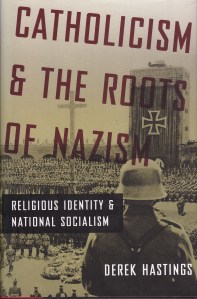
CatholicismRootsAs a lifelong pacifist, I’ve never been a fan of war books. Indeed, war seems to be to an utterly useless waste of life and a source of herculean suffering. The fact that wars happen, and books about them depress me, causes me to avoid them. Still, Derek Hastings’ Catholicism and the Roots of Nazism is less about war and more about, as the subtitle phrases it, Religious Identity and National Socialism. As I read through this history of the early Nazi movement, it occurred to me that this was probably the first actual book I’ve ever read about it. My knowledge of the Nazis had previously come from articles, movies, and documentaries. And Hogan’s Heroes. Being largely of germanic pedigree, I suppose I bear some residual guilt. I have to remind myself that my ancestors had left Europe before Germany had even existed as a unified state. I like to think they would’ve left during the rise of the Nazis, if they hadn’t already left generations before.

In any case, I had no idea of how the Third Reich dealt with organized religion. I have heard anecdotal opinions from time to time that the Catholic Church should have been stronger in its condemnation of the atrocities that wartime Germany perpetrated, but I had no sense of their official outlook toward each other. Hastings makes clear that although Catholicism and Nazism came to distrust each other implicitly, at the beginning of the Nazi movement they were considerably more chummy. In fact, anti-Semitism was something they had in common. Many of the early member of the party were Catholics—some of them priests—who felt an accord with the developing ideology. As Hitler’s rise to power increased, his personal antipathy to Christianity widened the growing gap between his own outlook and that of the early Catholic Nazis.

The book has no schadenfreude for the church, however. This is academic history. As Hastings notes, few studies have focused on the early developments of Nazism. In today’s political climate, that struck a chord with me. It seems vitally important to be aware of how such movements start so that we can recognize them as they attempt to rise again. I have little confidence, reading the news, that we are any better in the 2010s than people were in the 1920s when political instability, economic distress, and hatred of those who were different led to a reactionary, fascist regime. Could it happen again? I look around at a culture in love with guns and endless, selfish gain, and distrust of those of different ethnic origins and I wonder. The early stages are, I think, the most crucial to recognize. Surely no German Catholics could’ve anticipated just what Nazism would become.


Things Remembered

IMG_2839 copy

Freedom. Independence Day is our celebration of liberty. Yesterday I happened to find myself at Bethel Woods, the out-of-the-way location in New York where Woodstock was held. Probably no one in 1969 realized just how formative Woodstock and its message of peace, love, and music would become for American culture. Those of us who came of age in the ‘70s learned about it as recent history (I was only seven at the time and, I’m sure, would’ve found the whole thing somewhat unChristian had I been here then). Much has changed in the intervening years. Not many peaceful events get so much airtime any more. Upwards of 400,000, basically unpoliced, youth, gathered in Bethel, New York, for three days of music, chaos, and peace. The Vietnam War was still draining our nation of its youth and murdering its idealism. Fear of the other, racial inequality, and male superiority were part of the context that led to the need for Woodstock. Freedom was free.

Often on this blog I reflect on the sacredness of place. Events that take place in a location leave their impression on the land. Bethel Woods Center for the Arts, the current administrators of the property, have left the field largely intact. As my wife and I stood at the top of the hill and tried to imagine almost half-a-million people here, it was strangely quiet. The nearby museum had plenty of music playing, but standing where it actually happened, there were only ghosts of an event studied in school and which, even today, kids can generally identify. I couldn’t have named every act that played the concert and, although the music was clearly important, it was the gathering that is most remembered. Self-governing youth getting along in an area so remote that still today you have to drive a couple miles to find even basic necessities, sent a powerful message. It was an event that, I fear, can never be replicated. The snake has spoken.

Nearing fifty years later, we’ve become so paranoid that anyone who looks Middle Eastern is under suspicion. Guns, which children of the sixties shunned, have proliferated and may now be carried, wild-west style, in many states. A fear-mongering candidate bellows fascism before the Grand Old Party. Remember, Nixon was president during Woodstock. I may have lived hundreds of miles from here, occupying myself with the matters that seven-year-olds find so pressing. But Woodstock happened. By the time I got to Woodstock, everybody else had gone. I see others milling about the museum, slightly older than me. Perhaps some of them were here for the event itself. We all seem to be searching for something here. The festival had its problems, for sure, but with a sincere belief in freedom, it makes the pre-seventies United States feel like a strangely foreign county. How do we get back to the garden?


Summer of Frankenstein

Two centuries can make an enormous difference. Just two-hundred years ago Napoleon’s defeat at Waterloo was merely one year in the past. North America and parts of Europe were experiencing “the year without a summer.” Perhaps due to that cool and rainy summer, when Mary Godwin and Percy Bysshe Shelley called on their friend Lord Byron, their thoughts turned to ghosts. According to the legend, together with Byron’s personal physician John Polidori, the friends spent a night writing scary stories. Polidori, although not widely remembered today, invented the vampire that would, in Bram Stoker’s hands, become the aristocratic Dracula, and eventually, with Anne Rice’s influence, Lestat, Louis, and Armand. Mary Godwin, soon to be Shelley, gave birth to perhaps the most successful of new monsters ever created—that of Victor Frankenstein’s construction. Many have claimed the monster’s pedigree to have been that of the golem, but Shelley’s creativity went beyond this forebear into the sympathetic misfit who, like all of us, never asked to be born. The two centuries since that summer have been haunted.

477px-Frankenstein's_monster_(Boris_Karloff)

Quite apart from the monster tale, Frankenstein is also about building that which we, in our hubris, can’t understand. Progress without forethought, as Epimetheus could never learn, housed immediate and very real dangers. The two centuries since Frankenstein have proven Mary Shelley a prophet. An early supporter of women’s equality, she profited from her novel, but never managed to thrive. Just six years later her famous future husband would die tragically in the Romantic genre of a shipwreck. Even with important friends, Mary found it difficult to capitalize on her success. The monster was real enough.

We’ve become accustomed to making things we can’t control. When’s the last time you were able to fix a car broken down by the road, apart from the occasional flat tire? Can you really stop your job from becoming completely different from what you signed up to do? What about when that bully wanders from the playground into the political field? Once you’ve figured out how to split an atom, you never forget. It may have been Napoleon still recently in the news, or the fact that 1816 failed to warm up like it was expected after the solstice. Perhaps it was the fact that Mary Godwin was a liberated woman in a world still utterly determined by men. We can’t know her intimate and ultimate reasons for creating a monster, but we do know that once the monster is unleashed we can never bind it again.


Dinosaurs, Old and New

T._rex_old_posture

Tyrannosaurus rex, aside from being a photogenic movie star, was one of the top predators of its day. Ironically, in the Jurassic Park original trilogy (which would have been, more appropriately Triassic Park) tyrannosaurus rex becomes the ultimate protagonist, while unfeelingly killing to meet its own instincts. Since saying “tyrannosaurus rex” wears you out, we’ve become accustomed to calling the great carnivore t-rex. Everyone knows t-rex when they see it. Its a sign of danger, aggression, and unthinking acquisition. In one of nature’s great ironies, however, t-rex had tiny arms, nearly vestigial. What it wanted it had to get with its mouth. To live like that you have to grow pretty big, so big that nobody else can really challenge you. Punching is out of the question.

I’m often struck as how appropriate dinosaur evolution is to the human situation. Dinos (because “dinosaurs” is also too long) grew to be the top life-forms of their day. (We like to think of being the top. The perspective from down here in mammal land, in those days, was pretty different.) If you’re big enough, who’s going to stop you from taking what you want? Endless rows of teeth and a constant hunger can do wonders for evolutionary development. But then, extinction. Recent analyses have shown that it wasn’t as simple as an asteroid strike. It seems that many features of nature conspired against the dinosaurs, including the tyrant lizard king. T-rex had evolved into the monster featured in many pre-teen nightmares, only to be replaced by birds and mammals. Maybe it grew too big to be supported by the planet that allowed it to crawl out of the slime eons before.

In a recent photo of a Trump rally, one of the signs of a supporter had flopped over leaving just the word “rump” visible. I had to ponder this. T-rump. “Dinosaur” is a word used today to mean something that has outlived its time. Ideas, as well as such practices as, say, claiming that one race is superior to others, have rightfully gone extinct. There are those who say that t-rex was less a fierce carnivore than a scavenger. A vulture rather than an eagle. They claim that such a large snout and such small arms better suit one who picks at that which is already dead instead of working hard to bring down the more challenging beasts, often with horns. I’ve always thought dinosaurs were very appropriate metaphors for the human situation. Even Jurassic Park was superseded by Jurassic World, after all.


Half-Way Holy

I’ve been reading about Ruth lately. Ruth doesn’t have a last name. She’s a character in the Bible. The book named after her is one of the shortest in the longest, Hebrew section of the Good Book. It’s a fairly gentle story, although it has a body count. Ruth, a Moabite, marries the son of an expatriate Israelite. This was in the days before the West Bank, but there was still some distrust there. Widowed Ruth moved to Israel with her equally widowed mother-in-law, and supported this non-traditional family by gleaning. Unlike modern civilization, shop-lifting (or field-lifting) by the poor was not a misdemeanor. In fact, the Bible insisted that it be allowed. It turns out that the field she’s been gleaning from belongs to a relative who eventually marries her via a tradition known as levirate law. Again, this is something current family values oppose, although it is commanded by the Almighty. Levirate law stated that if a man died childless, his younger brother had to take his wife until they had a child in the name of the dead brother. Creepy, but practical. A widow, in those days, had to have a child to support her.

Dore Ruth

I can’t recall when I learned this was called levirate law. I started reading the Bible before I was a teen, so I knew the story, although I didn’t understand the finer details. It was probably in the heading of some Bible translation that used the word “levirate” that I first encountered the term. I assumed it had something to do with the Levites. I mean, the words share the same first four letters, and Levites were all over the place in the Bible, even if they cross to the other side of the road. So it was that I went for decades with the idea that marrying your brother’s wife, at least temporarily, was because of the Levites. Nothing in the Bible said that Levites did this, and other than the jeans, I didn’t know any other Levi words.

Recently I learned that this is a false etymology. Levirate comes from a Latin root for “brother-in-law” and not from a Semitic root meaning “half-priest.” It may sound strange, but this was a genuine shock to me. I’d never told students that the word came from Levi, but I assumed that anyone could figure it out. After all, things that sound so very similar must belong together, right? Well, I admit to having been wrong here. The story of Ruth, however, is one of the true gems of the canon. Men play a minor role, and it is a woman who shows the way. It is a tale for our time. Family values, according to the Bible, aren’t always what they seem.


Cryptology 46

From Wikimedia Commons

From Wikimedia Commons

Four centuries ago this year William Shakespeare died. In the literary world there have been lots of commemorations going on, and all the fuss reminded me of a post I’d written some years back concerning Psalm 46. While teaching at Nashotah House, one of my students told me that William Shakespeare had covertly been involved in the translation of the King James Bible. The King James Version appeared in 1611, and Shakespeare was the prominent writer of England in that era. If you look at Psalm 46 in that version and count the 46th word from the beginning, you find “shake,” and the 46th word from the end is “spear.” I mentioned in my post that I’d not found any academic treatment of the issue and I’m happy to announce that I finally have. Of course it would be in an Oxford University Press book.

I’ve not read Hannibal Hamlin’s The Bible in Shakespeare, but I am able to glance through it at work. It turns out that I didn’t have the full details of this biblical urban legend. Apparently if you find the sixth and seventh words of verse 10 of that Psalm you find “I am.” The sixth and seventh words from the end are “will I.” Will.i.am would be proud (pardon the capital W). As much fun as all this evangelical exegesis might be, Hamlin calls shenanigans on it all. He demonstrates the literary history of the tale, pointing out that—not to spoil our fun—the cryptographic mentions of the Bard in the Bible are creative efforts of those of later generations. The interesting thing is, however, that the Bible is so closely scrutinized for codes that all kinds of hidden messages may be found. Look, for example, at what I discovered:

“For the Lord himself shall descend from heaven with a shout, with the voice of the archangel, and with the trump of God: and the dead in Christ shall rise first.” I don’t know about you, but to me this is clearly Paul warning the first Thessalonians of the present day’s troubles. When Trump is elected the dead will walk. Could anything be more prophetic than that? I haven’t done the math yet, but I’m just sure if you count the millions of letters in the Bible, you’ll find the name “Donald” spelled out somewhere. Scripture, after all, is the repository of all truth. One thing you won’t find, however, no matter how deeply you look. The billionaire’s tax returns are something God himself will never be able to see.


Industrial Revolution

Everything’s industry. It has haunted me for some years now that we’ve let our corporate greed run away with our imagination so that nothing but “industry” remains. We don’t wish to interfere with the gun industry. The guns we like the best are those designed especially for killing lots of people. We feel happy having them in our homes. We’ve supported industry. Time was when society had more than just industry. Education, for example, was not an industry. It was just education. No measurable outgoes but a better society. Now we quantify and try to measure, thinking there’s something magical about numbers. My, what big ammo you have! The better to shoot you with, my darling. Think of it as the people killing industry.

After all, if you spend all that money on an expensive automatic weapon and don’t kill anyone with it, haven’t you wasted your money? Well, wasting money is good for industry, so we shouldn’t be too harsh. Most people know better than to take their weapons out and blow away those they don’t like. I would feel better if more people were like Pedro Reyes. (We, however, want to build walls to keep his kind out.) Reyes is an artist who had people in Mexico City turn their guns in for useful things. He had the guns smashed with a steamroller, at an army base, no less. The metal from the guns he melted down and made shovel heads so that people could plant trees. Over 1500 guns were turned in. The biblical allusion has already been made, but we would rather, in this country, ignore the good book we love so.

What would the gun industry do if people stopped needing to defend themselves so much? What if people felt less fear? What if politicians, instead of cynically using fear to win nominations, and elections, had the best interest of citizens at heart? Guns are for wars, and wars are useless. We have far more to offer one another than pools of blood and gore and guilt everlasting. Does it not strike anyone as odd that mass shooters intend to die at the end? We could use more shovels to bury them all. Wouldn’t it be even better if, before the shooting began, their guns were melted down and cast into useful tools? One might, in an optimistic mood, call such a thing an industry.

DSCN5084


Business Beating

Politics is about power. Say what you will about the Bible, but at least they were clear about it in those days. Kings were alpha males, not public servants. In the light of Orlando we can see how little has changed. Random acts of violence grow more and more lethal and the politicians filibuster, inflating the room with hot air to avoid this issue because this is an election year. An election year where one of the candidate’s cheers can barely be distinguished from “Sieg Heil” and we have put ourselves into a place where such a tragicomedy was possible. Maybe even inevitable. Meanwhile fifty people are dead, joining the many innocents who just happened to be at the wrong place—is there any right place in a land of abundant assault weapons?—in a land of limited freedom. The press argues about exactly what type of gun was used. Maybe that model should be taken off the shelves.

Our alpha males have, at least in states like New Jersey, and increasingly on the national front, modeled bullying. Bullies are nothing without their threat of power used against you. In the same day when schools and social programs emphasize over and over that bullying is unacceptable, bellowing bulls insist on their way and the crowd goose-steps in ecstasy. Those who are different are dangerous. After all, straight white men were here first. They won this country fair and square through genocide, as any Native American can tell you. And you get your way by refusing to compromise. Refusing to reason. Give vent to testosterone and call your opponent out for being a female. Land of the aggressive, home of the grave.

Gun violence may not be preventable completely in a nation where guns are a commodity just like anything else. Religion is a commodity. The ninety-nine percent are a commodity. The spoils are there for the taking by a bully and his thugs. It used to be that organized crime was illegal. Now it’s politics. How much did you pay in taxes last year? I don’t know about you, but I didn’t know there was an exemption clause just for being rich. I grew up in a family with simple morals. Right and wrong. We learned that taking something that didn’t actually belong to you, or not contributing when everyone must, is wrong. Taking what’s not yours is stealing. And that especially includes lives. How naive we were! Politics is about getting your own way. Guns make that possible. Heil to the thief.

DSCN4678


World of Color

DSCN3311

Albinism occurs across species. In human beings, suspicious and superstitious lot that we are, it’s sometimes an excuse for prejudice. I’ve confessed in the past to reading Weird N.J. (Long story.) When we first moved to the Garden State a series of stories ran about rumors of albinos in a secret town, probably deep in the woods. Don’t scoff—there are deep woods in Jersey! Typical of stories in the zine, people—mostly of the teen variety, I suspect—would write of driving around late at night, discovering these albino enclaves, and being chased out by people lacking pigment and tolerance for strangers. Average juvenile behavior. I had no idea at the time that people with albinism are actually seriously mistreated. This is particularly a concern in Malawi. A story in the Washington Post by Max Bearak describes how albinos are murdered for body parts because of a rumor that, among other fabrications, they have gold in their bones.

As someone who has a love of folklore (and it’s more puerile kin—thus Weird N.J.) this is deeply disturbing. Folklore often focuses on the strange, unusual, or uncanny. Let’s face it, there’s not much of a story to tell when everything’s normal. Humans have the natural predisposition to tell tales when something is out of the ordinary. Our saving grace is that we recognize stories are just stories. When we start taking fiction for fact, we’re all in trouble. Many the night before Snopes I cowered under the covers because of some urban legend spreading by however ideas spread before the internet. There were killers on the road at night, and hiding under your car in the parking lot. At the same time, I could separate truth from the stories my step-dad told of jars of buffalo nickels buried in the woods behind our house. Nobody wants to be thought gullible.

In the sad case of those who are killed for being different, the Post article cites a United Nations specialist stating, “The situation is a potent mix of poverty, witchcraft beliefs and market forces which push people to do things for profit.” Poverty. Market forces. Profit. A new kind of clarity. Violence comes in many guises. One of the most insidious is that which some specialists call “slow violence.” Systems set up to exploit, drain, and yes, enslave others to one’s own benefit. And it’s perfectly legal. The plight of those born with albinism in a nation where their differences plainly show dolefully demonstrates a side of human nature that we would rather hide. Those who have control of resources place others in situations where they contribute to their personal bottom line. We call it business as usual while those who observe closely call it by another name. Witchcraft.


All Things Newton

Andover Newton Theological School is the oldest stand-alone graduate school of theology in the United States. Was, I should say. Declining enrollment—supply and demand dictates fewer clergy are required—and the rising costs of a job description that has no obvious retirement age have led many seminaries to merge or close. It seems that Andover Newton is about to merge with Yale Divinity School, much like Berkeley Divinity School, bringing together a mix of Congregationalists, Episcopalians, and Nones to huddle together across the quad until people want to believe again. Those of us who grew up being taught that belief was normal, and widely accepted, have experienced a sense of bad investment lately. We poured resources into keeping our product current only to find the use by date predated the use of use by dates.

Think of it as evolution. From the earliest days of civilization, priests were integral to, well, civil society. Evidence more and more points to religious belief being the actual glue that held larger communities together in permanent settlements. In other words, that’s how we’ve lived for five thousand years. How were we to know that the rules were about to change? You could always count on a need for clergy. The world’s first service industry. Ah, but it’s the latter word of that noun phrase that’s the problem. When religion becomes a commodity it’s subject to supply and demand. Supply has exceeded demand for some years now and the factories are shutting down. Anyone want a used Bible, cheap?

The Episcopal Church, with its outsize influence for such a small body, used to have eleven seminaries in this country. The United Methodist Church, larger by nearly an order of magnitude, had thirteen. Once and future clergy such as yours truly were produced in classes of dozens. We didn’t diversify our portfolios enough. So now, Andover Newton—the very school where I learned Hebrew—is downsizing faculty by a rather drastic percentage. I’m not so worried about deans and administrators since they easily buy into the business model of education. I do wonder about the effect on society of having so many unemployed theologians around. One thing we don’t have to worry about is organized groups of them roving the streets; theologians are fiercely individualistic. As they transition into the corporate world—the only world that now exists—they’ll find themselves wondering how to live among the soulless multitudes. There’s only one orthodoxy here—lucre be thy name. And, oh, you might consider asking about entry-level positions.

IMG_1550


The Lure of the Dark Side

I have to confess that the easy self-publishing of ebooks is a real temptation sometimes. Perhaps it’s one of those inexplicable side-effects of earning a Ph.D., but sometimes you have the impression you have something to say and traditional publishers just don’t agree. In my work life I see many clever ideas that, well, let’s be frank, just won’t sell. Publishers do have to keep an eye on whether a book can earn back the money put into it, and sometimes a good idea leads to no cash payout. So when you can easily sign up online—you don’t even have to talk to anyone—and post your unedited words right on Amazon and call it a book, well, anyone can be an author. So I was looking up books with the terms “Bible” and “America” on Amazon when I came up with Donald Trump in the Bible Code. I found the self-designed cover frightening, and the sentiments expressed in the description grounds for terror. Then I noticed it was only 15 pages long. I’ve written student evaluations that were longer than that.

Trump

At three bucks, that’s—wait while I get my calculator—twenty cents a page. Now anyone who’s been able to read the original Bible Code and not cover a snicker or two will possibly find such a jeremiad palatable. After all, it’s a book! Somebody published it. Well, actually, all you need for self-publishing is an internet connection and at least one finger to type and click. Or a toe. You too can become an expert! No education required. Publishing fiction in such a format is one thing, but when people can’t tell a prestige publisher from a vanity press when it comes to factual material, we’re all in trouble.

There’s an old saying: “those who can’t do, teach.” I think I first came across this wisdom in a Peanuts cartoon, with all the gravitas that such implies. Editors, it seems, are not required for publishing. In fact, some of us who live by the word seem destined to die by the word. Even with connections I have trouble getting my ideas published. More than once I’ve lingered on Amazon’s CreateSpace page with my finger hovering over the mouse. Publication is one click away and some people make six digits a year publishing only on Amazon. Since I produce about 145,000 words a year on this blog alone (apart from my other writing), the urge is very strong at times. Then I look at that cover and I stay my finger as it hovers. I’ll wait a little longer. At least until November.


Avoiding Ritual

IMG_0100

While on my current British kick—not really intentional, but sometimes life gives you limes—I thought I’d mention another piece sent to me by a friend. This one falls under BBC Earth, and it’s about “Why Ancient Brits threw out their most valuable possessions.” You can find the story by Amanda Ruggeri at the link. The basics are pretty simple: some people with a metal detector discovered what turned out to be a Bronze Age “hoard” in Lincolnshire. You have to understand that, in a way that makes me totally jealous, the United Kingdom has tonnes of ancient artefacts still undiscovered. While my wife and I lived there it wasn’t unusual to read about such finds in the newspaper. (Newspapers still existed then.) People had been smelting in the British Isles for a long time. The Phoenicians actually popped round the pub to get their tin—which can be one of the main ingredients for Bronze. What the article somewhat embarrassingly addresses is the nature of the hoard.

Hoards are where a large number of (usually metal) objects are discovered, after having been deliberately buried. These are not uncommon, what with Phoenicians, Romans, Angles, Saxons, Franks, Vikings, and others invading all the time. The issue that embarrasses is the “r word.” Ritual. While we don’t know the reason, the fact that people deliberately deep-sixed their valuables, routinely, suggests a ritual. As the article makes clear, professionals try to avoid the r word. Ironically, such deliberate burials, often with items purposefully broken, is also known from the ancient Levant, often predating the hoards of the prehistoric UK. Intentionally broken items—often of clay, and not infrequently depicting perhaps deities—were buried in biblical times. We don’t know why, but scholars suggest they could’ve been offerings. After all, breaking something potentially useful is an act of faith.

I’m not suggesting a direct connection here. I took a sound scholarly thrashing some years ago for suggesting a tale I heard on the streets of late twentieth-century Scotland had its origins in ancient Sumer (grad students are prone to such thinking). Still, it might not hurt anthropologists to cast a wider eye now and again. People had similar rit— well, let’s just say strange habits, in a land far away. Just cross the Channel and make a left. When it starts getting arid head south. The ancient world may have had more of an “internet” than we think. While that pathway may not always be marked by material remains, we now know ideas travel fast. Even something such as putting a daily post on a blog might become a ri—, strange habit.


Latin Lessons

IMG_1134

The Romans are coming! The Romans are coming! No, wait. They were already here. Here, that is, if you’re European. And more specifically, a Londoner. The Guardian recently posted a story about the oldest writing in the United Kingdom being unearthed as Roman missives—originally written on wax that overlaid boards, Roman style—are being unearthed at the site of the new London headquarters of Bloomberg. Having spent many years of my life learning to specialize in ancient writings on original media, it always does me good to see hoi polloi getting excited about old texts. These Roman notes are so old that the marks on the wax have only survived by etching faintly onto the underlying wood, the wax having long ago deteriorated. The mundane writing wouldn’t have lasted had it relied on the original medium.

Even with their penchant for irony, the British don’t seem to have made much of the fact that the oldest writing in the UK has been located beneath what will become the headquarters of the media giant, Bloomberg. We will pay handsomely for good media. Anybody can coat a piece of wood with wax and scratch away. Almost nobody will read it. If it survives long enough after you die, it becomes a media treasure-trove. All the sudden we can’t wait to find out what Londinio Mogontio ate for dinner last night. Such mundane things we write about. Just to clarify, I’m talking about the Romans, not Bloomberg. Trenchant media information is, after all, what we live for. We must know what others think this commodity is worth. They’ll pay good money for that.

Tibullus will repay Gratus—it’s right there on wood. These guys were also worried about the exchange of commodities, it seems. And while nobody gives a Roman denarius anymore, we can get people’s attention by saying yes, the Romans were here. Sitting in this very spot before the cross has grown cold, making sure that accounts have been settled. The last thing you want is a Roman at your door demanding restitution. One does have to wonder what Junius the cooper thought about all this. Junius is the one with an office across from the house of Catullus. His barrels may have been broken down to make more planks for writing. The fourth estate gone wild. All that hard work would’ve gone unnoticed too, had not a major media giant decided, literally, to rake the muck under old London where before even the original tower was built friends, Romans, and countrymen were lending each other denarii. And one suspects, their beers, if Domitius Tertius Bracearius is who we think he is.


Man’s Best Fiend

While reading the Hull Daily Mail (don’t ask), I came across an article entitled “Rock legend Alice Cooper ask questions about the Beast of Barmston Drain.” Apart from that lovable Britishism of making groups into grammatical plurals, this brief article gave me much to wonder about. After all, Paul Simon’s most recent album features a song entitled “The Werewolf,” (about which I recently wrote) and here is another rock performer from my youth raising the question about a similar beastie. According to the piece by Amy Nicholson, the Beast of Barmston Drain is a new urban legend about a creature half-man and half-dog. No doubt, werewolf reported sightings have been in the ascendent over the past few years, but how such an insignificant beast drew the attention of Alice remains unknown.

800px-Lycaon_Transformed_into_a_Wolf_LACMA_M.71.76.9

Many who know me—and those are few—are shocked to learn that I grew up listening to Alice Cooper. A fundie kid listening religiously to the father of shock rock? Songs about monsters, spiders, female maturation, and necrophilia? Perhaps it was because Welcome to My Nightmare just summed my childhood up rather nicely. Whatever the reason, to this day Alice Cooper is the only big name rock act I’ve even seen in concert. And that was only about six years ago, when I was still teaching at Rutgers. I had trouble hearing student’s questions in class on the next Monday night. Alice and werewolves in the same headline feels so much like yesteryear that it makes me want to believe in shapeshifters all over again. No wonder Hull is set to be the City of Culture. (Hey, Glasgow had it’s turn, so fair’s fair.)

To me, werewolves reveal much about a culture that strives to be far too civilized. We suppress our inner animal to become tie-wearing, wine-swilling sophisticates only to wonder where the wonder’s gone. And we start seeing werewolves lurking in culverts and drainage ditches. At least people are getting out at night. I’ve followed American tales of the dogman for years now, reading all of Linda Godfrey’s books on the subject. Even if it doesn’t exist, we stand to learn much of the creature that just won’t go away. Of all the transformations people talk about, that to the wolf is the most compelling, and among the most ancient. It may only be a dogman that people are seeing at the moment, but given some time it will evolve back into the wolf from which the story had its very beginnings. The answers, as always, probably lie in our childhood.


Holy Castle

ManHighCastleReading about Philip K. Dick prompted me to read one of his novels. But which one? Some Amazon pick-up lockers on the way to work are painted with a mural of The Man in the High Castle. I haven’t seen the series, but there was the paperback, facing out, at the local independent. It’s been a while since I’ve read Dick, so I have to find my legs for his style. I’m surprised at just how much religious language he uses. Our cultural biases tend to insist that intelligent people aren’t hoodwinked by religion, but it does, nevertheless, appear. The premise of Dick’s novel is based largely on I Ching, the “Book of Changes.” Indeed, the conclusion of the novel relies heavily upon it. Along the way, however, Dick shows his sacred mettle when it comes to Judaism and Christianity as well. His prose is sprinkled with biblical quotes.

More than just a surface awareness, The Man in the High Castle offers some deep reflection for the reader. Mr. Baynes, seated on the rocket to San Francisco, ponders the Nazis who’ve won the Second World War. Reflecting on their hubris he considers how they’ve come to think of themselves as divine. “Man has not eaten God; God has eaten man.” This gave me cause for pause. Apart from Dick’s narrative, the idea of divine anthropophagy is in keeping with much human experience. We often consider ourselves masters of our own fates. Many, however, find themselves dangling like a spider from a web over the fire. Not that of Edwards’ Hell, but simply that of human circumstance. The Nazis didn’t win the battle, but listening to today’s political rhetoric, they may have won the war.

Nobusuke Tagomi explains to Baynes how I Ching, a 5000-year-old book, is alive. “As is the Christian Bible; many books are actually alive.” Far from poking fun, Dick suggests there may be something to all this mumbo-jumbo after all. We are conditioned to mock, dismiss, and ignore religion in this world where rationality leads to presidential races such as this one we’re currently suffering. Follow the trail back, I suggest. Look for clues. Philip K. Dick isn’t the only secular writer who knew more than the average person about what fascism looks like, and about the role of religion in its downfall. The novel may not be easy to read. It demands much of those who approach it. Nevertheless, it preserves the truth that many books, indeed, are alive.