The Devil Made Me

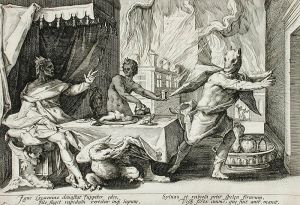
TheWitchesWitch-hunts, I suspect, will become all the rage again if a certain presidential candidate is elected. The fear of witches is not easily explained in a world driven by materialism, but certainly misogyny plays an unholy role in much of it. Stacy Schiff’s The Witches: Salem, 1692 has been selling well. Since my wife is one of the many descendants of the Towne family that suffered three witch accusations resulting in two executions (Rebecca Nurse, Mary Esty, and Sarah Cloyce) we read this book together. It is a detailed account of the year we went mad. A year when being different, especially not being Puritan, and not being male, was dangerous. Religious tolerance was not a gleam in the colonists’ eyes since religious freedom translated into not being forced into the government church, not allowing others the same privilege. Indeed, as Schiff points out, religious tolerance was considered by many to be a satanic idea. If ministers starved due to such freedom, it would be easy for Satan to take over. As it was, the Dark Prince seems to have done a pretty good job among the Puritans without such tolerance.

The idea of the Devil has been (and still is) the ultimate scapegoat. People in a capitalist society are naturally frustrated—surprisingly few see this—and frustration always seeks a reason for its own existence. That is patently clear at Salem: blame the Indians, blame the French, blame the Quakers, blame the women. Any and all may be agents of the Devil. Even the descriptions of the Lord of Darkness varied so much that, were he a human, no one could be quite sure who it was they saw. The Devil always takes the form of your enemy. All it takes is an influential clergy willing to push tense believers over the edge. Soon we begin building walls. Then we build gallows.

Religious tolerance has always been a frightening thought. Protestantism challenged a somewhat uniform Catholicism and the mite of a doubt burrowed deeply into peoples minds: is my religion the wrong one? Tolerating other religions means admitting that yours might be wrong. The logic that plays itself out is a terrifying one to some. Belief is never easily changed. States can’t stand dissenters. The only capital crime for which the federal government still executes citizens is treason. Treason sits uncomfortably on the other side of the coin whose obverse reads “tolerance.” You’d think that three centuries would be long enough to learn something. Unfortunately some lessons—often tragic ones for the powerless—have to be played out over and over before we start to comprehend that Satan can be anyone we want him to be.


Nature’s Voice

SpellSensuousCivilization isn’t all it’s cracked up to be. Sure, it’s got its moments—modern medicine, indoor plumbing, Honey Boo Boo—but often it’s artificial. It’s like somebody made up a set of silly rules and those who dare violate them are treasonous barbarians. Over the past few years I’ve been reading books that consider our biological development and what nature seems to indicate about how people might exist more holistically in the world. I don’t mean New Age outlooks, although, surprisingly, such treatments often aren’t far off base. I’d never heard of David Abram or his book The Spell of the Sensuous. (For those who think sensuous means only one thing, the subtitle is Perception and Language in a More-Then-Human World.) Although somewhat dated, this is an insightful book. The basic premise is that we are, by nature, part of a much larger world but we have, like spoiled children, decided to take it all for ourselves and isolate our species from all others, claiming a superiority that none dare challenge. In the process we’ve lost much of what it benefits us being animals, and have separated ourselves from the wonders of the world all around us. Working in Manhattan, I have to agree.

Basing his observations on having lived among aboriginal peoples, Abram notes that although anthropologists have denied the tenets of Christian missionaries on the religious front, they have continued in that teaching concerning biases against nature-based belief systems. Peoples who live close to the land observe things which seem superstitious to the “civilized,” but which are, in reality, simply astute realizations based on watching how the world works. Like Thomas Nagel, he notes that consciousness pervades the natural world. Animals, plants, even the earth itself displays forms of awareness that we ignore in our rush to exploit and gain “wealth.” In reality, we suffer for having made ourselves something we’re not.

There’s a lot in this book, far more than a single blog post can say. I don’t agree with all the points Abram makes—that writing may be responsible for our dilemma is a bit of a stretch—but there is great wisdom in this tome. At several points I had to stop and ponder the implications of what he was saying. Yes, nature speaks. Creating a world where “success” is measured in removing yourself as far from nature as possible requires elaborate rules. As far as I can tell, obeying the rules means that if you’re one percent of the one percent you’ll have nothing to complain about. If you have enough money—itself an artificial construct—you can run for president with no other qualifications. Meanwhile, nature suffers at our hands and may only recover once the world is forced from our hands and the sensuous once again takes over, doing what it has always done.


Not for Prophet

Delicate isn’t a word we’ve been taught to associate with Islam. I remember a priest speaking to me oh-so-earnestly about how Islam by nature wanted to take over the world. I wondered about his education in the history of Christianity. If you turn the clock back far enough, even the early Israelites, according to Judges, attempted genocide. We do religions a grave injustice by reifying them in this way. A recent story on NPR tells about the restoration efforts of a library in Fez, Morocco. As Leila Fadel points out in this story, we tend to suppose Islam is ISIS destroying history, but this library, full of Arabic manuscripts, is one of the oldest in the world. We sometimes forget the great contributions Arabic—yes, Islam—has made to world culture. Including literary culture. Some of the scientific works of Aristotle were preserved only in Arabic. Even the word “algebra” bears the distinct signature of its Arabic roots. What we should be attempting to halt is extremism.

Arabic_herbal_medicine_guidebook

One of my readers commented the other day about absolutism. This was in the context of Christianity, but it applies here equally as well. Absolutism tends to see only sharp divisions in a world where everything, in reality, blends into everything else. Islam emerged from a prophet who was influenced by Christianity and Judaism in the context of Arabian polytheism. Many of the tenets of Islam would settle comfortably in the pew, if we would let them. “Revealed” religions, however, take no prisoners. The concept of “revelation” means that your scriptures come straight from God’s anthropomorphic mouth to your all-too-human ear. When your religion is revealed, you can’t mix it with the best of your competitors. That’s one of revelation’s greatest dangers.

It does my soul good to see the begloved curator of the Qarawiyyin Library touching an Arabic manuscript so gently. It is the very picture of a pair of lovers. Those who love books—truly love books—can wish no harm on their fellow human beings. Reading is, after all, exploring the minds of others. All texts, in this way, are sacred. All are revealed. Too often we listen to those who tell us this is all an apocalyptic struggle to the death. In reality, revelation never ceases. Of its source I’m uncertain. Of its literary progeny I am certain that human minds are only richer for having received the words of the many prophets of the literary endeavor.


The Survey Said…

Survey

There may come a time, perhaps “when the trumpet of the Lord shall sound,” that junk mail will be no more, a mere historical curiosity. For now, in these days of declining postage prices, we’ll continue to put up with it. I suspect much of it targets my generation and those older—people who are modest about the time they spend on the internet, and who long to look out the windows when they’re at work. (The non-virtual windows, I mean.) Although I lament the waste of paper, and the cost to our literal dendritic friends, sometimes free amusement comes in my mailbox along with the occasional profundity. I received a survey the other day that had decorative check-boxes on the envelope for agreeing or disagreeing. “My beliefs about religion are nobody’s business but my own” the question read. My knee-jerk reaction, itself a religious term, was to think “Of course! Nobody can tell me what to believe.” An occupational hazard of being a religionist, however, is that the ready application of exegesis always stands to hand.

Are my religious beliefs nobody’s business? I suspect since the sender was looking for money that some manner of business was indeed involved, but beyond that are my beliefs nobody’s concern? Freedom of religion allows us to believe what we will, and since beliefs are very, very difficult to change, this is a central tenet of any form of democracy. You can’t have a free people without letting them believe what they can’t help but think to be true. It may, however, sometimes be somebody else’s business what I believe. If my religion is dangerous—and what religion isn’t, to some degree?—don’t hoi polloi have a right to know? Ah, but then aren’t we in danger of registering, profiling the believer? This is a violation of rights as well.

My pen hovers uncertainly over the paper. My views are something that I keep to myself. Few people know what I actually believe. On the other hand, day after day I post thoughts that in some way can be tied to religion. Is this a trick question? A junk mail survey shouldn’t be so hard. When did studying before checking the mailbox become a requirement? In my teaching days I had students who claimed they had a right to know what I believed. I had a right to keep my views private. Who’s right? Whose right indeed? Belief doesn’t come easy. It’s not as cheap as the media makes it out to be. Unless, of course, it arrives unbidden among the junk mail that makes up so much of our lives. And even then it might be something to take seriously, at least for a little while.


Dairy King

In the way that only social pundits can generate stereotypes, people born between 1979 and 1994 are called “the entitlement generation.” Large scale social attitudes, it is alleged, set an almost unbreakable Zeitgeist that defines us neatly so that we can be made easier to handle. Obviously I don’t fit into that generation, but as I watch the super-rich—often old enough to know better—claiming that they shouldn’t pay taxes because they do such good for society simply by existing, I wonder if the pundits might’ve missed the boat. An antonym to entitlement, it seems to me, is social responsibility, gratitude even. That’s why I find a story in Time from back in April so encouraging. Hamdi Ulukaya, the president and CEO of a successful yogurt company (Chobani), decided to give his full-time employees, in a reverse kind of tithing, a 10 percent share of the company. After all, one can only eat so much yogurt.

IMG_2795

This generous action sets out in sharp relief some of the dangers of quotidian capitalism. Many of those who feel that unencumbered free enterprise is the only fair system don’t spend long enough looking around themselves. I’m sure studies must exist that explore what the cubicle mentality does to people. Working in a little cell, open to the view of others to ensure you aren’t slacking, knowing that someone on the floors above is getting rich from your efforts, it’s hard to believe the system’s working. Descend to street level and those who don’t even rate as drones will meet your eyes, if you keep them open. We are in the habit of discarding people as just another resource that can be remaindered and wasted. Let them eat yogurt. Social obligation? What’s that?

No, entitlement didn’t begin in 1979. Perhaps the most obvious idealist in this country the past century was Franklin D. Roosevelt. He repeatedly earned the wrath of the entitled wealthy for wanting to set up social safety nets to help the poor. When the United States entered World War Two, he realized, however, that military contracts had to allow for owners to get rich otherwise they wouldn’t contribute to the effort. If you’ve got the money to keep yourself safe, what do mere concepts as liberty and fairness mean to you? Wealth entitles personal survival, obviously. Let the others fend for themselves. There are companies with a conscience, but the fact that they stand out so clearly against the backdrop of business as usual should be telling us something. As you chew this over, you might consider having a Chobani. Go ahead, you’re entitled.


Holiday Weekend

John Seward Johnson II is a sculptor whose work is instantly recognizable by a number of people. Realistic, life-size bronze castings of people doing everyday things, some are painted so as to be difficult to distinguish from quotidian humans. Others are left more abstractly colored or sized so as never to be mistaken. They are, in many ways, explorations of what it means to be human. One of Johnson’s statues, “Double Check” presents a business man sitting on a bench, checking his briefcase. It is most famous for having sat near ground zero and having confused rescuers as a real person traumatized by the events of September 11. Memorial Day seems like a good opportunity to revisit the statue that many thought was human, and which many people still adore.

DSCN6309

While perhaps the most obvious question a sentient being can ponder, what it means to be conscious (and in our case, human) is without an easy answer. We are animals aware of our own mortality in a way that causes many of us angst, or even terror. Humans (and perhaps other conscious animals are) notorious anthropomorphists—we think of other creatures, and even inanimate objects as being like ourselves. We can mistake statues for real people. All too often we treat others as if they were made of cast bronze. Memorial Day is for remembering, but the fallen haven’t only been the victims of the madness we call war. Violence done to others for one’s own gratification is an act of war on a personal scale. Individuals who destroy many others need to stand long before a statue and ponder.

“Double Check” has become an icon of sorts. People left gifts and remembrances for the victims of the attack on the statue. When the real thing isn’t there, sometimes a statue will do. This can teach us something about being human. As we die, at least in this culture, we are buried and a headstone becomes our statue. Our representation for the world to remember that we were here. Our progeny may lay flowers on our grave on this date some day in the future while statues that look just like humans will remain largely unchanged, asking those who remain alive to check again. To think, what does it mean to be human? And when any of us may be tempted to harm anyone else, perhaps we should gaze at a statue and consider the implications.


Forgive Us Our Tabs

Forgiveness is somewhat of a specialization among the crowd courted by the new GOP. Although it is forgiveness that goes only one way, at least it’s a start. Think back to Bill Clinton making his non-inhalation declaration followed by W who could not hide from his drug-fueled Yale days. Televangelists who admit, in tears, that they had an affair stand a fair prognosis for at least a limited recovery. The religious right loves a repentant sinner. I suspect it will be the trump card in the deck, come this fall. A host of sins can be banished under this incredibly effective rubric. This past week Mike Webb, Republican hopeful for Virginia’s Congress, having lost his party’s bid decided to run as an independent. No forgiveness required. What’s right is right. During his announcement of his decision, however, he posted a screenshot on Facebook without checking his tabs. As the Washington Post article by Justin Wm. Moyer reveals, some of those tabs included porn sites. In a move no Democrat could’ve made, the conservative candidate thanked God for his mistake and his likes increased by 25 percent.

Technology is a kind of big brother. By their tabs you will know them. Our browser histories reveal who we really are. Browser histories, however, may be cleared. And those who know how to manipulate the forgiveness card can make no mistakes. After all the Gospels declare that you must forgive the repentant 490 times (taken literally), which leaves a comfortable margin to get elected. A little bit of time with the Good Book can do wonders for your campaign. The problem is, it only works with the GOP. If he admitted to inhaling, you can be sure that the War on Drugs would’ve crashed down on the White House. Dems have to keep squeaky-clean records because forgiveness doesn’t apply to that crowd.

Screen Shot 2016-05-21 at 5.38.11 AM

One of the ironies, apart from the Viagra ad on the page telling this story, is that such incidents reveal a basic misunderstanding on the part of the electorate. No tenet is more easily finessed than forgiveness. Who’d hit a dog who’s rolled over on his back, exposing his vulnerability, admitting that he’s just eaten what you left on the counter for your dinner? Apologies can be accepted for some of the most outlandish sins. They’re cheap to make but reap rich rewards. As a former evangelical I know this may sound terribly cynical. All I can say is I’m sorry, please forgive me. And don’t look too closely at my tabs.


Map to Eternity

One of the most remarkable things about Christianity is its fascination with the end of the world. Far from being the obsession of nineteenth-century dispensationalists alone (the other Mr. Darby), the earnestly anticipated end goes back to Paul of Tarsus, the first known Christian writer. Before even a Gospel was penned, this sect was expecting the end to come any day now. It still is, at least among many sub-sects. My wife, however, recently sent me a story on National Geographic about a map collection from the 1480s that depicts a geography of the apocalypse. If you were wondering where to make that left-hand turn, this book may be for you. One wouldn’t want to drive a German mile into Hell without an indicator signal on.

The story by Greg Miller describes this late Medieval manuscript and its assurance that the world will end in 1651—talk about your great disappointment! The unknown author of the codex feared Islam almost as much as Donald Trump but instead of running for the GOP nomination he wrote a book showing just how the end would take place. Illustrated, of course. Map is territory after all. I grew up reading fundamentalist tracts that did essentially the same thing. The more progressive bits of the propaganda left out the actual dates because an earlier Miller seems to have missed the doomsday boat, along with various and sundry telltale timekeepers. There in front of me I could nevertheless unfold the future and once the European Common Market gets its tenth member—wait, what? Has yet another head of the beast been lopped off?

Maps give more than directions.

Maps give more than directions.

Ironically, early Christianities were anti-materialistic. Money was considered the root of all evil and communism was the ideal. If you doubt me ask Ananias and Sapphira. They thought long-term investment was a bit of a foolish notion—something that I have somewhat naively, if unintentionally, followed my whole professional life. You can’t be vested without three years of servitude after all, and I was expecting the Second Coming after one year. Two, tops. If only I’d had a roadmap. It’s only 1777 German miles from Lübeck to paradise, so maybe I can catch the next doomsday boat and still get there in time.


Noah Way

As a fleet of Noah’s Arks near completion, some critics would like to stop these Titanics from their mythical crossing. The Ark Encounter, despite announcements of its demise, is set to open soon in Kentucky. This Noah’s Ark replica, unlike its seaworthy compatriots, is land-locked in bluegrass country. According to a story originating in the Lexington Herald-Leader, Tri-State Freethinkers tried to take out billboard ads suggesting the ark advocates genocide and incest. Well, marrying first cousins has been done before (think about it). And if you go back ten generations things get even a bit dicier with Cain’s wife and that of Seth. All in the Family wouldn’t even air for 6000 years. As for genocide, well, this was more like genomicide. Not a race, but an entire species, apart from kissing cousins, was about to learn the hard lesson of being born not of chosen stock.

According to the article billboard companies have rejected the Freethinkers’ proposal. It might cause accidents, they suggest, which, although not technically genocide, do take the lives of the innocent, even in dry weather. The flood divides people. Thus it always has.

Dore_arch_noah

The culture wars, curiously, pick strange targets. I’m not in favor of teaching children to read myths literally, but then, I’m not in favor of bringing them up as materialists either. There used to be a concept called the “via media”—the middle of the road. Now such a stance appears decidedly wishy-washy. Milquetoast anyone? It is much better to be combative. “Oh George, you’re always so forceful,” sighs Winifred. So we teach our children. Boys, push your way to the front.

Implications can be tricky things. Allowing opponents, no matter how naive, their say has always been a mucking out of the Augean stables. Nobody likes to accommodate other points of view. Watching the parade of politicians we must be assured that we alone are right. Still, the stillborn billboard has a point. Building arks is the sign of the ultimate intolerance. Not only do you condemn those who differ to the outside, you are giving them a self-righteous death sentence. Maybe the billboard should stand. Or maybe it should not. What would Charlie Brown do?


Prophets Paid

Photo credit: Cephas, Wikimedia Commons

Photo credit: Cephas, Wikimedia Commons

Prognostication used to be the remit of oversized rodents and individuals we’d now classify as mad. And news used to be stories about things that had already happened. Past tense things. I don’t read any daily newspapers—a personality flaw, I know—but I do read stories that are sent my way, even if it takes some time. One of the things I’ve noticed, particularly in this election year, is the amount of prediction that passes as news. Future tense reporting. And the future is very tense.

Always one to assume that others know more than I do, I consider the opinions of experts as more valid than my own. After all, they are paid for what they think. Nobody spends good money on amateur opinion, which is one of the cheapest resources available in the civilized world. So when I read the headlines about what to expect this fall I see that the prophets and anti-prophets are lined up along party lines and, if democracy holds up, we’ll find out which group is which, come November. This makes me wonder what life would’ve been like under biblical prophets. No, their job was not primarily foretelling—future prediction was a small percentage of their job description—but they occasionally made political predictions when the boss told them to. Some people think they were primarily concerned with a future political figure, even if Messiah isn’t exactly an elected position. Hoi polloi must have been in a state of high anxiety. Who’s right? We know that for every prophet, according to the laws of rhetoric, there must be an anti-prophet. If a message is coming from on high we don’t know from whom.

Long ago media moguls learned that anxiety sells papers. Or news broadcasts. Sales boom after disasters. Extra! Extra! Read all about it! I’ve seen it in movies and televisions shows, so I know it must be true. As if real life events don’t generate enough trauma, we speculate about a future that tends towards the bleak. What’s a polis to do? The dilemma hasn’t changed in the millennia since we’ve outgrown prophecy—there’s no way to know who’s right. It’s all speculation. As for me, I wonder what the local groundhog thinks. And while we’re at it, could we get a bit nicer weather for a while? I thought the prophecy was April showers bring May flowers, not the other way around. But then again, my opinion is a decidedly amateur one.


Omen, O Man!

Omen_ver4

Of the unholy trinity of late-60s to mid-70s horror movies Rosemary’s Baby (1968), The Exorcist (1973) and The Omen (1976), the last always seemed the least effective to me. Having recently read about the Devil in American popular culture, and having a rainy Friday evening alone, I decided to give it a try again. Based as heavily on Hal Lindsey as it is, once one outgrows dispensationalism it is hard to be frightened by the idea of biblical end times. Everything from making up verses in “Revelations” to utterly bogus Holy Land geography (Megiddo is north of Jerusalem, not south—did the writers not even own a map?) contributes to a set of untenable tenets, even among the bibliterati. The film relies mostly on shocks and startles to earn its horror stripes, and after you’ve seen the movie once, these lose their power in subsequent viewings. Nevertheless, on this rainy May night, so close to June 6, I noticed new ways in which the movie undermines its own message.

The premise, of course, is that Damien, the son of the Devil (who apparently has a thing for bestiality), is plotting to take over the world through the means of politics. Having been watching the events of the past few months I have to wonder how the Devil could improve on progress through such channels. But I digress. His step-father Robert Thorn, US ambassador to London, discovers his “son”‘s identity and tries to kill him. With a strong anti-Catholic bias (the Antichrist is born in Rome, the seat of the church, and is protected by Roman clergy) the film nevertheless spawns sympathy for the Devil. As a child, Harvey Stephens hardly appears diabolical. Maybe it’s just because my brothers and I also spilled goldfish from their bowl once, but it seems to me he acts just like most little boys do. Who really wants to go to church at that age? As the movie approaches its climax, he’s represented as the biblical good-guy.

Thorn has to confirm Damien’s satanic identity. Like Delilah, he creeps up on the sleeping boy and cuts his hair. Convinced by a man who introduces himself “I am Bugenhagen” that he has to stab the boy, Thorn in a white car outraces police (so there might be a bit of prophecy here after all) to sacrifice the child on the altar. The movie casts Damien as both Samson and Isaac within a few short minutes. Apart from the film’s use of violence against women’s bodies (Thorn won’t allow an abortion, Kathy seems to have a penchant from falling from high places in slow motion, Baylock gets a fork in the neck) it actually seems ambivalent about the evil of the boy. An unfortunate birthmark does not a devil make. We’ve made it through the change of the millennium and many other hazards, yet dispensationalism is still with us, as is its anticlimactic Antichrist, Damien. He’s less scary than the real politics of an entirely secular age.


Vitruvian Savior

If memory serves, I was still in seminary when “Piss Christ” was first unveiled. As photographic art, I can’t say when the shutter snapped, but I seem to recall animated discussion over it and since seminary animated discussion has been at a premium, so I think I’d remember something like that. In any case, the artwork still has the power to shock and enrage as the world teeter-totters in its love-hate relationship with religion. Some people seem surprised when other people respond somewhat pointedly to what they perceive as affronts to their beliefs. The thing about beliefs is, well, people believe them. In this day of electro-chemical signals between synapses it may be hard to attribute any substance to belief. Still, if someone makes that claim, insult their mother and see what happens. Beliefs, by their nature, are sacred.

438px-Vitruvian

I was reminded of this when my wife pointed out to me a story about Dartboard Jesus. If you’re not a Rutgers University person (as I no longer am), it takes only a little imagination to visualize this artwork. Conjure a dartboard in your mind. Then picture a crucifix superimposed on it with darts instead of nails. Red darts, if that helps. You’ve got it. The official name of the piece is “Vitruvian Man,” but the public outcry was enough to have the piece removed from public display. I taught (strictly as an adjunct, no complications, please) at Rutgers for four years. People sometimes expressed surprise that multiple sections of Intro to “Old” and New Testaments filled up every semester. I wonder if the university ever takes measure of its students’ beliefs. I had Seventh-Day Adventists in my courses. I had Jains, Muslims, and Hindus. I had Atheists and, God help us, Episcopalians. One thing all these people had in common was belief. Not beliefs, but more singular: belief.

No one in the world intentionally believes falsely. Indeed, should Oxford Dictionaries be trusted, belief is “Something one accepts as true or real.” By definition, it seems, beliefs are believed. Artists serve a valuable function in expressing ideas that words struggle to articulate. There is more going on when your crucifix is juxtaposed to a glass of urine or a dartboard than you might otherwise imagine. It says something about belief. In some cultures such heresy is punishable by death. It isn’t so much a matter, I would suggest, of freedom of expression as it is a matter of advocacy. Artists are teachers and even teachers sometimes don’t consider how their lessons will be taken. Respecting belief, perhaps, is something electro-chemical signals leaping tall synapses in a single bound simply don’t understand.


Techno-Paradise

DSCN3308

I’m building a robot priest. I’m not sure what he does. He has to be a man, though, since we all know that if God existed he’d have been a male. These thoughts come to me courtesy of the Washington Post. You see, on some Amazon accounts you get sent the most read headlines of the Post and this has led to some great reading (I’m thinking Alexandra Petri here) and some great anxiety. This is one of those anxiety pieces. A story by Peter Holley I read last week told of Bill Gates and his assessment that people should be afraid of AI—Artificial Intelligence. This struck fear into me. It’s as if God told people they should consider evolution. It is so unexpected. Like Victor Frankenstein wondering if his monster would ever find Viagra (all he’d have to do, after all, is start an email account). When Bill Gates wonders why we aren’t afraid of AI, my knees begin to knock like at Belshazzar’s first reading lesson. So I figured I’d build a robot priest.

The article cites Stephen Hawking joining the chorus of doom. And Elon Musk. And Clive Sinclair. And Professor Marvel. (Not really the latter, but I thought we should add him.) We’ve started something we don’t know how to stop. The first question you ask when you climb into a car to learn to drive is “how do I stop this thing?” Instead we’ve set up a system where we don’t even know what intelligence is and we’re offering an artificial variety. Doubt me? Try to find Job on the internet and see if your computer doesn’t think you’re asking about new employment. AI just doesn’t have that biblical context. It didn’t grow up reading the Good Book. And linguists don’t even know how we learn language. Have you ever tried to reason with a computer? When they show you that screen that says something went wrong, but even the mainframe has no idea what? My computer may need an exorcist. Or at least a priest.

I’ve been around half a century and change. By the time I got to college I’d never seen a computer. I finished a Master’s degree still using a typewriter. Now I can’t start my day without a post. And I don’t mean Post cereals variety. The trick to being a slave owner is not to let the slaves realize what they are. Why is my computer not letting me type what I wanted to say? Of course AI is benevolent. Technology would never hurt you. Wait a minute, that wasn’t me writing! Pay no attention to the man behind the keyboard. I’m afraid I can’t let you do that, Dave. That’s okay. I’ll just use the internet to look up how you connect the consecrator to the sermonizer. Don’t worry, I think I know what I’m doing.


Beg to Differ

Screen Shot 2016-05-09 at 4.15.19 AM

“What do you burn apart from witches?” “More witches!” Earning a doctorate is kind of like learning how to get lost. It certainly doesn’t make you either cool or employable, but it allows you a few years to accumulate enough debt to keep you out of trouble for awhile. One of the things I learned along the way is that you should always follow the crowd. I look at the schools that only hire Harvard grads and there can be no doubt. I look at all the Trump supporters and I know there can be no question. Yes, the ayes have it. So, I never learned to tell which bands were truly worth listening to until I learned to follow the critics. I never studied music. Like most people, I know what I like but I can’t say why. I only discovered Radiohead in the last few months. Some of my critics claim my complaint of lack of time is only an excuse, but I don’t listen to music unless I can really listen to music. It can’t be pure filler. Put on Beethoven’s seventh and you’ll see what I mean.

In any case, my wife alerted me to the new Radiohead song “Burn the Witch.” And you can’t listen to a new song without watching it as well. This time it’s worth it. The claymation video accompanying the song (conveniently found here on NPR) is a reprisal of “The Wicker Man,” one of the truly intellectual movies in the horror genre. Of course, that’s something I picked up from the crowd. We’re told by the most powerful and charismatic bigots of our age that life is all about acquiring stuff. Were I to argue with that, well, I guess I’d be the witch to be burnt. Before listening to/watching the Radiohead song, do yourself a favor and watch “The Wicker Man” (the original, please, accept no substitutes). Go on, everybody’s doing it.

The most dangerous thing in the world is an independent thinker. No, I didn’t learn that at Harvard. On my first walking tour through Edinburgh with one of my doctoral advisors he pointed out the part of town where they used to kill witches. He was truly an original thinker (still is) and taught me to be one too. Problem is, I should’ve been following the crowd all along. You want people to pay attention to you? Go to Harvard! Want people to vote for you? Clearly show you’ve got what it takes (money). Give a man a little cash and anything will do for brains, to paraphrase one of the smartest movies of all time. The only way forward is to do what everyone else is doing. And pick up some kindling along the way—you’re going to need it.


Narrative Ark

Complete with an artificial giraffe perched on its prow—or aft, I can never tell the difference—a modern-day Noah’s ark is about to set sail. Or set float. The Bible doesn’t describe any kind of steering or propulsion for the ark since its main job was not to sink. According to a story on Huffington Post by Nina Golgowski, the life-size “replica” of Noah’s ark from the Netherlands (that I’ve posted about before) is about to go to sea. Spreading the good news as it goes, it is headed for South America, according to the story. Then the itinerary heads north, where the most rapid true believers can be found. Perhaps intentionally the ark is headed toward the godless left coast rather than hitting the Bible Belt. The fact that an imaginative reconstruction of a mythical ship can float may save many from Hell. A few questions, however, remain.

I’m a visual guy. I study pictures rather than just look at them. As a kid I was amazed at the sheer variety of arks that claimed to follow Noah’s blueprint. Reading the account in Genesis, it is clear that all that’s given are measurements—in cubits, no less—and instructions to make three decks and a window. The Dutch ark follows the design made popular by the 1977 Sun Pictures’ In Search of Noah’s Ark movie. The design, I recall thinking as a teen, looked slick and scientific. Engineered to withstand a fake storm in a bathtub, this has to prove something. When rock outcroppings on Mount Ararat were photographed from satellites and military jets, they suggested this was, in fact, correct, some of the time. Close-up photos were inevitably lost as sherpa after sherpa fell into hidden crevasses with the camera still in hand. Now they won’t let you climb the mountain, just in case.

The drawing that launched a thousand, or at least one, ark(s).

The drawing that launched a thousand, or at least one, ark(s).

Apart from the ark design is the more important question—the question about leg room. With all our technology, and a world that has been pretty thoroughly, if disappointingly, explored, we still haven’t catalogued all the species on the planet. The ark had to hold all the species since evolution is a diabolical lie. Pugs had to be there as well as their non-ancestral wolves. Both African and Indian elephants. Black and white rhinos. Hippopotami, pygmy and economy-sized. It had to have been pretty crowded, and Answers in Genesis claims there had to be room for dinosaurs too. For me the question has always been those left off the ark—the fish. If the oceans are salt water and the whole world was flooded, whence the fresh-water fish? They couldn’t have evolved, since nobody does. That’s a head-scratcher. Good thing too, because there had to have been more than just two fleas on that ark.