The Religion Industry

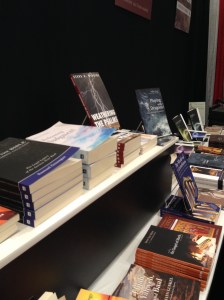
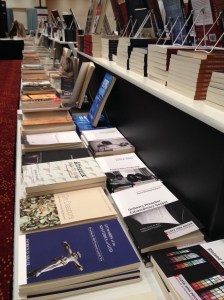
The American Academy of Religion and Society of Biblical Literature annual meeting can be a heady place. Religionists tend to be “big picture” people, looking at things from the perspective that this is what life is all about. How much bigger can you get? Religion is, after all, a matter of perspective. As quickly becomes clear from glancing across the crowds—there is a literal myriad here—a great diversity exists. Ironically and irenically violence, beyond an occasional rudeness, is absent. There are believers and non-believers and they actually talk to each other civilly. They want to understand, and in an increasingly polarized world understanding religion seems like a very sensible thing to do.

It feels, however, like an industry to me. Religion evolved out of primal fears. Nobody knows for sure where it started, but someplace (or someplaces) along the course of human development, the idea took hold that humans weren’t the final word in terms of power or direction of their own destiny. There is something beyond us. It may be a tao, or it may be a god, or it may be something we haven’t even conceived yet, but there is something larger than us. The scientific paradigm, on the other hand, starts by assuming human superiority, at least in terms of rationality, over the entire universe. Teasing things apart, looking at the smallest units and building up a big picture from there, it all comes down to equations and concepts understandable in empirical terms. If there is a tao, or gods, and if they don’t leave some physical footprint, they must be left outside the frame. Until the religion industry arrives.

Every field of study has its crackpots, but those thousands milling about me as I stand in a booth with knowledge for sale are mostly sincere. The official study of religion takes place in higher education. Its practice is left elsewhere. The Dalai Lama is not here. The Pope is not passing through adoring crowds. Even Mike Huckabee hasn’t put in a guest appearance. We are not always the friends of those who do religion, for this is a complex industry. Our role is to ask how religion works. Beyond that, we try to fit it into a larger picture—one that expands beyond the universe itself. Out to where a mysterious force may lurk. A force that reminds us that human effort, as strenuous as it may be, must acquiesce in the presence of the unknown.

IMG_2612


Go to, Let Us Make Brick

Next year marks a quarter century. It’s a sobering thought. A quarter century of attending the Society of Biblical Literature annual meeting. A lot has changed over the years. Much of the loss, I fear, has been of innocence. When I first flew into Kansas City, naive at 29, and still believing the world offered opportunities for those who would work hard enough, the academic job market was tight. I had no interviews whatsoever, and spent many hours in the employees’ hopeless lounge, dreaming that someone might call my name. Although no jobs came of it, I could hardly blame the academy for “market conditions” outside their control. An economy based on unadulterated greed and emulating the worst practices of the business world was eating higher education alive, from within. I had no way of knowing. For a couple of decades I attended more often than not, optimistic that the lies I’d been told might yet turn out to be false. That those who had the gifts and abilities would be recognized for what they were. I was so terribly young then.

Through a variety of roles I have continued to attend this conference for all these years. I have not seen so much hopelessness until this. Colleagues come to me, barely holding back tears. Conditions in our universities are bad and are getting worse. We have no students, but clients. The hours of preparation for the classroom are now being measured in metrics like “return on investment.” The basic vocabulary of higher education has evolved to the point that it is a new Tower of Babel. It sits on Wall Street and considers what is offered to our young as commodities. Nobody worries if they learn anything or not. The exchange of goods at personal advantage is the only way that one can exist in a market economy.

IMG_2610

The only hope any culture may dare to claim for its future lies in education. Those economies that have not suffered as much as our own are those where education is still revered. Where you don’t have to hold a MBA to speak with authority. Where truth might just be an abstract and where not all things can be measured in shekels. I have been attending this conference for a quarter century and never I have I seen despair such as this. I have to wonder about a nation that takes those highest achievers and those with the most initiative and slaughters their hopes on the altar of the angry deity of vain baubles of self-aggrandizement. We bet on futures that are no futures at all. My beard is whiter now, and my glasses stronger. I am still able to see, however, the folly of launching into the North Atlantic in early April before any kind of radar has been invented with lifeboats made only of money. I only hope I’m wrong.


Birth of a Legend

I was sitting in the restaurant attached to W, a boutique hotel cum chain, with my brother-in-law Neal Stephenson. He was on a book tour and kindly treated me to breakfast. Above his head I noticed a slightly salacious painting portraying a nude lady in bed saying “Of course I think you’re adequate. I love you!” In the doorway stood a headless man in a red coat, clearly intended to be the headless horseman. I pointed it out and Neal, being an author, made some inquiries about it. Nobody in the hotel seemed to know anything about the image’s relevance, so I did some internet sleuthing. I knew Washington Irving was born in New York City. I don’t know where precisely, and I’m not really sure how to find out. New York, in those days, didn’t reach so far up Manhattan Island, and we were near downtown, at Union Square. Probably this was the outskirts back in Irving’s day. I had already started my research for my paper on Sleepy Hollow, so I was attuned to the clues. W is now a chain, but I think the first W was the very one where we met. The restaurant where we had breakfast was the Irvington. The website said nothing about the origin of the name. Had we been eating where Irving had spent his youth?

This was a slight synchronicity. I had been researching Irving and had ended up meeting someone at a hotel which, it may turn out, had been named after him. Which Washington was the Squire really named after anyway? Washington Irving had been named after George Washington, so perhaps the point was moot. Months passed, and I wrote and honed my paper for public delivery. I’d almost forgotten the existential pleasures of following a lead and drawing some conclusions, whether or not history might bear them out. My brain was fully active.

759px-John_Quidor_-_The_Headless_Horseman_Pursuing_Ichabod_Crane_-_Google_Art_Project

My flight to Atlanta yesterday for the Society of Biblical Literature annual meeting took off from Newark Airport on time. I thought I had a row to myself, but a couple of guys came in, talking, just before the cabin door was closed. They obviously knew one another, but not terribly well. One asked if the other was from Valatie, “where Ichabod Crane is buried.” These were not professorial types, which you often see at the airport this time of year. Just regular guys. “Yeah, there’s an Ichabod Crane High School,” the other replied. Their conversation moved on to other topics, but I sat there thinking about the synchronicities my paper seemed to be generating in my life. Of course, many people do watch Sleepy Hollow, not many, I suspect, are academics looking for connections to American religious thought. It seems that research never really ends.


Atlanta Bound

IMG_2600

Every year as the latter half of November rolls around, the mind of religion scholars goes toward the American Academy of Religion and Society of Biblical Literature Annual Meeting. This morning I’m off to Atlanta to join a myriad of others who still think the academic study of religion is a good and noble thing. For those who read this blog regularly, it will be no surprise that I’m giving a paper this year. Honestly, I’m a little nervous. I haven’t delivered a paper in years—it is nearly impossible to do research when you are cut off from academic libraries and, more importantly, the time it takes to do the work. Having only weekends to pull ideas together is not conducive to pushing the frontiers of knowledge forward. Sleepy Hollow came to my rescue this time around. That, and reception history.

Reception history is the hermeneutic that looks at the Bible from the point of view of later interpreters. For the Hebrew Bible that reception might be that of the New Testament, or even later books within the Tanak itself. Of course, the Bible has been studied and interpreted for nearly two millennia now, and not all those reading the Good Book have official training. Increasingly, with religious extremists making headlines from decrying the color of Starbucks cups to an all-out attack on Paris, understanding the reception of religious texts is important. The Fox network hit Sleepy Hollow is an excellent example. The show begins with the Bible and although the end has yet to be determined, Scriptures have played a role throughout. And a viewership of pitiful biblical literacy drinks it all in. It is important to understand how the Bible has been, and is being, perceived.

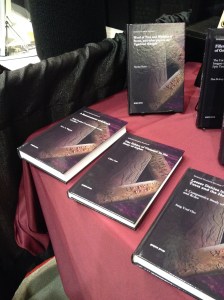
It may be, over the next few days, that my posts will be disrupted from their usual schedule. It is always a little hard to predict how things might play out when you’re away from home. I’m not sure what wonders Atlanta might bring. My own book should be on display in the book stalls for the first, and likely only, time. I will be meeting with people from dawn to dusk, discussing their book ideas. And I will, of course, be listening. Listening for the gallop of horse hooves in the background. Yes, the meeting is always a stimulating event, and with apocalypses in the news, I think I have selected a very timely topic this year indeed. If the frogs croak my name, I will know it is only my imagination.


As Others Think

As analysts step in where angels fear to tread, we have been given expert opinion on why ISIS’s terror in France was counterproductive to its goals. A few voices have chimed in stating that the result of escalation is just what an apocalyptic group hopes for. Rational people, having no idea how a fundamentalist thinks, are scratching their heads. Long I have wondered why universities and other bastians of higher education haven’t sought the advice of experts. No one can understand fundamentalism who hasn’t experienced it personally. Problem is, most people who have experienced it are experiencing it still. Those of us who thought our way out of fundamentalism are passed over repeatedly for university posts, while those better connected (surely not of fundamentalist stock) are handed influential positions from which to scratch their heads. You want to understand fundamentalists? Ask someone who’s been there.

There is nothing rational, in the common parlance, about fundamentalism. It has, however, its own internal logic. If you believe with every mitochondria in your body that the Bible (or any holy book or doctrine) that you were taught is true, and truly believe it, no amount of reason can convince you otherwise. This is (partially) because the ultimate cause of all events is open to question. Science does not address ultimate causes—it can’t. The endlessly creative human mind, however, can rather simply conjure them. If God is the ultimate ultimate cause, and if God said, x, y, or z, then other interpretations are simply wrong. If God has decided an apocalypse is necessary, what use is reason in the face of the impending certainty? Is there no way out?

There is. Some of us have made it. We, no matter our credentials, are not generally well-connected drones of the middle class. Fundamentalism is prized by the poor. Those who have no future on this earth look for another, better world. This is a perspective I understand very well. Our increase in ease of communication and exploding technology with ease of access have only given new tools to those who think in terms of ultimate causes only. You can’t talk a suicide bomber out of action with reason. You need to know the language of belief. We glory in our lack of belief and rationalism. We, however, close our eyes to the fact that the vast majority of people in the world are believers. And we won’t talk to them because they make us uncomfortable. We have written our own recipe for apocalypse.

From NASA's photo library

From NASA’s photo library


Apocalypse When?

We want to understand what worms through the mind of terrorists, and yet we don’t want to be bothered with religion. For decades universities have been shutting down departments of religion because they don’t make money. Religions aren’t materialistic in that way. In the light of the attacks on Paris over the weekend, many have been turning to the media to learn more about ISIS. A piece in the Atlantic by Graeme Wood, published back in March, pointed out how we have tended to see the movement as political, not religious. Wood, however, demonstrates the apocalyptic intentions of the leaders of ISIS. They are religious. Just because you carry guns and high explosives doesn’t mean you don’t believe.

Apocalyptic thought and politics are a deadly combination. The United States is not immune. Knowing the bent of George W. Bush’s distortion of Christianity, his terms in office were very frightening for many of us. Some Christianities, as well as some Islams, not only anticipate the end of the world but earnestly long for it. Pray for it. In the case of some Fundamentalist Christian sects, world leaders should orchestrate events to force God’s hand in bringing about end times. The fact that we had a president sympathetic to those beliefs should send shudders down anyone’s spine. The idea of an apocalypse is a religious one—there is nothing secular about it. We know the history of the concept, although universities eschew those who look that far back. Zarathustra, also known as Zoroaster, devised a new religion that reflected the basic dualism we all feel: good versus evil. The only way that good could ultimately win in such a worldview was through the complete destruction of evil. And evil wasn’t going down without a fight. This idea influenced Judaism during the Exile, and thus Christianities adopted it. And Islams. No moral relativism here.

The horsemen close in

The horsemen close in

Religion is not evil. Historically it has attempted to be a moral compass to guide believers toward right over wrong. The fact that any religion faces opposition shoves those weak of mind into an apocalyptic state. Gather the horsemen and try to prod God into action. We don’t see divine activity on any kind of scale that we would recognize. The religious events of the past—the Islamic expansion, the Crusades, the Jewish revolt against Rome—these events are merely political. Those who’ve been conditioned to see God behind human activities, however, view such things very differently. Apocalypses are religious events. No amount of reason will convince a convicted believer to look elsewhere for consolation. Yet we press on with guns and bombs and ignorance of what makes religions tick. And tick they will. No matter how secular we might wish the world to be.


City of Lights

As the civilized world struggles to make sense over the senseless attacks of ISIS in Paris, the question of where to turn emerges. An attack has taken place. Innocent people have died. We are in mourning, and we want to analyze what happened to make the world feel a little less insane. As my wife pointed out an article on CNN, I was shocked by the terms in which the attacks were described. Here I read about ISIS extending its global reach. Top leaders, we’re told, planned the attack. And ISIS is “getting into the international terrorism business.” These phrases are common in just about every business meeting I’ve ever attended. This commodification of terror frightens me. The way we’ve chosen to handle terror is by making it into a business. These are human lives that have been lost—futures of the most promising kind. Not only are we the victims of blind terrorist groups, but we are victims of a world that can’t see beyond capitalism.

Terrorism is not a business. It is evil, but in a world where religious value is never invoked outside the few who still find meaning in matters of the soul, the vocabulary has been lost. How do we deal with ISIS? Just like you would any business. A hostile takeover bid? Gather your resources, make some deals, and if retaliation takes innocent lives, well, some bonds and chattels aren’t worth that much anyway. Have we lost the ability to describe the world in anything other than economic terms? Is humanity simply another business?

Paris_SPOT_1017

I do not wish to downplay the horrible events that took place in Paris Friday night. At least 120 are dead for doing only the kinds of things people do on a Friday night. Yet there is a terror that has been creeping through the world that refuses to be named. When it feels threatened it clears out Zuccotti Park. It has taken over our institutions of higher education. It buys political offices and rewards those at the top until the rest of us become commodities. Yes, some goods are lost or damaged during shipping. We need to have a metric to measure that. And when our eyes are streaming with tears we grasp the nearest—the only way we have of describing what has happened. A new business has come to town. When terror becomes a business all hope is already lost.


Matins

At a certain time of year, around November after the time change, early morning immigrants to Manhattan see the light. As they stumble out of the Port Authority Bus Terminal and head to the east, it is as if the sun is rising like a monster from the sea. In Midtown the streets run east-west and the avenues north-south. I trip out onto Eighth Avenue and have to make my way to Madison, and the entire walk is facing into the unrelenting sun. You might think at 7 a.m. this should be no great challenge, but then you would betray the fact that you don’t commute in early. Hundreds of people pour in a human stream out of the Port Authority and head in all directions, many of them east. The streets are crowded and you literally can’t see what’s in front of you. You are, in the words of a young Bruce Springsteen, “blinded by the light.” I’ve watched in fascination as this happens for the past four years now. It isn’t the much touted “Manhattanhenge,” but simply the angle of the sun at this latitude at this time of day. It may be fun for a few minutes, but then you realize how dangerous it might be.

IMG_2595

One of the most basic elements of religion is care for others. Indeed, some religions suggest that you should treat others as more important than yourself. When I was growing up I was taught to think of things from somebody else’s perspective: if you were in that position, would you want someone to do that to you? It’s a message I took to heart and to this day I can’t pass a homeless person without a backstab of guilt for not pulling out my wallet and dropping a dollar or two into their outstretched hands. Having been on the receiving end of a pink slip more than once, I can easily imagine being there. Seeing from another person’s perspective can be dangerous. Not considering that perspective can be even worse.

Those out and about at 7 a.m. are go-getters. Climbers. They get to work early. Some, no doubt, stay late as well. The person walking west has the sun at his or her back. The street in front of them is brilliantly illuminated but not blinding. How many times I’ve nearly collided with them because they don’t realize that those of us going east just can’t see. You have to step into the shadow of a banner or awning or streetlight post just to get a nanosecond of relief and make sure you’re not about to step into a hazard like an open freight door. The photo doesn’t do it justice because if it were truly to show what I see, you’d see nothing at all. Raised as I was I can’t help but think of the beast rising from the sea, and the woman clothed with the sun. And the homeless being awoken by beams far too bright after a night on the streets.


Burden of Democracy

Speaking of revisionist history, I see that I’m negligent on updating my Egyptology. In a year when you need an Excel spreadsheet to keep track of the sheer number of GOP presidential wannabes, I had to ask my wife who Ben Carson was. She sent me a story explaining how the league of presidential dreamers believes that the pyramids were ancient Egyptian grain silos. His reason for believing this has nothing to do with archaeology or with history and everything to do with the Bible. Now, other presidents of too recent memory have had strange biblical beliefs as well. And that raises the intractable question of how you run a democracy with religious freedom. Some people like to claim religious belief is a matter of choice, but that is rarely true. At a young age we are programmed to accept what our parents or guardians tell us is true. Studies of the brain suggest that once wired for concepts of how God works, the circuitry is difficult to displace. In a country where most people can’t tell a Seventh-Day Adventist from an eight-hour clock, they may be surprised that a brain scientist might believe the pyramids were built to biblical specifications.

From WikiCommons

From WikiCommons

The Adventists are a literalist sect. And they are not the only ones who believe the pyramids have something to do with Joseph and the biblical famine that set the stage for the exodus. It is an idea I encountered as a child, and I didn’t even have a denomination to call my own. Religious belief can be, and often is, completely separate from rationality. Some very intelligent people are biblical literalists. The real problem is that the Bible doesn’t mention the pyramids at all, but then most Americans know as much about the Bible as they know about Seventh-Day Adventists. If people actually knew how much incentive George W. Bush had to start Armageddon, the turn of the millennium would have been far more tense than it was. And that’s saying something.

In our democracy, we want freedom of religion, but we don’t want to be bothered with the details of what a religion teaches. Like many, I was shocked by the headlines of a potential president grossly misunderstanding history, but as soon as I learned Carson is an Adventist everything clicked into place. I would suggest that it is a moral responsibility in a democracy to learn something about religion. We like to think we can fudge on that part of the homework. If we want the freedom of having anyone capable of becoming president, we need to learn something about a human being’s deepest motivations. No matter how much reporters and skeptics want to laugh and scorn, religion makes many decisions for by far the largest majority of people on the planet. The thought that a democracy can thrive without learning what truly motivates its leaders, I would suggest, is the most naive position of all.


Revisionist History

I recently came across a website with academic papers available on it.  Although the internet has yet to achieve its promise as a locus of solid academic material, such sites are becoming more common.  I’ve been uploading my own papers onto Academia.edu since they seem to be old enough not to impact anyone’s sales aspirations.  In any case, this particular website I found noted that a paper had been updated at such-and-such a time, and that anyone who had downloaded the previous version should delete it and use the new one instead.  This is a dilemma.  I know of publishers who make corrections without issuing new editions.  When I buy a book, what it actually says will depend on the printing rather than on the edition.  I wonder if such retractions are really fair.  How does one know when she’s reading something outdated?
 
Picture this: a young kid, perhaps an unknowing fundamentalist, reading his Bible.  Then he gets a newer copy of the same translation.  But soon he notices that there are differences.  Although the example may sound overly Talmudic, it is factual.  Bibles, being printed in large quantities, are especially susceptible to error.  When did the printed word become something that’s negotiable?  I’ve been pondering clay tablets and their apparent immutability.  Contrary to popular belief, most clay tablets weren’t fired—it was a lot of effort for something that had limited value.  Some tablets show signs of erasure or additional words being added.  In the case of clay, this is often very clear.  Besides, the readers were few and specialists.  They knew what they had.  But for a modern person staking the salvation of her soul on a document, is it not problematic to change a jot or tittle (of which not the least shall pass away)?  Has technology made us immune to fixed texts?
 
Back to the website I found.  What if I downloaded the faulty paper and wrote my own paper based on it?  How would I know to go back and check to see if a new version had been uploaded?  Am I to spend all my time revisiting web pages to see what has changed?  Knowledge itself seems now to have become whimsical.  What is true depends on the date and time you accessed it.  Perhaps I’m just a dreamer, but there was a time, it seems to me, before post-modernism, when you might purchase a book and be fairly certain of what you had.  Errata sheets (or the more fancy addenda et corrigenda) didn’t intrude into the typeset page.  You could still read correctly, assured that someone had spotted and acknowledged the mistake.  We have, I fear, outlived the need for sic.  And it is only a small step from siclessness to truth that changes second by second. Is this the siclessness unto death?

IMG_1363


Think Bigger

PlanetRagesI’ve spent a lot of time with academics. Having been one myself, I know something of their habits. Getting through a doctoral program involves, at least in some fields, becoming the specialist on a very tiny piece of information. Since people have been thinking about things for millennia, finding something new to say can be a challenge. Often, by the time they’re done, newly minted doctors know an incredible amount about a very specialized topic. This is, in many ways, simply an intensification of the human experience. We think small. Part of the problem is that our brains haven’t evolved to think big. Having learned an awful lot about the weather in the book on Psalms, I have instinctively taken an interest in natural disasters. Charles Officer and Jake Page share this interest, as is evident in When the Planet Rages: Natural Disasters, Global Warming, and the Future of the Earth. This, however, is a big idea book. Globally big.

Throughout the first two sections of the book, which deal with humans in the face of nature, God often comes up. As scientist and science writer (respectively) Officer and Page simply reflect common beliefs. Nowhere do they advocate invoking God, but they note that throughout history, in the face of just about any species of natural disaster, people have. Many people still do. Disasters and God. What a team! We worship what we fear. Once Officer and Page reach the third section of human impacts on nature, however, God drops out of the picture and the fingers are pointing solely at us.

When I read about what we’ve already done to this planet, I, as a colleague once said, start seeking another species to join. We have destablized the atmosphere so throughly that it will take at least ten-thousand years to return to it’s pre-Industrial Revolution state. Ten-thousand years. At the same time, the largest industrial pollutor (the United States) has jury-rigged politics so that only the wealthy can attain high office. Votes can be bought and we simply won’t sign the Kyoto Protocol. Those who knowingly doom their children are the smallest thinkers of all. We have changed the course of the biosphere well beyond our share of time, and even those scientist who deny global warming know that it is true. You don’t bite the hand that signs the pay check. After all, specialists have a tendency to be very small thinkers.


Northern Ghosts

It is the time of year when respectable publications can, in a half-serious way, address the unconventional. The New York Times, for example, recently ran a story on ghost hunting in Norway. Andrew Higgins points out that Norway, among the most secular nations in the world, has come under the spell of ghosts. In a country where church attendance and religious belief seem to be endangered, there is a growing belief that people might somehow survive this mortal coil. Since such a story has to come off as bemused, we don’t get any indication that people have good reason for believing in ghosts—as one of the officials in the story says, they represent something that isn’t “generally accepted as existing at all.” But I wonder if that’s true. Scientifically, in our heads, there just doesn’t seem to be any room in this godless world for ghosts. Skeptics ask questions like “why do they wear clothes?” or “how can a soul remain behind if we have no souls?” Who told you that you have no souls?

Even with the constant materialist discourse of only physical reality, some ghosts cases have been very well documented. So have some hoaxes. People have the spirit of being tricksters, and that doesn’t always help when it comes to understanding the unseen. The point that the article is making, however, is that ghosts seem to be filling a need that the church hasn’t. Church has long been understood as being trapped in the past—concerned with issues deemed irrelevant by people who are just trying to get by in the world. I’ve heard hundreds of sermons in my life and remember less than ten. What is it that we’re trying to do?

Eugène_Delacroix._The_Phantom_on_the_Terrace,_Hamlet

I don’t know if ghosts exist. Many days I’m not sure what reality is, because if it is simply crawling out of a warm bed into a cold apartment before 4 a.m. so that I can go to work, I’m not sure this isn’t some kind of afterlife already. And maybe not the best kind. I know that as soon as people began to record their thoughts in writing, ghosts have been assumed to exist. Despite Ghost Hunters and other popularizers, vague traces are caught by enough people that we can legitimately wonder about the narrative we’ve been fed that says if it can’t be measured it can’t exist. There isn’t a nation in the world where people don’t see ghosts of some kind. Why should Norway be any different? And we wouldn’t even be asking this question if Halloween didn’t provide us with a buffer that makes forbidden topics chic.


Uisce Beatha

The idea of a state church, I have to admit, sometimes seems not so bad. Before you click off this page in disgust, please let me explain. Once in a great while, I think about what state churches really are. From the most ancient of times, religious institutions supported governments and governments gave money to state religions. It isn’t a perfect system, but the reason it sometimes appeals is that it might prevent the kind of religious quarreling that we see in the run-up to every election: whose religious vision will govern us? I get theological whiplash. Wouldn’t it be easier to have a state church and be done with it? After all, those who live under state churches really aren’t obligated to believe in the teachings, but just to pay for them.

I’m only being facetious here, of course. We all know that in reality where religions and governments get too intertwined human misery results. The Reformation should have taught us that, if nothing else. The crimes of ISIS continue to show that religious belief makes a poor basis for government. Another case that my wife recently pointed out to me is in the quiet and civil nation of Ireland. Ireland has the stereotype of being Catholic, but according to an article in The Guardian, more than 90 percent of state-run schools there are under the control of the church. For some residents, like the family featured in the article, this becomes a conflict when schools won’t admit the unbaptized. Admissions committees with holy water may be a concept that many people find strange, but the fact is churches can set rules just as strict as secular bodies. No baptism, no confirmation, no matriculation.

I would, I think, be concerned as such a parent. Once my child was admitted and enrolled, would not the teaching go against what was being taught at home? Do governments have the right to decide a child’s religious outlook? Here is the dark underbelly of the apparently benevolent state church. Belief, of all things, is an intensely private matter. Many church goers do not understand the deep beliefs of their religious body, and since we seldom stop to think about religion we just do as we’re told. Education, it seems to me, should be very much aware of religion. Instead we see the opposite happening, at least in this country. If we pretend religion doesn’t exist, it will just go away, right? There is a reason that the church teaches that baptism is symbolic drowning. Only for those, however, who pay attention.

Angel's view of Ireland?

Angel’s view of Ireland?


To the Tower

A recent article in The Independent shows once again how deep our human need of magic can be. The Tower of London, among the oldest buildings in the city, and often considered the most haunted, was apparently protected by magic. Archaeologists have discovered ritual marks on the support timbers of the representative of the Queen’s residence that they believe were intended to keep the devil out. Given that building has been around for a few hundred years, that’s really not all that surprising. The amazing aspect, at least to me, is that the signs are a rare admission on the part of those in power that they are occasionally not in charge. In any case, now that Halloween is in the air, it seems appropriate to think about how even the most rich and powerful aren’t secure from spiritual anxieties. It’s no wonder that bishops were so powerful, back in the day.

IMG_0338

Since I’m writing a paper that discusses grimoires, magic has been on my mind lately. Anyone who follows the books I post on either this blog or Goodreads might easily discern that. The concern that Medieval people had with witches was their supposed ability to work magic. Ironically, historians of science are now suggesting that the study of magic may have led to what we now think of as science. In order to manipulate the physical world, you have to understand how that world works. Magic might have had some benefits for society after all. And we are still prone to magical thinking. It is deeply embedded in the human psyche. Magic, like miracles, can be fortuitous, but the prudent know better than ever to count upon them.

The Tower of London was the, or one of the, castle(s) of the city. Political prisoners were held there and often left with their heads in separate compartments. Even a regular tour of the grounds will include references to ghosts. A city as large and as sophisticated as London still can’t escape the past. The hex marks found by archaeologists may date from the early modern period—the time of the Reformation and thereabouts—but the human mind has not much changed since then. While we may not put secret marks on our buildings any more, we still instill them with a sense of magic. And people move out of haunted houses so often that some states have requirements to reveal troubling histories of properties before someone decides to buy. We are a society enamored of technology and future progress, and yet we stop and wonder when Halloween is in the air.


Myth Making

Beautiful.  Standing outside in the pre-dawn, looking up at the current alignment of Mars, Jupiter, and Venus in the east, I am struck by their presence.  The planets, “wanderers,” were known by the ancients to be gods.  Tales were told of how they came to have their places in the sky.  For those too busy to look up, Venus alone can take your breath away.  After the sun and moon, it is the third brightest natural object in the sky that can be seen on a quotidian basis.  It has been brilliant this month, and the peoples of ancient times were fascinated by how this morning and evening star rose high only to flee before the coming of the sun.  Myths were built around it.  Venus, it is no accident, was associated with the goddess of irresistible beauty.  She still is.

DSCN6017

Trailing behind is Jupiter. The Roman avatar of Zeus, Jupiter is the king of the gods, but not the brightest.  Following Venus, it is the fourth brightest object in the sky, followed by various stars in their unchanging positions.  Jupiter seems to be chasing Venus these days.  Sometimes I see the two of them cavorting in the light of the moon.  The object most desired by the king is no object at all, but a goddess who outshines even the power of the primal deity.  And then there’s Mars.  Mars lags farther behind, never quite the master of war, at least according to Homer, that he hoped to be.  He is nevertheless the consort of Venus, for strong emotions tend to go together.

I glance at my watch and I know I should be headed to the bus stop by now, but I dash inside for the camera.  It is a vain hope that I can capture what even these eyes can plainly see.  It is a drama acting out in the celestial sphere.  Three planets in a neat line, clear as Orion’s belt, within the length of my thumb held at arm’s distance.  I can hear the bus rumbling toward the corner, and I know I’ll have to rush, but even as I power-walk to the stop, I keep glancing over my shoulder to catch a few last glimpses of a myth in the making.  Is it any wonder that we’ve lost the magic in our lives, when we can’t even take the last moments of darkness to pay tribute to the gods?