Driving the Point

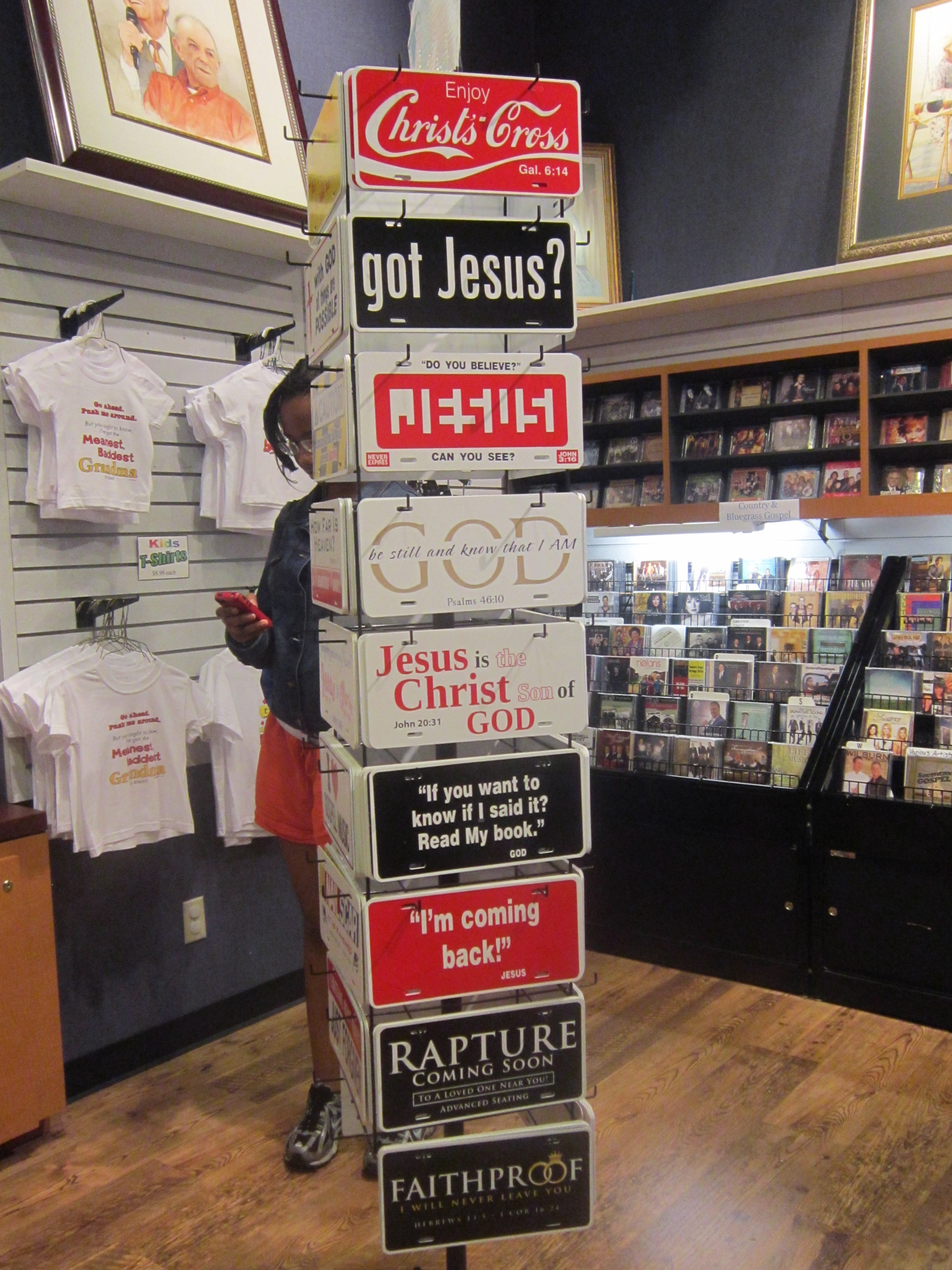
“I drive my car, it is a witness. My license plate, it states my business.” The words are from a song by one of the most creative Christian Rock groups ever, Daniel Amos. While I don’t listen to Christian Rock much anymore, I’ve always appreciated the fresh outlook of this particular band, which was, at least in the ‘80s, ahead of the curve. The lyrics came back to me when reading about a legal suit in New Jersey concerning vanity plates. Like many states, New Jersey has rules against offensive words being spelled out on license plates. When a woman applied for a license reading “8THEIST” it was rejected as “offensive to good taste and decency,” according to a story in NJ.com by Thomas Zambito. Trying the application with “BAPTIST” led to no objections. Others have tried other variations on the word “atheist” and have come up with rejections as well. In a country that prides itself on religious freedom, this is ironic, to say the least.

I’m a bit too pragmatic for vanity plates, or even bumper stickers. Having had to commute long distances after being dismissed from my post at Nashotah House, I often thought that I didn’t want people to know too much about me by the decoration of my car. The culture wars, played out a few years ago by Jesus fish, Darwin fish, Jesus sharks eating Darwin fish, and so on, seemed an opportunity for aggression to me. Already when I’m driving and someone cuts me off or does some dangerous maneuver in traffic, they frequently bear some paraphernalia advertising Jesus on their bumper. Maybe it’s a prayer for protection that allows for stupid driving. It certainly isn’t a witness to the “others first” theology that characterized Jesus’ teaching.

IMG_1216

Is it an affront to decency to be an atheist, or only to advertise being one? The culture wars that plague the United States are based on instant prejudices that make decisions about a person without bothering to witness their behavior. Behavior, after all, is the true measure of goodness. Even higher education is not immune to this system, especially in religion departments. We only want to be surrounded by those who believe like us. Somewhere in this unholy mix is the neglected idea of doing the right thing. Ours is a culture in love with appearances. We object when Muslims want to build a mosque. We object when Roman Catholics run for President. Weren’t not even sure that we really trust the Presbyterian next door. Our differences, one of the historic strengths of this country, have become a liability. Especially when behind the wheel. How different driving would be if we’d just assume that no what the vehicle says, it is piloted by a human being just like us, no matter who they believe the co-pilot might be.


Pillars of Science

I sometimes wonder if science would have the appeal that it does, if it didn’t have religion to shock and awe. I’m thinking of not only the fact that The Humanist magazine quite often has a focus on religion, but even websites, irreverently named to make the sensitive blush, frequently use it as a foil. My wife likes the site now more commonly known as “IFL Science!” Web acronyms have taught us what the second of those letters denotes, but perhaps because making the name more family friendly leads to more hits, it’s been muted a bit. In any case, the most recent post I’ve seen has to do with that marvelous Hubble image of interstellar gas and dust columns where stars are being born, know as “The Pillars of Creation.” Apart from the stunningly beautiful images, I’ve always been taken by the way that implicitly or even subliminally, concepts of deity lie behind this scene. When the image was first published, I remember staring at it in rapt fascination—here we had stolen a glimpse into the private chambers of the universe. We were seeing what, were we in the midst of, would surely prove fatal. It is like seeing, well, creation.

Eagle_nebula_pillars

Creation is enfolded in the language of myth. Reading the description of this great, gaseous cloud, we are told of the tremendous winds in space (what I had been taught was an utter vacuum) where dust is so hot (I was taught space was frigid) that it ignites into stars, like a silo fire gone wild. It’s like witnessing the moment of conception, although Caroline Reid tells us the dust will be blown away in 3 million years. Perhaps ironically, scientists are scrambling to study it before that happens. Or before that will have happened. At 7000 light-years away, it will have been gone as long ago as Sumerians first put stylus to clay before we know of it. We still have a couple million years for a good gander. And the Sumerians, the first writers of which we know, were writing stories of creation.

It is really a shame that science has, in general, such an antipathy towards myth. As scholars of biblical languages, indeed, nearly any language, know, the language of myth and poetry is especially useful when standard prose breaks down. “Wow!” is not a scientific word. Nor is “eureka!” What other response, however, can there be to seeing the act of creation with our own eyes? Meanwhile there will be those who use science to belittle the worldview of the myth maker and and thinker of religion. Our world, it is widely known, is that of superstition and ignorance. We are those who think only in shallow pools and deny the very reality that is before our eyes. That reality can be full of stunning beauty, but were we to describe it in terms empirical, we might have to keep the interjections and useless adjectives to a minimum.


Mother for a Day

In a world set on tearing itself apart because of its differences, there is one thing every single person has in common. We all have a mother. In societies enamored of domination and competition, we take one day out of the year to stop and remember those who gave of themselves so that we could live. We place this day on a Sunday, the most passive of days when it will not interfere with regular business. We give chocolates, flowers, fruit-baskets, and then go back to the same usual grind come the next day. At the risk of gender stereotyping here, I do wonder how much wisdom we must miss by relegating our mothers to the background.

Growing up, we all know, is inevitable. We need to release ourselves “from the apron strings” and learn to cope in a hostile world. Not only do those overseas, different from us, wish us harm, but even our neighbors become our competitors and although friendly, we look for a way to find our advantage. Motherhood is a reminder that there is another way. Families, at least ideally, are built on cooperation. A willingness to set aside our own personal agenda for that of those for whom we care deeply. Used to be that the largest families (before family became a weapon used by religion) were those best placed to succeed. You had a set of people who shared a common mother, who united in a cooperative venture. Capitalism has little room for such a dynamic. It’s “each man for himself.”

Although churches around the country will mention mothers in their services today, Mother’s Day is a secular holiday. Hindus, Buddhists, Muslims, and Mormons all have mothers. Many religious groups, however, do not. Just last week some Roman Catholic women were ordained as priests here in New Jersey. Of course, the “mother church” disowned them, as priesthood is a male prerogative. Mother’s Day is not on the church calendar. It grew out of the Civil War with the sad realization that, left to their own devices, men will make wars that pit brothers against one another. Although I am stereotyping again, I have a hard time imagining a mother who would do such a thing. Mother’s Day should be an opportunity. Not only should we thank or remember our mothers, we should take to heart what motherhood means. I can’t help but believe the world would be a better place for it.

DSCN1941


Biblical Art

Although the United States is a religious nation, according to all polls, not many Americans know about the American Bible Society. This organization, based in New York City, has been vastly influential in the history of the nation. Even more influential, however, has been the Bible itself. It pervades every aspect of life in America, whether acknowledged or not. It is an integral part of the fabric out of which the nation is cut. I used to ask my Rutgers students: if there were some unseen force that impacted your life every day in ways that you couldn’t imagine, wouldn’t you like to know about it? Of course they would! But our society has very little tolerance for actually learning about the Bible. As a story in the New York Times states, the American Bible Society had to sell its historical Manhattan property recently. I visited the site on my first trip to New York as a seminary student. Here amid the towering secular concerns of money and greed, was a building dedicated to Sacred Writ.

IMG_1272

The New York Times piece, however, is pointing to the fact that the selling of the building has led to the closing of the Museum of Biblical Art. As Randy Kennedy makes clear in his piece, the Museum was (technically will have been) dedicated to showing the impact of the Bible in secular contexts. The American Bible Society is an evangelistic organization. They arrange for the distribution of Bibles not for secular reasons, but for good, old fashioned conversion of the heathen. This set the Museum a little bit at odds with its host. The Museum, critically acclaimed according to Kennedy, is (was) generally secular in outlook. It recognized that the Bible has influenced us in ways far less than obvious, pervading into our artistic sensibilities.

Although I’ve worked in Manhattan for about four years now, I never had occasion to nip into the Museum of Biblical Art on a lunch break. (Lunch break? What’s that? Money takes no breaks.) This is unfortunate. It seems that the message I had been trying to pass along to my temporary charges was being openly displayed here for New York society to see. Little do people realize, I suspect, that the principles of capitalism—the very system that transfuses the lifeblood into the city—developed out of biblical outlooks on private property. Not that the Bible itself is capitalistic, but it gave a society the basis to develop a form of thought that is, honestly, quite foreign to the biblical outlooks themselves. And ironically, the American Bible Society will continue, even though its intent may be less in keeping the spirit of the very book whose impact the Museum attempted to display.


Book Culture

The book is not dead. Yesterday, on a warm, sunny spring day that veritably screamed “outdoors,” I found myself standing in line. I was at the Hunterdon County Libraries’ book sale. Having awoken in a panic a few weeks back gasping, “I missed the Bryn Mawr book sale!,” I made it a point to catch this one. You see, I read a lot of books on the bus. My job doesn’t pay very well, so I get inexpensive tomes where I can. And I wasn’t the only one in New Jersey sacrificing a rare, sunny weekend to look at books. I arrived twenty minutes before starting time and was well back in line. Although I seldom find items from my wish list, it always does me good to see so many people out for the purpose of literacy.

thumb_IMG_2160_1024

A book sale, like life, is like a box of chocolates. By far the majority of books here are publications vastly overprinted by excessively optimistic publishers. Of course, some people may buy books without the intent of keeping them, as difficult as that is for me to fathom. Since these are donations, it’s difficult to say much about how they reflect the taste of New Jersey readers. I couldn’t help but notice, however, as I wended my way to the religion table, that those who got there before me were racing through this particular table with a focus I can no longer muster, snapping up the gems, manically filling their bags. About the only other table where I saw that kind of passion was the science fiction section. I get overwhelmed in such environments. Too many titles, too close together, in only the loosest of orders (and sometimes very mis-categorized) can make for frustrated hunting. Nevertheless, I’m glad I marked my calendar.

The religion tables were mostly filled with predictable material that fails to challenge the intellect. Still, if it gets people reading, I have no cause for complaint. After about half an hour it was impossible to get through a single aisle without having to excuse myself a few times. Every subject, every category, had its readers. I was especially glad to see so many young people there. This may be the most hope for the future that I will see all year. Home with an aching shoulder and a supply to keep me going for forthcoming weeks, I notice the clouds drifting over what began as a glorious blue sky. No matter. If it rains, I will have plenty to do indoors. Resurrecting the mind from its slumbers is the most religious of all activities.


Post Script to Art

At work Christian Century is a magazine that sometimes lands on my desk. I suspect the book reviews are the main reason for this, but I like to skim the headlines to see what the more progressive, popular periodical has to say about the world. I always glimpse the news in brief section, and quite often the quotes of the week are poignant. This past week I read one from Paul Simon, who was speaking at Princeton University. The quote ran, “We are living in an anti-art age. The world is now a brutal place and obsessed with speed and wealth.” I found my head nodding as I read that sentiment. While I was a little too young to be aware of Paul Simon’s considerable contribution to popular music while it was happening (although I was old enough to appreciate Graceland when it came out), I nevertheless listened to Simon and Garfunkel during college and beyond, amazed at the depth and accuracy of Simon’s poetry. Here was a true artist.

What a difference half a century can make. I find myself not recognizing the world that I took for an assured thing as a child. Drawing back to get some perspective—which is something I think Paul Simon would appreciate—I think about the world without technology. Other species, for example. The behavior of, say, deer is the same today as it was when Europeans first invaded these shores. While deer still wander out onto roads in their natural quest for food, we race at them in heavy machines that leave them dead and twisted grotesquely at the roadside. Deer may not have the mental capacity to think, “hey, there’s fewer predators than there used to be,” but they are frequently brought into contact with a technology that is so nineteenth century, and the result is fatal. Where has the artistry gone? The deer remain the same.

I read a lot of older stuff. When I see the literature that was clearly published for its beauty of language and artistry, it brings a tear to my eye. We don’t publish work like that any more, unless it can make money. Everything has become a calculated capital venture. If you can’t make money off it, it’s not worth doing. When I was stressing out in college over exams, I would sometimes put on my old Simon and Garfunkel records and listen to the deep and complex lyrics to “Mrs. Robinson,” or “Bridge over Troubled Waters,” or “The Sound of Silence.” Despite the angst, this was a world that had a place for beauty for its own sake. It’s not just the music that’s changed since then, because I knew that I was listening to the words of a prophet. And prophets only appear when there’s trouble ahead.

Graceland


Bus Fare

The two things most likely to kill you on the streets of Midtown Manhattan are taxi cabs and city buses. Crossing the Fifth Avenue can be a dangerous game of chicken, even if the light’s in your favor. Over the past few weeks I’ve been noticing a lot of religious-themed advertising on the buses of this secular haven. A while back it was Killing Jesus—I suspect this must’ve been around Easter time. The movie based on the bestseller appeared with images of the savior tattooed over aluminum and glass. This week I noticed buses advertising A.D. “The Bible continues,” they claim. Don’t take that as career advice, however. With these thoughts in my head, it seems quite a coincidence that my wife would forward me a Huffington Post story entitled, “Anti-Muslim ‘Killing Jews Is Worship’ Ads Set To Go Up On NYC Buses, Subways.” New York City is a Judeo-Christian sort of town, I guess.

Of course, the text is deeper than that. I’d never heard of the American Freedom Defense Initiative (AFDI) before. According to Huff, it’s classified as a hate group directed at Muslims, and, in an ironic twist, designated public forums are not permitted to block adds. I’m just a layman, but I hope an educated one. Still, when I see public space as a battlefield for religious triumphalism, I wonder why the paid add space (what is the side of a bus, if not wasted advertising space?) is not restricted by any rules. I do not condone any kind of hate crime, and that should, I believe, include copy that intends to replicate hate. If human history has taught us nothing else, we’d be fools not to see that hate begets hate, and never love. The way out of a hateful situation is never to instill further hatred.

I spend a good deal of every week inside a bus. Sometimes as I try to read by the light of day, which has finally reappeared during my commute, the illumination is blocked by advertisements plastered over the windows of my expensive, public chariot. I sometimes peer out through the dots, unable to read what I’m advertising, and wonder what those on the other side see. Who am I shilling for? Perhaps this is a question the AFDI should put to itself—what if they were the ones on this bus. How will the person on the street look at them? With overflowing love or with reciprocal hate? The bus I ride is not really a choice I make. I like to think, however, that the destination for which we all hope would be for a more loving world.

You ad here

You ad here


Saving Face

Although it has been commented upon in Rate My Professor, my beard is not intended to be impressive. In fact, it’s not really. Since I was quite young I dreamed of being a bearded man. I don’t know why. My father and my step-father were clean-shaven. The pictures of Jesus with which I grew up, however, seemed to suggest that a kindly man must be a bearded one. Nature deemed, however, that my facial hair would be less impressive than that of many boys I knew in high school who were already contending with five o’clock shadow. I never liked shaving. To me, nature dictated that men should be bearded, and who was I to combat nature? Except for a brief stint when I had to make a living in retail, I’ve worn a beard since I’ve been able to do so. I don’t fuss with it, trying to make it something it’s not. It is simply who I am.

339px-Epicteti_Enchiridion_Latinis_versibus_adumbratum_(Oxford_1715)_frontispiece

So when my wife sent me an infographic from the Washington Post about religious beards, my curiosity was piqued. It actually makes me a little self-conscious, I have to admit. I vehemently dislike anyone commenting on my appearance. There’s also something vaguely sexual about facial hair, coming as it does with the onset of puberty (a few years later in my case). Looking at the ways various religious groups condone facial sculpting, I couldn’t help but think that traditionally religions have said, to borrow a phrase from Frozen, “let it go.” Or let it grow. God and nature are one here. Genetics may determine what kind of beard may grow, but it takes religions to say it is God’s plan. For me, standing before a mirror before dawn, scraping my face with a very sharp piece of metal while I’m still yawning hardly seems civilized. Wash and go seems much more natural to me.

In the biblical world, the beard was a symbol of experience. Lifespans in those days were precarious. Guys surviving to my level of whiteness were revered. Today we are considered scruffy and lazy and unwilling to play by the rules society has set. I suppose it’s no accident that I was always a fan of John the Baptist with his unkempt appearance. Like Elijah before him he was a man of the wilderness. As nature made him. I last shaved in 1988. Were I to do so again, I fear what I might find underneath. Harrell Beck, before he died, once said to me, “you’ll never shave it off.” Although once I did, he has proved himself among the prophets. Just don’t say anything about it to me since, like religion, to me it is a very private thing.


Worth Saving

Once we speed past Easter/Passover, holidays start to fall by the wayside as we try to get back to the serious business of either finishing up school for the year or, in a more pedestrian view, just plain business. Holidays interrupt the flow. Break the continuity. Stop and start. That’s why those of us on the working end of the spectrum appreciate them so much. Nevertheless, what should be the most important sacred day of them all is just another work day. Today is Earth Day. Recognized by no major religion (what religion wants to shake the status quo of business that brings in lucre?), Earth Day is a chance to pause and think about the undermining that we dole out to our long-suffering planet. We are nearing the point, many scientists warn, where climate change will become unreversible. We’ve had years, indeed, decades of lead time, during which the wealthiest nation in the world has been digging the grave the fastest. Even the popular media has been sending its subtle hints: anybody wonder why flood stories predominate in this climate? Think about it.

Reading books about environmental degradation is a depressing exercise. The size of the task is overwhelming and we’ve lost the ability even to reach our own government officials who are nevertheless impotent before big business. We can try to plant a tree, pick up trash, or recycle our plastics, but the destruction is taking place on an industrial scale. Ironically, as we go about making our own planet uninhabitable, scientists are beginning to believe that there is life on other planets. Some of us have suspected that all along. And if they come here that must mean we have something worth preserving. My guess is that it is nothing big business can provide. We can be so much more than consumers.

IMG_3528

Businesses are like all of the selfish motives we’ve had to suppress congealed into an anonymous venture in which none have the ultimate responsibility. Driving at night with the headlights off. I have worked for companies that have wanted to be seen as environmentally friendly. None of them, however, have taken the step of making Earth Day a recognized holiday. A moment of silence. A requiem for a dying planet. The draw of profit is just too strong. The old adage is that if a business is not growing it’s not healthy. Instead of ensuring that the only planet we can reach will be able to sustain us for a few more years, we want to go out with our pockets full. And where, I wonder, to we plan to spend all that money?


States Right

Can you name your state insect? State bird? State dinosaur? The concept of united states, perhaps more obvious in Europe where languages differ, is a complex one. In the United States of America we’ve got our culture wars that generally divide along predictable state lines, but each state has a mix of progressives and conservatives, and caricatures may be funny but are hardly accurate. In this jambalaya of divergent ingredients, each state develops its own image in keeping with a couple centuries (for some) of tradition. We even have quarters that show our distinctive features on the reverse side! As one of those whose profession (whatever that is) has moved me across state borders periodically, I know that choice of domicile often depends on what it might offer by way of employment. Although one of my parents was born in New Jersey, I moved here not out of family loyalty but out of desperation to find work. Nearly every day I cross a state border to get to a job, but it feels pretty much the same to me.

Although I’ve lived in these states for nearly half a century (some of my years were spent abroad) I didn’t know that states had a choice of books. I don’t know if every state has a book. It saddened me to hear that New Jersey rejected “Born to Run” as state song since it was about trying to get out, but I don’t know if we have a state book. The Godfather, perhaps? Moby Dick? When NBC announced that Tennessee had its proposal to name the Bible as its state book shot down, I was a bit shocked. What is a state book? Tennessee, which (as a caricature) still takes pride in the Bryan side of the Scopes Monkey Trial, often leads the way, like Davy Crockett, against the untrusted, heathen other. The undiscovered country of modern thought. The Bible can be a comfortable book in that way.

The Bible justifies our prejudices. Written mostly by white men who believed they were specially chosen by God, well, is it any wonder that it bestows a sense of entitlement? Radical in its time, the Bible now stands for status quo ante, ante meaning before women and non-whites won the right to be considered equal. It is a kind of Paleolithic justice. A caveman ethic. What better way to demonstrate that your state, like Indiana, is a special haven of the Almighty? Only here can the truth be found. If you’re looking anywhere this side of 1611 you’ll miss it. We don’t need to know what came before. Protestants, now partnering with conservative Catholics when it fits the political agenda, have always recognized book over state. We the people and all that. I really do wonder, can you name your state dinosaur?

800px-Crystal_palace_iguanodon


Honest to Good

IMG_2029_2

The oldest standing building in Oxford is the Saxon era church tower of St. Michael at the North Gate. Dating from around 1040, it still stands, providing shade to the various buskers who are hoping to earn a bit of cash from their musical talents below. Although there are some modern buildings that harsh the historical sense of the city, you get the impression that the British revere their tradition. A recent article in The Guardian notes that the United Kingdom, seat of the Anglican Church worldwide, is among the least religious countries in the world. Depending on one’s perspective, that is either very good or very bad news. Several analyses exist as to why it is so. The country has gone from an empire on which the sun never set to a strong, yet diminished country. The two World Wars took an enormous toll on the island nation. The population tends to be well educated. They adore their royals, although the monarchy is largely for show. There is a disconnect between the fiction and the fact of life in such a place.

Britain may be leading the direction toward which secular societies will inevitably follow. Still, the survey cited in the article indicates that two-thirds of the world population sees itself as very religious. Surprising and flummoxing atheist advocacy groups everywhere, the young tend to be more religious than the old. Religious belief shows no sign of dying out. It was predicted decades ago that it would be dead by now. We were supposed to have a moon base in 1999, of course, and I’m still waiting to see if we manage the Sea Lab in the next five years. History has a way of disappointing us. Perhaps the silent skies through it all make it difficult to think there’s any direction coming from above. Left to our own devices, what do we see?

The UK hardly qualifies as a hedonistic state. There are social problems, to be sure, but it maintains a fairly safe, cultured atmosphere throughout. Tradition can be fiction and can still be meaningful. We don’t see angry atheists trying to bulldoze an ancient, if phallic, church tower. We don’t see angry crowds taking sledge hammers to the British Museum. The people on public transit are unfailingly polite, and I’ve not been treated like an object as I commonly am on my daily commute to Manhattan. Religion, it seems, is not the motive for civilized behavior. Nor does religion appear to detract from it. Has the holy grail been discovered after all?


Accept Cookies

You have probably noticed it. As expected as the warmer days of spring are also the Girl Scout cookies. A symbol of wholesome fundraising, Girl Scout cookies have some dedicated buyers, and many imitators. Like any human organization, the Girl Scouts have their troubles, but I can’t help but compare them with the Boy Scouts in which I grew up. Well, at least for a few years. We’ve watched as the media have declared on the excluding of various demographics from the Boy Scouts. To rise to the top you must not deviate from the mythic model of the perfect man. Meanwhile, as an article in Tablet notes, Girl Scouts have been tolerant of difference from the beginning. In a day when being Jewish was still suspect in the wider community, Girl Scouts were founded with early troop leaders who were Jewish, and this was in the days before the First World War and the ensuing tragedy of the Holocaust during the Second. From those early days, Girl Scouts have continued to have a policy of acceptance of those who differ in religious outlook. It erects no barrier.

The success of social progress depends on how we train our young. Prejudice has to be learned. Children are accepting of those with differences until they learn not to be. Radical groups have to recruit constantly. Fear of strangers is natural, but when it becomes a paradigm it is a pathology. One of my professors once claimed that early Christianity thrived because it was exclusive. Only true members could join, like a country club, making it desirable among hoi polloi. Further research has demonstrated the falsity of this view. There were many varieties of Christianities in antiquity. Only by declaring itself uniquely correct, and convincing Constantine of the same, did one sect become dominant. And dominance was what it was about.

Society is all about getting along. We have come together around money to build the tallest structures on the planet. The tallest buildings used to be in the United States. Then China, Malaysia, Taiwan, Saudi Arabia, the United Arab Emirates. A tower serves no purpose without a collective to take pride in it. Religions, unfortunately, often measure themselves by those who stand outside. Taking the view that it only feels good to be right if others are wrong, it is easy for such thinking to slip into a prejudice that promotes and rewards exclusivity. One percent, anyone? Many aspire to such menial goals as getting more money. For me, a life that has a box of Girl Scout cookies available is enough. And I’ll take a tall glass of tolerance with that, and hope that others will feel free to share.

DSCN5045


New Faiths

Scientology is never far from controversy. In the light of the new HBO documentary on Scientology by Alex Gibney (with New Jersey roots) the Star-Ledger ran a Sunday piece about the Jersey origins of the religion. L. Ron Hubbard wrote Dianetics while living in the state. The article, by Vicki Hyman, points out that the current head of the Church of Scientology, David Miscavige, grew up in the Garden State. John Travolta and Tom Cruise are also New Jersey sons. Living in a religiously diverse state has tempered my perspective on New Religious Movements somewhat. That applies to Scientology as well.

L._Ron_Hubbard_in_1950

Many critics claim that Scientology began as a scam. There are those who claim that it still is. It seems clear, however, that there are many people who believe in it with all sincerity. No religion is free from episodes of abuse or poor judgment. Thus it is with human institutions. No universally accepted definition of religion exists, making categorizations difficult. What members of Scientology do, in as far as this is known, sounds very much like what other religions ask of their members. Oddness of belief is hardly unique to any religion. All ask for contributions from their members. Religions offer a community for those who belong, and many are strongly hierarchical. Even should a founder have had less than pure motives, that doesn’t translate to any less verisimilitude on the part of the faithful. Some viable religions have been based on known fictions.

Ironically, a common response to religions is anger on the part of unbelievers. (If we are believers of one religion we are, by default, unbelievers of others.) A friend of mine recently mentioned Heaven’s Gate on his blog. Although the outcome was tragic, can we say that those who followed Marshall Applewhite appear to have been true believers. Fear of Scientology may largely be based on the horrific outcomes of Heaven’s Gate, the Branch Davidians in Waco, and the People’s Temple in Jonestown. Religions can lead to people doing strange things. And those of us who live in New Jersey know that is indeed saying something.


Out There…

Spring is a time of hope. As crocuses poke their heads through the slowly yielding soil, we’re reminded that the long months of darkness are only temporary after all. It was only appropriate, then, that my wife should point out to me the returning of the X-Files. Only a limited season of six episodes, but after hearing rumors for years that the third movie was in the works, we’ll gladly take six episodes to remind us that the truth is out there. I’ve not always been a fan or the X-Files, but there are reasons for that which have to do with living in the middle of the woods in Wisconsin in a seminary where the paranormal was, at times, just a little bit too readily at hand. And also because the very topics addressed are those of taboo. The anomalous is fodder for ridicule. Nobody could be so naive. Meanwhile the show was winning awards and creating enduring cultural memes.

Thexfiles

As I’ve suggested many times on this blog, the paranormal and religion are closely related categories. While not many X-Files episodes directly dealt with religion, the second movie made the connections explicit, blending Bible and spooky effects at a distance with abandon. The X-Files and religion share a fascination with wonder. It is all right not to know. Sometimes wanting to believe is enough. We can find information on nearly any topic instantaneously by pulling out our phones and tapping into the local wifi network. We access any bit of random information with ease. And we wonder at our lack of wonder. Where has it gone?

Thirteen years ago the haunting music died. We’ve been left with a reality that feels dull and devoid of possibility. We need some sign of hope. Ironically, it is Fox that offered a world of possibilities far beyond a Republican purview. This was a realm where humanity was no longer in control. Forces outside of and more powerful than us swept into our mundane setting to remind us that even government control is only an illusion. Human pride requires timely mementos that we are simply the dinosaurs of our age. The incomprehensible overshadows us as we spin away our time on a planet nowhere near the center of our galaxy, let alone our universe. And yet we tell ourselves we are capable of discovering the laws that lie behind it all without stepping foot on even the nearest of other planets. Welcome back, X-Files. Remind us where the truth may be found.


Ice Church

Eternity is a concept closely associated with religious thought. It bears a freight that phrases such as “steady-state universe” and “Big Bang” lack. Indeed, the foundations of Christianity and Islam involve the belief that eternal life can be had for those who play by the rules. Great cathedrals and mosques were erected to last forever, or at least until the end of the physical world. Perhaps that is the reason I find the idea of a church constructed out of ice so engaging. Annually for the past several years, a church has been built of ice in the Romanian Alps. Accessible only by cable car, the church is a temporary structure in a land where varieties of Christianity (let alone other faiths) are openly hostile to one another. As the globe slowly wobbles back to a northern inclination, the church will melt and disappear. Still, in its brief time in the world, baptisms and marriages will be performed there. Eternal vows in a temporary structure.

A theological message is inherent in such an institution. We are trained from our earliest days to be consumers. We are to acquire goods and desire more. Were we ever to be satisfied, capitalism would crash to the ground like an ice church left out in the heat. The secular world in unrelenting in its message that we are born to eat, buy, and use. The more expensive, the better. And the more quickly obsolete, the more profitable it will be. The towers of our cities are constructed of concrete and steel, and yet, I have watched new buildings grow and supplant those that have seemingly stood forever but which, in reality, have existed for less than a century. Indeed, all of our towers ought to be made of ice.

IMG_1252

Ice is cold and hard, but it is still water. An article in The Guardian notes that some pastors see this as a kind of baptism frozen in time. Shape given to that which follows the contours of its container. The water, however, will ultimately follow its natural order and rejoin the oceans of the world. While humans are naturally disposed to collect, to save up against lean times, we have to be taught to be consumers. Some of us are content with relatively little, knowing that elsewhere our fellow human beings have nothing at all. Their churches are made of ice, and our corporations are eager to reach even them, to teach them to covet what the more “affluent” have. And the world slowly warms, turning all into liquidity.