To See the Sky

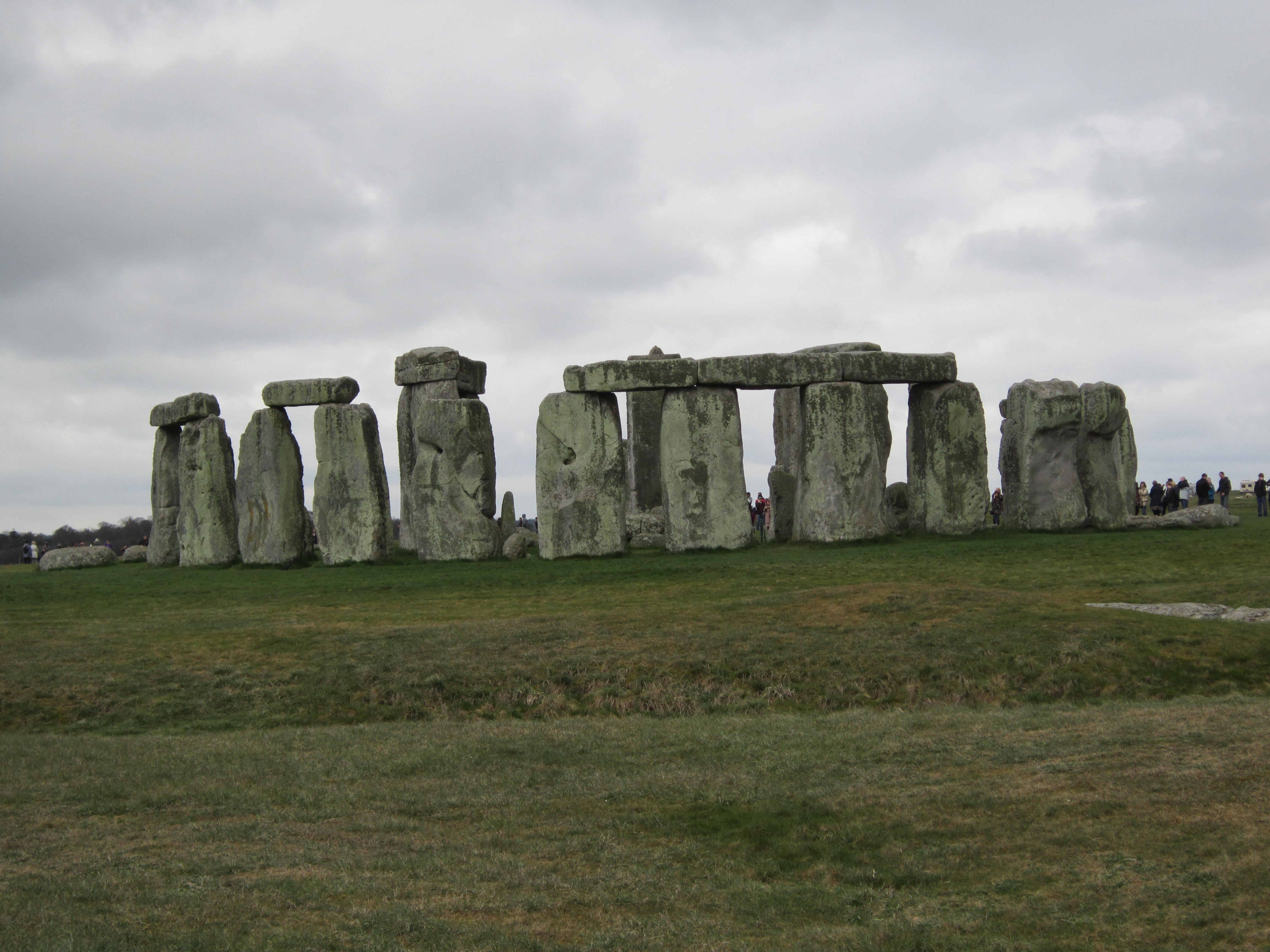
Stonehenge. The very name evokes mystery and myth. Although archaeology has revealed more about the monument than any mere visual survey, we are still very much in the dark about its origin and purpose. With one exception: we know it was something religious. When we discover artifacts that required a tremendous outlay of human effort in pre-industrial periods, the motivation, according to our current understanding, is almost always religious. Modernity has come to us with a cost. In any case, a recent story in The Guardian highlights the view of Julian Spalding, erstwhile museum director, that Stonehenge might have housed a platform on top of which the real action took place. As might be expected, experts disagree. With its precise solar alignment, one wonders if a roof might have been superfluous, but then again, there is the sky.

IMG_0129

When I begin to feel depressed working in the belly of a concrete bunker with no windows, indeed, no view of the sky at all, I find my way to a room with a view of the outside. I’ve always had a celestial orientation, and looking at the sky—especially on a day with some blue showing—can cure my sadness in a way almost supernatural. I suppose that was part of the reason I wrote Weathering the Psalms; there is just something about the sky. In that book I couldn’t really verify what it was. I still can’t. I know it when I feel it, however, and this perhaps the feeling the Julian Spalding is asking us to explore at Stonehenge. Ancient people directed their worship upward, not toward the ground.

Like all universal statements, however, there are exceptions. Some ancient religions recognized our place as children of the earth. The celestial sphere, however, is part of the package. Our atmosphere makes our world habitable. While the moon is beautiful and Mars inspires wonder, their lack of air spells their hostility toward those who need to breathe deeply and look up into the blue once in a while. Almost Frazerian in its archetypal view, Spalding’s idea has a beauty of its own, whether or not the evidence bears it out. People of ancient times had a talent we lose in our cubicle-infested, results-obsessed world. We all exist because of the atmosphere above us. And when modern views become too much for me, I head outdoors where, sun or not, I find my solace in the sky.


Rorrim

It was an object of wonder. Handed to me as a child, the Bible inspired a kind of awe reserved for the big events of a young life. Here were the very words of God, in King James English, for me to read, mark, and inwardly digest. Well, at least read. And read I did, as only the fear of Hell is able to motivate an impressionable psyche. When a parish minister saw the trajectory of my life, he suggested exploring the ministry. More Bible reading ensued. With only Halley’s Bible Handbook as a guide, interpretation was largely a matter of what the minister said, and the kind of primitive reason that resides in a teenager’s head. I made it through college as a religion major without ever hearing about Mesopotamia’s influence on the Bible. Once I did hear, in seminary, it was clear to me that to get to the truth, you had to go back beyond the first page. Mesopotamia was only part of the story. The Bible was a book compiled in a region where other religions shared concepts, deities, and stories with the Israelites. While unique in some respects, it turns out the Bible wasn’t as unique as I’d been led to believe.

Mesopotamia, vying with Egypt, was the true cradle of the civilization that gave rise to who we are in the western world. Perhaps in the eastern hemisphere as well. The great cities of Sumer, and later Babylonia and Assyria, yielded cuneiform tablets and other artifacts that insisted we widen our view of antiquity. The heirs of this tradition developed Judaism, Christianity, and Islam. All three monotheistic religions have bred sects that despise this ancient past with its uncomfortable truths, and thus we hear of IS destroying the evidence with abandon. The years of my life spent studying these cultures disappears so quickly under the bulldozer’s blade. For all this, it is IS that is the passing fancy. You can’t destroy the truth. You can damage it, however, to the detriment of everyone.

IMG_0188

Political regimes, and not just in the Middle East, operate with an unbecoming arrogance when they believe in their own self-righteousness. Were it not for those who wondered what these wedges on clay meant, we might still have to reckon (more seriously than we already have to do) with those who insist that it’s the Bible way or the highway. Unfortunately, it often takes disasters such as this wanton destruction of the past to wake the media from its lethargy concerning the cultures that gave our religions birth. There’s so much more to distract. The world can’t make up its mind about the color of a dress, and meanwhile those backed with a justification of true belief destroy that which can never be replaced. Given the rhetoric of political leaders even here, I suspect that our past is no longer safe, no matter where we house the artifacts bearing witness to the truth.


Music Alone

Thinking back to our days in Edinburgh, I had a song come to mind. I could remember only a word or two, but the tune and the cadence were still there. Not a singer, nor even a hummer, the best I could do was ask my wife if she remembered the song based on the two words I could recall. Amazingly, she did. When I went to download it on iTunes, I learned that it isn’t available in the US. Probably copyright laws—these can be quite bizarre. Music has a way of staying with you and one of the songs unforgettable to those of us growing up in the ‘60s is Don McLean’s “American Pie.” In a recent Bloomberg View piece, Stephen L. Carter, a professor at Yale, laments the fact that McLean’s original notes for the song are going up for bids and, after five decades of guessing, we may finally learn what the cryptic lyrics mean. Or will we?

AmericanPie

A colleague of mine used to say, “words don’t have meanings, they have usages.” In the literary technique known as reader-response criticism, it is the reader who has the final say in what a passage “means.” An author may intend one thing, but who is the author to control the meme once it’s out? (You can see why some biblical students get upset by such things since the same thing applies, even if the author is God.) While I’m not po-mo enough to accept this completely, it has introduced an edge of caution to my reading. After all, if an author is dead (ahem) we can’t question him or her to find out what they meant. Even if they remember. “American Pie” is notable for its lyrics with religious imagery which, fairly clearly, are not really religious. Or are they?

Carter laments the coming unveiling. The mystery will be gone. Don McLean, the ultimate one-hit wonder, will walk away with the goods yet again. I have no doubt that there will be analyses and hermeneutical disquisitions. The learned will claim that we finally have the answers. I’m not so sure. What if the “Father, Son, and Holy Ghost” turn out to be Buddy Holly, Big Bopper, and Richie Valens? What does that mean? Perhaps Don McLean, like any old prophet, was merely a vehicle for a message received from elsewhere. The questions go back in an endless regression, and no answer will ever be final. We all know the song is about “the day the music died.” As the old camp song says, “music alone shall live, never to die.” And as I sit here trying to remember how a song I last heard two decades ago goes, I’m pretty sure that the camp song is right, whatever it means.


A Kind of Lunacy

I can never keep track of the vernal equinox. Actually, I have the same problem with the autumnal equinox and both solstices. I think it’s because when I was growing up I thought they always came on the 21st of the month. That’s a nice, regular interval. Our months, however, are not natural. Were they to follow the moon (whence we get the word “month”) they would be about February length. The moon’s phases, however, do not keep to human time. In actuality, a month is approximately 29.53 days. Various emperors throughout history added days to their months, making our jumble of 365.25 days a mix of mostly 31-day periods, with some being 30, and February alone holding out at 28. Or 29, depending. All of which is to say, I didn’t realize spring was here until the day was mostly over. Here in the northeast it was snowing, and the celestial dome was occluded. That was a shame since it was also the day of a solar eclipse. I consoled myself by realizing that even if it had been sunny I was in the wrong location to see the eclipse, so I wasn’t missing much.

DSCN3762

So spring subtly appeared this year. Not only was the day an eclipse day, for some, it was also a “supermoon” day. That is to say, the moon was at its closest point to earth at the time, making the eclipse a truly spectacular one, if you could see it. All of these astronomical machinations on the event that sets the date for Easter has developed a new kind of mythology. According to The Guardian, some minority of clergy have seen this event as initiating the apocalypse. Of course, eclipses are by their nature local events. The vernal equinox occurs every year, and the first Sunday following the first full moon of the equinox will be Easter. We get a supermoon (or perigee-syzygy of the Earth-Moon-Sun system) about every 14 months, so this is hardly rare. But then, the moon has always been the locus of mythology.

Ancient peoples knew the phases of the moon intimately. As the main source of non-artificial light at night, it was a boon to those without electricity, or even gaslight. Without physics to provide a mechanism, stories developed to explain the ever-changing status of our nearest neighbor. Some of those tales took on religious elements, and many religious calendars remain lunar. The vernal equinox, however, is a solar event. From now on the days will get longer until the summer solstice, a day of celebration and mourning, as we move back into the days of declining light. Each of these celestial events comes with its own religious freight, and it seems, dissenting clergy notwithstanding, that so it shall carry on for many moons to come.


Losing My Religion (Excuse)

I’ve always appreciated New Jersey inventiveness. This is a state where lottery winners register with the social security numbers of dead people to avoid taxes. Politicians and honest folk both seem to resort to inventive means of getting around the system. A recent article in the New Jersey Star-Ledger brought this home. An uproar has developed, it seems, over a more stringent regulation concerning religious exemptions for vaccines. If the bill passes, parents and guardians opting out of vaccines for their children will have to state their religion and the cause for the objection. Many have been suggesting this is government of the worst kind, because, well, it wasn’t really a religious reason that they used the religion waiver. Have you met my dead relative? He recently won the lottery.

A timeless problem that arises from a situation such as this is the issue of defining religion. We’re not really sure what it is, other than a reason for not preventing disease. Experts disagree about the essential components of religion. Since the concept of God is up for grabs, doing what pleases said deity (or not, depending on whether a religion has a deity) would seem to be part of it. Most religions, whatever they are, suggest honesty is a virtue. And honestly, most religions have no trouble with vaccines. The paper even had a helpful chart of religions, even indicating that Christian Scientists and Jehovah’s Witnesses have no issues, really, with vaccines. Clearly some churches do. One suspects other may have had such regulations, but they eventually died off.

Since we can’t bother to define religion, it becomes a most convenient excuse for just about any kind of deviant behavior. Many religions exist; more than most people even suspect. Sects of Christianity alone number around 40,000, and that’s leaving aside all other religious traditions and their many splinter groups. Truly held religion, as the media often underscores, can lead to extreme behaviors. The only way to come to grips with this is to try to understand what religion actually is. The most logical locus for such study would be universities. Many of them are run by states. States that are afraid of breeching that wall of separation. Even in the cause of public health. In my opinion, funding the study of religion could be a real shot in the arm. But then, so could winning the lottery.

800px-Typhoid_inoculation2


The Greens

It would take a lot to make me open a website called “Business Insider.” Despite spending far too much time on the internet, my regular sites are few and my ability to find interesting stories often depends on my wife, daughter, or friends pointing out to me what they’ve found. I knew nothing, for instance, of the dress whose color flummoxed the world for a few days. Someone sent me the link and I pondered how strange the world wide web has become. There was a deeper issue, however, and another friend sent me a story on Business Insider to underscore the point. The piece, by Kevin Loria, is entitled “No one could see the color blue until modern times.” At first I scoffed. Blue is my favorite color, and I’ve always been able to see it. Then I read the piece. (It is a bit frightening in the context of a publication called Business Insider, however.) Beginning with yet-to-be prime minister William Gladstone (when is the last time a world politician knew his or her classics?) scholars began to notice that ancient writers such as Homer did not reference blue. Apart from ancient Egypt, most ancient cultures lacked a word for the hue (and remember when you read it in the Bible you are seeing the words of a frustrated translator). Did they even notice blue? The paucity of ancient records may be to blame. But then, Loria looks at modern experiments.

People who live in particular environment develop the ability to distinguish shades of colors that are difficult for the computer-bound to appreciate. For example, Loria cites an experiment in Namibia where members of the Himba tribe could not distinguish blue from green. They could, however, pick out a very slightly different shade of green with ease. In a world surrounded by greenery, knowing subtle differences is important. And we only pay attention to what is deemed important. Scientists have known for a very long time that we are flooded with sensory information incessantly. With our five basic senses an overwhelming amount of data bombards our brains constantly. Those who survive in this world have to determine what is truly significant.

Stepping back to apply this to societies as a whole, I find myself in a distinctly Tillichian mood. What is of ultimate importance? If our society is focused on lucre, it would seem that we, like the Himba, should be able to detect thousands of shades of green. Instead, we find a world full of color. I’ve been working in Manhattan for over three years now. While interesting, I have to admit that much of the city looks gray to me. Even the green on the rare dollar bills that come my ways seems surprisingly subdued. We notice color because it is important to our survival. Artists who work with color in unexpected ways are often under-appreciated for their talent. Those who splash color flamboyantly are accused of being garish. Amid it all, I turn my eyes toward the sky whenever possible. In my youngest days I learned its color is blue. And there is no other color I would rather perceive.

SDC10629


Alas, Babylon!

Religions tend to be backward looking. That’s not intended to be a universal, nor a condemnation. Few would want to admit that their religion is new, especially in this scientific era. We tend to believe the truth is old. But not too old. In the monotheistic traditions, real religion started with Abraham, or more properly, Abram. Beyond that we were all pagans. One of the sad stories brought to my attention this past week involves the IS (you know it’s bad when we have to use acronyms) decided to destroy Nimrud, one of the ancient Mesopotamian cities that has helped us understand whence we’ve come. In an era of political and social correctness, we’ve decided that the right to keep artifacts rests with those who’s heritage it reflects. The future, however, is just as unstable as the past. As someone who has spent many years trying to understand the material remains of our pre-Judeo-Christian heritage, it is a tragedy of the first degree to have unthinking guardians destroy what can’t be replaced because they represent “idols.”

In my Ancient Near Eastern Religions class, I used to begin by asking students what the difference was between an idol and a god. At first it seems that idols are images, and, by definition, offensive to the religion that names them “idols.” Then, as we probed deeper, it would become clear that all religions use images of some description, and that likenesses of deities were considered to be gods in sophisticated ways. Those who built the pyramids and the great walls of Babylon were not simpletons. Their images, many of them powerful still today, were psychological expressions, often backed with theological finesse. Even Protestants accuse Catholics of idolatry, and they worship the same deity.

It would be a mistake, however, to blame religion for such wanton destruction. All religions breed extremists. Extremists, like those who believe science can explain everything, are simply drawing their reasoning out to its ultimate conclusion. That’s not to condone their actions, but to try to comprehend them. All religious groups have those who slip past the bounds of conventionality into the realm where an all-consuming zeal requires excessive action to be noticed. Human beings are complex that way. A pagan philosophy of ancient Greece held that all things in moderation was the ideal. Religions with a concept of Hell, however, breed excessive ideologies. As a child I would have done anything to avoid Hell. In fact, with the little power that children are accorded, I conscientiously did what I could. When I wasn’t distracted by the other attractions life seemed to offer. If, perhaps, we considered that socio-economic justice would go a long way toward engendering a kind of contentment, we might find less extremists in the world. No matter what we do, however, we will not find ourselves in a world without religion.

DSCN1835


Geneva Conventions

As an alumnus of Grove City College, I generally don’t have the chance to consider other colleges as unreasonably conservative. College taught me, after all, that education involves thinking things through, and that, of all things, doctrine is one of the many human constructs that wilts under close examination. Both religious and political doctrine fall under this rubric. So when an article in the Chronicle of Higher Education fingered Grove City’s near neighbor, Geneva College, I was both relieved and not really surprised. Grove City was strict, but Geneva, located down the road in Beaver Falls, was even more Reformed. Tales at the Grove said that even off-campus dancing was an infringement of the student code there, and that even a legal sip of beer with dinner, off campus, could get you expelled. You know how students talk. In any case, both cut from Presbyterian fabric, Grove City and Geneva Colleges hold out against the world and its multiple evils. So why did humble Geneva merit notice in the exalted Chronicle?

Geneva College recently sued for exemption of the contraception-coverage mandate of the Affordable Care Act. You see, in many conservative religious traditions pre-marital sex is not only from the Devil, it practically never happens among true Christians. If it doesn’t happen, why should you be forced to pay for its treatment? Denial runs profoundly through these conservative colleges. While at Grove City, in a first-floor dorm room, my roomie and I were awakened one night by a group of pretty obviously drunken frat boys from the third floor. Cursing loudly, one of them rammed his fist through our window, showering the floor with glass before stomping loudly up the stairs. When I went to the housing office the next morning, they wondered about my story. Students at Grove City, drunk? It simply did not happen. In all likelihood, I’d broken the window and made up the story so I wouldn’t have to pay. I pointed out that campus security had noted the glass was inside the room and my roommate and I were both there at the time. Reluctantly, while still withholding judgment about the drunken part, I was believed.

Conservative Christian colleges often face the specter of reality. College kids were killed driving drunk. Girls, gasp!, did get pregnant and did not always decide to keep the baby. Real world issues declared anathema by a magisterium with its hands firmly over its eyes. No matter one’s view of morality, singling women out for punishment of sexual sins is just plain unfair. The issue here is health care, not the consequences of a decision made in the heat of passion. How often the anonymous male gets to scamper off, his health fully covered. The co-ed, however, is treated like Eve holding a newly bitten apple. Students attend Christian colleges for a wide variety of reasons, and the education, apart from the theology, can actually be excellent. It is the ethical obligation of the schools to cover all the human needs of emerging adults, not just those based on a morality still mired in the Middle Ages.

Time for a Reformation?  Photo credit: Roland Zumbühl, Wikimedia Commons

Time for a Reformation? Photo credit: Roland Zumbühl, Wikimedia Commons


Hot Pants

Over a decade ago now, the populace was buzzing about Stella Liebeck’s suit against McDonald’s. You may remember the case. Liebeck was handed very hot coffee through a drive-up window in one of those flimsy cups, and suffered second-degree burns when it spilled in her lap. The incident spawned a documentary movie and even a New York Times retro report a couple of years ago. No doubt the injury was serious enough to cause medical treatment including skin grafts, and McDonald’s does, as we all know, process its customers just like it processes everything; you can’t serve over 100 billion burgers and be the world’s second largest private employer without process. Food injuries in a world of business feeding can be serious. “Eating out” is a way of life for many and when people eat out they take their religion with them. That’s why Hiram Jimenez’s case is so interesting.

According to the New Jersey Star-Ledger, Jimenez decided to bow in prayer over a plate of sizzling steak fajitas at Appleby’s. For those who’ve never witnessed fajitas being served, they are an attention-demanding dish, served loudly steaming and popping with smoke rising up forever and heads being turned. I suspect that’s part of the appeal. According to the paper, Jimenez bowed over his food and the grease popped, burning his face, causing him to knock the plate of food onto his lap. None of the burns left scars, and a Superior Court here in New Jersey found the restaurant not negligent as the danger was “open and obvious.” What makes this story so interesting is not the injury but the cause behind it. Food being hot is somewhat universal. Praying in restaurants, however, is an evangelical cultural practice.

Growing up with evangelical friends, I learned to pray in restaurants. (My family was of rather humble circumstances and we didn’t eat at restaurants.) Partly it was in actual thankfulness, but clearly it was partly also in show. We were witnessing by invoking our gustatory gratitude. For being literalists, we didn’t take Jesus’ injunction to go into the closet and shut the door before praying too seriously. The culture around public prayer involves bowing. The bow is a mammalian display of submission. Thy will be done. In the biblical world being thrown into a blazing furnace for public displays of faith didn’t lead to lawsuits. Everyone knows infernos are hot. I can’t help but wonder whether a martyr complex is at play here. A praying customer is doing what his religion demands and gets burned for it. Yeah, I know what that feels like. And, I suspect, so do countless others who find no hearing in courts at all.

Photo credit: Bryan Hong (Brybry26), Wikipedia Commons

Photo credit: Bryan Hong (Brybry26), Wikipedia Commons


Wag the Tail

Among the most respected of intellectual endeavors is political science. Analysts who read and reason beyond national borders, finding implications in countries many of us have never heard of, they can be an intimidating lot. Experts in economy and psychology, they tell us what the big picture looks like—why we do what we do. And almost universally they disdain religion. We’re talking politics here, why don’t you go sit at the kid’s table? Religion is the stuff and nonsense of make-believe. What politics is about is who has the biggest bombs and bank accounts. Those who impact the world in real ways. And yet.

I would never claim to be up-to-date on current events. I don’t have time to read newspapers and if my friends didn’t send me pertinent articles now and again I might still believe that social justice is more important than the color of an anonymous dress. When no less than an authority than the New York Times speaks, however, I do have to pause a minute or two to consider the implications. Frank Bruni has recently been writing on the Opinion Pages about those ultimate strange bedfellows, religion and politics. I may have got the order wrong, but that’s for political scientists to determine.

Many people don’t consider that religion can be, in some respects, scientifically analyzed. As a deeply divided nation, one factor that even political scientists should note is that yes, religion does count. No matter how naively conceived, people vote with their faith behind that polling curtain. The Republican Party realized this in the 1980s. If you take just one or two religious issues and make them the platform on which you stand, you can garner a disproportionate amount of the conservative evangelical vote. A new study from the Public Religion Research Institute, according to Bruni, demonstrates just how disproportionate the outcome can be. Surveys may not be precise, but less than 20 percent of Americans are white evangelical Protestants. Yet their issues are the ones that make or break elections.

Life has a way of making one cynical. I grew up a white evangelical Protestant. Although my viewpoint has evolved with my education, I can’t shake two of those qualifiers even if I want to. I read political scientists dismissing religion as a bogus topic, mere twaddle to fill the daub of inert minds walled in by primitive thinking. And I read the occasional news story that demonstrates that the facts don’t fit the premise. Do we need to understand religion? Absolutely not, I’m told. But in the end, even the analysts of the political beast will have to realize that tails wag dogs just as surely as raising hackles will make any mammal appear larger than it really is.

Not a tail to be seen...

Not a tail to be seen…


British Libraries

Quintessentially intellectual, the mental image of the British goes, they are often the sophisticated, educated, literate, worldly individuals. I know I’m stereotyping, but play along a minute. Perhaps Americans and other colonials feel a sublimated respect for the nations that gave us our start, and even today the major academic publishers are British companies. Think about it. So when we ponder the United Kingdom, we conjure images of the pinnacle of urbane, cultured, society. Perhaps this is one reason that I decided to study in Edinburgh. One of my memories of being in that fantastic city is going to a library book sale. I’d never seen inoffensive old ladies throwing such hard elbows before. The hunger for books was palpable. So it is with dismay that I read John Harris’s Guardian piece, “In a country like Britain, obsessed with the now, libraries are a political battleground.” (Did I mention that Brits are also loquacious?) The article, however, has a disturbingly American feel to it. We live in the now, not in the past. Libraries (and museums) are the repositories of thousands of years of human wisdom and achievement. Who needs them?

Harris is concerned with the trend of libraries discarding books. After all, publishing is an industry, and if industry is anything it is about producing more. More books are now being published than have ever been since our human ancestors crawled from the primordial soup. Some are purely electronic, but as survey after survey shows, the majority of readers still appreciate a book in the hand. One might say that a book in the hand is worth two in the Kindle. But libraries, desperate for both funding and space, are resorting to throwing out books. They will be replaced with books, and who will miss them? I can’t help but think of Ray Bradbury. Do authors’ souls perish when their books are destroyed? Where will we go to find out, if our libraries have weeded their gardens too thoroughly? My biggest obstacle to continuing research as an independent scholar is the lack of a good university library. I agree with Harris, without our past, our now is but a passing fancy. When tomorrow becomes today, will we wake up and realize what we have discarded? Will we have to start from the beginning again?

Over the weekend I went to a local Barnes and Noble. I’ve never been a fan, but now that Borders is gone, B&N is the only show in town. (I visit the independent shops far more frequently, but this is winter and I don’t want to venture far.) I read about a newly released novel, still in hardback, and wanted to see if they had it. Amid the toys, videos, and puzzles, I stumbled upon a rack of books. New releases. The shelf of hardcovers wasn’t very large, so I stepped around back thinking there might be more. How naive I am. The store was nevertheless crowded. Those checking out weren’t buying books. The book bags, almost apologetically, bore quotes about how books change the world. I look down. I’ve got a puzzle in one hand and a game in the other. The world has only so much space. With what we choose to fill it says volumes about who we are. Our only hope is that our now contains those who, at least in the future, will live to read.

DSCN5025


Theological Fiends

SuchADarkThingVampires are among the most theological of monsters. Not that I’m a theologian, but I sometimes read those who are. Although zombies and vampires rival one another for the ascendent monster of the moment, I’ve always had a soft spot for the vampire, conceptually. The actual idea of drinking blood has always distressed my vegetarian sensibilities, but there is a deep intrigue about the character who constantly takes and never gives. And sees in the dark. And is practically immortal, unless violently killed. All of these aspects, and more, have theological undertones. M. Jess Peacock’s Such A Dark Thing: Theology of the Vampire Narrative in Popular Culture deals with such ideas and more. A self-admitted fan of all things vampiric, Peacock finds unexpected angles to the undead metaphor that make for connections between Christianity and the cultural vampire. He explores Otto’s understanding of the holy and how vampires fit aspects of it, the importance of blood, theodicy, and sin, as well as religious iconography and why crosses work against vampires (when they do). Most fascinating, however, is how vampires effect social change.

Since I often write about monsters, and specifically vampires, on this blog, it should be no surprise that I should read such a book. The question of why vampires have such staying power in our society is one that many have pondered. Peacock, by tying the vampire into deep theological needs (and we’ve been taught for many decades that theological needs are unrealistic fantasies themselves) has perhaps found a reason why. Just because we deny a need doesn’t mean it isn’t real. Think of all those Medieval monks denying sexuality. Biology, no matter how transcendent our focus, has a way of reminding us that we have needs. Vampires are, if anything, very forthright about their requirements. You have blood, they need blood. They will take it any way they can. And this leads to its own kind of ethic where, in some movies and stories, we, the victims, end up rooting for the vampire.

The social justice aspect of Peacock’s study is the one I found most compelling. We live in an era in which financial vampires openly and selfishly drain the blood of any victims they may find. What they do is done in daylight and no crucifix is large enough, no stake is strong enough, to stop them. We sit in our theater seats and watch as the economy rises and falls with the wealthy and their willingness to invest (or not) in the very economy that made them rich. Elections are won now by money supplied by corporations. Yes, the presidency can be, and is, purchased. Most politicians don’t know the price of a loaf of bread. Christianity, in any case, understands bread and blood to be analogues. The two are complementary, and represent the totality of human need. The vampire, as Peacock notes, can symbolize the difficulties of social justice. They may have their fangs deeply embedded in our necks, but at some level we have come to love our vampires. Even when they give us nothing in return.


National Reading Month

Welcome to National Reading Month. Today is the birthday of Dr. Seuss (Theordor Geisel). Since so many children begin reading with Dr. Seuss, March has been designated National Reading Month in his honor. Nothing could be more deserving of a holiday than reading. In an era when active, visual displays and lifelike animation readily draw eyes away from books, it is more important than ever to think about what reading has done for us. As a society, no significant advancements were made beyond agriculture and shepherding until writing was developed. We needed a way to convey knowledge not only over distance, but also over time. To participate in writing is to taste immortality. To read is to communicate with those long gone or far distant. How trivial we’ve made it all seem. Writing was a truly remarkable achievement. The entire purpose of schooling was originally to teach our young to read and do math. So we should all celebrate National Reading Month and put down the devices for a while and curl up with a book.

Okay, well, reading on devices does count. Still, some of us can’t help ourselves from acquiring books. I once visited a house of a friend’s relative on a trip. It turned out that we would be spending the night. As I glanced around my new surroundings I noticed something odd. There were no books in the house. None. It felt so hollowing that I knew I could not long remain there. Every room of our apartment (except the bathroom) has books. I travel with books. Even if it’s going to be a fairly brief car ride, I wonder what happens if I break down and don’t have anything to read while awaiting rescue? On the bus everyday I have at least one book with me, and sometimes two or three. I’m lost without them. Libraries and book stores are my favorite places to be. Surrounded by words, comforted by communication.

564px-Ted_Geisel_NYWTS_2_crop

Dr. Seuss was part of my childhood reading, but not so much as Bible stories and Easy Readers. We didn’t buy any Dr. Seuss, but I did check his books out from the library. When my daughter was born we corrected that misdemeanor. We purchased nearly every readily available book by Theodor Geisel, and this was in the days before Amazon. Some were difficult to locate, being in rural Wisconsin, but we persisted and instilled the love of reading into another generation. We have holidays to celebrate wars and victories in wars. Great deaths and momentous births. Love, fear, and the Irish. And yes, reading. The cracks in winter are beginning to show. Light is beginning, ever so slowly to increase. Why not celebrate the coming of the light with enlightenment for the mind? It’s time to read a book.


Live Long and Prosper

He lived long and prospered. Perhaps it’s a generational thing, but the icons of my youth have been dying. I have to confess to having sat far too many hours in front of the television as a young person, but fantasy of all sorts helped me cope with reality. Leonard Nimoy was a kind of father figure, in a way. Similar to Jonathan Frid, Russell Johnson, and Fred Rogers, all of whom stood in for an absentee parent and showed me different aspects of what it meant to be a man. Watching them die is like having someone tear pages from the book of my life—they made strong impressions, even though it was all make-believe. It’s difficult to say why Leonard Nimoy’s passing hit me so hard. I guess that the conceit of Spock living far longer than humans took hold at some level, and the rational, unflappable Vulcan seemed like a stable, if somewhat emotionally cold father to a child who was, in his own mind, conceived by the television itself.

I don’t really consider myself a nerd. I don’t have the tech to back me up. I’m more like a hermit who spends weekdays in Manhattan. Still, when anyone says Kirk or Picard, there is only one right answer. I watched Star Trek when it was new, still in original reruns. My mother decried it as “silly nonsense,” but along with other monster generation kids, I had my face pressed to the screen waiting to see what new and weird form of life might appear. It was the late sixties and all of this was fresh and untried. Star Trek became a vital part of my childhood. I think it might have been because this was a place with no limits. No limits beyond a shoestring budget, in any case. Space, as I was learning, was vast. There were endless possibilities out there.

Leonard_Nimoy_William_Shatner_Star_Trek_1968

As an adult, the possibilities seem somewhat severely effaced. I’ve tried to be rational and moral and conscientious, but I haven’t really held down a regular career. I don’t watch television any more, and instead read books and ask probing questions. Why does Spock resonate so much with me? Was it because he was apparently immune to emotion? Or maybe he was simply able to rise above it, since everyone knows he is half-human and even Vulcans have emotions, albeit deeply buried. Those of us who followed the original crew through the movies suffered through his death before. And his resurrection. This time, though, it’s not Spock who’s gone. Leonard Nimoy is one of those few people who, in their own lifetime, become a symbol. And symbols, if they are of any use, live long and prosper well after their creators pass on.


Our Gods, Ourselves

The near-death experience, made popular by Raymond Moody in the 1970s, has hit the cultural mainstream with movies like Heaven Is Real. The now-familiar scenario of going through the tunnel toward the light and meeting something like God is so widespread that mention of “staying away from the light” can be a metaphor for remaining alive. Although experts (one of which I’m decidedly not) disagree on interpretations, nobody doubts that the dying often report such things. Some say it is the impression left on an oxygen-starved brain about to implode, while others postulate a soul has made an actual bid for freedom only to be returned to sender. No matter what you believe, it’s hard not to be intrigued. Not all the experiences are identical, however. A friend recently sent me a story from World News Daily Report that headlines “Catholic Priest Who Died for 48 Minutes Claims that God Is a Woman.” The story by Barbara Johnson, which ran earlier this month, is an interesting variation on the standard. Often the “being of light” met at the end of the tunnel is kind of asexual. After all, there are no physical bodies there.

This story has me thinking. Traditional Christian, indeed, Judeo-Christian thought posits that God is neither male nor female. Of course, given human experience, many people find that difficult to conceive. It does occur in intersex persons, and it is actually pretty widespread in nature where some animals change gender over their lifespans. Still, when it comes to the Almighty, people want to know with whom they’re dealing. Think about it. When you walk into a doctor’s office and meet a physician for the first time, your response will differ depending on their gender. The same is true of going into a car dealership, or a daycare facility. We use gender to give us the first hint on how to respond. A genderless God, let’s admit, is somewhat disquieting. What is the message you want to send to a person without knowing their gender? Or maybe like me you’ve read a book and discovered halfway through that you had the gender of the author wrong. Doesn’t it impact how you read the rest? So, what if God is a woman?

Interestingly, the case of Father John O’neal comes from a Catholic context. Along with Evangelical Christians, Catholics are among the most likely to hold a residual maleness to God’s identity. Theology of the Trinity, always beginning with “the Father” makes it hard to escape. Perhaps what Fr. O’neal unexpectedly encountered was a God-concept without judgment. That would certainly be disorienting to a faith that has a multi-layered afterlife including limbo and purgatory as well as heaven and hell. A deity who decides the fate of souls must be a judge, and although Judge Judy rules daytime television, the church still has a traditional mensch on the bench. What if Fr. O’neal really did get to heaven? What if he found God really was female? Could human religions ever recover? I, for one, am intrigued. Still, I’m content to wait another few decades before finding out. And maybe for the time we have down here we should all start practicing by realizing that gender is always far less important than the personhood that we all share.

IMG_1858