Fear of Voodou

The Associated Press fed a story this morning entitled “How an earthquake shook the Haitian’s faith.” Among the aftershocks of last month’s horrific disaster, many groups have ignored Rush Limbaugh’s charitable advice and have gone to Haiti on humanitarian missions. The story reports how many of these groups, generally Christian, dispense their aid outside churches and that many of the native believers in Voodou are being encouraged to convert to mainstream Christianity. Voodou priests are worried about this since, in the words of one, “by rejecting Voodou these people are rejecting their ancestors and history. Voodou is the soul of the Haitian people. Without it, the people are lost.”

Many of the missionaries bearing gifts, among them Jehovah’s Witnesses, Scientologists, and members of the Church of Jesus Christ of Latter Day Saints, see Voodou as a strange and pagan religion. The fact is that Voodou is a form of Christianity blended with indigenous African religions during the unfortunate days of slavery. Retaining their African spirits in the guise of Roman Catholic saints, the slaves of the Caribbean developed a religion they could truly believe in as they were forced to “believe” in Catholicism. In mainstream Christianity their religion is viewed with fear and distrust primarily because the religion it blends with is non-European in origin. Most Christians are unaware of the blended variety of their own faith. Early Christian missionaries into Europe found it much easier to convert native gods into saints in order to convince local populations that Christianity wasn’t such as radical a switch as it seemed. The old gods could still be worshiped, only as lesser deities.

In the “New World,” Christianities continued to evolve. Today’s Fundamentalism has very little in common with the Christianities of the first century. Jehovah’s Witnesses, Scientology, and the Church of Jesus Christ of Latter Day Saints are all religions that have developed in or since the nineteenth century in America, quite often from blends of traditional Christianity and new religious sensibilities. Religion is not immune to evolution, and the history of religions proves that fact beyond any doubt. And yet to those who do not know the origins of Voodou it appears non-Christian and worthy of conversion. Is it not possible to help those of another variety of religion simply because they are humans in need rather than requiring a baptismal certificate in order to claim your daily bread?

A Voodou service from WikiCommons


Asherah to Asherah

Every great once-in-a-while I regret no longer being in a position to conduct active research and publication. In the days when a full-time teaching position afforded me that option one of my favorite subjects was the exposure of facile arguments made by otherwise careful scholars. Most of those arguments focused on the presence of Asherah as a fully formed goddess in ancient Israel. Extremely tenuous evidence for the association of the goddess with a variety of ambiguous artifacts has polluted the discussion for decades now. Any vaguely abstract image suggesting a female was declared an “Asherah” representation, sometimes even images as simple as a triangle or a mother cow.

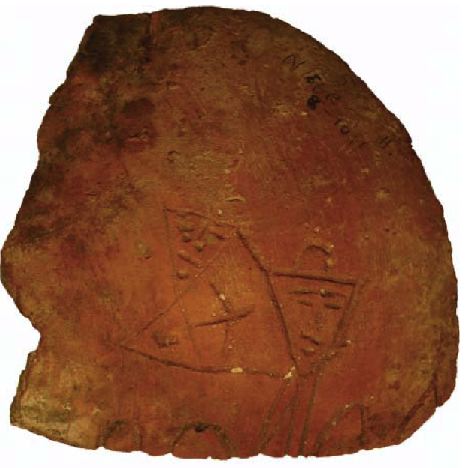
A colleague of mine just pointed out the recent article by Garth Gilmour in Palestine Exploration Quarterly 141 (2009), entitled “An Iron Age II Pictorial Inscription from Jerusalem Illustrating Yahweh and Asherah.” Having more than a passing acquaintance with the goddess, I read his article with considerable interest. A potsherd discovered in the 1920s, but unpublished until now, bears an incised “inscription” of two figures that Gilmour plausibly argues to be highly stylized female (left) and male (right). Basing his analysis of possible identities for this Picassoesque pair on the now canonical interpretation of the Kuntillet Ajrud and Khirbet el-Qom inscriptions, he suggests this is none other than the happy couple of Yahweh and Asherah.

Loving spouses or battling foes?

I encourage creativity in scholarship; otherwise it has a way of becoming deadly dull. The supposed pairing of Yahweh and Asherah, however, has been excessively overblown by scholars who should know better. When it comes to the point that escapees from Flatland who bear the suggestion of gender must be Israel’s most famous bachelor and his main squeeze, I have to wonder what the basis of solid scholarship is. There are no words obliquely hinting that this is a divine couple, nor is there a sacred context to suggest this shard was in any way religious. Given the fact that the image had formerly been on a spouted jar, perhaps holding water, would not a suggestion of Marduk and Tiamat be more appropriate?

Rorschach tests aside, this incised image is an important piece of a puzzle with far too many pieces missing – the puzzle of the artistic life of ancient Israelites. Given the all-too-human interest in relationships between women and men, I would see no necessity of making deities out of a pair of prospective lovers or foes. Why can’t people just be people?


Paul Does the Classics

I first became aware of Greek mythology in fifth grade. My teacher in an industrial, rough and yet rural school, believed in the benefits of teaching aspiring drug addicts and laborers the stories of gods and heroes. I immediately adored the stories we heard and read. Raised in a religious household, however, I feared enjoying the tales of what were admittedly pagan gods after all, too much. In the educational topography of my youth, we were on the brink of this brave new electronic world we’ve entered, and mythology was not considered a terribly useful part of the curriculum after that. I left the gods behind. In a class on the Christian Scriptures in college, however, my instructor suggested we all go see Clash of the Titans (the 1981 version) for its appreciative (if a little hokey) presentation of the Greek world. I enjoyed the movie and even took a class in the literature department on mythology.

Over the years I have touched and gone on Greco-Roman mythology while specializing in the mythology of Ugarit. Now that I’m teaching a course on mythology, I’m going back to my classical roots and rereading the stories of times not quite so ancient as the fertile crescent civilizations’, but older than what is considered practical nowadays. While rereading Euripides’ play The Bacchae, the concentration of images, concepts, and actions that recur in the Bible stood out in chiaroscuro. Especially noticeable were references to Paul in the book of Acts.

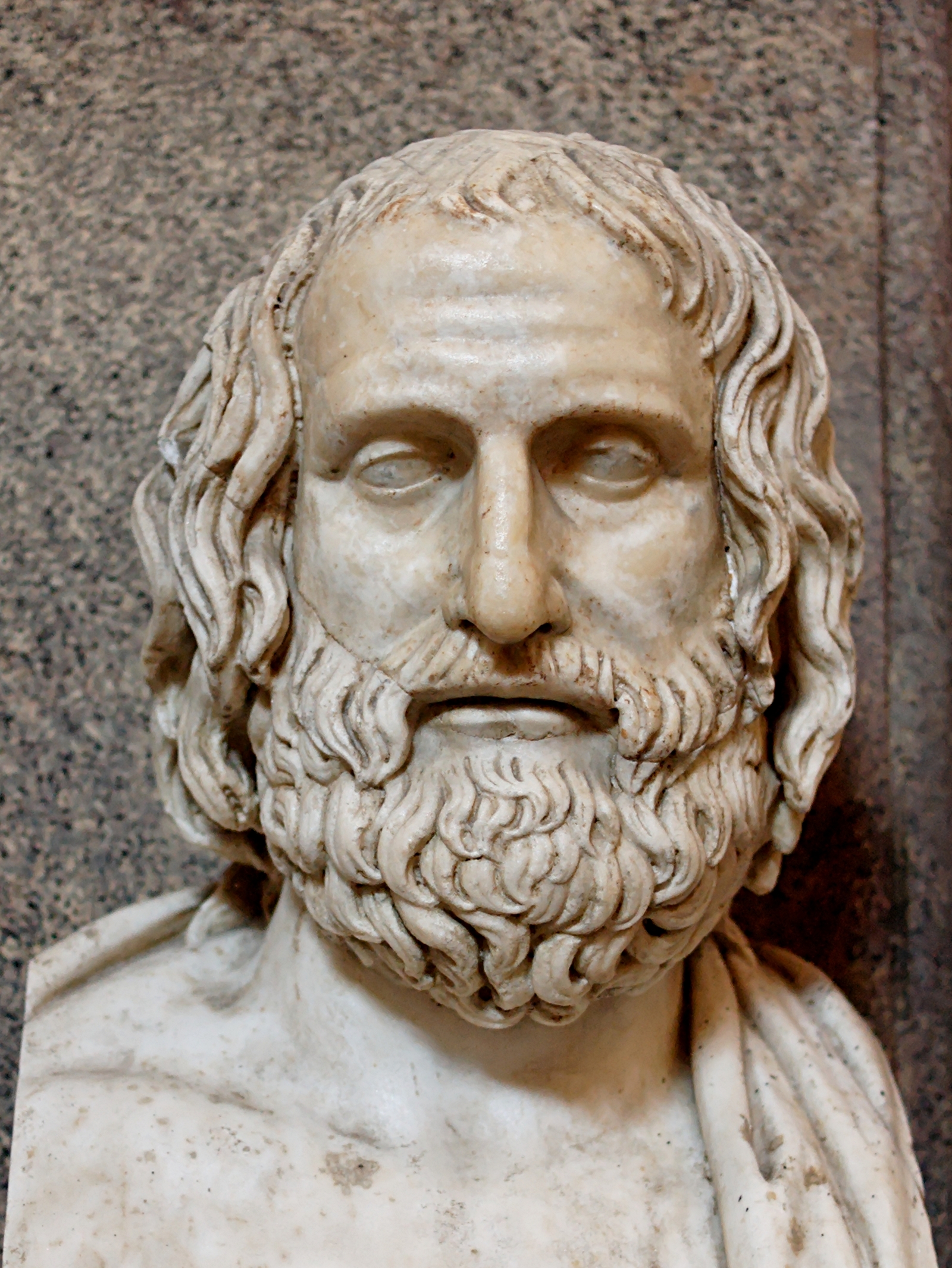
Like Paul, Dionysus comes to be imprisoned. Not recognized as a divine figure, King Pentheus of Thebes locked him in chains until he could demonstrate that Dionysus is just the wild imaginary figure of repressed women. An earthquake, however, soon rattles the city and Dionysus emerges, chains shed, to the astonishment of Pentheus. The scene reads like Paul and Silas’ escape from jail in Philippi (Acts 16). Admittedly this could be coincidence. A few lines later, however, Dionysus, free from prison, tells Pentheus, “Don’t kick against the goad – a man against a god,” (Act 3, Paul Roche’s translation). Even so, Paul on his way to Damascus sees a vision of a god and is asked, “Why are you persecuting me? It is hard for you to kick against the goads” (Acts 26.14). Perhaps Luke had read his Euripides?

Now I’m no scholar of the Christian Scriptures (although I have taught courses on them a time or two), but when obvious parallels exist it is incumbent upon modern readers to pay attention. The parallels of Dionysus and Jesus were evident to early Christians, so what I noticed was nothing new. When the followers of Dionysus, however, strike a rock with their sticks and water flows out, I wondered if Euripides had read his Torah!

Paul's bedtime reading


Theophagy, Or How do you Like your God?

Ancient folk did not always want to be close to their gods. It really depended on the kind of god you worshipped. In a gross characterization we might suggest that ancient Assyrians and Babylonians preferred to keep their gods at a cautious distance unless needed. Mesopotamian deities (like their environment) were (was) unpredictable and capricious. And with moody gods, distance is on your side. The ancient Egyptians, on the other hand, with their steady and regular flooding of the Nile, felt that gods were friendly and helpful. It was good to have them near ⎯ indeed, as close as possible.

When it comes a step further than being close to a god, the options seem to be inhaling or ingesting a deity. Inspiration (breathing in) is a familiar enough religious concept today, as is theophagy, or eating deity. Theophagy is a regular practice in many branches of Christianity that believe in transubstantiation or consubstantiation. During these Eucharistic events, the communion elements are believed to either transform into or go along with the body of Christ. Christianity traces this concept to that of animal sacrifice where God was thought to consume the animal (or in very early culture, perhaps the human victim). Somewhere along the line the concept was reversed so that God could be consumed.

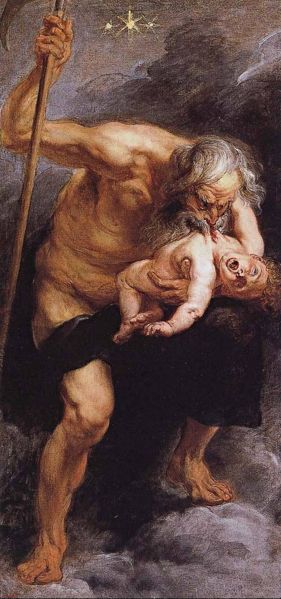
In preparing for my mythology class, I was reminded of Hesiod’s Theogany and the story of Cronus eating his children. This episode, dating from the eighth century B.C.E., has a jealous Cronos trying to prevent a takeover on the part of his kids by the extreme parenting measure of swallowing them. Not to worry, however! Zeus manages to be born on Crete and is able to free his siblings from the gut of his dysfunctional father. Cronus’ intention was to stop the gods by eating them while today theophagy is an attempt to absorb the deity. Ancient religions give us insights into modern religions, but only with a generous dose of evolution. It all depends on what you’re trying to accomplish by interacting with the gods.

Cronus has a little snack


A Sigh for Cybele

As we fall out of the holiday season into that distinctly chilly and sometimes cheerless February, Cybele comes to mind. Over the past several weeks I have added posts focused on the holidays associated with December and January. In the course of my research for a children’s book on American holidays (not published), I was astonished at how frequently Cybele appeared among the origins of current holiday practices. Having researched ancient Near Eastern mythology long enough to complete a doctorate in the field, and to write a book on an ancient goddess (Asherah), the lack of reference to Cybele in my sources was unexpected. I pushed this question mark to the back of my mind, but as I was reading H. P. Lovecraft’s story “The Rats in the Walls,” I found Cybele once again.

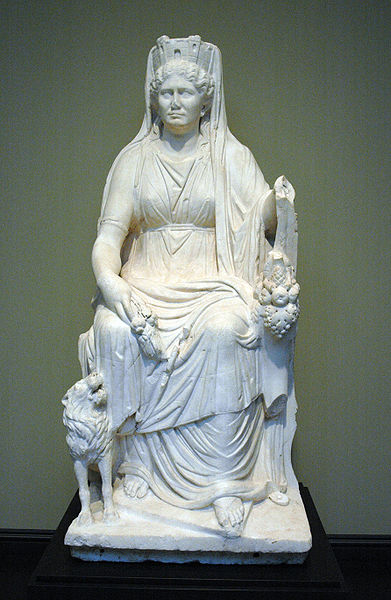
Cybele eventually became a major Roman goddess, although she was never among the Greek Olympians. Her importance shows in her connections with several Roman festivals and practices of antiquity, some of which have survived even to the present. Greco-Roman adherents to Cybele worship considered her to have been of Phrygian origin. Many scholars, however, see in her name and character echoes of a Semitic goddess named after Gebal, or the native name for Byblos in Phoenicia. If so, she is one further piece of the puzzle connecting the classical world with that of the fertile crescent.

Wikipedia Commons Cybele

A standard title for Cybele was Magna Mater, or “great mother.” As such, she was frequently associated with the earth itself, widely considered to have been a primordial female deity in the ancient Near East. In many respects she resembles Asherah, although the two are never explicitly identified. In myths where she is associated with Atys (later Attis), she becomes the spouse of a “dying and rising god.” She is prominent in festivals around mid-March, at the time of the renewal of fertility in the Mediterranean basin. Matronly, stolid, and powerful, Cybele lurks in the background of religious sensibilities. Her association with spring offers something to look forward to as the overly long, yet short, month of February starts to become visible.


Our Mother Who Aren’t in Heaven

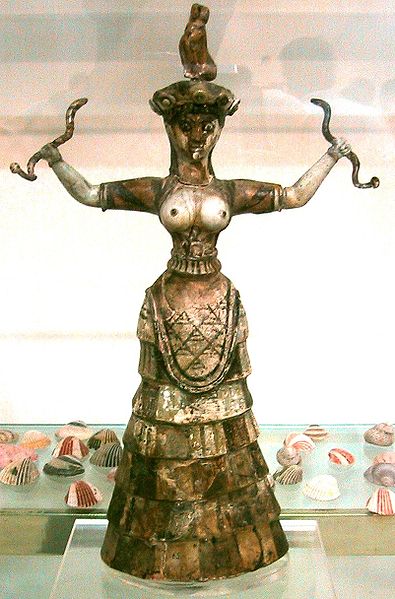
In the course of preparing to teach a course on Classical Mythology, I have been reading up on the Minoan culture of ancient Crete. This fascinating civilization is obviously related to many others in the Ancient Near East, but it has such a distinctive ethos that it always gives me pause. The Minoans had a religion that was apparently dominated by a great mother-goddess. Decades ago astute archaeologists and historians demonstrated that the amorphous “mother goddess” of antiquity was a modern construct rather than an ancient reality, but the evidence still stands that at least the Minoans revered the sacred feminine.

The work of Marija Gimbutas had overstated the case for a matriarchal society in antiquity, but she had touched on a truth sometimes obscured by the patriarchal world of yesteryear — some cultures did venerate the divine mother. Among the cruel ironies of history the name of this goddess has been lost, but images of a secure island with its chthonian female divinities remain. Among the artifacts discovered among the various Philistine sites in the Levant was an inscription, apparently dedicated to Asherah. Asherah is a thoroughly Semitic deity, first appearing in Mesopotamian contexts further to the east. The Philistines, however, likely settled their region after migrating from Crete a few centuries after the collapse of the Minoan culture. Could they have brought with them a remembrance of the divine mother?

I am not convinced by arguments that suggest a polymorphous “mother goddess” reigned in antiquity, as much as I might wish it had been so. What a different world might have emerged if monotheism had been based on a divine mother! Minoan culture appears to have been strong but relatively peaceful. In one of the androcentric twists of history “Cretan” and “Philistine” have come into modern usage as derogatory slurs against good taste and refinement. History demonstrates, however, that apart from foreign biases those hailing from ancient Crete may have developed the superior civilization of antiquity.


The Blessing/Curse of Janus

Janus wonders about January

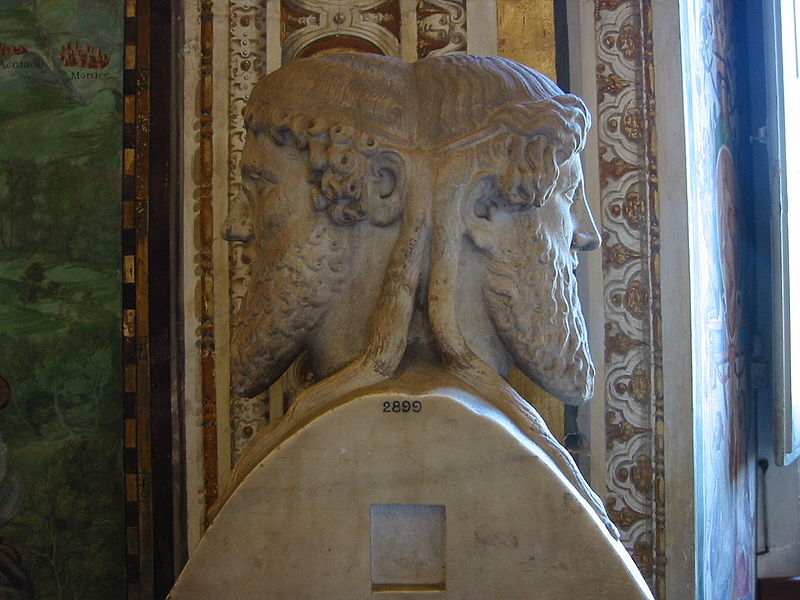
As the world stumbles into another new year, my thoughts turn to Janus. The namesake deity of January (since the Romans gave us a winter New Year’s day), Janus is a poorly understood ancient deity. Since he is overseer of beginnings and endings of all sorts, he is often portrayed with two faces or heads — one facing forward and the other facing back. There are no attendant mythological stories to this god, although he appears to have been very important in early Roman religion. He comes to mind as I prepare to teach a course on mythology that I haven’t prepped for since Oshkosh; my brief holiday break has been spent reading classical mythology.

Not only to we face a new year, but the beginning (or ending, it matters not which to Janus) of a new decade. Looking back over the muck-up made of the first decade of the twenty-first century, often because of religious extremists, I wonder what Janus sees down the road. There are many who feel optimistic about our firm bridle on technology and its ability to make our lives easier. Some of us believe that society has lost its appreciation for the classical study of the humanities and that we have lost our way because simplistic religion has seized the reigns from sensible mythology. In an age of information clutter, there is no one able to synthesize reason out of any of it. Perhaps it is the human condition.

Janus likely originated in the Ancient Near East. Once he reached Rome he continued to evolve into a major deity until eclipsed by the Olympians (many of whom first appear in the Ancient Near East as well). Not ironically, religious tolerance and religious intolerance both seem to have derived from the Near East also: Cyrus the Great’s declaration of religious freedom emerged in the midst of theocidal demands on the part of jealous gods. Now as we stand on the brink of a new decade, Janus only knows which way the unfeeling pendulum will swing.


Compassion Divine

A very generous relative graced this holiday season with the gift of the first season of Star Trek, the original television series. I am not now, nor have I ever been, a “trekkie.” I did, however, enjoy the show as a child and have come to appreciate it even more as an adult. I can’t cite episode and scene like a trekkie can, and a surprise FBI raid would not turn up any pointy Spock ears or a model phaser (although my wife’s cell-phone looks like a sophisticated communicator). As a child the show appealed to my love of science fiction, and as an adult the morality play aspect of the original series fascinates me. Yesterday we watched an early episode where a crew member has his mind boosted by a trip beyond the edge of the galaxy (a la Forbidden Planet). As this character becomes more and more omniscient and powerful, he refers to himself as a god. Captain Kirk, in his attempt to stop his old friend calls out that gods are marked by compassion rather than strength.

I have been rereading Homer’s Iliad in preparation for a course on mythology. Quite apart from the fact that Star Trek borrowed heavily from classical mythological themes, one of the features I have especially picked up on in this reading has been the appeals to the compassion of the gods. As Diomedes, Odysseus, and Ajax (and finally Achilles) battle Hector and Paris both sides call out for the kindness of Zeus, appealing to his compassion (as well as to his baser instincts). Reflecting the ancient perception of the world, Zeus’ responses are fickle.

Biologists have been probing the origins of human sympathies ever since Darwin. Creationists used to argue that compassion, altogether lacking in the animal world, could not have evolved naturally. Many recent studies, however, have demonstrated a naturalistic base for our altruism and compassion. These traits are certainly displayed in a number of animal species, particularly mammals. The ancient Egyptians believed animals to be superior to humans in many respects, lacking our weaknesses and being more adept at survival. It seems that they were right and some of the nobler human traits evolved from our animal milieu. If so, what is divinity beyond the gospel according to Star Trek — compassion to those in need by those who find themselves in positions of power?


Hadad in Copenhagen

Let us talk plainly about the weather. Global warming is a reality, and yet the issue is clouded by religious conservatism. To be precise, it is difficult to determine whether it is really greed or the religious right that stands so firmly behind free-market capitalism that is driving this chariot of the sun. The strange and unholy alliance between religious and political conservatism, however, has become a force daily striving against reality and its proponents want to be on the top of the pile when the whole thing collapses.

I can not speak to the political end of this continuum; I am not a political scientist or economist. As a “religionist,” however, I recognize a deeply disturbing trend that I have followed since my youth. Fundamentalists have consistently taught their young that the “Second Coming” is only minutes, possibly seconds, away. Undaunted by the two-millennium delay in wish-fulfillment, they suppose the words supposedly uttered by Jesus indicate a kind of divine “I’ll be right back” just before pushing off from the Mount of Olives. The signs of the times given in the Bible describe the then current condition, yet modern-day Fundamentalists wish to force the almighty hand, call the bluff of the Texas Hold-‘em expert above. If the general in the sky said wars would come, well, we’ll make wars. If the only way to get his attention is by destroying the planet around us, so be it. Deny global warming for the sake of the religious right, since their world is about to end.

Baal in Copenhagen?

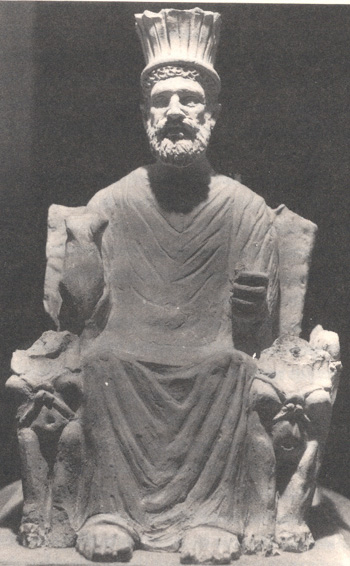
The rest of us might want to stick around for a while. Ancient meteorologists believed that particular gods controlled the weather. At Ugarit Baal, or Hadad, took responsibility for drought and plenty. If there was a problem, they knew just to whom to offer a sacrifice. In our monotheistic western world, we’ve pared the gods down to a single man. Not everyone agrees on his mood or character, but some are convinced that he has his bead trained right on this planet and they want to help from here below. Others believe — o the heresy! — that natural processes control the weather and that we can do something to make our situation better. We might be in a better place if those who believe the gods control the weather were relegated to theology classes rather than political offices.


The Call of Balu

After writing a post on Natib Qadish, a modern revival of Canaanite religion in the United States, I received some comments from Lilinah of Qadash Kinahnu, another modern Canaanite religion revival. These movements are a fascinating development in an overly technological era — both movements have online resources that include serious scholarly treatment of ancient religions of the Levant. Both appear to be sincere attempts to get in touch with what modern religions seem to have lost. Both have heard the call of Balu.

In a society where universities seldom offer programs to study the Ancient Near East, people are starved to know about it. I realize that the field of study will never bring in the money that the sciences or finance do, but obviously there is something deeply satisfying about it. And students are hungry for it. Not only appreciated by those who start revivals of ancient religions, many of those who read more recent popular treatments are intrigued. Neil Gaiman’s American Gods was a New York Times bestseller. Although much belatedly, H. P. Lovecraft’s Cthulhu Mythos has become a paradigm for many undergraduates I’ve met. I was reminded of this as I watched Stuart Gordon’s 2001 movie entitled Dagon. A relentlessly tense and macabre film, the Lovecraftian base assures a constant draw for those who hear the call of the ancient deities.

We love technology. I’m posting this entry on an internet where ideas are simply electrons forced into recognizable patterns. We can’t imagine what life was like before being able to communicate with people just about anywhere in the world instantaneously, and where we can live our entire lives without ever actually touching physical money. Over all the noise of technological progress, however, can be heard the distinct call of Balu — a call to a simpler era, pre-Christian, pre-Judaism, pre-Iron Age. It was an era when human destiny fell into the hands of ancient gods.


Demoted Angels

One of the questions frequently surrounding monotheism is that of angels. Surveys indicate that even non-religious North Americans, by far, believe in angels. So, where do they come from? In a monotheistic context where God is considered omnipotent what role could angels possibly fill?

Angels appear in ancient religions in medias res. Going back to the earliest attested religion, that of the Sumerians, we find winged divine assistants called apkallu. In a polytheistic world, gods could always use a little help. These divine beings, portrayed with wings, are sometimes called “angels” by modern commentators, and they do serve some of the basic functions of an angel, such as doing errands.

Other ancient polytheistic religions knew of differing classes of deities; not all gods were created equal! There were primordial deities, often old and retiring, and there were active ruling deities who received their authority from the primordials but who in fact ruled by might. Below the ruling gods were skilled-labor gods and messengers. It is from this class of messenger gods that angels eventually evolved. We don’t know that messenger deities were portrayed with wings, but in ancient times wings indicated speed — uninterrupted movement — so you could do worse than have wings if you were a messenger. The English word “angel” derives from the Greek term indicating a messenger. Indeed, by the time we reach the Hebrew Bible angels are often indistinguishable from humans.

The problem is that when monotheism developed during the Exilic Period, the Israelites had already become quite accustomed to having angels around. Before prophets showed up angels were often the means of learning the divine will. If there is only one god, what do you do with this tier of messenger deities? Demote them to angels! They are still supernatural, but not as powerful as God.

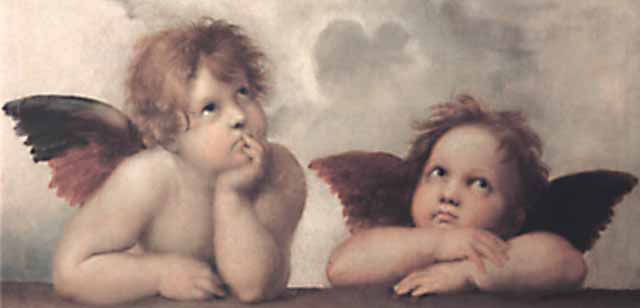
Probably under the influence of Greek Hermes, angels regained their wings to become the winged humans we know so well today. It is a mistake, however, to call all winged humans from the ancient world “angels.” Angels are the result of the religious evolution from polytheism to monotheism, and their ancient predecessors were truly gods.

Remember when we used to be gods?


Sky God Redux

This week’s Time magazine includes the periodic feature of the 50 best inventions of the year. Flipping through the pages looking at techno-gadgets that leave me vacantly spinning in my office chair, I was surprised to see that invention number 49 is the work of our hypothetical sky gods. The undulates asperatus cloud has been receiving high profile attention of late, and now it is seeded on Time’s greatest inventions list! When I last posted on undulates asperatus, it had been written up in Wired. Prior to that I had seen a feature on the cloud in the New Jersey Star-Ledger some months back. Having written a(n unpublished) book on weather terminology in the Bible, I have had my head in the clouds for several years now. To find the humble collections of condensed humidity making the news is a strange but welcome validation of my work.

Undulatus_asperatus

Undulatus asperatus from Wikipedia, by Agathaman

Time resists bringing the divine into the description of the cloud, preferring the more neutral term “ominous” to describe undulates asperatus. After having spent several days under the blanket of a nor’easter here in New Jersey with its impenetrable gray clouds, I can appreciate how ominous thick clouds can be. The more I study ancient religions the more I am convinced that major gods primarily reflect the content of the sky. After all, gods were seldom seen in the fields and cities of antiquity, but the sky holds endless possibilities.

Perhaps some editor somewhere will stumble across my conviction that weather matters in the biblical world and will want to take a look at my book. If not, no worries. I’ll just be looking at the sky.


Yarihk Finally Gets a Drink

594px-Full_Moon_Luc_Viatour

Gnu moon

Yarihk once again makes the news as NASA announced yesterday that they have discovered a substantial amount of water on the moon. I’m still reeling as if I’d joined Yarikh at the Marzeah. Although the local paper only deemed it page 2-worthy, this is a paradigm-shifting discovery! The arid, airless, lifeless, dead rock daily racing around our world has suddenly blossomed with new potential. Water on the moon? It seems as unlikely as satisfactory jobs for all graduate students.

Students are generally surprised to learn that in the Ancient Near East the moon was often considered superior to the sun. Given our knowledge of astronomy and physics it is difficult to look behind the curtain to see that it is not self-evident that the moon reflects sunshine without the subsequent development of a scientific outlook. For ancients the moon provided the gentler light that illuminated night — when you really need some light anyway — and was responsible for generating dew, a necessary source of water in regions where summer rains are unheard of. The benevolent moon waxes and wanes, forming a perfect circle and, by degrees, the crescent shape of the horns of divinity, and finally disappearing completely to start the cycle all over.

At Ugarit Yarikh is a thirsty character in text 114. He marries a foxy Hurrian goddess in the myth of Nikkal, a princess much above his station, then he easily fades into the background from the dearth of textual sources. Some have suggested a lunar connection for El as well, the very head of the gods. If El was lunar, perhaps Yahweh also drove the moon. Whoever is in charge, however, thought to pack water for the journey and as we further explore our nearest astronomical companion we will discover that Yarikh is just as interesting as the denizens of Ugarit had suggested.


Death of the Gods

Americangods

Ancient gods surround me these days. Surely part of it is due to having recently finished Neil Gaiman’s American Gods (I know I’m a few years late on this, but novel-reading time is at a premium even when teaching only part-time). Gaiman’s not the first to have taken on the theme of “what if ancient deities still survived?”. As a child I read Lester del Rey’s Day of the Giants with its science-fictionalized version of Ragnarok, and even earlier H. P. Lovecraft had resurrected Dagon and Cthulhu. Gaiman’s treatment, however, is contemporary and is a barometer of how the old gods are faring these days.

Dark and witty, Gaiman’s treatment is a fun-house ride through the fanciful concept that old-time gods and folk-heroes emigrated to American with their believers. The resulting adventure brings a multi-cultural mix of supernatural powers that end up mostly focusing on the Norse mythological cast. Same was true of del Rey — the Norse mythology reflects a stark world of raw power, betrayal, death and resurrection, that resonates with northern European experience. Anansi and Chernobog also take starring roles in American Gods, although the only ancient Near Eastern deities with any prominence in the story are the Egyptian Thoth and Anubis in supporting roles.

Casting an eye over the American landscape, this assessment is perhaps true to life. Ancient Near Eastern deities seem so distant and unfamiliar. Gods long dead. Despite recent movements to revive the worship of Mesopotamian or Canaanite deities, their powers seem to have dissipated at the middle of the first millennium B.C.E. as Yahweh gained a prominence he has never relinquished, and the Greeks and Romans paved over the graves of Ninhursag and Yarikh with European versions of the more prominent West Asian gods. Universities reflect this lack of knowledge with slowly dying departments of Ancient Near Eastern studies. Like Gaiman suggests, America seems to have gone after the more modern gods suited to our present-day lifestyle.


Care of the Dead

Stretching back before the advent of writing, back before civilization itself began, people have shown reverence for their dead. Paleolithic era grave goods attest to care of the dead residing among the earliest strata of human behavior, and it is a behavior that continues to evolve to reflect the belief structures of the Zeitgeist. The idea of constructing cemeteries in a garden where family and friends might visit their departed is a relatively recent innovation. Increased population and concerns about epidemics led to the landscaped, garden-variety cemetery outside of populated areas in the 18th century. Before that graveyards could be located within the city itself, often near a church or sacred location.

While visiting Swan Point Cemetery in Providence, my niece asked me why people left pennies on gravestones (H. P. Lovecraft’s tombstone had one on it, and others around it). My thoughts went to Wulfila’s recent blog post on the Black Angel tomb in Iowa City and the pennies scattered there. I also recalled La Belle Cemetery in Oconomowoc, Wisconsin where a “haunted statue” was always richly endowed with pennies in her cupped hands. LaBelleThe specific form of penny offerings seems to go back to Benjamin Franklin’s burial, at least in America. A few years back while in Philadelphia, I saw for myself that people still leave pennies on Franklin’s grave in Christ Church Cemetery.

Franklin

Franklin pennies (and a few nickles)

There is no universally accepted reason explaining why Benjamin Franklin should have been the first to have received such treatment — in fact, I would argue that it is much older than Dr. Ben.

Money to accompany the dead has a long history. Pennies on the eyes or under the tongue of the deceased originated in the need to placate the ferryman across the river of — what’s it called? — Oh, yes, the river of forgetfulness. The classical Greek form of this mythic character is Charon, the boatman who punted the dead across Styx. He required payment, and since coinage had been invented, it was a convenient way to pay. (Today the truly devoted might leave a credit card in the casket.) The ferryman must have his pay, as the movie Ghostship warns, but the idea is much older still. The earliest references to being poled across the river go back to ancient Sumer, the earliest known civilization. As soon as people became civilized they began to pay homage to the gloomy captain of souls.

While in Prague just after it opened to western visitors, my wife and I stopped by the famous Jewish cemetery where the tombstones are so tightly packed in that they are barely legible. My wife asked why so many of the tombstones had smaller stones on top, placed there as dedications.JPrague I recalled having seen stones on tombs outside Jerusalem some years back, and I even had a student bring me a stone from Israel to keep as long as I promised to put it on her grave after she died. This practice in its recent form is associated with Judaism, but again, it has ancient roots. The building of cairns, or piles of stones, is often associated with the Celts or the pre-Celtic inhabitants of the British Isles. On our many wandering through the highlands and islands we saw several Neolithic examples in Scotland, particularly in the Orkney Islands. The practice of putting stones atop the dead also goes back to ancient times. One plausible suggestion is that it was intended to keep the dead in their graves. A more prosaic conclusion is that digging deep holes takes more work than hauling over a pile of rocks.

No matter what the origin of the practice may be, one of the surest signs of civilization is care for the welfare of the dead. Today a penny is easily left, costs the bearer little, and creates a memorable image for all who follow.