The Return of the Goddess

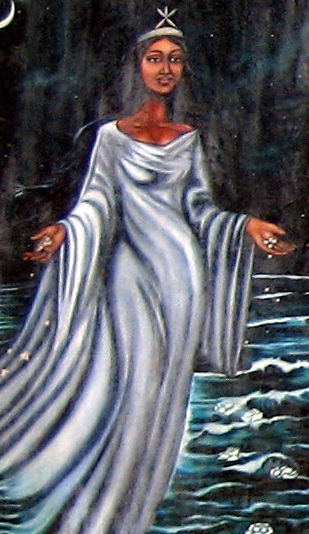
When the coalescence of events points in a single direction, it is worth paying attention. Goddesses, it seems, are once again on the move. Not Asherah this time, although she seldom sits still, but the creator goddesses. The notion that creation is a female prerogative seems only natural, and the concept is in the ascendant. In a local setting, the Alvin Ailey American Dance Theater troop is performing “Dancing Spirit,” a piece by Ronald K. Brown. The dance features a move that Brown attributes to Yemaya, the Yoruba goddess of creation.

WikiCommons' Yemaya

Now I have to confess to knowing little of Yemaya and Yoruba – African mythology beyond ancient Egypt has fallen outside my limited scope – but from the little I know I can see that she represents a fascination with feminine power. A dance to celebrate the power of the creatrix feels appropriate. Worlds created by masculine deities always go awry. Perhaps the power struggles built into images of strength and domination will always lead to conflict and suffering. The mother is here to protect.

Despite its flaws, Avatar also shares in this image of the protecting mother. Eywa may be a fictional deity devised to give the Na’vi a central focus, but her mythological profile is sound. It is the mother who gives life and protects that life. The father disciplines and starts wars. These are not universal archetypes, but rather coalescences. Religions involve worship and worship may derive from fear or from love. I suspect that the goddesses engender the latter. I suggest that we could learn much from the creator goddesses.


Friday’s Wednesday

The ultimate stag party?

Mythology never ends. Many people live by it today under its name “religion,” and many in the ancient world endlessly recycled their gods until they ended up looking rather unrecognizable from their earlier forms. I was, therefore, intrigued when a friend asked me about Herne the Hunter. Herne is a mythological character about whom I had not heard. The earliest reference to the stag-antlered deity comes from William Shakespeare, and he has been co-opted by the Wiccan community, nicely tying together many of this week’s posts. So, whence Herne?

Shakespeare seldom invented ex nihilo, but rather adapted. Herne, already an established character, was a wrongly accused poacher who was hanged from a great oak in King Richard II’s England. He had been magically revived after a near-death experience earlier in life and had been crowned with fantastic antlers at that time. The horned head has reminded some Celtic mythologists of Cernunnos, a horned chthonian god attested in mainland Europe but not found in the British Isles. Yet others, by virtue of his being hanged on a tree and the similarity of his name to the epithet Einherjar, suggest Herne may have evolved from Wotan, or Odin himself. Woden was involved in the “Wild Hunt” episode of northern and central European mythology, and since Herne is a hunter, well, isn’t the connection obvious?

Such tales as this are instructive of the way that religions evolve. We know very little of the true origins of the story, but later versions become canonical. The present-day version is perceived to be “historical” and all others are merely coincidence or happenstance. Today Herne is a typical ghost story of Windsor Forest, and those who report seeing him say he still wears his supernatural horns. Those who want to discover his origins are left with a handful of books by publishers of the occult and hundreds of unanswered questions.


Zoroastrian Odyssey

Clinton's Red Mill

Clinton’s Red Mill is a popular New Jersey attraction, but numerous reports of paranormal activity have thrown an additional lifeline to the museum in the form of much-needed revenue in the form of seasonal ghost tours. Last year about this time my family and I participated in one. Touring the old grounds at night can certainly lead to spooky experiences, even for those of us who sit on the fence about ghosts. We discovered that The Atlantic Paranormal Society, the “TAPS” of Ghost Hunters fame, had investigated the Mill the previous year. We watched several episodes of the popular show, and for a lark, my wife bought me a subscription to TAPS Paramagazine for my birthday. All in good fun. I always thumb through when it arrives, but it is hard to take much of it seriously.

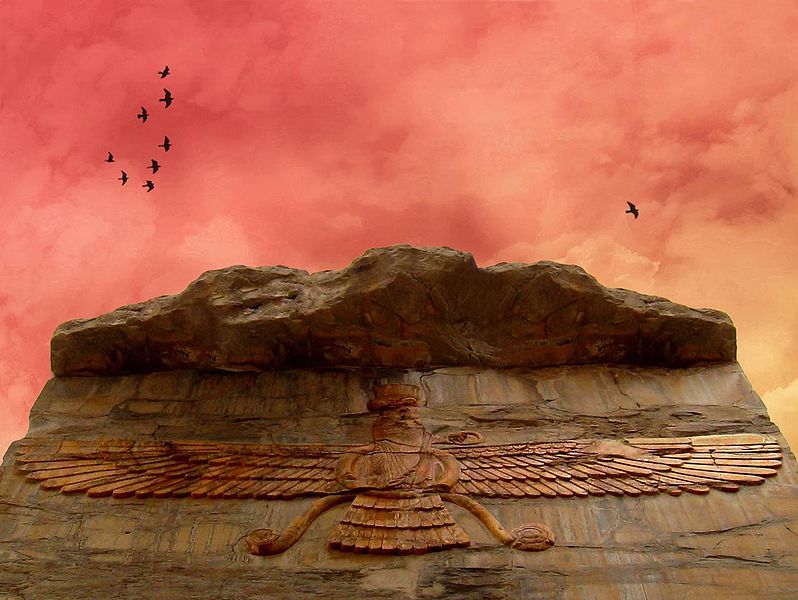
The last issue (volume vi, issue 2), however, contained an article about Demonology. Now, I thought I had graduated from The Exorcist and the Exorcism of Emily Rose to a healthy skepticism, but I could not resist reading this article. The first statement declares, “A demon is a fallen Angel that rebelled against God along with Satan, refusing to be humble before, and serve, God” (Adam Blai). While I never make light of things I don’t understand, I did consider the fact that the concept of demons, which derives from a Judeo-Christian mythology, presupposes a mythic war between the powers of good and evil. At the same time, I have been reading up on the Zoroastrians, one of the oldest continuously practiced religions in the world. There can be no serious doubt that the Judeo-Christian tradition borrowed the concept of the demonic from their Iranian neighbors of the ancient Persian Empire.

A Zoroastrian fravashi

The implications of the Zoroastrian connection are profound. If the ancient sage and Afghani priest Zarathustra was correct about the dualistic conflict of good and evil, was he not also right about Mithra and the Amesha Spentas as well? Zoroastrianism gave the Judeo-Christian tradition its base concept of Heaven and Hell, but the divinity of fire they did not accept. By picking and choosing what fit best into its experience, Judaism developed into a religion that allowed for Christian demons and angels and all the invisible hosts of the ethereal realms. Today many Christians accept demons as literal beings (less so jinns, although Clash of the Titans (2010) allowed for them). What does this say about the remainder of Zoroastrianism? Perhaps Ghost Hunters should begin with the Gathas and move on to the Avesta? As for me, I’ll be over here, sitting on the fence.


Co-opting Hecate

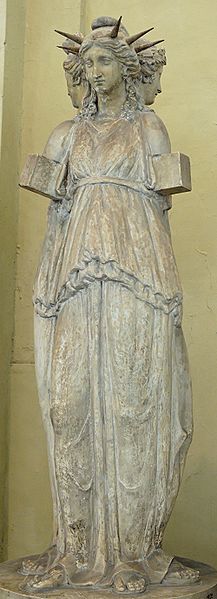
Students in my mythology class had to research and write about a deity from the ancient world. I was pleased that one of them chose Hecate, a misunderstood goddess of obscure origins. Hecate overlaps with other deities in her spheres of influence and her many roles, a sign that she was an early goddess adopted into the Greek pantheon at a stage before Artemis, Selene, and Persephone took over her connections with the moon and underworld. She was a guardian of crossroads, a task later attributed to Hermes – a god who also became a psychopomp. Hecate was left to languish in Hades where she became associated with gloom and magic and baleful spells.

What the Hecate?

It is likely the latter developments that have brought Hecate into the status of patron goddess of many Wiccans. She is chthonian – a right jolly old Goth – and she takes on a bad-girl image that would not have been recognized by the ancient Greeks. Even Shakespeare contributed to her witchy-woman image when he associated her with the weird sisters in Macbeth. Revitalized as a symbol of feminine power, Hecate enjoys such popularity today that it is difficult to find reliable information on the goddess.

I find it instructive that ancient goddesses are so embellished to make them tasteful to modern explorers. Perhaps because of the persistent patriarchality of ancient society, we have been deprived of deep knowledge of the goddesses. For those who originally worshiped them, however, the goddesses needed no blandishments. They were the personification of divine power manifested through the feminine. Ancients believed that all people were touched by supernatural forces, no matter what their gender. In a brash demonization of the powerful feminine, Hecate has become the goddess of witches and seekers after a female image that simply never existed. Why not accept goddesses for who they were – constant reminders that life is not possible without the divine feminine?


Mother’s Day and Earthquakes

It is Earth Day, a holiday that all the world should join hands to celebrate since it is secular and concerns all people. Except the religious. Theologies are inured to common celebration; any admission that others might be right is a chink in the implacable armor of conviction. So it was not such a great surprise when an Iranian cleric this week blamed Iran’s earthquakes on women. Fuming like Eyjafjallajokull, the imam cited immodesty on the part of women as leading men to temptation and the very earth whose day we celebrate shakes in rage. Why it is that the burden to prevent sexual temptation should fall on women alone is unfathomable. If men have such trouble controlling their urges perhaps they ought to explore real estate on Mars, although it is doubtful they would be happy there.

The earth, our common home, was conceived to be female by many ancient societies. The Greeks of the Classical era called her Gaia and gave her the honor of being the earliest deity to emerge from Chaos. In the Bible, desexed and depersonalized, the earth was constructed on the first three days before any living inhabitants cluttered its pristine surface. With the drive of Christian conviction that this unruly mother should be subdued under human dominion the industrial revolution began a process of disrobing and dismembering Gaia, an impersonal “it” to be exploited. The Bible could be cited as demanding such action; we were commanded to take control. And our religions provided the ethics to underscore our mandate.

If not for the second great awakening in the 1960s, Earth Day would never have found its fundamental expression. We would continue subduing and dominating, as per Genesis 1, until the great white man above would be forced to send his son on a great white horse to end it all. But the earth is our mother. The missing woman from the all-too masculine Trinity. Instead of blaming her daughters for the unstoppable lusts of her sons, and instead of repeatedly defiling her to keep up with the Republicans, we should take a moment today to honor her. She is the only such mother we have.

Son, behold thy mother.


Clash of the Titans

Over the weekend I joined the thousands flocking to theaters to see Clash of the Titans. I first met Perseus in fifth grade and have been intrigued by classical mythology ever since. I tried not to believe that it was nearly three decades ago that I sat in the single screen theater back in Oil City, Pennsylvania watching a film with the same title and Ray Harryhausen’s famous stop-motion animated creatures. I was anticipating great things. While the new Clash is visually stunning at several points, the post-modern story line primarily demanded my attention. While there are gods galore in the film, the message is maybe not atheistic, but, to coin a word, anolatric – denying worship to the gods. Time and again Perseus refuses the help of the gods and when he finally meets Zeus, his absentee father, he shows him anything but respect.

Who let the trogs out?

The Greeks, like all ancient peoples, primarily feared the gods. Not offending deities was a societal expectation since an infraction on the part of any citizen might lead to divine repercussions. Dictys, Perseus’ adopted father, rails against the gods for allowing the degeneration of society, a trait that Perseus takes to extremes in the movie. In battling the monsters, Perseus is storming Olympus itself. In a nod to the Easter weekend crowds, Perseus defeats death himself by banishing Hades to an incongruously fiery underworld. I left the theater slightly stunned; here had been a hero standing before the very gods but refusing to worship. Clash of the Titans indeed.

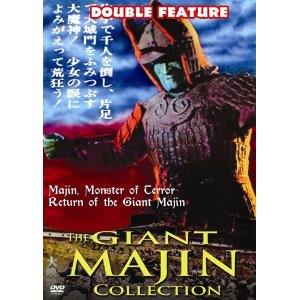
While my family was off winning the Connecticut Regional First Robotics competition in Hartford (go Team 102!), I had consoled myself the night before seeing Clash by watching the cheesy 1968 Japanese giant monster classic, Wrath of Daimajin (also known as Return of the Giant Majin). I had seen the original Giant Majin some time ago, but here was a “monster” movie where the destructive colossus was himself a god. The Giant Majin is a protective mountain deity who, when injustice grows unchecked, breaks free of his rocky home and destroys the wicked. The Wrath of Daimajin included startling biblical imagery: as the Majin stomps through the sea the waters part as if Moses were on the god’s shoulder. The faithful female protagonist is being executed on a cross (burned at the stake, but tied to a cross), and the Majin breaks the gibbet and holds her aloft, the very tableau of the evil-banishing crucifix. As always, the Giant Majin vanishes at the end, leaving the oppressed to build their own, better future.

I dream of Majin with a dark green face

Such movies are benchmarks of public theology. Made by laypersons trying to express their ideas about the divine world, I find them a crucial measure for any teacher of religion to watch, mark and inwardly digest. In just 24 hours I saw a Shinto god go Christian and a Greek polytheist lose his faith. The world just can’t figure out if the gods are for us or against us.


The Passover-Easter Complex

Some years back I completed an unpublished book for young readers on the holidays. This project was undertaken because most holidays have a religious origin and because I could find no comparable source for kids to learn this information from a reliable source. Unfortunately publishers have showed little interest. Rather than waste the effort it took to write the book, I have been installing segments here, on the Full Essays page of my blog. Since it is Easter for many Christians today, I have added the next installment: the Passover-Easter Complex. It begins like this:

No doubt the most complicated set of holidays are those that surround the changing of the seasons – the solstices and equinoxes. Among even those holidays, the Passover (Jewish) and Easter (Christian) complexes are especially complex. Like most major holidays these celebrations have very interesting roots. Problem is, it is hard to know where to begin! We’ve already started with Mardi Gras, but that is kind of a festival on its own. To really get started, we have to turn back to the calendar (again?).

Easter, like Passover, is a “moveable feast.” That doesn’t mean playing musical chairs while you eat! It means that the dates change depending on the moon, so to figure out the date you have to (you guessed it) look at the sky. (Actually, these days you can look on the web or in many books used by churches to figure it out. But work with me here, let’s pretend it is, gasp, before these things were invented!) Two days of the year have an equal amount of day and night all around the world, when the earth stands up straight on its axis. Marking the beginning of spring and fall they are called the vernal and autumnal equinoxes. (“Equinox” means “equal-night,” “vernal” means “green” or spring, and “autumnal,” duh, “in autumn.”) Back when people had no TV, this was a big thing! Not only was it cool to have equal day and night, in the spring it meant days were finally getting longer and warmer. For ancient people it meant that light was winning the struggle with darkness.

Read more…


Smile, You’re Condemned

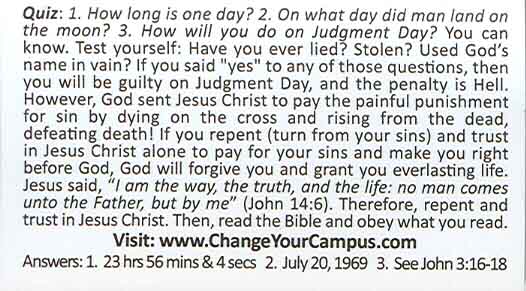
Yesterday at Montclair State University, I was sitting in the hallway (my office) prior to class. (Office hours are required, but space is limited for adjuncts such as myself.) While I was reading my book a student walked up and handed me a business card. “For you, sir,” she said politely. The card had a smiley face on it, and was designed to bring cheer.

Then I flipped the card over and found out I was going to Hell. A bit of a downer when you’re about to start class!

It isn’t the first time people have attempted to convert me without bothering to find out what I believe. It seems that if you already hold the zealot’s view you’ll appreciate the gesture of being condemned just to make sure your soul is saved. It is the thought that counts, after all.

The book I was reading was Joseph Campbell’s The Hero with a Thousand Faces – a book I’ve known since college but from which I have only taken a tipple until this year. Many scholars of mythology fault Campbell on being too much of a generalist and looking too much for connections where they are not obvious. His language can be florid and mystical, verging on “believer,” for those uncomfortable with any kind of faith. I find Campbell to be a welcome guide, although, as for any guide, I do not believe all he says! One nugget in particular stuck out at me: “Wherever the poetry of myth is interpreted as biography, history, or science, it is killed.” As we find ourselves on Good Friday, only those with eyes firmly shut will disregard Campbell’s wisdom.

I still remember my shock when I first learned that gods, centuries before Jesus, had been dying and rising. What had always been presented to me as a unique historical event actually had a long and venerable prehistory. It suddenly seemed as if the ministers I’d known hadn’t done their homework. Or perhaps they lacked the cognitive finesse to understand Orpheus, Adonis, Baal, Osiris, and even Ishtar, as types of either blatant or obscure resurrection. It is the Campbellian, or nearly universal hope: life prevails over death. As the young lady walked away, I sincerely wished her happiness in the quest she’s only beginning.


Asherah in Australia

It has been one of those weeks dominated by a lady from my past. Asherah. Just when I thought I could forget her and get on with my life, she has reappeared with a fury. The problem is, I haven’t kept up with where she’s gone over the past few years and we all know what kinds of problems society has out there. Turns out she’s in Australia. At least according to a comment left on one of my old posts about Asherah. The author of the comment provided a tip that led me to abovetopsecret.com, a conspiracy theory website. One of the threads is from Brian Leonard Golightly Marshall, a man who claims to be the messiah – apparently he’s returned with his spouse Asherah, in her form of Mary Magdalene. Also, he states, Prince Charles is the anti-christ.

The internet has provided a forum not only for the serious exchange of ideas that help shape the future, but also a soapbox more massive than any other. In general I don’t believe conspiracy theories – just this week my daughter came home from school with news about Disney’s alleged subliminal smut, leading me to recall the hysterical claims made about the New World Order. The more things change, the more predictable they become.

So, is Asherah down under, waiting for a new apotheosis, or has the collective imagination of the internet just taken over? I’m not the one to judge. Nevertheless, while doing a little web research on Asherah I discovered that Asherah greeting cards are now available. They’ll have to wait until I find a job, however. Maybe once that happens I’ll also be able to afford a trip to Australia to see the goddess I’ve researched for so many years.


We Still Need Asherah

A very prominent documentary-making company contacted me today. It is in the research stage of planning a documentary on Asherah. I am overwhelmed that I have been asked for advice and that the old girl has finally received some public interest. Scholars are generally accustomed to spinning in smaller and smaller circles of specialization that have little draw for the wider public. Having said that, Asherah is, my own interests aside, a most fascinating deity.

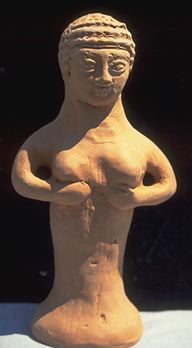
One of the greatest obstacles to modern readers on ancient religion is the fact that gods don’t neatly fit into predetermined categories. We like to think of deities as the “god/goddess of –” where the blank is filled by some natural phenomenon. This is a fallacy that I once whimsically coined the “divine genitival construct.” It is easy to think of Baal as the god of rain, but he is so much more than that! I tell my students that they must think of deities as “persons” first; they are fictional characters, and like good fictional characters they have many aspects to their personalities. They are complex, multilayered, and often conflicted. This is especially the case with Asherah. She is a goddess who represents the royal female. Kind of hard to picture. Not queenship, but the power behind the throne. She is more familiar in the form of Hera in Greek mythology – the primary spouse who tries to keep a philandering husband in line. She is, however, a powerful goddess. She is mother of the gods, the character without whom no other lesser deities would exist. By extension, she is the producer of the gods who make our world possible.

Publications continue to emerge claiming all manner of hypostases for Asherah, many of which are unfounded. I believe it is because we all need the sacred mother, the female authority figure. Our society, still hopelessly patriarchal, yearns for the goddess who understands. Unfortunately, that is not this historical Asherah, it is the Asherah of the modern imagination. If she helps to assuage some of life’s inequities, however, even a mythical Asherah may still serve a valuable function today.

Not Asherah, unless you need her to be


Virgin Goddesses and Human Fathers

Several years ago today I became a father. I try not to say much about my family online because I am old enough to be cautious about this brave, new, virtual world I post in just about every day; yet being a father is a life-changing experience like no other. The absentee father – something I personally experienced – sacrifices one of the most fulfilling aspects of life. Unless you’ve been there, you can’t understand it.

Today’s paper raises the question of whether celibacy is related to the continuing scandal of sexually transgressing priests that continue to come to light. Men who are not fathers but are called “Father.” Men, sworn by duty never to give in to human nature, appointed as spiritual guides to the masses who have succumbed to the dictates of biology and society. The church denies any connection. Could it do any differently? Two thousand years of frustrated men might storm heaven itself!

Among the most admired deities of the ancient Greeks were the virgin goddesses Hestia, Athena, and Artemis. Their divinity radiated through their self-sufficiency and self-determination; no god needed complete them. Goddesses had an integrity that few gods ever attained. We don’t read of virgin gods; Zeus was famous for his affairs, as were most masculine divinities. Many gods kidnapped or deceived women to slake their lust. Yet the virgin goddesses were formidable and truly worshipped. By restoring the virginity of Mary, the church constructed its own virgin goddess as a paragon for all to emulate. Priests were to be like the mythically chaste Joseph, longsuffering and self-abnegating. But they are mere mortals. Why not let religious leaders truly become fathers? It has forever changed my life for the better. Perhaps it would be healthier than chasing mythical virgin goddesses?

Athena, most chaste


Under G-d

In one of the great showcases of civil religion, the Pledge of Allegiance is again in the news for its brash statement, “under God.” Lawsuits have been introduced in California to try to label the statement as unconstitutional – state supported religion, a declaration that the United States is a theistic country. Even as a child, a religious child, no less, I was vaguely disturbed by the Pledge. I am a sentimentally patriotic American, and I begrudge no one that natural feeling of pride in their heritage. We all come from somewhere, and we like to think the best of ourselves, and therefore our forebears. I’ve tried to trace my ancestry and find that with a sole exception on a great, great-grandparent’s exodus from Germany that my roots are hopelessly lost in long generations of northern European expatriates that have been on these shores for well over a century and a half. Some even more. And yet, to pledge allegiance to a flag? As a student of religion, I understand the value of symbols, but I always felt that a hand over the heart while addressing a banner was a little like idolatry.

Well, I’ve grown up since then. I spent three years abroad, and returned with a renewed appreciation of how much this country has to offer. I’m still a little puzzled by the “under God” bit, however. Sure, America’s founders were generally deists (not Christian by any recognizable stretch of the definition), and since God is assumed, why not add him to the books? But God was only added to the pledge in 1954. In the heat of McCarthyism it seemed important to fly our “anti-communist,” theistic colors high for all to see. And yet, we never define who “God” is.

The God of the Bible has a name. Every semester I find students that have difficulty grasping the idea that “God” is not the name of a deity – it is only a generic title. It could be anybody divine. Shiva, Zeus, or even Baal. In the written work of many of my students from the Jewish tradition, the reverence accorded to the deity’s personal name has been transferred to this innocuous title. In essays and papers I frequently find reference to “G-d,” as if the Torah commands never to make reference to deity at all. So, out of reverence to the same divinity we have some citizens leaving out the lonely vowel of a one-syllable deity while others loudly proclaim that he (never “she”) must be kept in the little bit of civil religion we impress on our public school children. We don’t agree, as a nation, on who “God” is. Reading the rantings of the Religious Right with their tea parties and Conservapedias, I’m sure that this is not the G-d of the Bible. What does it mean to be a nation under a deity we don’t recognize?


Trojan Gods

Every great once in a while Hollywood produces a major motion picture that demands the attention of scholars. Well, at least those of us who like to stay current about the way our subject is being displayed to the wider public. When Troy was released in 2004, I was still firmly engaged in teaching biblical studies and the Trojan War, although located somewhere at the fringes of the Ancient Near East, was not a particular concern. Now that I’m also teaching a mythology course that covers the Iliad, I figured I’d better watch the movie. For research purposes only, of course. Although I hadn’t seen the film before, I knew of the critics’ complaints that the gods, conspicuous in Homer, had been left out. I was expecting to be disappointed, but I found the movie to be more intelligent and subtle than I supposed it might be. The absence of the gods, distressing as it may be to purists, gave the movie an angst that is generally reserved for more cerebral subjects.

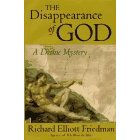
The question of where the gods might be in all the slaughter and destruction of war reminded me of a book that had profound influence on me several years ago. Richard Elliott Friedman’s The Disappearance of God: A Divine Mystery (Little, Brown, 1995) traces the gradual withdrawal of God from the scene in the course of the writing of the Hebrew Bible. The god who appears so active in the early chapters of Genesis distances himself further and further until the latest writings, according to Friedman’s dating, show few traces of the divine at all. God subtly, quietly, goes away.

Portrayed as defying the power of the gods in the film, Achilles desecrates the temple of Apollo and seals his fate. Nevertheless, although he is shot by an archer, the death of the hero seems more like an arbitrary act than the design of divine majesty. The Greeks, after all, did win the war. Atheism, however, did not exist in any real terms in the twelfth century before the Common Era. Then again, Achilles probably did not exist in any real terms either. Although Troy will never be among my list of most profound films, its commentary on the quiet skies of ancient Ilium serves as a useful metaphor, even for today.


Patriarchal Goddesses

My fascination with goddesses began when I decided to research Asherah. Having grown up in a monotheistic milieu, goddesses were strangely, but not surprisingly, irrelevant. I had, of course, read about them in mythology classes, but they seemed less defined than the gods who had strong, striking characteristics. Now that I’m revisiting many classical goddesses in the course of preparing my class on Mythology, I’m discovering a renewed appreciation for the feminine divine and its contribution to the ancient world.

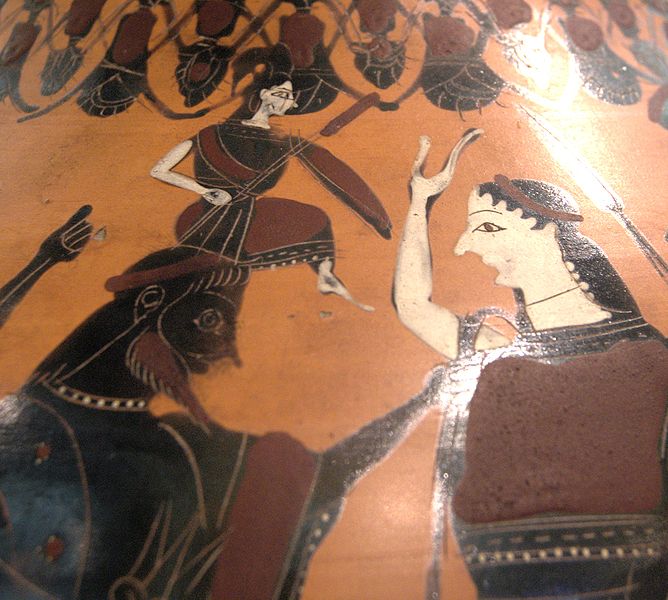
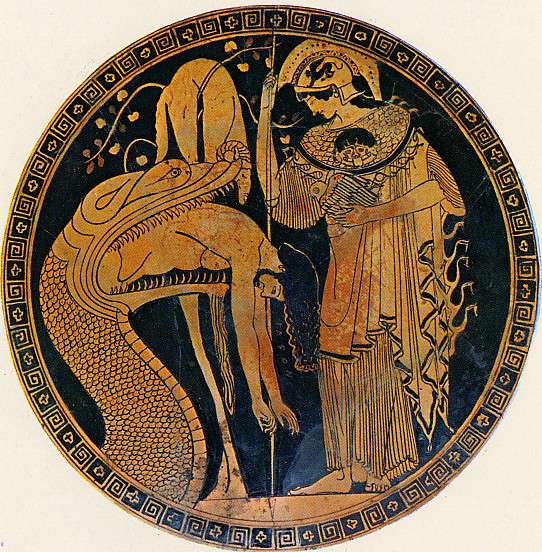
Athena saves a hero

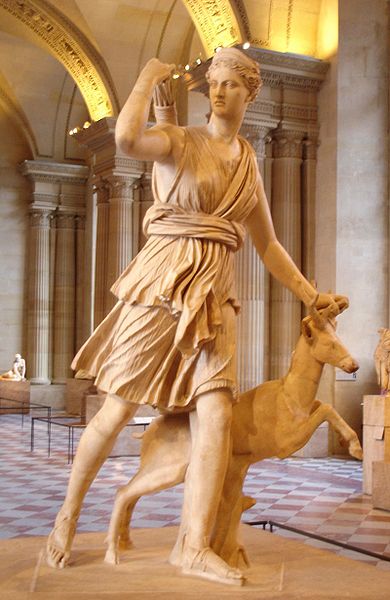
Athena and Artemis have been on my mind for the past several weeks. Among the Olympian deities they are among the strongest female figures (Aphrodite, of course, provides her own feminine form of power, and Hera, although mighty, remains largely in the background). Perhaps what creates such a striking form for Athena and Artemis is that they blend the traditional masculine and feminine roles in a way that the ancient Greeks were prescient to devise – they both possess weaponry and strength that frequently brings mortal men to their demise. They don’t wile with “feminine charms” like Aphrodite; instead they meet men on their own tuft – hunting and warfare, bravery and muscle. They are virgins, not needing male approval. Together they form the basis of many ancient aspects of divine nobility.

Artemis and her man-dog

Today, however, when we think of Olympians Zeus and Poseidon come to mind almost immediately as the two major figures. No one disputes the unstoppable power of Zeus’ thunderbolt or Poseidon’s earthquake. The goddesses, however, display their power on the human level. They may set the fortunes of armies going to war or individuals out for personal glory or fame. They touch the characters on a more human level. They also have their counterparts, unfortunately often eclipsed, in the world of the ancient Near East. Astarte is still poorly understood, and Anat, although more fully fleshed out at Ugarit, largely remains an enigma. The importance of Athena and Artemis thus stands out in sharper relief for having survived the overly acquisitive masculine ego to remind people everywhere that goddesses also will have their due. Given enough time, perhaps even the gods will understand.


St. Valentine’s Day

In keeping with my holiday series for young people, I present here my lighthearted essay on Valentine’s Day. This holiday was actually the starting point for the book project. My daughter had to do a school paper article on the holiday and had a difficult time finding information on the history of Valentine’s Day that was suitable for children. I starting writing this book at that time since there was nothing on the market. Still isn’t. In any case, here goes —

Hearts and cupids and tasty candy are a long way from the origins of this holiday! To get a grip on St. Valentine’s Day we have to go back to the Romans again. Remember that the Romans took over the known world in the first century B.C.E. Nobody has accused the Romans of having a great sense of humor! Like most empire-builders they had the serious business of looking out for their own best interests in mind.

Before Constantine (if you skipped New Year’s Day, there’s more there) the Romans worshipped lots of gods. Their religion didn’t really have a name, but it had plenty of gods, gods to spare even! So when they conquered the land where Jesus would show up, Judaea (aka “Israel”), they didn’t really need any more gods. There were so many religions around, in fact, that the Romans hated new religions.

One of the favorite Roman sports was killing Christians, because Christianity was a new and illegal religion. By a remarkable coincidence two guys by the name of Valentine were priests in the early days of the church. Although St. Valentine’s Day gets cootie points for some, the name actually means “valiant.” Well, these two Valentines were both traditionally killed on February 14 in the 200s (C.E.). So Valentine’s Day starts with blood and gore!

Read the rest here (under Full Essays).