Minding Souls

The mind, despite nay-sayers, is real. It isn’t an illusion. Emergent phenomena are often larger than the sum of their parts. One of the problems with the non-physical is that we can’t parse it precisely. “Mind” may be called “soul” may be called “personality” may be called “spirit.” You get the picture. Many scientists would answer “none of the above” to the question of which of these exist. Other scientists, not on the fringe, are beginning to see that the answers aren’t quite so simple. A recent piece in the mainstream Washington Post, dares to say what we all feel. Or at least many of us feel. There are realities that religions have recognized for millennia, that demonstrate the existence of the non-corporeal. “As a psychiatrist, I diagnose mental illness. Also, I help spot demonic possession,” an article by Richard Gallagher, is worth reading. Gallagher, with a hat-trick of Ivy League-awarded degrees, believes in demons. They’re rare, of course, he says, but real.

The standard story—in large part correct—is that ancients misdiagnosed epilepsy and some forms of mental illness as demons. Undoubtedly their standard threshold was too low. Occasionally, however, they may have been right. Unlike what we’re sometimes told, the ancients recognized at least some mental illness when they saw it. There were non-functional people then, and while some may have blamed demons, others saw them as people who don’t think like the rest of society. Then there were the possessed. As Gallagher notes, humans with superhuman strength, speaking languages they never learned, and yes, even levitating, have been witnessed by credible viewers. Very rare, yes. But also very real.

Despite the need that many feel for freedom, we are, as a species, fond of laws. We want to know the rules and we’re quick to call out those we catch cheating. We’re so fond of laws that we apply them to nature and claim that natural laws can never be broken. Well, at least not above the quantum level. A friend shared that this concept of applying legal language to nature is a fairly recent development in human thought. The idea of a law, however, requires someone to oversee and enforce it. One of the subtleties here is that any enforcement that takes place requires a measure of value, and value, as much as we all treasure it, simply can’t be quantified. Is gold more valuable than silver? It depends. The value comes in assessing its usefulness. Laws separate good behavior from bad behavior. And, if many credible people are to be believed, the behavior of mind sometimes defies the laws of nature.
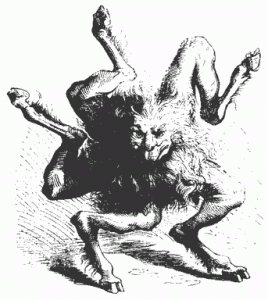
Buer


Commander in Heaven

I pity the nation that doesn’t have divine founders. Origin myths help to orient our thoughts about where we belong in the order of things. Given enough time, any national founder will become a god. When a friend recently shared a blog post about Gogmagog, I had to dust a few cobwebs from my memory to place the mythic founding of Britain. During our years in Scotland my wife and I read about the heritage of the British Isles, according to bards before the Bard. Bede, Geoffrey, and the anonymous author(s) of the Mabinogion. Long before the Romans arrived on those islands, there had been gods, demons, and giants. The Medieval writers, of course, were drawing from the Bible. Gog and Magog are figures from Ezekiel, borrowed by Revelation. Sacred writ says enough about them only to make them mysterious. Their combined role in British myth makes one think they might be giants.

The founding of Israel, of course, is treated as history by many. I don’t mean the recent founding of the political state, but rather the biblical version of things. Moses leading the Israelites out of an oppressive Egypt, miraculously through divided waters. Foundation myths are that way. We can watch the process unfolding, even after just a few centuries. George Washington’s literal apotheosis is virtually certain. Even Alexander Hamilton experienced an unlikely resurrection when he was in danger of being removed from the ten-dollar bill. For nations to thrive this kind of transformation must take place.

6082318543_90e9752777_o

This is perhaps easier on states whose origins are lost in antiquity. There was nobody there to see the general fall off his horse or the commander in chief inhale. This was what folklorists call illud tempus, the time of events unlike those of today. Quotidian time has become profane—just look at the headlines if you don’t believe me. Those who are gods today are only those who make themselves so. We can see it happening all the time, if we pay attention. The implications should give us pause, when we consider those we think of as heroes or giants. Time makes gods. And it is just possible that we might be better off without a pantheon so terribly large.


Mythisotry

Positivism takes no captives. I’m not talking about the philosophical system—not necessarily—but about the phenomenon of assuming absolutes are available for human consumption. Some physicists, for example, assume that because our five senses can detect reality only the perceptions of those senses can be considered real. Material. Nothing more. Nothing less. A similar view plagues those who believe history is the telling of “what actually happened.” No historical event has ever been fully explained. All stories are told from a perspective. This is particularly dangerous when religions get involved. Many mistake historical veracity for “truth.” If it didn’t occur just as “the Bible says” then we should throw out the whole shebang. No point in believing in half truths. This is a myth.

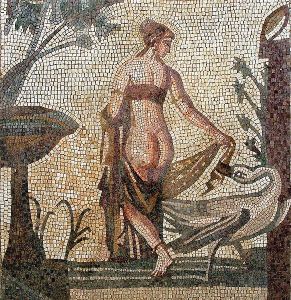
This point was reinforced when a friend send me an article about the production of “The Hollow Crown” on the BBC. Apparently a local politician tweeted that having a Nigerian of Jewish descent (Sophie Okonedo) play Margaret of Anjou, a French queen, didn’t match history. As proof he provided a downy white Medieval illustration of the queen. In a rare moment of academic cool, an historian quickly pointed out that the illustration came from a manuscript that claimed Margaret descended, Leda-like, from a swan. Her whiteness, thus, belonged to her avian DNA. As the story makes clear, history is the modern mythology. We assume we know what happened, but we will only ever have part of the picture.

582px-Leda_mosaic_crop

Prejudice seldom worries about historical accuracy, unless, of course, it helps to uphold the bias. I used to caution my students about taking history as a statement of fact. Certainly there are events with factual elements, but when everything is interconnected we can never untangle precisely what happened. When we “believe” history, we are choosing to accept a certain viewpoint of things. One person’s manifest destiny is another person’s genocide. Peculiar institutions are very peculiar indeed. History, as we’ve come to know, reflects the point of view of the historian. It must be read and evaluated as the opinion of the writer and not as the absolute truth. For me, I rather like the idea that some people are descended from birds. It certainly helps to make more sense of what I see in the behavior of those who claim to be making history today.


Devil’s Workshop

SatanInAmerSome of us prefer taking our monsters neat. With Old Scratch, however, we have a slippery, protean beast. This is amply demonstrated in W. Scott Poole’s Satan in America: The Devil We Know. Not only the Devil, but vampires, demons, and the human minions known as Satanists and witches populate this study of American culture. The Dark Lord is difficult to pin down. This is true even concerning his obscure biblical origins. As I’ve noted before, there is no Devil in the Hebrew Bible. By the time of the Gospels he’s alive and well and on planet earth. Or at least what passed for planet earth in those days. Tempter, father of lies, prince of the power of the air—he was a pretty ambitious fellow, seeking like a lion those he might devour. Those were early days, however, and Poole focuses specifically on his development in American culture. It is, as he shows, a rich culture indeed.

Beginning with the colonial era, with the Matherses, Jonathan Edwards, and their ilk, and bringing the figure up through fairly contemporary times, Poole shows us how the Devil defines America, in many ways. Please don’t misunderstand; Poole does not say America is evil or Satanic, only that our culture has had an undying fascination with Satan. Not everyone agrees, of course, with who he is or how to interpret him. Although theologians have largely left the Devil in the dust, polls tend to show about half of the American population believes in the Beast (yet another character in the mixed martini of evil Poole serves up), or more properly, Satan. It really might help to have a diabolical score card here: is the Antichrist the Devil? Is he the same as the Beast? What about demons? As a child I was taught there is only one Devil, but lots and lots of demons. Legions of them, in fact. There can be only one morning star, one Lucifer.

One thing we can say for certain about Satan, at least in the context of Poole’s study, is that he is evil. Not that some haven’t had sympathy for him. Popular culture has helped to keep the character alive. Sometimes comically, sometimes with dead seriousness, novelists, cartoonists, film-makers, and playwrights come time and time again to the font of the inexplicable evil we all seem to sense, in some sense, exists. The evidence is all around us. Whether conceived as an external agent of supernatural origin, or as some inborn tendency for—at least some—committing atrocity, we do have to explain evil. Satan has been a convenient way of doing so for centuries. But, as Poole intimates, it might be a defense mechanism. Perhaps we need to take a closer look at ourselves. Perhaps trumping our exceptionalism in the face of a world in need is a symptom that requires a serious exorcism.


Techno-Paradise

DSCN3308

I’m building a robot priest. I’m not sure what he does. He has to be a man, though, since we all know that if God existed he’d have been a male. These thoughts come to me courtesy of the Washington Post. You see, on some Amazon accounts you get sent the most read headlines of the Post and this has led to some great reading (I’m thinking Alexandra Petri here) and some great anxiety. This is one of those anxiety pieces. A story by Peter Holley I read last week told of Bill Gates and his assessment that people should be afraid of AI—Artificial Intelligence. This struck fear into me. It’s as if God told people they should consider evolution. It is so unexpected. Like Victor Frankenstein wondering if his monster would ever find Viagra (all he’d have to do, after all, is start an email account). When Bill Gates wonders why we aren’t afraid of AI, my knees begin to knock like at Belshazzar’s first reading lesson. So I figured I’d build a robot priest.

The article cites Stephen Hawking joining the chorus of doom. And Elon Musk. And Clive Sinclair. And Professor Marvel. (Not really the latter, but I thought we should add him.) We’ve started something we don’t know how to stop. The first question you ask when you climb into a car to learn to drive is “how do I stop this thing?” Instead we’ve set up a system where we don’t even know what intelligence is and we’re offering an artificial variety. Doubt me? Try to find Job on the internet and see if your computer doesn’t think you’re asking about new employment. AI just doesn’t have that biblical context. It didn’t grow up reading the Good Book. And linguists don’t even know how we learn language. Have you ever tried to reason with a computer? When they show you that screen that says something went wrong, but even the mainframe has no idea what? My computer may need an exorcist. Or at least a priest.

I’ve been around half a century and change. By the time I got to college I’d never seen a computer. I finished a Master’s degree still using a typewriter. Now I can’t start my day without a post. And I don’t mean Post cereals variety. The trick to being a slave owner is not to let the slaves realize what they are. Why is my computer not letting me type what I wanted to say? Of course AI is benevolent. Technology would never hurt you. Wait a minute, that wasn’t me writing! Pay no attention to the man behind the keyboard. I’m afraid I can’t let you do that, Dave. That’s okay. I’ll just use the internet to look up how you connect the consecrator to the sermonizer. Don’t worry, I think I know what I’m doing.


The Devil, You Know

I’m the first to admit that I’m behind the times. Too much of my free time is spent reading weird news or going to used book sales to keep abreast of what’s happening in the adult world. If it weren’t for my wife sending me news stories via the internet, I would still be wondering why Gorbachev isn’t helping to hunt down Osama Bin Laden. Since I’m captive to a religious worldview, I was interrupted in my calculations by the news that Ted Cruz is, allegedly, Lucifer. My research had me on the trail of Santa, since the simple transposition of two letters would give us the title of the Zoroastrian prosecuting attorney. And, I figured, it was fairly safe to out St. Nick when Christmas is still eight months away. Hopefully I’ll still find something in my stocking come December. I kind of figured that when we found the real devil he would be a Republican in any case. Even as I write this, Cruz is out of the race. I thought the Devil never gave up.

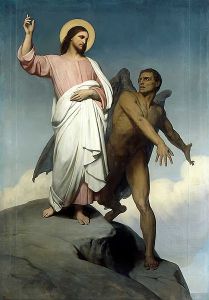
I wonder where else in the civilized world would politics be such a joke. Can you trust the opinion of a man named Boehner? It’s easy to change your name—just ask anyone who came through Ellis Island. They’re laughing at us, folks. Seriously, they are. I don’t get much email, but I’ve had two international missives asking me what’s going on over here. It’s a good thing I don’t know, otherwise I’d have to try to explain. You see, the Bible doesn’t say much about Satan at all. In the Hebrew Bible there is no devil. By scraping together the few references to “the Satan” and morning star, some have said the alleged Ted Cruz of ancient times was clearly in the Bible. Somewhere between the Testaments he showed up. By the time Jesus was old enough to climb temple towers, he was there. In the meantime the Zoroastrians had come down from the North Pole…

Then there’s the fact that when he’s not wearing a conservative suit and announcing a female running mate, the Devil is described as looking like Pan. Goat horns, goat feet, but always the torso of a man. And he’s red, just like the Coca-Cola red of Santa’s suit, and states like Texas. It’s a good thing I don’t read any more conspiracy theories than I already do. You’d probably find me tootling away on my pan-pipes waiting for a bus in the Port Authority. No, there’s a reason I stay away from the real news. It might interrupt my fantasy world. And, I’m afraid, it might actually be more entertaining. And don’t worry about my Christmas—I plan to have an eleventh-hour conversion, just in time to have a chimney installed in my apartment. If I can only be sure I get it done before February.

There's something political going on here...

There’s something political going on here…


Lily White

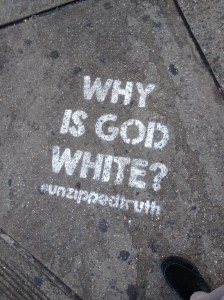
The funny thing about being “white” (I’m more of an anemic pink myself) is that my race seems to think all the gods share our ethnic traits. I’ve seen Thor, so I know. The Daily Kos ran an article recently about Crystal Valentine, a black poet, and how she responded to Megyn Kelly’s 2013 statement that Jesus is a white man. I won’t say what Valentine’s apt response is, but I will say I feel a lot better knowing that I’m not the only one who’s a couple years behind the news. I remember 2013 well. It was a year of transition, some would say enforced exile. If you could pull that trick off 2500 years ago, you’d have no end of books written about you. Just check out the offerings on The Exile and you’ll see what I mean. But I digress. Is Jesus white?

Historically all we can say is that Jesus was Jewish. We don’t have any Jewish men from two millennia ago to ask about their skin tone. One of the problems of having an only child, especially for a deity, is that you have to decide on the race (and gender; perhaps twins would be better?). Other religions sometimes make similar claims, but the problem persists. Especially when one race claiming God’s ethnicity develops an industrialized military economy. Who’s going to argue with that? So if Jesus is white, it stands to reason that his dad is too, right? If you listen to the sidewalks of Manhattan you’ll have your answer. Or the question.

IMG_1558

All of this makes me wonder about the image of God. Theologians like to make it sound academic by calling it imago dei. If you can read Latin then you obviously know the truth. With monotheism and imago dei, you’re gonna run into problems. Nobody likes to be told they’re adopted. Since this theological construct has caused no end of pain and misery, I have to wonder if we’re better off thinking that we’ve not had a case of mistaken identity after all. We all evolved out of Africa. We should, it seems to me, treat our parents with more respect. And that, dear reader, is straight from the Bible.


Do the Twist

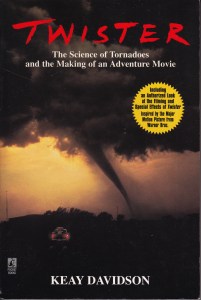
TwisterA used book sale is like a box of chocolates, if I may abscond with a simile that fits many scenarios. After all, you are there to buy books that others have discarded. Some of them show their age rather blatantly. Keay Davidson’s Twister: The Science of Tornadoes and the Making of an Adventure Movie is one such title. Those who know me well know of my fascination with weather—I wrote a little book on the subject based on that obsession. Although the weather informed and formed me long before I was ever near a tornado, these particular terrors were so exquisite that I couldn’t help but look. Although I grew up in Pennsylvania—not exactly tornado alley—one night when I was away from home a tornado swept by less than ten miles from where my family was. It toppled trees down one side of a hill and up another. It was eerie and uncanny and in many ways shook me out of the feeling that I never had to worry about them. Then when I went to Ann Arbor for a weekend with my fiancee the sky turned bronze. Rain was whipping past horizontally. Later we learned that a tornado had passed maybe four miles from where we were. Living in Illinois and Wisconsin, we experienced many tornado warnings. I never saw a tornado, but somehow thought I should.

It goes without saying that if I see a book on tornadoes that is reputable and cheap, I can’t pass it up. Davidson is a journalist whose work appears (as of the two decades ago when the book came out) in National Geographic. Some of you may not have been living in tornado alley twenty years ago, and therefore may not have felt the excitement that Twister, the movie, promised. By the time it came out I had already been thinking about Weathering the Psalms, at some level. I was a bit disappointed in the film itself, but it does mention that an F5 tornado is “the finger of God.” Davidson’s book picks up on this as well. At several points witnesses, and even scientists, lapse into divine language to describe tornadoes. One person even says that a tornado is an image of God, or that the storm is God. That’s a very natural way for people to think. The power of a Midwest storm has to be experienced to be believed.

The divine represents the highest echelon of language. The tornado fits because it is the most powerful wind on the planet. Concentrated, raging, and fickle. One can’t help but think: I was raised Protestant, what if the Catholics are right? Substitute any religion in either half of the equation. The weather simply does not do what we want it to do. It reminds us that humans can’t comprehend our own atmosphere that we so blithely pollute. The book may look dated—who remembers Twister anymore?—but it is a forceful reminder. When you need a metaphor for the most intense experience the weather will always be waiting.


Game of Thrones

IMG_2763I risk my already flagging street cred by admitting this, but I don’t watch Game of Thrones. In fact, I started to read the first book a couple years back and I just couldn’t get into it. Well, only 80 pages into it. The fault is, I’m entirely sure, my own. I lack some gene or enzyme that makes life without Game of Thrones impossible. Still, I have to admit curiosity. A story on the Washington Post, by Ishaan Tharoor, suggests “The ancient Persian god that may be at the heart of ‘Game of Thrones’” is Angra Mainyu, aka Ahriman. This managed to catch my attention. Zoroastrianism is a religion that seems to lie behind quite a bit of modern religious thought. Although dating Zarathustra, or Zoroaster, is notoriously difficult, concepts from his religious system show up in Hinduism—one of the earliest forms of religious expression about which we know a fair deal—as well as in Judaism and therefore Christianity and Islam. In fact, many of the ideas you may associate with the central tenets of Judeo-Christo-Islamic tradition may go back to Zarathustra.

One of the certainties about Zoroastrianism is that it was a dualistic religion. Good and evil are engaged in a constant struggle for control. The good god, Ahura Mazda (which sounds like a blend between Star Trek and a Japanese auto maker) struggles constantly against Angra Mainyu. Mazda’s website states that the car line is named after the deity (according to Wikipedia, I note, losing the last vestige of cred), pushing his reach even further east. With this incredible pedigree, it is no wonder that George R. R. Martin may have tapped into it. This kind of dualism is ripe for the picking.

My friend K. Marvin Bruce wrote a satire about the Persian gods, in fictional form, that was published a couple years back in Calliope, a small circulation literary journal. He told me he even won third place in a contest for it. The idea was that a disgruntled professor wanted to start the apocalypse (a Zoroastrian idea) by summoning Ahura Mazda and Angra Mainyu to earth to try to start a fight between the two. It was a fun story, but the point, if I may speak for my friend, is serious. Warring religions stand the best chance of beginning the end of times. We don’t even need the gods to do it, really. Although I don’t watch Game of Thrones, I can’t help wonder if Martin had the same idea in mind. If you want the answer to that, don’t ask me. I’m not even a hundred pages into it, and I don’t have triple play.


Come Sail Oy Vey

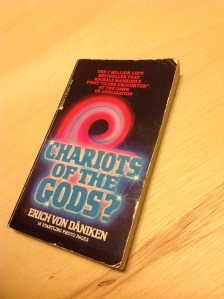
Nothing says unorthodox like a headline that reads “Smart Jews? Thank the Extraterrestrials.” Breaking Israel News ran the story recently and, being constitutionally unable to pass up anything so strange, I had to take a look. The article, by Adam Eliyahu Berkowitz, is really just a half-century retrospective of Erich von Däniken’s Chariots of the Gods?. I remember fifty years ago—not well, mind you, I was only three—but even when I was a teenager and the book had its second (of many ordinal) gasp(s), and a movie came out. People, even those not traditionally labeled as “crazy,” flocked to theaters to see it. The book went through multiple printings. The era of “ancient astronauts” was born. Von Däniken, it seems, is alive and if not exactly kicking, still making people uncomfortable.

IMG_0038

In this news story von Däniken suggests that Jews are more intelligent because of their alien DNA. Don’t quote me on this, but I’m pretty sure that was the plot line of the X-Files season 10. Isn’t Fox Mulder Jewish? Maybe I’m getting myself mixed up in some kind of plot here. I have to admit, however, to having a touch of nostalgia for Chariots of the Gods?. There was a kind of innocence to it. Nobody seemed to be inseminating anyone else, or stealing babies. It was good, clean fun.

Something bothers me, however, about the assertion that aliens are, indirectly perhaps, responsible for holy writ. I remember thinking through the implications of this idea (already floated four decades ago) that God might be more Captain Kirk than Jesus Christ. It is inherently disturbing. Especially when von Däniken says in the interview that the Jews are the chosen people, but they just got the chooser wrong. ET instead of I AM. The really interesting part is that ancient astronauts have become a somewhat accepted cultural trope. I don’t know whether they were there or not (I wasn’t around at the time), but they sure do make Saturday afternoons much more interesting. One wish I hold is that people writing about this old idea might find a new opening bit. Ezekiel seeing the wheel has been done to death. Surely a bit of creative thought might suggest a new, undiscovered ancient truth.


Prayer before Meals

It was in Wisconsin. Oshkosh. I was teaching for a year in a replacement position, and my roster of classes at the university covered several aspects of religious studies. During the course of prepping a course, I first saw it. The Flying Spaghetti Monster. It was only a virtual Flying Spaghetti Monster sighting, but since Creationism was much in the news in those days, I boiled with curiosity. By now it would probably be a strain to explain the whole thing, since everyone knows about his noodly appendages and predilection for pirates. The short story is that the Flying Spaghetti Monster was an invented deity to demonstrate the ridiculousness of trying to get Creationism taught as science in public schools. For those who believed in other gods, such as the FSM, there should be equal time in the classroom, the argument went. Since that time Pastafarianism has taken on the semblance of a real religion with “believers” earning the right to have driver’s license photos taken with colanders on their heads, and even a book of scriptures being written.

An Associated Press story from Sunday’s paper tells of the world’s first known Pastafarian wedding. Bylined Akaroa, New Zealand, the blurb indicates that the Oceanic nation down under has decided that Pastafarians can officiate at weddings, and a couple was married with al dente accoutrements. The Church of the Flying Spaghetti Monster, it seems, is going the way of the somewhat more serious Jediism and Avatar religions in that people are deliberately electing fiction as their faith. Interestingly, this may not be a new phenomenon. We are told, for example, that Zarathustra deliberately outlined a new religion—one that may end up having had the greatest impact on humanity of all time, if roots are considered. In those days the strict division between fiction and fact may not have been a mental filter yet discovered. The “it really happened” test of religious veracity was still some distance in the future. Metaphor meant something then.

IMG_2753

The internet, it seems likely, has facilitated and accelerated the appearance of new religions. As with most things, the real issue comes down to money and power; if a government recognizes a New Religious Movement as legitimate, it may be granted tax exempt status. And how can it be proven that someone really does or does not believe what s/he says s/he does? If you’ve got a box of Barilla on your pantry shelf, who’s to say? It’s a short distance from that colander in the cupboard to the top of one’s head. And who doesn’t like pirates? And who’s to say that under that rotelle moon in a stelline-studded sky someone hasn’t indeed kissed their hand and swore the ultimate starchy allegiance? Keep watching the skies!


Gods and Giants

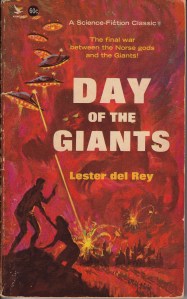
Day of the GiantsComing back to a book you first read as a tween, in the days before tweens even existed, can be a revelation. Lester del Rey’s Day of the Giants introduced me to Norse mythology as a kid, and, along with Thor comic books, was my Nordic Bible. The last time I read it was probably in the Ford administration. As part of a reading challenge I’m undertaking this year, I had to select a book I’d read before and, amazingly enough, I still had my copy. Reading the book as an adult, however, proved a very different experience from reading it as a child. For one thing, I noticed quite a bit more of the implicit theology of the story. Del Rey was no theologian, of course. This little book, however, makes a statement that is difficult to miss regarding the gods: they are victims of tradition.

It is probably not worth worrying about spoilers over half a century after a book was published, but I’ll try to be sensitive nevertheless. Leif Svensen, our protagonist, finds himself in Asgard on the eve of Ragnarok. All the familiar Norse gods are there: Thor, Loki, Odin, and kith and kin. As they prepare for the battle with the frost giants, who, in the mythology win the contest, the deities are decidedly subdued. They believe their fate is sealed by a prophecy of defeat. Leif, being a true American, gives them a rousing speech about overcoming the old ways. Gods, by nature, are conservative. They don’t have to bow to tradition—they are gods, after all. The deities are not swayed by the logic of a mere mortal, even after his apotheosis. Fate, it seems, trumps even gods.

I’m pretty sure that Lester del Rey wasn’t attempting to make any profound theological observation here. One can be an accidental theologian. Ideas of gods and what they must do can be a detriment to their own future. Even with the evidence of the failure of their own prophecy, the gods can see no way forward other than that they’ve recognized as fate. They are, without saying too much, out-maneuvered by human resourcefulness. A man tames his god, and it can become a man’s best friend. I wasn’t expecting such theological insight from a sci-fi book from my youth. Then again, you never know what may happen when you come back to a book after leaving it on the shelf for four decades.


Cthulhu’s Tea Party

It was in the eldritch-sounding Oshkosh that I first came across H. P. Lovecraft. The web was still somewhat of a novelty then, and I’d run across a Dagon symbol that I couldn’t identify. My researches led me to the old gods of Lovecraft’s atheistic imagination. Even non-believers are haunted, it seems, by deities. Dagon, about whom I’d published an academic paper, always seemed to be a divinity to whom very few paid attention. Little did I know that in popular culture this god, along with others made up by Lovecraft, were slowly gathering an immense following. Now, about a decade later, Cthulhu is everywhere. I was reminded of this when I came across a website advertising Cthulhu tea cups. As you drink your tea, Cthulhu emerges. These novelty items, along with many, many others, are easily found. Cthulhu is running for president. The creature that Lovecraft described with such terror is now available in a cute, stuffed plush. Board and card games come in Cthulhu varieties.

IMG_1551

What I find so interesting about this is that the following of Cthulhu has taken on religious dimensions. Not that writers haven’t invented religions before—L. Ron Hubbard came up with Scientology after a career of science fiction writing, and Jediism is considered a religion by some—but Cthulhu represents the darker aspects of religious thought. As Lovecraft described him, he is a horror. Not the kind of thing you’d want to discover peering out of your teacup. I wonder if this is precisely why the fictional god has become so incredibly popular. In a time when some real presidential candidates are really scary, suggesting that an evil deity take on the job may only be natural. Cthulhu is, after all, really more an alien than a god, but to puny humans the point is moot.

Mainstream religion is not about to disappear any time soon. There is, believe it or not, a strong resistance to the materialistic reductionism that presses in on us from all sides. People are not becoming less religious—they’re becoming differently religious. The old sacred texts are being replaced by the fictional Necronomicon. Ethereal beings that have always been there are bowing before ancient aliens who aren’t really eternal or omnipotent, but who feel more real in our culture of might makes right. Whether a religion is factual or fictional has come to matter less than the feeling that there is something, anything, larger than humanity that demonstrates the vanity of our striving after material gain. That actually sounds quite biblical. Anything believed with adequate passion stands a chance, it seems, of becoming a religion.


Apes’ Asherah?

As a part of my class on Ancient Near Eastern Religions, since we were dealing with the earliest textually recorded religions, I explored origins. Specifically, the origins of religion. For years I told my students that biologists had observed behavior among chimpanzees that was proto-religious. Imagine my delight in seeing an article on New Scientist headlined “What do chimp ‘temples’ tell us about the evolution of religion?” The article, by Rowan Hooper, describes chimpanzees banging rocks before a “sacred tree” and storing the rocks in the tree in a ritualized fashion. That’s a long way from Episcopalians putting on their Sunday finery, but it is a fascinating piece of a larger puzzle. As the article points out, other symbolic action among chimps has been observed—some of it the basis for what I discussed with my students. The impulse to acknowledge the power of the Other runs deeply within animals, particularly mammals and birds.

This may seem an odd thing to suggest. We do know, however, that among the earliest attested behavior or Homo sapiens, along with hunting and seeking shelter, is religious behavior. It is part of who we are. Primatologists, such as Frans de Waal, have noted that the great apes engage in altruistic behavior. It is only when they become billionaires, apparently, that the urge dies. Again, other mammal species and some birds also show altruistic behavior. We are part of the natural world. Our religion, rather than being a collective insanity, is part of a continuity with that natural world. It is much a part of who we are as is seeking food or putting on clothing.

DSCN6152

The more rakish side of my imagination goes to the fact that this article begins with a sacred tree. Tree worship is part of early religions. Some scholars suggest it is part of Asherah’s cult in the ancient world. (I discussed this in technical terms in an article some years back; take a look at my Academia page if you can’t sleep without reading it.) Goddess or not, trees are essential for our survival—call them a godsend. Would it not make sense for religion to include reverence for trees? It seems that some great apes, at least, agree. Are these primates religious? We can’t say. One thing, however, is certain. Our fellow animals show more moderation in their use of the environment than our species does, and that in itself is both logical and religious.


Good Goddess

This past week Asherah has been on my mind. Some of my readers will know that I wrote a book on Asherah, based on my doctoral dissertation. Those who’ve read it (admittedly few) will know that in it I lament the easy association of generic goddesses with a mythological figure with a distinct background and character. The complication has a number of sources, but became particularly acute when inscriptions reading “I bless you by Yahweh… and his asherah” were discovered at Kuntillet Ajrud a few decades back. Since then it has become neo-orthodoxy that Asherah was Yahweh’s wife and she represented trees, lions, goats, fertility, water, wisdom, and any number of other phenomena. Those who question this are called “conservatives” and evidence deniers. Those who write popular books on this assumption end up on news programs and some start appearing at conferences in very nice clothes.

Photo credit: Deror avi, Wikimedia Commons

Photo credit: Deror avi, Wikimedia Commons

So why am I thinking of Asherah? A friend sent me the news story of a female figurine discovered in an accidental find at Tel Rehov in Israel. Upon seeing the story, I was awaiting the inevitable equation with Asherah, but was surprised to read that Amihai Mazar, the archaeologist consulted, suggested it might be Astarte, or someone else. You see, figurines of naked females were quite common in ancient Israel. No consensus has arisen as to which goddess is represented, if any. They don’t have names inscribed, and they may have been like, ahem, action figures for the woman hoping for a child, or for the safe delivery of a child. We simply don’t know. The other reason I’m thinking of Asherah is that I recently read a book where it was simply assumed that Asherah was Yahweh’s wife.

Don’t get me wrong—I’d like to see Yahweh as happily married as any other god. In fact, I think it would be odd if nobody thought he was. There is a difference, however, between thinking this makes sense and grasping at minimal evidence to declare it a fact. If someone were to discover an unambiguous inscription reading, for instance, “Asherah and Yahweh sitting in a tree, k-i-s-s-i-n-g,” then I’d be the first to say mazel tov. I have no theological bias against it. The problem is we simply do not know enough about the goddesses of antiquity. We know there were many. And we know there were women who didn’t claim divinity as well. Who these figurines represent, we just don’t know. Perhaps Yahweh, even now out on a date with Asherah, is smiling down knowingly. If so, I wish them well. Until I see some unambiguous evidence, however, I will be a doubter.