Old Grains

Back when I was somebody—a professor is somebody, even if only a seminary professor—I was invited to meet with a group of Seattle writers and intellectuals.  I was in Seattle already because driving all the way out here was possible when you live in the Midwest and your summers are basically open and free.  (Professor’s privilege.)  One of the group members, the one who invited me, asked me about grain.  When the club met they ate.  With a bent toward history, one of them brought period-appropriate bread.  What kind would be fashionable for a night of ancient Near East talk?  (I was still researching and writing on Ugarit at the time, before Ugaritology passed away.)  Without stopping to think I replied “Einkorn.”  I didn’t know if einkorn was still around or not.  All I knew is that it was the earliest (at least as understood at that time) domesticated grain.  The loaf that arrived that night was a more accessible grain variety.

All of this came back to me as I stood in the local health-food store.  We don’t shop here for regular groceries—it’s expensive to eat healthily—but we’d been invited to someone’s house and said we’d bring appetizers.  The health-food store had vegan cheeses, so we needed crackers to go with.  Then I spied the word “einkorn.”  The Seattle discussion had to be well onto two decades old by now.  I was finally able to answer my question, einkorn was still alive.  The craze for ancient grains did not exist in my professorate days.  Some companies, according to occasional news stories, were trying to brew the beer of ancient Egypt or Sumer, but the health conscious hadn’t gone so far as to trying to replicate the diet of the earliest agriculturalists.

Ancient grains cost more because the yields are smaller.  Although the grain heads look disturbingly like those house centipedes that scamper in the basement when you flip on the light, they aren’t nearly the size of a current wheat head.  It stands to reason that it takes more of them to make up the same amount of flour, and appetites have grown over the millennia.  Like most vegans, I read boxes.  Another ancient grain cracker, apart from brown rice, included amaranth, flaxseed, millet, quinoa, sesame, and sorghum.  Never mixed this way in antiquity (for amaranth and quinoa were part of the “new world” and the others “old”), modern mixologists have devised new ways of using ancient grains.  Einkorn nearly went extinct with the development of wheat, rye, and barley.  But it hung on, and now, as a dozen millennia ago, it has a way of sustaining both dreams and fantasies.


Fly Away

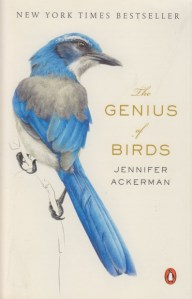
Humans can be quite likable, but we have some nasty traits.  One is that we tend to think of ourselves as the only intelligent beings on the planet.  The funny thing about evolution is that it gave us both big brains and opposable thumbs—a winning combination to destroy the planet.  (Just look at Washington, DC and try to disagree.)  Jennifer Ackerman’s The Genius of Birds is poignant in this context.  Page after page of nearly unbelievable displays of intelligence among birds demonstrates that we are hardly alone on the smarts scale.  Birds make and use tools, have better memories than most of us do, and can solve problems that I even have trouble following.  We tend to take birds for granted because they seem to flit everywhere, but the book ends soberly by noting how global warming is driving many species to extinction.

Homo sapiens (I’ll leave out the questionable and redundant second sapiens) like to think we’ve got it all figured out.  We tend to forget that we too evolved for our environment—we adapt well, which has allowed us to change our environment and adapt to it (again, opposable thumbs).  Many scientists therefore conclude that we are the most intelligent beings in existence.  Ironically they make such assertions when it’s clear that other species can perceive things we can’t.  Ackerman’s chapter on migration states what we well know—migrating birds can sense the earth’s magnetic field, something beyond the ability of humans.  We lack the correct organ or bulb or lobe to pick up that signal.  And yet we think we can rule out other forms of intelligence when we don’t even know all the forms of possible sensory input.  We could learn a lot from looking at birds, including a little humility.

The Genius of Birds explores several different kinds of intelligence.  What becomes clear is that birds, like people, have minds.  Like human beings they come on a scale of intellectual ability that doesn’t suggest only one kind is necessary.  For our large brains we can’t seem to get it through our thick skulls that we need biodiversity.  We need other species to fill other niches and our own remarkable ability to thrive has only been because we are part of a tremendous, interconnected net encompassing all of life.  Other species have contributed to our evolution as we clearly do to theirs.  When we end up thinking that we alone are smart and our own prosperity alone matters we are sawing away at the branch on which we sit.  Further up the birds look at us and wonder if we really know what we’re doing.


Dayglow

Yellow and orange leaves on a damp pavement.  A sky claustrophobically occluded with gray clouds.  A decided chill in the air.  All you have to do is add a few pumpkins and the feeling of October is complete.  I don’t know why this particular image of the change of seasons grips me the way it does.  As a homeowner I don’t want to turn the heat on too soon because the gas bills will jet up and will stay that way for seven or eight months.  I get depressed when skys are cloudy for days at a time.  Around here the leaves have only just begun to change.  In other words, there’s a decided difference between the way I imagine October and the way that it feels on the ground.  In my imagination there are Ray Bradbury titles, The October Country, The Autumn People, but here in the physical world I shiver and add another layer.

Over the past several weeks I’ve been struggling to figure out why horror appeals to me.  It seems to be the Poe-esque mood rather than any startles or gore.  The sense of mystery that hangs in the air when you simply don’t know what to expect.  Will it be a warm, summer-like day or will it be rainy and raw, a day when you wouldn’t venture outside without the necessity to do so?  October is like that.  It is changeable.  Beginning in late September it is dark longer than it is light and for much of the rest of the year I will go to bed when it’s dark outside.  It’s always still dark when I awake.  Is it any wonder that October has its hooks in me?

Short stories, of which I’ve had about twenty published, seem to be the best way to capture this mood.  You see, it isn’t a sustained feeling.  It’s piecemeal like that extra quilt you throw on your bed at night.  The urge to hibernate creeps in, but capitalism doesn’t allow for that.  October is an artist, and I’m just the guy wandering the galley, pausing before each painting.  This feeling only comes after summer, and it is fleeting.  In November the leaves will be down and the cold will settle in quite earnestly.  The candles we lit for Halloween will be our guide-lights to those we hold out to Christmas when the dayglow will begin to return at an hour that reminds us change is the only thing that’s permanent.  And in this there’s a profound hope.


Anthropocene

The word “Anthropocene” has been showing up quite a bit lately.  For a period of many years I was an avid, self-taught amateur geologist.  In my dreams I still am, I guess.  My interest in the ages of rocks began when I, like Charles Lyell, began to consider the implications of their extreme longevity.  The Bible, of course, famously intimates we live in a comparatively new neighborhood.  Having grown up believing that literally and firmly, and also having started a modest fossil collection, I failed to see the conflict.  I mean, there were fossils right down there by the river.  Tons of them.  Some Young Earth Creationists had already begun, by that point, to suggest they’d arisen because of Noah’s flood, but dinosaurs still seemed to be a problem.  In many ways rocks broke me out of my fundamentalist stupor.

While at Nashotah House I taught electives on Genesis 1-11.  I read about the geologic ages of the planet and would fall into Devonian dreams of a world entirely different from ours—a world in which there was no Bible for there were no humans to make God in their image.  I knew that we lived in the Quaternary Period of the Holocene Era.  I don’t think the term Anthropocene was in wide use then.  Parsing it is simple enough—it is the “human age.”  The age in which the planet was, has been, and is being altered by human behavior.   There’s no agreed-up start date for the Anthropocene, but it will likely be set in the twentieth century; the twentieth century in our way of counting.  There have been millions of centuries before that.

A couple of weekends back I attended a church program on plastics.  These useful polymers are deeply, deeply integrated into our lives and are promoted by the far too powerful petroleum industry.  The problem with plastics is that they break down and invade the bodies of animals and humans.  And although they do decompose it takes many centuries for them to do so.  Naming the Anthropocene is an effort to get us to see that a human perspective is far too brief to deal with the many issues we raise.  Our practices on this planet will likely not destroy the earth, but they may very well make it uninhabitable by us, or by creatures we like to see.  Life is persistent, and rock lasts for eons.  Even stone’s not eternal, however, and the idea of the Anthropocene is to get us to look at ourselves and realize that our use of this planet, as toxic as it is, is shortsighted.  We will someday be the fossils under a bridge long crumbled to dust for those in the future who know of no such thing as Genesis.  Perhaps we should act like it.


Burger Impossible

On the way home from Ithaca, we’ve learned the hard way to avoid I-80 through the Poconos on a holiday weekend.  Past experience indicates that about 80 percent of the population of New Jersey (to be fair, a percentage of that may be those from New York City) tries to squeeze through the Delaware Water Gap at just about dinner-time the day before work starts again.  There is a longer alternate route, I-476, the turnpike, which you catch north of Scranton and exit in Allentown.  The only issue with this plan is that, unless you want to exit the turnpike to try to find food in rural Pennsylvania, there’s only one travel plaza between our entrance and exit.  It’s a nice enough stopping point, but for a vegan on the road options are limited.  As we pulled in we noticed there was a Burger King.  Would they have the much touted “impossible burger”?

It turns out that they did.  Having last had a whopper well over two decades ago, mouth memory may have faded a bit, but I can honestly say this was like the whopper I remembered.  If you hold the cheese and mayo, you have a vegan version.  This discovery made me strangely happy.  For years at remote locations (and some urban) we’ve stopped when the only other options are meat based and had the BK veggie burger.  It’s not too bad most of the time, but if you want to think you’re eating meat while not contributing to the massive environmental degradation of industrial farming, the impossible burger seems like a reasonable option.  This is one area of technology that I’m glad seems to be catching up with ethics.

I often ponder how much our western point-of-view is based on the Bible.  Our reluctance to include animals in our ethics is another example of how the hard line between species has been applied.  Even scientists are susceptible to worldview bias.  When we realize we’re all part of a continuum of biological relatedness, it’s a lot more difficult to argue for our special place in the divine eye.  At the same time, insisting one’s ethics be applied to all is a form of fascism.  I’m just glad my conscience can be assuaged with some plant-based food options.  After all, I’ve been on the road for a few hours and I’m sitting here happy to be eating at Burger King.  It’s a matter of perspective.


Meatings

It was almost a little too real.  As I looked at the fake blood—this wasn’t a horror movie—I had a hard time accepting this wasn’t the real thing.  I mean Beyond Meat’s vegetable-based sausage.  My daughter recently sent me a captivating article about artificial meat.  Unlike many paeans to its virtues by fellow vegetarians and vegans, this was written by an omnivore who unabashedly stated that we’ve reached the point where synthetic meat has surpassed the real thing in flavor and the eating experience.  The piece on Outside made me glad.  Feedlots, apart from being the largest industrial polluters in this country, are a horror film based on a true story.  The way we treat “food animals” violates just about every ethical stance in the book, and it’s a big book.  We do it for profit, of course.  Now that artificial meat is turning a substantial profit, those who slaughter are starting to pay attention.

I recently ate at a local restaurant where our waiter recommended the cauliflower burger.  The thought wasn’t appealing.  Don’t get me wrong, I do like cauliflower.  I prefer it raw, however, since cooking brings out its more cruciferous qualities.  In any case, our server said, “It’s new on the menu.  We offered it once before and so many people requested it that we’ve made it a regular item.”  Now we don’t exactly live in a hippie haven here.  Still, enough people are asking for alternatives that we’re discovering it pretty easy to find plant-based protein in some pretty remarkable places.  It put me in mind of my most challenging course in college: biomedical ethics.

A class that asked, and then pressed on very sensitive questions, biomedical ethics required a term paper.  I wrote mine on animal testing.  This was back in the 1980s, and technology has moved on since then.  Even back in those dark ages of Reaganomics, artificial tissue was being lab grown, eliminating the need for animal testing on many products.  Now we’re reaching the point where the same may apply to comestibles.  I’ve long used vegetarian alternatives (now vegan ones) and they’ve increasingly improved.  When I had the most recent alternative, however, I couldn’t believe it wasn’t meat.  It was too real.  I’m not morally opposed to verisimilitude, I assure you.  The closer they get to the real thing, the better it is for the animals who’ll never need to be born to be killed by us.  It’s just I find the fake blood upsetting, and I’m happy to be reminded that this is only a simulacrum after all.


Whether or Weather

It was a self-inflicted double feature.  I’d been pondering movies about the weather.  Tons of movies have the weather in them, sometimes even as a significant plot element.  Few films, however, take the weather as their central thesis.  These movies verge on horror as the weather is something much larger than we are and which is deadly.  Let’s face it, a film about sunny skies and light breezes doesn’t have much of a hook.  I began by watching The Perfect Storm.  I’d seen it before, of course.  Not much like its book, which is nonfiction, it follows the loss of the sword boat Andrea Gail in the eponymous storm of 1991.  Not all members of the crew get a backstory, and since nobody knows what really happened, it was a chance for special effects to drive the story just as massive waves drive the boat.  The weather, while central, is seldom commented upon.  The characters are motivated by trying to make a living but there’s not enough time to give all six of them adequate stories.  Add to that another boat with no backstory and the movie become disjointed and smoky.

The next feature was The Day after Tomorrow.  Again, I’d seen it before, but you know how one thing leads to another.  Like The Perfect Storm, The Day after Tomorrow introduces more subplots than the movie can handle, even bringing a Russian freighter up Fifth Avenue in order to have a wolf-chase scene that is simply dropped after it’s discovered that wolves can’t climb ladders.  Still, the latter story has an environmental message.  Aware that human activity does lead to global warming, it tries to picture what would happen if it were speeded up into a matter of weeks rather than years.  No  matter how long it takes, the weather will get you.

As I’ve contended before, the sheer scope of the weather practically makes it divine.  Although we live in different climatic zones we’re all tied together under a single, volatile, powerful atmosphere.  Early humans realized that their survival depended on the weather.  Drought kills as readily as sudden ice ages.  The key, it seems, is balance.  Nature isn’t kind to species who assert too much dominance.  One of the means of nature’s control is the weather.  Until the development of meteorology, and even after its first tentative steps, the weather was considered a divine bailiwick.  We may proclaim it entirely natural, but it still commands its share of awe and majesty.  And it can easily claim a few weekend hours searching the skies for some kind of meaning.


A Decade

Please pardon my being sentimental, but today marks one decade of blogging on Sects and Violence in the Ancient World.  I realized, thinking this over, that I used to make some interesting, perhaps even quotable statements back then.  Why not, I thought, farm those older posts to celebrate what I was thinking when I was a tenth-of-a-century younger?  So for today’s post, I’m presenting some quotable quotes from July 2009, starting with one of the zingers from my very first post.  For convenience, I’ve even provided the links to the posts so you can see them in context, if your July has somehow not filled itself up already.

Sects and Violence in the Ancient World, by the way, was the name given when one of my nieces thrust a recorder in my face and asked me what I would call a blog, if I had one.  She subsequently set this site up for me.  One aspect of the title may not have been evident: it’s a quasi-anagram for my initials.  It has been, from the beginning, mostly metaphorical.  Without further ado, then, a few of my favorite lines from a decade long gone:

“He had a sidekick called Cypher (sold separately), and arch-enemies with such names as Primordious Drool and Wacky Protestor. I marveled at the missed opportunity here — they could have called them Text Critic and Doctor Mentary Hypothesis!” First post: Bible Guy, July 12, 2009. <https://steveawiggins.com/2009/07/12/bible-guy/>

“Technology has outstripped reality.” Asherah Begins, July 13, 2009 <https://steveawiggins.com/2009/07/13/asherah-begins/>

“Black and white are not in the palette of serious religious studies.”  God is Great (not)?, July 14, 2009 <https://steveawiggins.com/2009/07/14/god-is-great-not/>

“When he [Aqhat] refuses to release it to the goddess he is unfortunately pecked to death in a hitchcockian demise by a swarm of buzzards with attitudes.” Sects and Violence, July 15, 2009 <https://steveawiggins.com/2009/07/15/sects-and-violence/>

“Indeed, one may think of them [religion and monsters] as fellow ventricles in the anatomy of fear.” Vampires, Mummies and the Holy Ghost, July 16, 2009 <https://steveawiggins.com/2009/07/16/vampires-mummies-and-the-holy-ghost/>

“Better to consider it [weather] human than to face unfeeling nature.” Changing Faces of the Divine, July 18, 2009 <https://steveawiggins.com/2009/07/18/changing-faces-of-the-divine/>

“As the gods are drinking themselves senseless (how else can the latest Bush administration be explained?)…” Drunken Moonshine, July 20, 2009 <https://steveawiggins.com/2009/07/20/drunken-moonshine/>

“As usual, we kill off what we don’t comprehend.” Not Lion, July 22, 2009 <https://steveawiggins.com/2009/07/22/not-lion/>

“A bonobo was recently documented as uttering the word ‘yes’ to a keeper’s question, officially making her more articulate than some clergy I’ve known. Even today there are churches that still call their leaders Primates!” Religious Origins, July 23, 2009 <https://steveawiggins.com/2009/07/23/religious-origins/>

“I never used a computer regularly until I began my Ph.D., and then it was only a glorified typewriter, qwerty on steroids.” Who We Were, July 27, 2009 <https://steveawiggins.com/2009/07/27/who-we-were/>

“I grew up in a blue-collar household where paying ladies for favors was itself considered a sin.” Yes, Mammon, July 28, 2009 <https://steveawiggins.com/2009/07/28/yes-mammon/>

Where do you suppose we’ll be a decade from now?


Why July?

The weather in July can be exhausting.  I’ve always pretty much associated the Fourth of July with hot, sticky weather and this year’s holiday weekend has lived up to that.  Combine it with the incessant rain in the eastern half of the country and you’ve got a mix that won’t permit you to open your windows, but makes you simmer if you stay inside.  We often handle this by seeking out air conditioned facilities where you don’t have to spend a ton of money in order to find some relief.  It also happens that today is the anniversary of our moving into our new house when, as I recall, the current rainy cycle began.  Restless, stormy nights may be Gothic, but they don’t fit the staid, steady nine-to-five lifestyle very well.

Despite it all, I still value summer.  The sense of carefree days, as my friend over on Verbomania says, give estival days a shimmer like none other.  So much so that it’s difficult to keep track of what day it actually is.  For me this particular date will always remind me of buying a house for the first time and spending a literally sleepless hot night learning the hard lessons of homeownership.  Still, since I mentioned Independence Day, I continue to find myself relieved at the lack of land lordliness when it comes to the list of those who hold something over my head.  If only I could catch up on some sleep over a long weekend it might all seem more real.  July can be like that.

As I saw this weekend approaching from a distance, I made plans at how much I would accomplish.  I would get so much writing done that I’d be well ahead on my next project.  I might figure out what it was most important to say, and maybe finally find the meaning to life.  (Summer makes me feel optimistic, it seems.)  I would post new videos on my YouTube channel.  The weather, however, as the Psalms indicate, can change your plans.  Twilight lengthens to the point of making night and day difficult to distinguish.  Sleep doesn’t refresh the way it usually does and morning—my writing time—is hazy and lazy.  My next book sits untouched on my hard disc while I look over boxes that remain unpacked from a year ago.  Childhood summers set the pattern of dropping all and experiencing the mini-anarchy that lack of structure brings.  Despite all that I’d hoped to accomplish, I find myself welcoming this hot and humid anniversary.  That’s what July is like.


From Above

You can see a lot from 35,000 feet.  Alan Parsons Project’s “Eye in the Sky” comes back to me, although I’d never make so bold as to associate myself with Horus.  As I’m preparing for my return flight, I wonder what I might see.  Not much, I expect, since all the window seats were taken and I’ll be sitting in the middle section.  I like to see where I’m going.  On the way over, for example, about three hours into the flight, we were over the Grand Banks.  I’d just finished Brian Fagan’s Fishing, and the Grand Banks were on my mind.  The last land I saw was Cape Cod, although from the monitor I knew we’d passed near Nova Scotia and Newfoundland.   In other words, there was nothing but the north Atlantic beneath us.  We were hundreds of miles from land.  Then I saw it.

Was that an oil platform all the way out here?  I didn’t have enough time to wake my napping phone for a picture, but there was clearly a large platform and a nearby tanker.  Later I checked and, sure enough, Hibernia, the world’s largest oil platform is smack-dab in the middle of the Grand Banks.  A number of thoughts occurred.  We’d been flying for hours, and a platform this far out would make a great setting for a horror story.  (Okay, so my thoughts move in predictable directions sometimes.)  Another thought was this: why are we so dependent on petroleum that we’re all the way out here drilling for a polluting, non-renewable resource?  Is it not for profit margin alone?  This was an epiphany for me.

I still carry a little cautious hope around in a hidden pocket that there might be some places left for humanity to explore, but not exploit.  Fagan mentioned in his book that we’d trawled much of the ocean floor.  Although I admiring the engineering that could plant a platform in the stormy Atlantic, I still can’t help but feel a little bit let down that we’ve driven yet another stake into the unexplored world.  We really know so little about the oceans (apart from the fact that many creatures that live there can be eaten and otherwise exploited).  Our lack of scientific knowledge is addressed by great wells drilled down to draw out pollutants to grease the wheels of capitalism.  Yes, I was using fossil fuel in flying.  I’d be happy with solar-powered planes, if they existed (they’re above the clouds much of the time, so it would seem worth dreaming about).  In the meantime, however, the earth just keeps getting smaller and smaller.  Even from 35,000 feet.


Not for Men

Does anyone else think that feeding fishmeal to herbivores so that they, in turn can be eaten, is weird?  Brian Fagan in his Fishing: How the Sea Fed Civilization describes the long history of eating seafood.  In evolutionary terms it makes sense, but so does veganism.  One thing that becomes clear from this study, however, is that human civilization simply could not have developed the way that it did without fishing.  Food for those performing massive public works came from the abundance of the ocean.  Theology played its part too.  Roman Catholicism established a habit that still exists of eating fish on Friday.  In Catholic areas of this country Friday fish fries, and the occasional fish boil, are cultural icons.  As Fagan points out, part of the reasoning behind this was the belief that God gave humans fish to exploit.

We find, interestingly enough, that religious thinking often stands behind tragic results.  Although I’m a vegan, I find it distressing that the oceans—so vast in extent—have been depleted by human activity.  The main problem, which we’re slow to learn, is that technology has made fishing too efficient.  This isn’t some kid with a rod and reel on the bank of a muddy river, but rather the industrial-scale trawling that begins by locating fish schools with sonar.  Not only that, but the land habitat to which we bring the fish is also being depleted.  I’m probably not the only one who gets the feeling that Fagan’s writing about more than just fish.  Where there is abundance, we take it as an invitation to exploit.  Tech makes it so easy!

In the early history of humankind, seafood was a necessity.  As Fagan shows, it was sometimes reserved for hard times.  Now we feed fishmeal to domesticated animals not because it’s what they naturally eat, but because—you guessed it—it’s cheap.  I’m still not allowed to give blood because of the Mad Cow Disease scare that rocked Britain when I lived there.  In part it was caused by feeding herbivores feed that consisted of meal made from other herbivores.  I no longer eat fish.  With the world population what it is, and global warming stressing agriculture, it seems we need to be thinking about what’s for dinner.  Quite apart from the fact that fish are, despite proclamations of ecclesiastical bodies, animals just like any others, we’ve managed to scour the ocean so thoroughly that recovery may be impossible in some locations.  The reason often given is that God gave us the oceans to use.  And that kind of thinking always leads to disaster. 


Weathering the Sun

I may have given up on Weathering the Psalms a bit prematurely.  Those who know me know that the weather impacts my mood.  Now that I have a yard to mow that feeling has grown exponentially since perpetually wet grass is happy grass and is impossible to cut with a reel mower.  Today, while those of pagan inclinations celebrate the sun, there’s more rain in the forecast.  As there has been since Sunday.  If Yahweh’s the God of the sun, then Baal’s had the upper hand for some time now.  As an article on Gizmodo has pointed out, this has been the rainiest twelve months on record for the United States.  And we’re largely to blame.  We’ve known we’ve been warming the globe since the 1980s, at least.  Yet we do nothing about it.  You can’t stop the rain. 

Our species occupies that odd role of predator and prey.  Most predators, actually, are prey to somebody else.  Not being nocturnal by nature, we fear the dark when we feel more like prey.  Since we’re visually oriented, we crave the light.  Today, when the conditions are right, we have it abundantly.  Ironically, of the seasonal celebrations, the summer solstice is the only one with no notable holidays.  Easter and a host of May Day-like holidays welcome spring and Halloween and Thanksgiving settle us into fall.  December holidays around the other solstice are the most intense, but summer, with its abundant light and warmth, is perhaps celebration enough.  Or maybe we know that marking the longest day is a transition point, since now we’ve reached a natural turning point.

So, it’s the solstice.  From here on out the days start getting shorter and we slowly move toward the time of year when horror becomes fashionable again.  The light that we crave now ebbs slowly to the dark we fear.  There should be a holiday around here somewhere, for those of us outside academia continuing working right on through.  The problem is western religions, especially Christianity, place no especially memorable events here.  Resurrection’s a hard act to follow.  Calendars, apart from telling us when to plant and harvest, are primarily religious tools in origin.  When things are their darkest, six months from now, the church moved the likely spring birthday of Jesus to counteract pagan festivals encouraging the return of the light.  I, for one, would like to see a day to commemorate it, even if it’s raining again.


Tyranny of Plants

Notwithstanding what I wrote yesterday, there is a tyranny of plants.  Specifically those which make up lawns—in my case, mostly weeds.  A friend recently reminded me that weed is just a name for a misplaced plant, and I confess that I’m fine with weeds but neighbors may not be so open-minded.  Non-conformity is still a virulent stigma.  If an observer from outer space were to observe us during the spring and summer, they might well conclude that we were in the service of our yards.  The irony here is that yard care is perhaps the ultimate sign of success.  You have really made it if you can keep it neat and trim.  And you’ve excelled beyond that if you can pay someone else to do it for you with their tractor full of buzzing implements.

Because I’m concerned about fuel consumption, we purchased a reel mower when we bought our house.  I never mowed the lawn as a child.  First we rented, and when a stepfather came into the picture he didn’t let the kids mow.  (It wasn’t to be kind—it was a control thing.  If he saw a snake he’d race across the yard to dismember it.  More than once I’d be out playing only to find snake suey, with flies.)  College at Grove City involved carefully manicured lawns done by others, and after grad school we lived on campus at Nashotah House where the students cut the grass.  From there it was back to renting.  In other words, I never had the opportunity to learn how to mow lawns.  My lines aren’t straight, and I’m tempted to sneak out at night, when the grass is high, and leave crop circles at which the neighbors might wonder.  I don’t like being a slave to plants.

The reel mower is like pushing the grim reaper in a baby carriage.  Or at least it must seem so from the perspective of the grass and weeds I call my lawn.  The suddenness with which constant lawn care becomes a major concern has tightened my focus on the fealty we owe to ground cover.  We’ve had a break from the rain for a couple days and after work I find myself pushing that mower like a deadly thurible, releasing the scent of newly shorn grass.  Our particular town retains the right to fine those who let the grass get too long.  As I go along cutting back both grass and weeds indiscriminately, I wonder at the biblical nature of even this.


World Environment Day

Do you like where you’re living?  Planet earth, I mean.  Today is World Environment Day.  It’s not enough of a holiday to score time off of work, but it is well worth observing nevertheless.  More than that, it’s vital.  Other holidays tend to be the decaying remains of religiously appointed observances or sops thrown to the Cerberus of patriotism, but World Environment Day impacts every one of us, all of the time.  Whether sleeping, waking, working, or playing, it’s in the context of the one planet we have.  Even those in space have to check in here to survive.  We might try to make World Environment Day an international holiday, but I’m sure we could never all agree to it.  Business would collapse if everyone took the same day off, all at the same time.  Instead we’re left to dream.

I recently watched The Lego Movie.  Although released in 2014 it perfectly anticipated 45 with “President Business.”  Overlooking for a moment that Legos represent big business, the film underscored the problem: the only thing hard enough to cut a diamond is another diamond.  And the only way to fight business is with business.  Perhaps there aren’t enough people to envision what life could be like without the constant stress of having to make more money.  It’s a sickness, really.  But it’s a pathology we worship.  There are some abysses, it seems, into which nobody dares peer.  Who doesn’t want to be in charge?  And those in charge care nothing for Mother Earth.

We have spent the past two-plus years watching helplessly as the Republican Party has done its level best to lay waste the planet.  Rolling back and abolishing environmental initiatives deemed detrimental to “business,” these are folks who need to feel what it’s like to lose a job or two and have to reinvent themselves.  Not that long ago, most of the humans on this planet lived on farms or supported those who did.  Daily in touch with the planet in a literal way that those who mow with industrial, sit-down lawn helicopters can never be—how can you be in touch when your feet never even meet the ground?—they knew that paying attention to the planet is crucial.  But that’ll have to wait.  It’s a work day, after all.  And a Wednesday, no less.  In the middle of the week-long worship at the altar of Mammon.  Still, I urge you to take a moment or two today to consider how to save the only planet we’ve got.  It’s worth celebrating.


Not from Nazareth

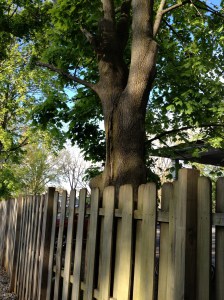
The world just doesn’t feel safe any more.  I’d better give a little context as to why.  You see, I just learned that what I thought was the work of carpenter ants is actually that of carpenter bees.  I never knew such things existed!  This still might not give you the thrills you were hoping for, so here goes a true story: when I was maybe six or seven my mother took my older and younger brother and me to a place in the woods where we could run around and holler and not bother anybody.  We had our dog there too, as well as our grandmother.  After a while my brothers started a game—throwing a stick to see who could get to it first, me or our dog.  I was running along, stepped on a stump, closely followed by the dog, when a swarm of angry yellowjackets flew out.  I was wearing shorts at the time and received multiple stings on my bare legs.  We didn’t think our dog would survive; he was completely covered.  So I have a thing about bees.

My phobia isn’t as bad as it used to be.  I’ve been stung many times since, and it always feels like an insult as well as a bad memory.  (I still don’t wear shorts, except on very rare occasions, when the bee quotient is zero.)  Believing in turning the other cheek, I’ve even captured and released bees from the house rather than killing them.  Still, to this day, when I get a haircut if the woman pulls out a set of clippers you have to pry my fingers from the naugahyde when she’s done.  Anything that sounds like buzzing near my ears sends me into spasms of terror.  Please pardon the graphic fear.  It’s heartfelt.

I used to have nightmares about killer bees.  I still worry about them a lot, and wonder that if, instead of a wall, we might put up a massive, small-weave net this side of Texas.  I don’t know how high they fly, but we should try to do something, don’t you agree?  Now I’ve learned that bees can eat you out of house and home, literally.  The carpenter bee, to the untrained eye, looks like a bumblebee.  They’re big, heavy-bodied insects that can crawl through three-eighth-inch holes, perfectly round the insect guy tells me.  They’ll eat and mate, and release their larva, ready to grow stingers, into the world of my back porch.  They appear to enjoy the global warming, judging by their numbers.  Maybe it’s a good thing we settled not far from Nazareth because a friendly carpenter might soon come in handy.