Why Horror?

Some people wonder why I like horror. Well, “like” is hardly the proper verb here, I’d rather go the passive route—why I’m compelled by horror. That fits better. But isn’t compel a transitive verb? What’s the object? It really depends on the circumstance—compelled to read, watch, or look at. Quite apart from grammatical imponderables, I keep finding myself coming back to horror and I frequently wonder why. Mathias Clasen may have answered that question for me. Why Horror Seduces is a fascinating study that considers biological and psychological explanations for why we’re compelled to watch or read or play horror, even when we find it distasteful. And it’s not just excusing bad behavior!

As fairly weak creatures that are prey as well as predators, human beings have always placed a high value on security. We’ve driven most of our predators to extinction, but we still have other people to worry about. And microbes. And things that come from space. And, after all that, we still die. These are, realistic or not, things we must face. Horror allows us to confront them and assists us in considering “what would I do if…?” Clasen delves into an evolutionary theory of horror—we’ve evolved to need it. Negative emotions are some of the most ancient, leading us to self-preservation in a hostile environment (something our own government is teaching us anew even now). Watching or reading how people cope in such settings provides us with valuable information. In other words, horror is a learning opportunity.

From that perspective, it doesn’t feel so bad to have written a book about horror movies. I’m participating in the long struggle of humankind against forces that are out to get us. As with most things evolutionary, we need not know why we do them for the whole thing to make sense. Our brains reward us for behavior that is conducive to survival—we like to eat, sleep, and reproduce. Reward centers in our heads go crazy. Then we go to the theater to see the latest, greatest horror film. What may seem counterintuitive here is that we are engaging in a similar kind of activity to other atavistic survival techniques. Watching these movies, reading these books, (and for those who do so, playing these games,) has a basic biological utility. Who knew? And once I get brave enough to crawl back out from under the bed, I may feel better about myself for admitting I like horror.
Devolving Apes

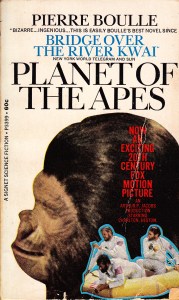
It would be difficult to overestimate the effect the movie Planet of the Apes had on me as a child. Raised a biblical literalist, evolution was, naturally enough, anathema to me. And yet here was a movie based on the idea that evolution had taken a different course. It was a transgressive film, but the screenplay had been written by Rod Serling, so well known for his trusted work on The Twilight Zone. I was utterly fascinated by it. Until the most recent iteration, I’d seen every sequel, spinoff, and reboot ever made. So important was this story line that as a child I found a copy of the book, in English, of course. Pierre Boulle told the story somewhat differently. Spying the book on my shelf after some four decades of my own evolution, I decided to read it again.

We all evolve. I noticed the improbabilities more this time through. The fact that, unlike the movie, humans wore no clothes at all must’ve scandalized my young eyes. I would’ve agreed, however, with Ulysse Mérou’s sentiments that humans were created in the image of God, not apes. In fact, there is an undercurrent of a somewhat conservative theological outlook here. Humans may experiment on animals, but when it’s reversed, it’s evil. In many ways, the cinematic version improves the story, but Boulle’s telling grows in intensity as the novel unfolds. Mérou develops a moral sense that includes the apes as well as human beings. The story, of course, is largely about prejudice and its evils. In that respect, it’s timeless.

As a child I realized that we lose something if we accept the fact of evolution. We lose that special feeling of having been intentionally created by a deity that made us God-shaped. Ironically, I also came to realize that those who rejected evolution often treated their fellow humans like animals. They held onto prejudices against other “races.” They castigated the poor for being lazy. They wish to remove healthcare from those made in the image of God. The contradictions and cruelties simply don’t comport with the Good Book they adore and ignore. Evolution, with the realities of nature impinging on our security, is far less dangerous than what biblical literalism has evolved to be. I can’t say why this book and its cinematic renditions became so deeply embedded in my young mind. But having read the book again, it’s pretty clear that the ideas have remained there, even as they have modified, with descent, over time.


Milkweed and Honey

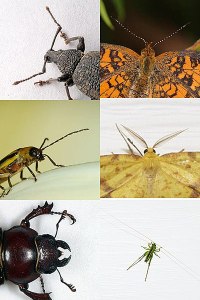
I’ve never thought of bugs as an ethical concern. Well, not directly anyway. I had some truly frightening encounters with insects and arachnids as a child, so I tended to avoid bugs when I could. At times, I hesitate to admit, I took advantage of my size and smooched them. I did, however, mature out of that. Many years ago I stopped killing bugs that got inside, choosing instead to favor capture and release. I’d trap them in one of a variety of empty peanut-butter jars we kept around the house expressly for that purpose. The imprisoned intruder is then escorted outside and released. It seemed the only fair way to handle the situation—I don’t believe in exploiting size, and hating things with too many legs is prejudicial. Then I heard that insects are dying out.

Public domain, from Wikimedia Commons

Instead of bringing glee, this instilled a kind of panic. According to a story in the Washington Post, scientists have noted a 75% drop in bug biomass over the past several years. Stop and think about that. Insects contribute so much to our lives that we barely pay them any mind. Everything from pollination to breaking down decomposing organic matter, bugs do it. We need our insects. As with most things these days, it seems that we humans are the likely culprits. We destroy habitat, we spread pesticides everywhere, we try to take all kinds of land and make it in our own image. And we’ve sacrificed our insects along the way. As the article states—driving around country lanes on a summer night doesn’t bring up the windshield splatter that it used to. I stopped to think about that. It seems to be true.

The tiny members of the animal kingdom do a tremendous amount of work. I know they’re not doing it for us, but the things they do we don’t have to—and oftentimes can’t—do. All fruits and vegetables are pollinated by insects. Honey has been the main place where some of this shortage has been felt most directly. Bees have been disappearing. So have monarch butterflies. The fact is, we can’t live in a world without bugs. This does make it an ethical issue. If we’re going to claim dominion over all things we have no right to overlook the smallest creatures. Sure, they can, well, bug you. They fly in your face or bite you while you’re sleeping. They’re only doing what they evolved to do. I don’t mean to bug you about it, but we need to look after the minuscule and vulnerable among us.


Learning to Evolve

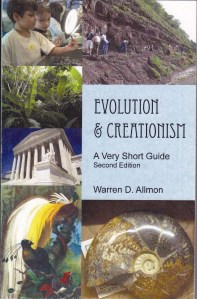
Not to beat a dead hadrosaurus, but creationism is in danger of driving us extinct. On a visit to the Paleontological Research Institution’s Museum of the Earth in Ithaca, I picked up a copy of Warren D. Allmon’s Evolution and Creationism: A Very Short Guide. Although I’ve read plenty of books on the subject, a refresher is never a bad idea. When it came to statistics, though, it grew scary. The majority of Americans do not accept evolution, despite all the evidence for it. What’s even scarier is that a large percentage of physicians—particularly Protestant ones—do not accept it either. Allmon is writing for a local readership, but these issues are quite large. World-wide, in fact. One thing most scientists don’t understand is that “religion” isn’t to blame. Literally reading of texts is.

Were it not for the creation myth in Genesis 1 there would be no conflict over evolution in Christianity or Islam. The question comes down to how one understands a sacred text. Many religious believers can’t get beyond the basic issue of if it took more than six days to create the world then that house of cards called biblical truth collapses. There’s a panic involved here. A very real and visceral fear that heaven itself is on the falling end of the balance. No amount of scientific reasoning will help with that. Hell is just too scary. And reason tells us that reason can’t solve this dilemma. Those raised religious by caring parents can’t believe that Mom and Dad would teach them wrong. Emotion plays a stronger role here than reason. More Kirk, less Spock. When even a majority of high school science teachers feel that “teaching the controversy” is okay, we’re in trouble.

Allmon’s book is well-intentioned. Of course, it was written before the post-fact world evolved. The stakes for not accepting reason (think Trump) are extraordinarily high. Having a figurehead that doesn’t accept rational explanations for what the educated can see plainly encourages widespread copycat ignorance. In the rational world there is no doubt about evolution. Most mainstream biblical scholars and clergy accept it. Don’t try to convince others with an argument, however. This is a matter of belief. Allmon does point out that science can’t speak to non-physical processes. It can say nothing about God. But a certain book can and does. Had it been written in modern times none of this might have become an issue. Until we realize the power of that book, we’re going to continue to struggle to come to grips with simple facts.


Trees, Please

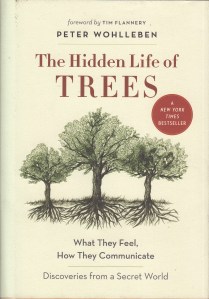
One thing we know about nature is that we don’t know much about nature. We can be a pretty self-absorbed species. Peter Wohllenben’s The Hidden Life of Trees is a good corrective for that. When we’re young we’re taught the difference between plants and animals. What Wohllenben shows is that such differences are more a matter of degree than we realize. Trees move, but slowly. Their timescale can be vast, compared to our brief, get-rich-quick outlook on life. It has been demonstrated pretty clearly that trees communicate with one another. They help one another, and they can, in their dendritic way, think. They cooperate with fungi to maintain connections between their root systems. Trees might even have what we would call personalities, were they fortunate enough to have been born human.

In a little like a medieval fantasy world, Wohllenben is a German forest keeper. He knows trees and their ways intimately. The trick, of course, is that we have a difficult time seeing things in timeframes that exceed our own. There are living trees that are 9,000 years old. That’s before the Sumerians ever showed up to invent writing. In human eyes, a lot has happened since then. And although we don’t know how to define consciousness, we’re sure that it’s limited to our species alone. Grudgingly we may admit some “higher” animals to the club, but our predilection for conquest of our world would be sorely diminished had we not other creatures to dominate. Looking at the world through a sympathetic lens, however, the fact that we’ve evolved these traits from the common ancestor we have with the animals should tell us something. As Wohllenben points out, animals diverged from plants at some stage, but we do ultimately come from the same stock.

Even on a practical level, we can’t live without plants. No matter how gourmet our foodies may be, our nutrition cycle begins with plants photosynthesizing food from pure light. There is perhaps a danger in recognizing our kinship with trees too closely. We depend upon them for food, shelter, warmth, and the oxygen we breathe. We might be inclined, as Wohllenben notes, not to use them at all. The key word here, however, is exploitation. We evolved along with plants and other animals and we all rely on each other. We are all connected. We should care for those with whom we share the planet. Trees have a much longer view than we do. When the desires of one species set the terms for all the others, we soon feel the pain of the trees.


Warnings Ahead

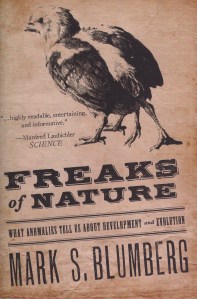
As a noun, “freak” is akin to a swear word. To refer to another person in such terms is often considered derogatory and degrading. Still, we all know what it means—an individual who doesn’t conform to expected models. I was a little worried about Mark S. Blumberg’s Freaks of Nature: What Anomalies Tell Us about Development and Evolution, then. It had the word “evolution” in the subtitle, and that sounded scientific enough. Besides, those of us interested in monsters know, deep down, that they are essentially freaky things. Indeed, Blumberg starts his book with teratology, the study of monsters. And monsters come from religious backgrounds. Their name is related to the root “to warn.” I’m a squeamish sort, though, and reading about freaks of nature requires a constitution I sometimes lack. Especially when it comes to science.

Yet I couldn’t put the book down. To begin with, the concept of developmental evolution (devo evo, for those in the know) is utterly fascinating. If you grew up, like I did, being taught that genes govern evolution solely, this book will surprise you. Evolution can happen at the level of the phenotype, based on environmental pressures. This is well documented and hardly a matter of dispute. Bodies can change according to what they need. Blumberg offers case after case where this dynamic may be seen. The idea that we are “programmed” falls, ironically, at the feet of biology itself. We, and all animals, are adaptive creatures. Humans may not be able to regenerate lost limbs, but many amphibians can. Sometimes it’s a matter of age, and sometimes it’s a matter of matter. I found such a quantity of astonishing stuff here that I overcame my queasiness to see what the next page might reveal. When I hit the chapter on reproduction I realized once again that nature does not agree that “man plus woman equals marriage.”

This must be one of the most threatening areas of science to Fundamentalists. The sheer variety of ways that “genders” interact in nature, and appear in human bodies, will have purists calling out for heavenly clarification. Reproduction, in other words, isn’t in the service of conservatism. Fish, for example, that change “genders” instantaneously after mating, taking turns being female and male with a mating partner, must surely call for theological justification of some sort. And female lizards that don’t require males to reproduce, but are helped along by being mounted by another female so as to jog some ancient reptilian memory, require us to rethink our rather simplistic terms of endearment. Not for the the faint-hearted, but amazing for those who dare, this book takes our appreciation for “life finding a way” to a whole new level. Even if it’s a little freaky.


Fall of the Titanosaurs

If I had it all to do over again, I might well have gone into paleontology. Like most kids, I grew up fascinated with dinosaurs. Then “real life” got in the way and you need to get a job since you can’t spend your time playing with your cheap plastic toys and dreaming Triassic dreams. There’s no future in the past. So I decided to study dead languages instead. Still, the recent discovery of Patagotitan mayorum is exciting. Titanosaurs—the really big dinosaurs—were not even known when I was a child. What we used to call “brontosaurus” was about as big as they got, but we did know that diplodocus was out there somewhere, even a bit longer. We didn’t have to worry about ark space in those days because we knew that extinction happens.

The current evangelical flavor of the day takes a hard line on evolution. Since it absolutely can’t happen and since there’s no denying dinosaurs, they must’ve crowded onto old Noah’s floating hotel along with everybody else. The problem is we keep discovering more and more large dinosaurs. Patagotitan was 122 feet long, without skin. It weighed more than ten elephants, making me wonder about water displacement ratios. Depending on your definition of that fuzzy measure of the cubit, the ark was only 450 feet long. And Patagotitan is only one of the titanosaurs that dwarf the already huge apatosaurus (the correct form of brontosaurus) and brachiosaurus. Even if they hibernated the sheer mass of reptilian tonnage wouldn’t leave much room for the latter ascendant mammals. That is, if mammals had come later and ascended.

Noah, despite being a traveler, never made it to Patagonia. In fact, the ark pretty much stayed still during the flood, coming to rest in Turkey after having been constructed somewhere just east of Eden. And since the Bible doesn’t mention continental drift we can’t even rely on Pangea to have gotten all the beasties to ark central on time. I’m guessing that Patagotitan was probably a slow walker. Since the continents were just like they are today, it must’ve been a fair swimmer as well. And it didn’t mind quarters just a touch claustrophobic for such a massive monster. What with all the home improvement shows these days, Noah might have considered an addition to the ark. But the Bible says God gave him the plan and one thing we know about the Almighty is that what he says he means literally. Dinosaurs or no.


Water Bears

Since we should all be busy planning on alternatives to planet earth, my mind has turned to tardigrades. Known as “water bears” these very simple animals are amazingly complex. Don’t go looking for them in your drinking water, however. They’re microscopic. So why am I thinking about tardigrades at a time like this? Because they’re one of the few organisms that scientists believe could actually survive the destruction of the planet. Who knows? They might even be able to survive in Washington, DC. Maybe that’s why they’re in The Washington Post.

You have to look closely to see one.

Able to cling to life at the cusp of absolute zero, in conditions with no oxygen, and at doses of radiation that would leave the human race—among most other species—fried, these micro-organisms are truly remarkable. No wonder scientists are playing with thought-experiments as to how to wipe them out. Hey, scientists are only human after all. Don’t worry—nobody’s really trying to kill these little guys off. The question behind Ben Guarino’s story seems to be what makes these tiny creatures so amazingly resilient. It raises an issue that I often ponder. The will to survive. Evolution is, according to standard theory, without purpose. Natural selection works in a “logical” way: the most successful organism survives long enough to breed and its traits become standard options in the next generation. Nobody needs to want anything (except to mate) and chance takes care of the rest. But that doesn’t explain the will to survive. The “eye of the tiger,” if you will. I’m sure this wasn’t what the Washington Post was intending to trigger, but doesn’t it seem strange that even “non-conscious” micro-organisms “want” to survive?

The desire to exist is dangerous territory. It has a whiff of the divine about it. One of the characteristics of life, if my high school biology isn’t completely outdated, is the ability to reproduce. What it didn’t address, for fear of teenage snickers, I’m sure, is the desire to reproduce. Why does life insist on its own continuation? Is it truly just an eons’ long succession of one-night stands that results in creatures capable of even asking that question? Or is there something more to it? Tardigrades have segmented bodies, legs, and claws. All at less than 40,000 cells per individual. They lack a neocortex (which doesn’t necessarily disqualify an individual from being president). They can’t answer the questions we put to them. As individuals they are remarkably easy to kill. As a species, however, their resilience carries the answers to some very deep questions. If only we had the will to ask them.


On Jordan’s Stormy Bank

All you have to do is spit in the cup. Well, you have to do it quite a few times, but that’s the basic idea. Then you send the contents to a religiously motivated lab and your genetic ancestry will be emailed back to you. (There will be a fee involved, of course.) Genetics, a science of which Darwin didn’t have the benefit, is capable of mapping out where various “races” originated and ended up. Enter the Bible. One of the most disputed groups among scholars of the ancient Near East is the Canaanites. There was, as far as we can tell, no “nation” called “Canaan.” No people called themselves “Canaanites” but the term was used by others to designate them. Yahweh had a vendetta against them and ordered them wiped out. And, according to parts of the Bible, the Israelites acquiesced. So where are the Canaanites?

Image credit: http://maps.bpl.org, via Wikipedia Commons

According to a Washington Post article by Ben Guarino, DNA sequencing has revealed that they’re still there. This should come as no surprise to most anthropologists. Racial purity is always partially a myth, since “race” is no barrier to love. Or at least lust. And genetic traits don’t lie. Tracing ancient DNA from “Canaanite” (I’m getting myself scared using all these scare quotes) burials, scientists have discovered the biblical nemesis still survives in abundance, especially in Lebanon. Interestingly, on a cultural level, there is no distinction between Israelite and Canaanite. They are virtually identical. This creates one of the many embarrassments for biblical scholars, since the differences should be more than just skin deep. As with so many cases of racial distinction, the reality is mostly imagination.

Literalists, of course, have been in a rear-guard position for well over a century now, so the news should cause minimal shock. The problem will be keeping them from finding new excuses to carry out an extinct mandate. Biblical scholars, that heathenish race, long ago capitulated with the enemy. You’d expect no less from those who would dare use reason when approaching Holy Writ. It’s the real-world application that’s a problem. What do you do when the biblical enemy is found, hiding in plain sight like a purloined Lebanon? The solution might be as old as the story itself. Darwin didn’t have genetics, but he did have the Bible. The issue in the nineteenth century was what to reject when worldviews clashed. The answer was to jettison the godless science. We can only hope that this time-honored technique will prevent future crusades fomented by scientific discovery.


Berrying Perspective

Two people looking at the same thing see something different. Since we’re living with a government of distorted perspective this truth appears refreshed daily. I was reminded of this while picking huckleberries. Huckleberries, according to the local edible berry guide, are called many different things. In this part of the country you know them when you see them. And if you see them you pick them. They appeal to the frustrated hunter-gatherer left in us city-dwellers. As I was trying my best to fill my bucket, I kept thinking of those who only see nature’s bounty as a means of turning a profit. In my mind they’re meanies—those who take all the fun out of the few freedoms we have left—although I realize that it’s a matter of perspective. Consider the huckleberry.

I’m a mere seasonal visitor to these parts. Since not too many of my own species make this location their permanent domicile, that’s perfectly natural. Many of the berry pickers I’ve encountered have been seasonal guests as well. There are the more “industrial” pickers, though. In a good year huckleberries can command fifty dollars a gallon on the local market. Unless you know an unfrequented secret site, a gallon can take several hours to pick even in a promising location. Overall, you need to arrive before anyone else and get the most productive bushes so that you don’t have to wander around the mountainside in search of a more lucrative locale. Not to mention that, like most berries, they have a limited shelf life. Nature prefers sharers to hoarders.

While I’m picking I generally think of bears. Unlike my species they don’t have the grocery store option. These berries are their survival, I suppose. Nature does provide. That’s how evolution works—we form symbiotic relationships with our environment. The meanies, however, can’t see beyond the self. What nature provides must be accumulated for my own benefit and not that of others. There are never enough huckleberries to go around, the industrial mind thinks, and so I’d better control the availability and set my price. You don’t even have to like huckleberries to do it. Ironically we call this having a gift. Standing here on this isolated mountainside, bent over a bush offering nature’s abundance, I believe that I’ve found a gift. I have to remind myself, however, that this too is a matter of perspective. It is a perspective that tastes right to me.


Clean Sweep

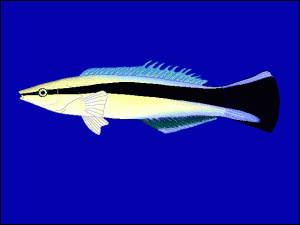
The other day I was reading about cleaner wrasses. These are the fish, usually in coral reef community, that establish a place of business, and other fishes who want to be rid of parasites come onto location to be cleaned. They allow the wrasses to nip them all over to get the pests taken care of, even allowing the smaller fish to swim into their mouths to work their specialization there. Kind of a mix between a visit to the dentist and the car wash. Documentary makers have filmed the process multiple times, and, being humans, we project onto the piscine scene a kind of business template—an exchange of goods for services. Then we turn back to our own lives and forget the underwater world.

Image credit: Robbie N. Cada, courtesy FishBase, courtesy Wikimedia Commons

Still, I have to wonder about what’s going on here in the realm of consciousness. We do not yet know what consciousness is, but we all recognize it in ourselves. We know we’re alive and conscious—except when we’re dreaming when we don’t seem to realize what’s going on in our brains isn’t really happening. Most of the time, however, we set our goals, have our intentions, and go about our business accordingly. What is the motive force that drives a fish to the cleaner wrasse’s studio? Isn’t there a level of consciousness involved to know that this fish’s house is where you need to be for this kind of treatment? Don’t the larger, predator fish know that if they eat the wrasse in their mouth they’ll have to find a new service provider? Are they aware of this or are they, as some scientists like to tell us, simply biological machines following their programming?

I’m not a scientist, but I see consciousness all around me. I watch the interactions of land animals—I generally don’t take trips under the sea, no matter what Sebastian says—and they are anything but simple. The birds on the wire and in the chokecherry trees have complex interactions. All you have to do is watch a single individual for a few minutes. They make decisions—the sky is a vast, open template with no obstacles, surely they have to decide why they want to go this direction and not that! And bowerbirds build nests as elaborate as Victorian mansions. Not that there are bowerbirds at my bus stop, or even in New Jersey. There are limits to how far even nature will go. As I stand here, waiting for my bus, I can’t help but think how like a cleaner wrasse I am. And I’m sure they must be conscious of what they’re doing since life’s all about the exchanges of goods and services.


Heresy Collection

Geology isn’t a great avocation for those of us with an unsettled existence. Having grown up with a fondness for fossils—maybe because they were so transgressive—my initial collection was tossed out because of a family move. Rocks are too heavy to take with you. I made the mistake of thinking, back in my Nashotah House days, that I was settled enough to let my rock-hounding sensibilities loose. Not that fossils were common, but Wisconsin has some great geological formations and I joined the Wisconsin Geological Society and even dragged my family along on some field trips. By the time Nashotah informed me my talents were no longer required, I’d amassed a few boxes that I was embarrassed to admit to the movers that, yes, contained rocks. New Jersey also has some great locations for rock-hounding, but my sense of being subjected to sudden, geologic career shifts has kept me from picking up nearly as many stones as I’d like to bring home.

The Museum of the Earth, here in Ithaca, is a dangerous place for someone like me to visit. I thought I had my fossil-collecting habit under control. The gorges in this region are famous for their fossils. Wandering through the museum, reflecting, as it does, the immense stretch of prehistoric time, it was obvious how arrogant humans are for assuming “control” of the planet. We’re so terribly late as to be classified as invaders on this planet. The world got by just fine billions of years without us. Perhaps that’s why I experienced transgressive fossils so captivating as a child. Ironically I found them in the creek bed right behind the Fundamentalist church we attended and where we were taught that evolution never occurred. I was fascinated by what I’d now call the juxtaposition of evidence and faith. We never questioned the reality of fossils. It was their interpretation that was the problem.

You can hold in your hand the most solid evidence that life evolved and call it heresy. Those delicate impressions of creatures dead for millions of years argue eloquently against Genesis and its mere 600 decades of world history. For me the fossils always won. On trips home from the seminary I would gather more fossils to add to the growing museum of time I’d been amassing in my basement. Then a Fundamentalist administration took the same approach as my exasperated mother trying to pack to move. Jettison the fossils. They’re heavy and they kind of make us uncomfortable anyway. Maybe the idea of too much time is something the biblically constrained simply can’t face. And when I see a fossil right there on the surface in one of Ithaca’s many gorges, perhaps I need to learn simply to let it lie.


Living Challenged

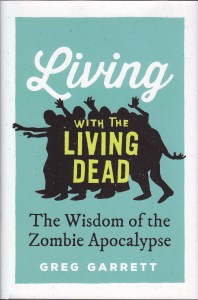
One of the surest signs of hope for the world is that academics are beginning to notice monsters. A trickle began some time ago and it’s probably best to call it a trickle still, nevertheless, the quality of the trickle is improving. Some serious publishers are now counted among the mix of those who pay attention to the lovable unlovable. Greg Garrett’s Living with the Living Dead: The Wisdom of the Zombie Apocalypse is one of the more recent approaches to the undead that looks for religious themes among them. They’ve been there from the beginning with zombies, of course, but few with tenured positions bothered to look. It’s an open question how long the current fascination with the undead might last, but Garrett’s treatment finds them useful sources of theological thought.

Perhaps the aspect of my own fascination that I feel most often compelled to explain is why fear has such an appeal. Garrett makes the point that fear often causes people to make bad choices, and I would have to agree. It is, however, the fear of fear that takes a greater toll. You see, fear is a survival instinct. Without fight or flight we’re all zombie food. Some of us learn this harsh lesson early in life, and if we manage to survive long enough we might even become nostalgic for it. It’s not that I like be afraid, but I do know that if we fear fear—if we avoid looking at what scares us—we put ourselves in danger that the flight response might well prevent.

Garrett’s treatment is helpful in demonstrating that there is a reason for such stories. In fact, according to his analysis zombies can leave you with a profound sense of hope. He uses the living dead as a means of thinking about community, ethics, and apocalypse. Not all end of the world scenarios are that bad. How we treat the living dead may tell us quite a bit about our own rectitude or lack thereof. In other words, zombies are more than their puerile thrills might suggest. There’s something of substance here. I don’t agree with all of Garrett’s conclusions, but he offers a stimulating tour of the current media frenzy around the living challenged and is surely correct that there is more going on with monsters than many of our parents would like to have a religion expert admit. Those childhood years might not have been wasted on monsters after all.


The Birds

While waiting for the bus, now that it’s light out that early, I like watching the birds. They have complex interactions and so many different styles of flying. They have ways that are a closed book to our species. From human eyes they seem so playful that it’s difficult to believe they participate in a struggle for survival. Evolution tells a different story, of course. Living not far from the great human nest of Newark’s Liberty Airport, it’s not unusual to see an engineered flying machine soaring high over their avian heads. Which, I wonder, are the better fliers? Birds, after all, evolved. Flying wasn’t planned, as far as we can tell. Although not so much around here, some birds don’t even fly.

I once read—many years ago and I can’t recall where—that if a person were to fly they would need an enormous chest to beat the very large wings they’d need for lift-off. Birds, apart from being naturally aerodynamic, have hollow bones which make them a touch fragile, but less tied to gravity. Our planes and jets, unlike the escape vehicle in Chicken Run, don’t flap. Bernoulli’s law keeps them aloft, along with some meticulous engineering and heavy fuel consumption. Humans may imitate nature, but they supersede it when they can. Still, I have to wonder why, if birds were a special creation as our literalist friends claim, God didn’t make them more like a plane.

Holding your wings out stiff all day, I’ll allow, would get pretty tiresome. Still, if you’re designing a critter to fly you might as well go with the best parts available, right? If not, I’m going to have a talk with my mechanic and ask for some of my money back. Birds, for all their charm, are very good illustrations of evolution at work. Dinosaurs taking to the air is so poetic that it has an organic feel. Flying is a great way to escape your land-bound predators. That step from long leaping to flying may be a doozie, but it seems to explain the shape of birds better than any intelligent design. Among bipeds, though, only one claims the place of being god-like in shape. Having said that, there are some flaws that a good biomechanical engineer might address. But then, who said God majored in engineering? When I went to college I was firmly under the impression that he’d majored in religion. And that, as many engineers might suppose, is for the birds.


Keeping Pace

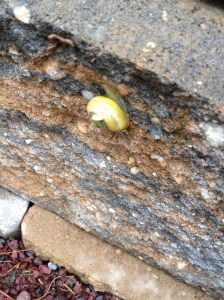
I had no idea my life was in danger. I was out for a weekend walk with my wife, when suddenly, there they were. Snails. In case you think I’m over-reacting, take a look at Christopher Jobson’s piece on Colossal titled “Why Knights Fought Snails in the Margins of Medieval Books.” One of the main points is that the snails were symbols. We tend to forget the power of symbols today. Even modern vampires no longer react to crucifixes—what are we supposed to do? For those who are willing to linger a moment instead of rushing on immediately to the next thing, snails give us quite a bit to contemplate. In a world that hates slow-pokes, “consider,” as my friend Ecclesiastes might’ve said, “the snail.”

As highly evolved cousins of the snail, we suppose we were cut out for greater things. We build towers. We make new nations. We watch them both crumble. On the ruins of those walls we find snails. They have very little to do and expend no worries about getting there on time. Nobody emulates them, although some masticate them. They tend to disappear when the sun is hot. They don’t like the limelight. Yet snails contribute to our world in ways we simply don’t take the time to contemplate. Our time has been commodified. We’re told when to sleep and when to wake for our jobs. Then we’re told none of it matters anymore since 45 has decided to change the rules with his latest tweet. And still the snails crawl.

Before I learned to fear them, I remember happy childhood moments finding snails. This was generally not at home since we rented even then, and landlords have a weird compulsion about landscaping. When wandering far enough from home I’d find snails crawling on stalks of damp grasses early in the morning. They fascinated me. If I plucked them off, they’d pull in their eye-stalks and retreat into their shells. So secure. So symbolic. Eventually I learned that I was obligated to move fast. Keep pace. Be measured by my productivity. Pharaoh’s watching, after all, and that quantity of bricks required isn’t getting any smaller. Not many, I would learn, share my appreciation of snails. It takes a great deal of confidence to go slowly. Those who routinely ignore speed limits won’t understand my symbolism here, I know. Still, I can’t help but think we have a great deal to learn from our cousins who remind us that time isn’t everything after all.