Biblical Hurricanes

Say what you will about western Pennsylvania, but it was a location fairly safe from natural disasters. My hometown was too far inland for hurricanes to cause much damage. A little too far east for Midwest tornadoes to touch down (mostly). Adequate-to-too-much rain, so wildfires didn’t occur. Not on any fault-lines that invited earthquakes, and volcanoes only thousands of miles away. We did get floods along the rivers during spring, but if you lived up the hill they weren’t much of a personal threat. It felt safe from the big news items of today. Leaving home for the sake of finding work moved me into Tornado Alley for many years, and currently, in New Jersey, in the range of hurricanes now and again. Still reeling from Hurricane Harvey and lack of effective national leadership, Irma is devastating lives, and Jose is in her wake. Then a massive earthquake rocks Mexico. It feels like the apocalypse.
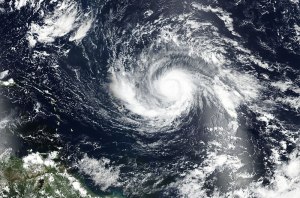
Image credit: NASA, public domain via Wikimedia Commons

Ironically, many people read the Bible as a linear story from the creation of the world in Genesis to the end of the world in Revelation. They make an obvious set of bookends. Unlike western Pennsylvania, Israel lies on a fault-line that means earthquakes are not uncommon. Droughts occur. And being right on the path between major empires, it was frequently subject to human disasters such as invasions. It was not the most secure place to write a book that would change worldviews for millennia thereafter. What is so fascinating about this is that the message (or more properly, messages) of the Bible gets lost in the conceit that this is somehow a story of the history of the world with lots and lots of pages of preachy stuff between the exciting bits at the beginning and the end.

In times of natural disasters, people turn to the Bible for comfort. There are verses, often pulled from context, that do a fine job of that. Nevertheless, the Bible is an enormously complex text. Of its many books, Genesis and Revelation have had disproportionate influence on society. Any natural disaster big enough can be called “biblical.” Since the time of William Miller and John Nelson Darby, such disasters have been interpreted as heralding the end of the world. It is scary to see the devastation a single hurricane can cause. When it is followed closely by a second, one can’t help feeling a bit like Job. The apocalypse, however, is a misreading of Revelation. The book ends with Heaven on Earth. And if you can find a quiet place to read, you’ll find plenty of unexpected stuff tucked away in the middle. Just don’t take it too literally since that too leads to disasters.
Noah’s Parable

I write a lot about Noah. For those who didn’t know me before this blog, I was once invited to write a book on Noah for a series ironically published by Oxford University Press. I had been researching Noah for years, and I intended to write the book. Then, as the kids are saying these days, life happened. My interest in Noah has never waned, however. And part of the reason is that it is perhaps the most influential story in the entire Bible. I realize I’ll need to explain that, but stop and think about it—Evangelicals seldom talk about Jesus any more. Their concerns are with unborn babies, people making babies outside wedlock, and destroying our environment in the name of capitalism. It is the last of these that brings us back to Noah.

A friend recently sent me a story on Splinter by Brendan O’Connor titled “How Fossil Fuel Money Made Climate Change Denial the Word of God.” O’Connor is looking at the history of how a pro-environmentalism-inclined evangelical movement decided to shift its base to align with climate-change deniers. Behind the scenes are fundamentalist clergy. Oh, we like to laugh at them and their ways, but they are the power behind the throne and we should really not let them out of our sight. You see, as O’Connor points out, they believe that the God of Noah can protect the world from the worst that we can throw at it. It’s perfectly okay to try to destroy the planet because the magic man upstairs can fix everything right back up if he needs to before sending his son back to town on the final business meeting. Laugh if you will. These people are dead serious and many who hold power in Washington believe every lie they utter.

As a nation—perhaps as an entire western culture—we’ve laughed off religion. Secure that there’s no God up there to rain down, well, rain, we laugh and jeer at Noah. It’s a children’s story, after all, isn’t it? Okay, forget about the part where everyone in the entire world drowns, except eight people. And when he gets drunk and lays naked in his tent after it’s all over. Other than that, it’s a kid’s story, right? The story of the flood is one of the oldest myths in the world. It has been part of human story-telling for millennia. We now have very powerful people with smart phones in their pockets and access to vast hordes of money who believe it literally happened. And since God took care of his own once, he can do it again. The educated smirk. The smart start building arks.


Fall of the Titanosaurs

If I had it all to do over again, I might well have gone into paleontology. Like most kids, I grew up fascinated with dinosaurs. Then “real life” got in the way and you need to get a job since you can’t spend your time playing with your cheap plastic toys and dreaming Triassic dreams. There’s no future in the past. So I decided to study dead languages instead. Still, the recent discovery of Patagotitan mayorum is exciting. Titanosaurs—the really big dinosaurs—were not even known when I was a child. What we used to call “brontosaurus” was about as big as they got, but we did know that diplodocus was out there somewhere, even a bit longer. We didn’t have to worry about ark space in those days because we knew that extinction happens.

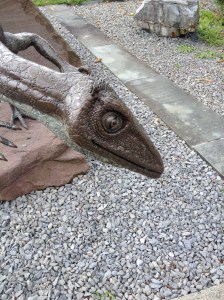
The current evangelical flavor of the day takes a hard line on evolution. Since it absolutely can’t happen and since there’s no denying dinosaurs, they must’ve crowded onto old Noah’s floating hotel along with everybody else. The problem is we keep discovering more and more large dinosaurs. Patagotitan was 122 feet long, without skin. It weighed more than ten elephants, making me wonder about water displacement ratios. Depending on your definition of that fuzzy measure of the cubit, the ark was only 450 feet long. And Patagotitan is only one of the titanosaurs that dwarf the already huge apatosaurus (the correct form of brontosaurus) and brachiosaurus. Even if they hibernated the sheer mass of reptilian tonnage wouldn’t leave much room for the latter ascendant mammals. That is, if mammals had come later and ascended.

Noah, despite being a traveler, never made it to Patagonia. In fact, the ark pretty much stayed still during the flood, coming to rest in Turkey after having been constructed somewhere just east of Eden. And since the Bible doesn’t mention continental drift we can’t even rely on Pangea to have gotten all the beasties to ark central on time. I’m guessing that Patagotitan was probably a slow walker. Since the continents were just like they are today, it must’ve been a fair swimmer as well. And it didn’t mind quarters just a touch claustrophobic for such a massive monster. What with all the home improvement shows these days, Noah might have considered an addition to the ark. But the Bible says God gave him the plan and one thing we know about the Almighty is that what he says he means literally. Dinosaurs or no.


Making Lovecraft

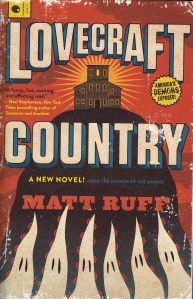
Perhaps it’s all just coincidence, but once in a while a number of unexpected things come together. Since I do a lot of reading this often happens in the context of books. The current case begins with my first noticing Matt Ruff’s Lovecraft Country. I saw a review online, and since I enjoy contemporary novels that build on the worlds created by H. P., I added it to my reading list. The first coincidental aspect of it was that I found in Buffalo Street Books in Ithaca. Like most independent bookstores, it’s not huge, so the selection of books that cater to my odd tastes is always adventitious. I found it on the staff recommendation shelf and recalled that it was on my reading list. A second coincidence came in finding Neal Stephenson’s name under a cover blurb. My brother-in-law’s name is enough to get a book onto the bestseller’s lists, but I had no idea this kind of book would be to his tastes as well.

I began reading it right away. The third happenstance is that Ruff crafted a biblically literate story here. In a day when those of us associated with the Bible are definitively passé, it is nice to see popular fiction fighting back a little bit. Not that Ruff is advocating or proselytizing, but his finely tuned story is definitely enhanced with a bit of biblical knowledge. He’s unapologetic about it. In our religion-critical outlook these days we sometimes forget that the Bible has several stories that maintain, and even reward, contemporary interest. The most obvious example in Lovecraft Country is the story of Cain. There are plenty of others that can be dug out as well, and Ruff even leaves some on the surface so that they aren’t hard to find. Not that this is a religious book. It’s just not afraid of religion.

Some may find that odd in a homage to the noted atheist Lovecraft. What they may not see is that the master himself used religion from time to time in his tales of horror. Also, for those who are willing to be honest, we know that an unsavory racism resided in Lovecraft’s outlook. Ruff, like other writers who see the positive side of this author’s work, tells a story of African-American struggles in the “idyllic” 1950s. The protagonists, dropped into a world of real Lovecraftian magic—and in a very self-aware way—are all a close-knit black family and their friends. Which led to another coincidence. Quite unconnectedly, I’d been reading Dr. Jekyll and Mr. Hyde. This plays an important part in the story as well. Sometimes reading itself can lead to a cascading set of coincidences. Lovecraft Country is one instance where it happened, but that may just be my unusual taste in books.


Heresy Collection

Geology isn’t a great avocation for those of us with an unsettled existence. Having grown up with a fondness for fossils—maybe because they were so transgressive—my initial collection was tossed out because of a family move. Rocks are too heavy to take with you. I made the mistake of thinking, back in my Nashotah House days, that I was settled enough to let my rock-hounding sensibilities loose. Not that fossils were common, but Wisconsin has some great geological formations and I joined the Wisconsin Geological Society and even dragged my family along on some field trips. By the time Nashotah informed me my talents were no longer required, I’d amassed a few boxes that I was embarrassed to admit to the movers that, yes, contained rocks. New Jersey also has some great locations for rock-hounding, but my sense of being subjected to sudden, geologic career shifts has kept me from picking up nearly as many stones as I’d like to bring home.

The Museum of the Earth, here in Ithaca, is a dangerous place for someone like me to visit. I thought I had my fossil-collecting habit under control. The gorges in this region are famous for their fossils. Wandering through the museum, reflecting, as it does, the immense stretch of prehistoric time, it was obvious how arrogant humans are for assuming “control” of the planet. We’re so terribly late as to be classified as invaders on this planet. The world got by just fine billions of years without us. Perhaps that’s why I experienced transgressive fossils so captivating as a child. Ironically I found them in the creek bed right behind the Fundamentalist church we attended and where we were taught that evolution never occurred. I was fascinated by what I’d now call the juxtaposition of evidence and faith. We never questioned the reality of fossils. It was their interpretation that was the problem.

You can hold in your hand the most solid evidence that life evolved and call it heresy. Those delicate impressions of creatures dead for millions of years argue eloquently against Genesis and its mere 600 decades of world history. For me the fossils always won. On trips home from the seminary I would gather more fossils to add to the growing museum of time I’d been amassing in my basement. Then a Fundamentalist administration took the same approach as my exasperated mother trying to pack to move. Jettison the fossils. They’re heavy and they kind of make us uncomfortable anyway. Maybe the idea of too much time is something the biblically constrained simply can’t face. And when I see a fossil right there on the surface in one of Ithaca’s many gorges, perhaps I need to learn simply to let it lie.


Scaping By

Failure is a part of life. We don’t like stories about failure, however, unless the protagonist goes out with a memorable bang. So it is that when we fail we start looking for a scapegoat. Now it’s a little too early to tell if Ken Ham’s Ark Encounter can be considered a failure. According to a story on Friendly Atheist, “Ken Ham is Now Blaming Atheists for the Economic Failures of Ark Encounter,” the ark may be loaded with dinosaurs, but not money. People need their myths, yes, but myths that take themselves too seriously often fail to convince. Atheists, even the friendly variety, have always been convenient scapegoats. I wonder how many scapegoat species are in the Ark Encounter.

I don’t know about you, but I’m curious about the Ark Encounter. I don’t want to go because I don’t want them to have any of my money. As I’ve told academic friends who visit—I just can’t see contributing to their cause. Although the Right seems to implode when it reaches power (there are far too many selfish people in the Party, and selfishness leads to easy splintering) one thing that it has is money. Think about it, the extremely wealthy are on their side. If I was given a free pass I might find it worth my while to wend my way back down to Kentucky. Who doesn’t like a spectacle? And I would like to see how they represent scapegoats in their dioramas. Besides, with sea levels rising from “fictional” global warming it might not be a bad idea to get a few tips on how to build an ark, no matter what you believe.

You only fail when you fail to try. That was a phrase a friend used to repeat to me before disappearing from my life. A friend from college once told me that I had to stop admitting my failures if I wanted to move ahead in life. There is a danger in easy appearances of success, however. Failure can be a very noble teacher. There are mornings when I’m walking across Manhattan, passing the homeless in their blankets on the street, and I realize that I would not be where I am were it not for failures. I could hide them, but if I haven’t learned from them they’ll only burst out of the closet again when it gets too full. Is Ken Ham’s Ark Encounter a failure? It’s far too early to tell. One thing we know for sure, however, is that scapegoats will never be an endangered species even if there’s a world-wide flood.

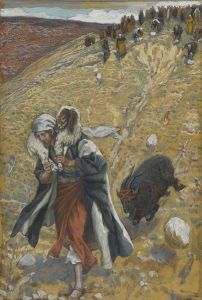
James Tissot,Agnus-Dei: The Scapegoat (Brooklyn Museum via Wikimedia Commons)


Spiritual Spelunking

Looking at the headlines it’s sometimes difficult to believe we’ve evolved. I still trust evidence-based science, despite official government policy, however. So when a friend sent me a story about a new human cousin I knew it was worth a look. Homo naledi bones date from much more recent times than they should. At less than 400,000 years old (which means they might fit GOP ideology pretty well) they are almost contemporary with Homo sapiens. And, apparently, they buried their dead. Now much of this is still speculation. The bones were found in caves with openings so small that onlyfemale spelunkers could fit in, and the question of whether dropping bodies in a hole counts as burial has raised its head. Still, the human family tree is being redrawn, and in a way conservatives won’t like.

I became interested in evolution because of Genesis. My mother gave us a few science books as children even though we were Fundamentalists. One of them talked about evolution and I was intrigued. Clearly it didn’t fit with the creation story—I was young enough not to notice the contradictions between Genesis 1 and Genesis 2—and yet scientist believed it. They likely weren’t Christians, I reasoned. College gave the lie to that deductive thinking when I ran into Christians teaching the required “Science Key” who believed in, and yes, taught, evolution. I’d missed something, obviously. Once I discovered evolution could coexist with Scripture I was eager to learn as much as a non-biologist could. In my teaching days I focused on the early part of Genesis and even began to write a book on it.

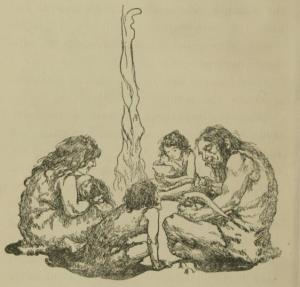
Image credit: Margaret A. McIntyre, from Wikimedia Commons

It’s much more honest to admit that we’re related to the rest of life on this planet than to set ourselves aside as something special. Evolution has done something that the Bible never could—brought all living things together. There are too many towers of Babel and chosen people themes in Holy Writ to allow for real parity with our fellow humans, let alone other creatures. Yet the human family tree is wondrous in its diversity and complexity. We now know that Neanderthals were likely interbreeding with Homo sapiens and I wonder how that impacts myths of divine chosen species. Did Jesus die for the Neanderthals too, or just our own sapiens sapiens subspecies? You can see the problem. For a literalist it’s just easier to crawl into a cave. But only if the opening is large enough to admit males, since the Bible says they were created first, right?


Wall-E of Separation

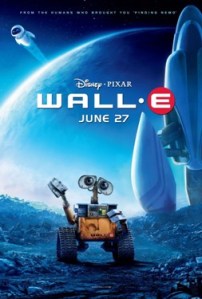
io9 is a progressive website. Its futuristic stories delight and entertain. When a friend sent me a story on io9 titled “New Fan Theory Asks the Obvious Question: Is Wall-E Satan?” I had to read. Then wonder. People know so little about the Bible. The idea is simple: in Wall-E the people live in an undisturbed paradise until Satan (in the form of EVE’s plant) tempts them to leave paradise and return to an earth they’d forgotten existed. Okay, so the Genesis parallels are blindingly obvious (Peter Gabriel was even formerly a member of a band named with the title of that very book). What’s wrong is that there’s no Satan in the Bible’s first book. I give Katharine Trendacosta credit—she discounts the connection of fat, immobile future humans and paradise. The idea that the snake of Genesis is Satan, however, is about as biblical as original sin.

Genesis never calls the snake Satan. It doesn’t mention original sin. In fact, many (Christians, especially) don’t realize the event isn’t called “the fall” in the Hebrew Bible at all. The gaining of knowledge by the first human beings is painful yes, but can be a good thing. Some Jewish interpretations of Genesis 3 suggest precisely that. The story goes that Eve and Adam were living, stupidly, in the garden. The snake points out that the fruit will make them wise—and it does. They do not immediately die as God said they would. Instead they lose a blissful ignorance and have to grow up. The serpent is never said to be the Devil until the very last book of the Christian revisionist scripture, Revelation. Sometimes a snake is just a snake. That’s the way it is in the book of Genesis.

Christian interpretation, however, took over the story of humanity’s awakening and made it into the fall into sin and evil. Things have been so bad ever since than that we have to elect Trump to start a war that’ll end it all. That’s Christian revisionism writ large. Read Genesis again. Slowly. The snake is not said to be Satan. “The fall” isn’t sinful. In fact, the word “sin” doesn’t occur until the story of Cain and Abel in the next chapter. So, is EVE inspired by Satan to end the paradise of the Axiom, unaware of its true origins? Only in a revisionist history of the Bible. The idea existed long before io9, and, according to Genesis, it was wrong even then.


The Cost of Chaos

BathingTheLionJonathan Carroll’s novels are always thought-provoking. My reading patterns tend to be driven by book sales and secondhand stores since my reading vice is particularly aggressive. The Ghost in Love is now already years in my past, but I found a copy of Bathing the Lion that I could afford and I was soon dropped into a world of chaos and order. I won’t try to summarize the complex plot here, but I would note the story’s participation in one of the oldest themes of literature—the struggle of order against chaos. The characters called “mechanics” in this book are those who attempt to maintain order throughout the cosmos. Many retire to earth. There, or here, they continue to work against the ever-encroaching chaos.

According to Genesis 1—not the earliest literature, but still fairly ancient—creation is God making order out of chaos. The universe, prior to creation, consists of uncreated, chaotic raw material. Order is what makes our world recognizable. Elsewhere in the Bible creation takes the form of a struggle against a conscious monster that represents chaos. This motif is reflected elsewhere in the ancient world in texts such as the Enuma Elish. Actually, the theme is so common as to be classified as a standard trope of ancient religions with its own name—Chaoskampf. Chaos is always waiting in the wings, ready to break back in and make a mess of our nicely settled existence. The flood story, placed as it is just after creation, is an example of what happens when chaos regains the upper hand.

The battle to maintain order represents a kind of ancient awareness of entropy. If energy isn’t expended, that which is accomplished becomes a wet, stinking mess and anyone who survives has to start all over again. This story is deeply embedded in human consciousness. To our way of thinking, we’re integral to the running of this universe. Spending time in nature gives the lie to this thought. There aren’t that many predators left, but those that are here—cougars and grizzly bears especially—remind us that in the eyes of nature we can be just another meal. Our outlook cannot accept such a low position. As Carroll has the mechanics say, they are not gods. Like human beings, however, they take on a role next to that of divinity. Chaos is the enemy, even garbed in the colors of making us great again. There are still those who will bathe the lion.


Eve’s Apple

Rituals rely on unchanging circumstances. When we attended a grocery store that was not our usual one my ritual was challenged. First I have to confess (as is appropriate for a ritual): I am no foodie. Having grown up in humble circumstances where eating out was an unknown, eating in meant the basic food of the unsophisticated. Although college and subsequent years opened my appreciation for new, and sometimes exotic foods (before my vegetarian days I ate ostrich when taken for dinner on a job interview. I didn’t get the job and shortly became a vegetarian—some things just aren’t worth it) I’m still a pretty boring grazer. I take the same thing for lunch each day at work. I eat the same thing for breakfast every day—inspired by the Seventh Day Adventist predilection for cereal—and I imagine my wife finds grocery planning with a guy like me to be its own trial. I see the grocery bill and scream. I eat to live, and not vice-versa.

Eve

So we were in a different grocery store. I take the same fruit for lunch every day, but here my apple of choice was more expensive. I looked for something in the price-range that I feel is affordable for fruit. My eye fell on a variety of apple I’d never seen. It was called Eve. Apples are one of those staples that I’ve always appreciated. We still sometimes go apple picking in the autumn, but it’s difficult to eat them all up before they go bad. In the orchards they list the different apple varieties available for picking on any given weekend, and I had never seen an Eve apple. For my boring lunch (since I eat breakfast about 3:30 most days, by noon anything tastes good for breaking the second fast) I wondered if Eve would do. Would this be too exciting for work? I pondered the dilemma.

Although our culture is increasingly biblically illiterate, here was a breed of apple based on Genesis 3. The Bible, of course, does not name the fruit of the tree of knowledge, and the apple was likely chosen much later because of the similarity of its name in Latin to the word for evil. The image has, however, become iconic. Eve reaching for the apple is so well known that advertisers use it with abandon and nobody fails to get the reference. This story is deeply embedded within our culture. The Bible on the grocery store shelf. Still, I’m wondering—should I try something new? Thinking of the work week ahead, I’m tempted.


Monkey Puzzle

One of the unexpected consequences of Christian theology is the ongoing insistence in science that human beings are qualitatively different from other animals. Actually, it goes back to the Hebrew Bible and the concept of “the image of God.” As the absolute line between human and beast continues to blur (intelligence, tool use, language use—you name it) mainstream teaching has trouble admitting that our special differences aren’t that different. A Washington Post story by Darryl Fears describes how capuchin monkeys have been using tools to extract cashews from their toxic husks for at least 700 years. These monkeys use a two-rock system to get at cashews, which, in their natural state, are inedible. The surprise here is that this makes these monkeys denizens of the Stone Age and capable of teaching complex behavior to their offspring.

Animals watch parents to learn to eat—it might seem to be a simple idea. In reality it’s more complicated than that. As I watched a doe and fawn foraging the other day, it occurred to me that what we call “instinct” is a way of getting around admitting animal intelligence. Why would a newborn (“unconscious”) animal seek to feed, or flee from predators? We call it instinct, but what we really mean is a form of will, a desire to survive. This “will” pervades nature well below the human-animal divide. Plants strive to thrive, and exhibit a “will” to live. By just taking all this for granted and calling it “instinct” we’ve further cut ourselves off from the organic world of which we’re all a part.

Christian culture gave rise to scientific method. No doubt this is an embarrassing scenario for those who believe science should reduce all the wonder of being alive to mathematical equations. Can’t we just pretend that rationality was creeping in from the beginning? Aristotle was going that way wasn’t he? But his work was “lost,” only to be recovered by Muslims who saw the value of such logical thinking and Christians—in an over-simplified history—wanted to catch up. Meanwhile, in the Dark Ages monkeys were using an intricate system to extract tasty nuts from toxic casings without the benefit of any religion at all. The Stone Age, we easily forget, was the first recognizable step on the road to the technological world we inhabit today. And we continue to use an outmoded paradigm to understand our place in that world.

391px-Organ_grinder_with_monkey


Ham’s Ark

Noah and his ark have been in the news quite a bit over the past several months. A friend recently shared a story on American News X about Ken Ham’s Ark Encounter, soon to open in Kentucky. It may be open already, but I haven’t been down yonder lately. I’m not going to attempt to match the well-deserved snark of Thomas Clay’s article, but I did find the design of Ham’s ark worthy of comment. I’m afraid I’ll have to wait while you check the article since photographs are covered by copyright and, well, I haven’t been down yonder. What first strikes me about Ham’s ark is that it has a rudder (as well as a keel). The Bible does imply that this was the first boat built, but then it also states the plans, like the Bible itself, came directly from God. The Almighty surely understands fluid dynamics, but I was wondering what the rudder was for. Did Noah plan on going someplace? Presumably in his flat world he’d have wanted to just stay afloat over the same place since, to quote another scripture, “there’s no place like home.”

Genesis doesn’t say anything about a rudder. In fact, apart from the inexact measurements in cubits, all we know about the ark are the following features:

•its dimensions (300 cubits by 50 cubits by 50 cubits; RMS Titanic, by comparison, was approximately 548.5 cubits long)
•it had three decks
•it had a door
•it had a window.

The Ham-style ark design is based on that advocated by Sun Pictures some years back as being especially seaworthy. Nobody knows what gopher wood is, but there was plenty of it around since all the plants were considered expendable in the face of a flood that would kill everything. But a rudder?

The biblical ark took its cue, somehow, from the much older tale of Utnapishtim. There are even earlier versions than that in the Gilgamesh Epic, but the parallels between Gilgamesh and Genesis have been known for well over a century now and are pretty remarkable. The original ark, however, was a cube. It had six decks. Now a cube of wood—even gopher wood—would sink like, well, a cube of gopher wood. Such a ship wouldn’t require a rudder to help it find the bottom of the New World Ocean.

Before my academic career took a tumble I was slated to write a book on Noah. Too bad that never happened, what with all the interest these days. A cottage industry in making arks has been launched. As modern-day arks sail, or at least get towed, through the present-day oceans, or are built high on dry ground, we can be glad for a rudder in the prescient mind of the sender of all floods.

Photo credit: Centre for Research Collections University of Edinburgh, via Wikimedia Commons

Photo credit: Centre for Research Collections University of Edinburgh, via Wikimedia Commons


Noah Way

As a fleet of Noah’s Arks near completion, some critics would like to stop these Titanics from their mythical crossing. The Ark Encounter, despite announcements of its demise, is set to open soon in Kentucky. This Noah’s Ark replica, unlike its seaworthy compatriots, is land-locked in bluegrass country. According to a story originating in the Lexington Herald-Leader, Tri-State Freethinkers tried to take out billboard ads suggesting the ark advocates genocide and incest. Well, marrying first cousins has been done before (think about it). And if you go back ten generations things get even a bit dicier with Cain’s wife and that of Seth. All in the Family wouldn’t even air for 6000 years. As for genocide, well, this was more like genomicide. Not a race, but an entire species, apart from kissing cousins, was about to learn the hard lesson of being born not of chosen stock.

According to the article billboard companies have rejected the Freethinkers’ proposal. It might cause accidents, they suggest, which, although not technically genocide, do take the lives of the innocent, even in dry weather. The flood divides people. Thus it always has.

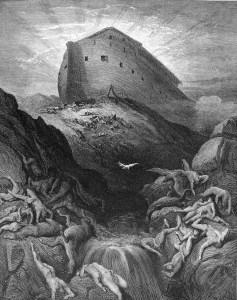
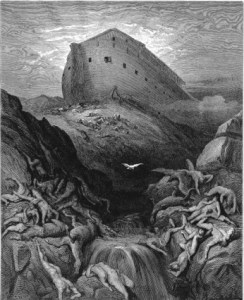
Dore_arch_noah

The culture wars, curiously, pick strange targets. I’m not in favor of teaching children to read myths literally, but then, I’m not in favor of bringing them up as materialists either. There used to be a concept called the “via media”—the middle of the road. Now such a stance appears decidedly wishy-washy. Milquetoast anyone? It is much better to be combative. “Oh George, you’re always so forceful,” sighs Winifred. So we teach our children. Boys, push your way to the front.

Implications can be tricky things. Allowing opponents, no matter how naive, their say has always been a mucking out of the Augean stables. Nobody likes to accommodate other points of view. Watching the parade of politicians we must be assured that we alone are right. Still, the stillborn billboard has a point. Building arks is the sign of the ultimate intolerance. Not only do you condemn those who differ to the outside, you are giving them a self-righteous death sentence. Maybe the billboard should stand. Or maybe it should not. What would Charlie Brown do?


Narrative Ark

Complete with an artificial giraffe perched on its prow—or aft, I can never tell the difference—a modern-day Noah’s ark is about to set sail. Or set float. The Bible doesn’t describe any kind of steering or propulsion for the ark since its main job was not to sink. According to a story on Huffington Post by Nina Golgowski, the life-size “replica” of Noah’s ark from the Netherlands (that I’ve posted about before) is about to go to sea. Spreading the good news as it goes, it is headed for South America, according to the story. Then the itinerary heads north, where the most rapid true believers can be found. Perhaps intentionally the ark is headed toward the godless left coast rather than hitting the Bible Belt. The fact that an imaginative reconstruction of a mythical ship can float may save many from Hell. A few questions, however, remain.

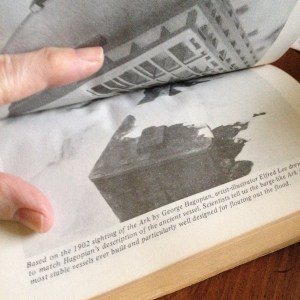
I’m a visual guy. I study pictures rather than just look at them. As a kid I was amazed at the sheer variety of arks that claimed to follow Noah’s blueprint. Reading the account in Genesis, it is clear that all that’s given are measurements—in cubits, no less—and instructions to make three decks and a window. The Dutch ark follows the design made popular by the 1977 Sun Pictures’ In Search of Noah’s Ark movie. The design, I recall thinking as a teen, looked slick and scientific. Engineered to withstand a fake storm in a bathtub, this has to prove something. When rock outcroppings on Mount Ararat were photographed from satellites and military jets, they suggested this was, in fact, correct, some of the time. Close-up photos were inevitably lost as sherpa after sherpa fell into hidden crevasses with the camera still in hand. Now they won’t let you climb the mountain, just in case.

The drawing that launched a thousand, or at least one, ark(s).

The drawing that launched a thousand, or at least one, ark(s).

Apart from the ark design is the more important question—the question about leg room. With all our technology, and a world that has been pretty thoroughly, if disappointingly, explored, we still haven’t catalogued all the species on the planet. The ark had to hold all the species since evolution is a diabolical lie. Pugs had to be there as well as their non-ancestral wolves. Both African and Indian elephants. Black and white rhinos. Hippopotami, pygmy and economy-sized. It had to have been pretty crowded, and Answers in Genesis claims there had to be room for dinosaurs too. For me the question has always been those left off the ark—the fish. If the oceans are salt water and the whole world was flooded, whence the fresh-water fish? They couldn’t have evolved, since nobody does. That’s a head-scratcher. Good thing too, because there had to have been more than just two fleas on that ark.


Fast One Flood

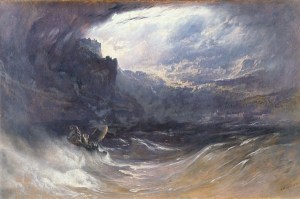
I’m not sure what to believe anymore. This crisis of faith revolves not around religion, but around media. Pundits have been saying for some time that the internet has meant the slow death of journalism, and there are so many websites that redistribute news that its like the whole world is involved in a constant, perpetual game of “telephone.” All of this is preface to a story a friend sent me that appeared on the website God. I’m not sure I trust God. The story is too good to be true. At least in a schadenfreude sort of way. God is hosted on thegoodlordabove.com, and, well, we all know about dot coms. The article concerns the destruction of Answers in Genesis’ Noah’s Ark theme park by a flood. That is believable. Floods do occur, as Noah knew. What becomes unbelievable is that the National Weather Service forecaster stated that there were no storm clouds in the area at the time. That qualifies as a miracle.

Martin,_John_-_The_Deluge_-_1834

Did this really happen? I don’t know. I wasn’t there. Plenty of times when I was there (wherever there happened to be at the time) I wasn’t even sure what happened. Can I find the truth? One of the police sites for internet rumors is Snopes (also a dot com). I remember when Snopes began as a place to quell fears of urban legends. Back when the worldwide web was young, there was a verisimilitude to stories gleaned from the net. Living in the sparsely populated Midwest, it was easy to believe that some of these things could happen to you. At times I held onto Snopes like a crucifix, especially if I had to go out alone at night. Snopes tells me that thegoodlordabove is not to be trusted. The story is false, like others that have originated on the site. Answers in Genesis, unfortunately, is still going strong with its theme park.

Authoritative texts aren’t what they used to be. There was a day when all you had to do was pull a black leather book off the shelf to find the definitive answers. In Genesis or any other of the books. Now we rely on the worldwide consensus of the web. You can’t trust God on a website. Snopes, however, is pretty reliable. It’s the Scully to our natural Mulder. That’s why the web will never have the same impact as print media. Even the website for your bank or government can be cleverly faked. I might’ve looked no further had the purported flood not fallen from a cloudless sky. I guess I’d better be a wary believer. For the internet tells me so.