Hallowed be thy Kane

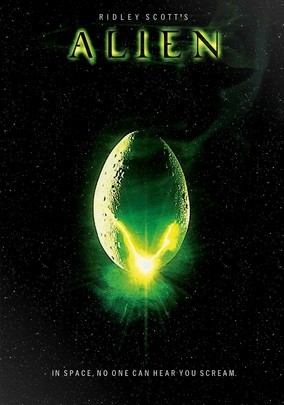
Watching the alien burst from Kane’s distended abdomen as he appeared to have eaten too much seemed somehow appropriate on Thanksgiving. I’m well aware that my taste in movies does not always match expectations and few bother to comment on my idiosyncratic observations. Nevertheless, it had been years since I’d watched Alien and on this particular holiday it felt like synchronicity. I’ve seen the film a few times before, but this is the first time since starting this blog. Not surprisingly, some biblical allusions popped out at me as I watched the crew of the Nostromo struggle with alien life. And I’d just read of NASA’s “exciting discovery” on Mars, a discovery whose official announcement for which, like Christmas, we’ll have to wait until December. Learning that the gut-busting alien was modeled on Three Studies for Figures at the Base of a Crucifixion by Francis Bacon (a contemporary one) only sweetened the analogy.

Character names hide aspects of personality and intention. Sometimes the writers may not even be aware of all the shades of gray. The alien’s first victim is Kane. On paper he seems an ordinary citizen, but on the screen the euphony with the first human child, Cain, is obvious. As Parker is lamenting how large the alien has grown in just a short time, science officer Ash whispers, “Kane’s son.” Or is it Cain’s son? Cain, the infamous ancestor of the sinful Grendel and any number of other villains of literature and cinema. Cain is, significantly, the first child born in Genesis, himself the genesis of sin in the world since his murder of his brother is the first act that the Bible declares a “sin.” The alien, born worlds away, conforms to biblical expectations.

Since Ash is actually an android and has no real feelings, he admits the alien to the ship and protects it until he is destroyed by his shipmates. He represents unfeeling science amid the horror of human bodies being invaded and rent apart. When accused of admiring the alien, the resurrected (!) science officer states, “I admire its purity. A survivor… unclouded by conscience, remorse, or delusions of morality.” Is he not really describing science itself? Religion is running rampant on the Nostromo. As Ripley sets the detonation charges and finds her escape blocked, she races back to the console and cancels the self-destruct order which the HAL-like Mother ignores. In a secular prayer Ripley calls out to Mother who, like any deity, does not answer all human pleas. And even as she escapes the detonating ship, Ripley will find that Cain’s son is still lurking in the corner of the emergency shuttle, for the science can never truly escape from Genesis.

Night of the Johnstown Flood

Floods always have a whiff of old Noah about them. I first heard of the Johnstown flood from a minister who has had a profound impact on my life. He had been in Johnstown for the 1977 flood, and that led me to learn a little bit about America’s first great natural disaster. I decided to follow up David R. Montgomery’s flood book by David McCullough’s The Johnstown Flood. Like most stories of human tragedy, this devastating flood combined elements of human culpability with nature’s own inscrutable workings. The 1889 flood came during an unusually heavy rainstorm. Some years before, an exclusive millionaire’s club had repaired an artificial dam rebuilt for the recreation of the wealthy high above the town. Records show the repairs to have been lackluster—at one point they purchased hay to act as cheap fill. Although the members knew of the danger they did nothing to avert the deadly potential a breech in the dam would inevitably cause. When the dam burst during the storm, over 2200 people died.

Wrenching, like most natural disaster accounts are, the story of human misery raises questions of theodicy and basic humanity. Members of the club were those who ran Pittsburgh in the days before their steel mills fell silent. Apart from a few like Andrew Carnegie, who gave generously to those in dire need after the tragedy, most of club members gave nothing to the relief effort for what their negligence helped cause. They hadn’t even hired an engineer to consult about their dam project when they decided to rebuild it. Lawsuits filed failed to touch them; the suffering of thousands failed to move them. Fast forward just over a century—as the towers of the wealthy came down the working class tried to save as many as they could, some at the cost of their own lives. We all know who are regarded as the heroes.

“Was it not the likes of them [club members] that were bringing in the [foreign workers], buying legislatures, cutting wages, and getting a great deal richer than was right or good for any mortal man in a free, democratic country?” McCullough’s words, explaining the sense of those who’d lost everything to the idle dalliances of the leisured class, still ring true in the world of one percenters. Often it takes a tragedy to bring society’s inequalities into focus. As a nation we’ve gone on to have even more costly disasters since May 31, 1889, but the instability built by corporate greed has kept pace, indeed, perhaps even surpassed what it was back then. “And God saw that the wickedness of man was great in the earth, and that every imagination of the thoughts of his heart was only evil continually,” or so I have it on good authority.


Bedrock

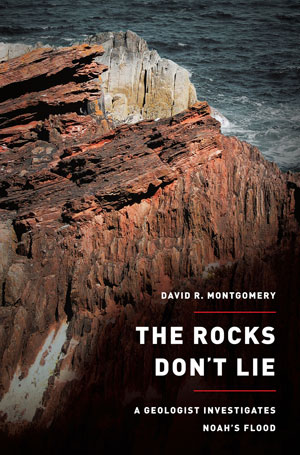
Sadly it is a rare occasion to read a truly stupendous book. There are lots of wonderful books in the libraries of the world, great and small. When I read a tome that brings two of my favorite subjects together in a genteel cotillion, subjects which are generally portrayed as aiming heavy weapons at each other from deeply sunk trenches, it deserves the epithet of stupendous. David R. Montgomery’s The Rocks Don’t Lie: A Geologist Investigates Noah’s Flood is one of those books. By page 8 I was thinking that Montgomery was someone with whom I’d feel comfortable raising a glass and sharing a story. He is a rare, serious scientist who considers that maybe religious stories have something to tell us about being human. The book, as the subtitle indicates, is about the Noah myth. Geology is the science that has taken the brunt of (the relatively new religion of) Creationism’s umbrage. Still, like a rational scientist, Montgomery doesn’t get mad or fly off into hyperbolic denunciations. He takes his rock hammer and taps until the flood myth crumbles.

Unlike many sober writers on the subject, Montgomery considers the possibility that folklore may in fact give clues to science. Those cultures that have flood stories, he patiently explains, probably has reasons to tell such myths. In this one book we are taken on guided tours of the Grand Canyon, bits of the Himalayas, “ancient” Mesopotamia, the scablands of eastern Washington, and even the Creation Museum in Petersburg, Kentucky. At each station, we learn a bit about floods and rocks and fantasies. Although not a biblical scholar, Montgomery obviously did his homework and gives a fresh view of how Christians went from non-literalists in the first centuries of the church, through the scientific revolution, only to become literalists in the geologically very recent twentieth century. Creationism has nothing to do with real floods and quite a lot to do with personal insecurities.

It must be easy for scientists to trumpet bravado throughout the infinite universe. The scientific method is our best testable explanation for the physical world. Montgomery resists that temptation, realizing that religion does count for something after all. Religion evolved for a reason. Maybe it isn’t scientific, but it helps people to make sense of their world. Instead of characterizing religion and science as combatants in a war, Montgomery likens the opposition to a dance where the partners sometimes step on each other’s toes. I read his book dreaming my geological dreams, lost in deep time, and thinking that the world is maybe even more wondrous than miracles could ever convey. And we have occasional floods, and floods sometimes give us reasons for going on. There’s perhaps something religious about that.


Star Tract

Over the past few years my wife and I have been watching the episodes of Star Trek (original series; please, we are connoisseurs). As a religious child watching Star Trek I had noticed that some of the episodes had biblical titles or themes, but now that I’ve been watching them systematically, if not swiftly, I have noticed a general trend towards more biblical themes as the series goes on. I suspect most readers know that Star Trek had only three seasons. During the first season references to the Bible were a bit vague and indistinct. Episodes 23-25 (“A Taste of Armageddon,” “This Side of Paradise,” and “The Devil in the Dark”) make reference to biblical motifs in their titles, but nothing too explicit. Paradise and the Devil are, after all, in the public domain.

Season two stepped up the ante a bit. In “Who Mourns for Adonais?” the pagan god Apollo appeared, but in “The Apple” the Enterprise was transported back to Judeo-Christian themes in the paradise genre again. “Journey to Babel,” episode 10, brought a biblical place into the title, and “Bread and Circuses” (episode 25) famously put the crew into the world of the Roman Empire where the rebels were found to be sun worshippers. But no! Worshippers of the son of God, we learn. The move away from Apollo is complete, we have come back to a comfortable, Christian world.

The third and final season delved even further into the biblical repertoire. Once again, “The Paradise Syndrome” (episode 3) brings Heaven to the heavens, but episode 4 also has a biblical title “And the Children Shall Lead.” Episode 16, “The Mark of Gideon,” takes considerable thought to unpack the biblical parallel, and episode 19 is entitled “Requiem for Methuselah.” Paradise, obviously a favorite theme, returns in “The Way to Eden,” or episode 20. Each season goes boldly further than the one before.

Quite apart from the titles of episodes, Star Trek, despite the technology and unflinching logic of Mr. Spock, is an extremely biblically literate show. Even as the 1960s were fading into the 70s it was a safe assumption that watchers would pick up on the many biblical motifs and themes. Now when younger people mention Star Trek, they inevitably mean one of the various spin-off series that have grown from this original root. Biblical references are surely there, but like the times themselves, I suspect they aren’t nearly as overt as they were when I was a kid. For many even paradise has lost its shine.


Secret Life of Apples

Considering that the story of Eden fits the pattern of many an ancient myth, modern writers still occasionally argue about what the fruit on the tree of life might have been. The favorite with medieval theologians seems to have been the apple because of the similarity of its name in Latin and the presumed badness of the act. Apples, however, are nutritious and make up a large part of autumn’s outdoor appeal. While at a local orchard over the weekend, apple picking, my daughter pointed out a tree with what might be termed biblical properties. A tree full of ripe apples yet to all appearances the tree was dead or dying. Perhaps that is nature’s way with apples, but it also seemed like such a resurrection symbol that I just couldn’t let it go. Would the apples carry on the line of the dead parent tree? Was there life after death?

I’m not sure why I’ve associated apples with new life. Shortly after my father died, I planted an apple seed in a plant potter in our Wisconsin home. To my surprise, the seed germinated and began to grow. We did not own our house, but we lived on a wooded campus and two large shade trees had been blown over in the past few months, so when the young tree was large enough, I planted it outside. The lawns on campus were rather aggressively mown with students who sometimes had anger issues, so I put up a little fence around the young tree to keep it safe from accidental mulching. By the time I was asked to leave Nashotah House, the tree was taller than me (not such a feat, but the fact that it survived so well was pleasing). No apples had yet appeared, but the tree is a symbol of new life. No one on campus knew its meaning, and I doubt very much that anyone thought much about it one way or the other after I left.

I often wonder if that little tree is still alive, and, if so, whether or not anyone enjoys its apples. Every year when the trees begin their long journey into a winter’s sleep, the apple trees send forth the own message of resurrection. Some will associate the fruit with sin while others will find pleasant autumnal memories. And a very few, I should suppose, will always think of trees as a symbol of someone they wish they might have known a little better. Far from being a sign of sin, the apple can be a sign of forgiveness and self-giving. Whether it is a myth or not, the northern hemisphere has begun its inexorable turn away from the sun. I look at a tree that is dead and full of life at the same time, and to me it seems to be a very different kind of fall than some suggest the Bible intends.


Dracula’s Dinosaur

It must be October when a dinosaur with a parrot’s head, porcupine quills, and fangs is announced. Yesterday’s issue of Time online featured a drawing of the creature and a nifty animation of reconstructing the aptly named Heterodontosaurus. Well, that’s actually the genus name. The species goes by the delightful name Pegomastax africanus. Last I checked, however, space on the ark was filling up. Dinosaurs create a unique embarrassment to Creationists. One suspects that if they didn’t have kids they’d dismiss dinosaurs all together, but the troublesome fossils just won’t go away. What’s more, although they’ve been extinct for 65 million years, they keep producing new species for us to recover, describe, and name. When I was growing up (and I have it on good authority that the argument is still used) Creationists told us that no transitional forms had ever been found. Therefore evolution simply could not have occurred. This was generally followed up by a reference to Genesis. Excuse me, a fanged porcupine-parrot? If that doesn’t count as a transition, what does?

Religion loses nothing by admitting to an ancient earth. Nothing but literalness. One of the joys of reading is the exploration of metaphors, similes, and hyperboles—writing delights us with its constant surprises. Even those who claim to read a text literally are engaging in a form of interpretation even earlier than the first wedge mark pushed into clay. Written texts give us something to ponder, to think about, and occasionally, to obey. Just when it looks like the cover has slammed shut on the black book we find a new set of dinosaur tracks running across our clay tablet. The literal-minded might not see these as being a message from God, but surely the endless variety of creatures that have walked this planet more than make up for it.

We used to have a pet parrot. His name was Archie, named after Archaeopteryx, the feathered dinosaur. Although Archie was cut off by disease in the prime of life, he was a curious bird and when I reached into his cage to try to get him on my finger he would dole out what he meant as a painful bite. I always took it as a sign of affection. Had our little friend had the fangs of Pegomastax africanus, I would’ve thought long and hard before risking the finger-perching trick. I like to think it would have reaffirmed my fascination with the amazing adaptability of nature. Evolution, unlike God, has no purpose. An endless tinkerer, it gives us thousands of differing dinosaurs that had been gone many, many millennia before Moses ever even thought of Noah. Pegomastax is safely extinct now, and the only ones who have to worry about this perfect Halloween dinosaur are those who think that one particular view of one particular book is the only way to find truth.

We still miss you, Archie.


Bretz v. Noah

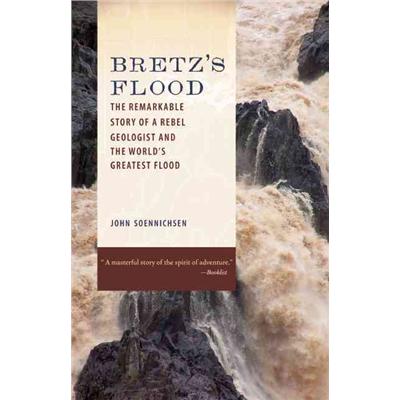
Until I met my wife I’d never been west of the Mississippi. Or even Ohio for that matter. Together we’ve traveled, in a fashion broken by years, from coast-to-coast and even overseas. Nothing in my life had prepared me for seeing the American West. No, I’ve not seen cowboys, but the landforms are so different from the weathered, ancient Appalachians among which I grew up. Eastern Washington is a fascinating landscape and with my occasional flirting with geology, I recently read John Soennichsen’s Bretz’s Flood: The Remarkable Story of a Rebel Geologist and the World’s Greatest Flood. Within the last couple of years I’d read about Glacial Lake Missoula, a juggernaut of an ice age lake that had flooded parts of Idaho and Washington thousands of years ago when its ice dam gave way. J Harlen Bretz was a turn-of-the-(previous)-century geologist who defied convention and insisted that the evidence of eastern Washington proved that a massive flood washed over the area, giving distinct shape to the region that empties into the Columbia River basin. For much of his career he was ridiculed by other geologists. The reason? The Bible.

Geology was the science that gave Darwin the idea for his evolutionary theory. The factor that had been missing from science, before geology, was time. The 6000-year-old earth just wasn’t old enough to account for the slow changes required for one species to morph into another. As scientists came to realize that billions of years were available, it became clear that change occurred even more slowly than the GOP is happy with. For geologists, anything that happened quickly was anathema. As Bretz’s Flood makes clear, a sudden flood sounded far too much like old Noah to be science. Catastrophism had been cleanly rejected by geologists because even if the evidence supported it, it looked like a return to mythology and superstition. Interestingly Bretz began his academic life among the Methodists of Albion College, and continued to quote the Bible to his last days. He was, however, an atheist.

The Bible has shaped our culture more thoroughly than Noah’s putative flood has shaped geology. I’ve read many geological studies over the years and any that are written for non-specialists never mention great floods without at least a nod to Noah. In fact, as Soennichsen points out, Bretz has ironically become a hero of Creationists who see the Missoula flood as Noah’s event. A large portion of Bretz’s career, however, was dogged by geologists duty-bound to deny a sudden flood just because the Bible tells us so. Sudden events are smeared with the residue of the divine.

J Harlen Bretz is hardly a household name, but his career is a microcosm of American culture. Glacial Lake Missoula did exist, as geologists now accept, and long before Noah was a twinkle in Moses’ eye. When the dam burst, the fable did fall, and down came the ark, Noah and all.


Edeniana

“On Jordan’s stormy banks I stand, and cast a wishful eye”—so begins a hymn I learned as a child and which has followed me to Bloomington, Indiana. Campus visits are an expectation of some academic editors, and as I stand and look at Jordan River on the Indiana University campus, I can’t help but feel a little disappointed. I have no idea if this little stream was named after the Jordan River of Israel fame, or if it just happens that someone named Jordan was a benefactor of the university. Given that there is a Jordan Hall, and a Jordan Street, the latter seems likely. Nevertheless, whether liquid or liquidity, any Jordan in contemporary society probably traces its origins back to the river that now separates Israel from Jordan (named after the river). Many hymns celebrate the mighty Jordan without the benefit of geographical experience. The mythic river is not mighty or majestic, but a slow-moving artery that sluggishly empties into the Dead Sea. With all the history of Christian imagination, however, we like to think of it on a par with the Euphrates, or at least the Mississippi.

Jordan’s stormy banks

Biblical images have a way of catching the imagination. Although many younger people have no training in the Bible or Christianity, our culture is steeped very thoroughly in it. For some who are just rising to voting age, it must appear incredible the amount of effort politicians still put into keeping the old faith alive. It is clearly so here in Indiana. Driving down from Indianapolis I passed many signs that the Biblio-Christic pulse still throbs in the heartland. As I stopped to check my directions, I realized I’d just parked across from Pray Street. In a land where an imperative verb for a religious function stands a chance of becoming a street name, anything is possible.

After I returned from my trip to Israel many years ago, I realized that I’d neglected to take any pictures of the Jordan River. It runs like a leitmotif through our national imagination that it almost seems worth going back just to snap a shot or two. The Jordan is redolent of Eden, a land that is, according to Genesis, defined by four rivers. Water is a precious commodity in the arid Middle East. Its fluid nature seems not to have achieved the level of metaphor for those who insist on warring over religion. For gardens to bloom, there must be water and its short supply raises tensions. Water connects, however, just as readily as it separates. One of the first steps towards the great civilizations was the technology of travel by water. Why can we no longer use it for connecting rather than gerrymandering? I don’t know why this little stream is called Jordan River, but I do stand by its banks and cast a wishful eye.


Last Genesis

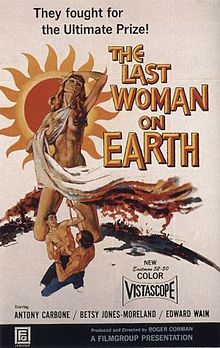
Roger Corman was famous for saving a buck on his movies. When it came to low-budget sci-fi and horror, he could be counted on to stretch pennies into dollars. The B quality with which this impresses most of his films makes them all the more addictive. I watched my share growing up, but I’m still discovering ever more as an adult. The Last Woman on Earth is one I recently found and the religious implications of the film were so obvious that they seemed worthy of a little exegesis. The plot is simple enough, three skin-divers, a man, his wife, and his lawyer friend, are the only survivors of an anoxic episode. When Harold Gern (the man) wonders what happened his friend Martin says, “A new and better bomb, act of God, it doesn’t really matter.” The destruction of humanity is a time-honored divine pass-time, so no one considers the statement blasphemous.

Naturally enough, within a short time Martin starts to feel that Harold’s claim on his wife Evelyn (clearly, by choice of name, an Eve figure) is a bit unreasonable under the circumstances. Biology is, in this instance, the misogynic element as the men increasingly step up their hostilities. Evelyn eventually decides to run away with Martin, but Harold is in hot pursuit. The entire episode takes place on Puerto Rico, and so there are a limited number of places to hide. Martin tells Evelyn to await him in the church, which she dutifully does. Harold catches up with Martin and blinds him. Martin finds his way to the church and when Harold comes in Martin provides a final homily (including some lines from Alice Cooper’s “School’s Out”) declaring that there is no more God. He then dies on the church floor.

The movie ends with Harold and Evelyn leaving the church to try to learn what life is all about. Reading up on the movie, I learned that Corman wanted to keep the costs down so that the writer of the script was cast as Martin for the film. The script wasn’t finished before they started shooting. Nevertheless Robert Towne’s story brings the overall trajectory back to an updated Garden of Eden story. Puerto Rico, a tropical paradise, where the one woman is Eve, is the scene of the first sin—the murder of Martin by Harold. Throughout the movie, Martin is clearly the Abel character while Harold is selfish, unsympathetic, and emotionally absent. Cain wins the epic struggle and God, we are told, is no more. Not the most profound of story-telling, but the themes and concepts are very much biblical. And when the final couple leave the church the remainder of world history is set to begin. I’d gladly give this one a B.


Father Abraham’s Faith

Okay, so this is the scene: Abraham is old and he has just one son to whom a promise has been made (this is the biblical version, by the way). God had promised him that he’d have as many descendants as the stars in the sky, so it seem that Isaac has a long way to go. And the boy’s not married yet. Abraham calls in his trusted servant and gives lengthy, detailed instructions on how to go back to ancestral Iraq and find a wife for Isaac. Just to make sure the servant understands just how serious this is, Abraham says, “Put, I pray thee, thy hand under my thigh,” (I can’t help thinking he added a big wink) and instructs him to swear to obey the instructions precisely. Readers of the Bible since at least the Middle Ages have recognized that “thigh” here really means genitals. The more we’ve learned of the ancient world the more we’ve discovered that men touching each other’s privates was a sign of a most serious oath—it’s a touch that can’t be taken back, and any promises made in this way must be kept.

I’ve been reading about monkeys. More precisely, about evolution. When reading about how baboons show intent to form an alliance, I was surprised to learn that males utilize scrotum-grasping. Since all’s fair in love and war, when baboons fight ripping off another guy’s jewels is considered perfectly acceptable. That means that allowing another male to fondle your testicles is a sign of ultimate trust. Baboons, it seems, have been doing it long since before Abraham showed up on the scene. I wonder if this then is a case of convergent evolution of whether Abraham’s oath goes back to nature in its most basic form. Once castrated, especially in antiquity, a man had no choice about going back. To invite another man to put his hands “down there” was a serious matter indeed.

The only requirement really given to Abraham by God was circumcision. Again, from what we know of ancient times this was not unique to Israel, but the theological freight associated with it was. For a man who’s been promised as many descendants as the sand on the sea shore, allowing another man to cut away part of your reproductive organs is a sign of ultimate trust. This is a behavior that seems not to go back to nature, however. Not even chimpanzees have quite figured out how to make knives or use them to carve up sensitive areas. This has none of the marking of evolution. An act like that seems to have come directly from the gods. Abraham, in a way most modern believers would find incomprehensible, was the paragon of faith.

Contemplating the ineffable


Zongfu’s Ark

While riding the elevator up to work last week, I glanced at the little LCD screen that plays single-page news stories for those who only have the seconds in an elevator to catch up in what is happening outside the world of commerce. That’s where the really creative stuff occurs. The picture on the screen appeared to be a large, orange, smashed ping-pong ball. I caught the words “Noah’s Ark” in the caption before the busy screen flashed onto a new and more pertinent story, such as who is winning what in the Olympics. I remembered the odd image when I got home and tried an Internet search and discovered only a small bit of information. This ark is in China, which may account for the lack of full coverage. Here in God’s own America, stories that potentially validate biblical myths are sure to attract readers and/or watchers, so there must be more to the story than I can find.

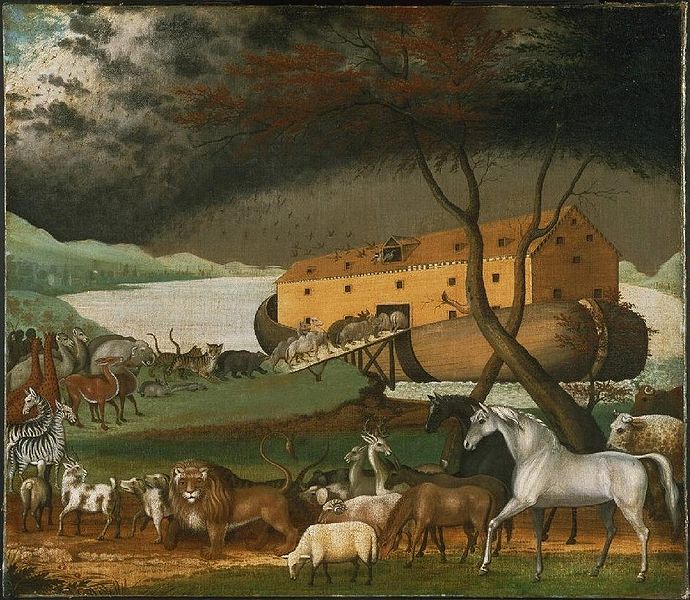
The details I’ve been able to locate note that Yang Zongfu, a Chinese inventor, designed an improvement on Noah’s ark. His ark is a sphere and really doesn’t have much room for animals beyond the occasional tapeworm or wayward spider. “Noah’s Ark of China” is a six-ton ball that costs nearly a quarter of a million dollars to build. Five people can live for ten months inside, sheltered from heat, impact, and, of course, water. Like a latter day bomb shelter, this is the place you would go to survive a disaster. The odd number of survivors, however, made me wonder about the repopulating of the earth part. Even in the Bible God made sure that instead of any individuals the ark was populated with couples. The more I thought about attempting to survive in a world with only four other people, the more frightened I became.

This is old school ark building.

Our lives are intricately inter-connected. Most of you reading these words will never have met me, yet here we are, sharing the same cyber-head-space. Movies like I Am Legend make it seem that a single man, whether Vincent Price, Charlton Heston, or Will Smith, could survive for a great length of time alone. This is pure science fiction. With the exception of Vincent Price, I doubt that any of our omega men could have successfully planted and raised a garden, let alone survived more than a few weeks. We need each other. The picture of Yang Zongfu popping triumphantly from his ark fills my head with a strange vision. A post-apocalyptic world in which the toxic runoff of our irradiated rivers will have a jumble of orange balls at their deltas and a bunch of confused, somewhat nauseous millionaires inside. As I stare out over this valley of dry balls, I think to myself, Who’s winning ping-pong at the Olympics?


Isaiah Thwarted

Back in January, out of a sense of curiosity on a number of points, I began tweeting the Bible. I wondered how long it would take, at 140 characters a day, to type the King James Bible into Twitter. Since that time, I have not missed a day. Until this week. International travel and business travel with uncertain Internet access have been overcome as I flew with Bible in hand to keep it going. On Monday I was just wrapping up the flood story. Clearly this was going to take a long-term commitment. Then early this week a message popped up on my Twitter account stating, “You cannot send messages to users who are not following you. Learn more,” so naturally, I learned more. Unfortunately I am not now, nor have I ever been, a techie. Just a sentence in and words I don’t understand begin to flummox me, building confusion on confusion. What it appears to be telling me, in layman’s language, is that I can no longer post to Twitter.

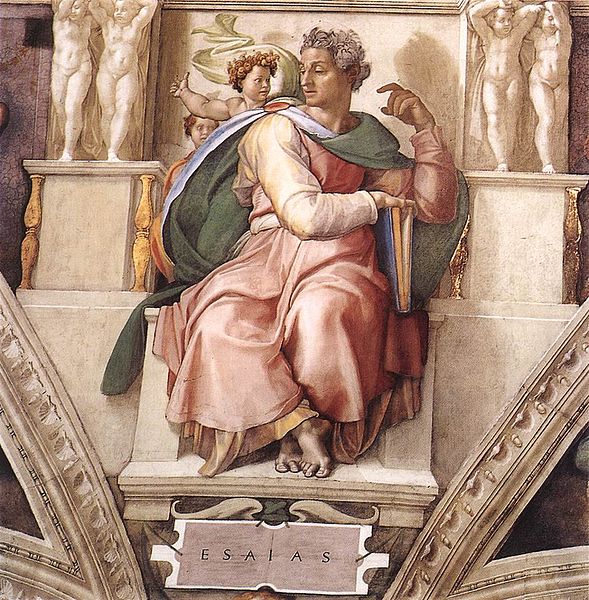
Apart from the personal rejection such impersonal messages inevitably engender, this development brought to mind the famous verse from Isaiah 40.8, “The grass withereth, the flower fadeth: but the word of our God shall stand for ever.” Hath the Lord been stopped by Twitter? Technology changes rapidly, and those of us who’ve never had any formal training in it sometimes feel like we’re driving a car on a dark country road at night with no headlights. I’m not really sure how this all works, but I try to send daily thoughts out into cyberspace and, yes, what you say can and will be used against you. And I wonder about old Deutero-Isaiah sitting there in Babylon peering into an indefinite future.

Our abject dependence on the Internet has changed us as a species. I’ve recently read about how technological innovations have become the evolution of the human species. This collective brain we refer to as the Internet has revolutionized the way we do business, but it has also introduced a component of fragility into the equation. Electronic information is untested in the long term. Some of my earliest writing projects now exist only on three-and-a-half inch floppies, most of which are tucked away in some musty corner of the attic. And what if the earth passes through a comet’s tail or a nasty solar flare jets out our way? Doomsday scenarios have been based on such things (just remember Y2K and smile). So maybe Second Isaiah was onto something after all. Printed books have been known to survive for at least half a millennium, and in rare instances, a couple thousand years. And the pagan sources on which parts of the Bible are based, written in clay, last even longer. And one of the earliest stories recorded was that of a worldwide flood.


Seedtime and Harvest

With the drought deepening over about half the United States, it is with not inconsiderable irony that I am reading the story of Noah’s flood. I have been tweeting the Bible for some months now and am just reaching the end of the fascinating account of the deluge. The difference in the case of the drought is obvious, but similar. Having spent some time in the Midwest, I came to know how intimately and intensely many of the citizens trust God’s providential care (this is true elsewhere, of course, but I noticed it more in that region). When disasters come, however, just like an animist would suggest, answers will be sought in the divine world. “While the earth remaineth, seedtime and harvest, and cold and heat, and summer and winter, and day and night shall not cease.” Genesis 8.22 rounds out God’s plan for the perpetuity of nature’s cycles, stating in just the previous verse that he knows people to be wicked and will never punish them for it again, as he did in the flood. Such biblical assurances, however, do little to allay fears when crops are dying in the field.

The problem in looking for answers in nature is their ambiguity. Just consider the record number of church picnics that haven’t been rained out this year—the number of prayers I’ve heard for the staying of rain for human convenience is surely a reflection of how intimate divine interaction with the workings of nature is supposed to be. One of the benefits of science has been its ability to straighten out all the cards in the deck, tapping them on the table-top and squeezing them into line. How would God weigh prayers for no rain so that an outdoor wedding of a devout couple could take place versus the prayers of a backslidden farmer for much needed precipitation (without hail)? Are decisions made by majority request? Wouldn’t that be excessively dangerous, given humanity’s track record of deciding what is good for itself?

The drought is a serious concern, and I do not mean to suggest otherwise or make light of the situation. What concerns me is the human tendency to look for a divine bailout. Many politicians of certain persuasion (usually the greenback kind) tell us that the climate is just fine. Our greenhouse gasses are not unduly affecting it. Now that a drought is upon us—and even a child can understand that all weather is related—the focus shifts to God. This dancing around the elephant in the room is tiring and dizzying. We can spend billions of dollars making bombers that are almost invisible to radar and so oddly shaped that they get reported as UFOs and yet we can’t get politicians to consider our impact on the very skies they fly in on their bombing missions. The atmosphere is larger than us all and it is warming up. And when we bake ourselves out of existence isn’t it a comforting thought that seedtime and harvest will continue, at least until our sun burns out?


Heat Wave

Stewing in the heat of the wave washing over much of the east, my thoughts sometimes turn to the cool, refreshing flood of Genesis. I’ve been Tweeting the Bible for some months now, and I am in the midst of the stories of the flood. Noting the many contradictions and discrepancies, it is a wonder to me how many of the religious are able to overlook or harmonize infelicities for the sake of a consistent faith. Most famously the story states that Noah took one pair of the clean animals, but also seven pairs of clean animals. The rain came down forty days. Or was it 150? One of the reasons that people continue to believe this story may be its specificity. No approximations or guesses, the numbers are precise, as if written down by an eyewitness at the scene. In actual fact, the story is among the oldest of recorded civilization and has its origins at least as far back as ancient Sumer. For as long as people told stories about the gods, they told stories about world-wide floods.

As a species that is able to think ahead, we have long been concerned with the fate that might befall us. Consider the amount of hype about the end of the world that has accompanied the random calendrical dates we’ve assigned to the cosmos: the world has been expected to end nearly every year since 2000, and that is only the most recent incarnation of this foreboding. If there are gods out there, they must have it in for us. The very fact of our being human seems to anger the deities. Even after God promises the world will never again be destroyed, he adds a caveat—not by flood, anyway. By the time we reach the letters near the end of the Christian Scriptures the future torment has turned to fire. There’s always something out there looming on the horizon.

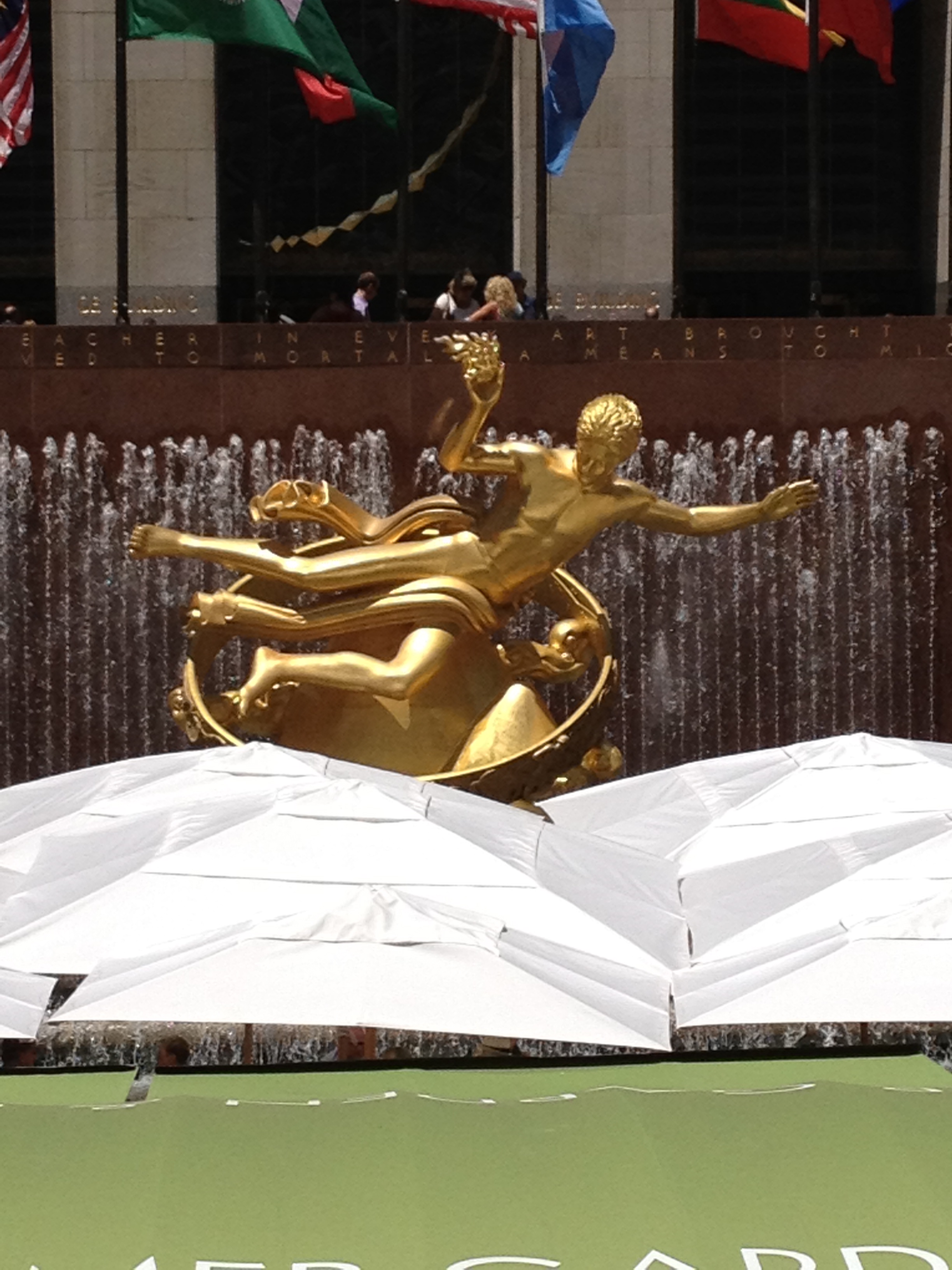
“Prometheus teacher in every art brought the fire that hath proved to mortals a means to mighty ends,” so reads the quote from Aeschylus behind Paul Manship’s statue of Prometheus. Prometheus was the Greek god (Titan, actually) favorably disposed toward humanity. His name means “forethought.” When humanity cowered and shivered in the dark, Prometheus brought the light and warmth of fire. It is easy to suppose the Greeks to have been more enlightened than earlier or contemporary civilizations, but Prometheus had offended Zeus and was subject to eternal torment for his thoughtful gift. Perhaps it is just the divine way—gods are jealous of us although they hold all the power. As I continue to tweet the good news of an angry god, I am starting to understand the power deities will always have over their vulnerable creatures.


Problematizing Noah

As I continue to Tweet the Bible, I’ve been working through the story of Noah. Considering the number of children’s items imprinted with the friendly, smiling Noah and Mrs., and the cute, predatory animals they’re taking aboard their private yacht, the utter belligerence of the story is frequently lost. There is one seriously peeved God behind this. “And it repented the Lord that he had made man on the earth, and it grieved him at his heart,” Genesis 6.6 states. And it only gets worse from there: “I will destroy man whom I have created from the face of the earth… for it repenteth me that I have made them.” Indeed, the wrath of God is emphasized more than the wickedness of the humans that have spawned it. No matter what is done, it seems, God will still be in a rage.

The truly striking aspect of this account comes, however, when Noah is instructed on whom to save. “Thou shalt come into the ark, thou, and thy sons, and thy wife,” verse 18 dictates. Men first. Now, we cannot judge a product of the past against standards of the present day, but it is quite clear why many women find the biblical text less-than-friendly. Even the animals are explicitly paired from the start do not receive the radical disjointing that the women receive from the men. If the purpose is to procure a new generation, arguably pregnant women could have done that with the men treading water above the remains of Eden. If survival is the point of the story, as the saying goes, ladies first.

The flood story is a complex account of a deity with anger management issues and a preference for the company of men. Although theologians may say with a wink that God has no gender, clearly the Bible begs to differ.

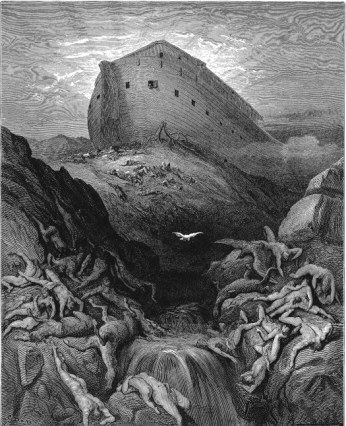
Humans and animals alike are victims of the divine wrath, and even though humanity survives the flood can the relationship with deity ever be the same again? How do humans face a creator turned destroyer, knowing that they will never really please him again? The weight of such divine displeasure is surely greater than all that water pressing our ancient cousins into fossils on the primeval sea bed. I think back to all the children’s toys with the happy little animals and a smiling Noah and I know they resemble the biblical version only in the most fleeting of fashions. Yet the myth lives on.

What shape is your ark?