Flipping

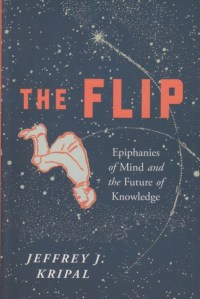
The mind-blowing book I mentioned last week is here unveiled.  I discovered Jeffrey Kripal’s work years ago, and have subsequently had a few conversations with him.  The Flip: Epiphanies of Mind and the Future of Knowledge is a challenging and necessary book.  In a way that only full-time academics can, Kripal examines the large picture.  When I say “large” I mean cosmic in scale.  He does so through the lens of the humanities and, especially, religious studies.  If anybody’s going to make religious studies cool, it is he.  The world is full of weird things.  If we’re honest most of us will admit to having had strange things happen to us.  Often we’ll filter them out or explain them away, but at other times we will stop, scratch our heads, and wonder what just went on.

The Flip is not a book of such anecdotes (and I, along with the author, am willing to take anecdotes seriously).  There is some strange stuff in here, but there is also a lot of science.  Historically the humanities, as understood by ancient Romans, included what we would call sciences.  Humanities, in other words, were attempts at understanding the world.  Today religious studies is among the humanities while science is separated out into STEM.  Kripal takes science seriously.  In fact, much of what he discusses here is the application of quantum physics to the macroscopic.  (I’m probably not explaining this well, but then, I guess you’ll have to read the book!)  In other words, science and the humanities need to come together again.  It’s not either/or, but both/and.

Holding out a hand across the aisle is uncomfortable.  Religion has done a great deal to disgrace itself of late, and it’s no wonder respectable folk want to keep their distance.  To understand what we are, however, requires a willingness to admit that humans are both deeply intellectually curious and deeply religiously inclined.  We can be both.  In fact, it is unlikely we can be any other way.  Anomalous occurrences aren’t generally welcome in religious studies any more than they are in the sciences.  That doesn’t stop strange stuff from happening.  This little book of big ideas uses that disjunction to lead the reader into spaces where the future might faintly be discerned.  Wide-ranging and provocative, this book needs to be read.  It is a strange world where two different approaches to knowledge so often decline to speak to one another.  Here they do, and their conversation is mind-blowing.

Time To Meet

I feel compelled to state up front that this wasn’t the mind-blowing book I was writing about in yesterday’s post.  One of the perks of working in publishing is the occasional offer of a free book.  (It’s not as generous as you might think, so when one is offered I always say “thank you.”)  The Surprising Science of Meetings, by Steven G. Regelberg, isn’t exactly “mind-blowing.”  The realization that some people make a living studying meetings was certainly, well, surprising, but the corporate world is all about returns on investments and boring stuff like that.  We all hear of companies that value innovative and exciting ideas, but most of us know the feeling of being desk drones parked behind a soulless monitor all day.  At least I’m no longer confined to a cubicle.

The academic world I once knew was the stimulating environment of learning for its own sake.  The academy has followed the business world to its own form of perdition and as Rogelberg points out, there are millions of meetings any given day.  Many of them are poorly run.  This book is for those who want meetings to flow more effectively, to better the bottom line.  Still, I found the chapter on servant leadership particularly hopeful.  I couldn’t help but wonder if Rogelberg was aware that servant leadership was something that developed in the church, out of the effort to imitate the way Jesus was said to have led his flock of disciples.  The point was not to aggrandize himself (this is a chapter 45 and his ilk should read) but to help others to be their best.  This is the kind of leadership—rare, to be sure—that the church has always, at least vocally, promoted.

It didn’t take long for ecclesiastical organizations to start running like businesses, however.  The bishop became a boss rather than someone who reluctantly had the crozier forced into his (or her) hand.  I’ve always believed you should have to take a pay cut to become a bishop.  That would immediately weed out most of the climbers.  In fact, if servant leadership is really the ideal, and the good of the company is really the goal, pay cuts should be expected as you climb the corporate ladder.  Can you imagine a business world where workers were well compensated, and those who really had vision sought promotion because their motivation wasn’t their own bottom line?  It’s an intriguing idea, to be sure.  I’d like ponder it more, but I’ve got a meeting to get to.


Pay Per View

One of the things editors can teach academics is that the latter should pay more attention.  Especially to the world of publishing.  An erstwhile academic, I learned to go about research and publication in the traditional way: come up with an idea that nobody else has noticed or thought of, and write about it.  It is “publishing for the sake of knowledge.”  (Yes, that is Gorgias Press’s slogan, and yes, it is one of my hooks—marketing, anyone?)  The idea behind this is that knowledge is worth knowing for its own sake.  Researchers of all kinds notice details of immense variety and there’s always room for more books.  Or at least there used to be.  The world of publishing on which academics rely, however, is rapidly transforming.  Money changes everything.

The world has too many problems (many of them generated by our own species) to pay too much attention to academics.  Universities, now following “business models” crank out more doctorates than there are jobs for employing said wannabe profs, and those who get jobs pay scant attention to knock-on changes in the publishing world.  Just the other day I was reading about “pay per use” schemes for academic writing that, unsurprisingly, came up with the fact that most academic books and articles lose money.  If someone has to pay to read your research, will they do it?  Especially if that research is on a topic that has no obvious connection with the mess we’re busy making of this world?  Probably not.  Publishing for the sake of knowledge is fast becoming a dusty artifact in the museum of quaint ideas.

For those still in the academic sector that means that research projects now have to be selected with an economic element in mind.  “Would anyone pay for this?” has to be one of the questions asked early on.  The question has to be answered honestly, which requires getting out from beyond the blinders of being part of the privileged class of those who are paid to think original thoughts.  Academia has followed the money.  A capitalistic system makes this inevitable.  How can you do business with an institution that doesn’t play by your accounting rules?  And academic publishers, which have difficulty turning a profit due to low sales volume, are bound to play along.  This situation will change how we seek knowledge.  More’s the pity since some of the things most interesting about the world are those that nobody would think to pay to view.


Book and Bell

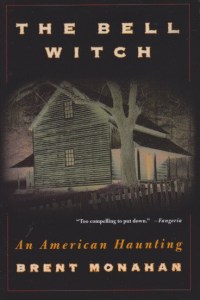
The Bell Witch: An American Haunting, by Brent Monahan, is a book I’ve read before.  The subtitle was used for a cinematic version.  I discovered the book, however, through what might be considered a chance encounter with the author.  He was teaching a course on offering distance education courses at Rutgers University, and, as an adjunct teaching over eight classes per year, I’d been selected for the distance education program.  (As life goes, of course, I was hired by Routledge for a full-time job before I could actually deliver the course.)  By a strange irony, I had watched An American Haunting just the weekend before the course, and I had no idea who would be teaching it.  Neurotically punctual, I was the first one there for the class, and as Dr. Monahan and I talked, I knew I’d need to read the book.  I posted on it back when I did, but this time I decided to pay better attention than one can on a bus.

Of course, when you watch the movie first, which I had, you know “the reveal” well before it comes late in the novel.  In case you’ve done neither, I won’t give it away.  The tale is based on an historical haunting, attested in sources from near the period.  And it is a strange kind of possession story.  The “witch” is actually a demon conjured by a trauma, and although book wraps things up nicely, it leaves a few questions at the end.  I suppose that’s appropriate for a scary book.  One of my current projects involves tracing the accounts behind fictionalized narratives to their originals.  The Bell Witch was well researched, and is a good example of how the line between fiction and fact can be effectively blurred.

The Bell Witch legend is credited with influencing several horror films, including The Blair Witch Project and others which tellingly have “Bell Witch” in their titles.  The story has a fairly incredible longevity, given that it was a localized legend from early in the nineteenth century.  Monahan’s novel is written as a “confession” from the schoolmaster, and historical personage Richard R. P. Powell.  This blurring of the lines makes for the kind of ambiguity that gives horror its particular ability to stand between fact and fiction.  The early versions of the lore, combined with elements intended to offer verisimilitude, leave plenty of queries at the end.  So much so that I’ve occasionally contacted the author for clarification.  What really happened?  It depends which side of the line you prefer.


Upstate Reading

In terms of cash flow I don’t fall into the wealthy bracket.  My assets are largely in pre-printed paper form, and when I visit the local Little Free Library it’s generally to donate books rather than to take them.  Over Labor Day weekend I was in Ithaca.  One of the more famous features of the town is its weekend Farmers’ Market.  Indeed, the north-south corridor through town is a continuous traffic jam during Market hours.  Not only are there farm stands in the permanent open-sided structure, but there are a few craft booths and several places to buy al fresco fair from local restaurants.  In the summer parking can be hard to find, but the place has a carnival-like atmosphere nevertheless.  It also has a Little Free Library.  I’ve been to the Market many times but I’d never noticed it before.

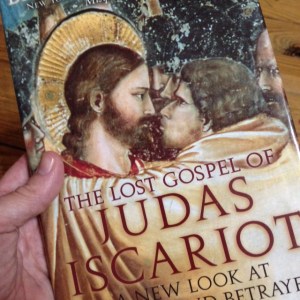
Upstate New York is beautiful but it tends toward the conservative end of the political spectrum.  Ithaca is a pixel of blue in a screen of red, and that strangely showed in the Little Free Library.  Many of the books were either Bibles or popular kinds of devotional titles.  Given that Cornell isn’t known for its religion department (Ithaca College has a respectably sized philosophy and religion department, however) these books aren’t the kind you’d expect to find in an institution of higher education.  That’s why I was surprised to see a near mint copy of Bart Ehrman’s The Lost Gospel of Judas Iscariot on the shelves.  The Gospel of Judas hasn’t been big news for a few years now, but this was a book that suggests a different demographic than your average evangelical readership.

Like Ehrman, I once made a living as an adjunct at Rutgers University.  Indeed, it was this commonality that helped me to get to know him a bit.  He’s gone on to a kind of fame rare for biblical scholars.  Indeed, to have a sufficient number of copies of your book printed to end up in a Little Free Library—in other words, you have to have more cachet than your garden variety Ph.D.  In my local community LFL I like to leave books for others to take.  Just last week I stopped by and noticed that the summer had depleted the stock.  Ironically, I had noticed one of Neal Stephenson’s novels in the same circumstances as Ehrman’s.  I’m glad to see intelligent works on offer for the reading public.  And trading books with no money involved suggests to me that there’s a better form of economy than material greed.  All it takes is a Little Free Library and a little good will.


Gods, Monsters, and Publication

One of life’s great ironies is that those of us not born to wealth have to spend the years we’re young enough to enjoy ourselves stabilizing our situation until suddenly we realize we’re too old to do that kind of thing any more.  I know I’m being overly dramatic, but it often does feel like life operates backwards.  My professional career began where I’d hoped it would end, as a professor.  I taught and published for almost twenty years and really nobody paid much attention.  At least I had my teaching.  I also had a family to support, so I had to accept the shift to publishing when that came along with an offer of a full-time job.  Thus it has been for about a decade now.  Within the last decade colleagues have begun to approach me, asking me to contribute to academic volumes, or to be involved in pursuits that are more associated with professors than editors.  I could do with more irony in my diet.

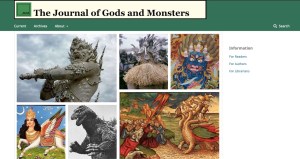
All of this is a long-winded invitation to check out the new Journal of Gods and Monsters.  I probably won’t be writing articles for it; lack of library and research time (both of which I had when invitation-free) assure that my scribbling will be non-technical and hopefully of the more general interest crowd.  Then why am I telling your about this journal, fresh from the box?  I’m on the Executive Advisory Committee and the first Call for Papers has been issued.  Now, this blog really has no way to include attachments that I know of, so if anyone wants in on the ground floor for this journal please contact me (the About page on this website says how).  I contributed to the first number of the first volume of the Journal of Ancient Near Eastern Religions and look where I am now!  You just never know.

In addition to the books on which I’ve been assiduously working, I’ve got a number of commitments to edited volumes and encyclopedias (these invitations waited until I was safely out of academe before rolling in).  The monster crowd is, I assure you, a welcoming one.  As we seem to have turned the corner into autumn a touch early this year, and I see leaves beginning to change before August is out, my mind turns toward the realm of the uncanny.  It may be less academic than ancient religions, but the world of monsters feels much more relevant these days.  If you’re a researcher in these realms I’ll be glad to send you a call for papers.


https://godsandmonsters-ojs-txstate.tdl.org/godsandmonsters/index.php/godsandmonsters


The Holy

It’s perfectly natural.  Trying to make sense of things, I mean.  It’s been a little difficult in America for the past three years or so, given that nothing seems to add up beyond greed and narcissism supported by a senate majority.  Still, as I retreat into my horror films I realize that there’s a logic to it.  Over the past several months I’ve been attempting to articulate it.  You see, I have a couple of presentations to give on Holy Horror in October and one of the questions likely to arise is why.  Why bring together the sacred and the scary?  Those who’ve studied religion formally—and many who’ve not—are aware of Rudolf Otto’s classic The Idea of the Holy.  It’s outdated and I’ve been waiting for someone to write its replacement, but we’re past the era when one scholar corners the market.  Has nothing new emerged this past century?  Nevertheless, Otto’s main ideas still make sense, before he lapses into a Christocentric view.

Mysterium tremendum et fascinans isn’t an incantation, but with a little imagination the Latin makes sense.  The holy, according to Otto is a mystery that is both terrifying (tremendum) and fascinating.  To the laity in the pews this may be strange, but chances are pretty good that your minister has read this book.  In the monotheistic west, the divine is terrifying.  It’s not splitting hairs to suggest terror and horror differ, nor is it unreasonable to suggest they have much in common.  Horror seems more embodied—a working-class variety of terror.  Still, both have that element of fascinans.  We fear but we can’t look away.  I don’t have the time to sit and ponder that a Gilded Age academic had.  Otto didn’t have to keep up with Facebook and Twitter.

Although academia required far more than eight hour days, the time during those days wasn’t spent “on the clock.”  As one intellectual I admire once quipped, staring out the window is work.  Not as far as HR is concerned, however.  Productivity in an industry under stress is its own kind of mysterium tremendum, I guess.  It doesn’t really allow for unstructured hours to read, take notes, close your eyes, and read some more.  Work measures inspiration in terms of currency, which is one of the problems that stretches past beyond these last three years.  Struggling hard with an idea is like wrestling an angel until dawn.  You can’t win, and you can’t lose.  But when the sun clears the horizon it will be time to be at your desk and ideas will have to wait another day.


Linking

So I’m active on LinkedIn.  I try to keep social media down to the essentials, but you never know when opportunity might rap its knuckles next to your shingle.  When LinkedIn began they ran the warning that you should only connect with people you actually knew, since people can say bad things about you and hurt your job prospects.  Since that kept me down to about a dozen connections (many academics, being secure with tenure, don’t bother with LinkedIn), I eventually followed the advice of a wise friend and accepted invitations from people I didn’t know because, as he pointed out, they might be the ones with jobs to offer.  That made sense.  There is a flip-side to it, however, and that is people think I have work to offer.  I don’t.  At my job I have no hiring capacity whatsoever.  (I can feel the links being broken even as I write this.)

The vast majority of people who contact me on LinkedIn want something from me.  They obviously don’t read this blog.  (See paragraph above.)  Many people send me messages wanting me to publish their books.  Editors, my dear and gentle readers, work in specific disciplines.  No one contacting me on LinkedIn has written a book about the Bible, although my profile indicates that’s my gig.  And besides, many companies, including mine, have policies against doing business over social media.  I often think of this because the book business is easily researched.  There’s a ton of information both online and on shelf about how to get published.  Messaging someone on LinkedIn is not recommended.

Writing a book takes a lot of effort.  I know, because I’ve done it a number of times.  If you’re going to put years into doing something, it pays to spend at least a few minutes learning about how the publishing industry works.  I made rookie mistakes in my younger days, of course.  But that led me to learn about publishing even before I had a job in the industry.  Quite apart from my job, I freely admit to being a book nerd.  And publishing, despite its many problems, is an inherently fascinating industry.  Although I’ve had academic books accepted for publication, I still struggle getting my fiction to press (I have had short stories published, but my novels remain unread).  I won’t contact other publishers I know through LinkedIn, though.  I’d rather have it be a personal experience whether it’s acceptance or rejection.  And that’s something social media just can’t replicate.


Reading Railroad

Rereading books takes time.  When I was a professor my reading time was largely limited to the summer and winter breaks.  Those who haven’t experienced the academic lifestyle firsthand may not realize just how incredibly busy you are during term time.  Class prep, grading, delivering lectures, leading seminars, committee meetings, office hours—it really is much more than a nine-to-five job.  Time to sit down and read through books is limited, and since those books are heady, academic tomes, they take considerable time.  (I’m reading an academic book at the moment and I can only get through a finger-full of pages at a sitting.)  All of this means I’m generally reluctant to reread books.  Not that I’m a traditional academic anymore, but because I have a huge and growing stack of books I haven’t read yet.

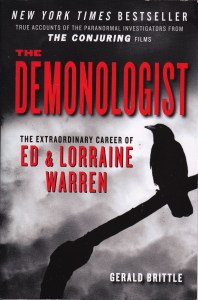
Nevertheless, a project on which I’m working required rereading Gerald Brittle’s The Demonologist.  I read this about two years ago, while commuting.  The thing about reading on a bus is that the quality of reading time is strained.  Recall isn’t the same as when you’re in a comfy, stationary chair, and no stranger’s head is lopping onto your shoulder as they doze.  (Yes, that happens, and frequently for those of us on the first bus of the day.)  In any case, my copy of this book doesn’t have an index and I couldn’t remember if some specific instances were discussed.  The only thing for it, then, was to read it again.  My second reading was done with more skepticism than I could conjure on a bus ride, but still my original sense remains: we willfully cut out much of human experience if we stop our ears completely.  At least in principle.

Ed and Lorraine Warren were self-taught ghost-hunters.  More often than not, their cases turned into what they believed were demonic cases.  Since academics tend not to publish much about such things, the self-taught are pretty much free to declare themselves experts—just switch on reality TV and check me on this.  Experts are those with experience who are willing to share it.  The other day I met someone who, like me, used to live the commuting life.  We both agreed that telecommuting was a more authentic way to exist—your otherwise mandated three or four daily hours traveling can be more sanely used at home.  Still, we had to agree, bus time could be used for activities like reading, and once you stop commuting you have to carve time out for it.  In such a situation rereading a book is at times necessary.  When I was a professor, I reread frequently.  But then, it was mostly articles or books that I wouldn’t take on in their entirety.  In the reading life there’s never enough time.


Somebody’s Coming

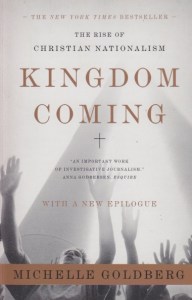
Sometimes updates don’t help.  That’s because evil is so good at masquerading as righteousness that constant vigilance is required.  Michelle Goldberg’s Kingdom Coming: The Rise of Christian Nationalism was recommended to me by someone at a local church.  I’ve been giving educational talks to help people understand what Evangelicalism is, so I figured I’d better read it.  The optimistic epilogue to this otherwise excellent book allowed relief after the 2006 midterm elections.  Of course, nobody back then could’ve believed an even less intelligent president than W could ever be put forth by the GOP.  That doesn’t mean Kingdom Coming shouldn’t be read.  It should.  And it should be required reading (aw, gee!  Homework?).  There have been many studies that have demonstrated repeatedly that Christian Nationalism is highly organized and well funded.  Meanwhile intellectuals scoff that religion is dead.

I spent most of the last week in a kind of panic.  I have another public talk coming up, and I needed to read Goldberg before that.  Yes, it is dated.  But yes, we have Trump’s bumbling form of “leadership” with a well funded, highly organized Evangelical subculture calling the shots.  Forget the politicians—they’re only interested in money—it’s everyone else who suffers from America’s growing fascism.  The fact that the GOP won’t stand up to 45 shows that we’ve already turned the corner toward das Vaterland.  Anyone the Republican Party elects from now on could be the new dictator.  Christian Nationalism stands behind this as journalists scratch their heads.

Goldberg’s book has likely been shelved because eight years of Obama made it seem like the threat was gone.  The problem is, silence works to the benefit of Christian Nationalists.  Perhaps the most frightening thing about all of this is that many intellectuals simply don’t take the threat seriously.  At the same time I was reading this, I was also reading about Nazi Germany (because I’m such a cheerful guy).  The parallels are blatant and entirely too obvious to miss.  Christian Nationalism has an agenda and it is fascist in nature.  Even obeying the words of Jesus takes second place to the political objective of making America in their own image.  This may sound alarmist, but it’s based on solid information.  The Devil, they say, is most powerful when people don’t believe in him.  Those who would make America into a theocracy would claim to follow the other guy, but looking at their tactics, it’s pretty clear who’s really in charge.


Private Matters

Mercenaries have long been part of human culture.  With some exceptions, people really don’t like to fight to the death meaning that wars have often relied on those willing to fight for pay.  As society buys more and more into capitalism—and capitalism always means you want what someone else has—we’ve had to pay armies to become a massive part of our national existence.  In the United States the military budget is the most massive drain on taxpayers’ dollars, dwarfing all other areas of government spending.  Even Dwight Eisenhower, himself a military man, warned the country of the military-industrial complex.  It was becoming too powerful, he believed.  Knowing better, we continue to spend to curb our fears—generally unfounded.

The other day I was reading about the private military industry.  I didn’t even know there was such a thing.  Yes, I’ve known of mercenaries since I was a kid, but I think was got to me was the word “industry.”  This has apparently now become a legitimate line of work, I suspect with tax breaks and other kickbacks.  What’s more, it’s recognized by governments as a legitimate business.   Perhaps I spend too much time in my own headspace—I am a Bibles editor after all—but I felt like I’d just crawled out from my scriptural rock.  There’s an entire industry where your job is to be a fighting force for hire?  Victory to the highest bidder?  The ultimate, weaponized free agents?  How does that feel?  Mercenaries have often suffered in reputation.  Now we recognize them as just another job.  I guess that’s one way to handle unemployment.

While the Good Book is considered outmoded by many, I do think it has many things right.  One of its most compelling messages is that we should be peacemakers.  We should love one another, seek to help, not to harm.  Nobody’s going to pay a lot for that, however.  War is more profitable.  Meanwhile the education industry—even it can be capitalized—suffers.  We don’t want to pay for cooperative ventures where the entire human race, and other species, might benefit.  That we deem too expensive.  After all, there’s only so much money to go around for bombs and missiles and whatnot.  How are we supposed to protect that which we’ve extorted from others if we don’t have a massive military?  I suppose we could hire freelancers, but then, that costs money.


Religious Studies

Prominent public intellectuals, as opposed to us obscure private ones, often brashly castigate religious thinking.  They may be aware that the vast majority of the world’s population is religious, but there’s  a kind of arrogance that comes with public adulation, I suppose.  I was just reading about the European Middle Ages and I was reminded once again just how seriously religion was taken and how the very foundation of civilization is based on it.  During said Medieval Period everyone knew—note I don’t say “believed”—knew that human beings had eternal souls.  They also knew there were eternal consequences to our actions and therefore correct religion was absolutely essential.  The Enlightenment began to change some aspects of received wisdom, but not all.  Many intellectuals who led the charge still believed in God and Heaven and Hell.

Whenever I consider the sorry state of academic religious studies today, and look at how politics are unfolding, my thoughts turn to history.  Just because we no longer think in a certain way is no reason to forget just how formative religion is to human life.  The Republican Party has cynically accepted this as a means to power.  While leaving left-leaning intellectuals to debate their choices, they roll toward electoral victory.  They acknowledge that people are religious, and that’s what it takes to win their trust.  Where was Dawkins when Brexit was decided?  It may not have been religiously motivated, but nationalism is closely tied to religious thinking.  While religious thought may be gullible it’s not necessarily so, and without those who think religiously there’s no way to a true majority.

I’ve always had more questions than answers, and one of my largest unanswered ones is why prominent public intellectuals don’t think studying religion is important.  Religious thinking isn’t going away just because they say it is.  In fact, the data show exactly the opposite.  The Middle Ages are quite instructive for understanding the way people behave.  Although belief in the religious structures may be eroded, people still want to find a way to continue their impact beyond their earthly lives.  Modern Nimrods are just as concerned with image as religiously motivated Nimrods were.  To understand where we are it’s necessary to look back.  Looking back entails a certain comfort level with ways of thinking that many moderns find embarrassing.  Religion is part of who we are.  Looking around we can see the consequences of denying it. 


Belonging

You never know where you might find yourself, but wherever it is it’ll cost you some money.  Well, at least in this instance it did.  Nashotah House sent me packing just as we were thinking about college for our daughter.  It took several years to find any kind of full-time position again, and when university time began I had had a full salaried job for a total of one year of the last seven.  Not ideal, of course.  I remember sitting (again) in the financial aid office, explaining the situation and, as it often goes in higher education, receiving no mercy.  As much as I remember the conversation, I don’t recall a photographer in the room.   There must’ve been, though, since I recently showed up on the Binghamton University website.

I had, of course, applied for a job or two there.  When out of state tuition is riding on such a deal, however, I doubt there’s any way to get considered.  I actually like Binghamton University quite a lot.  I appreciate the fact that it doesn’t pour its money into a football team and that it has the reputation of being a “Public Ivy” school.  I even like the campus removed from city bounds—just like Nashotah House.  I did end up paying them quite a bit of lucre through the years, even as my own alma maters were asking alms.  Higher education is a funny world.  Standing somewhere between a money-making venture and a site of education for its own sake.  Many professors don’t realize just how privileged they are to have jobs like that.

Upstate New York, although I’ve never lived there, is one of my ancestral homes.  My grandfather and his family had lived in the area at least as far back as the 1770s.  I tried to convey that sense of connection in my application, many years ago now.  Academia doesn’t put much stock in the idea of belonging, I guess.  It has become far too businesslike for that.  Binghamton was also the town in which Rod Serling, one of my childhood heroes, grew up.  There seemed to be so many reasons to be in that area.  Eventually I settled for life in my own native Pennsylvania.  People sense, although academics less than others apparently, that they belong in a place.  And if you can’t actually be there, you can still spend your money in any location.  I’ve now got a picture to prove it.


AKA

“Professor?”  While not technically correct, I was surprised and not unpleased to hear the title yesterday while on the streets of Easton.  One of the greatest compliments a former teacher can receive is word from a former student.  While dressed in Saturday clothes on the way to the country’s oldest continuously operating farmer’s market, I wasn’t sure the voice intended was for me.  I’ve been out of the classroom now since 2011.  Sure enough, one of my students from Rutgers recognized me and called out.  We had an ersatz but wonderful conversation after a completely chance meeting.  Already since graduating he’s had a few different jobs, but he remembered the classes I’d taught and I recalled that he’s the person who started me reading Neil Gaiman.  Teaching is, you see, a two-way street.

I’m doing a guest service at a local church next Sunday.  In preparation I’ve had lots of emails (for me).  One of them was from the music director.  He opened by calling me “Reverend.”  I’ve never been a reverend.  The idea isn’t unappealing but I’ve gone pretty far down the path of independent thinking and any church that would ordain such as me would need to be comfortable with that.  In fact, I heard a sermon recently by an Episcopal priest and was pleasantly surprised at how welcoming and, dare I say, liberal it was.  I was never really welcome in that club, I know.  When I was still fairly fresh out of seminary and working on my doctorate the idea of being “Rev. Dr.” was still appealing.  Now I go by my first name.

Labels.  I tend to eschew them.  Like my young colleague I’ve had to learn that work doesn’t necessarily define you.  (I’ve had many employers, however, who not only beg, but insist to differ on that point.  The ideas of owning individuals die hard, apparently.)  On the weekend, though, off the clock, people are calling me “professor” and “reverend.”  I’m generally sitting in a corner with my laptop on those early mornings calling myself a “writer.”  For none of these things do I receive any pay.  (Well, perhaps some for writing, but very little and very infrequently.)  The move to our new location was a chance, I think, to try to remake myself.  A chance to figure out what labels, if any, really fit.  Better throw “telecommuter” and “remote worker” into the mix.  Those are the ones, come Monday morning, that matter most.


Internet Epistemology

Where do we find reliable information?  I’m asking this question on an internet-based medium, which itself is ironic.  While spending time with some younger people, it’s become clear that the web is their source of truth.  You find purveyors of information that you trust, and you accept their YouTube channels as representing correct data.  This can be a disorienting experience for an old doubter like me.  One of the reasons for studying for a Ph.D., apart from the vain hope of finding a career in higher education, is to hone critical thinking skills.  When I went through the process, that involved reading lots and lots of print material, assessing it, and weighing it against alternative views, also in print format.  You learn who really makes sense and you judge which publishers have good information more frequently.  As you navigate, you do so critically, questioning where they get their information.

Now, I’m not one of those people who think the younger generation is wrong (in fact, there are YouTube educational videos about just that).  The situation does, however, leave me wondering about how to fact-check when you don’t know the publisher.  It may be an older person’s problem, but it’s essentially the same dilemma behind self-publishing—the reason you trust a self-published book depends on the author alone.  Is s/he persuasive?  Did s/he document the sources of her/his information?  Are those sources good ones?  The young people I know seem quite adept at filtering out obviously biased information.  Many YouTube personalities footnote their presentations with links to sources (many of them online), and after an hour of watching I’m left questioning what’s really real at all.

You see, many of these internet personalities have sponsors.  Sponsors bring money, and money biases anyone’s angle toward the truth.  In fact, many of these YouTube sources call out the lobbying groups that influence public opinion for political ends.  Only someone completely naive—no matter their generation—would not acknowledge that government runs on money provided by corporations with interests to be protected.  There have been reliable sources, even from the days of print, that prove beyond any reasonable doubt just how corrupt governments tend to be.  But who has time to fact-check the government when the rest of the information we receive is suspect?  Those of us with training in advanced critical thinking aren’t immune from biased information.  It’s just that there’s so much data on the web that my head’s spinning.  I think I need to go read a book.