Social Madness

I’m reading a book written in the mid-1980s.  (All will become clear eventually.)  The author notes the connection between social madness and personal mental illness.  He cites the alarming rise of teen suicides.  This was over three decades ago.  Suicide rates have continued to climb, and this particular author got me to thinking about something that troubled me even as an undergrad.  Although I went to college intending to be a minister, I ranged widely in the subjects I studied.  (Being a religion major in those days allowed for quite a bit of flexibility.)  I took enough courses in psychology to have minored in it, if I had declared it.  Since my mind was set on church work I saw no reason to make said declaration.  The thing that troubled me was I had also taken sociology classes.

Like most people who grew up in uneducated households, I suspect, sociology was something I’d never heard about.  Asking what it was, in college, someone answered along the lines of “psychology of groups.”  My own experience of it was that it involved math and graphs—it was a soft science, after all—and now I read sociologists who say that such numbers can be made to declare what the sociologist wishes.  In other words, psychology.  The point of all of this is that the book I’m reading suggests societies exhibiting illness cause individuals to be sick.  Sociology leads to psychology.  In times of national turmoil, individual mental illnesses rise.  I had to pause and put the book down.  The eighties weren’t a picnic, but the national madness of the Trump era bears no comparison.  We are a nation gone mad, and when society can’t project health, the many who stand on the brink of individual mental illness simply get pushed over.  That sure makes sense of what I’m seeing.

Looking back, I often think I should’ve probably declared that minor.  Raised in a strong biblical environment, however, I wanted to learn as much about the Good Book as possible.  I was teaching Greek by my last year in college and in seminary I specialized in the Hebrew Bible.  It would’ve been a natural place to continue studying psychology.  By that point I’d decided to go on to a doctorate, and psychology required medical training.  For a guy as squeamish as me that wasn’t possible.  Ancient languages, though, they were something I could handle.  It’s rather frightening that those writing at that time already saw America (in the Reagan years, I might add) teetering towards national insanity.  We’ve gone far beyond that now.  And a society that doesn’t know it’s ill will sacrifice many individuals who realize that it is.


Conversations

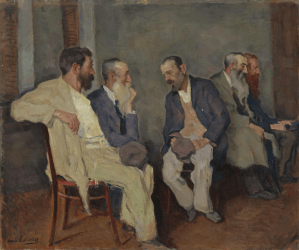
Arnold Lakhovsky, The Conversation, via Wikimedia Commons

While I tend not to discuss books on this blog until I’ve finished them, I realize this practice comes with a price tag.  Reading is a conversation.  Your mind interacts and engages with that of another person (or persons, for books aren’t usually individual efforts).  I find myself as I’m going along asking questions of the author—whether living or dead doesn’t matter—and finding answers.  Materialists would claim said answers are only electro-chemical illusions spawned by this mass of gray cells in my skull, only this and nothing more.  The realia of lived experience, however, tells us something quite different.  These interior conversations are shaping the way I think.  There’s a reason all those teachers in grade school encouraged us to read.  Reading leads to an equation the sum of which is greater than the total of the addends.

I’ve been reading through Walter Wink’s oeuvre.  Specifically his trilogy on the powers.  Although this was written going on four decades ago, I’m struck by how pertinent and necessary it is for today.  As he posited in his first volume, the embrace of materialism has blinded us to spiritual realities.  Wink was bright enough to know that biblical texts were products of their times and that simple acceptance of these texts as “facts” distorts what they really are.  He also convinces the reader that institutions have “powers.”  Call them what you will, they do exist.  Throughout much of western history the “power” cast off by the church has been somewhat positive.  Christianities has established institutions to care for the poor and for victims of abuse and natural disaster.  Orphans and widows, yes, but also those beaten down by capitalism.  They have established institutions of higher education to improve our minds.  Until, that is, we start objecting that our improved outlook demonstrates that the biblical base isn’t literal history.

Churches then often fight against those educated within its own institutions.  Ossified in ancient outlooks that value form over essence, many churches take rearguard actions that we would call “evil” if they were undertaken by a political leader such as Stalin or Hitler.  Those evil actions are justified by claiming they are ordained by an amorphous “Scripture” that doesn’t really support those behaviors at all.  I’ve been pondering this quite a lot lately.  Although I taught Bible for many years my training has been primarily as an historian of religions.  I specialized in the ancient world of the northern levant, for that culture provided the background of what would eventually become the Bible.  Reading Wink, I think I begin to see how some of this fits together.  I won’t have the answer—we many never attain it—but I will know that along the way I’ve been engaged in fruitful conversation.


Job’s Jobs

Many years ago, after Nashotah House decided it no longer required my unique outlook, I bought a book.  (That’s my default reaction.)  This book was on how to write killer cover letters.  I don’t remember the title or the author, but I followed the advice, well, religiously.  It got me nowhere.  Business tricks, at least historically, don’t work in academia.  Sitting at home, pondering my sins, I flipped to the chapter on advice to take if none of the rest of this was working for you.  Here’s where the human side began to show through.  Have you been eating onions or garlic before your interviews? it asked.   Do you need to lose weight?  Try dressing nicer.  It occurred to me that the business world lacks the imagination required for denying jobs.  And besides, who was getting any interviews before which I shouldn’t eat garlic?

Business advice is, in a word, shallow.  It assumes that if you’ve got the goods there’s no reason you won’t get hired.  Reality is a bit more complex than that.  I often ponder how people simply go for what they want.  They reach for the biggest piece without pondering the repercussions of their actions.  I see it in my small world of publishing all the time.  Those who are “hungry” (read “greedy”) succeed.  Those who wait behind to help others simply can’t compete.  So the cover letter book did get that part right.  Is it possible, however, to devise a society where everyone fits?  Not all are created equal, perhaps, but do we have to reward those who seem to care only for themselves?  Let them eat garlic.

The cover letter book, in the end, never really did me any good.  I found my way into publishing by being willing to aim low.  I’ve written many cover letters since leaving Nashotah House, and only two ever led to a job.  Those who work in business, what with their concerns about readers’ aromas and weights, seem never to have considered the intricacies of the intellectual job market.  What strikes me as particularly odd is that there are plenty of smart people out there, and yet they haven’t organized to offer alternatives to the greed-based structure on which our work lives are based.  They can’t, it seems, gaze beyond capitalism as a mechanism for helping individuals lead productive lives.  Business operates on the principle of replaceable parts, many of which happen to be human.  And even those who know how to write can’t hope to compete against those who prefer cogs that know to avoid onions.


Powerful Wink

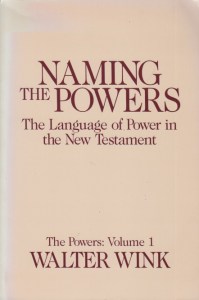
Those of us who became academically aware (in the biblical field) in the 1980s knew the name of Walter Wink.  Now, if you’ve ever become academically aware, you know that we all know some names vaguely, as if seen in a glass darkly, and some more intimately.  Wink fell into the former category for me.  He specialized in “the other testament,” and although I read Greek quite well, my academic track led me through Hebrew to Ugaritic and beyond, in the opposite direction.  I taught New Testament in my academic career, but never found the time to go back to Wink.  I knew he’d written about “the powers,” and the idea was interesting, but I had other research I was doing and I never got around to him.  Now I’ve finally finished the first volume of his famed trilogy on the powers (Naming the Powers).

“Powers” was a circumlocution for many things in antiquity.  It is a high abstraction.  Why do you do what you’re told?  The powers.  They can be human, such as bullies or governments (which are increasingly difficult to distinguish), or they can be supernatural.  Much of Wink’s book is technical—this isn’t easy going, even if it’s theology.  He looks closely at the terminology of power and exegetes it minutely.   The book comes alive, however, in part 3.  There were quite a few worthy insights here, but the one that struck me the hardest is how institutions generate a power that no one individual can control or contain, let alone comprehend.  As Wink points out, a school isn’t a building.  What goes on inside such a building takes on a power that reaches beyond any of the individuals involved in teaching or learning.  Think of Harvard.  What is it?  Who is it?  It bears power simply by the citation of its name.  No scientist can quantify it, but none will dispute it either.

Thinking about “the powers that be” in this way is transformative.  Wink draws this into the ancient perception that what is happening “down here” is merely a reflection of what is taking place on high.  Not unique to Christianity, or even monotheism, the idea that our lives reflect the reality of some higher power is pervasive in human thought.  And institutions.  Harvard, as most prestigious universities, essentially began as a place to train clergy.  Even at this stage it began to exert a power.  Today Harvard (and many other schools) still hosts a seminary and training ground for clergy.  They face a largely unbelieving society when they’re done.  And if they’re at all like me, it might take them decades to realize something may be missing.


To Be Continued

I’m about in the middle of Neal Stephenson’s Fall: Or Dodge in Hell.  I’ve also just about finished Walter Wink’s Naming the Powers.  At the same time I’m revising the draft of Nightmares with the Bible, which will become my fourth published book.  While doing all of this at the same time (and working about nine hours a day), it occurred to me that to really “get” an author you should theoretically read her or his oeuvre from start to finish.  Ideally, to trace the arc of thought, you shouldn’t leave anything out.  The reason that this is as important as it is futile is one of the nagging problems that came to me while working on my doctorate: how do you know what a source you’re citing is really saying?

Pardon my nihilism, but this is an important matter when it comes to academic practice.  Academics cite many sources, and often miscite them.  I’ve seen it regarding my own work.  One scholar argued the exact opposite of what I published in an article and even made the point that he was building on what I’d stated.  Clearly he was digging where I’d been building or vice versa.  We were going in opposite directions and what I’d written was to undermine what he was arguing.  The thought came to me now because both Stephenson and Wink are the writers of many volumes.  I need to cite my sources, but it’s clear that the books are merely slices of lifetimes of thought.  Academia wants you to show your work, but its dated even before you press the “send” button.

I’m not knocking scholarly process.  It’s the best system we’ve come up with for getting near to the truth.  Since no one person has the entire truth, however, we get closer still if we follow a writer from start to finish.  Those of use who use pseudonyms in order to keep our day jobs only complicate things.  Our works (which we hope will outlast us) are only fragments of a larger world of thought that goes on behind the writing of books.  And what about weblogs, or “blogs”?  The million-plus words on this one are a stream of consciousness that weave within, behind, and outside of the books, articles, and stories I write.  Some writers make bold as to attempt biographies of other writers.  Some try to read everything said writers wrote.  Even so they’re only getting part of the picture.  To understand where a writer’s coming from requires more commitment than we’re likely willing to spare.  Now, if you’ll excuse me, I’ve got some books to finish.


Honest Labor

When an artisan begins a new job, s/he must acquire the tools of the trade.  During a period of unemployment I seriously considered getting certified as a plumber.  I’d done some plumbing repair and, unlike many people, I wasn’t afraid of it.  (I am, however, terrified of electrical work.)  When I was looking into it, it became clear that there would be a significant outlay of tool purchasing up front.  While all of this may seem obvious, people are often surprised to learn that writing books also involves tools acquisition, although it generally pays far less than plumbing. The tools used to be made of paper, but they can wrench pipes apart and rebuild a bathroom from scratch.  I’m referring to books, of course.  In order to write books you have to read books.

Long ago I gave up on trying to read everything in an area before writing.  There’s just too much published these days.  When I was teaching and actually had a modest book allowance I would attend AAR/SBL only to come back with armloads of books that I needed for my research.   Of course I had the backing of the seminary library as well, so I could find things.  As an independent scholar doing the same work, however, you have to do a lot more tool acquiring since no library will back you up.  Nightmares with the Bible came back from peer review with a standard-issue academic who wanted me to “show my work.”  (I.e., document everything.)  Apart from slowing the book down (it is written), this also means acquiring tools.  AAR/SBL always reminds me of just how much is being published these days and that my toolbox, although already quite hefty, isn’t nearly big enough.

As I’m going through Nightmares rewriting and adding footnotes, I’m discovering more and more material that could be included.  As an editor myself I try hard to keep to assigned word counts, and the entire allotment could easily be taken up by bibliography alone.  I am very modest in my spending at conferences now—independent contractors have to be.  Nightmares will likely be my last academic book; I can’t afford to keep going like this.  I don’t plan to give up writing, of course, just academic publishing.  Both this book and Holy Horror were written for non-specialist readerships, to showcase my non-technical way of explaining things.  Both ended up with academic presses and are slated to be among those specialist tools that the beginning artisan covets but for which s/he has to budget.  And when this house is finished it will have an impressive, if most unusual, private library.


Post Facto

“Yea, though I walk through the valley of the shadow of death,” Psalm 23 asserts, “I will fear no evil.”  Nor should one fear evil when flying over Death Valley, as I did coming out of San Diego, but I did.  There are perhaps not too many national monuments that can be appreciated from 30,000 feet, but the only way I’ve seen both the Grand Canyon and Death Valley is by plane.  My flight home from AAR/SBL had me sitting over a wing, so a photograph of the famed graben would simply show mostly wing and a bit of Death beyond.  This valley holds the record for the hottest ambient temperature recorded on the surface of the earth (134 degrees) and is famed as one of the filming locations for Star Wars.  Still, from the air the juxtaposition of mountains and salty, flat dearth was impressive.  I had no one with whom to share my excitement; the kid next to me was watching a movie on his phone and I had no idea who he was or if he’d be interested.

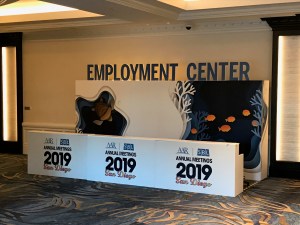
Disneyland, they say, is the “happiest place on earth.”  While I have my doubts about than endorphin-laced claim, I do know one of the opposite locales.  The hotel in which I stayed, the Grand Hyatt, San Diego, hosted the AAR/SBL Employment Center.  The hotel is not to be blamed for holding the most unhappy place on the planet, but as I looked at the booth I wondered if this was truth in advertising.  Should it not read “Unemployment Center”?  That two-letter prefix would make this at least honest, if not cheery.  I have spent some of the most miserable hours of my life in the employee hopefuls’ lounges at past conferences.  Hours and hours wasted, waiting to see if anyone, anyone at all was willing to grant you an interview.  I saw more than a few tears shed in that horrid place.  Some of them mine.

Now I’m high over Death Valley.  It feels far too sanitary to experience it in this way.  The professorate, which seeks to improve the world, is generally a powerless lot.  Signs scattered throughout the Convention Center and hotels asked such things as Does your school have over 50% contingency faculty?  And statements like Tenure track is not the norm.  The psalmist, it seems to me, got it right.  If you want to face the valley of the shadow of death and not fear, you have to walk through it.  The more people who do, the better the hope that we’ll land this plane with some kind of resolve to do be open to visions and to act upon them.


J L Seagull

Perhaps it has happened to you as well.  At some undisclosed period life became so busy that you felt as if—in a good southern California metaphor—you were riding on a huge wave and you couldn’t get off.  Back in my teaching days I had time to plan my trips to AAR/SBL and fit in some human activities as well as maybe even getting around to see the outside once in a while.  It’s great to run into so many people from every stage of my academic life—toddlerhood at Grove City College through my current doddering editorship—but I can’t help having the feeling that I’m popular now because I’m thought to have something others want.  The keys to the kingdom.  A possibility of getting published.

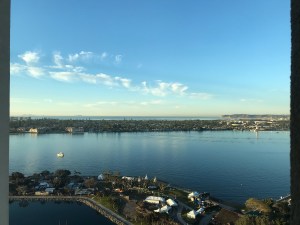
Those of you who read my daily reflections know that I’m glad to share publishing knowledge.  I encourage academic authors to learn a bit about the publishing industry.  It’s rapidly changing and when you have an inside track (here is the real added value) you need to look beyond your current book project to see what goes on behind the veil.  Widen the focus.  There’s a whole world out there!  My glimpses out the hotel window inform me that there’s an entire bay to be explored.  I watched seals or sea lions (it’s hard to tell from this distance) playing in the water as the sun rose.  Then a seagull flew up and landed inches from my face on the windowsill of my room.  It stayed for nearly a minute, looking me over as I looked it over.  Noticing the tiny white feathers that formed a W on the edges of its beak.  Its Silly Putty pink feet with small black nails.  The emerging red patch on the underside of its bill.  It took a step off the ledge, spread its wings and looked elsewhere for a snack.  I soon learned why.  A second later a larger gull landed in its place.  We too regarded one another curiously.  Had the glass not been there, we could’ve easily touched.  It also lept off to be replaced by an even larger, more mature gull.  None of the three were in any hurry to get away, but when they realized I couldn’t give them what they wanted, they left.

I’m a great fan of metaphor.  Academic writing, unfortunately, doesn’t encourage the craft of utilizing it (neither does it often encourage being coherent).  Later this morning—it will be early afternoon back home—I have to rush to the airport to catch a hopeful tailwind back east.  Someone else will check into my room.  If, perchance they sit by the window with the curtain drawn before dawn, the gulls will visit.  And maybe a lesson will be taken away.


Wisdom of Trees

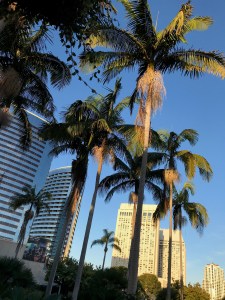
Stepping out of the airport the first thing I noticed was the palm trees.  I’ve traveled to this area enough times that I shouldn’t be surprised, but I always am.  And since we are creatures of the culture in which we’re raised, palm trees inevitably make me think of Gilligan’s Island.  We grasp for culture to help us make sense of this odd world of negotiating other people and, like many children born in the sixties, I was raised on television.  Gilligan’s Island (somehow appropriate training ground for attending AAR/SBL—it actually featured a professor) was as close to seeing a palm tree as I ever got, being raised in a very humble household.  To me, palm trees were as much creatures of fantasy as the monsters that populated the movies I watched on Saturday afternoon.

My first experience of a real palm tree was in Israel, 1987.  I’d signed on as a volunteer at Tel Dor, an archaeological dig near Haifa.  Then, as yesterday, I encountered palm trees—so alien and yet so natural—at the airport.  Welcome to Tel Aviv!  And so we think of palm trees as being part of paradise, a place where it’s always pleasantly warm and although well-watered it doesn’t rain too much.  Trees symbolize our culture.  Although back home in the northeast most of the leaves are down from the hardwoods, the region is also defined by its large plants.  Trees do that for us.  Spreading high over our heads, with dense cellular structure that makes them heavy, trees have always been attractive to our species.  And they can help us define, at a glance, where we are.  “Paradise” derives from a Persian word for “garden.”  Even in arid zones they value their trees.

Looking out my hotel window I see the bay.  In the bay stands a marina.  Back home most boats are shrink-wrapped by now and I’ve already seen smaller bodies of water start to freeze over.  Paradise has no ice.  For the castaways, being on the island was always a challenge, but never a terribly serious one.  Thurston Howell III used his money (useless where there’s nothing to buy) to try to assert his influence.  Everyone treated him with respect, always calling him “Mr. Howell.”  In that paradise, however, one of the two characters (who had names) referred to always by title, the professor—the skipper, of course, was the other one—was the person looked to for guidance.  If anyone would figure out a way to be rescued, it would be the academic.  I’ll be spending the next few days on an island with mostly professors.  And when it gets too intense I’ll look at the palm trees and remind myself that this is paradise.


Daylight Saving Time Zone

One or two of you out there—you know who you are—put yourselves through reading my musings on a daily basis.  I haven’t missed a post in nearly a decade, but travel always complicates things.  Yes, it’s that time of year again—I’m on my way to AAR/SBL.  The American Academy of Religion and Society of Biblical Literature Annual Meeting is the trade show of the guild.  This year we’re meeting in San Diego, California.  The hope of many of us is that it’ll be sunny and warm.  Last year, of course, I missed the conference for the first time, exchanging the Denver Hilton for a night on the floor of Newark’s Liberty Airport.  This year I’m flying out of a different venue—one where egress is possible in the case of snow.

I always like to post a reminder to the faithful few that normal service on this blog may be interrupted.  One never knows what might happen when away from the regular routine.  And three time zones will surely wreak havoc with circadian rhythms that haven’t yet caught up with the end of Daylight Saving Time.  Or is it the beginning of Daylight Saving Time?  It makes no difference, because it lead to lack of normal sleep, no matter what we call it.  In any case, San Diego may make usual posting unusual.  At the very least it’ll be a few hours off.  I’ve become a creature of habit, posting my thoughts between six and seven on weekdays.  On weekends I’m up just as early, but I give the web a chance to sleep in.

These annual meetings are exhausting when you go on behalf of a publisher.  Unlike the leisurely experience of a paying customer, you don’t get to go back to your room for a nap, or even to sleep in.  Every year colleagues ask me to receptions but I decline because every day is a school day.  And I have appointments from 8:30 until 6:30 daily.  Sometimes even later.  You, my gentle reader, have been given advance notice.  I’ll try to continue my daily chronicle of life inside this particular head as thousands of scholars of religion mill about, wondering about the answers to the big questions.  Right now the big question is whether I’ve packed everything I’ll need.  I’ll gain three hours on the way out, but I have to leave them at the desk when I get back.  Along the way I’ll scatter posts like breadcrumbs to help me find my way home.


Geography Lesson

As someone who eschews easy labels, I’m always conflicted when someone asks what my doctorate is “in.”  Universities have departments, of course, and different academic fields have differing standards of what qualifies you as an expert.  My Ph.D. was mainly in the field of history of religions, but focused (all such project must be narrow) on what is best called ancient West Asian cultures.  Recently someone showed me a website with free geography quizzes on it.  (I post the link here with the caveat that this can be very addictive.)  This friend asked me how good my Asian geography was.  I knew that once I got east of Iran I was going to be in trouble.  Some countries, such as Russia, India, China, and Japan are hard to miss, but the others I was properly humbled over.

I tried the quiz again and again until I could point to any of the official Asian nations with a fair degree of accuracy.  Eurasia is a very large landmass, and when you consider that it is, apart from human-made canals, attached to Africa this is a lot of space to label.  Considering that many isolationist politicians can’t correctly find smaller countries on a map without an app, I started to realize just how lopsided the world is.  Many more people live in Asia than populate the “New World.”  They actually have more space than we do here, but much of it is too cold or too dry for comfortable living.  Still, I considered that if I’d had this quiz as a kid I might’ve known my geography much better than I do.

As I’m preparing to attend the American Academy of Religion and Society of Biblical Literature Annual Meeting in a few days, I recall priding myself at knowing all fifty states of my native country.  I’ve been to all but five of the lower 48—Alabama, Kansas, Oklahoma, New Mexico, and Nevada have eluded me (the conference never meets in them and I don’t have friends who’ll put me up for free in them).  But at least I know where I haven’t been.  

After trying my hand at Asia on the app, I attempted Africa.  Let’s just say I still have a lot left to learn.  And unlike when I was a kid, I look forward to taking quizzes.  Work interferes with web time, though, and learning modern countries isn’t the same as knowing where Hatti or Elam used to be.  Religion, after all, forms borders just as impermeable as mountains, oceans, or deserts.


Author Revise Thyself

Monster fans may have noticed that, despite the season I haven’t been writing much on the topic.  One of the reasons for this is that I’m in that dread stage known as “revision.”  As an editor I often see book proposals—or even entire books—that have never been revised.  You can tell.  I learned this while writing Holy Horror.  If you’re one of the people who took out a second mortgage to buy a copy, the book you purchased was based on a manuscript rewritten thoroughly at least five times.  The idea is that like rocks in a river, all that pouring over a text smooths the words like stones over the millennia.  Few rocks emerge from volcanic or sedimentary situations as smooth and round.  That takes revision.

My peer review report for Nightmares with the Bible came in a few weeks ago.  Nightmares had been revised a couple of times, at least, before I submitted it.  I understand the review process very well, as I deal with it daily.  Sometimes single blind (the writer doesn’t know the reviewer’s identity), other times double blind (neither reader nor writer know the other’s identity), the process is meant to provide feedback on a manuscript.  Having written many more manuscripts than have seen publication, I know just how useful peer review can be.  Like anything, however, it can also be treated legalistically, as if the reviewer knows more about a subject an author has just spent years researching.  No matter your impressions about this, once the reports come in, revision is in the cards.

Self editing is difficult.  And occasionally embarrassing.  You read again what seemed to make sense to you at the time, but even after you hit the “send” button you’ve continued reading.  New information comes to light.  Monographs are a very expensive form of dialogue.  Well, not so expensive as all that.  Many people are happy to pay out the cost of a monograph for a dinner out, which lasts an evening.  A book, mutatis mutandis, lasts much longer.  Like that meal, it’s taken internally and digested.  You can read the same book twice, however, without having to pay the second time around.  It’s a good idea, then, to revise before sending it to a patron’s table.  Ironically, revising a book on monsters takes time away from writing about monsters.  I also have essays awaiting revision, circling overhead like planes at Newark’s Liberty Airport.  And then there’s work, which has nothing to do with my own writing at all.  There’s a reason Nightmares occurs in the title.


Seventies

It’s pretty rare for me to be out on a week night.  Like a kid on a “school day” I’ve got to get up early the next morning.   And yawning a lot at work is bad form, even if nobody can see you.  I risked it recently, however, to meet with some colleagues from the Moravian orbit in Bethlehem.  As we talked, current projects came up, as they’ll do when doctorate-holders get together.  Demons are a conversation stopper, but I nevertheless asserted that our modern understanding of them derives directly from The Exorcist.  The insight isn’t mine—many people more knowledgable than yours truly have noted this.  One of my colleagues pointed out the parallel with The Godfather.  Before that movie the mafia was conceived by the public as a bunch of low-life thugs.  Afterward public perception shifted to classy, well-dressed connoisseurs who happen to be engaged in the business of violence and extortion.

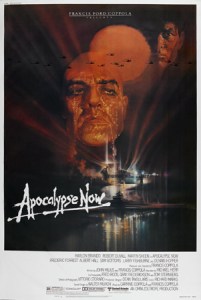
The insight, should I ever claim as much, was that these films were both from the early seventies.  They both had a transformative cultural impact.  Movies since the seventies have, of course, influenced lots of things but the breadth of that influence has diminished.  I noticed the same thing about scholarship.  Anyone in ancient West Asian (or “Near Eastern”) studies knows the work of William Foxwell Albright.  Yes, he had prominent students but after Albright things began to fracture and it is no longer possible for one scholar to dominate the field in the same way he did.  Albright died in the early seventies.  Just as I was getting over the bewilderment of being born into a strange world, patterns were changing.  The era of individual influence was ending.  Has there been a true Star Wars moment since the seventies?  A new Apocalypse Now?

You see, I felt like I had to make the case that The Exorcist held influence unrivaled by other demon movies.  We’re still too close to the seventies (Watergate, anyone?) to analyze them properly.  Barbara Tuchman suggested at least a quarter-century has to go by for the fog to start clearing.  Today there are famous people who have immense internet fame.  Once you talk to people—some of them my age—who don’t surf the web you’ll see that internet fame stretches only so far.  It was true even in the eighties; the ability to be the influential voice was passing away into a miasma of partial attention.  The smaller the world gets, the more circumscribed our circles of influence.  And thus it was that an evening among some Moravians brought a bit of clarity to my muddled daily thinking.


Frozen Streams

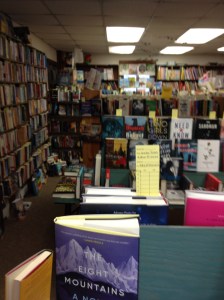
I was walking in Ithaca, with my feet not far from Sagan.  Winter had settled in prematurely, as it often does in upstate.  I was wearing a hoodie and old fleece combo and I suppose I looked a bit tatty.  My wife and daughter had gone to see Harriet, but movies about how badly people have mistreated others, strangely for a guy who watches horror, really depress me.  Ithaca, until recently, supported three independent bookstores, so I figured I could pass the time easily enough.  It was growing dark and breezy, and I visit bookstores only with a list, otherwise it’s too dangerous.  Autumn Leaves, a used vendor, I’ve visited many times.  Their religion section is disappointingly small, but I tend to find offerings in other areas when I blow in.

Buffalo Street Books is the last remaining indie that handles new books, but I stopped by The Bookery, now closing, on my way.  This was saddening.  Ithaca houses both the ivy league Cornell and the highly regarded Ithaca College.  I suspect many of the street sweepers hold doctorates.  Has book culture entirely bent the knee to Amazon?  At the end of the last millennium, Ithaca housed 25 independent bookstores.  Today it’s evident that Buffalo Street (formerly The Bookery II) struggles to keep its hold.  I feel ethically obligated to buy something there, to take one for the team.  I had a short list and the shelves in The Bookery had been nearly bare.  It was just too depressing to stay there.  I found an inside bench and sat to read until the movie was over.

Or so I thought.  I ventured back outside and now it was fully dark, being six p.m., and I wandered back to the familiar Ithaca Commons.  I went into a couple of shops, but they looked at me as if I were homeless.  (I suppose I was, in a sense.)  I haven’t had a haircut in a while, and my beard is scruffy and white.  My hoodie and fleece don’t speak to affluence.  I had unconcealed books—I routinely refuse bags—and I suppose I could come across as a touch eccentric.  (I don’t have enough money to be authentically eccentric.)  I wondered how street people do it.  Outside the east wind was decidedly sharp and windbreaks on the pedestrian zone are few.  I came to the monument to Martin Luther King Junior.  I was walking in Ithaca but I really felt that books could make that dream come true.


Old Grains

Back when I was somebody—a professor is somebody, even if only a seminary professor—I was invited to meet with a group of Seattle writers and intellectuals.  I was in Seattle already because driving all the way out here was possible when you live in the Midwest and your summers are basically open and free.  (Professor’s privilege.)  One of the group members, the one who invited me, asked me about grain.  When the club met they ate.  With a bent toward history, one of them brought period-appropriate bread.  What kind would be fashionable for a night of ancient Near East talk?  (I was still researching and writing on Ugarit at the time, before Ugaritology passed away.)  Without stopping to think I replied “Einkorn.”  I didn’t know if einkorn was still around or not.  All I knew is that it was the earliest (at least as understood at that time) domesticated grain.  The loaf that arrived that night was a more accessible grain variety.

All of this came back to me as I stood in the local health-food store.  We don’t shop here for regular groceries—it’s expensive to eat healthily—but we’d been invited to someone’s house and said we’d bring appetizers.  The health-food store had vegan cheeses, so we needed crackers to go with.  Then I spied the word “einkorn.”  The Seattle discussion had to be well onto two decades old by now.  I was finally able to answer my question, einkorn was still alive.  The craze for ancient grains did not exist in my professorate days.  Some companies, according to occasional news stories, were trying to brew the beer of ancient Egypt or Sumer, but the health conscious hadn’t gone so far as to trying to replicate the diet of the earliest agriculturalists.

Ancient grains cost more because the yields are smaller.  Although the grain heads look disturbingly like those house centipedes that scamper in the basement when you flip on the light, they aren’t nearly the size of a current wheat head.  It stands to reason that it takes more of them to make up the same amount of flour, and appetites have grown over the millennia.  Like most vegans, I read boxes.  Another ancient grain cracker, apart from brown rice, included amaranth, flaxseed, millet, quinoa, sesame, and sorghum.  Never mixed this way in antiquity (for amaranth and quinoa were part of the “new world” and the others “old”), modern mixologists have devised new ways of using ancient grains.  Einkorn nearly went extinct with the development of wheat, rye, and barley.  But it hung on, and now, as a dozen millennia ago, it has a way of sustaining both dreams and fantasies.