Finite Gods

Just how many gods are there, anyway? Well, that’s not really a fair question. For one thing, do I mean “real gods” or gods that people believe in? Do I mean “believe in” or made up? Do I mean “made up” or intentionally fabricated? And the nesting questions could go on and on. Over the years in my professional capacity as an erstwhile teacher, I accumulated books listing the deities of various cultures with brief descriptions. I once even argued that using “god/goddess of” (the divine-genitival construct) as a phrase distorted ancient concepts of divinity. The fact is people have believed in many gods in many different ways. As modern scholars of religion we’ve only begun to reach the heavens (or underworld, or anywhere in between, for deities may be found anywhere). This issue comes to mind because a friend recently shared a story from IFL Science about a new Etruscan goddess. The piece by Ben Taub mentions a stone recovered from Poggio Colla, a site in Italy, written in Etruscan. The stone seems to mention a new “fertility cult” goddess. And once again religion and science have met, but not quite kissed each other.

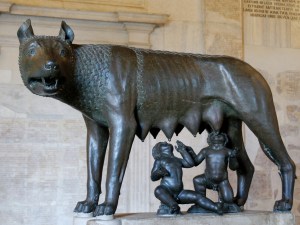
Photo credit: Jastrow (2006), Wikimedia Commons

Photo credit: Jastrow (2006), Wikimedia Commons

Let’s begin with the Etruscans. Before the Romans, Etruscans lived in Italy, giving Tuscany its name. We know very little about them, as their language (Etruscan) is rarely found and imperfectly understood. Some of the classical gods may go back to Etruscan originals, and the Etruscans seem to have known of at least some of the cultures of the ancient Near East, or ancient West Asia. We have no idea how many deities the Etruscans recognized. Polytheism, for all its heathenish exuberance, never had a problem with adding more gods. Interestingly, the “new” goddess mentioned here, Uni, is someone I used to talk about in my Rutgers classes on ancient Near Eastern religion some five-plus years ago. Pardon my crowing—I seldom get to suggest I was ahead of my time.

What really interests me here is that websites that advocate science still take an interest in religion. Although belief is relegated to inferior minds (generally) science does admit, from time to time, that it’s interesting. The study of religion, in at least some schools, is a scientific enterprise. No, we don’t put gods under microscopes (telescopes might be more useful) but we use the same techniques as empirical studies of nature use in order to try to draw some conclusions about religion. Despite the fact that the vast majority of humans on the planet are believers, higher education has consistently under-funded or disbanded departments who apply rational thought to religion. We suppose that someone else can pick it up and study it, coming to useful conclusions without putting in all the homework. Don’t mind me, though. I’m just basking in the light of having known about Uni years before she was discovered.


Twitter Me This

Techoncrat I’m not. At least I understand that to be authentic in this world you need to be on social media. I have a Twitter account. Have had for years. I don’t follow it religiously, but then, I don’t treat any social media like holy writ. The other day I noticed a disturbing trend. Donald Trump’s tweets end up on my bird feed. No, I didn’t accidentally follow him—I have a natural aversion to fascists with delusions of divinity—but nevertheless his mug shows up so frequently that I tend not to follow the bird maybe as much as maybe I should. I wonder how someone thinks s/he has the right to buy part of my consciousness.

Tweet or honk?

Tweet or honk?

The world-wide web is without laws, like the subconscious mind. Thoughts from around the world—at least the affluent part of it—milling, swirling about in an electronic soup thickened by irony. It’s addictive. The opiate of the masses. Perhaps it is a religion after all. Tweets are micro prayers. Blogs are sermons. Facebook is coffee hour. All these connected minds have created a consciousness of their own. Like Victor Frankenstein, we too know what it feels like to be God. It’s not a particularly joyous place to be. Does God, I wonder, lack the control that we experience on the Internet?

I like Twitter. It doesn’t demand much. The only problem is that to stay on top of things you have to have it going all the time. I turn it off and when I come back on I’ve missed hundreds of tweets. And then there’s Donald Trump again. I can come up with my own nightmares, thank you. I don’t need Twitter to suggest any.

Perhaps this is the apotheosis of capitalism. The ability to buy anything, including space on somebody else’s bird feed. Buy the most powerful office in the country, if not the world. Buy hatred and distribute it freely. One thing you can’t buy is intelligence. At least, up until now, some universities still understand that. It has taken me years to gather Twitter followers, like Mrs. Partridge the family band-mates fall behind in a neat, technicolor line. I have no money. I have very little influence. I’m really not a very good capitalist at all. I give away for free what universities charge for. Just like in the classroom, few pay attention. What do I expect? Who really listens to sermons anyway?


In the Details

To a certain mindset, nothing conveys a threat quite like Satanism. Many parts of the world witnessed this dynamic during the “Satanic scare” of the 1990’s. In reality, however, most groups identifying as Satanism do not believe in a Devil and, often enough, don’t engage in worship. These groups are a reaction against aggressive Fundamentalism. For example, a Washington Post article timed as parents (at least) are thinking of back-to-school worries, announces “An After School Satan Club could be coming to your kid’s elementary school.” News headlines are intended to make you want to read a piece, and this one worked in my case. It turns out that the Satanic Temple, the group behind this current initiative, is one of those rationalist groups that doesn’t believe in the Dark Lord. They object, however, to schools allowing Good News Clubs to meet after school hours and want to make a point by offering alternative programing. Devil-themed, but not Devil-believing.

It’s difficult to imagine this kind of situation developing in many world cultures. It raises some very basic dilemmas where two conflicting freedoms co-exist: freedom of speech and freedom of religion. Most people would agree, upon reflection, that public schools should not be used for religious instruction. After school programs, in the minds of kids, still take place “at school” and are not easily separated from regular instruction. (Just ask an undergraduate what an adjunct instructor is and you’ll see that they pay little attention to administrative issues like that.) Fundamentalist groups, such as Good News Clubs, use freedom of speech as their wedge to offer after school programs. It’s not “school,” and it’s after hours. Don’t we allow freedom of speech, and isn’t there space available? Good News Clubs are, of course, evangelistic engines. The Satanic Temple makes the claim that if one religious group can meet after school, so can another.

Neither academics nor society have a good understanding of literalist beliefs. Those of us who once believed—sincerely believed—Fundamentalist teachings are a resource academia has chosen to ignore. Higher education is still an “old boys network” where jobs are offered on the basis of who you know and not on the basis of the knowledge they might offer to students. This, I suppose, is yet another clash taking place. Fundamentalism may seem laughable from the outside, but from the inside the untenable beliefs are taken with deadly seriousness. After school programs are an expression of a very deep-rooted fear that such religions promote. Satanist groups will get headlines by taking them on, but they will continue the conflict rather than offering dialogue to try to understand. They’re only doing what higher education teaches them to do—support those you like instead of trying to move knowledge ahead. Perhaps that’s the real work of the Devil after all.


Hollow, Sleepy Hollow

Legend_of_Sleepy_Hollow_U.S._Stamp

It was recently announced that Fox has renewed Sleepy Hollow for a fourth season. Please! No spoilers in the comments (as if)! I’m running a season behind so I want to protect my innocence. The announcement coincided with the happy news that my article on the Bible in Sleepy Hollow has been accepted for publication in the Journal of Religion and Popular Culture. I’m irrationally chuffed about this since my past publications have been primarily textual explorations of documents in languages nobody reads any more. Having something contemporary accepted for publication felt—dare I say it?—cool. As if I were part of the supernatural television crowd. It also affirmed my decision for which book to pursue next. When I say “pursue” I mean “write.”

You see, as a young scholar I struggled trying to decide what direction my research would take. After writing my book on Asherah, I was a bit sated with Ugaritic goddesses, although I started a book on Shapshu, goddess of the sun. The sun gave way to the weather and I wrote Weathering the Psalms. I lost my job in the midst of my revision of that project and it has taken a decade to find my way back to academic publishing. Research, however, takes on a vastly different form when you’re not hired to do it. Colleagues say, “I can get you access to my university library.” Such a kind thought, but my mind always says “when?” When would I have time to visit a library? I get up at 3:30 for my commute and get home in time to go to bed so that I can wake up again at 3:30 the next day. Research reading on the bus is dicey at best. Weekends are for getting the things done that are neglected all week long. Research has to be squeezed into the interstices.

That’s why I’m pleased about Sleepy Hollow. Watching television, even if on DVD, can be research. I’ve got decades of backlogged reading upon which to draw. When my tastes for light horror integrate with what I’m interested in researching it is a happy day. “The Legend of Sleepy Hollow” captured my imagination as a child. It was probably based on the Disney version, but even so, I never lost the fascination. Tim Burton’s Sleepy Hollow is still one of my favorite movies. Watching the episodes of the Fox series takes time, but now I know that time is not just simple relaxation. No, it’s research. Now to find the time to write that book that’s brewing in my head. Inspired, perhaps prophetically, by a Headless Horseman.


Leaving Town

After grousing about having too little time, today begins a trip out of town. Changing time zones, forsaking civilization, resting at a mountain lake. And I’m thinking of all that I’ll accomplish without having to go into the office for an entire week. I made similar plans last year. I’d lined up all the projects that had been piling up and figured that being away for a while would be perfect for getting them done. On the flight across the country, however, my laptop died. Gave up the electronic ghost and died. I grieved, and I was in shock. Thoughts of buying a replacement came to mind, but then, I told myself, I justified buying all my past laptops because of teaching. I carried my PowerPoints with me to class. We’d become a two, then three, computer family. I remembered the sign-up sheets they used to use when you needed an hour on the computer in the library. I’ve practically become a single entity with my hardware, how would I survive without?

Last year, survive I did. Concerned family members kindly offered to let me borrow their laptops so that I could post my daily ravings here. I was surrounded by nature’s majesty—mountains, a pristine (or nearly so) lake, huckleberries, fresh air—and my thoughts turned to the Borg. I’d read about transhumans, and now, I could see, I was becoming one. I don’t want the internet plugged into my brain. In fact, sometimes I don’t even want it sitting on my lap.

All of this is my long-winded way of saying to the ether that my usual posting pattern may be disrupted. It was at the lake, however, that this blog was born. I’m sure that those who first suggested it are a touch disappointed at the way it has grown up. Initially it was supposed to be mostly podcasts. My servers for those casts, however, charged for the service of holding my voice bytes. I used to get paid for sending that same voice out over a classroom full of students only to fall on the wrong side of politics and economy. So it is that I await my flight to remote reaches—remote reaches with Wifi, if the elements allow. If you don’t see my usual musings at my usual time, this will likely be the reason. Although, this time around, with a new top for my lap, I hope I’ll remember to get outdoors every now and again.

IMG_2362


Up, Up and Away

OurSuperheroesIntellectuals often have difficulty, it seems, taking popular culture seriously.  I remember feeling slightly guilty taking a class on Science Fiction in college and actually getting credit for it.  At the time—I remember the Dark Ages—a course on comic books, or even superheroes, would’ve been laughed out of the academy.  And not in a good way.  Monsters, likewise, were considered the opiate of the small-minded.  I’m not sure what happened to turn all of this around, but I think my generation growing up may have had something to do with it.  Scholars began to pay attention to more than the cheap paper and eye-catching, if impractical, costumes.  There were, unnoticed by standard readers, messages embedded in comics.  Superheroes may have been telling us something about ourselves.  Now tenured professors can write about various caped crusaders without fear of ridicule.  Some of the books are quite good.

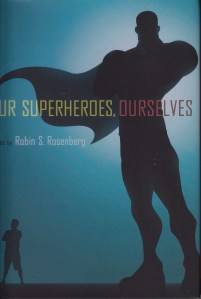
Robin S. Rosenberg’s Our Superheroes, Ourselves, is a rare example of a uniformly fascinating edited volume.  Contributions from a variety of psychologists and psychologists explore several of the deeper aspects of  the superhero phenomenon.  Insightful and thought-provoking, this little book gives the lie to the frequent admonition of my youth that reading such things was a waste of time.  Anything but.  Now, I didn’t have the level of commitment to comics that Big Bang Theorists do, but I recall being entranced by much of what I read.  Some comic panels are still vivid in my head, although I haven’t seen the original in more decades than I’d like to admit.  They are, as one of the essays suggests, a form of modern mythology.  Another form of modern mythology is the movie.  Superhero movies are discussed as well as the print versions.  These cheap, easily read books were more, it seems, than meets the eye.  I’ve fallen a little behind in my superhero movies, but perhaps it is time to start trying to catch up with Superman.

What is really striking, to me, is the discussion of super-villains.  As more than one contributor points out, you can’t have a superhero without the nemesis of an arch-criminal.  This quite naturally leads to the discussion of abstracts: good and evil.  Early comics tended to be Manichaean in this regard.  In our world evil may be much more subtle than it appears on the outside. The book appropriately ends with a reflection on morality. More than one ethical system may be found in superhero tales. Super-villains, apart from becoming role models for some political candidates, allow us to explore our own dark sides. In the end, however, we know that Batman must overcome the Joker, no matter how appealing he may be.


Auld Reekie

DSCN3452

Those of us who once tried to storm the walls of academe from humble beginnings soon learn our lesson. This is a guild meant only for those whose parents knew enough to suggest an Ivy League education. Those whose parents have never heard of Harvard (they exist!) and who don’t know what an Oxford is aren’t really well-placed to give advice on these matters. At a small-town high school you couldn’t count on a guidance counselor noticing your academic prowess as anything more than a statistical blip in a non-challenging career. I learned about the Ivy League too late. It was, therefore, a very pleasant surprise to have an Edinburgh colleague ask me to write a piece for a Cambridge Companion. I don’t have the contract yet, but even the invitation made my day. Maybe my month. Or career.

I spend my days commissioning just such works for a different press. I know hundreds of colleagues. Only one ever said, “would you consider writing…” I’m not being entirely fair here. I’ve been asked to contribute to Festschriften. Such volumes are the highest praise an academic can be given. John C. L. Gibson, of blessed memory, was the first honoree. Nick Wyatt was the second. Simon Parker, also departed, whose Festschrift is currently in the works, was the third. I’ve been asked for others, but regular research is beyond my reach with my current schedule. I can churn out an original article once a decade, it seems. The ideas are still there, alive and popping. The time, alas, is not.

So I’m happily sitting here thinking of how to write a Companion article. The colleague who asked me is someone I recently met. He found out that I had attended his alma mater and wondered why I hadn’t landed a regular teaching post. Edinburgh University, in the larger world, is a recognized name. I can’t see through the ivy to discern it on this side of the Atlantic, but I’m assured it’s still there. Recognizing that those who fall between the cracks can still sink a taproot and make a contribution, he asked me if I might consider it. He had me at Edinburgh. School loyalty still counts for something, I’m glad to learn. For once I feel that I don’t have to apologize for having ventured to Scotland with only my transcripts and high hopes in my pocket (and with an indulgent wife by my side). Now I’ve been asked to write. I’ve gone all red, and I hide my face behind my hand. Of course I’ll do it.


Biblical Literature

HB as LitIt must be difficult to write a Very Short Introduction. Although the series is published by Oxford University Press, I’m not being a shill. As someone who writes the equivalent of several of these little books a year, I imagine it must be nearly impossible to confine what you need to say to such a small space. I recently read The Hebrew Bible as Literature: A Very Short Introduction, by Tod Linafelt, and I imagined the anguish of my colleague as he had to decide what to leave out. Professors these days appreciate short books because there is an actual chance that students might read them. The Bible itself is intimidating as a textbook—massive and brooding as it is. Then, in addition to the Ding an Sich, the instructor also has to provide interpretive tools. One of the most common these days is that of the Bible as literature.

This obvious assignment is not without dispute, however. Literature is defined by some as a secular category. The Bible, as a set of one, is a holy book. That is to say, it can’t be considered literature at all. As a collection of written texts, however, the Bible can be understood as a literary venture as well as a sacerdotal one, and for many schools this is the only way the Bible can be legally taught. Not only that, but almost all scholars now realize that, protestations aside, the Bible is literature. It is one of the great books of the western canon. Civilization for huge swaths of the planet was based, in some way, on this book (the Bible, that is). Understanding it as literature is the venture of a lifetime, and condensing that down to an easily digestible Very Short Introduction is no mean task. Linafelt performs his duty admirably. The basics of prose and poetry are covered, as well as their interaction. The examples he chooses are compelling and I learned quite a bit myself, even having taught the Bible many years.

As I read, it struck me that the main objection to the Bible as literature revolves around the concept of truth. Linafelt raises this question early, and it stayed with me throughout the book. In a kind of sacred exceptionalism, “Bible believers” treat literature literally. Ironically, this can lead to grave misunderstandings. Truth, however, is a difficult concept to pin down. Many people equate literature with fiction and truth with fact. Truth is actually a bit more fluid than that. As any poet knows, some truths can’t be expressed in prose. Or history. Or philosophy. And some truths are best expressed in fiction. That brings us back to literature as a form of truth. I suppose that’s a good thing too, because were I to write much more I might be in danger of accidentally composing a Very Short Introduction. As long as I’m being a shill, just consider this a very short introduction to a Very Short Introduction.


All Things Newton

Andover Newton Theological School is the oldest stand-alone graduate school of theology in the United States. Was, I should say. Declining enrollment—supply and demand dictates fewer clergy are required—and the rising costs of a job description that has no obvious retirement age have led many seminaries to merge or close. It seems that Andover Newton is about to merge with Yale Divinity School, much like Berkeley Divinity School, bringing together a mix of Congregationalists, Episcopalians, and Nones to huddle together across the quad until people want to believe again. Those of us who grew up being taught that belief was normal, and widely accepted, have experienced a sense of bad investment lately. We poured resources into keeping our product current only to find the use by date predated the use of use by dates.

Think of it as evolution. From the earliest days of civilization, priests were integral to, well, civil society. Evidence more and more points to religious belief being the actual glue that held larger communities together in permanent settlements. In other words, that’s how we’ve lived for five thousand years. How were we to know that the rules were about to change? You could always count on a need for clergy. The world’s first service industry. Ah, but it’s the latter word of that noun phrase that’s the problem. When religion becomes a commodity it’s subject to supply and demand. Supply has exceeded demand for some years now and the factories are shutting down. Anyone want a used Bible, cheap?

The Episcopal Church, with its outsize influence for such a small body, used to have eleven seminaries in this country. The United Methodist Church, larger by nearly an order of magnitude, had thirteen. Once and future clergy such as yours truly were produced in classes of dozens. We didn’t diversify our portfolios enough. So now, Andover Newton—the very school where I learned Hebrew—is downsizing faculty by a rather drastic percentage. I’m not so worried about deans and administrators since they easily buy into the business model of education. I do wonder about the effect on society of having so many unemployed theologians around. One thing we don’t have to worry about is organized groups of them roving the streets; theologians are fiercely individualistic. As they transition into the corporate world—the only world that now exists—they’ll find themselves wondering how to live among the soulless multitudes. There’s only one orthodoxy here—lucre be thy name. And, oh, you might consider asking about entry-level positions.

IMG_1550


Vitruvian Savior

If memory serves, I was still in seminary when “Piss Christ” was first unveiled. As photographic art, I can’t say when the shutter snapped, but I seem to recall animated discussion over it and since seminary animated discussion has been at a premium, so I think I’d remember something like that. In any case, the artwork still has the power to shock and enrage as the world teeter-totters in its love-hate relationship with religion. Some people seem surprised when other people respond somewhat pointedly to what they perceive as affronts to their beliefs. The thing about beliefs is, well, people believe them. In this day of electro-chemical signals between synapses it may be hard to attribute any substance to belief. Still, if someone makes that claim, insult their mother and see what happens. Beliefs, by their nature, are sacred.

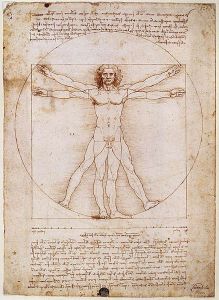
438px-Vitruvian

I was reminded of this when my wife pointed out to me a story about Dartboard Jesus. If you’re not a Rutgers University person (as I no longer am), it takes only a little imagination to visualize this artwork. Conjure a dartboard in your mind. Then picture a crucifix superimposed on it with darts instead of nails. Red darts, if that helps. You’ve got it. The official name of the piece is “Vitruvian Man,” but the public outcry was enough to have the piece removed from public display. I taught (strictly as an adjunct, no complications, please) at Rutgers for four years. People sometimes expressed surprise that multiple sections of Intro to “Old” and New Testaments filled up every semester. I wonder if the university ever takes measure of its students’ beliefs. I had Seventh-Day Adventists in my courses. I had Jains, Muslims, and Hindus. I had Atheists and, God help us, Episcopalians. One thing all these people had in common was belief. Not beliefs, but more singular: belief.

No one in the world intentionally believes falsely. Indeed, should Oxford Dictionaries be trusted, belief is “Something one accepts as true or real.” By definition, it seems, beliefs are believed. Artists serve a valuable function in expressing ideas that words struggle to articulate. There is more going on when your crucifix is juxtaposed to a glass of urine or a dartboard than you might otherwise imagine. It says something about belief. In some cultures such heresy is punishable by death. It isn’t so much a matter, I would suggest, of freedom of expression as it is a matter of advocacy. Artists are teachers and even teachers sometimes don’t consider how their lessons will be taken. Respecting belief, perhaps, is something electro-chemical signals leaping tall synapses in a single bound simply don’t understand.


Beg to Differ

Screen Shot 2016-05-09 at 4.15.19 AM

“What do you burn apart from witches?” “More witches!” Earning a doctorate is kind of like learning how to get lost. It certainly doesn’t make you either cool or employable, but it allows you a few years to accumulate enough debt to keep you out of trouble for awhile. One of the things I learned along the way is that you should always follow the crowd. I look at the schools that only hire Harvard grads and there can be no doubt. I look at all the Trump supporters and I know there can be no question. Yes, the ayes have it. So, I never learned to tell which bands were truly worth listening to until I learned to follow the critics. I never studied music. Like most people, I know what I like but I can’t say why. I only discovered Radiohead in the last few months. Some of my critics claim my complaint of lack of time is only an excuse, but I don’t listen to music unless I can really listen to music. It can’t be pure filler. Put on Beethoven’s seventh and you’ll see what I mean.

In any case, my wife alerted me to the new Radiohead song “Burn the Witch.” And you can’t listen to a new song without watching it as well. This time it’s worth it. The claymation video accompanying the song (conveniently found here on NPR) is a reprisal of “The Wicker Man,” one of the truly intellectual movies in the horror genre. Of course, that’s something I picked up from the crowd. We’re told by the most powerful and charismatic bigots of our age that life is all about acquiring stuff. Were I to argue with that, well, I guess I’d be the witch to be burnt. Before listening to/watching the Radiohead song, do yourself a favor and watch “The Wicker Man” (the original, please, accept no substitutes). Go on, everybody’s doing it.

The most dangerous thing in the world is an independent thinker. No, I didn’t learn that at Harvard. On my first walking tour through Edinburgh with one of my doctoral advisors he pointed out the part of town where they used to kill witches. He was truly an original thinker (still is) and taught me to be one too. Problem is, I should’ve been following the crowd all along. You want people to pay attention to you? Go to Harvard! Want people to vote for you? Clearly show you’ve got what it takes (money). Give a man a little cash and anything will do for brains, to paraphrase one of the smartest movies of all time. The only way forward is to do what everyone else is doing. And pick up some kindling along the way—you’re going to need it.


With Your Measure

“With what measure ye mete,” someone once said, “it shall be measured to you again.” I certainly hope that’s true, but empirical verification seems to be lacking. I’m looking at, with the full armor of irony, a postcard from Nashotah House. Those of you who’ve long read my posts (I know who both of you are!) will know my history with said sacred institution. No, it’s not with me that they stay in touch, but my wife. You see, she’s one of those women who kept her maiden name, so in the eyes of many at the sacerdotal school we were probably never properly married. They certainly never came out to wave goodbye. Anyway, this past year they’ve begun corresponding with my spouse. I can’t remember—did I ever teach there for a decade and a half? So what are these sweet nothings they’re sending?

The card in front of me informs me that they’ve been praying for my spouse. Don’t get me wrong—she’s married to me and she needs all the help she can get—I never begrudge anyone’s prayers. I also can’t help exegeting a bit. Occupational hazard. One of my students once told me “don’t exit Jesus from your exegesis.” And they tell me I have no practical experience in the real world! So I’m looking at this prayer card wondering whose autograph it is. A man wants to know who’s praying for his wife. More than that, it appears that the name was scribbled out and written again. Did someone pray for those in the outer darkness by mistake? Heaven forfend! Alas, for my meting days seem to be about done. I must have a measuring tape around here somewhere.

That same guy whom I’ve quoted above also said, “pray for them which despitefully use you,” which I suppose might be some good advice. I understand that one-percenters and their ilk couldn’t be where they are despite using you. You just can’t help it—if something is inconvenient, you can simply toss it away. Build a tower to the heavens—what can be more biblical than that? See, words are endlessly flexible. They can be twisted and turned and made to say whatever you want them to mean. And should it ever come to meting cups, there are some recipes that might call for more than a wafer and a sip of wine. This is probably all obscure, but I’m trying to read by candlelight, and this text seems to say “when thou doest thine alms, do not sound a trumpet before thee” and “when thou prayest, enter into thy closet, and when thou hast shut thy door, pray to thy Father which is in secret.” But how will anybody send you money if you don’t let them know?

IMG_2767


Used Knowledge

One of the unadulterated pleasures of life—or maybe adulterated is the better adjective—is the used book sale. The year I missed the Hunterdon County Friends of the Library sale felt like a year without a summer. There are other book sales around, but this one’s my favorite. Books are my heroin. You see, I became an academic because it was too difficult to make a living as a writer. Besides, I never formally studied writing and what are you without credentials? Just a poser making some claim of talent. Like most academics I learned to write in staid, measured prose, never exaggerating or showing any emotion. Research for that kind of writing requires a university library since who can afford those kinds of books and you need a JSTOR account to keep on top of all the journals. You read and read on the same topic for months at a time until you have something new to say. Thus knowledge, they tell us, progresses by baby-steps, into a safe and conservative future.

Nietzsche, meet Evangelicals

Nietzsche, meet Evangelicals

The reading that I do is of a different species. I’ve had academics ask me “why don’t you do research on the bus?” Have you ever tried to do research on a bus? Some stranger sleeping next to you with his/her body relaxing and melting into your side of the seat, their arm falling off their rotund belly onto you before being retracted to start the cycle all over again? And staid, measured prose before the sun comes up hardly makes the trip any faster. Of course editing pays much, much less than the professorate. So I buy cheap books. Nothing like a buck a book to bring out the reasonable side of any economically minded obscure private intellectual. You never know what you’ll find at a book sale. Some of my best reading experiences on public transit have been at the behest of orphaned books others turned out into the streets. Books I would never have read otherwise. Books that I feel would understand me.

The once and future academic in my brain tries to reconcile this with what I paid thousands and thousands of dollars to learn how to do (research). Isn’t this in some way pushing knowledge forward? After all, maybe a dozen people will read this post and that’s kind of like publishing, isn’t it? Don’t mind me, I’m just book drunk. It’s the used books talking. While my academic friends prepare themselves for a summer off, some going to vacation houses they justly deserve, I’ll be filling my commute with adulterated books. And hopefully by the time I reach the bottom of this stack another sale will come along so that I don’t have to go through withdrawal. Methadone for books hasn’t been invented yet, and besides, I take no substitutes.


Or Just Sleeping?

442px-Nietzsche187aYesterday was the anniversary of the death of God. The Time magazine cover, the first to be text only, asking “Is God Dead?” was one of the iconic images of the 1960s. Fifty years ago yesterday, the media ventured out onto a limb that hasn’t snapped but hasn’t exactly bloomed either. Maybe it’s because the idea wasn’t original. Philosopher Friedrich Nietzsche had suggested that God is dead in 1882, nearly a century before Time. A friend in seminary reported seeing graffiti that read “‘God is dead’—Nietzsche; ‘Nietzsche is dead’—God.” Although we laughed over it, this waggish statement contained a profound truth. The concept of God has proven remarkably resilient. Indeed, it may be part of what makes us human.

The media, nothing if not endlessly self-referential, responded. In fact, an article by Lily Rothman on time.com, is a Time story about a Time story. An endless regression of unbelief. Roth mentions theologians in her column— theologians still, and perhaps always have, debate the question of God’s existence. The ultimate untestable hypothesis, God, in that sense, is an easy target. The media reach readerships of which the rest of us only dream. I didn’t see the Time cover as a child (we did not subscribe), but it made its way into Rosemary’s Baby as a statement of the Zeitgeist more effective that a declarative sentence. It is a question that haunts. Miracles, according to the Bible, used to be large and spectacular. Today they don’t happen at all. What went wrong?

Rothman’s story begins with a seminary professor being fired. William Hamilton, at the then Colgate Rochester Divinity School, was dismissed over the question of God’s existence. Seminaries have been particularly sensitive to questions of God’s continuing presence. We sometimes forget, however, that magazines exist to make money. The same is true of some theologians. If you wanted to get noticed when the Vietnam War claimed so many headlines, you needed to say something striking. As the article points out, the question of God’s death seems a lot less radical today. Living through this campaigning season running up to the Republican National Convention it might be less difficult to disbelieve. I wonder what Nietzsche would’ve said.


Ivory Towers

IMG_0481

I sometimes confuse “ivory tower” and “ivy tower.” It’s only a matter of or. In my mind the halls of academe are frequently covered with ivy, but the usual term for a rarified higher education is actually “ivory tower.” A pristine, white edifice unstained by the concerns of day-to-day life. It never occurred to me that the phrase might be biblical. According to tradition, King Solomon quoth, “Thy neck is as a tower of ivory” to his beloved (Song of Songs 7.4a). How the term moved from an obscure reference in a love poem to higher education involves the nature of the latter. Higher education was an enterprise of the church. These days we tend to think of religion as opposed to learning, but in fact, universities were natural outgrowths of cathedral schools where future clergy were trained. There was also a guild-consciousness about the Middle Ages that also played into this, but primarily what we think of as universities today were developed to educate clergy. Many of the Ivy League (again with the ivy!) had their origins as seminaries.

Ivory towers, however, are still remote from this. Eventually, probably due to the difficulty of interpreting the Song of Songs, ivory tower came to be an epithet of the Virgin Mary. Indeed, some interpreted Song as the love between Mary and the church. Rather than the erotic intent of Song, which quickly became an embarrassment to the chaste church, the ivory tower came to symbolize the purity of the Virgin. Untouchable, sparkling white. From the pre-Reformation church, universities sprang. Devotion to Mary ran high.

Although the origin of ivory towers as a metonym for universities is uncertain, it appears in literature by the nineteenth century. Possibly it reflects nothing more than the dignified life of the mind as opposed to the sullying of hands. Or perhaps it reflects a deeply buried knowledge that the university, as secular as it has grown, is a scion of the church with its devotion to a virgin who somehow commandeered the language of a love poem from antiquity. Today ivy is less common on campuses than it used to be. Our higher education is much too modern and chaste for that. The towers of ivory, however, remain. Now they refer almost exclusively to dreamers who’ve lost touch with the everyday world. And, as often as not, with the Bible that gave them their start.