Beg to Differ

Screen Shot 2016-05-09 at 4.15.19 AM

“What do you burn apart from witches?” “More witches!” Earning a doctorate is kind of like learning how to get lost. It certainly doesn’t make you either cool or employable, but it allows you a few years to accumulate enough debt to keep you out of trouble for awhile. One of the things I learned along the way is that you should always follow the crowd. I look at the schools that only hire Harvard grads and there can be no doubt. I look at all the Trump supporters and I know there can be no question. Yes, the ayes have it. So, I never learned to tell which bands were truly worth listening to until I learned to follow the critics. I never studied music. Like most people, I know what I like but I can’t say why. I only discovered Radiohead in the last few months. Some of my critics claim my complaint of lack of time is only an excuse, but I don’t listen to music unless I can really listen to music. It can’t be pure filler. Put on Beethoven’s seventh and you’ll see what I mean.

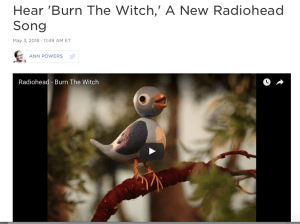
In any case, my wife alerted me to the new Radiohead song “Burn the Witch.” And you can’t listen to a new song without watching it as well. This time it’s worth it. The claymation video accompanying the song (conveniently found here on NPR) is a reprisal of “The Wicker Man,” one of the truly intellectual movies in the horror genre. Of course, that’s something I picked up from the crowd. We’re told by the most powerful and charismatic bigots of our age that life is all about acquiring stuff. Were I to argue with that, well, I guess I’d be the witch to be burnt. Before listening to/watching the Radiohead song, do yourself a favor and watch “The Wicker Man” (the original, please, accept no substitutes). Go on, everybody’s doing it.

The most dangerous thing in the world is an independent thinker. No, I didn’t learn that at Harvard. On my first walking tour through Edinburgh with one of my doctoral advisors he pointed out the part of town where they used to kill witches. He was truly an original thinker (still is) and taught me to be one too. Problem is, I should’ve been following the crowd all along. You want people to pay attention to you? Go to Harvard! Want people to vote for you? Clearly show you’ve got what it takes (money). Give a man a little cash and anything will do for brains, to paraphrase one of the smartest movies of all time. The only way forward is to do what everyone else is doing. And pick up some kindling along the way—you’re going to need it.
With Your Measure

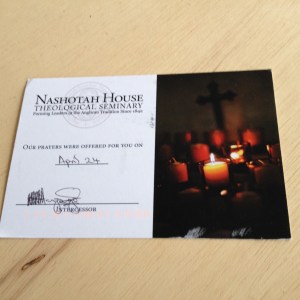
“With what measure ye mete,” someone once said, “it shall be measured to you again.” I certainly hope that’s true, but empirical verification seems to be lacking. I’m looking at, with the full armor of irony, a postcard from Nashotah House. Those of you who’ve long read my posts (I know who both of you are!) will know my history with said sacred institution. No, it’s not with me that they stay in touch, but my wife. You see, she’s one of those women who kept her maiden name, so in the eyes of many at the sacerdotal school we were probably never properly married. They certainly never came out to wave goodbye. Anyway, this past year they’ve begun corresponding with my spouse. I can’t remember—did I ever teach there for a decade and a half? So what are these sweet nothings they’re sending?

The card in front of me informs me that they’ve been praying for my spouse. Don’t get me wrong—she’s married to me and she needs all the help she can get—I never begrudge anyone’s prayers. I also can’t help exegeting a bit. Occupational hazard. One of my students once told me “don’t exit Jesus from your exegesis.” And they tell me I have no practical experience in the real world! So I’m looking at this prayer card wondering whose autograph it is. A man wants to know who’s praying for his wife. More than that, it appears that the name was scribbled out and written again. Did someone pray for those in the outer darkness by mistake? Heaven forfend! Alas, for my meting days seem to be about done. I must have a measuring tape around here somewhere.

That same guy whom I’ve quoted above also said, “pray for them which despitefully use you,” which I suppose might be some good advice. I understand that one-percenters and their ilk couldn’t be where they are despite using you. You just can’t help it—if something is inconvenient, you can simply toss it away. Build a tower to the heavens—what can be more biblical than that? See, words are endlessly flexible. They can be twisted and turned and made to say whatever you want them to mean. And should it ever come to meting cups, there are some recipes that might call for more than a wafer and a sip of wine. This is probably all obscure, but I’m trying to read by candlelight, and this text seems to say “when thou doest thine alms, do not sound a trumpet before thee” and “when thou prayest, enter into thy closet, and when thou hast shut thy door, pray to thy Father which is in secret.” But how will anybody send you money if you don’t let them know?

IMG_2767


Used Knowledge

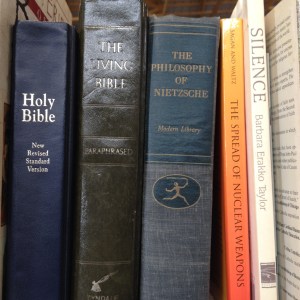
One of the unadulterated pleasures of life—or maybe adulterated is the better adjective—is the used book sale. The year I missed the Hunterdon County Friends of the Library sale felt like a year without a summer. There are other book sales around, but this one’s my favorite. Books are my heroin. You see, I became an academic because it was too difficult to make a living as a writer. Besides, I never formally studied writing and what are you without credentials? Just a poser making some claim of talent. Like most academics I learned to write in staid, measured prose, never exaggerating or showing any emotion. Research for that kind of writing requires a university library since who can afford those kinds of books and you need a JSTOR account to keep on top of all the journals. You read and read on the same topic for months at a time until you have something new to say. Thus knowledge, they tell us, progresses by baby-steps, into a safe and conservative future.

Nietzsche, meet Evangelicals

Nietzsche, meet Evangelicals

The reading that I do is of a different species. I’ve had academics ask me “why don’t you do research on the bus?” Have you ever tried to do research on a bus? Some stranger sleeping next to you with his/her body relaxing and melting into your side of the seat, their arm falling off their rotund belly onto you before being retracted to start the cycle all over again? And staid, measured prose before the sun comes up hardly makes the trip any faster. Of course editing pays much, much less than the professorate. So I buy cheap books. Nothing like a buck a book to bring out the reasonable side of any economically minded obscure private intellectual. You never know what you’ll find at a book sale. Some of my best reading experiences on public transit have been at the behest of orphaned books others turned out into the streets. Books I would never have read otherwise. Books that I feel would understand me.

The once and future academic in my brain tries to reconcile this with what I paid thousands and thousands of dollars to learn how to do (research). Isn’t this in some way pushing knowledge forward? After all, maybe a dozen people will read this post and that’s kind of like publishing, isn’t it? Don’t mind me, I’m just book drunk. It’s the used books talking. While my academic friends prepare themselves for a summer off, some going to vacation houses they justly deserve, I’ll be filling my commute with adulterated books. And hopefully by the time I reach the bottom of this stack another sale will come along so that I don’t have to go through withdrawal. Methadone for books hasn’t been invented yet, and besides, I take no substitutes.


Or Just Sleeping?

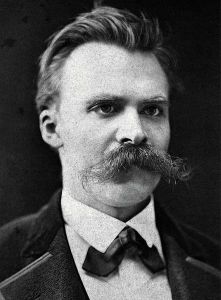
442px-Nietzsche187aYesterday was the anniversary of the death of God. The Time magazine cover, the first to be text only, asking “Is God Dead?” was one of the iconic images of the 1960s. Fifty years ago yesterday, the media ventured out onto a limb that hasn’t snapped but hasn’t exactly bloomed either. Maybe it’s because the idea wasn’t original. Philosopher Friedrich Nietzsche had suggested that God is dead in 1882, nearly a century before Time. A friend in seminary reported seeing graffiti that read “‘God is dead’—Nietzsche; ‘Nietzsche is dead’—God.” Although we laughed over it, this waggish statement contained a profound truth. The concept of God has proven remarkably resilient. Indeed, it may be part of what makes us human.

The media, nothing if not endlessly self-referential, responded. In fact, an article by Lily Rothman on time.com, is a Time story about a Time story. An endless regression of unbelief. Roth mentions theologians in her column— theologians still, and perhaps always have, debate the question of God’s existence. The ultimate untestable hypothesis, God, in that sense, is an easy target. The media reach readerships of which the rest of us only dream. I didn’t see the Time cover as a child (we did not subscribe), but it made its way into Rosemary’s Baby as a statement of the Zeitgeist more effective that a declarative sentence. It is a question that haunts. Miracles, according to the Bible, used to be large and spectacular. Today they don’t happen at all. What went wrong?

Rothman’s story begins with a seminary professor being fired. William Hamilton, at the then Colgate Rochester Divinity School, was dismissed over the question of God’s existence. Seminaries have been particularly sensitive to questions of God’s continuing presence. We sometimes forget, however, that magazines exist to make money. The same is true of some theologians. If you wanted to get noticed when the Vietnam War claimed so many headlines, you needed to say something striking. As the article points out, the question of God’s death seems a lot less radical today. Living through this campaigning season running up to the Republican National Convention it might be less difficult to disbelieve. I wonder what Nietzsche would’ve said.


Ivory Towers

IMG_0481

I sometimes confuse “ivory tower” and “ivy tower.” It’s only a matter of or. In my mind the halls of academe are frequently covered with ivy, but the usual term for a rarified higher education is actually “ivory tower.” A pristine, white edifice unstained by the concerns of day-to-day life. It never occurred to me that the phrase might be biblical. According to tradition, King Solomon quoth, “Thy neck is as a tower of ivory” to his beloved (Song of Songs 7.4a). How the term moved from an obscure reference in a love poem to higher education involves the nature of the latter. Higher education was an enterprise of the church. These days we tend to think of religion as opposed to learning, but in fact, universities were natural outgrowths of cathedral schools where future clergy were trained. There was also a guild-consciousness about the Middle Ages that also played into this, but primarily what we think of as universities today were developed to educate clergy. Many of the Ivy League (again with the ivy!) had their origins as seminaries.

Ivory towers, however, are still remote from this. Eventually, probably due to the difficulty of interpreting the Song of Songs, ivory tower came to be an epithet of the Virgin Mary. Indeed, some interpreted Song as the love between Mary and the church. Rather than the erotic intent of Song, which quickly became an embarrassment to the chaste church, the ivory tower came to symbolize the purity of the Virgin. Untouchable, sparkling white. From the pre-Reformation church, universities sprang. Devotion to Mary ran high.

Although the origin of ivory towers as a metonym for universities is uncertain, it appears in literature by the nineteenth century. Possibly it reflects nothing more than the dignified life of the mind as opposed to the sullying of hands. Or perhaps it reflects a deeply buried knowledge that the university, as secular as it has grown, is a scion of the church with its devotion to a virgin who somehow commandeered the language of a love poem from antiquity. Today ivy is less common on campuses than it used to be. Our higher education is much too modern and chaste for that. The towers of ivory, however, remain. Now they refer almost exclusively to dreamers who’ve lost touch with the everyday world. And, as often as not, with the Bible that gave them their start.


Foundational Books

Over the weekend I visited one of my favorite used book stores, The Old Book Shop in Morristown. It’s neither huge nor fancy, but it has the feel that is so important to the restless mind. The feel of not knowing what you may find. The mystery of discovery. As I browsed, it occurred to me that although books of all varieties lodge here, the predominance of the old books tends toward the religious. The books associated with the church have survived for their centuries, closely followed by the classics—what was once considered the purview of the educated. I suppose one might argue that the breviaries, hymnals, and Bibles indicate overprinting on the part of overzealous presses, but I know that’s not the whole story. In fact, until quite recently the educated were expected to be religious as well. There was a kind of humility at work here. Even scientists respected the God who’d put all of this into place. This was not so much overprinting as it was meeting a prevalent need.

In early America, for example, if a household owned a book, it was more than likely a Bible. Bibles existed in profusion due to—putting it most crassly—demand and supply. People wanted to have a Bible. Particularly Protestants who’d been taught that it alone held the key to their salvation. There are some things you just don’t leave to chance. As that era continues to fade and people unload the books they no longer need or want, the Bibles and hymnals and prayer books make their way to antiquaries and I spend my weekends browsing among them and pondering how we came to be in this place.

Education—books—is/are foundational to our society. Books may be messy and lend to clutter, I’m told. In our apartment they climb in stacks alongside overfull bookshelves like ivy up the side of a tower, and yet I find them difficult to release. There’s knowledge here for the taking. The visit to the used bookstore inevitably leads to finds I hadn’t expected. There were no Bibles in my hand as I checked out, but no matter. I’ve got many Bibles at home. I’m aware that building requires foundations. Architecture may change over the centuries, but old foundations remain for millennia. To be educated is to be aware of them and appreciate them for what they are.

IMG_2732


As (Not) Seen on TV

Screen Shot 2016-04-04 at 4.16.28 AM

Last night, I fear, I did not see “The Story of God with Morgan Freeman.” Our “double play” service already rivals the cost effectiveness of a ballpark lunch, and a triple play is out of reach for as little time as we have for television. This may be one case, however, where I’d be inclined to sacrifice some Sunday evening sleep to watch. I’ve seen numerous episodes of Through the Wormhole. I’ve noticed that over time the topics have grown more and more metaphysical. Yes, there is an uneasy after-shave burn to Occam’s razor. We’ve been told for so long that reductionistic materialism can account for everything, even these unorthodox thoughts in my head of an early Monday morning, and that religion is what’s left over after cleansing a dirty pig. Yet still, yet still…

A few years back, when I was still active in FIRST Robotics, I noticed a few things. Many of the mentors to the teams were not opposed to religion. Far from it. Not only that, but the national (now international) finals of the competition were met with religious fervor. Then, my last year as a mentor it was announced that “God himself” (aka Morgan Freeman, a reference, of course, to Bruce Almighty) would be present for the event. Science and religion are met together; technology and spirit have kissed each other. Perhaps this one size fits all universe is a bit premature?

“The Story of God” will spend six weeks on the National Geographic Channel exploring the origins of religious belief. People who haven’t learned that this is all nonsense will watch and wonder. Universities will, however, continue to close departments where such things are explored. Just because something is interesting doesn’t mean it’s profitable. One must think of such things when one has a business to run. I’m no prophet, but I do have to wonder if this might not be a sign. Maybe Occam’s razor-burn is chaffing a bit more than we thought underneath this white collar. Maybe it’s time to let the beard grow a little and see what the face really looks like. Maybe it’s time to watch TV.


Heroic Gestures

It seems like superheroes have been around forever. They are really, however, the product of comic books from the 1930s on. Adapting well to the big screen, a generation of kids is growing up that may have had their first taste of caped crusaders on the silver screen. I haven’t seen Batman V Superman, only the latest of a long string of the recent procession of such movies. Even so, the character of Superman—among the first superheroes—is less than a century old. Since the meme was conceived, however, it has mushroomed out into all kinds of outsiders offering deliverance. Superheroes are clearly about salvation. Even the anti-heroes. Otherwise they’re a hard lot to classify. Some have super powers. Others have only a lot of money and highly honed physical abilities. Or exceptional intelligence. The one thing they all offer is some kind of salvation. You might have to look for it, but it’s there.

Comic books in general, and superheroes in particular, have recently gained academic credibility. The ivory tower is often a location from which to look down on popular culture—the unwashed crowd—and seek more rarified topics of investigation. Superheroes, however, have proven resilient enough to this academic kryptonite to garner some attention. Comic books can be works of art. More than that, if a meme won’t let go, well, that itch should be telling us something. Sociologically, in a world of near constant uncertainty (who’d have guessed Trump would ever be where he is today?) superheroes seem to offer a stability that daily life lacks. Call it escapism, but what is salvation if not a form of escape? Let somebody else don the cowl and take care of the dangers we never even knew existed.

IMG_0037

Like many kids, I grew up making my own comic books. I invented a couple of superheroes that never found any adoring audiences, but the process taught me something. Looking back at those times in my life, they were periods of extreme crisis. My own superheroes were coping mechanisms. We couldn’t afford a lot of comic books, but once I started working, during junior high school, I started buying Doc Savage novels and consuming them like popcorn. I was trying to get through difficult times. I’ve seen editorials suggesting that the era of superhero movies is dwindling. I doubt that it is. They may eventually fade from the silver screen, but they will still lurk in the graphic novels and recesses of the internet. We need our heroes. We need deliverance.


St. Pat Tricks

What does it say about a saint when the celebration of his day is excessive drinking? Virtue and vice, while not nearly as Manichean as sometimes made out to be, nevertheless conflict in such a setting. Like many American mutts, I have some Irish heritage. I wear green on St. Patrick’s Day, as it’s the done thing. I avoid any celebrations, however. When my job calls for travel to college campuses, I know to avoid the time around St. Patrick’s. Indeed, I’ve taught on campuses where Spring Break was always scheduled around St. Pat’s so as to minimize property damage on campus. Send them off to Florida, where they can be some other electorate’s problem.

IMG_2681

This is an interesting dichotomy. We live in a fairly permissive culture, at least when it comes to things like sex and violence. We nevertheless have built a Prohibition-Era-like mystique around alcohol consumption that makes our college-aged kids a little too curious. Binge drinking and its predictable aftermath have become far too common. Put them together with an Irish saint and all bets are off.

Historically, the Irish have been maligned in what is an acceptable way. Few complain when a nationality is non-ethnic on the surface but non-welcome nevertheless. The Irish have been historically oppressed, but today we forget all that. We hold parades with bagpipes to bolster solidarity, but only if the taps are freely flowing. Drinking with holidays is nothing new. Even Judaism has its Purim and other religions may, from time to time, relax strict rules on the evils of alcohol. But what does it say about a saint that there is apparently no other way to celebrate his day? Wearing green, yes, but that may be entirely accidental. It is, after all, a Dionysian rite of spring, our apparel matching the verdure we soon anticipate as winter wends its weary way out. Even so, I’m glad not to have to be on the streets of a major city when the parade marches by. Even with my Irish ancestry, I prefer to celebrate in my own quiet way, just by wearing green.


Moral Money

Yesterday I spent at the Mid-Atlantic Regional American Academy of Religion and Society of Biblical Literature meeting. Not a registered guest, I was there in mufti. Those who know me stopped by to greet me, even without a name tag, but I noticed, as I increasingly do, the youth of the attendees. Apart from the business discussed, the issue of these younger colleagues kept arising. It’s as if the tap was left on but the glass is already full. Presidential aspirants aside, we live in a world where people are increasingly realizing that you can’t squander resources. We have compulsory education to try to make the next generation smarter, more fortunate than our own. And those who have the inclination and ability to go on for advanced study, we throw into menial jobs and poverty because, despite the myth, a doctorate doesn’t help your financial prospects. Universities have become businesses and one of their top-end products is the doctorate. The doctorate with no future.

Sitting in the lobby between appointments, I can’t help but thinking back to a younger me. I am part of what older colleagues are calling “the lost generation” of humanities scholars. Those who have the credentials but no opportunities. A wasted resource of a nation that loves reality TV and blustering windbags, as long as the windbags are billionaires. It makes me sad to think that instead of making a place for those driven to high achievement, that we’ll offer them poverty-level adjunct positions with Obamacare, food stamps, and excessive hours. When they burn out, like a high wattage bulb, we’ll go to the closet and screw in another to replace them. Just don’t turn off the tap. Graduate students bring in money.

This is a moral issue. Since it involves what are scare-quoted as “the elite” we seem not to care. Isn’t it fun to knock down those who think they know too much? I sit in the lobby and watch the bearded young men, the young ladies with heavy backpacks thrown over their shoulders, and I want to warn them all. And it’s not just me. My colleagues, lost generation or not, all agree. We’re sending our best students to oblivion. In the most prosperous nation in the world. You can tell we’re prosperous because all it takes to gain the confidence of a political party is lots of money. Lots and lots of money. I won’t mention the obvious that such loose lucre could be put to good ends, making jobs for those who’ve poured their lives into bettering their minds. Or maybe I will. It is a moral issue, after all.

IMG_0213


Seminary History

Seminary is where you go to learn what they didn’t tell you growing up.  Many people have rather idealized views about clergy and somewhat untrained views about their church (the same may apply for religions outside Christianity, but I wouldn’t be so bold as to say so).  Since church membership is declining, albeit not drastically, seminaries are finding themselves less in demand.  Meanwhile all manner of political candidates can claim a biblical literacy they don’t rightly deserve, and who’s to challenge them?  It is sobering to read The Christian Century and see just how sickly theological education appears to be.  Seminaries closing, seminaries merging, seminaries not really appearing on anybody’s radar scope.  As the founding institutes for nearly all the Ivy League universities (which are not closing), it seems that few people appreciate just how much our seminaries have contributed to our culture.  Our culture, however, is focused on more material pursuits now.  Let history bury the dead.

IMG_2694

The days when clergy were a step away from royalty and political power are long gone.  Figures like Increase Mather could personally pull cords with the crown to select a governor for colonial Massachusetts.  Rev. Martin Luther King, Jr. could almost single-handedly lead to the beginnings of the demise of one of the greatest social injustices in a democracy.  Even Fred Rogers could daily assure us that it was a beautiful day in the neighborhood.  Seminary graduates all. None of that matters now, as long as my back pocket’s heavy with greenbacks and one of the rich elite inherits the White House.  The thing is, seminary helped many of our past leaders to mature.  Not just spiritually, but intellectually.  Obviously seminaries aren’t perfect.  They can leave you with PTSD just as easily as a PhD.  Still, I wonder at the loss.

I didn’t know about seminaries, growing up.  Those who attend fundamentalist, non-denominational churches seldom do.  When I learned that there were specialized schools to attend to become a minister, I was intrigued.  I guess the idea of a monastery was somewhere in the back of my head.  Little did I realize that seminary was about forcing you to think about things you’d always assumed.  Yes, seminaries have their casualties.  Some leave with as simplistic an outlook as when they entered.  For the majority, however, it is the opportunity to find out that the world of religious belief is much more complicated than people would ever, ever imagine.  Angels dancing on the head of a pin, this is not.  Any computer could calculate that with the right algorithm.  Those who think deeply about what they say they believe are rare.  They do a service to society in general, but only if we are willing to listen.  When the doors are closing, this will become increasingly difficult.  As long as the money flows, I guess it really doesn’t matter.


Making History

We should learn from our mistakes. This is something of which historians are keenly aware. James Grossman, executive director of the American Historical Association addresses the recent concerns raised on campuses throughout the world of removing monuments to historical founders who’ve fallen from grace. The dead white man has been out of favor for some decades now, but Grossman, as an academic, is keenly aware that we can’t take only the good from history. Who would ever read it if it was all sweetness and light? History is who we are, and there are unlit corners in every soul and although we prefer to think of ourselves as victims, we sometimes find ourselves asserting our will over that of others. It’s only human. The related question Grossman addresses is that of monuments. The winners of the moment, after all, incise the figures in stone and cast them in bronze.

IMG_0814

As an example, he notes, Stone Mountain in Georgia commemorates leaders of the Confederacy. Knowing that slavery is, was, and always has been wrong, casts a strong shadow of emotion over such monuments. The question is how to handle them ethically. I recently mentioned female figurines from ancient Israel in a post. Although they offend some, we know not to destroy them because they tell us something of how we became who we are. We have a moral obligation not to run from the darkness. We need to be willing to face who we really are.

History is interpretation. Everything that has ever happened is potentially a part of it. None of us has the scope, the breadth, the depth, to understand where any of this may be ultimately leading. We can only interpret. Religions, often positive, but also often negative, play an important part in that history. We can be assured they will continue to make history in the future. We have, as a society, decided religion isn’t worth our time to learn about. Our institutions of higher learning can less about history or religion than about business and economics. Ethics? Isn’t that somewhere in the philosophy department? You’re welcome to it, if you can find it. Meanwhile monuments are raised to trump the naysayers, and history becomes what we decide to make it.


Used Bookends

There’s nothing like spending a Saturday in a bookstore. It is actually a rare treat these days with Borders gone and some of the smaller indies having trouble keeping up. I particularly like used bookstores. Unlike most durable goods, books—at least some of them—grow in character with renewed ownership. Like most academics, I have books that had previously been owned by big names in the field. Sometimes because I was a student of one of their students, at other times because their library went for sale and I found the tome in a second-hand shop. A few years back I had to go to Boston for work, and I stopped at the Boston Book Annex only to find it closed. It’s sad when even a used bookstore can’t keep up.

So when my wife told me she had to work on Saturday, and it was in Montclair, my thoughts turned to the Montclair Book Center. It isn’t the largest bookstore around, but it does have used books and it is a healthy walk from my wife’s office. I never go planning to spend much, but being in a bookstore, you see things you didn’t know existed. When the staff comes up to ask if they can help me find anything I just smile and say, “No thanks, I just want to browse.” Maybe it’s because I have no idea what I’m looking for. I’ll know it when I see it.

IMG_2685

I used to visit the Cranbury Bookworm. In a sprawling old house outside Princeton, I often found pleasant, used surprises there. Then the landlord evicted them. They sold off most of their stock and moved to a closet down the street. Even though it’s tiny, there are always others there. I’m never alone in a bookstore. Other patrons feel the draw. I wonder if everyone who reads doesn’t owe a debt of obligation to stop into their local bookstore and pitch in. I grew up in a town without any bookstores at all. The nearest one I knew of was thirty miles away. I know what it is to be book-deprived. It’s Saturday, and a little too cold to spend much time outdoors. It’s probably just an excuse, but you’ll find me in the bookstore nevertheless.


Religious Monsters

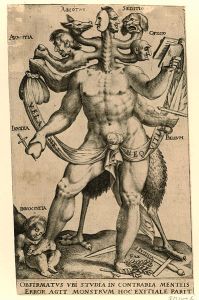
Some colleagues and I are working to meet a deadline. I suppose I use the word “colleague” rather grandly, since they both have teaching positions, nevertheless, we have a common goal. We are fascinated by monsters and we’d like to see the American Academy of Religion dedicate a small section of its large annual meeting to them. We’d do all the work. At first glance, this might seem an odd topic for the serious study of religion. The fact is, however, that monsters are a part of human experience—at least in our imagination—and the conceptual space overlaps considerably with religion. Many monsters have their origins in religious thought. Some theorists go further than that and suggest the very concept of “monsters” comes to us, courtesy of religious beliefs. We can see it time and again in popular culture; the movie or television show, or novel that features monsters ventures into the territory of religion.

The reason for suggesting that this relationship be formalized is the fact that, although this connection exists, it has not be given adequate study. Monsters are the denizens of childhood imagination. When we grow up we leave our monsters behind. But not really. We just stop talking about them. With our mouths. The film industry knows that a horror film will generally draw in the lucre. Halloween has become a major commercial holiday. Stephen King is a household name. I’m not sure why all of this is so, but I think it might have something to do with repression. When we grow up we are taught there’s no such thing as monsters. Those who refuse to relinquish those beliefs are ridiculed. We have more important things to do. Things like making money. Deep down, however, we may still believe.

The fantastic and belief are intimate companions. In fact, belief is at the root of much of our experience. That’s not to say there are really monsters in the night, but at some level we believe there are. And we also believe that infinite deities control this infinite universe that may be only one of many multiverses. It just seems likely. Evidence may point in the other direction. Empirical proof is lacking. And yet, we believe. I’ve discovered a number of colleagues over the years who share this academic fascination with monsters and religion. I don’t know if we’ll be approved by the powers that be, but at least we will have begun to raise the question. What lurks behind it is a matter of belief.

397px-Arminianism_as_five-headed_monster


The Price of Academic Publishing

During seminary, I believe it was, a professor once told those of us in class, “You don’t get rich in academic publishing.” As the author of a widely used class resource, he added, “unless you write a textbook.” Both sides of his observation are true. I work with many young scholars who haven’t published as much as I have and I have to “manage expectations.” No, that monograph will not become a bestseller. Libraries will buy it, and, statistically, a few hundred people will read it. For those who play the more lucrative game of being acknowledged experts, however, cash can be freely flowing. The public is hungry for authentic information on religion. Despite what we’re told in the media, people are very curious about the truth.

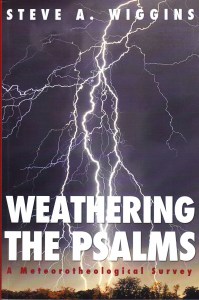
My own academic career ended before I could crank out all the books I’ve got in my head. You have to reach a certain stage of academia before that begins to happen. I’ve been working on my writing in the meantime, and I think I might be able to reach that crossover crowd that writes for non-professionals. I’m not sure I’ll have the time, but the ideas and, I hope, the skills are there. This all came back to me when preparing my taxes. One of the truly religious certainties of this world, taxes are, I know, for the common good. At least in theory. I never complain about them. Preparing them is a different story. My little book, Weathering the Psalms, followed the typical academic course of being largely ignored. I received a small royalty check for it. I wished I hadn’t. You see, I use TurboTax to file my return because someone with as simple an economic life as I have finds hiring a professional superfluous and, ahem, not cost effective. We don’t own a house or any capital. We just hope we’ve paid enough to get a little back in the spring.

WeatheringThePsalms

Then I came on the 1099 for my meager book royalties. (They were in the double digits, just to give you an idea.) I tried to enter it into TurboTax. Uh-oh. That kind of income requires a separate form. “Congratulations,” the screen said, “on earning money from your freelance business.” That can’t be good. It turns out I had to purchase an add-on for TurboTax to handle this new tax scenario. The add-on, literally, costs more than the amount of royalties. Technically, then, I lost money on the publication of my latest book. Those are the harsh realities of academic publishing. An abstract publisher contacted me a few days later—would I like to do the abstract of my own book? Why not? I’ve paid for it. If I ever get back into academe I’m going to write books people will want to read. In the meantime, I write them to contribute to the tax base. At least academically.