In Poor Taste

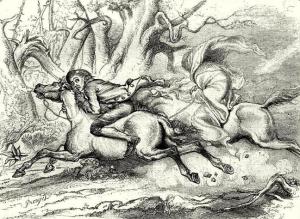
I remember seeing a television commercial once (not during the Super Bowl) where an older guy, a lawyer, complained at the camera, “It used to be that lawyers didn’t advertise.” He went on to say that he felt uncomfortable promoting himself since it was in poor taste, but since the legal profession had swung that way he was entering the game. I know how that guy felt. I grew up with the firm notion that self-promotion was in bad taste. If my career has taught me anything, it’s that unless you’re born well connected, if you don’t promote yourself nobody else will. Still, it rankles. With that hearty introduction, I would, in poor taste, point out that my latest article has been published. Those of you who keep an eye on this blog will know that I gave a paper about the Bible in Sleepy Hollow to a learned society a couple years back. That paper is now available in the Journal of Religion and Popular Culture.
ichabods_chase_crop

Doing research is difficult when you don’t have institutional support to carry it out, but doing such things as an independent scholar can be kind of liberating. I used to research, write, and get published an article a year, back in my teaching days. Nashotah House didn’t have the greatest library, but they did have interlibrary loan and, towards the end of my time there, internet access. More than that, life wasn’t measured in increments of nine-to-five. Living on campus, commuting could be measured in seconds rather than hours. Although publication didn’t bear the weight there that often pressures academics elsewhere, like that lawyer whose name I can’t remember, I wanted to be in the game. I guess I still do.

In these days of uneducated government, if you don’t do it yourself nobody’s going to do it for you. It’s what I once called “the educational imperative.” We are duty-bound, as conscious beings, to move knowledge forward. How many apocalyptic scenarios are there where, when the powers that be devolve into inanity, the monks in their cloisters have to keep knowledge alive? (The question’s rhetorical.) I’m reminded of Station Eleven by Emily St. John Mandel since there women do a good bit of keeping the culture alive when society collapses. Or, to put it another way, like Sleepy Hollow. When the forces of evil break into the world, it’s an African American woman who saves it. If your school has access to JSTOR, you’ll be able to find out more in my paper.
I’m Saying Nothing

It used to be called argumentum e silentio, the argument from silence.  It didn’t take very long into my post-graduate reading to learn that arguments from silence were very rarely admitted in the academy as any kind of evidence at all.  In fact, argumenta e silentio are generally considered a logical fallacy.  The idea is fairly simple: an argument from silence is when a source (often an ancient one) doesn’t mention something.  That lack of mention is sometimes used to argue for the absence of the thing not mentioned.  For example, some first century writers in the region of Roman Palestine did not mention Jesus of Nazareth.  This has led some to suggest that Jesus never existed.  The evidence is an absence of evidence on the part of certain important historical figures.  There are obviously lots of problems with this.  I’m a modern person and there are plenty of people I never write about.  It doesn’t mean that I don’t know who they are (although in my case, it might!).
 
Why am I concerned about arguments from silence?  Lately I’ve noticed quite a few scholarly tomes coming out on the topic of silence.  I’m not referring to Susan Cain’s excellent Quiet, but to scholarly monographs that explore the silence in ancient texts about certain subjects.  In my more curmudgeonly moments, I feel that perhaps when we have nothing left to explore but what a text doesn’t say maybe we’ve explored that text enough.  Younger scholars, casting about for something new to say about the Bible, look to what ancient sources don’t say to give them a research topic.  Back in my own academic days you’d receive a stout scholarly rap upon the pate for even including an argument from silence in your thesis.  Now you can write entire books about what someone didn’t say.  What’s more, you’ll likely find a publisher.
 
I’m at times a bit fearful for the future.  Although my academic work approached the Bible critically it wasn’t because I didn’t like or didn’t respect the Bible.  Hey, it’s far more famous than I’ll ever be, and in fact, more people have heard of it than have even heard of Trump with his endless tweets. No, the Bible is an endlessly fascinating book.  It’s just that if you can’t find something to say about it, why write about what ancients didn’t say?  Maybe it’s time to move on to a sacred text that hasn’t been probed for a couple of millennia.  I have no vested personal interest in this, having been excluded from the academy by biblical literalists and having had the rest assent to that decision by silence.  Ah, but there’s the rub.  That phrase, by the way, doesn’t occur in the Bible.  I wonder if that’s significant.

dscn4370


Publish or Perish

Working in publishing, I’m well aware of the stresses of the information industry. Jobs frequently evaporate as new, less formal ways of spreading ideas develop. To the typical academic what a university press offers is the secret knowledge of where to send their monograph to get it printed and bound. As if a printer and spiral binder weren’t available at the local Kinko’s. Oh, wait. Kinko’s doesn’t exist any more. You can do most of this at your own university anyway. With 3-D printers you might even be able to print a reader. No, what academic presses have to offer is credibility. If we’re honest we’ll admit that some presses are known for publishing just about anything sent to them while others are selective. The selective presses are often considered the more reliable since they set up the highest hurdles and accept only materials that come as close to being true facts as information can. Self publishing, as might be expected, has muddied the waters.

The same is true in book publishing’s cousin, the newspaper industry. As analysts point out, you can get whatever “news” you want from social media. With varying levels of truth. Stop and think about the people you knew in high school. Those who tend to friend you on Facebook. Would you trust them for accurate news? This has become all the more important because our government is now in the business of fabricating facts. Fact checking is too much work and besides, who has time? It’s easier just to believe lies than it is to buy a copy of the New York Times. Newspapers, you see, used to offer the same thing as the academic press—credibility. The New York Times and the National Enquirer are two different things—you could tell at a glance. Now it’s hard to tell where the news originates.

img_3186-copy

This point was made by Deborah Lev in a recent editorial in the New Jersey Star-Ledger. The real problem is our nation’s founders presumed that democracy would work for informed voters. Yes, there were difficulties with the way the system was set up. It was based on privilege and convention. We’ve finally, in theory, gotten to the point that any citizen of a certain age can vote, but we have no requirements for ability to discern the issues. That would be elitist. And we have eroded the traditional sources of attaining quality information—publishers of all sorts are struggling. For some topics self-published books outstrip traditionally published tomes by a fair margin. You can’t believe everything you read. Don’t take my word for it. I’m open to fact-checking. Just be careful where you reap your facts, because not all facts are created equal.


Alas, Binghamton

“Store Closing” the signs veritably shout. “Everything Must Go.” It’s something I hate to see in an economically depressed town. The tragedy is redoubled when it’s an independent bookstore. While undergoing the ritual of returning our daughter to college after the holiday break, we were driving through Binghamton, appropriately enough, at twilight. In that first, lonely freshman year we’d discovered River Read books in downtown. Like many indies, it was small. Intimate even. I never walked out, however, without some treasure that I wouldn’t have found in a larger store. River Read eventually became an irregular habit based on parents’ weekends and academic breaks, and I’ve come to depend on it after a long drive across three state lines. Once again, however, the lack of concern regarding reading takes another victim.

img_2947

In the ancient world there was a poetic genre scholars now call the lament for a fallen city. I’m that way about bookstores. Amazon has proven wonderfully capable of getting things to me quickly. Obscure tomes, sometimes. Since our nearest independent is a 25-minute drive, this is often a necessity—I can spare 25 minutes only on a weekend, and then, only select ones. Ironically, just on the way to Binghamton we stopped at the Bookworm in Bernardsville, New Jersey. We try to help them survive. My mind goes back to fond occasions outside the home and how often they involve bookstores. Finding a new one. Returning to one already well loved. Even, back in the day, Borders. In a pique of nostalgia I starting searching the web pages of past favorites. Books & Company in Oconomowoc, Wisconsin. Farley’s in New Hope, Pennsylvania. Pages for All Ages in Savoy, Illinois. Ah, alas, the latter has also closed its doors forever. The store I’d visit after a long commute to Nashotah House and back, looking for something I really want to read.

The neon after dark is like an alien invader in my car. River Read is closing. The liquor stores and “gentlemen’s clubs” seem to be fine. The cars up here sure weave around on the road a lot after 9 p.m. on a Saturday. It’s not just here, I’m sure. I’m seldom out this late any more. Perhaps, even likely, this has been a long time coming. Civilization unable to support its foundation. Literacy, after all, spread the common ideals we used to share. Presidents united us and we were eager to read and every town wore its own bookstore like a badge of honor. I’ve seen the signs and I lament the fall of yet another fondly recalled city.


Hopeful Horror

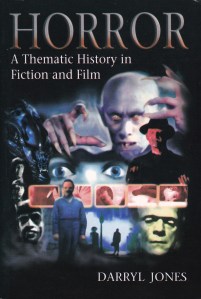
joneshorrorI don’t make New Year’s resolutions. To my way of thinking, if I’m aware I’m doing something wrong, I try to change it at that point, rather than waiting. Needless to say, then, I’m up to my old habits of reading about horror movies. Actually, Darryl Jones’ Horror: A Thematic History in Fiction and Film goes a bit broader than just the cinema. As the subtitle indicates, this charming book also addresses narrative fiction as well and the result is quite engaging. Divided thematically, Jones considers the various types of horror without delving into pretentious theorists to give him academic credibility. Here is a true fan who’s capable to sharing the excitement of the genre. Along the way, accompanying the usual observation that horror and religion share considerable conceptual space, he makes the point that in movies horror is one genre that makes use of academics as characters of authority. Sure, there are others, but in this realm to be educated is a benefit, whether the plan is to take over the world or to stop some evil force from doing the same.

I’ve been watching movies that can be broadly classified as horror since I was young. And I had admired—emulated to some extent—the professors and scientists I saw in those presentations. When a monster was on the loose, you went to find an expert to learn what to do. At the risk of contradicting myself, theorists have been suggesting that one of the problems with post-truth is the death of expertise. Anyone can be an expert these days. The question, “Why should I listen to you?” is on every self-appointed smarty’s lips. Earning a doctorate, the horror world tells us, gives you access to some kinds of knowledge that others don’t have. Problem is, zombies don’t respect such learning. They only want brains to consume.

It never seemed to me that watching horror was a means of learning. As a kid escapism is part of everyday life—taking things seriously is for adults. Growing up, however, I kept my love of scary movies in reserve. Little did I realize that it was a form of training. Now university-affiliated academics are finally able to begin admitting that they find monsters compelling. More than that, they actually learn something from them. Although not a resolution, I see myself reading further books about horror movies this year. It may be a naive hope, but it would be wonderful if they were all as insightful as this one has been.


Need to Know

It’s particularly encouraging when the first book I finish in a year is an important one. I try my best to read books that won’t disappoint, but the thing about books is that you sometimes can’t tell until the end. In any case, I can highly recommend Stephen Prothero’s Religious Literacy: What Every American Needs to Know—And Doesn’t. It’s easy to acquire blinders, especially when you stick with a subject through childhood, three degrees, and a career of teaching and editing in that same field. You kind of think other people can see how important it is. Having grown up religious, I was well aware that other people didn’t share my family’s convictions, but it was pretty clear about the continuing uproar of prayer being deemed unconstitutional in public schools that many Americans were concerned about religion. Or so it seemed in my small town.

Prothero, a specialist in American religion, demonstrates in this book just how little we really know about religion—any religion. He traces this lack of knowledge to the Second Great Awakening and the conviction that belief required Christians not to study religion, but to feel it. This “ethic” of knowing little about what you believe, he suggests, became dominant and has reigned ever since. Clearly, watching the results of the presidential election, many people have no idea what Christianity has historically taught, or in official channels, continues to teach. They know that they feel it is right, but they can’t quite say what “it” is. Most Americans fare even worse when it comes to other religions. As a culture we remain very religious. It’s just that we don’t know what we say we believe. Belief has become politicized and it bears little resemblance to what its historic roots have been.

Critics will say that of course people like Prothero—he’s a religion professor after all—will say that we should know about his subject. The truth, however, goes much deeper than that. The world is a very religious place and we have effectively blocked our children’s way to learn about it. Religion motivates billions of lives, but most Americans know very little about it. Those of us who’ve spent our lives studying it are often condemned to stints of unemployment because what we know is deemed unimportant to Wall Street. Religious Literacy, although the statistics are a bit outdated after nearly a decade, remains more relevant than ever. The potential to learn about religion is widely available. The spirit may be willing, but the mind, it seems, is weak.


Undiscovered Countries

My friend Marvin always amuses me with what he’s got in his refrigerator. He likes to buy products that he considers appropriate to the season. On a recent visit he pulled out a bottle of Arrogant Bastard Ale. He said it was prophetic, in the sense that later this month we’d all be faced with someone fitting of such a moniker. I appreciate his sense of humor—I think we’re going to find that laughter, incredulous and otherwise, is going to help get us through to 2020. Once we reach that mythical date when there will be cities under the sea (unless my childhood cartoon watching has steered me wrong yet again) crewing aquagum all the way, we will have to begin undoing the damage that our government is planning even now. Of course, we were supposed to have a moonbase in 1999, and that show wasn’t even animated. Television produces the biggest liars of all, I guess.

img_3122

January always makes me think of Janus, the two-faced god. Looking forward and looking back. Even Janus seems to have taken on new meaning this year. That’s the thing about symbols—you can’t pin them down to one thing. One of the benefits to studying religion is that you get to feel comfortable around symbols. There may be no real symbology department at Harvard or anywhere else, but scholars of religion inhabit that territory. We skulk around the dark places that human beliefs may go, even allowing people to believe things that are factually false. Instead of getting too dark, maybe we can think of a joke. Two Corinthians walk into a bar…

The future is the famously undiscovered country. Maybe by the time we get there we will have realized just how silly the very idea of countries are. Seems now that citizens of foreign nations can legally take over the US election process, so why bother with borders at all? Put in another way, who wouldn’t welcome the spy who came in from the cold? It’s January out there and all people need shelter from the chill. I keep telling myself there’s no mess that’s so bad that it can’t be cleaned up. Or maybe I’m just thinking of Bruce Almighty again. My friend Marvin refuses to let reality get him down. When the days are short, it is especially important to be the light. Maybe he’s right.


Solstice Blues

The relief is so real that you can feel it with your fingers. Or brushing your cheek. The feeling of being done with another semester, and knowing you’ve got some time for recovery after the intensity of going flat-out for months at a time. I miss that feeling. As a guy who has often been accused of being “too intense” I tend to run pretty near the red line all the time. Pit stops are few and very far between. Once this vehicle’s in drive, there’s no stopping until the destination is reached. What do you do when there’s no clear destination? That’s what working for mere money is like. How do you know when you have enough? Just ask Mr. Trump. Too much is always too little. That’s the kind of world we live in.

Higher education, it used to be, was a place for people who believed in higher values than mere lucre. There was a time, historically, when we took transcendence seriously. The price (if you’ll pardon the analogy) that we’ve paid for letting transcendence go will become apparent. Those who believe only in what they see miss most of reality that swirls by them like a river under the ice. Yes, it still flows. Just ask the fish. There’s a wisdom outside our paltry economic efforts, if we’d only just get out to inquire of it.

Work is built around the foolish concept that you can never have enough. I have to think that our fear of a year of drought has deeply impressed itself on our psyche. Back in biblical times and up until just a couple of centuries ago people considered work to be farm work. Growing your own food. Building your own house. Knowing what to do in an emergency. If nature didn’t cooperate with that scheme what choice had you? Now, however, we labor for a concept as abstract as transcendence. When’s the last time you were paid with actual cash? What wouldn’t you pay for a little more time off? Time to stay in your pajamas all day and ponder what’s really real? Perhaps sleep until you’re not tired rather than awaking at the sound of a factory bell? The sun hasn’t risen by the time I reach my windowless office. When I step out again it’s already set. The solstice reminds me of the semester break that no longer exists. I have to believe, however, that under the ice the river’s still flowing.

dscn5944


Identity Crisis

It’s starting to feel like Groundhog Day. The movie, I mean. As a child I was taught never to talk to strangers, but that’s a little hard to maintain in New York City. You’re never really alone there. Standing in line for the bus, I read. The Port Authority Bus Terminal is a crowded place around rush hour and I try to spin my literary cocoon so that I can get some reading done and so that I can have a little alone time. Introverts are like that. When the guy standing in front of me is confused, however, I like to help. There are three different bus lines that get mixed at my gate, and since I do this nearly every day I usually have a pretty good idea where to stand. I pointed this young fellow in the right direction. “Thanks,” he said. After a pause he asked, “are you a teacher?” I get this a lot, actually. By everyone but deans and search committees.

The writing on the wall.

The writing on the wall.

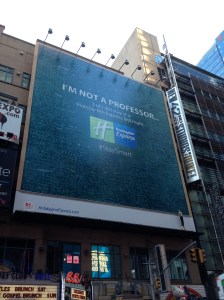
I was out for a walk in a city I’d only been to once before. Some guys were setting up for an outdoor function (the city was in the south). I was actually using my phone for geocaching, so I wasn’t paying too much attention to what was going on around me. One of the guys stopped me and said, “Excuse me—are you a professor?” Some might accuse me of cultivating the look—glasses, beard, slightly puzzled expression most of the time—but the reality is the look is simply who I am. There are those who are professors because they want to be. There are those of us who should be because we can’t help it. I read as if books were food. When somebody asks what the weather’s like, I’m wondering if this world is reality at all. Thing is, academics too are busy finding jobs for their friends to care.

“I’m sorry to disturb you,” he went on. “I mean, I’m a complete stranger.” Actually he’s not. He’s a student. I don’t know him. I’ve never had him in class, but he needed some information I had readily available. I shared it with him. No, the fact is I’m not a professor. Professors are paid (much better than editors) for dispensing what I’m glad to give away for free. A teacher, you see, teaches. The best teachers I ever had were those who continued the lifestyle outside the classroom. They were never arrogant or privileged. They simply shared. Every day, in this situation, begins to look like the one before.


Radio Nowhere

Those of us who somehow managed to be educated without the use of computers, at least nothing more advanced than a TI-30 calculator, fumble our way through the world-wide web. I’ve got this blog, a Twitter and a Facebook account, and I’m on Google + and Medium, and I really don’t know how any of these things work. One of my motivations for starting this blog was to continue the tradition of speaking to audiences that I used to have in my lectures while I taught. I was told that such a format was known as a podcast and I found a host site where I could leave my recordings for free. I could then make a link and bring them onto the podcast page of this blog. How any of that works, I have no idea.

img_2855

Recently a few would-be listeners have asked what has happened to the podcasts. Since I don’t really know where they were in the first place, I’m not sure how to send a map to them now. One of my readers, however, has kindly set up a new webpage where all 23 podcasts are available. You can find it by clicking on this link. My thanks to Ahmed Fasih for setting this up. The podcasts cover various aspects of ancient religion. Even now, every great once in a while, a world-recognized name in academia will ask me about some of these topics. When you’re an academic you have the opportunity to spend vast amounts of time focusing on a single subject. The only subject you have that privilege with outside academia is money. I do hope my friends in the academy realize just how lucky they are.

In any case, the podcasts are back. Maybe now that they’re not invisible any more, and since in coming days it may be important to remember when things were better, I may find time to add to them. Blogs—at least those that are regularly read—are locations for discussion. I’m always glad to answer questions that are posted here. During the work week my time is constrained, so you might need to wait for a weekend, but I will respond. I know religion is passé. I know people have better things to do with their time. I also know that for the vast majority of humankind religion remains a vital and integral part of their lives. Exploring it seems to make sense to me. For those who’d rather listen than read, the podcasts are once more available.


Hallow’s Eve

img_2982

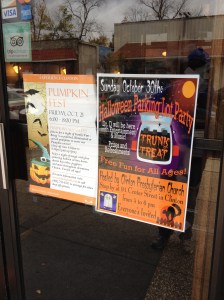
Halloween is finally here, and I’m on my way to work. Over the weekend I noticed youngsters about in costume, heading to a local business that was holding, apparently, some kind of ghostly do. For me it’s just another day—Halloween isn’t an official holiday in any government’s book. Business as usual. Still, I can’t think of Halloween without recalling Nashotah House. I began, and effectively ended, my academic career at Nashotah. Idyllically located in the woods, it was a seminary that knew how to celebrate Halloween well. We were expected—required, actually—to be in church for a good part of the next two days for All Saints’ and All Souls’ days. But Halloween night we were allowed to be afraid.

Gothic writers often used to focus on places like monasteries and churches for moody frights. Nashotah began its life as a monastery, but soon turned into a seminary. The stone buildings were old—for this country—and gothic in design. We had an on-campus cemetery with a bona fide black monk. Students reported seeing ghosts, and with such a small population of religiously devoted people the imagination grew like toadstools. One morning at around 5 a.m. the door handle to my apartment rattled loudly. I’m sure it was just someone trying to get into a forbidden chapel whose only access was through my rooms. Thunderstorms echoing through the kettle moraines that surrounded the Wisconsin campus could be impressive indeed. On Halloween the maintenance man drove a hayride through harvested corn fields and the cemetery where opportunistic ghouls would pop out to frighten the slow-moving, exposed riders.

Since those days Halloween has instead become just a day of work. No more the grandeur of All Saints’ Day being an actual holiday, holy day, followed closely by All Souls’. This is just another day except for the kids who can come around and get some candy if I’m not too tired to hand it out later. I suspect this is why I spend so much of October reading about monsters and ghosts and scary movies. I no longer have a Halloween to focus my energies. So here it is Halloween. It’s dark outside and I’ll be standing in that dark, waiting for a bus. When I climb off at the end of the day, I’ll be sharing the nighttime streets with children who are perhaps the only ones who celebrate holidays as they should be commemorated. Already a month ago I began noticing the Christmas displays in local stores. It was my first real scare this season.


Paying off College

img_2985
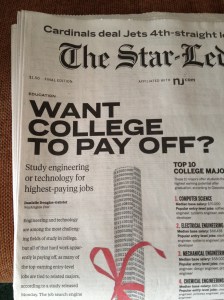
“Want College to Pay off?” the headline asks. It depresses me. I’m an unapologetic idealist. Cost-benefit analysis has its place, but that’s not all there is to education. Or better yet, cost-benefit analysis isn’t just about money. The article has suggestions for finding good paying jobs, which is what higher education is all about these days. Getting an education to increase knowledge and to benefit society in that way has become the mark of true naivety. We tell our kids not to study the arts, humanities, or literature since there are no jobs in these fields. We want them to be able to survive in a culture that has cool devices but which has lost its soul. Pretty strange for an institution (or “industry”) that began primarily to study theology.

The earliest universities focused on the then-related fields of law and theology. Since people took religion seriously, this was not the mere diversion that it is today. There are those counter-cultural warriors who study theology to take parishes to combat their increasing irrelevance, but really, the study of law and theology parted ways long ago. Neither one guarantees the return on investment that they used to. Society’s interests are in racing ahead with technology—discovering even faster ways to text while driving, or better ways to ignore those walking down the street with you. Or making money so you can build large towers in major cities and name them after yourself. We call that success. Thinking deeply about an issue, looking at it from multiple angles, and critically assessing it, these are “luxuries” that aren’t “worth” studying. College must, as the headlines say, pay off.

The rapidity with which this has transpired is truly amazing. We allow electronics to drive our culture. Who has time to keep up with all the posts, tweets, and grams that populate every second of every hour? We crowd-sourced knowledge into some great wikipedia of human experience that substitutes for taking time to look closely and think through the implications. It’s not that I despise technology—I use it quite happily daily—it’s just that I think there’s something more. I studied ancient religions and I see many of those archaic patterns beginning to repeat themselves in electronic format. It’s as if by replacing theology with technology we’ve lost sight of just a piece of what kept progress moving forward. Maybe I need to go back to college. I’m just not sure of the cost-benefit analysis.


Sects These Days

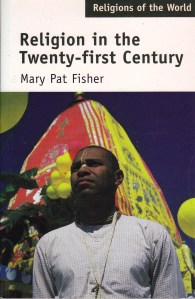
fisherreligionNew Religious Movements (NRMs) have long fascinated me. As a natural historian, looking back over where we’ve been has been my usual source of orientation. The idea that a new religious truth could emerge used to strike me as unlikely, especially in the western hemisphere. All major religions of ancient times have come from Asia. (I’m using “major” here only in terms of numbers, not importance.) I wasn’t sure if Mary Pat Fisher’s Religion in the Twenty-first Century was going to be about those traditional religions or NRMs. Both, it turns out. This little book, spun off of a bigger book, looks at very brief histories and contemporary expressions of traditional religions as well as some newer expressions of the spiritual quest. As such, it really doesn’t strive to reveal too much that’s new, but I found it interesting nevertheless.

To begin with Fisher reveals a bit of her own spiritual journey. This may be the first time I’ve ever read of a major textbook author (her larger world religions books are bestsellers) admit to having had a near death experience (NDE, as long as we’re using abbreviations). I know for a fact that Fisher is not the only academic to have experienced such, but trying to get anyone to admit as much requires, well, the confidence of a bestselling textbook, I guess. The fact is, human beings have a spiritual sense. Even academics. It can be effaced, sublimated, buried, or neglected, but it is there. There’s no other way to explain the persistence of religion. Even Nones, to update the discussion a little, often list themselves as spiritual, but not religious. It is part of the human condition, and it is well worth trying to understand.

This little spin-off text, at seventeen years old, does look a bit dated. Some of the predictions for the then coming new millennium were a touch optimistic. I suppose that’s the danger of any description of contemporary developments. Interfaith dialogues and initiatives, I suspect, still continue although we hear little of them. We continue to use religions as a way to divide between insiders and outsiders. Although our common yearning for spirituality has great potential to bring people together, historically it has wrenched them apart. I’m not sure that this particular book by Fisher is still available any more. Or it may have been updated. As one who tends to look back over history, however, I find the optimism refreshing. Perhaps as we continue to struggle with what it means to be human we will come to realize that religion is about what is inside, not out.


Signed, Sealed, Forgotten

the_seventh_sign

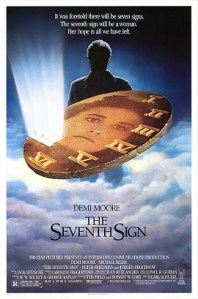
I’m a little ashamed to admit it. With such a long list of moody horror movies out there, I gave in to watching The Seventh Sign again. 1988 was a momentous year. I had graduated from Boston University School of Theology the year before and had been functionally unemployed, as befits a future adjunct professor. I had joined the Episcopal Church, cutting off my chances of ordination in my previous United Methodist sect. I’d been accepted into doctoral programs at Oxford, St Andrews, Aberdeen, and Edinburgh but couldn’t afford any of them. I proposed to my future wife and by the end of the year had married her. In the midst of it all a friend convinced me to go see The Seventh Sign, then in theaters. A typical end of the world movie, The Seventh Sign was a “see once” movie to me, but I guess I’m weaker than I thought.

The movie got me to thinking about the end of the world. Not literally, but rather how we came to have such a strange idea. As creatures conscious of our own deaths, I suppose it’s natural that we think everything comes to an end. The mythical scenario of “the end of days,” however, is cobbled together from various pieces of the Bible, like some distorted, religious picture puzzle. The Book of Revelation doesn’t give a coherent story of the future. In seminary I learned that it was because Revelation is actually about what was happening in the Roman Empire in the first century, not about what would happen in the days when I happened to find myself conscious and eating Kraft macaroni and cheese, mixed with water instead of milk and working for Ritz Camera. I was sleeping on the floor of a friend’s apartment. That was my own kind of personal apocalypse, I guess.

The Seventh Sign is unusual in that a Jewish boy, Avi, and a lapsed Christian woman, Abby (who rents a room to the new incarnation of Jesus who lives, apparently, quite a lot like I did at the time) have to figure this out together. Tying in several other mythological motifs, the number of seals broken is, if I count correctly, only five. The world is saved by self-sacrifice, as is generally expected, and everyone ends up feeling let down. It is a downer of a movie, and not very scary for a horror film. What struck me was how many scenes I remembered so precisely. So I guess it did manage to impress me on some level, back in 1988. I selected Edinburgh University and now once again, find myself outside the institution I covet. I’m still waiting to see what happens with those two last seals.


Scary Thoughts

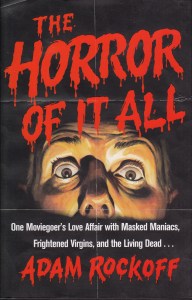
rockoffThose who know me personally—and not just through the internet—sometimes are surprised to learn that I watch horror movies. After all, I’m a pacifist, vegetarian, and a very caring person. Plus I’m squeamish and I eschew violence. Why, then, do I watch such things? I don’t have a good answer for that, but I might be a bit closer now that I’ve read Adam Rockoff’s The Horror of It All: One Moviegoer’s Love Affair with Masked Maniacs, Frightened Virgins, and the Living Dead. Now, I’ve never met Mr. Rockoff, but from reading his book I get the impression that he’s a descent human being and fun to hang out with. He’s also a family man and a sympathetic individual. The Horror of It All is an extended discussion of that troublesome question: why do some of us watch movies of this kind?

It’s pretty clear from this book that Rockoff is way ahead of me in the number of horror movies seen. I’m sure he doesn’t mention all of those he’s watched, but there are some I’ve seen that didn’t make this book and, in my own way, I hope, show that I’m no slouch when it comes to the genre. I’m not in the media like he is and those of us trying to be respectable ex-academics have to read weighty tomes to keep any street cred at all on campus. That having been said, it was fascinating to read how many of the same triggers are at work in not just Rockoff and myself, but in other horror watchers he’s known and interviewed. These films are, for the most part, not just degenerate trash. Many of them have redeeming value and an unexpected profundity. Academics and other society people don’t like to get caught watching what hoi polloi do, but just take a look at the box office take and you’ll see that horror sells. We are not alone.

Ultimately every horror viewer has to struggle with this monster him or herself. Why do we watch? While in grad school I had a sociology doctoral candidate interview me to explore just that question. Why? At the time, admittedly, I had seen only a fraction of the films that I’ve moved on to see since then. One thing I can definitively say—I’m looking for something. Life is plenty scary as it is. A world where a good job can be yanked away from you at will and the specter of a life on the streets leers, can be an intimidating place. In the horror movie you see how it could be even worse. So as my waking hours are increasingly spent in the dark, as if the sun itself is afraid, I see books like Rockoff’s as a kind of flashlight through this forest. If I run into monsters, I want to have prepared myself.