New Hope Nightmare

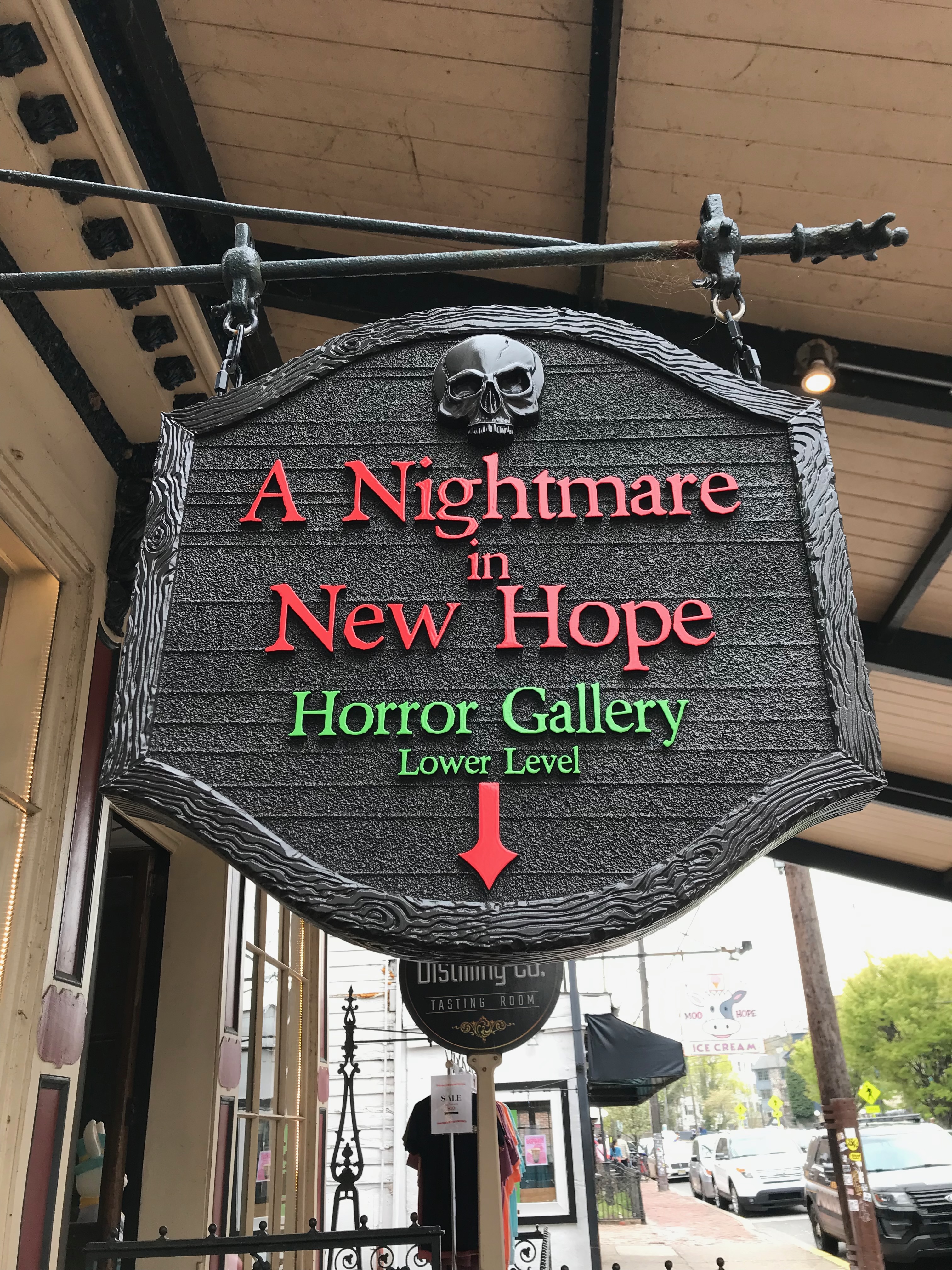
One of my favorite places along the Delaware River is the town of New Hope.  Across the river is the very nice town of Lambertville, New Jersey, but New Hope has a feel to it.  When I learned that a new horror museum had opened there—Nightmare in New Hope—we scrambled to change plans to get there right away.  We went the Saturday before Easter.  We’d planned to spend some time touring the rest of the town as well since it’d been years since we’d done so.  We managed to find parking and, since the museum opens at one, grabbed some lunch and went to Farley’s Bookshop.  Independent Bookstore Day was actually the following weekend, but bookstores need no special occasion.  Farley’s has changed a lot since our last visit.  It’s smaller (as has happened with many indies) and brighter.  I found plenty to like there, but I did miss the darker, dustier feel to the first incarnation of the store I’d known.

We made our way to Nightmare in New Hope.  And waited.  And waited.  Several people passed by, noting that they’d have gone in if it were open.  One of our party messaged the website since telephoning did nothing.  Eventually the owner indicated that he was closed for Easter.  Of all things.  A horror museum, open only on weekends, closed for the first nice weather we’d had on a weekend?  That was the main reason we’d driven an hour to get there.  We found a place with vegan ice cream and fed the ducks on the river.  I was sad that the main objective of the trip, the museum, hadn’t turned out.  And I knew it would be quite some time before we could try again.

My daughter, knowing my tendency to get depressed over such things, suggested we could go to Peddler’s Village instead.  My wife and daughter had visited it before, and so we decided to round out our Saturday trip there.  Peddler’s Village is a set of speciality shops that was born about the same time that I was.  These days there are about 60 shops with items that may or may not be strictly necessary.  Although we’d been to Farley’s, I couldn’t pass up the Lahaska Bookshop, part of the Village.  It was warm that day and we saw maybe only five or six shops.  At least one of them was an independent bookstore.  Not exactly the day we’d planned, but a day spent in and around New Hope is never wasted.  But really, closed for Easter without even putting a notice on the website?

(See updates here and here.)


Thinking of Home

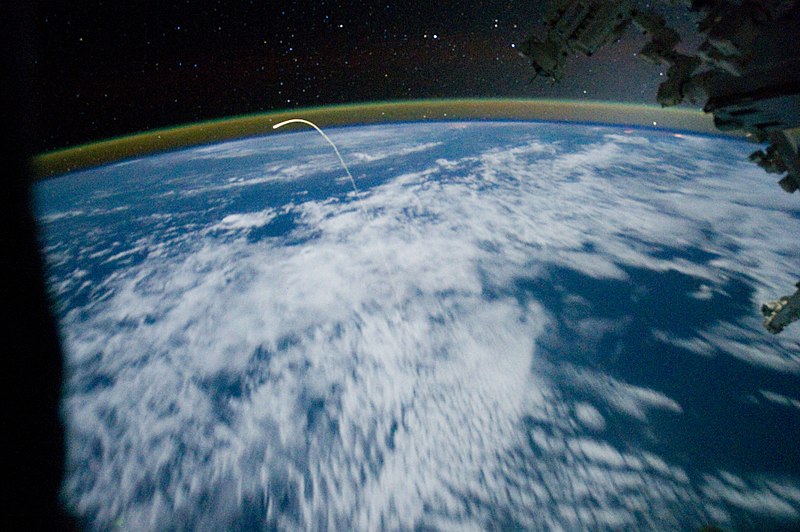
The earth, and even life on it, will, I’m confident, outlive our petty desires for money and being the king of the hill.  Scientists are getting tantalizingly close to demonstrating something that many of us already know—life exists elsewhere.  Chemical signatures of life appear as close as Venus and as far as K2-18b.  I suspect our universe is full of life.  And life is more than just rationality.  We’re creatures driven to survive and that level of will appears to be universal.  As Ian Malcolm says, “Life will find a way,” or something similar.  Earth Day should be a celebration but under too many Republican presidents it has become a plea to please stop intentionally harming our planet.  I grew up in that distorted religion known as Fundamentalism.  I learned that the destruction of the world was necessary to force God’s hand with the second coming.  The planet was here to exploit and waste since he’ll be back any day now.

Unlike many of my cohort, I decided to learn more about that perspective.  The more I learned the more shocked I became.  A warped and twisted message had been passed along as Gospel truth, and that the care the creator bestowed upon creation was merely a smokescreen to hide Jesus’ return.  I still believe we are not capable of completely destroying the planet.  Life will continue with or without us.  Life is persistent and hopeful.  That doesn’t mean we shouldn’t take care of it.  Earth Day has become a rallying point for those who see the world sensibly.  We have so much wonderful life on this planet.  In our arrogance and in our tendency to take mythology literally, we have assumed the worst.  Why not take care of what we were given?  Jesus may not come back, but perhaps the Lorax will.

There are ways to live sustainably on this planet.  It does mean that some of the richest will need to surrender some of their wealth and power.  We need to learn the habits of requiring less and appreciating more what we have.  Like most people born into the world in this era, I struggle against the desire for new things.  Novelty is natural to such curious creatures as ourselves.  But there are other such curious creatures too.  They have a place here, even as those which seem to have no curiosity do.  It’s a planet big enough for all of us.  We just need to be sensible about it.  And remember the earth today and be thankful for our home every day.

Image credit: NASA/ISS Expedition 28, public domain from Wikimedia Commons

Easter Gathering

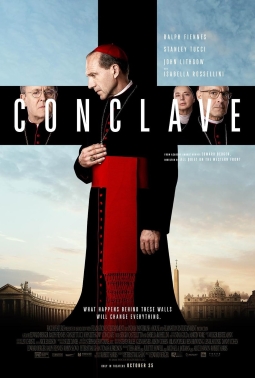
On Easter I’m thinking of Conclave.  My wife had been wanting to see it and we watched it on Good Friday—a work day, of course, in this “Christian” nation.  In any case, it’s fascinating for a couple of reasons.  One is that, as a drama surrounding the election of a new pope, it draws you in.  The politics and intrigue are, I assure you, quite real within in the church.  People are, in seems, incurably political.  Conclave is fiction, of course.  And in reality, very few people are ever admitted to the chambers where a world leader is elected by those priests who’ve risen to the highest levels of church hierarchy.  This fictional reconstruction may give a window into that.  The other reason that I found it so fascinating is that it was quite a box office success for being a movie about a religious subject that isn’t biblical.  Appropriate viewing for Easter weekend.

There were a few striking scenes.  Here’s the outline, though: a pope has died and Cardinal Lawrence is the deacon in charge of the conclave to elect a new one.  Four main candidates exist—one a staunch traditionalist, one a liberal, one an African who is conservative, and the last a moderate American who has a past.  The pope had appointed a new cardinal shortly before his death and some people think he’d make a good pope, despite his relative youth.  One of the striking scenes is Cardinal Lawrence’s homily to open the conclave.  He preaches against certainty.  Not only is this a powerful scene, for some of us watching he is absolutely correct.  Certainty is the death of faith.  That scene alone is worth watching the movie for.  Go ahead, it’s Easter.

The other striking scene is the twist ending, which I won’t reveal here.  Anyone who’s honest and who’s lived long enough to become a pope has secrets.  Not all of them reach to the level of scandal, but the movie also emphasizes that the pope is also a sinner but must be willing to seek forgiveness.  Indeed and amen.  The problem we face today is that, even and perhaps especially in Protestantism, many people look to condemn sinners without realizing their own faults.  The movie points out that even the holiest acknowledged person within Christendom can’t make any claims to perfection.  If we’d all admit that we’re doing the best we can not to offend deity or fellow human being, perhaps there really would be cause to celebrate this Easter.  Even without a conclave.


Book Stages

Books appear in stages.  All publishers are different.  These platitudes encapsulate my experience in finding a venue for my ideas.  Sleepy Hollow as American Myth has just appeared in McFarland’s spring and summer catalogue.  I haven’t seen the proofs yet, but I suspect I will before too long now.  What’s with the spring and summer catalogue?  Well, believe it or not, books are seasonal.  Publishers go by seasons.  For many academic publishers there are two seasons: Spring/Summer and Fall/Winter.  The timing of certain books may fall in a specific place within those seasons but many academic books are aimed at classroom adoptions so early spring and early autumn are the most popular times.  It’s no coincidence that academic conferences also cluster around the semester system, the big ones being either autumn or spring.  Academics have a migratory instinct.

Personally, I’m hoping Sleepy Hollow will be out in late summer.  I don’t have any control over that, but it’s about then that normal people’s thoughts start turning toward falling leaves, long nights, and monsters.  Every year there’s a day in August when I step outside and literally smell autumn in the air.  As a kid seasons seemed like something as rigid as a biblical law: spring was March through May, summer June through August, and so forth.  The older I get, the more I realize how negotiable seasons are.  The Celts celebrated the start of spring in February.  Yes, there are lots of cold days yet to come, but the early signs of spring have begun.  For early risers, we finally start to observe earlier sunrises.  (These technically start around January 10, but they’re slow getting out of bed.)

You might think the ideal season for a book on spooky stuff, like Sleepy Hollow, would be timed for release in the fall/winter cycle.  Not necessarily.  Both Holy Horror and Nightmares with the Bible hit the market after Halloween.  Normal people’s thoughts had shifted to Thanksgiving.  I’m pleased that Sleepy Hollow will be released a bit earlier.  Summer is ideal for Halloween-themed books.  And yes, I devote a chapter to Halloween and the Headless Horseman.  They are closely related.  So I was glad to receive McFarland’s spring/summer catalogue and find my book on page two.  I don’t have a publication date yet, but I’m looking forward to being part of the discussion about one of my favorite ghost stories of all time.  Speaking of which, it’s almost time to begin gathering firewood for next winter, or at least it will be in summer.  And it’s not that far away.


Hoping for 2025

Those who predict, as pollsters repeatedly remind us, can’t really prognosticate.  In ancient times some prophets were thought to be given (usually conditional) views of the future directly from God, but even these weren’t fail-proof.  Nobody knows what 2025 holds for us.  I love holidays, but New Year’s Day is one of the more chancy ones.  I don’t stay up until midnight because if I do I don’t sleep that night (I tend to awake just a couple hours after midnight most days), and I don’t make resolutions since I try to correct errors in my life as soon as I find them.  Maybe New Year’s could stand a makeover.  Something beyond staying up late and drinking.  In my experience, the next year comes anyway.  And it should be an opportunity for hope.

Interestingly, although attempts have been made to Christianize the day, it tends to remain secular.  The current date was established in the west because of the rebranding of solstice celebrations to the birth of Jesus, but the religious elements never really stuck to New Year’s Day.  It marks a clean slate for taxes and other financial resets.  Importantly, it’s a day off work.  Maybe we should rebrand it.  Honestly, I don’t have any suggestions myself—this sounds like a job for a committee.  Who wouldn’t want to be on a holiday committee?  And holidays do evolve over time.  When it was Columbus Day many employers didn’t make it a paid holiday.  Rebranded as Indigenous Peoples Day, some progressive companies did.  See what I mean?  Holidays are what we make them.

The more I think about this, the more I wonder if we shouldn’t reinstate the twelve days of Christmas.  Epiphany (aka Insurrection Day) comes on January 6, and, pre-Adam Smith the twelve days lasted until then.  New Year’s could be one among siblings.  I’m sure that if we tried hard enough we could come up with some branding for each day.  The Brits already have Boxing Day on the 26th.  The Scots make the 31st Hogmanay.  Our task, should we choose to accept it, would be to fill in the 27th through the 30th and January second through the fifth.  If we divide that up and send it to committee I’m sure we could come up with something.  It seems we already have the ten lords a-leaping lined up.  Said lords prefer having two more work days this week, I know.  Perhaps New Year’s, or even the Christmas season, could stand a bit of workshopping so we can really catch up with our sleep.  Here’s hoping, for 2025.

Let’s give them time to arrive! Image credit: The Adoration of the Magi – painting by Gerard David, Creative Commons CC0 1.0 Universal Public Domain Dedication by the Metropolitan Museum of Art

Eves and Holidays

If you stop in to this blog for reading about horror movies, don’t worry, there’ll be plenty of that to come.  One thing everyone who knows me knows is that I believe in holidays.  Capitalism has been killing us for centuries, but since I began having to do a 9-2-5 job, I feel the grim reaper’s approach more steadily.  Day after day after day being eaten up by work and leaving so little time to be who I really am.  I invest a lot in holidays because they break, if only temporarily, capitalism’s death-grip around our throats.  And today is Christmas Eve.  Not technically a holiday, I’ve worked for employers who, Scrooge-like, don’t consider this a paid day off.  You want to mentally prepare for Christmas (the only paid holiday in the season), you cash in a vacation day.

Image credit: Sol Eytinge, Jr., The Ghost of Christmas Past. Public domain via Wikimedia Commons

As influential as Charles Dickens’ A Christmas Carol is, late capitalism simply doesn’t get  the message.  Studies show, consistently, that work in this era is more efficient when workers have more time off.  Now, I’m not so naive as to realize that some professions require work on holidays.  After all, I trained for ministry for many years, and Christmas is always a work day in that profession (even if nobody comes to church).  Emergency workers of all sorts have to be at least on call for holidays.  Police can’t assume citizens will behave just because it’s a holiday.  But such professions, I profoundly hope, have other payoffs.  I entered a profession (professoring) partially because of the division of time.  (And it is one of the few things I’m very good at.)  People should have fallow periods.  Why is Christmas Eve still a work day?

Scrooge is clearly still in charge.  I, for one, will not shed a tear when capitalism dies.  I’ll predecease it, I’m pretty sure, but even so, I welcome a world where people’s needs come before the plutocrats’ profits.  A friend of mine always insists on saying that we don’t live in a democracy but a plutocracy.  Seeing the election results last month only confirms that he’s right.  As I recently wrote here on this blog, the howling is most fierce before the new dawn.  And lasting change must take place slowly.  Sudden shifts only lead to more sudden shifts.  Stable growth is slow.  I’m sure influential people don’t read this blog, the humble musings of an unfluencer, but if they do, there’s a simple plea here.  Consider the holidays.  Read Dickens, and have the courage of your convictions afterwards.  And yes, a blog post (unpaid) will appear on Christmas.


Solstice 2024

We have a small solstice celebration at home.  We’re not pagans, but it seems that the shortest day ought to be observed.  Noted.  Pondered.  You see, this holiday season had its earliest beginnings as solstice celebrations.  Fervently praying for more light, and a bit more warmth, ancient folk of the north knew to propitiate whatever powers that be in the dark.  “Please bring back our sun,” you can almost hear them sigh, in the bleak December.  I’m stunned and stilled by this each year.  The gradual change makes it less of a shock, but we’re living primarily in darkness now.  Until today.  The solstice is a turning point, an axis around which our lives turn.  Forgotten ancients celebrated it and eventually Christian and other holidays gathered around it, as if coming to a campfire on a cold night.  Why not stop a moment and reflect?

I’m a morning person.  More extreme than most other auroraphiliacs, I don’t remember the last time I wasn’t awake for sunrise.  Attempting to stay healthy, I try to get out for a morning jog before work, and that can be challenging for a guy who starts work early.  I sometimes start work even earlier than usual so that I can jog once the sun shyly glances over those eastern hills.  I notice the slow creep of the year.  At the other end of the day, it’s dark by the time work ends.  Mundane tasks such as hauling the garbage can out behind the garage can become tenebrous hikes.  Others who exercise, and work, most go to the gym.  I’ve tried jogging in the dark—it’s full of peril.  Like the ancient pagans, I look forward to a little more light.

Progress, like lasting change, must come slowly.  The earlier sun rises and later sunsets are first measured in matters of seconds, not minutes.  We remain in the dark even as we hope for light.  Hope pervades this time of year.  We anticipate Christmas, yes, but our light-starved eyes look beyond.  Beyond the chill of January into what some Celts marked as the start of spring—February.  Yes, the cold can be very intense then, but rages are always their most furious before they die out.  I suspect Dylan Thomas knew that when advising his dying father on how to approach the end.  I’m writing this post in the dark.  By dinner time the night will have already settled in.  And we’ll light a candle, encouraging more to join in looking for the elusive light.  Dawn always comes.  Eventually it comes.


Thankful Time

Thanksgiving’s late this year, for which I’m thankful.  I must be nearing retirement age because I really could use a little more time off.  Of course, I’m a big fan of holidays and I wish our late capitalistic system might throw a few more bones to the dogs.  Autumn is always my favorite season.  In September I feel the migratory urge of the classroom, but that’s an unrealized desire now, so I set my eyes on Labor Day and Indigenous Peoples’ Day.  Some of the more progressive employers give the latter off.  From there I can see Halloween, although it’s often a working day.  Still, it’s Halloween.  It’s yet a long stretch from there to Thanksgiving, but if I’m careful with my vacation days I can take a few long weekends as stepping stones to this four-day weekend.

I’m not being sarcastic or facetious at all.  I don’t believe I could survive the calendar year without the holidays and I am deeply, deeply grateful for them.  Capitalism seems to have a death grip on the idea of people as “assets”—a brand of thinking that should be buried with a stake through its heart.  People are people and we work for a living.  We don’t sell our souls for health care and a roof over our heads.  The internet has increased productivity immensely, but most companies are reluctant to consider the costs of overwork.  When you can check your work email from 6 a.m. to 9 p.m., for those of you who can stay up late, don’t you think that a few more holidays might prevent burnout?  Do assets burn out?  Engine parts have to be replaced when they wear out.  Why are we so slow to learn the lesson?

Today we reflect on the things for which we are thankful.  Even in difficult times there are many.  I’m thankful to live in a world with books in it, for one.  On those rare days off I read, trying to catch up with an ever-growing stack of intellectual stimulation.  And I try my best to contribute to literary life, although my books appeal to few.  I’m thankful for hope.  Without it this last year would’ve been impossible.  And I’m thankful for family and friends, whether actual or virtual.  This is an interesting world that I’ve come to inhabit.  The more I learn the more there’s left still to learn.  And with Thanksgiving so late this year, Christmas is less than a month away.  I look ahead and I’m thankful.


Consciousness Conscience

Not so long ago—remember, I read old books—living to 60 was considered a full life.  I’ve passed that and while I’m in no hurry to shuffle off this mortal coil, I often think of how improved medical practice has prolonged many lives.  This is a good thing, but it does make death a more difficult fact to deal with.  If there is any good that came from my Fundamentalist upbringing, it was that it taught me early on to think about death with some frequency.  I’m not a particularly morbid person, but since we all have to face this, avoidance seems to lead to grief, shock, and acute mental pain.  I tend to consider watching horror movies a spiritual practice.  Little reminders, in case I forget to consider my own mortality today.

Our faith in science is a little bit misplaced.  Sure, it helps enormous numbers of people live longer, healthier lives.  But it may also detract from the necessity of attending to our spiritual lives.  I don’t care if you call it consciousness, your soul, psyche, or mind, but we have a life we’re accountable to, and it’s not all physical.  Since consciousness feels neutral enough, let’s go with that.  We don’t know what happens to our consciousness after death.  There are plenty of theories and ideas about it, but no certain knowledge.  There may be faith, and there may even be some evidence, but it is always disputed.  It does seem to me that facing death squarely on may help take care of at least some of the anxiety.  Fear of the unknown is probably the greatest fear our species possesses, so pondering it may take the edge off a bit.

Some people claim to remember past lives.  Sometimes I wonder if they might be tapping into the great unknown: consciousness.  Perhaps consciousness survives without a physical body.  Perhaps it’s large—expansive—and encompasses far more than we can imagine.  Maybe some people can access part of that consciousness that includes the past lives of others.  We have no way of knowing, but it seems worth thinking about on this All Souls Day.  Of course, I have the advantage of having lived what used to be considered a full life.  In it I have set aside at least a little time each day to consider what happens after this.  Do I have a definitive answer?  No.  I do have faith and I do have beliefs.  And I’m always reflective on All Souls Day.

Frans Hals, Young Man holding a Skull (Vanitas), public domain via Wikimedia Commons


This Is Halloween

He was probably trying to impress his wife with his wit.  I was in a department store—a rarity for me.  I was wearing a mask, because, well, Covid.  As this guy, older than me, walked by he said “Halloween’s over.  Take off your mask.”  It bothers me how politicized healthcare has become, but what bothered me more was that it was only October 20.  It wouldn’t even be Halloween for another 11 days.  What had happened to make someone think Halloween was over so early?  Yes, stores had switched over to Christmas stuff by then.  In fact, I wandered into another store where Christmas carols were playing.  Capitalism seems to have wrenched the calendar out of order.  We’re tired of All Hallows Eve before it starts.  In fact, just the day before we’d gone out to a pumpkin patch to get our goods and the carved pumpkins are now showing their age.

If that little exchange in the store had been in a movie, it would’ve been a cue for me to transform into some big, scary monster.  Of course, Halloween is what it is today because of relentless marketing.  And a handful of nostalgia from people my age with fond childhood memories of the day.  For some of us, however, it is a meaningful holiday in its own right.  It makes us feel good, even after we’ve grown out of our taste for candy.  It is significant.  Christmas is a bit different, I suppose, in that there is nothing bigger following, not until next Halloween.  Besides, Christmas is supposed to go for twelve days.  The fact that Halloween is a work day makes it all the more remarkable.  We have to work all of this out while still punching the clock.

I had really hoped to be able to get to Sleepy Hollow this Halloween.  Sleepy Hollow as American Myth tries to make the case of how that story and Halloween came of age together.  It is the iconic Halloween story, what with ghosts and pumpkins and all.  And the month of October is spent with scary movies for many people.  This month I’ve posted about horror movies every other day, pretty much, trying to connect with my audience.  If that is my audience.  I tend to think of Halloween as a community.  Those of us who, for whatever reason, think of this as our favorite time of year.  A time when perhaps we don’t feel so stigmatized for liking what we do.  A time that we’re not hoping will shortly end so we can get onto the next thing.  It may have been meant as a joke, but I wasn’t laughing.  Happy Halloween!


A Second Post?

A second post in one day?  Not really.  As much as I’d love to post more, work drains me.  But I also realize I post early and some people may miss my musings because they’re so early.

Enough prologue.  This is simply a public service announcement.  McFarland is offering 40% off when you order two horror books, through the end of October.  Now that Holy Horror’s price is reasonable, you can really make a killing.  To take advantage of this limited-time sale, use the code HALLOWEEN2024 at checkout.

McFarland prices their books reasonably for an academically inclined small press.  And they have a great selection of horror-themed titles.  Check it out!  Back to your regularly scheduled programming.  (I’ll post again in the early morning, as usual.)


Ichabod’s Body

Maybe you’ve noticed this.  When Halloween comes around, the Headless Horseman and the Legend of Sleepy Hollow reemerge.  There’s a reason for that, and I discuss it quite a bit in Sleepy Hollow as American Myth.  Right now there seems to be quite an interest, or maybe I’m just noticing it more.  For example, a local theater where we saw a Poe performance last year is offering a Headless Horseman show this year.  Articles have recently been appearing on Tim Burton’s Sleepy Hollow movie, given that it was released 25 years ago—online discussion, however, is often eclipsed by the Fox television show by the same name.  And before it switched over to Christmas decorations, Michaels had its share of Sleepy Hollow merchandise.  Halloween and the Headless Horseman go together.  (Read the book to find out why!)

One of the tchotchkes I picked up at Michaels was Ichabod Crane’s tombstone.  In the many renditions of Washington Irving’s legend, Ichabod is treated as the protagonist of the story.  Although Tim Burton’s movie wasn’t the first to have Crane survive, besting the Horseman, the old wives’ tales, according to Irving, had him spirited away by the Horseman.  That’s why I found his gravestone so interesting.  The dates on it (1787–1857) indicate, at least according to this recension, that he died at seventy, surely not the victim of the attack that took place around the turn of the century.  If you’re not familiar with the original story, Irving set it “some thirty years since” the 1820 in which the tale was published, putting the events around 1790.  Burton shifted this to 1799, partially, I suspect, because that was two centuries before the release of his movie.

I do wonder where the maker of the Michaels tombstone got their information.  According to their reckoning, Crane would’ve been but three years old in 1790.  Of course, the story never tells us his age.  Since it is intimated that he relocated and became a judge after dabbling in politics, all of which would seem to indicate that he was a somewhat young man at the time of the tale.  To make Sleepy Hollow scary, though, having Crane cut off in his youth would seem to be more in keeping with the spirit of the season.  Of course, Sleepy Hollow is a legend that has become mythic through its many retellings.  Enough of them that someone could write a book about it all (ahem).  And this is the time of year to ponder it.  


Seasonal Poe

The more I read of and about Edgar Allan Poe, the more convinced I become that he wasn’t as associated with horror in his own mind as he has become.  As one of the earliest American writers, he has become the icon of those who wrote on the dark side.  His contemporaries—Washington Irving, Nathaniel Hawthorne, and Herman Melville—did as well, but it was Poe who became iconic.  On a recent trip to Michaels to take in the seasonal ambiance, Poe’s presence was difficult to ignore.  I wasn’t prepared to shoot a photo-essay (I’m not sure how they feel about such things in a store, in any case) so I didn’t photograph all the pieces.  “The Raven” is frequently referenced, with typewriters with the poem emerging and large, ominous black birds about, but Poe himself also appears.  There are, of course, painted busts of Poe.

But Halloween has grown more whimsical over the years.  Arguably for my entire life it has been primarily a children’s holiday, but many have noticed that those of us who grew up with Halloween have retained adult interest in it.  Part of this is no doubt commercial since the captains of industry have learned people will spend more on Halloween than any other holiday except Christmas (I do discuss this in my forthcoming book).  And indeed, the Headless Horseman appears quite a lot as well.  Irving, however, isn’t there on the ground.  Poe is.  The whimsical part comes through in showing the humor of the season.  For example, although Poe is shown in the noble bust format, he’s also portrayed (fully clothed) on the toilet.

Finally, there were figurines of a fanciful tombstone of Poe.  They even got the dates correct.  Now, there’s more to be said regarding the comparison with Irving.  You can find the Headless Horseman on the toilet as well (along with Dracula).  You can find the Horseman in bust format as well.  When it comes to tombstones, however, the fictional Ichabod Crane shows up alongside the nonfictional Poe.  That casts a certain light on Irving’s most famous story.  I’ll save that for another post, however, since authors are expected to repeatedly plug their books.  I left Michaels strangely reflective.  Poe-themed merchandise is fairly typical any given year, but since we’re having our first Halloween party in some years, and since I’ve been exploring Poe’s range as a writer, this clear abundance of Poe as an icon gave me pause.  As if I were coming within view of the melancholy house of Usher. 


Liminal Time

Considering the number of people who declare autumn their favorite season, the equinox receives pretty slim press.  This year it falls on the 22nd and, as always, it is one of the four quarter days of the pre-Christian European calendar.  Even among pagans it seems not to have had the same level of celebration as the other solstices and equinox.  I sometimes wonder if that’s because things are generally good already in September.  The intense heat of summer is over but the chill of October hasn’t yet arrived.  We stop using the air conditioning and don’t have to turn on the furnace.  It’s the Goldilocks month.  It’s part summer when living is easy, and part fall when the world is beautiful.  Like its fellow quarter days it is truly a liminal time.  

Liminal periods are always good for reflection.  No matter how much I want to savor this time of year, I have a feeling that it always catches me off guard.  There are changes afoot.  Starting Monday it will be dark more than it is light, and that will hold true until the sister equinox visits us in March.  These longer nights have traditionally made room for ghosts and goblins.  If we haven’t begun to store up supplies for winter, now is the time to start.  It’s the season when we all believe in magic, if just a little bit.  I’m one of those people who finds melancholy somewhat lovely.  It’s not depression (believe me, I know!), but a kind of happy sadness that the season itself is ephemeral.  Pretty soon people will be watching scary movies, but not quite yet.

Harvest is a joyful, spooky time.  Those trees that have been green since April now put on their colorful winter coats but soon will spend the colder months bravely naked.  Snow may come.  Fall is a prophetic season, warning us of what might come.  Monsters may be set free from their chains.  And yet there will be cozy indoor holidays when we can hunker down and recollect the year that has just been spent.  There’s a wisdom to seeing the quarter days as the spokes on the wheel of the year.  Like many wheels already rolling it’s futile to attempt to stop them.  They’re moving us to the next place that we’re meant to be.  It’s true that the autumnal equinox falls on a weekend this year, but it does seem to me a natural holiday.  And a time, like all holidays, for reflection.


Under Construction

It’s fascinating, watching a book taking shape.  Just yesterday I noticed Sleepy Hollow as American Myth is now up on McFarland’s website.   And yes, it’s on Amazon too.  Go ahead and preorder!  (It hasn’t made it to Bookshop.org yet, though.)  I have to say the feed to Amazon was much quicker this time than it was with The Wicker Man.  That book took several weeks to appear, probably because it was with a UK publisher.  Yes, it does make a difference.  Now the trick is to try to get people interested in the Legend of Sleepy Hollow again.  I’m thinking I ought to join Historic Hudson Valley.  They might be interested in such a book.  It is, in a sense, right in their back yard.

The thing about writing a book is that you come to suppose other people are interested in your obsession.  I know that Sleepy Hollow is deeply embedded in American culture.  I also know that some of the fandom began to die down when Fox’s Sleepy Hollow went off the rails.  Most analysts suggest, with good reason, that the show failed when it began foregrounding white characters and writing Americans of color into the background.  A great part of the appeal was the melting-pot aspect of the cast, no doubt.  In the book, however, I suggest a somewhat different reason for the decline.  It’s one I’ve seen no one else suggest.  I’m hoping that we can both be right.  In any case, that was the fandom that got this book started.

You see, I had written my first popular culture article on the role of the Bible in Sleepy Hollow.  That article, published in the Journal of Religion and Popular Culture, led to the book Holy Horror.  I was already thinking about a project around Sleepy Hollow then, but I had a couple more books to finish first.  I’m excited about this one because it marks a move away from publishing primarily about religion to publishing primarily about a story.  There’s still religion there, of course.  We have the Old Dutch Church to pay mind to, but there’s even more about the Headless Horseman, and Ichabod Crane.  And so much more!  Sleepy Hollow as American Myth was a lot of fun to write.  I’m not sure when the book will be out, but I’m hoping next year.  Maybe if I can generate a little excitement around this Halloween—it is closely connected with the story, as I explore—there’ll be some interest next time.  Until then there are still plenty of steps to be taken.