Uisge Beatha

Water is essential for life. Life as we know it, in any case. It is no surprise, then, that many religions incorporate water into their rituals. Last week I posted about the biblical stories of Jonah and Noah, both of which involve acts that were later interpreted by Christians as baptism. Muslims use ritual ablutions as part of their worship tradition. Water is life, after all.

IMG_1392

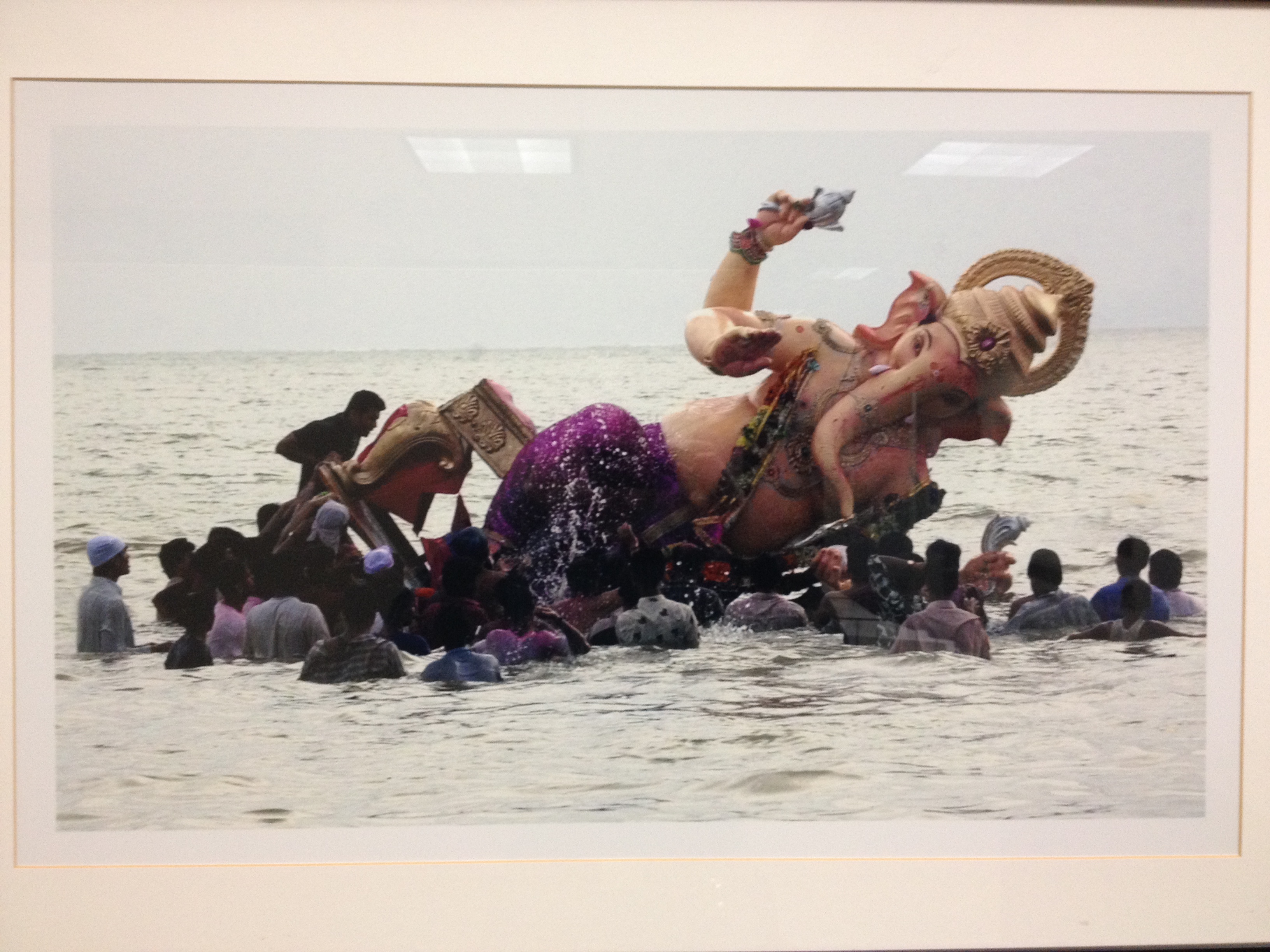
While wandering the halls at work, I notice the various artwork on the walls. One large, framed image has frequently caught my attention: several men are shown carrying a statue of Genesha, the Hindu elephant-headed god, through the water. Coming at this from a Christian background, I wondered what was going on since it looks like baptism. Hinduism, I know, is not a unified religion, but rather a conglomeration of many folk traditions from ancient India—one of the two seats of ancient religiosity. The stories of ancient India are colorful and diverse, and a bit of research suggests that this particular photo is likely the festival Ganesha Chaturthi, commemorating the story of how Ganesha came to have an elephant’s head. Crafted from inert matter by his mother Parvati, Ganesha was posted to watch the door while his mother bathed. Parvati’s consort Shiva returned and not knowing who the boy was, the lad’s refusal to allow anyone to enter led to a war. Eventually the Ganesha was beheaded and to appease his consort, Shiva supplied him with the head of a dead elephant and the boy resurrected. The immersion of Ganesha statues, or Visarjan, takes place as part of the Ganesha Chaturthi, during August or September.

I admit I’m not an expert on Hinduism, so some of the details may be a little off here. What strikes me, however, is the similarity between this story and that of Jesus. Like Ganesha, Jesus was associated with a modest mother, slain, and resurrected. He, too, is associated with ritual baptism. Growing up, we were taught of the many unique aspects of Christianity. We had, we were led to believe, the only resurrecting deity in the world. Our God alone could bring back from the dead, and the way in was through immersion in water. While learning about Ugaritic religion I read of Baal’s death and resurrection. Although stories of baptism haven’t survived, he also battled the sea and came out victorious. Some ideas, it seems, are particularly fit for religious reflection. The details may be unique, but the archetypes are very similar. Religions may be many things, but in the end, unique is a word that must be applied with the greatest of care. In the meanwhile, the next time I read of walking on the water, I will recall that even Asherah was know as “she who treads upon the sea.”


The Price of Flags

As a child, Memorial Day signaled the start of summer. Most of the time it announced that the obligations of school were nearly over and that was sufficient cause to celebrate. It was not until well into adulthood that I realized the holiday commemorated those who’d died in the armed services. I’d noticed the flags in cemeteries, of course, and we often visited the graves of civilian ancestors buried close enough to reach. The message did not penetrate my head, however, that all of those little flags should be telling me something. I grew up not knowing my father, but I did know he was a veteran. When all his children gathered for a (mostly) impromptu picnic yesterday, for the first time in well over thirty years, I realized how much of a mystery he was to me. At his funeral the flag on his coffin was presented to my older brother as part of military tradition, although he had died in peacetime, and pretty much isolated from all his progeny. It is a somber thought even now, although it was eleven years ago.

I have been a pacifist since my youngest days. Sure, I played with toy guns and G. I. Joe, but that was the culture of kids growing up during the Vietnam War. Only vaguely did we realize the actual horrors that were happening daily thousands of miles away. In my mind there was no reason to go to war. In Sunday School we were taught to settle our differences nicely, even if it meant that you had to be cheated or take less for yourself. This always seemed the central tenet of Christianity to me, and I wondered why the most conservative of Christian presidents seemed the most hawkish, the most ready to sacrifice the fathers, sons, brothers, and now mothers, sisters, and daughters of others for so little. The number of flags even in that little country graveyard where my grandparents were buried haunt me.

We still have members of the armed forces over seas. The military budget of one of the most prosperous nations on the planet is astronomical. We can now kill with drones so that we don’t even have to see the carnage we create. When did the lives of young adults become small change? I know it’s idealistic of me, and probably terribly naive, but I still can’t make sense of our cultural perception of how cheap human life can be. Maybe I’m just a little overly sentimental about a father I never really knew. But looking over my siblings, I see that he produced some nice, generous, and peace-loving children over half a century ago. And while we have our picnics and enjoy a rare day off of work or school, thousands of silent flags will be flapping in cemeteries all across this country reminding us that better ways exist to resolve our differences. If only we could take a holiday from war and violence we might see fewer flags and even more holidays.

Photo credit: Remember.

Photo credit: Remember.


Rosemary by Any Other Name

Rosemary

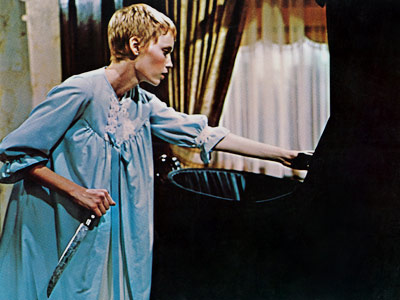
With NBC’s remake of Rosemary’s Baby into a mini-series in the news, I sat down to watch the original again. I’ve blogged about it before, but with most available funds being diverted to college, watching new movies will be a rare treat for some years to come. Besides, the original is a mishmash of religious ideas that despite their lack of coherence still leave the viewer somewhat disturbed. Since the last time I watched the movie, I’ve read several books on witches and have come to recognize the strange brew that Roman Polanski concocted for public consumption. Reaching back to the myth of diabolic witches, the original movie presents such witches initiating a new world by literally spawning Satan on a woman whose name is based on the mother of Jesus and who will ultimately care for the helpless little devil. The viewer, despite the knowledge that Rosemary is carrying evil incarnate, still sides with the vulnerable, pregnant protagonist. It’s the end of the world as we know it.

I’m not sure how you make a miniseries out of this thin plot. I suppose a nine-month pregnancy would lend itself to slow development, but haven’t we grown a little too old for witches and devils? In fact, Wicca is now a recognized religion in much of the industrial world, and the devil’s been on the run for decades. Religious movies, or at least movies based on religious themes and characters, are perennially popular, however, no matter what the secularists tell us. And why not open a series about pregnancy on the weekend of Mother’s Day? Nothing stirs the emotions like putting a young mother at risk. That’s perhaps the insidious side of the original movie—we silently side with the devil.

Rosemary is, of course, manipulated by her husband with the everyman name of Guy. This isn’t in any sense his child and, like any businessman, he stands to gain enormously from someone else’s labor. Exploitation is the cost of the continuation of the human race. It doesn’t take much to figure out that we’re watching a parable here. After all, the Time magazine cover asking if God is dead makes a cameo in Dr. Saperstein’s office. And the setting in Manhattan clues us in from the beginning that this is the place were many millions are asked to make a few very rich. There is a witchery in New York, and for those who know how to look, the devil may be found in the details.


Take a PAAS

Like so much of life, PAAS Easter Egg coloring kits were the result of an accident. To be more specific, a chemical accident in New Jersey, something which is far from rare. This particular accident, however, had a fortuitous side-effect: the brightly colored (but not radioactive) Easter Egg dye that many of us associate with childhood. Around 1880 Newark druggist William Townley spilled colored dye onto his suit, leading him to individually package holiday colors, according to a story in the New Jersey Star-Ledger. That individual packaging allowed for a full set of egg colors to be sold together and the PAAS brand was soon launched.

The idea of coloring Easter Eggs, like so many Christian traditions, likely has pagan roots. Eggs were a sign of new life with the coming of spring in many cultures (although boiling the poor things rather defeats the purpose). Christians adopted the egg as a resurrection symbol—the chick pecking out of its shell was like the resurrected Jesus bursting from the tomb, albeit somewhat less dramatically. Watching a newborn chick hatch is an emotional experience. At the 4-H Fair, standing around the incubator in the chicken tent, you can see wobbly, uncertain, tiny birds tentatively trying to assess this strange new world that is colder and somehow more compelling than life in the shell had ever been. The mighty son of God they’re not, but they are much more like us, looking for answers and taking small steps until they’re more certain of what they face.

DSCN4483

The coloring of eggs has origins lost in antiquity. Nobody’s quite sure why it was done beyond the fact that they look nice. Romans ate eggs as part of their spring celebrations, and Christians came up with a story to explain colored eggs. The legend claims that Mary Magdalene, in trying to convince the emperor of the truth of the resurrection, turned eggs from white (or brown, as they likely were in those days) to red in her open hands. This proof, however, failed to convince the Caesar. What seems certain is that pagans liked coloring eggs so this provided a new source of evangelism to the Christians who assimilated the practice. Like Christmas, the Easter Egg has become a thoroughly cultural symbol—since Easter comes on a Sunday employers aren’t obligated to give the day off, so everyone can celebrate. Children hunt eggs on the White House lawn and we can still expect everyone to be in the office on Monday morning. Resurrection, after all, can only reach so far.


The Plague

Plagues&Peoples Sitting on the bus next to some guy with a consumptive cough may not be the best place to read Plagues and Peoples. But William H. McNeill’s book is considered a kind of modern classic, and since the Middle Ages have been on my mind, I persisted anyway. I did wrap my scarf around my face, though. Plagues and Peoples isn’t just the story of the Black Death, however. It is a sweeping account of pandemic and endemic outbreaks and how they form recognizable patterns with human populations. Perhaps the most striking aspect of McNeill’s study is how determinative plagues have been for many decisive aspects of human history, including religious ones. Indeed, religion keeps cropping up in the book. One reason is because of the roles religions play in human suffering—to be more precise, I should say in trying to alleviate human suffering. (Yes, some religions definitely cause it as well, but that’s a story for another time.) McNeill even suggests that fear of disease might have led to the parting of the ways between Swiss and German Reformers, playing a role in the divergence of what would become the Presbyterian and Lutheran flavors of Protestantism. The spread of some religions was facilitated by the ravages of disease.

During the period of the spread of the Plague, however, McNeill notes that those cultures attended by Christian and Buddhist institutions managed to fare better than irreligious, or, perhaps more accurately, folk-religion ones. Once people figured out Plague was contagious, they sensibly kept away from the sick, but the moral teachings of Christianity and Buddhism compelled the religious to tend to the ill, with the result that more people in those religious traditions survived. That’s not a universal declaration on McNeill’s part, but it is a fact worth bearing in mind. The risk to self paid off when more individuals cared for each other rather than just heading for the hills when the Black Death came along. On the other hand, religions frequently insist on behavior that spreads disease as well. The great pilgrimages to Mecca or the Ganges often brought great crowds together where disease could quickly spread. The passing of the peace in some churches is more like the passing of the plague.

In ancient, pagan times, disease had its own deities. In ancient Ugarit, Resheph, the archer, was also the god of pestilence. Pestilence frequently accompanied the horrors of warfare, and even Apollo opens the Trojan War by firing his arrows at the Greek troops. Gods are the source of disease. One of the ancient truisms, which may not be taken as true today, is that the force that wounds is also the force that heals. Instead of ignoring Resheph, you pray to him, make offerings to him. He can slay, but he can also heal. In the monotheistic and even non-theistic traditions McNeill mentions, the focus shifted to the care of those suffering rather than the offering of sacrifice to unhearing gods. Even the Romans were impressed by Christian care for one another. Of course, that was well before Obamacare offered the hope of medical treatment for those cut off from lucrative employment. The Christian response now, it seems, is to complain about others taking advantage of my surplus cash made over to a program to prevent illness in one’s fellow citizens. Take the bus to work, you’ll see what I mean.


Wee People

Whence we come influences our outlook. Sometimes invisibly, at other time quite consciously. I remember as a child, wanting to be honest about the wearing of the green on St Patrick’s Day, asking whether we were Irish or not. Of course, for many Americans being Irish, German, or Swedish really means having ancestors long ago from a different country. Most of my ancestors had been in America for some time—a couple hundred years at least. In New Jersey, where many people are literally from elsewhere, that can seem exotic. Great-great-grandparents in one of my lines can be traced to another country, but most of my ancestry is already settled in the United States long before that. Unknown to my mother at the time of that question, one of my ancestors was indeed from Ireland, a stowaway, as I understand it, and thus I could wear green without being dishonest. (Children can be so parsimonious.) When I saw the locals walking away from yesterday’s St. Patrick’s Day parade in my local town it was obvious that not all of them were Irish (or American with an Irish ancestor), but they nevertheless came out on a cheerless, chilly day to join in the Celtic spirit of celebration. St Patrick’s Day is all about belonging.

Photo credit: Andreas F. Borchert, Wikicommons

Photo credit: Andreas F. Borchert, Wikicommons

The rich mythology of Ireland was never supplanted completely by the Catholic influence that became synonymous with many parts of the country. Leprechauns, the little people with their pots of gold, have been fused into a mythology of St Patrick and his magical clover that somehow explained the Trinity, while it is the four-leaved variety that brings good luck. And Ireland’s snake-free evolution was attributed to sacred innovation rather than the Ice Age, the true culprit. It is our myths who make us who we are, however. Where would Ireland be with a massive chunk of ice preventing snakes from evolving in a land where a genetic variation sometimes leads to a fourth leaf on a common grass of the field? And where is that pot of gold anyway?

And yet, within the last year construction on a highway was halted in Iceland (I know I’ve island-hopped here, despite the difference of a single consonant) because locals protested that it would disturb the habitat of the little people. While a post-graduate representative to the Faculty of Divinity in Edinburgh (switching islands yet again), one of the faculty admitted to a fascination with Celtic folklore. A more rational theologian challenged him saying, “what about the farmer who loses valuable space in his field because he leaves a ‘magical’ tree standing—isn’t that tragic?” The renegade faculty member allowed that this too was especially wonderful. A world enchanted is swiftly disappearing beneath the unrelenting tires and blades of scraper and cold planer, or the axe-bearing lord of ultimate efficiency. The soul is just another casualty on the road to enlightenment. And yet yesterday, those with ancestry from Africa, India, China, Italy, and even England, gathered to watch the parade where the mythology of an island that never had an empire nevertheless draws together people of all ancestries to wear a bit of green and to celebrate whence we came. St Patrick’s is a day to celebrate whoever we are. And to leave the door ajar for the wee folk that might still be around.


Porcine Prognostication

Punxsutawney Phil phled his shadow this morning, leaving many despairing another six weeks of winter, which meteorology seems to dictate anyway. I used to tell my students that Phil is a most peculiar prophet, in that he is, presumably, neither Christian nor Jew, but rather of the rodent religion (whatever that may be). People pretend the little guy has powers beyond those of the average mammal when it comes to predicting vast, chaotic systems. If a groundhog flaps his eyelids in Pennsylvania, prepare for plows and shovels and more thermal underwear. Playing into this annual phenomenon is the provocative persistence of the idea that prophecy is prediction. As much as scholars attempt to expunge the idea that foretelling wasn’t what prophets were ever really about, the populace likely wouldn’t have paid them any attention, had the possibility not presented itself that these preachers knew something the rest of people didn’t.

Prophecy is a strange phenomenon. We claim that we would like to know the future, but I’m not sure that we really would. Knowing that we’ve set ourselves on many tracks that inevitably lead to tears, do we really want to know? After taking my daughter back to college, we sat in a fast-food place to grab a bite on the way home. It had been snowing again, as it will do in the winter, and the television in the corner was blaring on about another apocalyptic band of snow. A bearded and burly Pennsylvanian at the next table turned to me, attracted, I supposed by my own facial hair, and said, “What about this global warming?” I nodded politely, not being very burly myself, but I thought of the fact that global warming does mean more severe winters in some places and warmer conditions in others. It is marked, scientists predict, by erratic weather, not a constant sauna in those regions accustomed to snow.

Although a Pennsylvanian by birth, I have noticed that my ancestral New Jersey does not receive much snow. Until this year. We’ve had the white stuff on the ground for over two weeks in a row. Yes, it snows in winter, but not usually here. I shiver and think of global warming. It is a chilling thought. Punxsutawney Phil may live far enough inland not to have to worry about learning to swim, but the same can’t be said of the inhabitants of most of the major cities of this country. We know it is coming, but we turn a blind eye. Progress in the name of unbridled big business interests brighten a future otherwise a bit more gloomy than we might prefer. Phil ducks back into his burrow and the rest of us clutch our coats a little tighter around us. Prophecy is a mixed blessing indeed. We already know the outcome before the groundhog awakes.

An agnostic groundhog ponders the inevitable (photo credit: I. EIC)

An agnostic groundhog ponders the inevitable (photo credit: I. EIC)


New Century

Time is the ultimate commodity. New Year’s Day is one of the ten standard holidays to the business world, a grudging nod in the direction that those who are tasked with making money for others might take a little break. Yesterday as I arrived in Times Square at 7 a.m., with a handful of others on the bus, vendors were already setting up their card tables on street corners with cheap, glitzy baubles to celebrate the drop of a ball as 2013 slowly wound out. Like many others, I marched to a job where little was happening. Emails elicited no response. Entire buildings in parts of Manhattan didn’t bother with anything but emergency lights since who really works on New Year’s Eve? Some of us must. As the long hours slowly passed at my cubicle, my mind wandered back over the past few weeks, months, year, decade, quarter and half centuries. New Year’s Day is one of the oldest religious holidays, if not the original one. But how far have we come?

800px-Royal_Irish_Rifles_ration_party_Somme_July_1916

Only a century ago the world was poised for the Great War as 1914 dawned. Trenches were dug in minds before they ever appeared in the mud of the Somme. 1918 brought a tenuous peace that would lead toward inevitable renewal of hostilities after a decade was allowed for Gatsby and the jazz age. World War Two ended with the first threats of mutual annihilation, and just five years later the Korean War began. The police action ended in time to offer another opportunity at war in Vietnam around three years later. I grew up aware of the Vietnam War, but in a religion that taught me it was just preparation for the Really Great War yet to come. We gave ourselves fifteen years before starting a war in the volatile Persian Gulf, a conflict with a sibling Second Gulf War with its premature mission accomplished. Technically it’s over, but for how long? Drones fly over our heads even now. Books on World War One line bookshop shelves (in as far as there are any bookstores anymore). Sometimes I hope there are no prophets.

New year was a ritual marking that sacred resetting of time, and eventually it took on a significance all its own. A spiritual reboot, as it were. A time to move on from past troubles. As I walked through Times Square yesterday evening, my only thoughts were for the bus that would take me home, away from the massive celebration. I had a book to read against the long journey and already by five o’clock the crowds had begun to coalesce. So many people. So many hopes and dreams. The ball stood poised over Midtown, ready to fall, and a new kind of symbolism became apparent. We begin the new year with a downward trend. The tangled webs we’ve been weaving for decades have not been reset. Politics and power-brokers will continue to build on what they started long ago. Some of us just want to get home.


Silver and Gold

“He has also set eternity in the human heart,” old Ecclesiastes lamented at the end of the most famous passage in his book, noting that it is nevertheless impossible to conceive. We mark the passing of time in centuries. I suppose we like a good round number, but it is also a convenient frame since few of us make it much beyond the century post, so we can keep it in our eye as a reminder of how long we might have left. Life has held more fear for me than death, so I approached and passed my fiftieth birthday without much anxiety. When it comes to others, however, the caviler perspective soon fades. Centuries are important. And so are halves. And so are quarters. At twenty-five the world stretches endlessly before you. But to what have we really committed to twenty-five years? How much have we changed in that time? Today is my twenty-fifth wedding anniversary. The “silver” anniversary they call it. Although I’m not much of a Hallmark kind of guy, the fact that one woman has put up with me for a quarter century continues to amaze me, and we had made plans for a grand celebration. Then Routledge slashed my job. Fortunately, Oxford University Press came to the rescue.

Ah, but with provisional requisites. You see, I had saved a week’s worth of vacation so that I might spend my anniversary at home (or on a little trip) with my wife. Publishers do not get the week between Christmas and New Years’ off. While our academic counterparts are sleeping late and spending time with their families, we’re rising early, commuting into the City, and sending emails that won’t been seen for a few weeks at least. Business rules. Routledge took away my accumulated vacation days, carefully squirreled away during the long year, and since I’m a new hire at Oxford, I haven’t earned any vacation yet. Twenty-five years, and I can’t even give my wife a day. Silver in a world defined by gold. It’s not easy being married to me.

I began work at age 14. With a single exception I have never quit a job. I am a very hard worker and I have never had a performance review that did not say as much. Since Nashotah House set about ending my academic career, I have suffered through three dismissals, all following very positive reviews. You may be forty, forty-five, or fifty, but you are starting over again. Bottom of the pay scale, bottom of vacation days earned. Child in college and eternity in your heart, you have to watch those pennies and be to the office on time. Nobody’s stopping you from going to a nice restaurant (as long as it’s not too expensive), but the bus will drop you off about 7 p.m. and you’d better be asleep two hours after that so that you’re not groggy at work the next day. My old friend, Ecclesiastes, you are wiser than your years. And Kay, thanks for an amazing quarter century. I know of nobody else who would’ve put up with it.

A young couple's anniversary in Wales.

A young couple’s anniversary in Wales.


Make Light

Despite the war on Christmas, it came. To be honest, I haven’t yet gone to the window this morning to see if smoky remains litter the street of my small town, but there is something decidedly positive inside me that tells me that it’s Christmas. Religious holiday or not, any celebration that can make people feel at peace for even just a day is worth it. Christmas has always been a time of sharing. Not to exclude our southern hemispheric and equatorial companions, but the darkest time of year requires something to lift the human spirits. I wonder if even the Romans back in their salubrious Mediterranean climate felt a bit of a pinch at this time of year as they planned the festivity that marked the shortest day of the year. Without precise timekeeping, it is difficult to know exactly when the solstice is—to me for about a fortnight is looks dark pretty much all the time. I catch the bus to work in the dark, arrive at work before sunrise, leave work in the dusk and by the time I’m on the bus home it is dark. These few days around the solstice I know that I could use a little break.

SolsticeLights

How like human nature to take such a wonderful concept and turn it into something to fight over. I don’t know the religious preferences of everyone at work. I suspect a large number might be Jewish, and some are likely Muslims. Many, I suspect, have no religious leanings at all. Yet today they all have a gift, tree or not. They are paid for not working. The gift might be extra sleep, or it might be the light that neighbors shed in the darkness with gaudy displays of Christmas lights, or holiday lights, or just colorful lights—what is the difference, really?

The whole concept of a war on Christmas has to do with feelings of superiority. Those who take up the war cry feel proprietary rights to a holiday their religion did not invent. We don’t know when Jesus was born. The best guess scholars have is that it was in April, around about the time we celebrate Easter, I suppose. Christmas was despised and scorned by many Christians until the nineteenth century, the very ancestors of the conservative factions that claim Christmas as their own banned the holiday for its papist trappings and pagan undertones. Now they wish to claim Christmas as uniquely theirs. Like the Grinch up on Mount Crumpit, I put a hand to my ear and learn something new. Christmas is for everyone. Any holiday that can bring peace to this troubled mind for a few hours is a day to be shared.


Believe Eve

While NORAD has already begun to track Santa with DSP (Defense Support Program) satellites, and last-minute shoppers are being bombarded with Christmas carols to cinch out that extra dollar or two, it may be odd to consider the music Sine Nomine by Ralph Vaughan Williams. Better known as the music of the stirring hymn “For All the Saints,” Sine Nomine (“without name”) is some of the most inspiring music of the liturgical year. I remember a friend once leaning over after the hymn and whispering, “hard to believe it was written by an agnostic.” Vaughn Williams was an Anglican agnostic. At this time of year his piece “Hodie: A Christmas Cantana” may be heard in the households of anglophiles around the world. “Hodie” (“this day”) is an anthology of poems set to Vaughn Williams’ music. One of the poems, “The Oxen,” was written by Thomas Hardy. I really never paid much attention to it, until my wife pointed out the words and the liner notes by Alain Frogley on our CD of “Hodie.” Hardy’s poet recalls believing in his youth that oxen kneeling (as oxen do) was a reverential act on Christmas Eve. Now as an adult, the poet writes that if someone should invite him to see the kneeling beasts, “I should go with him in the gloom, hoping it might be so.” Frogley’s notes point out that Thomas Hardy, like Vaughn Williams, held a “complex agnosticism.” It is not the solid rejection of the divine that is all the rage these days, but a difficulty in believing something that is hard to let go. And Santa flies over Russia.

Faith can be a many faceted stone. We keep the myth of Santa Claus alive for our children, thinking it merely harmless fun. Then comes the moment of truth. Some prescient children at that point begin to extrapolate: what else have you been telling me that isn’t real? That the creator of an infinite, but expanding universe took time out of a busy schedule to be born in a cattle stall in Bethlehem two millennia ago? That a government might turn on its children and kill them rather than face a challenge to literal, kingly authority? That emissaries from the Middle East might come with rare and precious gifts? That Santa visits that homeless man I saw curled up on a corner of Seventh Avenue last night under a black umbrella as chilly rain pelted New York City? So much to believe!

Screen Shot 2013-12-24 at 6.59.21 AM

I once held a secure job in an anglophile seminary. The music of Vaughn Williams was often heard to echo through St Mary’s chapel, and many myths were propagated. Standing out under a frigid, clear Wisconsin night, it was almost possible to believe that Santa was up there somewhere, being tracked by North American Aerospace Defense Command. Yes, the oxen would be kneeling on such a night. This morning before dawn, I glanced at NORAD’s page. I saw the words “Secret Santa Files” and my mind flew to NSA. A government that keeps track of our personal emails and private phone calls even holds secret files on fictional characters whose motive nobody ever questions. Truth in advertising indeed. So, on this Christmas Eve, I imagine myself out among the free range cattle and sheep of first century Judea and there I happen upon two shivering artists in the dark, huddled around a campfire while others claim they hear angels singing. Vaughn Williams and Hardy exchange knowing glances, and Herod prepares to roar his decree from his one-percenter throne.


Exegeting for Peanuts

Peanuts, the cartoon, is about as pure as the Bible itself. Like the Bible it is included in ritual, as in the annual viewing of A Charlie Brown Christmas in our home. I grew up in the generation that eagerly awaited the special to be aired on television (if you don’t know what I’m talking about, ask your parents). When we were finally feeling affluent we purchased the DVD to continue the tradition with our daughter. Last night as we watched, however, it struck me that, like the Bible, many variant traditions are present in A Charlie Brown Christmas. I began to suspect a kind of documentary hypothesis. The program begins with Charlie Brown, in his house, wearing his famous yellow zigzag shirt and black shorts, getting ready to go outside. This must be the oldest tradition since wearing shorts in the winter is the lectio difficilior, or the more difficult reading—any good Bible scholar knows the more difficult text is most likely to be the original because later scribes try to make the story make sense. I’ll call this Urtext C. The crisis is evident because as Charlie Brown pulls on his coat to go outdoors, he is wearing shorts. He steps outside in the next scene wearing long pants. This represents a harmonization by a scribe uncomfortable with a child on a snowy day outdoors in shorts—a simple scribal correction. This source, designated H for long pants (lange Hosen in German), subsequently appropriates the script since Charlie Brown is not shown wearing shorts again.

When Charlie Brown consults with his psychiatrist, Lucy van Pelt, however, the real evidence emerges. Lucy’s sign on the front of her stand originally reads “The doctor is out,” each of the first three words occupying its own line. When Lucy spies Charlie Brown she runs over and switches the “out” sign to one that reads “real in,” representing the story line of H. When the tight shot to emphasize “real in” closes on the desk, however, “The doctor is” has now come to occupy two lines instead of three, “The doctor” sharing the top register, and ‘Is” on the line with the new status of the analyst. This is the work of S, the Schilderhersteller, or Sign Maker. A further variant tradition appears in the shot of the two characters talking since “The doctor is real in” once again occupies three lines. Either H is reasserting itself or D, the Deutero-Schilderhersteller has tampered with the text. When the desk is then shown with epigraph “The doctor is in” on three lines, we are clearly dealing with a redactor with literalist tendencies, L, or perhaps this is C, our Urtext, having been further elaborated as “real in” by S, for obviously theological reasons.

The composite nature of the script is even more evident with the Christmas tree. When purchased by Charlie Brown and Linus, the tree has three branches, obviously a reference to the Trinity, so a later addition. It is easier to explain branches taken off a tree than a dead plant growing new ones. In the auditorium, however, the tree has five branches. In the next scene, six. When Linus gives his hortatory address, the tree is shown with four branches. Then in the following scene, seven. When Charlie Brown attaches an ornament, the tree again has five branches (an obvious nod to the Pentateuch), but when the children decorate it, it has transformed into a full tree on which it is impossible to count the number of branches. This will take a more adept scholar than me to unravel. I’ve lost track of the Urtext. Could a university-employed academic help me out here?

If any of this sounds far-fetched to you, remember that Charles M. Schulz bore a German name. Like Moses, he gave us the original text, and like Graf and Wellhausen, he forever changed the way we viewed the faith tradition. It is my hope that you enjoy the holiday season. I’m going to be too busy trying to piece together the corrupt tradition of that miraculous tree.

Final, canonical form.

Final, canonical form.


White Christmas Revisited

In the light of yesterday’s post, I’d like to tip my metaphorical hat to Brian Regal of Kean University for a piece he wrote in the New Jersey Star-Ledger. Entitled “The Real Meaning of Christmas,” Regal’s piece shows the striking disconnect that comes between the image of a “Christian” Christmas and the oft-ignored words of Jesus that make him such a great example to follow. We want the image and the affidavit without having to do the hard work of loving those we don’t like. This really seems to be the heart of what was once know as gospel—it’s okay to be who you are (for those of that bent, “who God made you.”) Too often “Christian” has come to mean someone who wears their hair far shorter than Jesus, who shuns those welcomed by Jesus, and who smile far more than Jesus. My Bible says “Jesus wept.” I don’t recall any verses reading, “Jesus put on his ‘I love you’ smile.” Ours is a society that wants it both ways—all for me, but isn’t that what Jesus really wanted? You know, he must’ve smiled a lot.

Regal rightly points out that the majority of Christmas traditions are admittedly pagan, and we are glad to baptize them as long as we don’t have to let the homeless into our churches or admit equal rights to those of all genders, races, and orientations. What seems to be the real desideratum is a “white” Christmas. A white, affluent Christmas. The very idea of the ownership of a holiday characterized by giving is a phenomenon worth serious study. Religion can certainly be used to justify such self-centeredness, but it is condemned by that very same faith. What are people worried about? Christmas has been a commercial holiday essentially from its origins in the modern period. It is one of the few holidays to which nearly everyone looks forward, at least for a break from work or school, if not for a windfall of new stuff.

Privilege as blessing is a perverse theology, as is shown repeatedly in the Bible. Israel’s long line of descent is chosen from the least, the youngest, the meek. Now we are constantly told that God rewards those who are blessed, and that the poor and underprivileged have only themselves to blame. At Christmas time it may be worse than many other seasons of the year. We want not only to keep good cheer, we want to keep a holiday only partially of our own making for ourselves, and then congratulate ourselves on just how good we are. It would seem that the spirit of Christmas might lie, as the pagans said, in giving. I am not a fan of commercialism, as my regular readers know. I can’t help but think that believing one deserves special rewards for righteousness in their own eyes will only have the opposite effect. Remember: he sees you when you’re sleeping, he knows when you’re awake…

Adolph_Tidemand_Norsk_juleskik


Won’t Someone Think of the Gods?

The annual holiday tradition of fighting over peace on earth has begun. It’s difficult to attribute blame since the “Keep Christ in Christmas” crowd do have a certain historical parsimony about them. Still, it was with tongue frozen in cheek that the Freedom From Religion Foundation put up a billboard in Pitman, New Jersey, with the message “Keep Saturn in Saturnalia.” Won’t someone think of the gods? In just the short span of my lifetime (well, half-a-century is really not that long) many assumptions about American religiosity have come to be questioned. There are those who seriously believe the Greco-Roman gods exist and they do have a right not to have their religion belittled. Those who find all religions laughable, I suppose, have the right to belittle. Some are devoted to Saturn. Others take seriously the Norse gods. Belief is like that—rationality is not a huge part of it.

Megyn Kelly, an anchor on Fox News, boldly declared this past week that Santa is, by dint of historical fact, white. I suspect she wasn’t thinking of Nicholas of Myra, but rather the jolly (white) man with glandular problems and the magical ability to visit every house in the world in a single night. The historical Saint Nicholas was born in Turkey. Kelly also made an unequivocal claim for Jesus’ whiteness, although he was clearly Semitic and historical records about him are extremely dicey. Conservatism, it seems, can only be pushed so far. I tend to think the problem is with making people into gods. Once a person becomes divine, in a monotheistic system—apart from all the theological casuistry than ensues—the nature of godhood is irrevocably associated with one race only. Of course Kelly, and many Fox News fans, have co-opted Christ from Judaism and suppose he was rather Nordic, as an article on CNN’s Belief Blog notes. Kind of like Thor, for what carpenter doesn’t know how to use a hammer?

To keep (white) Christ in (white) Christmas does betray a lack of familiarity with the Christmas story. Apart from angels appearing to some shepherds, the event was obscure—in the part of town across the tracks. Even the wisest men in the world had to stop and ask directions because they couldn’t find the place. The first Christmas, in as far as we can reconstruct it, was a silent affair with only the sounds of birth and the quiet desperation of a working class family far from home. No malls stayed open late that night.

The solstice is literally the darkest day of the year, the time when the slow return to light begins its weary trek over the next six months. We think of the cold, the dark, and hope for peace. No matter the holiday tradition, you’d think that peace would be one thing we could all agree upon. But gods are jealous beings, and, technically, they belong to no human race at all.

O holy night?

O holy night?


Bleak Friday

Among the high holy days of capitalism, Black Friday stands as a beacon for those in the service of Mammon. It seems that we’ve taken the basic process of fair trade and constructed from it an über-religion based on getting more for less. Certainly in my little world of academic publishing I’ve encountered those who believe marketing a book is far more important than what it actually says. Ironically, my last two publishing jobs were located through LinkedIn. LinkedIn allows you to put your professional life online and those who shop for souls are free to “find” you, read about your accomplishments, and even occasionally contact you with employment options. It may not work for everyone, but it has for me. LinkedIn will also email you with opportunities, and this Black Friday as I opened my email I discovered that the top article they’d selected for me was entitled, “How Neuroscience Is Key to Successful Marketing Strategies.” Welcome to the temple of Mammon.

Screen Shot 2013-11-29 at 4.25.20 AM

Neuroscience has been as fascinating to me as it can be to a layperson. Since we all encounter the world through the gateway of our brains, we stand to learn a lot through its study. Of course, my mind always goes to the deeper questions: what can we learn about religious belief through neuroscience? What can the study of the brain reveal to us about reality? Will this science eventually reveal to us that more than brains are involved in the pure, raw experience of the ultimate? Of course, you can also use this study to figure out how to make a buck. We are so eager to make money that we’ll open stores on the prototypical family holiday itself, before the turkey is even digested. Try to corral the stampedes in a day early, and the great god Mammon smiles. We consume, therefore we are.

If you want to shop, someone has to be on duty. The worker might be enticed from her or his family by the prospect of “time and a half” pay. It might sound tempting, but I ask what the baseline cost really is. We’ve known since at least the days of the Charlie Brown Christmas and the original Grinch that happiness does not accompany owning more stuff. As a society we’ve promoted materialism so heavily that we are left feeling empty without the urge to buy making us feel like we’re accomplishing something important. I still find learning new things more satisfying than buying new things. Ironically, just below the neuroscience article, LinkedIn suggests I read “The End of the Public University?” It seems to me that Black Friday might have more than a single connotation. Of course, I’ll have to check in with Mammon on that; the smart money’s on the most demanding god.