Sleepy and Hollow

Call it nostalgia.  (“It’s nostalgia!”)  What with major expenses rolling in like the longer nights—a major plumbing job followed by the roofers back again to fix another leak—I try to accept my joys in inexpensive doses.  I’ve written before about how “The Legend of Sleepy Hollow” caught my childhood imagination.  My brothers and I, growing up in quite humble circumstances, were collectors.  Not having much money, the collecting tended to be of free stuff, much of which drove our mother crazy.  Bottle caps, believe it or not, could be had for free from the openers on vending machines that dispensed genuine glass bottles.  We had bags full and the aroma was wonderful.  We had baseball cards—which were cheap and would now be worth something had they been kept—by the boxful.  And we collected stamps because they came free in the mail.

Yes, even bills used to have stamps.  The Legend of Sleepy Hollow stamp was released for Halloween in 1974.  I don’t recall how I heard about it, because there was no internet in those days.  I knew, however, that I fervently hoped one would come so that I could add it to my collection.  It never did.  In fact, I never actually saw the stamp itself.  When we moved house my childhood philatelic ambitions met an abrupt end as those endless childhood collections (which included metal slugs dropped from trucks rumbling out of the local steel mill and fossils found by the river under the bridge where those slugs pinged) were simply thrown out.  I would never see the coveted stamp, and now we use email.

It took many years—decades now—to occur to me that the stamp might be available online.  I guess I had pictures of the price tag of that upside-down airplane stamp in mind as I navigated to a vendor who was asking less than a dollar for a mint copy of a ten-cent Sleepy Hollow stamp.  Gritting my teeth between plumbing and roofing bills, I finally clicked “check out.”  With postage ironically costing more than the contents, still I felt giddy.  This was a piece of childhood on a simple slip of sticky paper.  I am not a stamp collector.  I will likely never be.  I do have vivid memories of bags full of aromatic bottle caps, and shoeboxes groaning with baseball cards, and cheap albums with common stamps.  They’re long gone.  But on my desk I now have a small piece of memory from many years ago, and  I have to wonder if I’m the pedagogue or his headless haunter.


Early Light

There are times when the Internet’s asleep.  Okay, well, so maybe that’s overstated, but if you have my hours you’ll quickly find the things you can’t do online well before 9 a.m.  For example, just the other day I wanted to check out one of my accounts that I only vaguely understand.  It’s with a company my employer contracts with, and it has an innocuous name that tells you nothing about what it really does.  Still, I had to check in.  After looking up the password, and going through the usual 18-step confirmation of my identity (it didn’t recognize my laptop), I landed on a page stating that it was the routine maintenance period for the website, and would I be so kind as to check back in later.  This is not an isolated incident.  In fact, I often awake around 3 a.m. to find that my laptop’s also doing routine maintenance, although I’m using it nearly every day at that time.  Smart tech, indeed.

You see, the ultra-early riser has a different view of time than the rest of the world.  After about 4 p.m. I don’t have the sharpness that was evident twelve hours before.  Oh, I can still function, but it’s on auxiliary power.  No warp drive that late in the day.  I realize I’m the weird one here.  After visiting friends and family and staying up to the obscenely late hour of 10 p.m., I’ll take an entire week to get back on track with days passing in a fuzzy haze of timely confusion.  I’ve been trying to break the habit for over a year now, but I still occasionally have to go into New York City, and those days require ultra-early awakening.  Knowing such a day is coming up, my body doesn’t want to be vulnerable to that shift.  So I wake up naturally when many others are just getting to bed.

This is mid-day for some of us.

The problem with this is that if you have to get some business done before work hours, many websites are undergoing their maintenance.  They don’t want to be interrupted when I’m actually alert.  There’s a lot of talk about diversity these days, but the person trapped in the early rising net is not a protected category.  It is frustrating to have people say “why don’t you just go back to sleep?” when you can’t.  I’ve gotten used to all that.  The early bird, they say, gets the worm.  That depends, however, whether the worm is on the Internet or not because, believe it or not, the Internet slumbers in the middle of the night.


Write Brothers

Work interferes with my concentration.  I suspect I’m not alone among writers in this regard.  Just last week I had two fiction pieces accepted for publication (one of which won honorable mention), but the little time I can allot to writing is divided between fiction and non.  Up until now the non has been more successful at finding publishers, but last week might’ve tipped the balance a bit.  As someone who works well more than eight hours daily, culling that time for creative enterprises can be difficult.  I’m told that Isaac Asimov, in the days before personal computers, kept three typewriters, each with one of his projects ready to go.  He would work on the one he felt like at any given time without having to reload a single typewriter with a half-finished piece.  My laptop has the dubious advantage of keeping multiple windows open in which several projects are simultaneously active.

At the moment I have three book projects going; two nonfiction and one that will become novel number seven, if it ever gets finished.  Not only that, but my short stories file has many contenders for my rationed time.  Long ago I lost track of just how many tales there are—some are on disc and others are on paper.  Some are finished, awaiting revision, and others have just begun clawing their way into written form.  The problem is finding the time to work on them.  The oft-heard lament of the working writer is that life is more working than writing.  And having had some minor affirmation of my fictional functionality recently, I’d love to explore that a bit more, but who has time right now?  Even as I finish typing up my blog post for the day the hour to begin work is looming.

Stephen King’s advice to wannabe writers is to read.  A lot.  Although I do my best to keep this dictate among my personal commandments, I run into the immobile object of nine-to-five-plus repeatedly.  If I take a vacation (which is seldom) it is often “to get away,” but writing is more a matter of aging in place.  Finding your comfortable spot where your thoughts flow freely and where the coffee pot’s just in the kitchen and if an idea catches you before sunrise you can spend time wrestling it even after light filters in through the curtains.  Those are rare days since weekends are for doing the chores neglected in your forty-five-plus hour work week.  And settling between fiction and non is never an easy decision, especially when one has just received a vote of confidence before login time on a Monday morning.  For now, however, I have to concentrate on work.


Horseman Horror

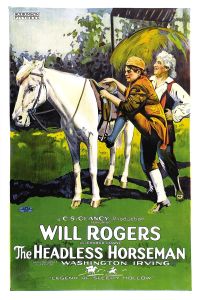
Yesterday was distinctly autumnal around here.  Cloudy and cool, the overcast was definitely moody although the equinox is still a couple weeks away.  Still, the mood was right for the Legend of Sleepy Hollow.  The earliest full cinematic adaptation of Washington Irving’s story is the 1922 silent feature The Headless Horseman, starring none other than Will Rogers.  Now, Irving’s story is fairly brief, and to get nearly a full seventy-five minutes out of it, the tale lends itself to some padding.  The film makes a great deal of Ichabod Crane knowing Cotton Mather’s A History of Witch-Craft, and even being accused of being in league with the Devil that leads to a  disturbing scene where he’s nearly tarred and feathered.  In reality Mather’s book was Wonders of the Invisible World, but the point of the film is better made with the fictional title.

Having watched Tim Burton’s 1999 version—Sleepy Hollow—many times, I was taken by the introduction of the Bible into the story.  The groundwork, however, was laid by Edward D. Venturini’s version.  True to the story, Ichabod teaches Psalmody in his role as schoolmaster.  Venturini’s film has a contrived scene in the church on Sunday that includes a lengthy sermon with everyone—even the usher—falling asleep.  The episode, which is lacking in Irving’s original rendition, introduces the Bible into the narrative.  The connection is thin, but nevertheless present.  Burton picked up on the religious element and built it firmly into the plot as Ichabod Crane’s backstory as a skeptic, raised by “a Bible-black tyrant.”

As someone interested in the integration of religion and horror, early examples, despite the comic aspect of Venturini’s version, are often instructive.  The comedic spirit is actually in the original; Irving’s tale gives a caricature description of Crane that gives the lie to the handsome protagonists beginning with Jeff Goldblum on through Johnny Depp and Tim Mison.  Will Rogers plays the homely image to its hilt, and although lighthearted, the movie has some classic horror elements.  To arouse his dozing parishioners, the minister yells “Fire!” When they awake asking where, he states “In Hell,” which sleeping churchgoers can expect.  Although the eponymous headless horseman is shown to be Brom Bones, a remarkably effective early scene presents a skeletal, ghostly rider that haunts at least the imagination.  The sun is out this morning, and the brooding skies of yesterday have passed.  They will be back, however, as the season for ghost tales is only just beginning.


Fun and Fear

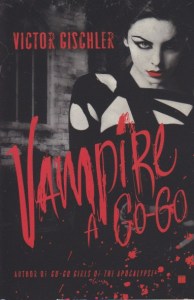
It’s curious the way people find books.  I sometimes see them advertised (the way publishers suppose people see them), but far more often I find them more serendipitously.  I’m active on Goodreads, and many times a book someone else has reviewed will catch my eye.  I like to read things that I notice in independent bookstores.  I’m always on the hunt for a bargain.  At work we have a used book rack where any volume is half-a-buck.  During lunch one day I spied Victor Gischler’s Vampire a Go-Go.  Now the title told me this wasn’t exactly a serious novel, but it had vampire in the title and when I write horror it often ends up on the funny side.  All in all it seemed like it would be worth the tiny investment, even if I don’t have a clear idea of what go-go really means.

While not laugh-out-loud funny, this is an enjoyable romp through monster land.  Kind of like Harry Potter with some adult themes thrown in.  The characters—which include ghosts, witches, wizards, a werewolf (sorry lycanthrope), a golem, and a vampire—are likable and strangely believable.  An unexpected twist came with the Battle Jesuits, a nice touch that shows yet again how close religion and horror can be.  I won’t try to summarize the action here, but I’ll simply note that there are twists and turns aplenty and smiles and splatter along the way.  It’s clear that Gischler researched the novel well, bringing interesting texture to the tale.

Like the last novel I read, also acquired in an inexpensive browsing situation, much of the story is set in Prague.  My wife and I visited Prague back when it was still in Czechoslovakia, and before it had become a tourist haven.  From reading these recent novels, apparently quite a lot has changed there.  Of course, in those days I hadn’t tapped into my love of monsters for many years.  Working on a doctorate has a way of doing that to you.  Now that I’m back, I’m enjoying the variety available in the genre these days.  I still have a soft spot for Stephen King novels, and Poe will always remain among my sacred texts, but I’m inclined to read these newer treatments as well.  There’s nothing really to scare you in Vampire a Go-Go, but there are remarkably moving moments.  And some of the monsters are quite a lot of fun.  It would restore my faith in the power of the accidental find, if it ever required resurrection.


Belonging

You never know where you might find yourself, but wherever it is it’ll cost you some money.  Well, at least in this instance it did.  Nashotah House sent me packing just as we were thinking about college for our daughter.  It took several years to find any kind of full-time position again, and when university time began I had had a full salaried job for a total of one year of the last seven.  Not ideal, of course.  I remember sitting (again) in the financial aid office, explaining the situation and, as it often goes in higher education, receiving no mercy.  As much as I remember the conversation, I don’t recall a photographer in the room.   There must’ve been, though, since I recently showed up on the Binghamton University website.

I had, of course, applied for a job or two there.  When out of state tuition is riding on such a deal, however, I doubt there’s any way to get considered.  I actually like Binghamton University quite a lot.  I appreciate the fact that it doesn’t pour its money into a football team and that it has the reputation of being a “Public Ivy” school.  I even like the campus removed from city bounds—just like Nashotah House.  I did end up paying them quite a bit of lucre through the years, even as my own alma maters were asking alms.  Higher education is a funny world.  Standing somewhere between a money-making venture and a site of education for its own sake.  Many professors don’t realize just how privileged they are to have jobs like that.

Upstate New York, although I’ve never lived there, is one of my ancestral homes.  My grandfather and his family had lived in the area at least as far back as the 1770s.  I tried to convey that sense of connection in my application, many years ago now.  Academia doesn’t put much stock in the idea of belonging, I guess.  It has become far too businesslike for that.  Binghamton was also the town in which Rod Serling, one of my childhood heroes, grew up.  There seemed to be so many reasons to be in that area.  Eventually I settled for life in my own native Pennsylvania.  People sense, although academics less than others apparently, that they belong in a place.  And if you can’t actually be there, you can still spend your money in any location.  I’ve now got a picture to prove it.


Conjuring Success

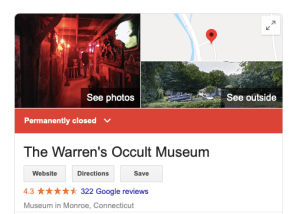
I wonder if it’s one of the consequences of success.  While writing up some thoughts on The Conjuring diegesis, I got to wondering how accurate the movies’ portrayal of the occult museum of Ed and Lorraine Warren is.  The museum set appears in multiple films, and in Annabelle Comes Home it serves up a smorgasbord of horror.  Some of these artifacts, such as Annabelle, really do hold places of infamy in the establishment and some are clearly used in the cinematic version to set up spinoffs to keep the franchise alive forever.  Curiosity drove me to the open web—website owners of spaces of reputation now distrust this “open web,” what with its money grubbing and lack of peer review—to peruse some actual photos.  That’s how I learned the museum is permanently closed.  The reason given: zoning issues.  (I presume they don’t refer to the Twilight Zone issues.)

That The Conjuring franchise has proven remarkably successful hardly requires footnoting.  With The Conjuring 3 due out next year, a total of eight films will have been produced over seven years, currently and it currently stands as the second most profitable horror franchise in history.  For anyone wondering why I wrote Holy Horror, such numbers may help explain.  Now what of these zoning issues?  I wonder if it’s not the number of visitors drawn by the films that have created a problem.  (Those with questions aren’t purchasing Holy Horror, that’s for sure!)  Since the Warrens have now both passed away, the New England Society of Psychic Research runs the museum and is seeking a new place for it.  (We have space in my garage, just sayin’.)  And hey, Gettysburg isn’t too long a drive from here!

Success, I suspect, does come with its price tag.  People are drawn to those who’ve captured the interest of the big screen, and what with everyone dying death is a growth industry.  I suspect part of horror’s appeal is just that.  We all have to face it some day and while many run from it screaming some use this opportunity to prepare.  But I’ve also got to wonder if it can maintain its level of fear.  I recently watched the current iteration of It and found little that was even frightening about it.  But then again, clowns have never bothered me that much.  The bullies are the scariest thing in the film and Washington DC’s full of them.  Talk about success and its consequences.


Fearing Errata

Well before I became an editor, I noted mistakes in books.  I go through phases of marking up books as I read them—in pencil only, please!—and not doing so, but I used to mark mistakes when I found them.  At that point I hadn’t realized the complexity of the process of book production and I had no idea of the many ways in which errors might creep in.  I’m a bit more forgiving now.  In any case, errors are a regular part of book publishing.  Older books used to carry pages with incantational-sounding titles like “errata” and “addenda et corrigenda.”  Errors, in other words, were considered inevitable because every time you have another set of eyes look over the manuscript it adds to both the costs and time for the production schedule.  Then I started writing books.

Now, before I get too far I should explain that many book editors don’t line edit submissions.  The standard “editor” is an acquisitions editor, which means you sign up books for your press, but you don’t necessarily (if ever) actually edit them.  I still have the sensibilities of a copyeditor, however.  That’s the main reason I fear to read my own books after they’re published.  I’m afraid I’ll find mistakes.  I do take the proofreading stage seriously, but often a writer has little control over when proofs arrive with a tight turnaround time.  You have to drop everything to get them returned by the deadline.  I’m always worried that errors might’ve crept in.  For example, with Holy Horror, I corrected with website copy for the book.  The errors, however, remain online.  They’re minor, but as the author you’re always considered culpable for such oversights.

Now that I’m working on a presentation to give for Holy Horror, I find myself facing my fears.  I need to go back to a book already published and look inside.  Since writing it I’ve completed another book, Nightmares with the Bible, and my mind can’t help mixing up a little in which book I said what.  To make sure I don’t tell potential readers the wrong information, I need to go back and reread parts of my own work.  What if I find errors?  Will I have to mark up my own copies like I used to do to those of others?  Will I need to compile an errata sheet?  I tend to be a careful reader, especially with proofs.  But facing possible errors is nevertheless a terrifying prospect, even if it’s a regular hazard for those who attempt to write books.


Making Monsters

It’s not so much I’ve been away from monsters lately, but that life has intervened between them and me.  Life can be scarier than monsters sometimes.  In any case, the summer is when my mind turns back to haunting even as on the breaks during heat waves a whiff of autumn can be caught on the air of a July morning.  Yes, we’ve past the solstice and days are getting shorter.  Slowly, of course, but that’s what builds suspense.  And there are local signs that I need to get my haunting in gear.  It is finally time to get Holy Horror out of wraps and give the book a proper launch.  Being published around Christmas last year was poor timing for a subject so readily coded for fall.

I received the welcome news this week that the Moravian Book Shop—the oldest continually operating bookstore in the country—will be hosting a book signing for Holy Horror in October.  This is a fortuitous turn of events because when I first approached them with the idea the price of the book made the idea look unrealistic.  But we’re now thinking of autumn, and with autumn comes Halloween.  There have been a spate of horror films this summer, all of which I’ve unfortunately missed.  Time, as Morpheus notes, is always against us.  There does, however, seem to be a lively interest in the genre and the curious wonder what it has to say about what we believe.  Horror loves religion, and indeed, thrives on it.  So it’s been from the beginning.

October will also see the Easton Book Festival in this area.  I will be on the program for that as well.  While none of this is earth-shattering, these events represent the first successes in trying to build awareness of Holy Horror.  This was a book written for a general readership, but not priced for one.  Working in the academic publishing world, this is a phenomenon with which I’m all too familiar.  Many colleagues offer to read and spread news about your book.  It seldom happens, though.  Academic presses can’t afford book tours (especially if they have to price books at $45), but these self-driven presentations are opportunities to spread the interest in ideas.  That’s what those of us who write really want—to be part of the conversation.  We’re in the midst of a heat wave here.  It’s the height of summer.  Even so, those who know about monsters can feel them coming, even from here.


Identity Crisis

Living in Boston can be a heady trip for a budding academic.  Even if you’re across the river from Harvard and MIT, it’s a city known for its education scene.  Like many who studied there, I never wanted to leave.  A fringe benefit of being a student of religion was that a short trip would take you to Peabody.  Why?  Peabody was home to CBD—Christian Book Distributors.  In their showroom they had rock-bottom prices for something theology students crave—books.  That was many years ago now, and over time CBD grew to be the largest distributor of Christian paraphernalia in the country.  In my mind they’ll always be associated with happy little trips that ended in armloads of reading.  What more could you want?

A story by Emily McFarlan Miller explains why the revered CBD is changing its name.  Cannabidiol, a legal derivative of cannabis, is popularly known as cbd.  Lots of things share initials, of course, but these are the days of the web, and an internet search for cbd now pushes the distributor (at least the book distributor) off the first page.  One thing we all know in this online universe is that you’ve got to be on the first page.  CBD’s decision might seem extreme—changing the name of the business to get back on the front page.  Despite the amusing aspects to this story, it emphasizes something of an ongoing jeremiad with me: the web has redefined reality.  Think about it this way: when a digital image is over-enlarged it pixellates.  That’s because it’s composed of minuscule squares of a single color.   When brought together in a pattern, they form images we recognize.  It their basis, however, they are squares.

The earth, however, is an orb.  The natural state of falling liquids—the principle behind the shot tower—is a sphere.  Now, spheres together in a closed space leave gaps—just look at a jar of marbles and you’ll see what I mean.  That’s the order of the natural world.  Reality, if you will.  Tech, on the other hand, is pixels.  They fill the space better, and if done well can create the illusion of a curved line.  They can never, however, fit into a round hole of the same surface area.  The world has gone after the convenience of the internet in a small box.  It has changed the recording industry, the movie industry, and the publishing industry.  And just try to find your way to CBD on it.  You might have to change your search parameters.


Tumblin’ Down

RadioLab (not to be confused with Radiohead) is an NPR program to which my wife likes to listen.  She’s introduced me to a few episodes since, as a person who does a lot of writing, I don’t normally gravitate toward programs with a lot of talk.  It’s part of the writer’s curse.  In any case, she recently played a segment on acoustic warfare.  I’ve known for some time that acoustic warfare is a thing, and that militaries use sound to disrupt enemies’ machinery and human operators.  I didn’t really know how it worked.  The interesting thing about this RadioLab spot was that they took the story of the walls of Jericho as a starting-off point.  Also of interest is that one of the hosts had never heard the story—something that would have been somewhat impossible for many growing up in my generation.  In case that’s you, however, the story goes like this—

God commanded Joshua to take on Jericho, a major, walled city, with a ritual procession and the blowing of trumpets.  After marching around the city several times, the priests blew their trumpets and the walls collapsed.  The story’s told in the book of Joshua.  The question discussed on RadioLab was whether it was possible to knock down walls with noise.  It is, they concluded, but at a noise level beyond the abilities of shofars.  This very discussion, however, raised any number of issues.  One is that the collapse of Jericho’s walls isn’t attributed to the rams’ horn sound, but rather a miracle.  Another is that biblical scholars and archaeologists have long known that Jericho wasn’t even occupied at the time of Joshua, and so the story isn’t historical.

Those who produce educational materials on various media generally don’t consider scholars of religion as interesting or noteworthy speakers.  TED talks don’t feature a category for religion, and, as this RadioLab episode demonstrated, those who understand acoustics have more interesting things to say than biblical scholars.  It’s not so much a rude awakening as it is a confirmation that what has long seemed obvious is indeed true—biblical scholarship isn’t really of general interest.  The Bible, however, retains a certain mystique.  I struggle with this disconnect constantly.  While the Good Book remains an iconic symbol—divine, even—those who know it well have less to say than others who have scientific methods to apply.  Not once was it mentioned on RadioLab that pretty much no biblical scholar would argue that the story is historical, but then, what fun would that be to pick apart?


Digging Well

Having spent a good bit of the past week in waiting rooms in Ithaca, I fell to reading Tompkins Weekly, the free local community paper.  If you’ve spent any time on this blog you’re no doubt aware that I have an interest in the weird and unusual.  Although I got teased rather mercilessly for this as a kid, thanks to The X-Files such interest has become somewhat mainstream.  In any case, after fumbling with the crossword and finishing the sudoku, I read an article about dowsing.  Now Tompkins County is the home of both Cornell University and Ithaca College, so I was a little surprised in finding such a topic addressed at all.  What’s more, the usual ridicule expected with anything even approaching the paranormal was lacking.

Dowsing is the practice of finding water, or other underground resources, by using a crotched stick or dowsing rods.  A larger version of the quantum “spooky action at a distance,” dowsing is said to produce an effect on the twig or rods that will point to the hidden source.  Like ESP it is decried by mainstream science yet used by some governments when other methods fail.  As an example of “folk wisdom” dowsing occupies a similar, if less conventional, space to religion.  Scientism has taught us not to trust the invisible.  Scientists, however, are well aware that we can’t see everything.  We slide a finger around our collar, however, when something “unscientific” seems to work.  As the dowsers explain, however, there is a kind of science to what they do.  Problem is it doesn’t work for everyone.  Only some people can do it.

Now I’m not a credulous person.  I spent many years and even more dollars learning how to be a critical thinker.  Skepticism, however, leads me to ask how we know that dowsing can’t possibly work.  Have we discovered all there is to know in this infinite but expanding universe?  With finite minds it seems highly unlikely.  Duke and Princeton Universities once studied parapsychology in an academic setting, and the University of Virginia has left some related areas open to investigation.  The real problem is that we’ve been taught to laugh at anything we’re told to.  The US Navy, for instance, has recently revealed that it takes UFO reports seriously (unlike Project Bluebook).  We’ve been laughing so long it’s difficult to take even the military at face value.   Does dowsing work?  It’s difficult to say without all the facts.  Of course, I’ve been sitting in a waiting room, pondering what we don’t understand.


A Decade

Please pardon my being sentimental, but today marks one decade of blogging on Sects and Violence in the Ancient World.  I realized, thinking this over, that I used to make some interesting, perhaps even quotable statements back then.  Why not, I thought, farm those older posts to celebrate what I was thinking when I was a tenth-of-a-century younger?  So for today’s post, I’m presenting some quotable quotes from July 2009, starting with one of the zingers from my very first post.  For convenience, I’ve even provided the links to the posts so you can see them in context, if your July has somehow not filled itself up already.

Sects and Violence in the Ancient World, by the way, was the name given when one of my nieces thrust a recorder in my face and asked me what I would call a blog, if I had one.  She subsequently set this site up for me.  One aspect of the title may not have been evident: it’s a quasi-anagram for my initials.  It has been, from the beginning, mostly metaphorical.  Without further ado, then, a few of my favorite lines from a decade long gone:

“He had a sidekick called Cypher (sold separately), and arch-enemies with such names as Primordious Drool and Wacky Protestor. I marveled at the missed opportunity here — they could have called them Text Critic and Doctor Mentary Hypothesis!” First post: Bible Guy, July 12, 2009. <https://steveawiggins.com/2009/07/12/bible-guy/>

“Technology has outstripped reality.” Asherah Begins, July 13, 2009 <https://steveawiggins.com/2009/07/13/asherah-begins/>

“Black and white are not in the palette of serious religious studies.”  God is Great (not)?, July 14, 2009 <https://steveawiggins.com/2009/07/14/god-is-great-not/>

“When he [Aqhat] refuses to release it to the goddess he is unfortunately pecked to death in a hitchcockian demise by a swarm of buzzards with attitudes.” Sects and Violence, July 15, 2009 <https://steveawiggins.com/2009/07/15/sects-and-violence/>

“Indeed, one may think of them [religion and monsters] as fellow ventricles in the anatomy of fear.” Vampires, Mummies and the Holy Ghost, July 16, 2009 <https://steveawiggins.com/2009/07/16/vampires-mummies-and-the-holy-ghost/>

“Better to consider it [weather] human than to face unfeeling nature.” Changing Faces of the Divine, July 18, 2009 <https://steveawiggins.com/2009/07/18/changing-faces-of-the-divine/>

“As the gods are drinking themselves senseless (how else can the latest Bush administration be explained?)…” Drunken Moonshine, July 20, 2009 <https://steveawiggins.com/2009/07/20/drunken-moonshine/>

“As usual, we kill off what we don’t comprehend.” Not Lion, July 22, 2009 <https://steveawiggins.com/2009/07/22/not-lion/>

“A bonobo was recently documented as uttering the word ‘yes’ to a keeper’s question, officially making her more articulate than some clergy I’ve known. Even today there are churches that still call their leaders Primates!” Religious Origins, July 23, 2009 <https://steveawiggins.com/2009/07/23/religious-origins/>

“I never used a computer regularly until I began my Ph.D., and then it was only a glorified typewriter, qwerty on steroids.” Who We Were, July 27, 2009 <https://steveawiggins.com/2009/07/27/who-we-were/>

“I grew up in a blue-collar household where paying ladies for favors was itself considered a sin.” Yes, Mammon, July 28, 2009 <https://steveawiggins.com/2009/07/28/yes-mammon/>

Where do you suppose we’ll be a decade from now?


The Joy of Techs

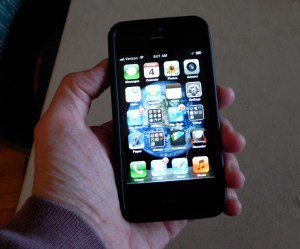
Those of us with Luddite tendencies prefer to hide them.  Tech is the ultimate good, right?  You’ve got a smart phone in your pocket or purse and it contains the entire internet and what more could anyone possibly want?  Besides an upgrade, that is.  I recently misplaced part of the charger for my old iPhone 4S.  Yes, a phone that old can still work, no matter what they tell you!  I went to the store to replace said part only to find that you had to purchase an upgraded replacement that costs twice as much as the old part did.  Why?  It had a new type of USB port, in addition to a “traditional” USB.  Pardon my ignorance, but I thought the U stood for “Universal.”  Now even vocabulary has to change to meet the demands of tech?  Whoever the tech god is, s/he is extremely mercurial.

So I was in a meeting the other day.  A guy older than me was talking about the future of tech.  It occurred to me that guys my age (who didn’t get to take early retirement) are trying to act like those half our age, as if we really understand technology.  Growing up with something is the only way, it seems, to adapt to it in any kind of naturalized way.  There are kids today, if the internet’s to be believed, who don’t understand that you had to lift the receiver on an old-style telephone before dialing.  And if that dial is rotary, well, let’s just say the pizza’s not going to be delivered anytime soon.  Those who grew up with the internet and smart phones have a native understanding that people my age lack.  I still write ideas down on paper.  I prefer DVDs and CDs to streaming.  And I believe books should be made of paper.

Changes in the tech world vindicate me.  I heard that iTunes is going to be retired.  This is after I’ve spent plenty of money downloading songs that I could’ve bought on DVD and have in “hard copy.”  Indeed, friends are telling me to back up my MP3 files on some kind of storage device before iTunes goes the way of UltraViolet.  And we’re supposed to trust tech.  I’ve lost ebooks by switching devices.  Some of my tunes have been licensed away because I downloaded them on an older computer.  What’s one to do?  Buy them again.  In a new format.  On a platform that will eventually be retired so you’ll need to repeat the purchase a third time.  Or you can buy it once in paper or plastic and have it for good.  Now there’s a radical idea.  If only I had something to write it down on.


Selection, Natural or Not

Darwin is extinct, it seems.  At least in the UK.  Perhaps I ought to explain.  I do not travel to England often, and I’m not always good about changing cash before I go.  Usury doesn’t sit well with me, and someone taking a cut just because I have to travel (usury actually doesn’t sting so much when you make a trip by choice) seems unethical.  When I discovered I was required in Oxford, my wife suggested I take some cash.  I went to the attic and rummaged through papers from a trip sometime within the last decade (my passport is still good, so it had to have been in this time frame), and found some ten-pound notes with Darwin on them.  They didn’t smell bad to me, so I said “I’ll just take these.”

I suspect that, like most people, I keep a pocketful of change as a souvenir when I travel to foreign shores.  So I had a few bank notes that hadn’t seemed worth changing back at the time.  Bread cast upon the waters, and all.  I had to make a small purchase in Oxford and the clerk said, oh so politely, “That’s old money, I’m afraid I can’t accept it.”  Interesting.  I had no idea money had a sell-by date.  She said “The bank will change it for you.”  Banks handle all kinds of money.  I walked to the nearest bank and the polite young man (all the bank tellers carry tablets here, like iPads at the Apple Store) told me that banks don’t do that service unless you’re an account holder.  “The good news,” he said, “is that the post office will do it for you, and it’s less than 300 metres from here.”  I was up to a 300 meter walk, so I went.  The British post office isn’t just a place to mail letters, I knew from living here years ago.  The woman at the counter frowned.  “I don’t know why banks send people here,” she said.  “We can’t exchange pounds for pounds.  I can change it into dollars for you.”  Of course, there was a charge to do so, just as there was a charge to change the notes from dollars to pounds in the first place.

Sadly I handed Darwin over and received American faces in turn.  Such is natural selection.  Ironically, just a few days ago I was at a farmer’s market (in the United States).  The man next to me received a silver note in change—he commented that these bills are somewhat more valuable than a standard Washington.  They are still accepted however, as legal tender.  In fact the last time I went to a US bank to turn in change, the bank officer looked at some very eroded coins and said, “As long as I can verify it’s US currency I can accept it.”  I still find occasional old coins in circulation.  Updating currency and then charging for having old money seems like it ought to count as usury.  But then, perhaps my ethics are simply outdated.