Six Impossible Things

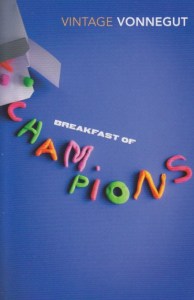
Solipsism, as a philosophy, has its attractions.  The idea behind it is that since all we can truly know is our self, the self is the only being that really exists.  This outlook is expressed in tragicomic form in Kurt Vonnegut’s Breakfast of Champions.  Written in Vonnegut’s characteristic style, there’s confusion and continuity, and almost a mockery of the gullibility of readers.  Kilgore Trout, a penurious science fiction writer, wrote a novel where one character was human amid a planet of robots programmed to act like people.  Dwayne Hoover comes to believe this is true and acts on it, with several other characters ending up in the hospital.  The story ends with the narrator realizing, I think, that he’s the only real human being because he made up this entire novel.

As someone who generally works alone, and whose lifestyle includes early rising and early sleeping, solipsism suggests itself from time to time.  Writers tend to spend quite a bit of time in their own heads, either reading or expressing their own thoughts via their craft.  Anyone who’s been a victim of a solipsist (and we all have) knows that such a viewpoint is wrong, but it does address one of consciousness’ deepest fears—how do we know what others know or experience?  We keep secrets.  We hide our weaknesses and insecurities.  We show others, most of the time, only what we want them to see.  Addressing the individualism of the late sixties and early seventies, Vonnegut takes to task a society that still promotes prejudice and wages war.

Vonnegut experienced war and it’s clear that it haunted him for the remainder of his life.  He tried, and often succeeded, in finding some hilarity in life, but it always seems to stop short with a slap of cruelty.  I’ve been reading quite a few of Vonnegut’s novels over the past few years.  He’s a writer that mixes profundity with frivolousness in such an easy way that it’s beguiling.  Breakfast of Champions is, despite being an easy read, a difficult book.  Quickly finished with its goofy doodles and swift pace, it leaves you feeling as if you’ve been poisoned with an idea, somehow.  Or maybe it’s just me.  For this year’s reading challenge I’ve selected two more of Vonnegut’s novels, but I haven’t decided which ones yet.  I think about asking others, but then I remember that if he’s right in this one, there’s really nobody else to ask.



Vapid

The smoke encircled his head like a thief.  And not in a saintly way.  I was going to have to rethink this.  You see, the culture of the early morning commute is one where you stand in line with strangers before dawn.  Having grown up a victim of second-hand smoke at home, I can’t stand it now.  Should I go wait in the line (which was growing) where the last guy was smoking, or sit in my car?  Work anxiety always wins out in such situations, so off I trudged.  I discovered, however, that the man in front of me wasn’t smoking after all.  He was vaping.  What was this chemical stew hanging in the air that had just come from his mouth?

I worry about second-hand vape.  How desperate must a person be to smoke a device?  You see, my trust in technology goes only so far.  People are slowly beginning to understand that electronics don’t solve every problem.  Vinyl records are starting to come back, even at Barnes and Noble.  Independent bookstores are returning, despite the rise of Kindle.  I’m still waiting for it, but film cameras may once again appear.  There’s something about the Ding an sich.  The tech of the stereo was invented for the analogue record.  Yes, the MP3 is faster and cheaper, and you can buy just the song you want with the click of a virtual button, but we still have our favorite LPs around.  This isn’t misplaced nostalgia, like those who long for the 1950s.  No, this is simply the recognition that faster isn’t always better.  Some things were meant to linger.

Vaping is, however, an example of how a bad habit becomes a vice with no point.  Initially meant to come to the succor of smokers who couldn’t do it indoors, vaping was also quickly relegated to the outside.  Many people, it seems, don’t want to breathe someone else’s smoke.  Do you develop artificial cancer from artificial nicotine?  Another commuter comes up to the guy in front of me.  Like a couple of kids on a 1970s schoolyard, they exchange vape flavors.  The first guy doubles up with a coughing fit.  Spits off the curb.  The second guy says, somewhat anticlimactically, that this one’s strong stuff.  I have to wonder what future generations, if there’ll be any, will think of our love affair with devices.  The bus pulls in.  I’m the only one on the whole thing who clicks on the over seat light.  I have a physical book to read.


Aging Tech

When I get an idea my first impulse is to grab an envelope and pencil and start scribbling.  I run around with an older crowd.  Many of my generation don’t appreciate how much a single “share” can do for a blog post, or what a simple link to a page can do.  I have college friends who have no email addresses and who are invisible on the web.  I guess this is a young person’s playing field.  I suppose one of my reasons for writing about horror is that it keeps me in the younger demographic.  I don’t know too many people my age who are fans of “the genre.”  Sci fi is a little more acceptable, I suppose.  Still, I’ve been thinking quite a bit about why I find horror so fascinating.  There’s actually something redemptive about it, at least in my reading of the material.  It’s also a coping mechanism.

One reason that people tell stories (and read stories), according to psychologists, is to learn how to handle situations they might encounter.  This is on a subconscious level most of the time, otherwise speculative fiction simply wouldn’t apply.  I can’t recall having been in a crisis situation and stopping to think what a Stephen King character would have done in such circumstances, but I suppose that might be in the back of my mind somewhere, along with information about all the things I’ve mislaid over the years.  The older you get, in a technologically rapacious society, the more things there seem to be worthy of horror stories.  I haven’t even figured out the last round of devices before the new generation’s introduced.  No wonder so much of horror has to do with being attacked by monsters that look innocent.  Clinically engineered in a clean room.

Image credit: Pattymooney, via Wikimedia Commons

Some of the horror comes from the inherent instability of a constantly upgrading tech.  My laptop’s a few years old.  While a little younger than that, the device that sits on my laptop is also not fresh from the factory.  The last time I tried to back up the contents, the external hard drive (new from the factory) refused to do what I commanded.  While I did eventually figure it out, I wasted a good deal of my scarce free time working out how a device I couldn’t control was in fact controlling me.  Younger folks grew up with this kind of problem solving drilled into them from kindergarten on.  Now I find myself in a world of devices I can’t comprehend and which don’t even react the same way they did last time I bought the exact same one.  I ask my fellow quinquagenarians what to do and I watch as they grab an envelope and pencil.


In the Inn

One of those things that really bothers me is the concept of being forced out of a home.  It’s never happened to me personally, but that doesn’t mean I can’t fear it.  That idea works its way into more theoretical applications as well.  Lately both my phone and my laptop computer have sent me messages saying there’s no more room in the inn.  Now, dear reader, you may understand technology better than I (you almost certainly do), but I wonder just how much these weightless thoughts I store here can possibly tip the scale.  I back up my hard disc weekly—there’s no telling who’s going to get kicked out when all the room is finally gone!—but when I open my space manager I find all kinds of things I can’t identify.  Software that I’m not sure it’s safe to remove.  I have no idea what the function of many apps might be.  So I just start deleting.

No room for your data here!

And I keep deleting.  I won’t touch my writing, however.  It’s backed up on a high-capacity drive, but such drives fail.  I want to keep a copy here on my laptop where I can reach it.  The real problem is that this massive sorting exercise keeps me from doing the things that I’d rather spend my time on—writing blog posts, for example.  How can I relax to do that, though, knowing that there’s no room to store them when I’m done?  Why does iTunes take up so much space anyway?  I feel guilty deleting anything from it because of all those warning dialogue boxes with their dire notes that this action can’t be undone.  Occam’s erasure has its consequences, I guess.

I suppose this is related to my recent observations on how tech demands time.  I’ve got some big projects going.  One is to sort out and file all my browser bookmarks.  They are embarrassingly plentiful.  Then there’s the sorting of thousands and thousands of electronic photos into files.  When I first starting using devices there weren’t enough pictures or bookmarks to worry about.  Now each of these projects has been ongoing for months and neither is nearing the end.  I’m old enough to recall when office supply stores sent catalogues (print catalogues, no less!) to my employers stating things like, “We’re in the  midst of an information explosion.  You should buy folders in bulk.”  They meant manilla folders.  Were we ever so naive?  Now what about these ebooks that I also have in hard copy?  Which should I get rid of?  That choice, at least, is easy.  Even my manger has room for books.


Punch Bug

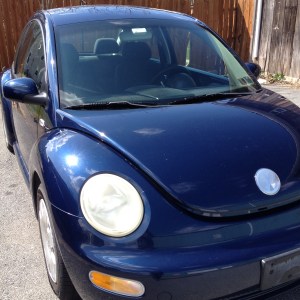
There’s no other reason for buying a Volkswagen Beetle than making a statement.  We bought ours in 2003, before they got squashed.  Mechanically it has been a good little car, but, despite the fine engineering, the hood latch is made of plastic.  And we all know what plastic does.  Yesterday was sunny and a Saturday so I spent at least four hours trying to get the hood open.  (Unsuccessfully.)  Now, I’m no gear-head, so I watched a video on YouTube that 23,000 views (some 22,000 of which were me) on how to work around this major design flaw.  After three hours in the sun I had my face pressed to the bumper, trying hard not to think of all the bugs that have met eternity there, so I could see up to where the inaccessible latch smugly sits.  No tool in the history of humankind can reach it. After another hour I gave up, although just one weekend before this trick worked.

YouTube is an alternate universe.  There, latches can be made to work.  Men who appear larger than me can wedge their entire hands in that unforgivingly tight space while my knuckles are going to take days to heal.  They use simple tools that trip well-oiled springs and their engine blocks are revealed to them like the commandments on Mount Horeb.  Clearly I am not counted among the blessed in this mechanical paradise.  I do pretty well at this kind of thing if someone shows me how, but with a broken hood-latch you’re working by faith with car parts unseen.  Kind of like wrestling with an angel at night.

I did notice among the YouTube videos an unexpected sense of tradition.  The new Beetle (although ours is well over a decade old) has the engine in the front.  The original Beetle (one of which I drove until the cost of parking in Boston compelled me to sell it) famously had it in the rear, making the front the trunk of the car.  That nomenclature has persisted despite the passage of time and changing the facts.  In my mind the front of the car, where the engine is located (or so I hear) is called “the hood.”  The rear is “the trunk” (more spacious in the new Beetle, as I know from experience).  Although the design and layout have changed, the old language remains.  It seems to me that all of this conforms to a belief in special revelation.  Once uttered it cannot be changed.  Or opened, apparently.  Please excuse me, but after all this typing I’ve got to get some ice for my knuckles.


The Reboot

It lied to me.  My computer.  Don’t get me wrong; I know all about trying to save face.  I also know my laptop pretty well by now.  It was running slow, taking lots of time to think over fairly simple requests.  A lull in my frantic mental activity led to the opportunity for me to initiate a reboot.  When it winked open its electronic eye my screen told me it had restarted to install an update.  Untrue.  I had told it to restart.  I gave the shutdown order to help with the obvious sluggishness that suggested to this Luddite brain of mine that my silicon friend was working on an update.  There’s no arguing with it, however.  In its mechanical mind, it decide to do the restart itself.  I was merely a bystander.

Technology and I argue often.  Like JC says, though, authority always wins.  I should know my place by now.  I’ve read enough about neuroscience (with thanks to those who write for a general audience) to know that this is incredibly human behavior.  We are creatures of story, and if our brains can’t figure out why we’ve done something they will make up an answer.  We have trouble believing that we just don’t know.  I suppose that will always be a difference between artificial intelligence and the real thing.  Our way of thinking is often pseudo-rational.  We evolved to get by but machines have been designed intelligently.  That often makes me wonder about the “intelligent design” crowd—they admit evolution, but with God driving it.  Why’d our brains, in such circumstances, evolve the capacity for story instead of for fact?

As my regular readers know, I enjoy fiction.  Fiction is the epitome of the story-crafting art.  Some analysts suggest our entire mental process involves construing the story of ourselves.  Those who articulate it well are rewarded with the sobriquet of “author.”  The rest of us, however, aren’t exactly amateurs either.  Our brains are making up reasons for what we do, even when we do irrational things (perhaps like reading this blog sometimes).  Stories give our lives a sense of continuity, of history.  What originally developed as a way of remembering important facts—good food sources, places to avoid because predators lurk there—became histories.  Stories.  And when the facts don’t align, we interpolate.  It seems that my laptop was doing the same thing.  Perhaps it’s time to reboot.


Strange Ending

Perhaps it’s from growing up as a biblical literalist, but I’ll probably always have problems with post-modernism.  You see, when you’re taught as a kid that there is one absolute right and you already know it (it’s Genesis to Revelation, no Apocrypha, please), you kind of get the idea that things are just what they seem.  Po-mo teaches, among other things, that there’s no true objectivity—reality is subjective and there is no neutral ground upon which to stand.  I’m down with that, but the old ways of looking at things remain.  This is a long-winded way of saying I finished Kohta Hirano’s ten-volume manga, Hellsing.  Over the past year I’ve been reading for a friend of mine, but manga has never really been my thing.  I read The Watchmen as a graphic novel, but looking at pictures somehow feels like cheating.  It’s that literalist thing again.

I might be dropping some spoilers here, so if you’re even slower than me be warned.  There’s quite a bit of shape-shifting here and it’s not always easy to tell who’s who.  In a kind of homage to my childhood monsters there’s vampires, werewolves, and even a Frankenstein’s monster in the series.  All of them are engaged in a constant state of combat against which the Protestant Hellsing organization stands for a stable civilization.  The Catholics are associated with Nazis along the way.  It’s a fascinating look at how an eastern culture might view the religious wars of those in the west who all go by the name “Christian.”  I think this is the genius of the series.  The friend who lent me the volumes has no declared faith, but he finds the dynamic fascinating.  Real religious fighting has made it easy for him.

The story, however, falls clearly into the generation of those without absolutes.  For someone my age a plot clearly laid out is a thing of beauty.  In college we used to argue about how absolutes might exist.  Where did they come from, and which is the strongest?  Did God make them or does God have to conform to them?  Even without the answers, the fact that absolutes existed was assumed.  Argument-driven science tells us that a theory is never proven.  Science is the best explanation we have at the moment, based on the evidence amassed.  In its own way, it has become post-modern.  Hellsing is a kind of mind-blowing work.  It will likely be a long time before I attempt another manga series.  Although I accept the po-mo premise, I still find old-fashioned fiction my favorite.


Stranger and Stranger

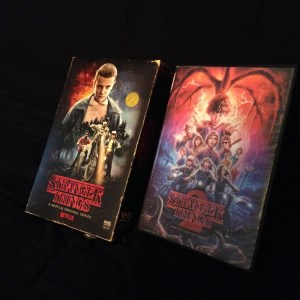
Like many fans of the X-Files and the early years of Sleepy Hollow, I’ve fallen into the Stranger Things orbit.  While I don’t have a Netflix account, I have friends who do and they got me hooked.  If you’ve watched it you’ll know why, and if you haven’t I’ll try not to give too many spoilers away.  The reason I raise it now, when we’ve gone such a long time without a new season, is that Stranger Things 2 took on shades of The Exorcist, but without any of the attendant religion.  Secular exorcists do exist, and possession is a feature of cultures with all different kinds of belief systems.  Exorcism works based on the belief system of the possessed, it seems, and if there’s no religion there’s no problem—call a secularcist!

Spoiler alert: Will is possessed by the mind flayer.  As the authorities flail around and get eaten by demidogs, his mother figures out how the exorcism has to work.  The thing about possession is that nobody really knows what demons are.  Dungeons and Dragons, which I confess I’ve never played—my life is too complicated already, thank you—gives the analogy for the possessing entity.    No matter what the demon, however, the only way to get it out is through exorcism.  Quite apart from sci-fi and fantasy, this is also the case in real life.  Part of the appeal to Stranger Things, I suspect, is that it indulges in the mysterious without the burden of religion.  While religion makes for good horror, good horror may exist without it.  Or can it?

Contrast this with Sleepy Hollow, now defunct.  Possession was a trope there as well, but the story had obvious elements of religion embedded in it.  As I point out in Holy Horror, religion often drives the fear.  That doesn’t mean it’s the only driver.  People fear being taken over by something else.  Stranger Things knows that if nobody can really figure out what that something else is, it can be scarier still.  We know it comes from the upside down.  We know it can possess people.  And we learn that it can be exorcised.  Although the setting is completely secular, there are elements of religious thinking even here.  It’s simply part of the human psyche.  We can deny it exists.  We can try to describe it only by analogy.  We can try to exorcise it.  It is there nevertheless, even as we eagerly await the advent of the third season.


Green Eyes

All of us fall prey to the green-eyed monster once in a while.  For an editor like me, it starts lurking when I see others make content production look so easy by taking copyrighted material from elsewhere.  I’ve read books—often self published—that take great swaths of material under copyright and reuse it with no permissions acknowledged.  You can build big books that way.  Quickly.  And there are websites that use  crisp, clean images that look more immaculate that any kitchen counter.  Often those images, however, come from sources “protected” by copyright.  With a web this large, who’s going to find them?  They’re not making money off them (usually) so what’s the harm?  My jealousy, I suppose, comes from working in publishing where copyright is a daily concern.  It’s the currency in which we peddle.

Copyright isn’t intended to make websites like this one look lackluster.  No, it’s intended to protect the intellectual property, or visual or auditory inspiration, or the creator.  It’s a remarkable idea, really.  If I have an idea, it’s mine.  Once I express it in written, aural, or visual form, it is covered by copyright.  (We haven’t figured out a way to regulate original smells and tastes yet, beyond protecting their recipes.)  Putatively copyright is to protect the creator’s rights.  In fact, it tends to impact the publisher more.  This week at work I had to spend some time, once again, reviewing copyright law.  One thing most authors don’t comprehend is that a book contract is a negotiation for trading rights for royalties—turning ideas into money.  Even intangibles can be purchased.  Intellectual property can have a fence around it.  And a dog or two in the yard.

I try not to violate copyright.  When I want to borrow my old published ideas in new venues, I rewrite them.  When I want to use somebody else’s pictures on this blog I take them from public domain or fair use sources (thank you Wikimedia Commons!).  A great number of them are my own that  I cast upon the web, hoping they will come back to me in time of need.  With the exception of one guest post many years back, all the words on this blog (approaching a million-and-a-half, at this point) have made their way from my addled brain through my trembling fingers and onto the internet.  Maybe I just want to protect my babies.  Maybe some would call it jealousy.  I like to think of it as a mother bear and her cubs.  Or perhaps the spawn of a green-eyed monster.


Friends with the Devil

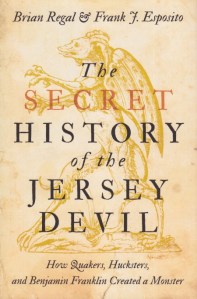
The Pine Barrens of New Jersey strike the first-time visitor as eerily odd, even today.  Stunted trees grow from sandy soil, crowded close together and growing hard up to the edge of the road.  You can see the sky above, but dwarf trees of uniform height block your lateral views over any distance.  It feels claustrophobic.  Add to this tales of inhospitable residents and an actual profusion of tree-climbing lizards, and you’ve got the grounds for wondering what else might lurk in the deciduous woods.  Brian Regal and Frank J. Esposito aren’t so easily frightened.  Their fascinating book, The Secret History of the Jersey Devil: How Quakers, Hucksters, and Benjamin Franklin Created a Monster is a bit of a chimera on its own.  The subtitle gives a pretty good idea of what you’ll find in the book.  For someone who had lived in Jersey for a dozen years, and who loves monsters, it was a must-read.

Not to provide too many spoilers, Regal and Esposito spend some time in colonial New Jersey sketching the little that can be known of the rather prominent Daniel Leeds.  Anyone from Jersey knows that its eponymous state demon is also known as the Leeds Devil.  This particular family had good connections despite being Quakers—a capital crime in some parts of the British Empire.  Daniel, however, had a falling out from the Friends and made his name by publishing an almanac.  This almanac and the proximity of Philadelphia to the Barrens brings Benjamin Franklin into the story.  Franklin competed with the Leeds almanac, and Poor Richard eventually won out in this war of the words.  Demonized by their former Friends and gently satirized by Franklin, the Leeds family was eventually all but forgotten.  Then stories began to emerge of a dragon-like monster in southern Jersey.

To get the details you’ll need to read the book.  Particularly interesting for this blog is the way religion and monsters interplay.  There’s a good bit of history of monsters in the story, including Quakers and early attempts among scientists to understand birth defects.  The very word “monster” is, in its “word cloud,” related to ideas such as revelation and portents.  Early scientists resorted to divine anger when they couldn’t explain what nature had wrought.  And of course folklore is a very potent lubricant.  There are some gaps in the story here, but this is an enchanting exploration of whence monsters might come.  The Jersey Devil has international fame now, and its birth may have begun with insults flashed back and forth among religious believers that eventually were taken literally.  The devil’s in these details.  Or at least in the spooky topography of the Barrens.


Qaulity Education

Perhaps it’s from having a stubbornly blue collar, but snobbery has never appealed to me.  While in seminary at Boston University, I applied for a transfer to Harvard Divinity School.  In spite of being accepted, I stayed at my alma mater and paid the consequences.  There’s a strange loyalty among the working class, you see.  And now I’m finally seeing my former mistress, academia, taking a turn toward the lowly but worthy.  The title of a recent article in the Chronicle of Higher Education says it all: “As Scholars Are Driven to Less Prestigious Journals, New Measures of Quality Emerge.  Hmm, why might that be?  The industry mantra, “publish or perish” has grown more aggressive over the years and the number of publishers has decreased.  Your academic net worth, it seems, can no longer be based on how elite you are.

People are funny that way.  We’re very impressed by those paraded before us as successes—as if some kind of magic clings to those who are where we wish we were.  In academia where you went to school matters more than what you’ve proven yourself capable of.  If you attended the “best” schools your work will be accepted by the “best” journals and publishers.  What rarified company you’ll keep!  For the rest of us, well, we have the numbers.  And blue collars aren’t afraid of hard work.  Let the academic aristocracy enjoy its laurels.  Laurels are poisonous, however, for those with an eye open for parables.

Primates, according to those who know them best, can see through pretense.  I often wonder if our political chaos isn’t based on this simple fact of biology.  As a priest I knew once told me, “We put our pants on one leg at a time too.”  This didn’t prevent many postulants I knew from anticipating the day when they would be ontologically transformed.  Priesting, I was informed, would make them better than the laity.  Closer to God.  Here it was, even among the clergy—the desire for prestige.  Chimpanzees will take down an alpha who abuses his power.  Nature has a set of balances.  Tampering with them leads to, well, scholars being driven to less prestigious journals and the like.  The net result, as the Chronicle suggests (if read one way), is that the last shall be first and the first last.  Probably it’s the result of reading too much Bible in my formative years, but I’ve always appreciated parables.


Yes or No

Reading about demonic possession is enough to scare you away from ever using a ouija board.  In fact, I’ve never played with one; growing up my strict religion would’ve prevented it in any case, and already as a child I’d been warned of the dangers.  During my research for Nightmares with the Bible, I’ve been reading quite a bit about ouija.  Originally a species of divination, the ouija, or spirit board, became popular during the growth of Spiritualism.  Spiritualism is a religion based on the idea that the dead still communicate with the living, ensuring believers that life continues beyond death.  It still exists, but not with the numbers that it boasted in the early days.  Among the solemn admonitions of Ed and Lorraine Warren (about whom I’ve posted much in recent months) was that ouija boards opened doorways for demonic entities.  Some of their stories are quite scary.

Image credit: Mijail0711, via Wikimedia Commons

Whatever else you can say about America, a fact beyond dispute is that if something can make a buck it will be marketed and sold.  So it was with ouija boards in the 1970s.  I remember seeing them on the shelf with other games at local department stores.  Even then I knew they weren’t a toy and I wondered how anyone could be promoting them for general consumption.  At Grove City College—that bastion of undergraduate conservatism—stories circulated about how students (usually coeds) were attacked in their locked rooms after playing with ouija boards.  This is, I was later to learn, a staple of collegiate urban legends.  At the time, however, I took it very seriously.  

Thus it’s strange when I find out that others my age were more curious about them.  Recently at a party with friends around Valentine’s Day, the question naturally came up of how some of us met our spouses.  One of the women mentioned that before she’d met or even heard of her future husband (who has an unusual surname) a ouija board spelled out his name.  She later met and married him, not on the board’s recommendation, but she remembered that years before she’d been given a hint.  Now these friends are not cheats and liars—they’re not even Republicans.  They’re people we trust.  On our drive home that night my wife mentioned she’d used a ouija board once, with friends, back in her high school years.  She asked the name of her spouse (long before we met) and came up with Sam.  I’m no Sam, but when we first met in grad school I was still going by my stepfather’s surname and my initials were S-A-M.  Coincidence?  Probably.  My future wife did not pursue me; indeed, it was the other way around.  Even so, there in the dark on the nighttime highway I felt a familiar frisson from childhood concerning a form of divination that seems to know more than it should.


Type Right

Image credit: Rama, via Wikimedia Commons

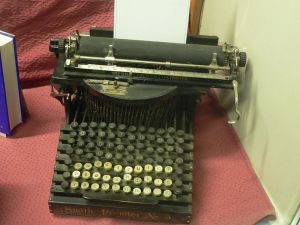
I’ve mentioned before on this blog that I’d like to get a typewriter.  An old one, without electric capacity.  Clacking keys flying before the dawn.  At first this might seem impractical—why buy a typewriter when almost all publishing is now electronic, at least in one stage of its life cycle?  You type something out and you’re going to have to “re-key” it for the hegemony of technology.  But wait—there is a method to this madness.  I’ve heard it said that good writing is just clear thinking.  That sounds right to me, but with a proviso: good writing is edited writing.  The editor may be someone else, or it may be the author, but the point is that something written, with rare exceptions, improves upon rewriting.  Like ordinary stones in a rock tumbler that come out glistening.  Type it, then retype it.

Back in college I wrote all my papers out by hand before typing them.  (Sometimes three lines of handwriting on each college-ruled line.)  “Keyboard composition,” as it was called then, was shorthand for quick, sloppy writing.  The uniformity of type hides a host of syntactical sins.  I used to see the same thing with student papers prepared on a computer in my teaching days—colorful images and fancy type utilized to mask a lack of engagement.  The paper written and rewritten shows itself to be of a higher standard.  I (or others) notice more errors on this blog when I run out of time for editing, often because work looms.  If I have the time, I edit.  And I actually miss writing my thoughts out longhand.  What I need is a typewriter.

Reading has always been a large part of my job.  Student papers and book proposals aren’t so very different.  Many of both come in what appears to be first draft form.  It’s understandable—good writing takes time not only to hammer out a draft but to think, mull, change angles, and hammer again—and we’re all so terribly busy.  The end result is often worth it.  At this point in Nightmares with the Bible I’m printing out my draft so that I can see what I’ve written.  The handwritten comments come after the keyboard composition, but they still come.  The important thing is that drafts require re-reading.  Better, re-writing.  The niceties of pleasing writing can be added or enhanced by an editor.  When editors write books, other editors edit them.  And as I sit here typing this silently on my computer, I’m imagining the satisfying sounds of a manic typewriter early in the morning.


Caveat Emptor

When you work in academic publishing, various higher education news sources find you.  Not able to distinguish faculty from industry professionals that rely on them for their by-products, these sites often offer friendly advice on how to succeed in academia.  Having had not a little experience in that venue (if you’ll pardon my litotes), I noted a recent headline before clicking the delete button.  I can’t reconstruct it word-for-word, but the gist of it was that if you wanted to earn more as an academic, you should study overseas.  Your salary, the article implied, would be higher if you did.  Now I recognize that things constantly change, but in my field of study if you want to get any job at all, let alone a good paying one, you study domestically.  Specifically at Harvard.  Academics, just like publishers, rest on their laurels.

The funny thing about this headline is that it contained the same advice that I received all the way back in the 1980s.  I followed up on it, choosing Edinburgh after having been accepted at Oxford, Cambridge, Aberdeen, and St. Andrews.  Only later did I learn that of those schools only Oxford opened the door to positions in my native United States, being, as it is, the Harvard of the United Kingdom.  Defying the odds, I did get a job that, when I became Academic Dean with access to industry stats, I discovered was among the lowest paying of its peers.  Studying overseas, in other words, had the exact opposite effect than the headline promises.  Perhaps things have changed in the intervening years.  Even today I have to remind people that Edinburgh is a world-class research university, one of the four ancient schools in the kingdom of the Scots.  Some of the most famous minds in human history studied there.  Ach, well, a job by any other name would smell of sweat.

Xenophobia isn’t unique to the GOP.  It exists in higher education too.  Academics are extremely tribal, and if you try to break in from the outside—no matter where you study—you’ll learn that your money might be spent more wisely learning a trade.  As a homeowner, I’ve discovered that just about any practical job that doesn’t require college pays better than what you can get with the detritus of a doctorate on your résumé.  In fact, during times when work was scarce I tried to hide it.  One of the skills I picked up in my educational journey was not to believe everything you read.  Problem is, you only pick that up after you’ve already paid that tuition bill.  The delete button is right there; don’t be afraid to use it.


Internet of Happiness

Are we really happier for instantaneous news?  Has the internet brought us paroxysms of ecstasy with the quality of information?  Wouldn’t you just rather wait?  I don’t think we should go to extremes, or go backward.  Samuel Morse, it is said, developed the telegraph in part because he was away from home and only found out about his wife’s death after her burial, for which he could not return in time.  More rapid communication was necessary and the telegraph provided the means.  No, I’m not suggesting that happiness lies in being uninformed, but perhaps I lingered long enough among the Episcopalians so as to believe in the via media, the middle way.  Some of the happiest times of my life have been spent without a screen glowing in my face.  There is, however, good stuff here.

One example is blogging.  I wish I had more time to read blogs.  Verbomania, for example, showcases writing that sparkles.  The weekly posts set me up for a good weekend.  There are many more that I could name as well—and for me blogging has become a way of life.  Marketers call it “platform building” but I think of it as fun.  And the practice I get writing this blog daily has made my books much more user-friendly.  A family friend with no college education tried to read Weathering the Psalms, with “tried” being the operative word.  There’s no comparison with Holy Horror.  (Weathering the Psalms was written to be my “tenure book,” and it may well be my last technical monograph.)  I have this avocation of blogging to thank for that.

But instantaneous news—does it make us happier?  Sometimes perhaps, but often the opposite.  It’s a phenomenon I call the internet of unhappiness.  (There’s a whole field of study emerging called “the internet of things,” which, no matter how much I ponder I just can’t comprehend.)  News, after all, tends to focus on negatives, as if there’s too much happiness in our lives.  Just yesterday there were early morning helicopters hovering not far from where I live.  Within seconds I could learn of some kind of domestic dispute about which I’d otherwise have been none the wiser.  The next few hours I spent occasionally reloading the page for updates.  They didn’t make me happy.  Add to that the three-ring sideshow that the American government has become and you’ll soon be wanting just three channels from which to select before turning off the TV and going outside for a walk.  And when the 1970s start to look like happy times, you go to your closet and start digging for the semaphore flags.

They must be in here somewhere…