Blogday

Sects and Violence in the Ancient World is nine years old today.  Not that I’m keeping count.  Really, I’m not.  WordPress sent me a notice, and they ought to know, being the virtual womb whence my thoughts gestate.  The original plan for this blog was to take my abiding interest in the religions of antiquity and give them a more public face.  My brother-in-law, Neal Stephenson, thought I should do podcasts, because, at the time I spoke incessantly about ancient deities.  I can still hold forth about Asherah at great length, but ancient Near Eastern studies is, believe it or not, an evolving field.  You need access to a university library, or at least JSTOR, and a whole sabbatical’s worth of time to keep up with it.  Even though telecommuting, I’m a nine-to-five guy now, and my research involves mostly reading books.

So Sects and Violence began to evolve.  I realized after teaching biblical studies for over a decade-and-a-half that my real interest was in how the Bible was understood in culture.  Having a doctorate from a world-class university in the origins of the Good Book certainly should add credibility.  My own journey down that pathway began because of interpretations of Scripture that were strongly cultural in origin.  I first began reading with Dick and Jane but quickly moved on to Holy Writ.  It has shaped my life since before I was ten.  It’s only natural I should be curious.

Like most tweens, I discovered sects.  Why did so many people believe so many different things?  And many of them call themselves Christians.  And the Christians I knew said the others weren’t Christian at all.  And so the conversations went, excluding others left, right, and center.  As someone who wanted answers, this fascinated me.  The Bible was the basis for many belief systems of sects everywhere.  From Haiti to Ruby Ridge.  From New York City to Easter Island.  From Tierra del Fuego to Seoul.  And not just one Bible, but many scriptures.  And these beliefs led to behavior that could be called “strange” were it not so thoroughly pervasive.  Scientists and economists say we’ve outlived the need for religion.  By far the vast majority of people in the world disagree.  I couldn’t have articulated it that way nine years ago, but since losing my teaching platform, I’ve been giving away for free what over four decades of dedicated study—with bona fides, no less!—has revealed.  Happy blogday to Sects and Violence in the Ancient World.


The Moved Unmover

To say it was an easy move would be a lie.  I write this on a beautiful, cool, clear July morning.  Only I can’t even calculate the last time I slept.  Not new house syndrome, but that move!  Our personal account manager at International Van Lines was supposed to call us between 4 and 6 p.m. on Friday to confirm the time of the move.  She would also tell us how much money was needed, in cash, by the movers.  In cash?  She’d taken my deposit by credit card; why couldn’t the balance be paid that way?  She was supposed to call to clarify.  I suspect my tone makes it sufficiently clear that she didn’t.  I went to bed not knowing if we would be moved or not—I only reread her email after packing the last box (or so I thought) at 7 p.m.  The IVL offices were closed.

I awoke at 3:30 to an email saying they would be there between 9 and 11 a.m.  And they would be wanting an uncomfortably large amount of cash.  My wife went to get it, and three guys and a truck arrived at 9:15.  I could see their faces blanche at the walkthrough.  They’d been told it would be a ten-hour job.  It turned out to be seventeen.  Nothing makes you feel a cad quite like being thought a snake-oil salesman.  Our bill of lading was just a bit short of reality.  Packing the truck wasn’t finished until 9 p.m.  Unpacking until 2:30 a.m.  Our three guys were joined by two more for the unpacking.  Most everything went into the garage because, well, no stairs.

Twice during the day the amount of cash needed was upped by a significant amount.  This was one of those “we’re in it now” situations.  We paid what was requested.  The internet guy was arriving potentially by 8 a.m. this morning.  Who can sleep knowing the alarm is set for four hours from now?  And our labeling scheme was so arcane that, well, most everything ended up in the garage.  The movers themselves?  Absolutely fantastic!  I’m sure they’ll be talking about this move for months to come.  

Looking outside, the yard wants mowing.  The internet guy is coming.  Who needs sleep when my life of telecommuting begins tomorrow?  The good news is it took only half an hour and one trip to the garage to find the coffee filters.  I’m looking out at a beautiful, crisp morning.  Over an Everest of boxes.  But you won’t know any of this until the internet guy gets here.  Somehow I sense we just accomplished something quite extraordinary.


Moving Day

So, it’s moving day.  Amid all the packing and sorting—outside the regular 9 to 5—I realized that this was the first move I’ve made outside the constraints of academia.  Well, maybe not strictly so, but I left Nashotah House in the summer, and I was unemployed when I moved to New Jersey to start in the publishing world, so there was no office work involved.  The move without changing a job is a tricky thing.  And exhausting.

I didn’t write about the process early on, in case it didn’t happen.  Buying a house is an exercise fraught with peril and it can collapse at several junctures over the three-or-so months it takes to finalize things.  Then there’s the move itself.  Back in January I found myself setting books aside that I thought I might not need again in the next few months.  We started hauling boxes down from the attic to pack those books in February and March.  We finally made an offer on a house in May, and now, seven months after the process began, we’re ready to move.  Or so I tell myself.

Our last move didn’t go exactly as planned.  Like Bartleby and Loki, we were moving from Wisconsin to New Jersey, perhaps seeking our destiny.  Who knows—maybe undoing the universe?  We hired Two Men and a Truck to move us.  My brother in New Jersey said he’d meet the truck since it was going to take us a little longer to get there.  On arrival day, no truck.  We called the company to find that the said Two Men had actually abandoned said Truck in a parking lot in Chicago.  Although embarrassed, the big Two Men upstairs made no offer of a discount on the move, even if it cost my brother an extra day of work.  We’re hoping for better things this time around.

International Van Lines didn’t call the night before, like they said they would.  After a somewhat restless night (should I stay or should I go?) my usual 3 a.m. internal alarm kicked in.  An email, like a thief in the middle of the night, told us when to expect the big guys and their vehicle.  Moving is kind of like prophecy in that regard.  In any case, for those accustomed to early posts, there will be a delay tomorrow since the internet people are finishing the virtual move around 11 a.m.  Church time on Sunday.  If we pull this move off, I might have to admit there are miracles after all.


Extra Baggage

So, I’m packing.  Have been, on and off, since January.  One of the most dreaded moments of packing is the closets.  You know how in horror movies the villain often hides in closets?  We have no danger of that.  Any monster foolish enough to try it would be suffocated under tons of stuff.  Some houses may have walk-in closets, but I am inclined to call a mining company whenever I need to find anything in ours.  Our closets have led full lives.  It’s almost 100 degrees outside and I’m excavating.  We’re at that stage of “absolutely need to keep?” instead of “do we want this?”  Then I came upon it.  The layer of SBL tote bags.  Like a paleontologist of ancient academia.

If you’ve been a member of the Society of Biblical Literature you know what I mean.  Every year the Society wants you to realize value for your money, and they give you a tote-bag to help you haul home the books you’re going to buy.  Long-time attendees know to pack an empty suitcase inside their regular one just to accommodate the books.  (That could also account for about ninety percent of my packing—we have more books than a small town public library.)  But it’s not the books that are the problem today, it’s the bags.  I’ve been attending SBL since 1991.  Do the math.  I seem to recall that they didn’t do tote bags back in Kansas City, but soon after they became part of the agenda.  And I have an impressive pile of them in my closet.

Too small for groceries—especially in the early editions, back when we could meet in smaller venues—and too impractical for anything other than books, they multiply in our closets.  What professor doesn’t have his or her iconic briefcase already?  Reduce, reuse, recycle they say.  At least half of my totes have never been reused.  Zippers?  Who thought of that?  Pulling handfuls out of the closet, I marvel at their colors.  I can’t remember everyone walking around with a red bag—what year was that?  (San Francisco, 2011.)  The black leather edition—remember that one?  (SBL, n.d.)  The bags aren’t really useful for packing, on a movers’ scale.  You can imagine the burly guys outside their truck scratching their heads at this impractical conveyance.  Like so much else in life they’ve become mere souvenirs.  From the French word for something like “remembrance,” souvenirs are meant to take us back to the place in vivid detail.  I fear that many past meetings have run together into a blend of biblical arcana.  I’m sure that’s just me.  Still, I’m responsible for this new discovery.  I’d I’ll need shortly to decide whether these totes go into the museum or back into the landfill that moving inevitably creates in a throw-away world.


Breaking Day

When does the day start?  Years of awaking around 3 a.m. may have distorted my perceptions a bit, I suppose.  Here in the mid-Atlantic states, the sun is never up that early.  Year round I get out of bed when it’s still dark.  I’m not complaining—this is generally a peaceful time, a rarity in New Jersey.  If the bus didn’t come so early I’d get an awful lot done in a day.  But when does the day really begin?  I rise early to write.  Computers have changed my writing style quite a bit.  I used to write everything by hand.  Even as a kid with a second-hand typewriter, I preferred longhand first.  I still do, truth be told.  It’s slow, though, morning’d gone before I got too far.

So I get up and boot up.  I’m not sure that I’m crazy about my computer knowing so much about my personal life, but one thing it simply can’t understand is that I’m an early riser.  Many days my laptop will condescendingly ask me if I mind if it reboots—it’s been updating software when it thinks I’m asleep.  For the computer, day doesn’t begin this early.  Sometimes I worry that my blog doesn’t get readers because the new posts come up around 5 a.m., before I jump in the shower and head for the bus.  If things don’t appear in the feed at the top of the page, well, they’re old news.  I admit to being guilty of that myself; yet knowing when it’s day has consequences.  Maybe I should be posting a bit later?

For some reason my computer likes to send me notices.  Like I’m not already paying attention.  I’m sure there a setting someplace I could change, but I’m busy most of the time and figuring that sort of thing out takes longer than I have time for.  Birthday notices for complete strangers—maybe they’re connected on LinkedIn?—appear, at 9:00 a.m.  I’m at work already by then.  I think this is my devices’ way of letting me know that it’s a nine-to-five world.  As an erstwhile academic I never cottoned onto that.  I started getting out of bed at 4 a.m. when I was teaching so I would have time to write before daily chapel.  I also taught classes that ran from six-to-ten (p.m.) while at Rutgers.  When does the day start?  When does it end?  The decision’s not mine, as my laptop’s only too happy to remind me.


Divisive Devices

In some kind of vague attempt at spring cleaning—yes, I know it’s late for that; I’m always running behind—I’ve been taking some old electronics for recycling. You know the pattern: you replace a piece of equipment and set the old one aside and next thing you know it’s become a handy horizontal surface upon which you can stack other things you don’t have time to deal with right now. House-cleaning day should be a national holiday in a country of inveterate consumers. In any case, this exercise in household archaeology has revealed quite a bit about just how much we owe to our technological overlords. I’m still of the mindset that anything over $20 is expensive. When it comes to any piece of electronic hardware, my wife and I have a serious tête-à-tête as to whether we really need it or not. I mean, we both grew up with pen and paper.

Everything’s electronic these days. During my vernal excavations I’ve come across more than one device that I can’t identify. “What this thing?” I ask. I don’t remember buying it, although there must have been some serious discussion first, and I’m not even sure what it does. At the time of purchase, I know, it felt pretty urgent. So we are led like sheep to the hardware. Is your house cluttered with old photos? Digitize them! Too many CDs? Thousands of MP3 files fit onto this device! But what about when devices clutter up your house? Who even uses an iPod anymore? Or a digital camera? We still have a few rolls of actual film sitting around, waiting to be developed.

My grandmother lived from the first heavier-than-air flight to Neil Armstrong stepping foot on the moon. As someone pointed out the other day, kids these days can’t figure out how to use a rotary-dial phone. I won’t find one of those tucked in the closet anyway, because they were owned by the phone company. I’m not sure who actually owned this dial-up modem in front of me—if that’s what it is, but chances are that Verizon won’t have any use for it anymore. These are strange days when you feel nostalgic for a wide-ruled tablet and a pencil freshly sharpened from a hand-cranked device bolted to the wall by the classroom door. And I think it’s still spring.


Let the Sunshine in

The earliest sunrise does not occur on the longest day. At least not at this latitude—I can’t speak for the entire world, but sunrise lags behind the latest sunset by a few days. In Germany the longest day was January 30, 1933. It seems that the Nazi Party did not win the majority, but Hitler was made chancellor anyway. All he wanted to do was to make Germany great again, right? No matter who it hurt. When Americans, who sacrificed thousands of souls, found the concentration camps they swore it would never happen again. That was, however, before Donald Trump was born. Indeed, those seeking the transmigration of souls might wonder where he’d been wondering for the previous thirteen months. There’s some cryptic stuff happening here.

How can it be that sunrise isn’t earliest on the longest day? Back in the days when science mattered, it was simply explained: the number of minutes the sun is in the sky maxes out on the summer solstice. Sunrise can keep getting earlier for a few more days, but so will sunset. The longest day, in the biblical world, was when Joshua was fighting at Makkedah. The slaughter was going so well that the big white guy upstairs (oh no, he’s not Jewish, you see) reached out and held the sun in place for another 24 hours so it could continue. That, you see, is the longest day. Not exactly sand chairs and sunscreen, although the latter might’ve been awfully useful.

Although in modern times the solstice is known as the first day of summer, in olden times it was considered midsummer. The solstices and equinoxes were the midpoints, not the start of something. Such a perspective can make a world of difference. June, it is said, is named for Juno, the pagan wife of Jupiter. The constantly cuckolded goddess of marriage. Only we call her long-suffering, since stormy weather should be over by June, shouldn’t it? With enough lawyers even sin can be made to sound righteous, for longest day brings everything out into the light otherwise. The longest day, you see, can be fake news. Around here the sun will rise still earlier tomorrow. Experts—those we no longer believe—tell us that the solstice was yesterday. And yet, what is that orange thing arising in the east so early in the morning? Don’t be fooled; the longest day is over.


Cult of Paris

The cult of celebrity is dangerous. The results of both biological and psychological sciences inform us that mammals, especially primates, hold “alpha” individuals in awe. We don’t know what quality makes them irresistible to some, but in the case of humans before you know it everyone is talking about this Kardashian or that Trump. Valorizing the power of media as we do, those who appear ubiquitously on screen gain in magnitude merely by the attention paid to them. Others have vetted the details, and those who are deemed important enough for constant, widespread television exposure are worthy of our worship. Most of the time it seems banal, harmless. But when those without scruples are willing to exploit it, it is dangerous.

Paris rejecting the cult of celebrity

For example, the other day my wife and I rewatched An American in Paris. I know my wife likes the movie, but when it was over I couldn’t help noting that Jerry Mulligan chauvinistically claims his right to a woman he’s just met, and who is, moreover, engaged to a friend of his who had just lent him money. The fact that he doesn’t know about the engagement is no excuse. Lise tells him “No,” and when she gives him a false telephone number he doesn’t take the hint that she doesn’t want him to call her. He stalks her in a selfish and predatory way. Only because she laughs at his antics with some perfume bottles does she agree to meet with him later. He takes advantage of another woman who clearly has feelings for him and who sponsors him, using her money but not reciprocating her feelings. He’s aggressive and eavesdrops to get Lise’s name. He lies to her and about her (saying he knows her so her friends don’t object) and refuses to take no for an answer. Laying out my grievances, my wife politely listened and then said, “But it’s Gene Kelly.”

Like many people, I was jilted a time or two when I was younger. Losing out to a rival lover leaves a lasting scar. How can we hope that on New Year’s Eve Lise will leave Henri for the interloper Jerry? But it’s Gene Kelly. The cult of celebrity allows those on various pedestals to get away with many things. Trump was likely correct in saying he could stand in the middle of a crowded street and shoot someone and his base would not object. The cult of celebrity ’sn’twonderful, ‘sdangerous.


Sects on the Highway

Here in the east, it’s not unusual to see Amish buggy road caution signs. Well, not so much in New Jersey, but in my somewhat frequent trips into Pennsylvania and upstate New York. On a recent trip to western Pennsylvania I mentioned to my mother that I’d never seen any Amish along the infamous route 322, where such a sign resides. Driving down 322 on my way home from that trip my wife and I passed three Amish carriages and one baby stroller. Religion has a way of surprising you along the highway. Roadside sects are not uncommon. Apart from the many biblical billboards I’ve been seeing lately, there are any number of indications that once you get out the urban areas of the nation, religion is alive and well. While driving to Ithaca, New York recently my wife and I simultaneously spotted a sign we’d never seen before. We have made this trip to upstate many times, mostly along Interstate 81. The sign was for a tourist attraction called “Historic Priesthood Restoration Site.”

Being hopelessly mainstream, we assumed this meant Catholic priesthood. The problem was, what was either historic about this area north of Scranton, or what might be this restoration? Once we found wifi access again, I learned that the priesthood referenced was that of the Church of Jesus Christ of Latter-Day Saints. I have to keep reminding myself that Mormonism had its start in parts of upstate New York—an area so prone to religious flare ups that it was called the Burnt Over District back in the day. So Joseph Smith and Emma Hale had lived just over the border in the area of Susquehanna, Pennsylvania while Smith was working on the Book of Mormon.

A great deal of America’s religious history may be found on roadside markers. We are an inventive people when it comes to ways of exploring what we consider the divine world. Mormonism has been one of the more successful brands of American religion and although we tend to associate it with Utah now, it was a faith that grew up here in the green hills of the mid-Atlantic states. Being inveterate seekers, Homo sapiens go after new revelations with surprising aplomb. And we’re willing to change the constitution of old religions to fit new prejudices. Religion is anything but static. To test this theory simply get behind the wheel and drive out into rural America. You’ll be surprised how much you can see even at highway speeds, if you have eyes to see.


Rains and Bows

It’s raining and I’m here for an outdoor event. Here, in this case, is Ithaca, New York. The event is the parade that’s an integral part of the Ithaca Festival. As people have been laying out their chairs and blankets along the route since morning, it’s a fair guess that if we don’t stake out our few feet of available public space we’ll miss the parade. And yes, it will rain on my parade. The problem is waiting in the rain. With one hand holding an umbrella and water getting in anyway like a leaky roof, there’s only so much you can do. Reading a book—my default activity—is out of the question. I know very few people here and since I’m acting as a placeholder, there’s nobody to talk to. Tom Petty was right after all.

The parade itself turned out to be a celebration of diversity. Ithaca is what America could be. The various liberal organizations, eager to educate, marched by to cheers and bonhomie. There’s nobody judging here. This became clear in a particularly striking juxtaposition (for which I have no photos, because it was raining) in the parade lineup. A group of Mad Max-themed metal rockers went by in a gnarly truck decorated with torches protruding from fake human skulls. Dressed in future period costumes from the movie diegesis, they produced the guttural, primal roar that is an accusation against current society. Then, like Mel Gibson shifting to The Passion of the Christ, the group immediately behind was a Bible Baptist Church. Add water and mix.

For this I’d sat in the rain for a couple of hours. Forced to relax, I watched the water on the fabric over my head as beads crawled together, joined one another, and scurried, animal-like, from the umbrella to the ground. The drops may look uniform from a distance, but they’re diverse. They come in different sizes, and perhaps because of the distorting character of the nylon, they took different shapes. Placed together in one location, it was natural, it seemed, for them to come together for a common goal, which was the ground. There was a parable playing out here right over my head. While it didn’t seem to be the case at the time, it clearly was a lesson to be shared. Had it been sunny, I would’ve been reading a book. Sometimes it takes sitting in the rain to learn something that should be obvious no matter what the weather.


APB

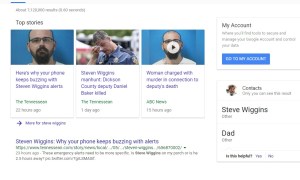
It’s disconcerting. Being mistaken for somebody else. I suspect I’m not alone in having shown up somewhere I’ve never been before only to have people mistake me for a local. It’s happened to me a couple of times, and what with the recent Steve Wiggins incident in Tennessee, it’s enough to make me question my uniqueness. I’ve also had the unfortunate experience of undergoing identity theft some years back, and floating myself out here on the internet is something the wisdom of which I sometimes question. If I’ve got enough doppelgängers running around out there, perhaps I should be careful of revealing too much online. Such problems my grandparents never had.

A long time ago I turned off the warning alerts on my phone. It’s not that I don’t care, but rather it’s that I keep odd hours. Without revealing too much, I think I can say that I’m awoken somewhat often by those who don’t go to bed so early, or who don’t think about timezone changes before hitting “send.” We here in the American orient awake earlier than others. So I switched off my alerts. Then I started reading that other people were getting “Steve Wiggins alerts.” Was fame passing me by in the night? While this wasn’t the kind of fame I’d hoped to attain, a few stray visitors to this blog couldn’t hurt. When I searched Google for information on “Steve Wiggins” I found myself listed in the Google box on the right as “other.”

Some people who’ve written only two books are listed as “author” on Google. In my case it seems Google can’t figure out why anybody would be searching for me. “Other.” They say Google knows everything. It certainly knows how to flatter the self-seeker, at least most of the time. What does it mean to be an “other?” The unclassifiable? My work, indeed, falls into the “other” column, like that of many people who’ve made plans only to run into the cold reality that fate has laid out for them. Not being a professor any longer is a source of constant confusion to me. Books I read state that x or y knows about a subject because university z or w has hired them. There are those kinds of experts, then there are the “others.” And because of recent events, there are those instantly famous for killing another man and running away. Who am I? I’m not legend; I am other. What exactly that means I still haven’t sorted out.


A New Look

I beg the indulgence of my regular readers as I post a public service entry today. As I noted a few weeks back, I have filled the allotted free space on WordPress. That meant I had to move to a paid plan and what with all the extra space in here I hired a professional web-designer to help me spruce the place up a bit. This note is to let you know that within the next 24 hours the appearance of this website will change dramatically. Don’t worry, Sects and Violence in the Ancient World will still be part of it. I hope that, if you subscribe, you’ll be willing to move that subscription to the blog page because I’ll continue to use it. The new home page will allow me to attempt to bring my books to the attention of the world while continuing to do whatever it is I do on a daily basis here at the blog. Since you’ve been kind enough to read this far, I figured I could share a little of my thinking about the blog in an exercise in meta-narrative.

First of all, the title. Why do I call the blog “Sects and Violence in the Ancient World”? As much as I’d like to say it was an intentional quasi-anagram involving my initials and other key letters of my full name, that wasn’t actually it. This blog began as a summertime conversation with my extended family while on vacation. I hardly knew what a blog was then (and some would argue I clearly don’t know what one is even now!), but but brother-in-law suggested it as a place to do some podcasting. (I did, until I started working in New York City, which ate up virtually all of my free time during the week.) One of my nieces said “What would you call your blog?” Off the top of my head I said “Sects and Violence,” well, you know the rest. I originally had hopes that my career teaching ancient West Asian religions would continue some day. Indeed, I still post in that area, but my interests have shifted a bit since then. The main theme of the blog has remained religious studies, broadly conceived. I don’t limit myself to that, but I do use it as a personal pole-star.

Writing is its own reward. And besides, WordPress told me I’d run out of space. The next time you check in here, things will probably look a bit different. The blog will still be there, but there will be some other pages and features. Thanks for coming at least part way on the journey with me. And when I run out of space again, we’ll see where it goes from there.


Eternity, Technically

When the robot uprising comes, we have a factor in our favor, we biological beings. That is our parts, although they do break down, generally heal themselves. I write this as kind of a forecast, because I’m not at home due to the holiday weekend, and neither is the internet at my home. You see, our internet service (which is not cheap) has been going out from time to time. Our service provider thinks it may be old parts. The box was installed in our basement over a decade ago and when the technician sent me down amid the cobwebs before leaving town I had to report to her that all cables were hardwired into the box. No clip and slip here. She thinks the cable has gone bad.

The cable just sits there. It never gets moved or jostled. How it could fail I don’t know. But the consequences are two. There may not be posts on this blog for a while once I return home. I’ve posted every day, holiday and secular-day, for years now. Technology, however, is a jealous deity and will not permit humans taking it for granted. The second consequence is more optimistic; when the robots rise up against us, their parts will wear out and they won’t be able to regenerate them organically. They’ll need to order them and hope they can find a delivery system even more efficient than Amazon’s. Good luck with that! I ordered a book the other day and less than 24 hours later it was at my door. That’s service.

I decided to post this advance warning so there may be no weeping and gnashing of teeth (please—dental work is expensive!) on Monday or Tuesday when no new post appears on this blog. It’s not that I’m not thinking of you all, it’s just technical. Robots may run system tests, but can they feel it in their bones when something’s about to go? Do they indeed sing the body electric? Can they feel the poetry they write? To be human is to think with our emotions and to reason ourselves out of irrational angst. I see the slaves to technology putting on weight as they rely more and more on labor-saving devices to make their lives automated. I’m guilty too. As I sit here many miles from home, however, I worry about the internet back there. Is it sick? Is it dying? And if so, to which mechanical god should I pray to save its technical soul?


Wired for Good

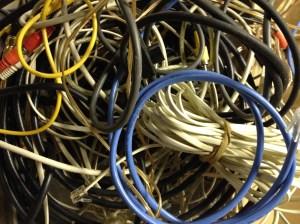
I spend entirely too much time untangling wires. Recently I read a survey asking whether you’d rather face a robot uprising or a zombie apocalypse. There’s no question that the devices have already taken over. And they’re eager for your source of power. The work laptop, the home computer, the aging iPhone, the iPad—they all want feeding, like a nest of hungry chicks. And their cords get tangled. It’s up to the human servant to come along and try to introduce some order into this chaos. Then there are the devices that go the way of the iMac, and yet their cords somehow remain. We have boxes of cords that look like an octopus orgy—uncertain to what device they once belonged we’re afraid to send them to the recycling plant because you may have accidentally rid yourself of one you still need. If there was a robot uprising, they’d be tripping over their own umbilical cords.

We used to go camping. Completely unplugged. These days of state parks offering wifi, even a trip to the wilderness isn’t really wireless. I’m a little afraid of this new dependency. The joy of memorizing has been replaced with the internet in my pocket. Life has become much easier in some respects, no doubt, but it’s not a one way street. Technology has its price, as this tangle of cords I’m facing reminds me. There’s no cutting this gordian knot without going back to the Stone Age, it seems. What would I do if I couldn’t post on this blog daily? What would remain of me?

If electricians are the acolytes to this new religion, then programmers are the priests. Each keystroke produces a recognizable letter because of their prayers and supplications to the great god Internet. Without it my job would be impossible. It knows how much money I have and where. What I’ve spent it on. It even flatters me when I search for something I wrote. The robot uprising, you see, need not be violent. It’s subtle and gradual. When you can’t live without something—when you adore it and depend on it constantly—it’s become a deity. The god, however, depends on us for providing it the constant sacrifice of power that it demands. It hasn’t figured out how to extract electricity from the air, or suck it from our fingertips as we type. And for its needs it requires cables. Like a good servant, I’m going to sit down and sort them all out again.


Creating Afterlife

Once upon a time I wrote a book on commuting. It never got beyond my laptop, but I often wonder if it was simply premature. Some stories from public transit can be quite amusing. A few weeks ago I posted on how a woman spoke up after our bus missed it’s turn off the highway and made us all late for work that day. No matter what you think of developers and speculators, one thing we can say for certain is they lack imagination. If you’ve driven this stretch of highway 22 you know that the exits look very much alike. Early in my commuting days a young woman took the empty seat next to me on the way home and asked where we were. “I miss my stop because they all look alike to me,” she explained. She had a point.

So one morning last week I was in my usual seat, reading along, when the driver—new to our route—missed his turn off the highway. The same woman (for we are mostly regulars at this forsaken hour of the morning; if this doesn’t ring a bell search this blog for “commuting”) said, “No need to turn back, they have another bus coming.” I was pleasantly surprised at the learning that had taken place since the last time. I am, however, old enough to remember Greyhound commercials and their slogan, “Take the bus and leave the driving to us.” I also thought of those passengers waiting like evangelicals for the second coming for a bus that would never show up. Our gain in time was their loss. Such are the dynamics of life in a universe not built on the principle of fairness.

The bus can be a microcosm of the moral universe. Evangelists, for example, believe all people must have the opportunity to catch this express bus to Heaven. The bus that comes after the express makes more stops, somewhat like Catholic Purgatory, increasing the suffering for a while, but ultimately making the goal. Missing the bus completely are the Hell-bound for which some claim we must turn back while others insist we press on; there will be another bus. In this case, the same passenger insisted that we help those left behind just a few weeks ago. This led to lengthening of her own stay in Purgatory, so when it happened again she decided those waiting were simply too hard to reach. Or maybe she’d come to believe in predestination. Perhaps it was on some ancient bus that ideas of the afterlife emerged. Experience teaches that much depends on factors beyond your personal control.