It’s Okay

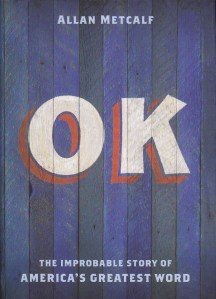
It once seemed improbable that an entire book could be written on one word. The first time I noticed this I was a doctoral student who’d run across the late William Holladay’s published dissertation on the Hebrew word shuv. Wow, I thought, an entire book on a single vocable. One syllable, nonetheless. Thus I was predisposed to read Allan Metcalf’s OK: The Improbable Story of America’s Greatest Word. The justification Metcalf gives for his “greatest word” award is the fact that OK is the most-used word of American origin world-wide. Even in languages with other scripts, there are ways of fabricating the “okay” pronunciation and everybody knows what it means. It’s really quite interesting. All the more so since OK first appeared as a joke. It’s now used by everybody in all seriousness. Just think of what one says to someone who’s been hurt or is ill. Isn’t the first question inevitably, “Are you okay?”

OK, you may be saying, but you say your blog’s about religion. Yes, and I’m getting to that, okay? Along about halfway through the book, Metcalf discusses how OK tends not to be used for products because it suggests mediocrity. An exception was James Pyle’s O.K. Soap back in the 1860’s. One of the ads included this affidavit: “The most intelligent classes in New-York use it. Editors of most of the religious papers patronize it.” I had to smile at that. Religious folk had, and sometimes still have (when they’re not too oily) the reputation of clean living. If you’re selling soap, you’re selling sanctity. It’s a very ancient connection. Anthropologists have shown time and again that purity is a concept that the religious own. Something about being worldly makes you feel like you should take a shower.

And it’s not only soap that makes okay religious. In the concluding chapter that describes OK as an American philosophy based on the “I’m Okay—You’re Okay” transactional psychological school, Metcalf notes we treat religions in just that way. Religious tolerance is saying “your religion’s OK.” That’s a lot to think about, considering that we’re talking just two letters here. And this book was written before the 2016 election, when tolerance was a word Americans were just beginning to understand. Maybe our hope is in getting OK back into circulation. After all, giving national security secrets away to Russia is okay. If you’ve got a Republican majority who’s going to quibble? Even Russians know what OK means, at least when it works to their advantage.

Kindling

Paula Cocozza, writing for The Guardian, describes “How E-books Lost Their Shine.” Like most inveterate readers, she says she has stacks of books growing like mushrooms after a summer rain, in her bedroom. I was working in the publishing industry (I still am, so please take no alarm at my rhetoric) when e-book sales plateaued. Then declined. “Industry analysts” were baffled. I wasn’t. The reasoning goes like this: e-books are light and cheap and amazingly convenient—why would anyone want something different? Those of us who love books know. If you know what I mean when I write “library smell” I’m preaching to the converted. More beguiling than new car scent, that first deep breath when you step into a library takes you places your physical body may never go. All those bodies of books gathered together let off a bouquet that insists you follow your nose to an earthly paradise. I just tried sniffing my iPhone. Nothing. No synapses fired. I’ve read books on it, but have I really?

Studies tend to show we have trouble remembering books read electronically. It’s just too fast. Wham-bam-thank you whoever you are. Let’s get on to the next thing. But books, as Cocozza writes, are slow. Publishing’s a slow industry. You submit your proposal, and the editor reads it. The editorial board discusses it. The book is written and sent to a copyeditor. Then a compositor or typesetter. Then a proofreader. Then it’s off to the presses. Printed, bound, and shipped. It can take a year or more. And when you curl up in bed with a book, furtively sniffing it, gently rubbing your fingers along its pages, drawn into a world not your own, plastic’s the last thing on your mind.

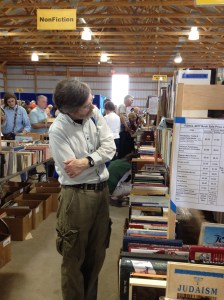
A few Saturdays ago I attended the Hunterdon County Library book sale. I go every year. It’s a big deal. People line up in advance. You step into the barn-like sales floor and it hits you—the smell of all those books. The aroma of knowledge. You can’t repurpose an e-book. You can’t sell it back because nothing was ever really produced. You purchased electrons, you’re stuck with electrons. Hit “delete” when the storage is full. All these books in this room are valuable. All for pocket-change. Many of them were wildly overprinted in the exuberance that naturally comes from being over-stimulated. Like kids about to enter Willy Wonka’s chocolate factory. Industry analysts are puzzled. If they’d get their fingers dirty by thumbing through a used book once in a while they wouldn’t be. Yes, its dusty, grungy, and probably laced with germs, but I wouldn’t trade it in right now for a Kindle, even if it costs me nothing.


Taking Time

Good writing is hard work. One of the mixed blessings of the internet is that it makes publication so easy. Get yourself a blog and nobody has to approve anything! Ideas come tripping across your fingers onto some electronic substrate and, viola! You’re an author! The problem is that being an author’s not the same as being a good author. Writing well (and I make no such claim for myself—after all this is just a blog) is hard work. A piece has to be written, and then read again and again. I’m reminded of the story of a convicted murder whose name I’m forgotten (call it a defense mechanism). This was early last century. The murderer was caught, initially after having been found wandering, disheveled, in public. As a respectable man (he was a doctor, I think) part of his defense was that he’d never have left his house without being presentable. He would have on a collar and hat. People would see him, and he had to convince them of his presentability every single time he walked out that door. (This isn’t an affliction that I share, by the way.) Writing for publication is like that—you need to take care to look respectable every single time.

I can’t speculate about how other writers do their thing, but for me the main requirement for this is time. Any piece that I want anyone else to see, has to be written. Read. Edited. Re-read. And probably edited again. All before the public sees it. This is just for the informal stuff. I’m currently writing a book (which is pretty much a constant state with me). The draft was finished months ago. I started thinking about a publisher. Then I read it again. I couldn’t believe I’d ever thought it was ready for a publisher. Several rewrites followed. I’m in the midst of another one at the moment. I think of it like my ill-used rock tumbler. You want shiny rocks, you’ve got to send them through with finer and finer grit. If you do it right, they’ll come out looking like they’re wet, and they’ll stay looking that way. Polished writing takes time.

Some things can’t be hurried. As a middle-schooler I had a summer job with the school district. One of my assigned tasks was painting bus shanties. Many of these were, as you’d expect, way out in the middle of nowhere. I’d be dropped off with a couple other teens and we’d paint the shelter inside and out. One day I got tired of the constant, boring, and repetitive task of filling a paint pan with white paint, carrying it into the shelter, using it up, and then doing it all over again several times. I decided to pour the paint directly on the plywood floor of the shelter. All I’d have to do would be to roll it out and who’d be the wiser? I only did it once. Little did I consider that the best painting, like the best writing, is a thin layer over the substrate. You need to go over it more than once, leaving time between layers. More importantly, I didn’t realize that you can’t gauge how much paint you need this quick way. The best thing is to run out and refill. Then you can pour the remainder from the pan back into the can. The floor took hours and hours to dry. Not only that, but the top surface dried first, so when I stepped in, I pulled up a thick layer of paint off on the bottom of my shoe. Tom Sawyer I was not. I had to redo it. What I learned that day, though, was a lesson about writing. Take your time. But you don’t have to take my word for it. I just write a blog.


Dog Daze

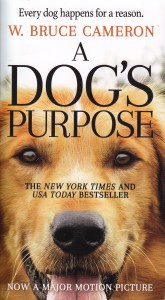
I read quite a bit about animals. One reason is that when you’re counting all the species on the planet we’re pretty clearly among the animal part. Having grown up with many pets, the dogs particularly stand out. We tended to have only one dog at a time and they were so full of personality that it obviously wasn’t a matter of projecting to understand that one was more or less optimistic or joyful than another. Some could be mean while others were loving. There was quite a bit of buzz about W. Bruce Cameron’s A Dog’s Purpose back in January. For Modern Mrs. Darcy’s 2017 Reading Challenge the book fit one of the categories for me, and so I found myself reading about animals again. The thing about buzz is that I listen with only half an ear. I didn’t know much about the book except that it was a novel narrated from a dog’s point of view.

A couple of things struck me as I got into the story. One was that the protagonist ended up still believing that humans were more important than dogs. I suppose there’s some kind of evidence for that, from a dog’s viewpoint, but it doesn’t seem very strong to me. After all, we’ve bred wolves into pugs and cockapoos with an intentionality that even Mr. Darwin would’ve recognized as unnatural selection. Left to their own wolves would’ve adapted, but they’re pack animals and while dogs may think us the alphas, they’re each an important part of the group. They are giving, but that’s the nature of being in a pack. It’s also something that elected officials in Washington could stand to learn. When there aren’t rifles and traps, pack animals prosper.

The second thing that stood out about A Dog’s Purpose was reincarnation. The idea scares me. Life’s been a long challenge this time around and, unlike Nietzsche I’m not sure I could face it this exact way again. In any case, reincarnation only works if there are souls to pull it off. Cameron posits that for Toby to become a fully developed Buddy four cycles of reincarnation are needed. Like a good Platonist, our protagonist recalls the important lessons from each previous life and is able to develop into a more fulfilled dog each time around. The karma here is good. Cameron does seem to “get it” from a human-projected dog’s point of view. It can be fun, and it can be sad. The important lesson, for me, is that animals are who we are and to be a successful pack we need to look out for the good of each other.


Beautiful Beast

Like most kids in America I grew up with some form of Disney. We couldn’t afford to see many movies, but those we could often originated from the acknowledged master of childhood viewing. When I became a parent I naturally turned to Disney as one of the components of constructing a happy environment for my own child. Who doesn’t want better for their children then they had themselves? This was, however, in the days of VHS tapes. Disney frustrated more than one attempt to see a movie that was currently “locked in the vault”—a marketing tool used to glut the already overflowing coffers on demand. The heart wants what the heart wants, as the saying goes, and you knew that if you didn’t purchase the movie when it was available you might never see it again. Regardless, Disney does produce memorable work.

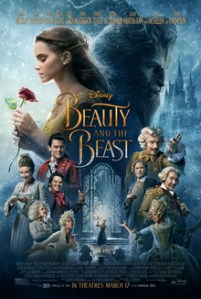
One movie that we missed until the vault unlocked was the animated Beauty and the Beast. We didn’t want to send the message that girls should be the captives of men, but Belle is a strong character, and we eventually realized that withholding much of childhood culture would isolate our daughter from what everyone else knew. Old habits die hard, as Disney knows. Our daughter is now grown, but a new Beauty and the Beast is in theaters and what was once vault material has softened into nostalgia. Recently I’ve begun to notice differences between original films and remakes when it comes to religion. In the new Beauty and the Beast there are only a couple of such instances, but they did make me wonder. In the opening sequence, as Belle is returning her book to Père Robert, a large crucifix stands in the background. Indeed, the camera keeps Belle off-center so as to make the cross obvious in the scene. Clergy and books make sense, and, of course, Belle offers to sacrifice herself for her father—a biblical trope.

When Gaston riles up the angry villagers, Père Robert is once more shown, objecting to the growing violence. Then, unexpectedly, as the castle transforms at the end, a gold finial of Michael the archangel slaying the dragon appears atop one of the towers. Again the symbolism is clear as the beast has allowed Gaston to escape, but the 45-inspired antagonist, unwilling to let grudges go, shoots the beast anyway. As the movie opens the famous Disney castle shows itself topped with that same finial. Is there a deeper message here? It’s just a children’s movie after all. Yet Père Robert is black and there are two interracial couples in the film. We should be, if I’m viewing this correctly, entering into a more tolerant and accepting world. Prejudice has no place in fantasy. Or reality. There are dragons to be slain here. If there is a deeper conscience at play it’s likely only to be found locked away in a vault.


To Whom?

The other day I heard someone use the phrase, “preaching to the converted.” I’ve read enough anthropology to know that regional variations on folk sayings exist, but I’ve always heard this as “preaching to the choir.” What’s the difference, you ask? Actually, these two statements imply very divergent things. It all comes down to preaching. Preaching is what clergy do. (I know I’m over-simplifying, but bear with me.) And where do ministers preach? That’s right, in the church. Aha, you might say, those in the church are both converted and some, anyway, are in the choir! What’s the difference? The difference is the choir has to be there. It’s an issue of volition.

Since this isn’t eighteenth-century New England (at least not yet, although the current administration is trying to make it so) there are no real consequences for not attending church. Many of the converted exercise their God-given right not to worship. The choir, however, has committed itself to being there. They’re more than converted. They’re the faithful. The minister, in other words, doesn’t really need to preach to them at all. Turn this around. Preaching isn’t necessarily to convert someone so much as to improve their lifestyle. Preaching to the unconverted is actually evangelizing. “Evangelizing the converted,” though, just doesn’t have the same ring to it now, does it? Preaching to the choir is applicable to the rest of the church goers who show up regularly. They’re not, however, in the same league with the choir.

I decided to research the history of the saying. It turns out that the original is “preaching to the converted.” The saying originated in England in the 1800s. “Preaching to the choir” appears in America in the 1970s. Perhaps the choir emerged as a new ecclesiastical force in twentieth-century America. Some of the clergy I know would certainly agree with this assessment. They’re really a smaller subset of the converted, after all. The committed converted. Of course, it’s a distinct possibility that I’m spouting nonsense here. If that’s the case, I’m probably preaching to the choir.


Interior Theodicy

Photo credit: Richard from Canton, Wikipedia Commons

Speaking of theodicy, I have a dentist appointment today. Now, if you were raised with the Protestant guilt that used to be so pervasive in this nation, you’ll understand. I do brush my teeth twice a day. I even use floss and that mouthwash that burns away a layer of mouth lining every night. But there’s always more you could do. I’m not particularly good about visiting the dentist, though. Partially it’s a memory thing, partially it’s a pain thing, but mostly it’s a time thing. No matter how far back I jam the toothbrush, well beyond my gaging threshold, cavities seem to appear. And I don’t even have a sweet-tooth. What kind of deity allows cavities in a person who eats very little sugar and brushes so assiduously that last time the dentist told him to ease up a bit since he was scraping away the enamel? (People tell me I’m too intense.)

One of the real ironies of all this is that for all the trouble teeth give us during our lifetimes, they are our most durable parts after we die. Archaeologists find mostly teeth. In fact, it seems that Neanderthals might have practiced some primitive dentistry. I wonder what they thought of their neanderthal deity? So teeth are pretty useful, no matter whether the gray matter above them is dead or alive. I can explain this to my dentist, but he only seems interested in me as a specimen of carnassial curiosity. Maybe it all goes back to my belief that fillings were meant to last forever. Or all those root canals that seem to come in pairs that cost as much as a semester at a public university. Mostly it’s the memories.

In Edinburgh I had a tooth go bad. The Scottish dentist was surprised. “You’ve got a twelve-year molar erupting,” he said (you’ll have to imagine the accent). I asked if that was unusual. He owned that it was as I was a post-graduate student in his late twenties and the twelve-year molar was so precise in its timing that child labor laws used to be built around its presence. Years later in Wisconsin a different dentist asked about one of my fillings. I told him it was from Edinburgh. He called all the other dentists in announcing, “You wanna see a real Scottish filling?” Or maybe the fears go back to my earliest dental nightmares where the cheap doctor seemed unaware that teeth actually had nerves in them. I always left with a guilt trip. “You should brush —“ (more, better, longer, with a more gentle touch) you fill in the blank. I’m afraid of another kind of filling. And I know as it is with Protestant guilt, so it is with teeth. There’s always more you could be doing.


The One Who Seeks

Academics and social media are, at times, an uneasy fit. In my work as an editor I come across many of the professorate who have virtually no web presence at all. If you’re wanting to write a book these days and you aren’t yet famous, you need what they call a “platform.” That is to say, you need to be easily found on internet searches, you have to have “followers” on various social media, and people have to know where to look to find information about you. A starter site that does fairly well is the for-profit venture called academia.edu. Because of that final “edu” extension, many suppose this is an educational site with no money in mind, but that’s not really the case. Still, it’s free to post your academic papers there and many intellectuals, public and otherwise, have vested some of their effort on getting academia followers.

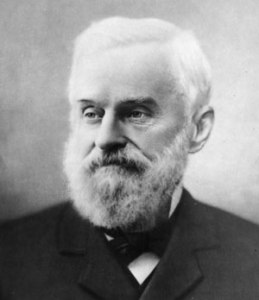
J. C. L. Gibson, someone, and Nicolas Wyatt

My own profile on academia, which has copies of most of my papers available for free downloads, at one time was in the top 2%. I felt so special. Being kept out of academia for so many years, one does begin to wonder. In any case, one of the features of the site is that when someone lands on your page you receive a notice telling you how they found you. More detailed information is available for a fee (this is one of the not not-for-profit aspects I was mentioning). Sometimes they will provide you with the search terms used and the paper found. My site has quite a bit about Asherah. I wrote a book on the goddess, still largely overlooked, and several discrete papers. The other day I received a notice that someone found my page with this notice of how:

Someone from India found “A Reassessment of Asherah:…” on Google with the keyword “sex photos hd com R A N ilaku.”

I have the feeling someone left my site keenly disappointed. Although my book does discuss sexuality a little—you kind of have to with Asherah—I did wonder about the “photos” and “hd” and “ilaku” parts of the equation. You must be pretty desperate in your pornography quest to stumble across my academia page. Not that I’ve replicated the search, but I must be thousands of pages down in the results. Still, someone found my first book that way. And that’s the lesson—an internet platform may bring your work unexpected fame. Whether or not that fame is ill, will, however, remain an open question.


Non-Lending Library

One of the hidden benefits of the coming societal collapse is the chance for the resurgence of print books. Since I’ve spent most of my life surrounding myself with volumes thick and thin, dense and light, I’ll have plenty to read between bouts of skulking out for food like a feral cat and clawing off those who follow me home, thinking that it’s edible stuff I’m stockpiling. Won’t they be surprised to learn it’s only books! My wife sent me an Atlas Obscura story the other day about book curses. The description of the life of a medieval scribe sounded oddly compelling to me—hunched all day over a writing desk, copying books by hand. Not having to worry about catching the bus before sunrise or being too tired to answer your personal email in the evening. The point of the piece, however, was the book curses.

I’ve been an avid reader since moving to a small town where the main occupation of kids my age was recreational drug use. I was one of the very few who didn’t inhale. Reading became my escape from the loneliness I felt. And I used to lend books to people who’d ask me. I quickly learned that others didn’t share the same care for books that I had. Lent books seldom made their way back to me. We were poor and there were no bookstores nearby and Amazon wasn’t even a meme in Jeff Bezos’ eye yet. Replacing books wasn’t easy. Once I lent out a book I’d already read (but you couldn’t tell it, I’d been so careful). The borrower actually did return it, but the spine was all creased and cracked so that you couldn’t even read the title anymore. I soon began to regard books like those medieval monks who put curses on them so nobody would steal them. I stopped lending them out.

The thing I’m banking on is that books will retain their barter value when society implodes. Of all possible universes only in that one will I be considered wealthy. Those who visit our little apartment inevitably comment on the number of books. What they don’t realize is that there’s a strategy involved here. Like those medieval monks, I have a suspicion that knowledge—including facts that don’t have alternatives—will one day in our dystopian future be valued above all the tweets and lies Washington seems to suggest we follow blindly. And blindness will make a great curse, now that I think about it, to protect these books from being stolen. Or “anathema-maranatha,” as my medieval mentors used to say. Or as Sarah Laskow ends her piece, “May whoever steals or alienates this book, or mutilates it, be cut off from the body of the church and held as a thing accursed.” Maybe this isn’t so strange for a guy whose first academic appointment was at a school that reminds many of The Name of the Rose. (Which was the last book I lent out, for the record.)


Neologism

I like a good neologism as much as the next guy. Oxford English Dictionaries recently released a covey of new words added to the famed lexicon. Most of them, it seemed to me, had to do with dangers of technology, like “drunk text” and such fare. Still, increasing vocabulary is one of those rare joys in life that is continues to be free, so I indulge. A friend sent me a BBC story about another new word: champing. Well, my spell-check recognizes that one so maybe it’s not new. In any case, this champing is derived from two words “church” and “camping.” Some locations with medieval churches—which kind of rules out anything on these shores—are now opening them up as camping spots, thus church-camping. The article asks what it’s like to stay overnight in such a place.

Growing up in western Pennsylvania, medieval churches were hard to find, but I spent more than one night sleeping in sacred spaces. It’s an uncanny experience. In what may have been more innocent days, our United Methodist Church allowed youth group sleepovers, as long as there were counselors present. (Ever naive, I only learned later that there were ways around such obvious strictures.) On a Friday night, then, we could occasionally gather with our sleeping bags and slumber under the sanctuary. For theological reasons we couldn’t sleep in the sanctuary itself (although that couldn’t be prevented on the occasional very long sermon) but we could go in. Churches are scary at night with the lights out. We may give lip service to holy ground, but large, cavernous spaces suggest so much by absence and implication that it would take a stout soul indeed to sleep there.

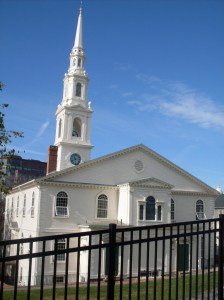
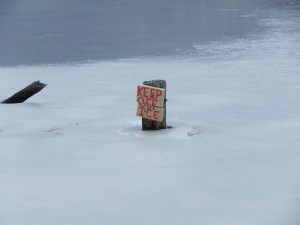
Looks okay from the outside.

Sleeping in sanctuaries in ancient times was an acceptable practice. In fact, there’s a name for doing so: incubation rituals. A person who slept in a sacred place believed any dreams had that night were a message from God. Knowing the dreams I tend to have, I do wonder. Once, at the United Methodist camp called Jumonville—famous for its large white, 60-foot, metal cross visible in three states—we counselors (still naive) had our charges sleep outdoors at the foot of the sigil on the bare top of the mountain. In the morning my champers gleefully informed me that I’d been praying in my sleep. “You kept saying ‘Amen. Amen,’” they told me. Alas, I don’t remember the dreams of that night. Perhaps when I find a medieval church on my journeys I’ll be brave enough to try an incubation ritual once again. This time I’ll take a tape recorder.


Ready, Ames,

Ames, Iowa is famous for many things. Not only is it where my wife grew up and where we were married, but it’s also the home city of Howard Bannister from What’s Up Doc? and it served as the staging ground for the crew of Twister, which includes some scenes shot in the area. Probably its greatest claim to fame, apart from the sadly defunct Do-Biz Cookies, is being the location of Iowa State University. Often I lingered near campus during family visits, wistfully hoping that someday someone in the religion department would welcome me among the faculty. My academic curse, however, is a powerful one. And that brings me (finally!) to the topic of this post—the haunted history of ISU.

Even the first president had a biblical name.

The website onlyinyourstate (we’re evolving out of the need for a spacebar) has a whimsical story about the hauntings on ISU’s main campus. The story isn’t scary at all, but it does raise that interesting specter of the ghosts of higher education. I’ve read a few of Elizabeth Tucker’s books about haunted campuses (Tucker teaches at another family school, Binghamton University) and, having spent a good deal of my life in academia, I’ve heard many tales first-hand. The very institutions that repeatedly bash our heads with facts can’t escape their own spooky pasts. Even conservative Christian Grove City College had its share of hauntings that we all knew about. You know, the Ketler ghost, and the spirit of the basketball player who broke through a glass door and bled to death right there on campus? Every campus I’ve known has had its baleful wraiths.

Sometimes I wonder if such stories aren’t a natural reaction to having the wonder excised from the world as we mature. Most of us can make it through high school somehow believing in the real possibilities that the world might offer, only to graduate from college to a 9-to-5 existence robbed of any supernatural splendor at all. Is it any wonder coeds see ghosts? Just the other day I read that a tree trimmer with a high school education in Iowa makes a much higher salary than I do with a Ph.D. working in New York City. Maybe that’s why I enjoy the movie Ghostbusters so much. When the reality of higher education and its politics and cruelty become clear escapism can be your best friend. And if you find yourself in Ames, you might want to avoid Friley, just in case.


Ode to Zibaldone

Scribbling. All it takes is a margin of an agenda paper or the back of an envelope. I don’t remember when I started doing it—I’ve been writing my own blend of fiction, facts, and philosophy since I was in elementary school—but I would find a relatively clean piece of paper, fold it up, and put it in my pocket. I’ve carried a pen around with me for decades. Why? You never know when an idea might strike. There’s nothing like the discovery of a new idea. Lifelong learning is like that. So it was when I was reading Lemony Snicket’s Series of Unfortunate Events to my daughter that I learned about commonplace books. A commonplace book is a notebook where you jot all kinds of things down and you know where they are, unlike that piece of paper in my pocket that long ago started to rip apart at the folds, the ink becoming illegible as the paper grew softer and more pliable. A commonplace book seemed like a great idea.

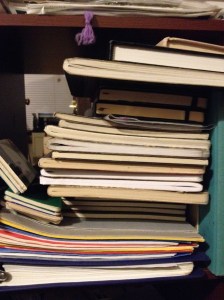
This all came back to me when a friend send me a story on zibaldones. I’d never read the word before. A zibaldone, according to the story by Cara Giaimo on Atlas Obscura, is an Italian commonplace book. They used to be part of every thinking person’s accoutrements. A blank book where you could write down anything of importance. Giaimo suggests that the internet has taken the place of the zibaldone—blogs, Facebook, Twitter, Pinterest—we’re spoiled for choice where to put our thoughts. I still carry a commonplace book, however. Too many, in fact. Next to my writing chair rests a stack of notebooks. There’s one for each non-fiction book I’ve written, whether published or not. There are several filled with fiction. Some with poetry. My most recent zibaldones are Moleskines, which I purchased—as many as I could afford—when Borders sadly went out of business. Ideas. They just keep coming.

Some of my notebooks.

Some of my notebooks.

Perhaps the greatest benefit of the zibaldone is that, if one survives, an historian gets a glimpse at what someone who was not famous saw. Observations about the world scribbled down. The most proficient of scribblers organized their commonplace books in advance. As for me, I still scribble things on scraps of paper. I carry a notebook and pen at all times, but sometimes an idea is so slippery I don’t have time to pull a formal zibaldone from my pocket. I tape scrapes of paper into my notebooks. Right next to new words I’ve learned. Somewhere among today’s scribbles you’ll find the word zibaldone along with the hope that some day some of this might be significant.


An Anatomy of Lies

I had an email from Mike Pence. Mike Pence doesn’t know me from Adam, but if he met me he surely wouldn’t like me. His email tried to explain, in tottering logic, why he voted for Betsy DeVos. When I finished wiping the vomit from my mouth, I began to think about someone America needs again: Mark Twain. I’d just been reading about some of Twain’s classics and I recalled his famous quip (which he attributed to Disraeli): “There are three kinds of lies: lies, damned lies and statistics.” We now live in an era so surreal that it requires a fourth kind of lie: alternative facts. Government communications are full of them. Not one word from the White House can be trusted with the common decency that you’d attribute to a Boy Scout innocently helping an elderly person across the street. One hand is held out for you to shake while the other is picking your pocket.

The volume of the lies has grown louder. I’m sorry Nigel Tufnel, but this amplifier goes up to twelve. Some time back I blogged about the overuse of superlatives. When everything’s the ultimate, nothing’s the ultimate. We need a new anatomy of lies to apply to our Addamsesque government. Since the only people who believe in Hell are the ones who elected Hell’s own party to the White House, you can’t even tell them where to go any more. There was a day when telling someone to go to Hell brought real consternation. These days all you have to do is buy a ticket to the District of Columbia. People listened to Mark Twain. Here was an educated southerner who told the truth, no matter how fictionalized. Truth no longer exists, and I should just get over it. Problem is, the country I was born in now only supports the rich and I can’t afford to live in a cardboard box.

We all know what a lie is. If we’re honest we’ll all admit to telling one once in a while. All humans do. Damned lies are those we used to condemn. The exegesis of the word “damned” these days is perhaps euphemistic for “good for government.” Statistics, as 99 percent of people know, are made up. Then come “alternative facts.” Even after being called out repeatedly for making things up, Sean Spicer, Kellyanne Conway, and now even Mike Pence, continue to rationalize their own reality.

Mr. Clemens, what do you call fabricated detritus so filthy that “lie” is hardly adequate to make an impact in its dense, brown verbiage? The kind of thing we might expect from an individual incapable of distinguishing truth from fantasy? Don’t take it personally, Mike, but I’ve assigned you to my SPAM list. You’ve just been made an alternative fact in my personal reality. How’d you even get my email address? Mark Twain may have been a pen name, but his fiction was fact. He was a man ahead of his time.

Image source: Qwertyxp2000, Wikimedia Commons

Image source: Qwertyxp2000, Wikimedia Commons


I’m Saying Nothing

It used to be called argumentum e silentio, the argument from silence.  It didn’t take very long into my post-graduate reading to learn that arguments from silence were very rarely admitted in the academy as any kind of evidence at all.  In fact, argumenta e silentio are generally considered a logical fallacy.  The idea is fairly simple: an argument from silence is when a source (often an ancient one) doesn’t mention something.  That lack of mention is sometimes used to argue for the absence of the thing not mentioned.  For example, some first century writers in the region of Roman Palestine did not mention Jesus of Nazareth.  This has led some to suggest that Jesus never existed.  The evidence is an absence of evidence on the part of certain important historical figures.  There are obviously lots of problems with this.  I’m a modern person and there are plenty of people I never write about.  It doesn’t mean that I don’t know who they are (although in my case, it might!).
 
Why am I concerned about arguments from silence?  Lately I’ve noticed quite a few scholarly tomes coming out on the topic of silence.  I’m not referring to Susan Cain’s excellent Quiet, but to scholarly monographs that explore the silence in ancient texts about certain subjects.  In my more curmudgeonly moments, I feel that perhaps when we have nothing left to explore but what a text doesn’t say maybe we’ve explored that text enough.  Younger scholars, casting about for something new to say about the Bible, look to what ancient sources don’t say to give them a research topic.  Back in my own academic days you’d receive a stout scholarly rap upon the pate for even including an argument from silence in your thesis.  Now you can write entire books about what someone didn’t say.  What’s more, you’ll likely find a publisher.
 
I’m at times a bit fearful for the future.  Although my academic work approached the Bible critically it wasn’t because I didn’t like or didn’t respect the Bible.  Hey, it’s far more famous than I’ll ever be, and in fact, more people have heard of it than have even heard of Trump with his endless tweets. No, the Bible is an endlessly fascinating book.  It’s just that if you can’t find something to say about it, why write about what ancients didn’t say?  Maybe it’s time to move on to a sacred text that hasn’t been probed for a couple of millennia.  I have no vested personal interest in this, having been excluded from the academy by biblical literalists and having had the rest assent to that decision by silence.  Ah, but there’s the rub.  That phrase, by the way, doesn’t occur in the Bible.  I wonder if that’s significant.

dscn4370


System Reboot

I think Steve Bannon has already taken over my computer. How else can I explain everything stopping in the middle of a word, fingers flying, building up to some rhetorical flourish and suddenly the screen goes blank. Windows that I’d forgotten I had open reappear only to shut down. A brief message appears telling me that an “update” is being installed. I don’t mind do I? After all, it’s the middle of the night. Who’s watching in the middle of the night? We all know who the real president is, but why he’s interested in my muddled musings is anybody’s guess.

You see, I live a regimented life. You have to when your bus arrives before 6 a.m. I crawl reluctantly from my bed at 3:30 for one purpose only—to write. The commute and work take about 14 hours of the 24 I’m allotted every day, and I’m told that 8 of the remaining should be for sleeping. That doesn’t leave much time. So I skimp on the dozing part and get up to scribble my thoughts when, traditionally, demons are a-prowl. I need my computer to be with me on this. Kind of difficult to post on a blog without it. Not that I enjoy my early morning violence to the soft fabric of dreamland. My fellow early morning commuters know what I mean. Every day there’s a car just pulling up to some bus stop as the driver’s put on his blinkers, indicating he’s pulling out. I know some folks roll out of the bed, into the shower, and onto the bus. Some continue their sleep on the bus. I can’t blame them. I’m Manichaean about my day. It’s either asleep or awake. I don’t nap, so I need to write when I’m most awake. Just after 3:30 a.m.

How do I know it’s Steve Bannon? It’s only a guess really. I’ve heard that Mark Zuckerberg and Bill Gates keep a piece of opaque tape over the camera of their laptops. Why anybody’d want to see a confused, morning-headed, middle-aged guy with his mouth hanging open, wondering what’s just happened to the blog post he was writing is beyond me. But then I’m no expert in national security. In this year of 1984 we’re all threats to the powers that be, I guess. Thing is, I can’t remember what I wanted to say once the laptop restarts half an hour later. And that’s probably the point.

Image credit: Nirwrath, Wikimedia Commons

Image credit: Nirwrath, Wikimedia Commons