Who’s to Say?

Stereotypes are so easy to fall into. Having been “typecast” myself, early in my career as a “seminary professor” and a “conservative”—neither of which matched my mental outlook at all—I eventually had to abandon higher education as a career option. Why did I take a job that didn’t fit? If you’re asking that question, obviously you missed the 1990s. It was a brutal time to be looking for a job; there was this recession… wait a minute. What decade was I writing about again? In any case, many people will always remember me in the various roles I’ve played as I sought to actualize my ideal career. It is always interesting to see how others break out of their expected roles into new venues. Penn Jillette of Penn & Teller has established a reputation for speaking his mind. To those with limited experience, such as myself, he is stereotyped as a “magician,” more specifically, a “bad boy magician” who gives away the secrets of the guild. To find out that he is a writer was a kind of epiphany.
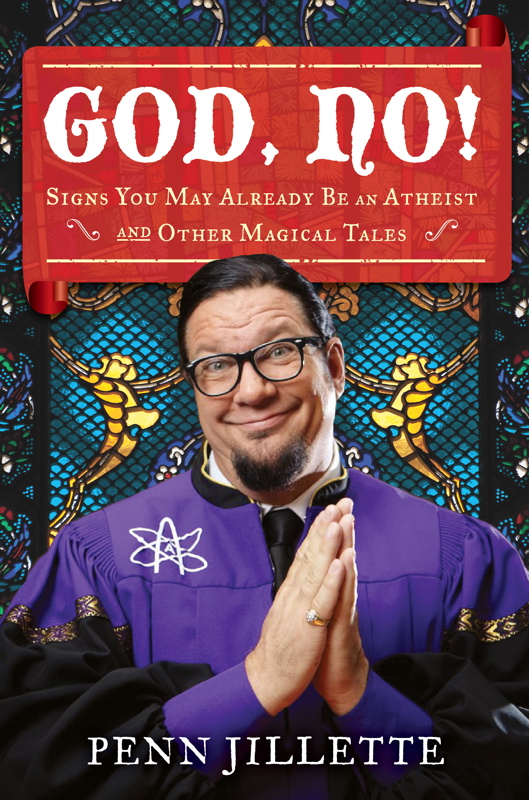
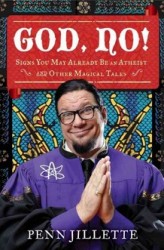
I read his new memoir/confession, God, No! this past week. I’ve always been cognizant of the strangeness of a world where someone may speak authoritatively on the basis of star status, but Americans love their performers. I’ve enjoyed the Penn & Teller acts I’ve seen on television, and after reading Penn’s book, I think I would like him in person. I can’t agree with him much of the time, but his honesty and good moral sense are very winning. I seriously cannot remember the last time I read a book that made me snort out loud with laughter or try to sink even lower on public transit so the polite person sitting next to me would not be able to see all the profanity on the pages before me. The book itself very loosely follows the Ten Commandments, which, surprisingly, the author largely agrees with in principle. The essays are all over the place, but the libertarian spirit is difficult not to admire. His appreciation of rational explanations for the world is admirable.

Probably the most difficult point of agreement for me, however, is his definition of an atheist as anyone who do not know if God exists. He does have a chapter lambasting agnostics, but as a stickler (as much as anyone in religious studies can be a stickler about anything) for definitions, it is useful to distinguish atheism and agnosticism. Saying one does not know is not the same as declaring one is certain. Since the existence of God can be neither proven nor disproven, those who say God does not exist believe that assertion. Those who say God exists also believe their assertion. Objective knowledge, in our current state, is not possible. I had to agree, in the final chapter, that faith causes most of the problems we find associated with religion, but I’m afraid faith is a huge part of the human condition. God, No! is not for everyone. Those who read it will, nevertheless, find an author as convinced as any evangelist that he’s right. And if they are honest, they will have to admit to having laughed along the way.

Moosechief

The moose, depending upon which standard you use, is either the largest or second largest known land animal in North America. This aspect of the moose, as well as its general docility, has often spurred me to the northwoods in search of the elusive beast. Those of us with few tracking skills, however, often must be approached by the greater party rather than finding it. My trips to Maine have seldom yielded moose, but in my periodic forays to Idaho the creature sometimes makes an appearance. This past summer I spotted two of them in the west. In their ungainly way they are beautiful animals. Large they may be, but intelligence is not a necessary corollary to size.

Moosing around.

From about the 1840s, up to its formal passing into law in 1919, prohibition ranked high in the list of evangelical Christian concerns. A distinctly Protestant issue—Catholics still recognized that any tipple good enough for Jesus was good enough for them—the outlawing of alcohol was understood to be in keeping with the Gospels. Some groups even suggested that Jesus had been quaffing Welch’s, or the first century equivalent thereof, rather than Mogen David (the shield of David, after all). Latest research seems to indicate that fermentation was known before the Sumerians ever appeared, and we all know what happens when cavemen have too much to drink. Strangely, this became a religious issue along about the time Fundamentalism began to appear. But Fundamentalists considered neither the practices of Jesus nor the moose.

A story in today’s New Jersey Star-Ledger concerns a moose in Sweden. Known for their liberal social values, the inhabitants of Sweden are often presented as champions of free lifestyles. A moose near Gothenburg apparently had trouble steering herself after eating several fermented apples that had fallen from a tree. The inebriated moose lodged herself in a tree fork. The rescue involved bringing a crane to the scene to release the trapped, and slightly disorderly, animal. Such a story makes me wonder if prohibition should not be among the laws of the jungle. After all, the observation of nature often calls the certitude of many religious doctrines into question. If God prohibits alcohol, we might rightly wonder, why are there moose in Sweden sleeping off a hangover?


The Truth of Ghosts

Strange noises in the night. Objects moving of their own accord. Disembodied voices laughing fiendishly. It must be nearing autumn. After having a brief discussion on novel writing with Brent Monahan earlier this summer, I decided to read his book, The Bell Witch: An American Haunting. Setting the story in the “found manuscript” genre, Monahan tells this famous account through the eyes of Richard Powell, one-time elected official in the Tennessee House of Representatives. The can be no doubt that the story has some basis in actual events, but the serious study of “ghosts” is a taboo that serious scholars break at their own peril. On my long bus rides this week I read Monahan’s version of the story as the rain continued to fall. As I read I was continually reminded how dependent we’ve become on genre labels. The book purports to be an eyewitness account and there is no genre declaration on the back cover. The Library of Congress Cataloging in Publication (CIP) data declares it fiction. Where is truth to be found?

Human beings are capable of great and terrible acts. Working in a city the size of New York after having been raised in small towns, the amount of distrust is very blatant. Security is evident in many places with cleverly locked doors and guards surveying those who enter buildings. We simply can’t trust everyone. Or anyone. When it comes to literature, stories often blend fact and fiction. Guidelines on books or classifications in bookstores help us to decide if our reading material is conveying actual events or not. The Bell Witch is one of those reminders that sometimes the truth will never be known. Historical records can be searched, but even these are often subject to human error. If someone tells us a ghost story, we base the veracity on the teller’s reputation. At the end of the day, sometimes we just can’t know.

Perhaps the most poignant aspect of Monahan’s version of these events is his reconstruction of the history. Although the supernatural remains intact at the end, Powell is able to uncover the “fact” that Betsy Bell was abused as a child and that the poltergeist-style events that pervade the story are an extension of her trauma. Actually, the treatment is very closely tied to the religiosity of the Bell family, good church-going folk who ran afoul of a fine point of church teaching. In the end, it is this rejection by the church that pressures John Bell to the point of incest. Is the story true? Yes. Did it every really happen? Probably not. The two are very different questions. In a society that increasing seeks easy answers, stories like this remind us that we are all a blend of fiction and fact. Easy answers are inevitably wrong. The movie An American Haunting once again revived “the Bell witch” but also raised the specter of the ambiguity of truth. Is it out there? If it is, how will we know when we’ve found it?

What really happened here?


Biblical Muppets

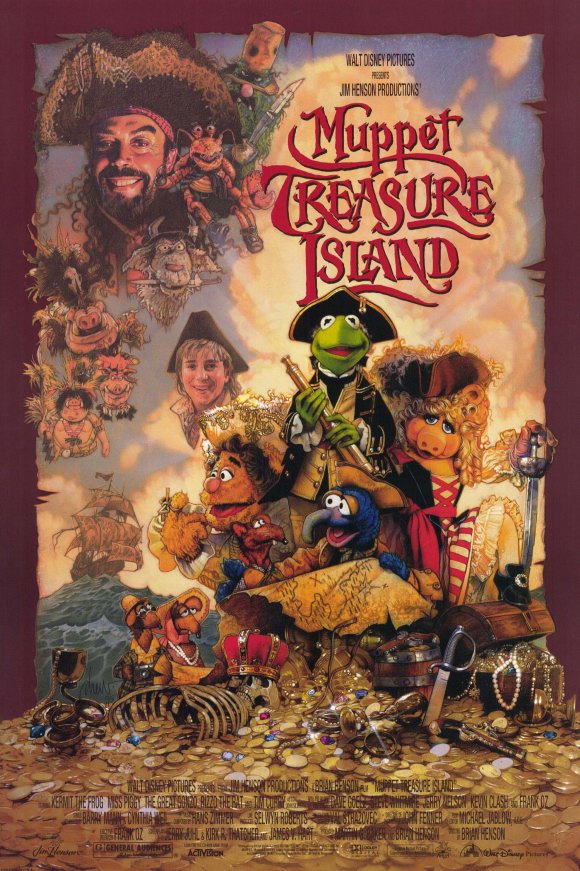
Back in the days when I was teaching intensive summer courses, I frequently used movie clips to help break up the three-to-four hour class sessions. I would find movies in which the Bible featured in what I’d call a minor supporting role—almost as a character—and would try to get the class to discuss it. One of the immediate observations is that such an exercise is starved for choice: the Bible appears frequently in films, both secular and religious. Sometimes its role is pivotal, at times incidental. Last night as my family prepared to return to work and school, we watched a movie to say goodbye to summer. The movie was Muppet Treasure Island.

Like most children of the 60’s I learned about Muppets from Sesame Street. By the time I was a teenager The Muppet Show had emerged on prime-time. Before long Muppets made their way onto the silver screen. Muppet Treasure Island was a movie I had missed until my daughter saw it in primary school. I have used it as an example in my summer classes for years. The story follows, as faithfully as Muppets can, Robert Louis Stevenson’s Treasure Island. Tim Curry—selected for Long John Silver because of his fame in the Rocky Horror Picture Show—makes a believable singing pirate. In this version of the story, when the pirates reach Captain Flint’s treasure it has been absconded by Benjamina Gunn (Miss Piggy). The pirates, now guilty of mutiny, give Long John the black spot. (For a generation raised and weaned on Pirates of the Caribbean, the black spot requires no explanation.) Long John, playing on the superstitious nature of the other pirates, sermonizes them because they used a page of the Bible to draw the black spot. Terrified of this sin, the pirates beg Long John for forgiveness.

This is a textbook example of the Bible acting as a magical book. Often in the movies it functions in that role; the Bible has the invisible authority to bring mortals to their knees. Pirates in need of paper might dismember any other book (I might suggest Going Rogue: An American Life), but the Bible is itself sacred. This particular role for the Bible reflects American sensibilities about the nature of religion particularly well. Without ever reading the Bible many people venerate it as if ink on paper is a little piece of God. There is a grain of truth in that, for literacy is a little piece of God and books do guide us. The problem is limiting that role to one single exemplar. Perhaps after all the Muppets shall guide us to a deeper truth.


Secret Life of Language

I recently met with a friend to catch up on several years of silence. Increasingly I’m discovering the wisdom of those I’m privileged to know—perhaps it is the shedding of a purely academic way of learning. We all share in this very human voyage of discovery. This particular friend presented me with an idea that I just can’t dismiss: what if language is a living entity, existing in its own world but intersecting with ours? In a symbiotic relationship, we use words and they help us to survive and advance. This friend is a writer, and like all of us who attempt the art, knows the joys and frustrations of dealing with words that can elude but also fall subtly into place forming a poem or story of sublime beauty. We haven’t fully tamed language, but it defines us. Even my feeble attempt to replicate his fascinating idea is fraught with difficulty, for language won’t be relegated to the page, whether of paper or of electrons.

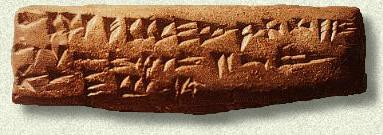
Language evolves along with us, helping us to express concepts that defy explanation. I recently read of the disappearance of three of our alphabetic letters in English. Alphabets, beginning with the earliest complete exemplar in Ugaritic, contain roughly thirty members that may be combined to replicate, in facsimile, the sounds we make. Different cultures use differing sounds; letters that represent those sounds require symbolic representation. Not all alphabets are created equally. One of English’s missing letters is “ampersand.” I always wondered why when I learned the alphabet the song ended with “W, X, Y and Z”—why the “and”? “Ampersand” was part of the alphabet in the early 1800s. Students sang “X, Y, Z, and per se and.” “And per se (‘by itself’) and” eventually ran together into “ampersand.” Over time it fell out of our rank of letters. As the runic Anglo-Saxon that gave us English was absorbed into Latin characters, the Teutonic “thorn,” or th sound, went extinct in our alphabet as well. As any student of German knows, “th” has distinct pronunciations in Germanic languages. It has its own letter of the alphabet in both Arabic and Greek. Since the Latin “y” resembled “thorn” the letter was replaced by ye olde “y.” The archaic letter “wynn” looks like a flattened “p” but was pronounced as “w.” As Latin superseded runic forms “wynn” was written as a doubled “u,” literally “double-u,” which, in Latin was scripted with a “v” shape. This gives us the anomalous W written with what looks like two “v”s.

The alphabet, second to writing itself, is perhaps the most important invention that humans have devised. The alphabet made writing much easier to learn and with writing ideas could be preserved for centuries and could be sent vast distances without changing. Writing allows us to stand on the shoulders of giants. As the school year is beginning again and kids everywhere feel the strain of losing the freedom of summer, I think back to the purpose of education—teaching our young to read, write, and calculate. Language has been guiding us all along. It may evolve, shed a letter or two, frequently grow by taking on entire new words, but it still cradles us as we struggle to find the perfect expression. We should take a little time to get to know our own language better, for without it we are merely biological entities.

An Ugaritic abecedary


Glass Act

One of the main cultural Meccas of central New York state is the world-renowned Corning Museum of Glass. I recall visiting the museum three decades ago, as a child. Since then the museum has continued to expand and diversify its programs and displays. The Corning Museum of Glass is perhaps the greatest collection of art glass in the world. The history of glass is laid out chronologically, and along about the Middle Ages, religious glasswork comes into fashion. Some of the pieces were manufactured as intentionally religious artifacts. Others acquire a religious significance through less orthodox means.

Traditional religious glass

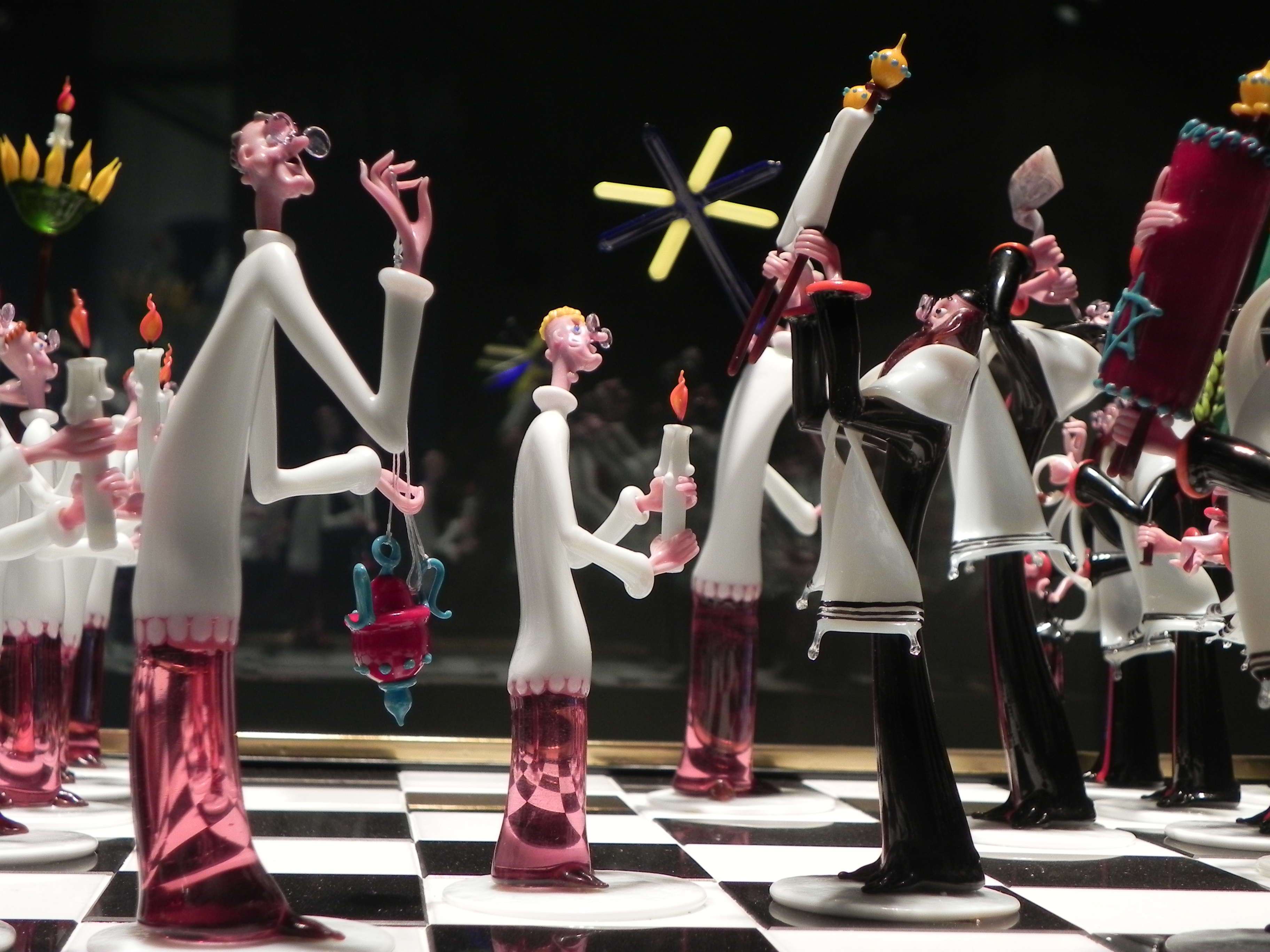
Near the end of the display is a piece by Gianni Toso, done around 1981. Entitled “Chess Set,” the glass sculpture features Roman Catholic pieces facing off against Jewish rabbinic pieces. The sculpture is intended to be comic as the expressions and the postures of the figures clearly indicate. Each piece bears some symbol of their faith: thuribles, lulavs, crosiers and Torah scrolls face off against one another, each side wearing unmistakable looks of superiority on their faces. Countless hours obviously went into the fabrication of such an intricate piece, and as with most art, it contains a serious message.

Toso's Chess Set

The figures here may be Jewish and Christian, but they could really be any religious traditions. The concept of putting them into a chess match is an inspired commentary on the constant struggle for superiority among religious traditions. In a world of differing religious outlooks, and where such outlooks are taken with deadly seriousness, no one is willing to relinquish religious superiority. The aggressors are difficult to discern since, as in life, any true believer must be a kind of missionary.

Toso's face-off

The medium of an artwork also makes a statement about its subject. Glass is a difficult medium to manipulate. Since it often must be very hot, the artist is familiar with the burns that accompany such intense heat. Glass produces a superior shine as an artistic medium, but it is also very fragile. Like the conflict presented on this chessboard, the religions behind it bear the limitations of the medium: they shine at times, yet they can also cause severe burns. And above all, they are fragile.


Religious Democracy, Media Style

A delightfully witty book review appeared in yesterday’s newspaper introducing Penn Jillette’s book God, No! Signs You May Already Be an Atheist and Other Magical Tales. Having just learned of the book I’ve not yet read it, but I am intrigued. Penn Jillette is best known as the talking portion of the magic-debunking duo Penn and Teller. Having forged a career of exposing false claims to the supernatural mystique of stage magic, Penn and Teller delight in bucking the orthodoxy of the guild and showing that anyone clever enough can fool many people into believing what they know can’t be true. They are exploiting, of course, a phenomenon that neuroscientists have been exploring for a number of years: human brains retain belief even in the face of disproving evidence. Many religious believers call it “faith.” According to Hank Gallo, author of the review, Jillette uses his book to endorse atheism as the only real option for a thinking person. The book is generally categorized as humor.

Although Bill Maher’s Religulous makes many good points from a similar perspective, one of the haunting realities poised for religious specialists is almost a chiaroscuro with excessive contrast. It takes no special training to be a religious specialist. That is hard news to hear for those of us who’ve spent over a decade of our lives and thousands of dollars learning the trade. Comedians and others who are famous will impact far more people than this little blog ever will. Rick Perry can call together thousands to pray to pave his way to the White House. Maher and Jillette can poke fun at religious yokels and scholars will sit at their desks ignoring the crude efforts of those who have no training. There is no doubt, however, as to which will reach a wider audience.

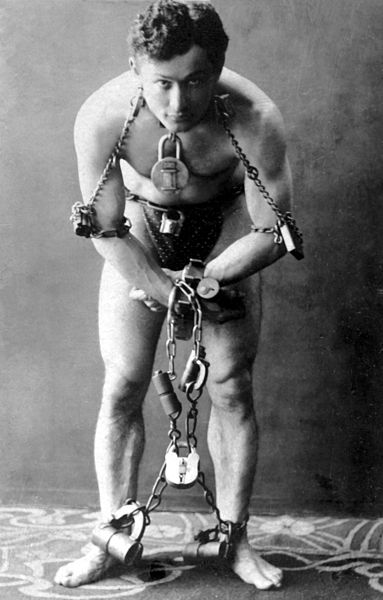
Harry Houdini famously debunked spiritualists in his day. Like Penn and Teller, he was a stage magician who recognized that people could be easily fooled. He was able to expose mediums that scientists and academics of his day failed to uncover. It seems that those with access to the most basic of human desires—the will to believe—gain credibility more readily than an erudite yet obtuse specialist with several odd initials after his or her name and several obscure books to his or her credit. Those in the media have direct access to the mind of the public. If the tent is big enough the whole town will show up for the circus. The truth may be out there, but the minds of the public are won over by those who entertain, not those who bury themselves in dusty tomes and seldom see the light of day. The fact is people want to believe. Until a better alternative is offered, we might prepare ourselves for a long round of Texas Hold’em and a Tea Party or two.


Six Red Flags

Answers in Genesis’ biblical theme park with its life-sized ark was back in the news yesterday. Journalists just seem to be fascinated that people really do believe in their religious convictions. Having grown up in a religious family, I understand where they’re coming from. The version of the Bible they offer to the public, however, is much too tame. I spent the day dreaming about a literalist Bible theme park that would put Evangelical Christianity back on the map. I’m thinking it should be in Rick Perry’s Texas and we could call it the Literalist Six Red Flags.

The first attraction would be the Garden of Eden—sans clothes. If we’re going for the full Bible experience we should go all the way. The full Methuselah. For those who are worried that this might lead to morality concerns, I would assure them that experience belies that. From the few nude beaches I’ve stumbled upon—who would’ve thought there’d be one in New Jersey? New Jersey!—it is my guess that this might be the most effective way to scare kids into religion. Why pass up an evangelical opportunity like that?

Station number two would be the Egyptian Late-Term Abortion Clinic. By this I mean Exodus chapter 1, with a nice tie-in to Leviticus 20 and Psalm 137. The pro-lifers could leave a little green but very self-righteous after seeing what the Bible prescribes for uppity children.

Our third flag could be the battle of Jericho. Especially interesting for the kids would be the visit of Joshua’s spies to the prostitute who betrayed her city. Children could blow on ram’s horns, carry a plastic ark with authentic death-rays emanating from it, and shout while the Styrofoam walls come tumbling down. If they wanted to be really literal, however, they’d have to explain that archaeology demonstrates that Jericho had been abandoned for a century before Joshua showed up, but who wants to dampen all that youthful, Christian bloodlust?

Flag four could be the story of Samson. After leaving his first wife to visit a prostitute, kids could watch in fascination as Samson heaves the city gates of Gaza from their place, showing that the Lord approves. Since he’s a muscleman who likes to have affairs, maybe we could check to see if Arnold Schwarzenegger is too busy to take on the role of God’s version of Hercules. I’m sure that Delilahs would not be too difficult to recruit. Perhaps this could be an audience participation event.

Attraction five has to be the Story of David. This would be a good opportunity for parents distraught after the previous stations to take out some aggression with the sling. I’m sure my friend Deane could come up with some giants for them to practice on. Otherwise, maybe something could be worked out with the NBA. After killing a few giants, the station could lead to the palace roof with a view to Bathsheba’s bathroom. Since David didn’t want to send her to the clinic (see station number two), he decided to have her husband killed instead. Maybe we could have a side exhibit: Uriah’s Last Ice Cream Stand. (He was only a Hittite, after all.)

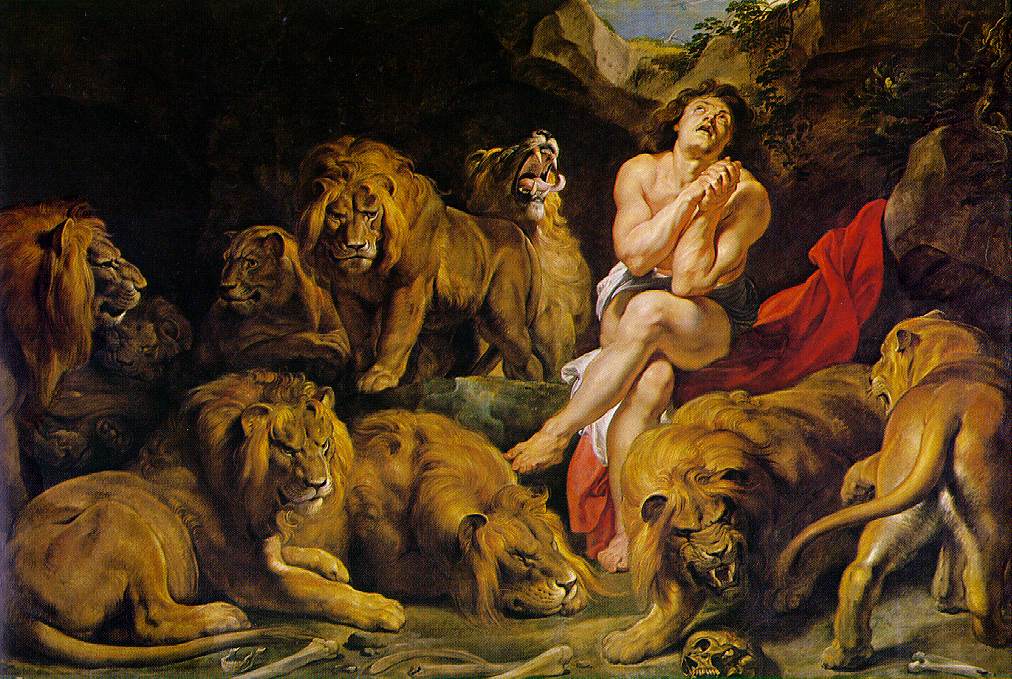
Our sixth red flag would be the Lion’s Den. Here we could offer Tea Partiers and NeoCons the opportunity to prove their faith by spending a night in a den of hungry lions. They like to claim loudly that their faith is being castigated, just like Daniel’s was—here would be the opportunity to prove it! Somehow I believe that the lion’s den would remain empty and crickets could be heard chirping throughout our Literalist Six Red Flags even before it opened its festively decorated gates.

"Oh please let Rick Perry be nominated!"


Sports Religion

I’ve never been a fan of organized sports. Call it sour grapes, but having been born with an inner ear affliction that makes sudden turns debilitating, I’ve never been effective at much beyond running. Maybe also the occasional flirtation with free weights. So when my wife showed me a story about Tim Tebow, I had no idea who he was. It turns out that he is the quarterback for the Denver Broncos. He was in the news not because of his apparently lackluster performance, but because of his religion. The Miami Herald story by Dan Le Batard insightfully points out that football fans participate in what amounts to a religion in their devotion to the game. Add an evangelical Christianity to that “sports religion” (Le Batard’s term) and a “holy war” (again, Le Batard) breaks out. Religious fans praise Tebow because of his character, sports fans castigate his allegedly mediocre ability. The controversy over Tebow, however, goes deeper.

Hallowed be thy game (but not thy Photoshop)

Home schooled in Florida, his family took advantages of laws that allowed home schoolers to play on actual schools’ sports teams. Even going as far as to rent an apartment and move out of their home with her son, his mother placed her son in advantageous school districts while teaching him at home. The problems with home schooling are legion, but clearly among the most troubling are the frequent use of religious indoctrination and the lack of critical thinking skills. Those who are truly educated are aware of just how little they know. Those who presume they can teach their children everything they’ll need often seem impressed by their own knowledge. But I digress. While in college Tebow’s penchant for painting Bible verses in his eye black led to the “Tebow Rule” that forbade messages in the paint. Interestingly, the Bible verses he scrawled on his game face received high numbers of Google hits during the games.

No doubt for many sports are a form of religious release. Le Batard suggests that football religion and traditional religion rest uneasily together. In a world where I might mention a particularly important Bible passage for students to read and most won’t bother, the flash of Proverbs 3:5-6 on a starry-eyed quarterback’s face will send fans page-thumbing the good book. Perhaps religions have been focusing their energies in the wrong places. If the various religions of the world formed football franchises and joined the ranks of the NFL, the benches, or pews, would be filled every Sunday. And it might also solve another perplexing problem: which religion is the correct one? They could be determined once and for all on Super Sunday.


If God Could Blog

My wife pointed me to the current Shouts and Murmurs section of the New Yorker online; this issue’s is “God’s Blog” by Paul Simms. It is witty, as usual, and the comments outshine the divine post. I had a good smirk and soon forgot about it. I found my thoughts turning to recent events and the idea of God blogging returned to me with a greater intensity. What if God could blog? The responses of online experts might be notoriously predictable.

Most politicians and Tea Partiers would fail to recognize the author, I’m sure. The conservative life-style and outlook have their own particular structures that may have had roots in Christianity at one time, but have now taken on an agenda of their own. God, admittedly a long-haired liberal in his last incarnation, certainly doesn’t advocate the way his dad’s name is taken in vain by such political bluster. I suspect he’d be denied more than three times before the stock market bell sounds.

The theological liberals would probably find such an anthropomorphic activity distasteful for a being as abstract as the divine. After all, by stooping to our level and showing himself active in the world he would be raising the ugly question of theodicy again. If the Big Guy can afford the time to type out a blog post from his android in the sky couldn’t he at least solve one of the more pressing human problems such as starvation or war?

Bibliobloggers would surely rate his posts pretty low. Erudition is born of online prestige and although God is a big draw, his book is still a bestseller and literary types are much more comfortable deconstructing the written word. Besides, since he doesn’t belong to any denomination (or monotheistic religion, for that matter) his authoritative comments would certainly be disconcerting.

I suspect the atheist camp would suggest it was all a hoax. With sufficient skill the source of the posts could be pinned to a physical machine and the words themselves would be traced to a physical brain that is no more than an organic computer. The God Blog could safely be ignored.

We live in an age that has outlived the need for a live feed from the divine. Real-time responses from on high would make everyone uncomfortable. Since we construct God in our own image, those who blog already know what the divine would write if s/he could blog.


Red Eye Religion

It is a slow news day when Bigfoot makes the front page of the New Jersey Star-Ledger (without a body being found, of course). Not even halfway through the article the word “supernatural” shows up. This illustrates once again my contention that paranormal and religion often share mental space. A few months back I posted on the recent book Paranormal America by Christopher D. Bader, 
F. Carson Mencken and 
Joseph O. Baker. The authors, sociologists by trade, expressed a revealing connection between religious belief and willingness to accept the paranormal. One exception stood out, however; professionals who engage the hunt for sasquatch often toe the line of science and disparage the popularizing notion that their quarry is supernatural. There’s no doubt that Bigfoot has a growing clientele. Whether mythic or biological, there can be little doubt that the big guy’s here to stay.

Appearing in the newspaper as a bit of New Jerseyana, the local tradition about Big Red Eye—the north Jersey version of Bigfoot—suggests instant comparison with the Jersey Devil, a tactic the paper takes. Similar to responses presented when religious behavior turns criminal, adding a light touch helps to ease the tensions. Both religion and the paranormal thrive in the realm of belief. As I waited all morning in the garage for car repairs yesterday, the incessantly chatty morning talk-show hosts were going on about some quote that the Tea Party had been compared to terrorists. One of the gambolers stated, in rather self-righteous tones, “they are entitled to their beliefs-the constitution protects our right to believe what we want,” or something to that affect. Belief is a very powerful motivator. Even those who thrive on science alone secretly imbibe.

The physical reality of a phenomenon is not the sole indication of its significance. People are meaning-seeking creatures. Our concepts of what life means range from nihilistic, to simple, to complex. Even those who claim life has no meaning arrived at that place after the search. The significance of the unseen, the unknown, is that it provides an Ebenezer for meaning. Does Bigfoot exist in New Jersey? I can’t say. If so, it would still not rank as the strangest thing I’ve seen here. Nevertheless, among the fervent critics and uncritical adherents a common bond exists. Belief can’t be measured in any laboratory (yet) but only the most naïve would assert that it doesn’t exist.

Do you want to believe?


Demo-God

Not having access to the news wires, I am generally scooped by CNN’s Belief Blog. Of course, blogs dealing with religion are a pretty cheap commodity these days, especially since, as I’ve mentioned before, everyone’s a self-proclaimed expert on the subject. So it appears appropriate that God’s approval rating was put to the polls. According to Public Policy Polling, God only enjoys a 52 percent approval rating. Only 9 percent of those surveyed dared give God a negative “disapprove,” but that still leaves a large middle ground where— to borrow a phrase—God is in the dock. The scenario where a democratic society expresses its opinion on leadership, both human and divine, makes me recall the movie The Mission. Fr. Gabriel has to remind Fielding at one point, “We [the church] are not a democracy.” Religion is handed down from on high and those who inherit it have no right to question.

Or do they? When I was growing up in the sixties one of the common social references in the media was the teenager (oh, what rebellion!) yelling at his parents, “I didn’t ask to be born!” In the current universe, however, that is where all religious believers find themselves. With the exception of the few who suppose themselves somehow self-generated, we all realize that we are subject to the whims of the creator. That, of course, does not prevent us from sharing our opinion on the issue. Fr. Gabriel is right: this is not a democracy. The stereotypical 1960s teenager is also right: we did not ask for this. No wonder the approval ratings for the divine have plummeted. It seems that the tenets so readily accepted in more submissive times have eroded. Is God about to retire? Step quietly from center stage?

What’s next for the Big Guy? Will he write his memoirs—wait, he’s already done that; what do you think the Bible is? Perhaps an unemployed creator would be interested in making another universe. The problem is that wherever consciousness exists, ideas will soon follow. Some ideas fit comfortably in the system: do as you’re told because I’m stronger than you, for example. When the expression of power as an inappropriate means of governance evolves, however, the voices of democracy will emerge. Maybe it is safer to schedule an apocalypse after all. Let’s just hope that God doesn’t take a page from the politicians’ handbook, otherwise nothing will ever really change.


Internet Asherah

Things represented on the Internet are not always what they seem. Removed to the back-bench of academia, I don’t have the opportunity for research that I once had. Every now and again, however, I still like to see what people are saying about Asherah. When I check the popular goddess books available off the shelf, my book on the subject is not often mentioned. At least on the Internet some researchers seem to have noticed it. A recent search for Asherah on Google, however, brought some surprising results. The first item of interest was a quinoa-based, organic veggie burger from Asherah’s Gourmet. The Asherah in question here, however, is simply a woman’s name. As a vegetarian I thought I would put a word in for the product, in any case. I found this brand at a health food store last week, but miles from home and with an air temperature of over 100 degrees, I was afraid the frozen products wouldn’t make it home without half baking in the car.

My next stop on the web was Sacred Suds. This New Age-themed site offers hand-made soaps, many of them associated with goddesses. The product entitled Asherah is named for “the Canaanite mother goddess” and is made with milk and honey. The website doesn’t actually state anything about washing away sins, but it seems difficult to go wrong by washing with a goddess. Another selling point—also not on the website—might be to point out that Asherah is known as the one who “walks upon the sea.” There is even a scene in the Baal Cycle from Ugarit where she is presented as doing her laundry in the sea. Asherah and soap, it seems, are a natural match.

One final product seems to be biding its time, although I suspect there is a market for it. The Asherah action-figure, privately made, does not appear to be commercially available yet. Garbed in an Egyptianizing cobra headdress, armed with a cobra staff, this heroine looks to be a suitable partner for Captain America, bringing the United States and Middle East together in an attempt to bring peace to a troubled region. Maybe heroes can accomplish what gods apparently can’t.

Not exactly big business yet, nevertheless Asherah appears to be on the move. Maybe once she breaks into the big time, those of us who’ve tried to make a living on her cape-tails might be dragged out of obscurity as well. In the meantime, it is about time for a veggie burger and a luxuriant bath.


Out of the Depths

You’d think that a lifetime of theological study would be excellent training for repairing a toilet. If, however, you live in an old rental unit that has been ritually neglected for decades and that has a plumbing system designed by the Marquis de Sade’s evil twin, you’d soon think otherwise. All I tried to do was replace the flapper—something I learned how to do before leaving home. When the overflow tube snapped off, corroded all the way through at the bottom, I figured I’d just replace the unit. The bolts holding the toilet tank, however, were installed before Noah even built the ark and therefore wouldn’t budge. The leverage room for a wrench, is, of course, negligible. So it was, temperature about 100 degrees, no air-conditioning, no working toilet (bad combination) on a weekend, that I came to face the human condition once again.

As biological creatures, humans have constructed themselves a grand, spiritual universe that kindly overlooks the basics of daily living. Religion, in origin, seems to have had a survival value. Psychologists have suggested that the sense of hope that religions often project might have led to a stronger desire to thrive. Others have suggested religion is part of the curse of consciousness—aware of our own mortality, we attempt to overcome it like any other obstacle. Religion gives us the leg-up over pure biological existence. Unlike other creatures, many western religions assert, we survive our own deaths to face a (hopefully) better world beyond.

In the meantime, however, we are faced with a messy biological existence. Some of our compatriots in this venture stumble along the way and cannot meet the expectations like those who know how to work the system. Religions have traditionally dictated a moral imperative for those who are in positions of power to assist those who are weak. Of late, however, that has somehow shifted—at least in popular Christianity—to the overarching objective of looking out for one’s self. As a species we are all, rich and poor alike, constrained by the same biological necessities. It would speak well of our religious constructs should they reflect the same. As the temperature climbs once again, and I must face my plumbing nemesis, I realize that the metaphor may go deeper than I originally surmised.

The theologian's best friend


Oh, Eye

As a frequent user of dictionary.com, I note the daily blog-post headlines as I look up my various words throughout the day. Yesterday’s article promised to be a good fit into this blog as well: “Why are zero and the letter ‘O’ both circles? The answer involves both science and mysticism.” The title is a bit wordy, but this is a dictionary site, after all. Each semester I briefly encapsulate the history of writing for my students. Since the Bible is a written document, it stands to reason that its origins reside within the sphere of writing. Many letters of our alphabet are pictographic in origin. Often as the initial letters of a word beginning with their sound, our letter-forms are mostly borrowed from the Greeks, who, in turn, borrowed most of them from the Phoenicians. The pictographic origins of all current ciphers in the alphabet are not known, but some have stories behind them. O is one such letter. As the article explains, O derives from the Semitic letter Ayin, a consonant that has no regular English equivalent. My late doctoral advisor at Edinburgh, Professor J. C. L. Gibson, delighted in saying it was the sound a camel made when overloaded. I have never forgotten how he rolled his eyes and stuck out his tongue while trying to replicate it. The shape seems to derive from ayin’s original meaning of “eye.”

The zero is more metaphysical. As the article at dictionary.com states, its premiere was attended by philosophical and religious arguments. The concept of nothingness still disturbs many people, and its early history was filled with debates about the divine implications of nothing. (Some things never change.) How could such an abstraction fit into a divinely planned and ordained world? Does it not imply that God left a few cracks in the joinery? Debate as they might, eventually the utility of zero was forced upon human thinkers. Its shape, apparently, derived from either the sun or the moon, but not the eye.

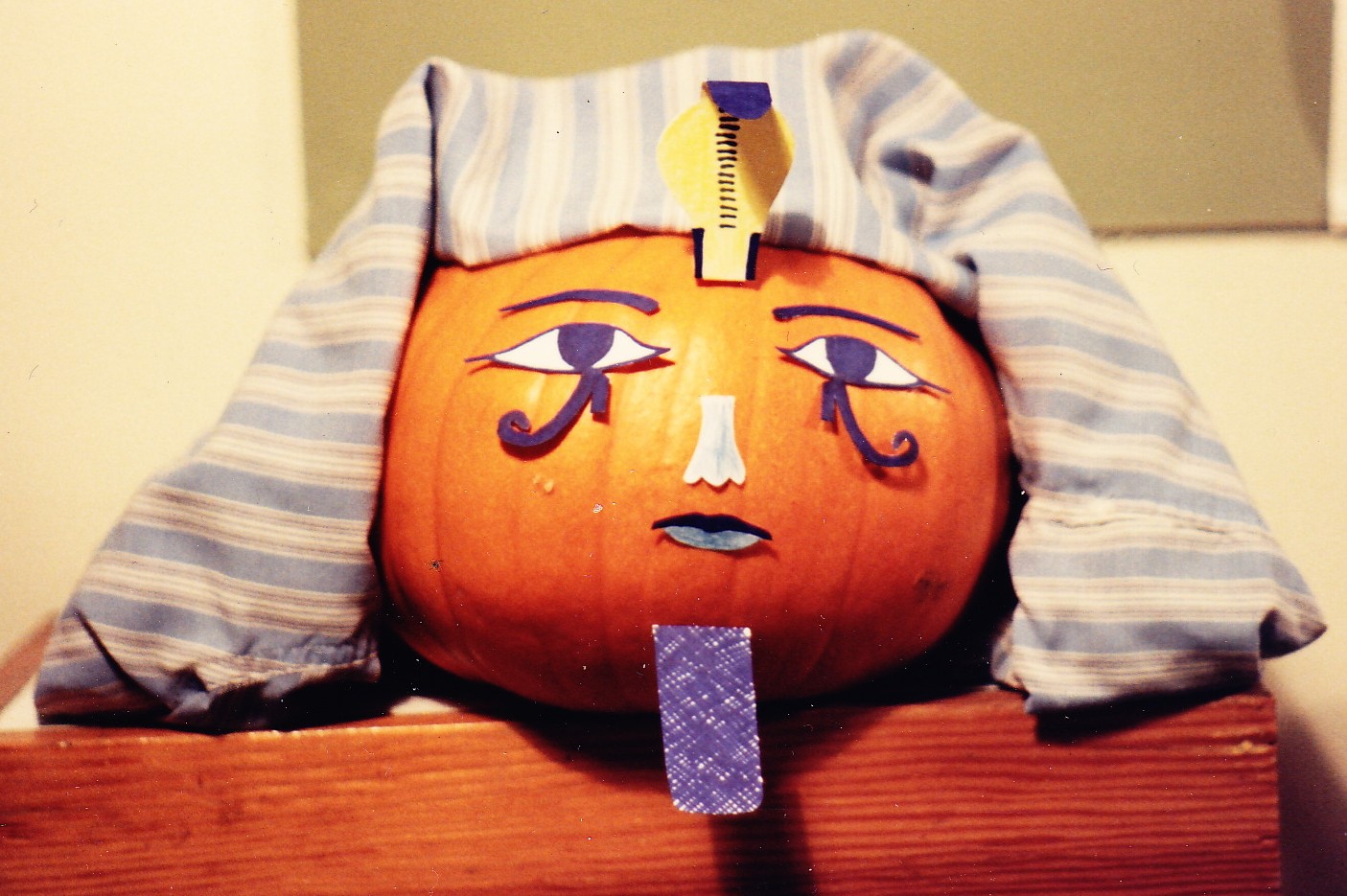
In ancient Egypt, however, possibly where the round ayin shape originated, the sun and moon were sometimes equated with the eyes of Horus. Horus is a benevolent god, overseeing the fortunes of the king, and thereby the nation. His wounded eye, damaged in his combat with Seth, has the power to heal as it cycles through its stages as the moon. His solar eye, necessary for life, can be harsh and unblinking. Today O is the fourth most used letter in our alphabet. It has its origins among the powers attributed to eyes in the ancient world. Perhaps if we learn the art of truly seeing, along with Horus, we might discover how to bring peace to those who gave us the gift of writing.

Somebody's eyes