Dutch Treat

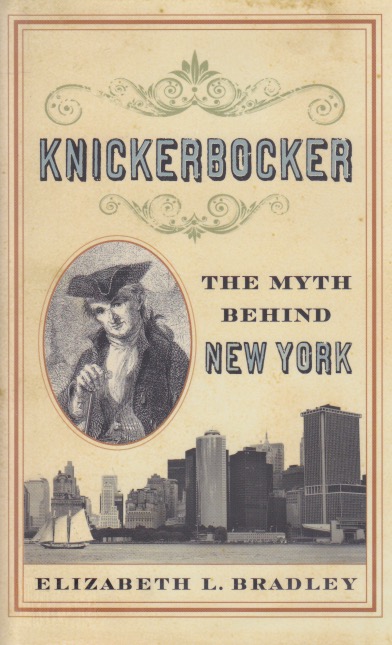
It was back when I was researching my first religion and horror paper that I learned it.  Since the paper was about Sleepy Hollow, I’d been reading about Washington Irving.  I knew little about him beyond that he’d written this story and also “Rip Van Winkle.”  I had no idea that he was the one responsible for the nickname Knickerbocker for all things New York.  Since then I’ve been quite curious about Irving and his world.  A glance at the books noted on this blog over the last few months will demonstrate this.  I found out about Elizabeth L. Bradley from an interview about Sleepy Hollow during the heart of the pandemic.  Irving was first sent to Sleepy Hollow because of a yellow fever outbreak in New York.  It led to his introduction to the lore and folk of the region.

Bradley’s book isn’t about that, however.  She’s writing about how Knickerbocker went from Irving’s nom de guerre to essentially a trademark for Manhattan, and New York City more broadly.  Knickerbocker graces hotels, sports teams, and once upon a time, a brand of beer.  And much more.  All of this is because of a volume I’ve never read, A History of New York by Diedrich Knickerbocker.  Irving was a satirical writer and this history is an extended satire.  He wasn’t Dutch, but he was born in Manhattan and cut his writing teeth there.  An older sibling to America’s other fledgling writers, he gained fame enough to be able to retire near Sleepy Hollow.  That particular story, along with Rip, made him a household name.  Of course, he wrote much else but it’s not talked about so much.

This book is a brief tour of the city and its love affair with Irving’s pseudonym.  Even having commuted to New York for about seven years of my life, I feel I only know very little about Irving’s hometown of Manhattan.  I do know that on my walks across midtown hurrying either to the office or to the bus, I found a quirky little view of the city emerging.  Little sites of significance only to myself—plaques on a seldom-used street, a church nestled between towers for capitalism, a quiet restaurant that made you forget the millions of others just outside.  It gives me hope that a writer can make such an impact on an ever-evolving entity like New York.  And this quick introduction contains much to help one reflect on the enormity of it all.


Devils and Days

The kind of devil envisioned by Andrew Michael Hurley in Devil’s Day may not be the traditional one, but it’s scary nevertheless.  In his follow-up novel to The Loney, Hurley demonstrates that he knows the devil can still be frightening.  The Endlands, in northern England are hemmed in by the moors.  The landscape plays such a commanding role here that this can only be folk horror.  And it fits folk horror to a tee.  Tradition, an unchanging life in a land untouched by technology, and forbidding moors where survival is difficult, all amid an English sensibility brings this tale into the folk category neatly.  As should be clear already, Hurley is well aware that religion and horror belong together.  This novel makes their companionship clear.

John Pentecost (note the name) has decided that he and his young, expectant wife—both of whom hold professional jobs—are going to move back to the family sheep farm.  The death of John’s grandfather means that his own father is left to run the farm alone.  Knowing that he belongs there and that his unborn child will need to tend the farm when he dies, a visit to help with the gathering of the sheep, and the celebration of Devil’s Day, turns into a lifelong commitment.  At the same time, the devil has been body-hopping as sheep are killed and family members die and a family of bullies cause more harm than their due.  There’s an inevitability to all of this and at the end you’re not really sure who the devil really is.

The story builds slowly.  By the day of the gathering you really have trouble putting it down.  Putting the Devil into a story can be a dicey proposition.  It’s been done successfully a handful of times, but that doesn’t make it an easy sell.  Our worldview has moved beyond a literal netherworld and the theology that accompanies it.  That doesn’t mean we can’t spot legitimate evil in the world.  Or that evil isn’t often vested in the garments of righteousness.  Ways of thinking that jeopardize others for theological purposes that simply don’t match what we know to be just and fair.  Powerful exploiting the weak.  Wealthy taking advantage of the poor.  Bullies getting their way through brute force.  In this novel the devil is active in a number of characters for a short time.  And you never know where that devil might turn up next.


Godic

I have tried, in my halting way, to articulate what religion has to do with horror.  Alison Milbank is more experienced than I and it shows in her book God and the Gothic: Religion, Romance, and Reality in the English Literary Tradition.  There can be little doubt that the gothic is the direct ancestor to what became horror in the twentieth century.  In this intriguing study, Milbank explores just how the gothic made extensive use of religion, a sensibility that has carried over into modern horror.  Having taken a good long look at this myself—the fascination was there before Holy Horror and reaches back to my childhood—it is nevertheless affirming to find another student of human fears and fascination regarding the darkness has come to similar conclusions.  I always walk away from books like this with a renewed reading list.

Milbank points out, in the context of the literary world of England, how horror and religion not only cover the same theological ground, but come into direct contact time and again.  She does so by suggesting that Protestantism constantly seeks the lost Catholicism.  In England this came to be embodied in the Church of England, the middle way between Catholic and Protestant.  She covers various aspects of this such as melancholy, the doubling of characters, supernatural creatures, and death.  And more.  This isn’t a quick or light read, but I found myself making many connections I had missed.  Much of this, admittedly, came in books I’ve not read.  One of the problems with interest in the classic gothic is that bookstores don’t cater to selling older books and some of them weren’t successful in their own day, let alone ours.

There is a vindication in finding you’re not alone in a field.  Many of us who work on religion and horror know one another.  We’re a somewhat small, hidden group.  Milbank approaches all of this from the point of view of theology.  Theology is a somewhat distinct practice from religious studies and even from biblical studies.  There is overlap, of course, but theology is generally distinctly Christian in a context like this.  And that fits the living context of the many authors explored in this study.  Many familiar, and a few unfamiliar names appear.  What they have in common, apart from making up the cadre of gothic writers, is that religion influenced their writing and they weren’t shy about noting it.  This book explores the shadows very well and I’ll be revisiting its insights again and again.


Old Ghosts

As someone who reads about ghost stories, as well as ghost stories themselves, I’ve long been aware of M. R. James.  His Ghost Stories of an Antiquary is regarded as a classic in the ghost-story genre.  Sometime in the haze, I recollect it was years ago, I found a copy at a used bookstore on the sale rack.  Something I’d been reading about ghost stories lately made me decide to read it through.  Now James was an actual antiquary.  He was also an academic at Cambridge University.  His tales are erudite, generally focusing on some ancient secret that releases ghosts, or sometimes monsters, after the individual who discovers the antiquity.  The stories are varied and inventive, but not really scary to the modern reader.  They assume a different world.  One in which antiquaries were monied individuals—often university men—who have both servants and leisure time, rarities today.

I found myself constantly asking while reading, how could they get so much time off?  How did they access such amenities that they could even get to the places where the ghosts were?  James’ world is both textual and biblical.  It’s assumed the reader knows the western canon as it stood at the turn of the nineteenth century.  The Latin, thankfully, is translated.  James, it is said, was a reluctant ghost-story writer.  A university employed medievalist, he had academic publications to mind as well.  Nevertheless he managed to publish five ghost-story collections.  Clearly the idea seemed to have had at least some appeal to him.

The aspect I find most compelling here is that an academic could admit to such an avocation.  While it’s becoming more common these days among the tenured, I always felt like I was walking the eggshell-laden pathway to academic respectability.  I was, after all, at a small, haunted seminary that few outside the Anglican communion knew about.  It was risky to admit being drawn to anything speculative.  Come to think of it, although I read novels while I was there I don’t recall reading many, if any ghost stories.  It was scary enough to be about on campus at night, particularly if you were going to the shore of the small lake to try to photograph a comet alone.  There were woods punctuated by very little light.  On campus ghost stories were fine—the librarian even showed me a photograph of a ghost in the archives—but off-campus such things could never be discussed.  I was an antiquary without any ghost stories. James showed the way.


Fragmented

The existentialists, remember, used to put scenes in their plays to remind you that you were indeed watching a play.  In keeping with their philosophy, there was no reason to fool yourself.  Meanwhile, movies seldom break the fourth wall, immersing you in a story that, if done right, will keep your eyes firmly on the screen.  With home based media, however, we’ve all become existentialists.  (Of course, some of us had made that move before the internet even began.)  When we watch movies we always have that “pause” button nearby in case an important call, text, or tweet comes through.  We can always rejoin it later.  Life has become so fractured, so busy, that an unbroken two hours is a rarity.  I see the time-stamps on my boss’s emails.

While the existentialist side of me wants to nod approvingly, another part of me says we’ve lost something.  What does it mean to immerse ourselves into a story?  I know that when I put a book down it feels like unraveling threads at the site of a fresh tear in the fabric of consciousness.  Even the short story often has to be finished in pieces.  Poe, who knew much, wrote that short stories should be read in a single sitting.  All of mine have bookmarks tucked into them.  For a fiction-writer-wannabe like me, you need to feed the furnace.  To write short stories, you have to read short stories.  Novels must be spread over several weeks.  Some can take months.  I would like long novels again if time weren’t so short.  Presses are even encouraging authors to write short books.  Readers want things in snippets.

Perhaps all this fragmentation is why I enjoy jigsaw puzzles so much.  Part of the thrill is remembering several places in the picture simultaneously.  Being able to pick up where you left off.  I limit my puzzle work to the period of the holidays when I can take more than one day off work in a row and the lawn doesn’t require attention and those trees that you just can’t seem to get rid of don’t require monitoring.  But puzzles are designed for interruption.  Movies and short stories are intended to engage you for a limited, unbroken period.  The real problem is that we’ve allowed our time to become so fragmented.  A creative life will always leave several things undone by its very nature.  Other forces, mostly economic, will demand more and more time.  The best response, it seems to me, is to be existentialist about it.

Photo by Hans-Peter Gauster on Unsplash

Various Plagues

At the encouragement of a friend I watched Roger Corman’s version of Poe’s The Masque of the Red Death.  As I’ve mentioned from time to time lately, making short fiction into movies requires padding.  Poe’s tale is easily summarized: Prince Prospero and his wealthy friends attempt to socially distance themselves during the plague of the red death.  During a masquerade, one of the characters is the red death and they all succumb.  Getting about 90 minutes out of this was something to which Corman was well suited.  The interesting thing, and the reason my friend, I suspect, recommended it, is that Corman did so theologically.  Vincent Price’s Prospero is cruel to others to make them face reality.  He’s also, and not unrelatedly, a worshipper of Satan.

When the red death breaks out in a small village, Prospero holes up in his castle where he tries to win over a local girl that has caught his attention.  He’s drawn to her not only for her beauty, but for her faith.  Francesca believes in the goodness of God as strongly as he believes that Satan will welcome him.  The film is further padded out by blending it with Poe’s story “Hop-Frog.”  Despite the Corman hallmarks of quick production and low budget, this adaptation draws much from conflicting religious views.  In fact, this story centers on them.  Granted, this was in the sixties, but the ideas still resonate these decades later.  Rumors of Satanism still spread panic and spark the same kinds of discussions.

Interestingly, the film ends up suggesting that death is stronger than Satan.  And that justice dictates that at least some of the faithful will survive.  Those dedicated to their faith, their family, and their friends make it through alive.  Death specifically lets them go.  Prospero, however, seals his fate by his selfishness.  Apparently his explanations of his motives do him no good.  Death doesn’t condemn him for his devotion to Satan.  The treatment of his fellow humans, it seems, is the ultimate measure used.  Some would argue that theology is best left to theologians, but it seems to me that we all work with the same data.  Philosophers attempt to convince based on the power of their reason.  Theologians try the same, but there’s always something external and unknowable in the equation.  How you know this unknown is on the basis of sacred texts and sacred tradition, as well as reason.  Why does it seem unlikely that writers and directors might have something to add to the conversation?


Slow Running

It’s extremely slow.  In fact, you might think nothing is happening at all.  I mean the book publishing process, of course.  It takes a long time to read 60,000+ words.  Even longer if you’ve had a few poor nights of sleep.  And many people have to read it before it gets anywhere near a printing press.  Everything about writing a book takes time.  While everything in the outside world happens at an unbelievable pace—last year at this time there was no war in Ukraine, for example—the slow process of organizing thoughts, putting them into words, sending them to a publisher who has many, many other proposals and manuscripts to consider, getting it rejected once or twice, finally finding a publisher, making the requested changes, getting it copyedited and typeset, getting the files sent to one of the few domestic printers left (who have tremendous backlogs), then to the bindery, and finally shipped out to the warehouse—it takes years.

Centuries of work

Current events publishers can rush things through and it often shows.  Meanwhile the authors of all other books learn to wait.  And wait.  Often the payoff isn’t great.  (I’ve received no royalties at all for Nightmares with the Bible.)  So why do we do it?  Those of us compelled to write have many motivations, I suppose.   One is to expand human knowledge.  We’ve discovered something and we want to share it.  We want to inform and entertain.  Those of us who write fiction also hope that our ideas may speak to others.  Having the fiction piece accepted is a validation of our outlook and experience.  Those who do so well may be inflicted on future literature classes.  I still remember The Loneliness of the Long-Distance Runner by Alan Sillitoe.  We had to read it in twelfth-grade English.

None of my friends liked it.  It was a collection of short stories by Sillitoe, titled after the one story that is still his only real claim to fame apart from his novel Saturday Night and Sunday Morning.  The tale of an English boy’s alienation didn’t speak to the rural western Pennsylvanians of the late seventies.  One of my classmates disliked it so much that he drove his pencil through the runner’s image on the front cover in a kind of uncouth performance art.  Now as I experience trying to get short stories published (with a little success here and there, but no royalties), I can feel for Sillitoe.  Still, “The Loneliness of the Long-Distance Runner” was made into a movie and has quite a few cultural references pointing its way.  Long-distance running, like publishing, is sometimes a slow process.  And at times you decide not to finish the race.  Or at least realize this race may last for years.


Aleph, Borges

I’m never quite sure how I’m supposed to approach books of short stories.  Some of them are truly massive and contain only a handful of tales I wish to read.  Others are governed by a dedication to the author that compels me to read from cover to cover.  Some are by differing authors, among whom some appeal more than others.  I wasn’t sure where to begin with Jorge Luis Borges.  Not having been raised in a literary family, and having never formally studied literature, I found Borges through a friend and co-worker.  After my academic career crashed and burned, I started reading more literary writers and discovered Borges again and again.  I knew the basics of his story—he was perhaps the most famous Argentine writer, he had gone blind, and he had written probing, unusual stories.

I picked up this collection because of the title.  “The Aleph” is included here.  It was also the title of a collection of Borges’ stories, which make up the basis of this book.  To that collection are added some other pieces, and these last become a mix of poetry and philosophy more than a simple narrative.  Of course, Borges didn’t write simple narratives.  His stories are layered labyrinths.  A complex person doesn’t write simple stories.  Often they reflect on religion.  Some of them explicitly so.  They aren’t, however, religious stories.  Indeed, I was drawn to “The Aleph” because of my own experience of Hebrew and the sense that it is a sacred language.  Borges also puts this into the mix here.

So what kind of collection is this?  I’m still not certain.  This time I did read it cover to cover and at several places I became uncomfortable.  Borges doesn’t shy away from the harsh realities of life.  What people are capable of doing to each other, and what they in fact do.  Some of the pieces just under a page long stopped me in my metaphorical tracks.  Was I reading fiction or some kind of history?  Was philosophy secretly being fed to me by being left right out in the open?  This isn’t weird fiction, although it’s clear that some of it could be taken that way.  It is the work of a mind that operated on a plane different from that of many others.  There’s an uncertainty, a tentativeness here that is very becoming, and even beguiling.  Having read the book I’m not sure what it was.  It will, however, lead to yet more reading.  Of this I am certain.


Haunting History

It’s difficult to do without feeling guilty, even if you personally had nothing to do with it.  It does seem that “Whites” have to take the initiative to dismantle systemic racism before any kind of fairness can settle on the world.  Toni Morrison is a great example of why that’s so important.  Beloved is perhaps her best-known work.  Although it involves a ghost it’s not so much a ghost story as it is a haunted story.  Black experience has been one of enforced poverty, after the emancipation proclamation—much like the American Indian experience.  Morrison represents this in a non-accusatory way, but she indicates in her story how the pain and mistreatment persists.  Her work is more important now than ever.  White supremacists are controlling the narrative in much of the country although they are the minority.  They need to read this book.

There will be spoilers here, if you’re even later coming to Beloved than I am.  Sethe was a slave.  The novel is set just after manumission, but she escaped before that.  She had four children and when she was sexually assaulted she realized this could happen to her children and she decided to spare them that fate.  Although she was stopped before she could kill all four, her first daughter, Beloved, was her victim.  This story is about what happens when Beloved returns to live with Sethe and her remaining daughter.  It is a haunting story.  No “boos” or jump startles, it sets up a sad atmosphere of a woman falling apart because of guilt.  Guilt for an event that would’ve never happened if she’d been treated like a human being.

Apart from the schoolteacher and his cohort, the whites in the story are kindly to Sethe.  Her “owner” was a slaveholder who gave his “possessions” respect.  She was saved from hanging after the death of Beloved by a local white man who understood what slavery might do to a person’s mind.  Even so, these kind people think of Blacks as servants rather than as people in their own right.  It’s difficult to read books like this.  That’s one of the reasons that it’s important to do so.  There is a lot to analyze here, much to reflect over.  If we put books like this on reading lists instead of banning them, it would help to bring understanding and sympathy rather than hatred and fear.  The future only improves when we admit our past errors and move to heal the scars we continue to inflict.


Annotating Irving

Really concentrating on a short story is sometimes difficult to do.  I don’t have a degree in literature (I took a few courses, but my specialization was religion).  I’ve been on a bit of a Sleepy Hollow kick lately and I wanted to move beyond just the short story by Washington Irving.  Although I’m sure working through the entire Sketch Book of Geoffrey Crayon, Gent., the book in which “The Legend of Sleepy Hollow” was published, would probably be rewarding, it would also be time consuming.  Irving was trying to find his way as a writer and this particular story has been his lasting contribution.  So I turned to local historian Henry John Steiner’s annotated edition.  It has a useful introduction, but still wouldn’t be “book length” without several pages of photos and a large font size.

Sleepy Hollow may lay claim to several signs of historical importance.  It featured in the Revolutionary War.  Washington Irving did eventually settle there.  As a getaway it attracted the wealthy and powerful from New York City because it’s not that far from Manhattan.  Several movie and television renditions have been made of Irving’s story.  This book generally provides local place connections in the annotations.  A visitor to Sleepy Hollow might wonder where this or that event in the story was set.  This book will help with that.  Still, it left me looking for a bit more substantial treatment.  Not necessarily a literary-theory kind.  Let’s face it, academic writers tend to write for other academics. No, a bit more of the folklore, I suppose.

It did allow me to slow down and really concentrate on the story.  Books have an endpoint that really helps in that regard.  This little book (as was the one I recently read on the Old Dutch Church) was published when the Fox series Sleepy Hollow was taking off.  That all-important media tie-in helps to sell books.  Interestingly, the details of a closer reading are revealing.  This isn’t, in origin, a Halloween story.  It’s a tall tale told American style.  Steiner indicates it was based on an older legend—this is something I’d be interested in hearing more about.  Writers are great recyclers.  I suppose a book on the folklore of the lower Hudson Valley might have more of what I’m seeking.  Nevertheless I came away from this edition feeling as if I’d gotten to know the story better.  Irving’s “Rip Van Winkle” also appears in his Sketch Book, but perhaps it’s asking too much to have both analyzed together.


Evening Out

It feels like magic.  The morning after staying up late for something special has a transcendent quality to it.  You can almost touch the veil.  Now, for me it’s an admittedly low bar.  I get up around 3:00 a.m. most days, so “late” is when I venture past about 8:00 p.m.  And I don’t mean for a board meeting where you’re trying to solve the problems of the world.  No, I mean staying up for something you anticipate.  Or even if it’s something you experience only by association.  I had to pick somebody up in Easton after an evening event recently.  It wasn’t over until after I’m normally asleep, but I made plans to hole up in Dunkin’ Donuts and perhaps even sip a coffee if I had to, for the drive home.

This was a Tuesday night so most businesses were closed.  After parking the car I found out that Dunkin’ wasn’t keeping evening hours either.  I try always to travel with a book.  The one thing I learned from my brief stint in Boy Scouts was “be prepared.”  With no Dunkin’ the only places open were bars and clubs.  Thankfully it was a warm evening, so I found a free bit of curb on which to sit to read my book.  Easton’s a college town so young people were out and about.  It was good to see other folks enjoying life.  Then a woman stopped and leaned down.  She was looking at the cover of my book.  “Just wondering what you’re reading,” she said.  “I’m always on the look out for something good.”

Reading in public

I can’t recall the last time a stranger struck up a conversation with me.  Especially about literature.  I was reading Toni Morrison’s Beloved (more anon) and she asked what it was about.  (You, dear reader, will need to wait a few more days if you don’t already know.)   I told her as best I could in a sentence or two, but I was in shock that someone I didn’t know was taking a moment out of her busy life to ask me about a book.  Her companion was ready to get going, so she left.  Shortly after that the event ended and I picked up my charge and headed home.  The next morning had that magic feeling.  I slept later than normal although it was a work day and when I went for my morning walk a startled bald eagle took off from the ground and flew less than twenty feet over my head.  Staying up late, talking about books, and a dawn-time walk in the morning.  Even everyday life can be magical, when it’s rare enough.


Falling Usher

Roger Corman is a name well known to film buffs.  The producer of many low-budget, obviously cheaply filmed movies shot over a matter of days, his early career was prolific.  Often working in genre films, he directed horror (among other projects), occasionally drawing on Edgar Allan Poe.  The problem of adapting a short story to a length required for cinema release could be solved in a number of ways, but padding out the story was common.  I had only a few minutes to watch a horror movie over the weekend, so I pulled out a Vincent Price collection I’d bought some time ago.  A number of them are Corman films and I may have seen them when I was younger, but if so the path recall is completely eroded.  I decided to watch The Fall of the House of Usher.

This story by Poe remains my favorite for its sheer moodiness and imagery.  The premise is brief and the action little.  I knew Corman would have had to have changed quite a bit.  It turns out that he’d brought Richard Matheson in as the writer.  Many films can be made or broken by the writer.  While it doesn’t improve on Poe it is certainly a watchable effort that develops a mood in its own right.  The low budget is evident, but despite that the story is a slow build using many of Poe’s famous concerns such as premature burial and isolation in dangerous locations.  While not scary in the same way as modern horror, and stretched out by a dream sequence and overture, it nevertheless works.

Given my particular angle on horror, I noticed the introduced religious aspects.  While identification is difficult due to the lack of focus, there seem to have been two large, iconic Bibles in the story.  Indeed, the Ushers have a private chapel in which Roderick prays over his dead (?) sister.  The curse of the Ushers has to do with family evil that is being punished, causing Philip Winthrop to quote the Bible in his denial of the passing down of divine wrath.  The paintings of the Usher ancestor as Roderick explains this are the scariest part of the movie.  Not all Corman adaptions of Poe work well, but with the ministrations of Matheson and the rich ground for development from the original story, this is an atmospheric contribution to early horror.  And it works if you only have a few minutes on a busy weekend for your favorite avocation.


Old Churches

I doubled its authenticity, but it was revered in a way similar to the Shroud of Turin.  The old guide, a priest if I recall, showed us an actual lantern hung for Paul Revere’s ride.  This was the Old North Church in Boston, of course.  Its history is so storied that children across the country learned about it in school.  A similar feeling comes from reading The Old Dutch Church of Sleepy Hollow by Janie Couch Allen and Elinor Griffith.  Subtitled Legends and Lore: The Oldest Church in New York, it is clearly a celebratory work, printed in full color and with pictures on every page.  This church’s claim to fame isn’t as much historical as it’s the result of the imagination of Washington Irving.  It features in his short story “The Legend of Sleep Hollow.”

Built in 1685, it was already an old building by the time Irving had settled in North Tarrytown.  Being early enough, Irving had immense influence on the culture of a young country.  Although born in New York City, and although he lived for many years overseas, he came to represent the voice of the emerging American literary tradition.  America has been home to many writers since then, some successful, many not.  But this book is about the church, not Irving.  Irving does play a big part in its story, although he was never a member.  I kept thinking as I read how influential a single story can become.  And even a small Dutch Reformed Church can benefit from it.  This book gives a high-level overview of the history of the area and some of its colorful characters.  It turns a few times to the Headless Horseman, but it also explains the trials and triumphs of a small church.

Although most towns can’t claim such a storied structure, American churches have had an outsized influence on who we are as a people.  I’ve sat through meetings lamenting the lack of funds for the operating budget as money grows tighter even as the worldview of ancient Palestine effaces.  As an historian of religion I tend to look back.  I don’t believe our future will be entirely electronic or virtual.  If it is, I think I’d rather find myself on a chill, uncomfortable pew in the Old Dutch Church lit by candles on a Christmas Eve, shivering but still alive.  No matter what a person believes—and with the varieties of churches we can’t all be right—we know that it’s part of what makes us human.


Ode to Books

There are fewer things more personal.  Each one has a story and it reveals quite a lot about you.  Really, it’s a brave thing, putting your books out on a shelf for others to see.  Seldom have I read a book more euphoric about a book than Alberto Manguel’s The Library at Night.  A deeply literate book collector unashamed, Manguel takes the reader on a pleasurable tour of many aspects of libraries, including his personal one.  Libraries may represent many things because books are so varied.  Many of us who are bibliophiles are used to trying to justify our libraries to those who don’t care to read or to complaining movers threatening to quit.  Or even to those who write books claiming other books are clutter.  Manguel understands.

Those of us with many books but little of anything else can tell you the story behind most individual books we have.  Where we bought them and why.  Why we’ve kept them even if we haven’t read them.  Manguel understands that not all books are reading books.  There are reference books.  There are episodic instructional books.  There are books laid up against retirement or incapacitation.  Books for work, books for play.  Books bought to help you prepare for that event that never took place but might, in some remote future, still happen.  Yes, books take up space, but so do pets, furniture, and children.  There’s a cheerfulness to rooms with books, unrivaled even by elegant spaces.

On a recent dentist visit the television was set to one of those shows where a couple is given their dream home.  I’ve watched those before in other waiting rooms and medical facilities and one thing I’ve never seen is a couple saying, “I want a home to fit my books.” And yet those homes with books occasionally make the news and garner thousands of clicks on the internet.  Those of us who are bibliophiles know we’re a minority.  Some of us actually enjoyed those high school reading assignments that so many of our classmates despised.  Our educational system, undervaluing teachers as we do, often fails to inspire the love of reading in the young.  Manguel’s book is for those who were inspired, who remain inspired by books.  Those of us who categorize and move them around.  Take them with us.  Who love them.  The Library at Night is a beautiful book full of wisdom.  It is a love letter to books. Happy National Independent Bookstore Day!


Places and Books

I recently had the opportunity to travel to a new town and spend the night there.  This is a rarity in the days of pandemic and I’d forgotten the magic of waking early in a new place and looking out the windows at the deserted, artificially lit streets.  It’s so peaceful and full of wonder.  The place we were staying was next to a public library and I noticed that there was a light on in the cupola in the pre-dawn hours.  I like the idea of books watching over us in the night.  Often when I’ve traveled to conferences I’ll arise early and look out on that orangey, artificial light while most other people are still asleep.  Even the city in pre-dawn can be a peaceful place.  This is a pleasant displacement since it’s only temporary.

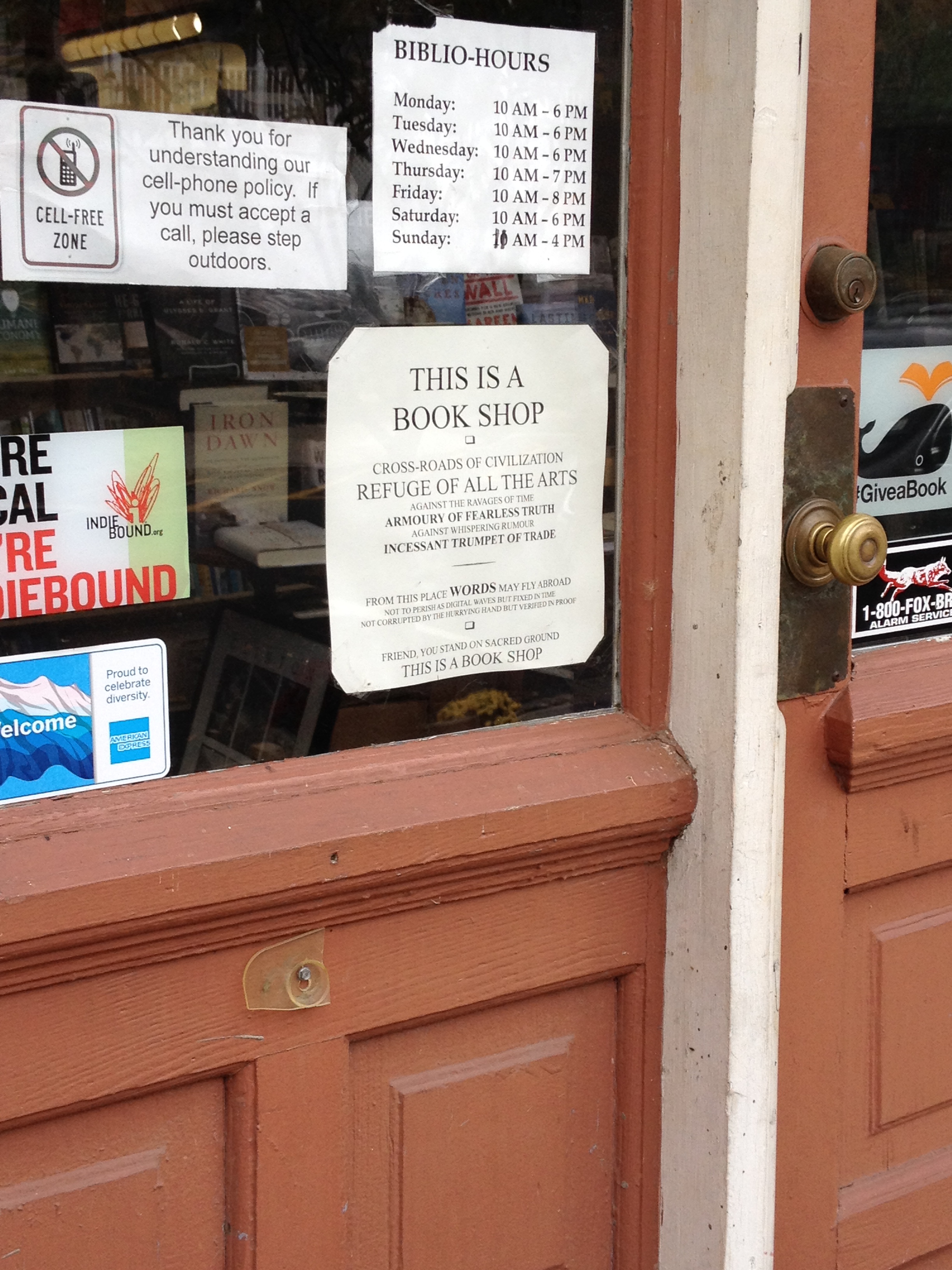
One of the things about the pandemic is that it has accustomed us to life just so.  The controlled environment of home.  There’s a comfort to routine, but there’s wonder in breaking it as well.  When it’s not a conference and still a new city, I begin to look for a bookstore.  One of the common misconceptions—perhaps bolstered by the cookie-cutter experience that has been Barnes and Noble—is that bookstores are all the same.  They aren’t.  Each reflects the minds of the owners.  They reflect their knowledge of their public.  New ways of looking at things.  I suppose this fascination with books has been enhanced by my starting to read some Jorge Luis Borges again.  Those of us who read for pleasure are in the minority and we find the open book to be open arms welcoming us in.  Welcoming us home.

I always travel with books.  My travel bag carries my laptop and my reading.  New technology having to learn to adjust to the old.  I’m not a particular fan of technocracy.  I’ve always preferred paper to plastic.  In a new town I look for authenticity.  We lived for many years in Somerville, New Jersey and one of my concerns was that it couldn’t seem able to support a bookstore in the shadow of that equalizing Barnes and Noble.  The new owner, James Daunt, believes that bookstores should reflect local interests.  His own stores in Britain are cathedrals to books.  Unlike other industries, bookselling isn’t all about the business.  Much of it is about the place.  We travel to see new places, and we read to visit them as well.  And perhaps to reflect in the artificial orange glow before the city awakes.