Insubstantial Reading

Because of the shortness of time, I recently bought an ebook so that I could get it done under deadline.  Although the coronavirus still has book delivery slowed down, things are much improved.  There was a book, however, I absolutely needed to read for my current research that is available only in ebook form.  Sighing, but emboldened by my recent experience, I began reading it electronically.  Shortly after I started my critical faculties kicked in and I began wondering whether the book was fact or fiction.  The author has an internet presence but is seldom addressed by scholars.  I found myself thinking, “if this was a real book, I’d stop right about now and examine my physical copy for clues.”  I’ve done that more than once when it comes to questionable material.  Books, you see, come with built-in indicators of their trustworthiness.

The ebook, however, gives you scant information.  For example, this one has no copyright page.  I may be a publishing geek, but a copyright page is essential for determining what kind of book you’re reading.  Then I would, if this were an actual book, close it and look at the back cover.  There in the upper left I would look for the BISAC (Book Industry Standards and Communications) code.  These are the words that classify the genre and subject of the book for you.  It is often a publishing professional, such as the book’s editor, who assigns the BISAC code, so depending on who the publisher is, you have an accurate description.  This ebook on my Kindle software has no BISAC code.  The publisher itself often tells you something about a volume, but this is a small press without much online information available.

I’m walking you through this because of our current crisis of critical thinking.  With a president unwilling to stick to facts and crying out “fake news” when empirically proven realities don’t match his liking, being able to assess our sources is essential.  Ebooks have eroded the possibilities.  I read esoteric stuff, I admit.  The authors had to have convinced a publisher (and don’t get me started on self-published books!) that their project was viable.  The book in my hands has a number of ways to assess whether it is accurate or not.  The ebook on my lap does not.  I’m working on a longer article on this topic.  Our ability to think critically includes the necessity of assessing the clues as to the nature of our reading material.  Right now I’m reading an ebook stripped of the helpful clues of the print book and fact-checking is limited to Google.  The truth may be out there, but if this were a printed book chances are it would be right in my hands.


WWW

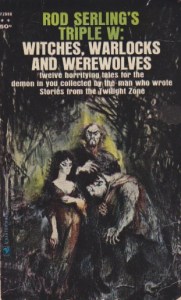
With a few exceptions I think we’ve lived beyond the time when a single name could spawn an industry.  I used to watch re-runs (itself an arcane concept) of The Twilight Zone when I was a kid.  These weird stories drew me in, and, it seems clear, not only me.  Rod Serling’s brainchild led to an industry and “twilight zone” became a household concept.  Lots of little books were written bearing Serling’s name in some way.  One of those paperbacks was Rod Serling’s Triple W: Witches, Warlocks and Werewolves.  I can’t remember where I picked it up, but it was a used book and it had Rod Serling’s name right there on the cover.  Going over my books to find unread gems, I picked up Triple W and sat down to find out what it was like.

None of the stories are by Serling himself.  He’s listed as the editor and he wrote a very nice little introduction.  The tales here reflect, as the subtitle indicates, witches, warlocks, and werewolves.  Some are old stories and some are fairly recent for a book published early in the 1960s.  Descriptive writing does tend to evoke a scene, but I’m often amazed at just how dated it can make a story seem.  What struck writers from the 1940s and ’50s as huge sums of money are likely less than we pay for our monthly internet bill.  Men all try to act tough and the ladies prepare dinner.  Stereotypes.  That’s somehow appropriate for this collection since most of the stories have to do with witches.  Serling was well aware of the tragedies of history, and these tales are told mostly for fun.  The scariest characters are the witch hunters (generally men).

Serling’s famed conscience shows in the choice of the final piece.  Not a story, not even fiction, Charles Mackay’s “Witch Trials and the Law” is an essay about the horrors of witch hunting.  It’s a rather sober piece with which to end a book of speculative fiction, but then Serling was always known for his impatience with injustice.  Also included is Nathaniel Hawthorne’s “Young Goodman Brown,” which I’ve been wanting to read for some time.  Given his shame at the Salem trials and his own ancestor’s part in them, it was mildly surprising that Hawthorne’s story seems to presuppose the reality of witches.  Of course, it condemns the respectable folk who, in reality, all participate in the ills of the society in which they find themselves.  In all, this collection made me think.  Not bad for an impulse purchase on what was probably a rainy afternoon. 


Old Seas Man

Although my fiction writing has been said to resemble his by one of those websites that tell you who you write like, I’ve never read any Ernest Hemingway before.  In the wake of Melville I had a hankering to read his The Old Man and the Sea.  I honestly had no idea what it was about or how the story went.  I’d read Coleridge’s “Rime of the Ancient Mariner,” so Hemingway’s classic was the last of the holy trinity of sea-faring literary classics to remain unread.  Not knowing what to expect, I was blown out to sea by it.  Published about a century after Moby Dick, The Old Man and the Sea visits some of the same themes but also pulls into new ports as well.

Santiago has hooked a massive fish after nearly three months with no luck.  To do so, however, he has gone out too far from land.  This watery hubris leads him to make fast to a reasonable stand-in for God.  I don’t know Hemingway’s religious outlook, but sea-faring novels already have such a large dose of Jung that it’s difficult to imagine there’s nothing divine in the massive marlin Santiago snags.  With many classics the end is known before beginning to read.  I wasn’t sure if Santiago was going to make it back to land, or indeed, if he would kill the fish.  The old man’s conversations with himself are the heart of the novel.  And one in particular turns to the religious idea of sin.

Not a religious man, Santiago bargains Hail Marys and Our Fathers for the successful catching of the fish.  Then he begins to reflect on sin.  In words similar to lyrics discussed in a recent post, Santiago declares everything a sin, even though he doesn’t believe in sin at all.  His view of life is stunning at this point, and commentary on which theologians would do well to chew.  Sin is a concept meant to impute guilt to mistakes, often made unintentionally.  What might’ve begun as a form of social control has grown into a mass neurosis for those who believe humans are capable of no good.  This is especially worth pondering if the reader considers the marlin to be God.  Try it and see what you come up with.  I know little about Hemingway, but having read his Nobel Prize-winning novel, I do feel that I have learned something worthwhile.  And I also feel the trilogy is complete.


Rainbow of Reading

Reading in a time of plague is more than just a pastime.  It’s an opportunity to learn.  I keep fervently hoping that an occupation might be made out of reading, but those I’ve tried always have many long strings attached, most of them tied to capitalism.  Early on in the social distancing phase, a group in my town began posting children’s stories on lawn signs in the park.  Each sign stands six feet from the last one, and if you linger a few minutes you can take in a children’s book, presumably for the benefit of your child.  Such signs have cropped up in a couple of the parks here in town.  I’m pleased to see the attempts at literacy education continuing.  If anything’s going to get us out of this crisis, it’s going to be reading.

The local library, again early on, began giving away books that normally make up part of the book sale.  Libraries, which have proven their worth over and over, have been doing what they can to get people through the difficult times of loneliness, and in some cases, joblessness.  Those of us who cottoned onto reading at a young age realize just how much problem-solving you can glean from reading a novel.  Instead of encouraging writers, however, the capitalistic system makes agents and publishers interested only in those writers who are deemed to have commercial value.  All the rest, who often find a core audience after their deaths, are left to obscurity since money makes the world go round, right MC?  And yet where would we be without our formative fiction.

I’ve quite often admitted that Herman Melville’s Moby Dick is my favorite novel.  I’d always assumed that it was a success but I recently learned that it too was a flop.  At first.  There was little interest in what has become the prototypical great American novel.  Its draw is in the lessons it teaches.  A bit too long to put on signs in the park, it explores what drives some people.  Indeed, for the owners of the Pequod it is money.  But there are more important things.  As the weather has been improving, it makes me glad to see the signs of summer.  The signs posted with books.  While I have no small children to take to the park, I am made happy by the efforts of those who take the initiative to show young people the way out of any crisis.  You must read your way through.


Under the Plague

Some events transform a society.  While we keep waiting for things “to get back to normal,” many of us have already come to realize that there is no normal to which we can get back.  That’s my main impression after reading Albert Camus’ The Plague.  The story is set in 1940s Algeria where the Bubonic Plague breaks out in a single town that has to isolate itself from the rest of the world.  As the months and realizations of long duration develop, the emotions the characters go through are very much in line with what seems to be happening with Covid-19.  Indeed, that’s why the novel seems to be going through a surge of popularity right now.  I’ve always associated Camus with the great existentialist writers, but that slipped to the back of my mind while reading this poignant story.

Existentialism is all about making one’s own meaning in a meaningless universe.  This is precisely what Dr. Rieux does in Oran as his former life becomes one long ward call of service to the town.  He befriends characters who represent the best and the worst of human nature as they respond to the pressures of isolation and boredom.  Camus pointedly notes that despite the equalizing forces of death and hardship, the rich manage to make sure they have it better than the poor although they all end up in the same common grave.  There are morals to this story, and it’s clear that “leaders” in Washington have never read it.  Literature quite often teaches important lessons, but to get at them you have to read.

Rieux befriends Tarrou and it seems to me that Tarrou’s lengthy monologue on why he has volunteered to stay in Oran and help those who are suffering is the main message of the book.  Tarrou understands the lessening of suffering, the attempt to bring peace, as the main purpose of human beings.  He says at one point that it’s like becoming a saint.  Despite the ways saints are often worshipped these days, that is at the heart of their canonization.  Care for others.  Rieux points out that Tarrou doesn’t believe in God, and yet, as the story winds down it is clear that he has become a kind of savior figure.  The novel is disturbing in its simplicity and in its timeliness.  It would seem that if we’re to get anything at all out of being under the cloud of a modern plague that we need to take the view that others matter, despite what Washington says, perhaps even more than ourselves.


Wandering

Sarah Perry seems to be a writer who refuses to be pinned down.  Some of us are careful in our fiction to make sure things progress logically, almost factually.  With Perry you’re never quite sure.  Was there a sea monster in The Essex Serpent?  I’m not sure how this played into my decision to read Melmoth.  I knew the title had to have drawn its inspiration from the gothic classic Melmoth the Wanderer, a book I’ve never read.  (The internet has, in some ways, taken the sport out of wandering used book stores, where the possibility of finding such things was once a part of their charm.)  In any case, I saw Melmoth on the front table of Buffalo Street Books in Ithaca, and you learn which bookstore front tables to trust.  It was back when bookstores were open and autumn was in the air.

The concept of the wandering Jew (which I address in Holy Horror) is one that has the power to offend.  By emphasizing the atrocity of the Holocaust, Perry parries that here while maintaining the concept.  The wandering Jew committed some ancient crime and is sentenced to roam the earth until, well, usually the end times.  Perry makes Melmoth one of the women at the empty tomb of Jesus who, when asked to confirm the truth of the event, denies what she saw.  Condemned to walk the world on bleeding feet, she finds sinners and invites them to join her.  Not only finds, but watches—she is the one who sees all your transgressions—and insists that you come to her.

Melmoth is, like the original story, a set of nesting dolls.  The frame story contains other documents that shed more and more light on this dark wanderer.  Characters must own up to their shortcomings.  Indeed, confession is a large part of the story.  Although set in modern times, the book is quite biblical, both in sensibility and in some of the plot elements.  It even has several quoted snippets from the Good Book.  This caught my attention partially because a recent article I wrote (there will be notice here when it appears) suggests that the horror genre goes back to the Bible itself.  Those uncomfortable with the darkness may not realize just how much the two have in common.  Not all the strings are tied up neatly by the end, but this novel will perhaps inspire the reader to do a bit of wandering their own. 


Nothing To Eat

Some stories are unsettling to the point of spirituality.  That’s my impression of Han Kang’s The Vegetarian.  My wife wanted my opinion of it and when she used the adjective “Kafkaesque” I knew I had to comply.  The comparison is eerie in that Franz Kafka essentially starved to death because no way could be found to feed him with his underlying medical condition.  The Vegetarian shifts focus in its three parts, but the protagonist, Yeong-hye, is a young woman who finds her life run by other people in her family after she decides to become a vegetarian (in actual fact, a vegan).  Basing her decision on disturbing dreams she has, those in her Korean culture cannot accept vegetarianism and attempt, by various forms of coercion, to change her decision.  Throughout the account, Yeong-hye becomes silent—we’re never given her point of view—but those around her can’t accept her decision.

This is a challenging book to read, given my own personal history, but after scratching my head a bit when I finished it I came to reflect on this spiritual side of it.  My own vegetarianism was an ethical decision.  I realize that I can’t and shouldn’t impose my ethics on others, but I’ve not had much resistance from others (apart from colleagues who occasionally make reservations at eateries with no hint of the concept).  Likewise, I became a vegan a few years back based on further reflection of an ethical kind.  This is actually a spiritual practice.  I don’t often express it in those terms, but clearly it is.  In the novel when Yeong-hye’s brother-in-law tries to direct her life, he takes her to a Buddhist restaurant because he knows nowhere else to find vegetarian offerings.

Yeong-hye believes herself to be becoming a plant, and that leads to the next logical step in this progression of thinking.  Eating is, or at least can be, a spiritual exercise.  Many religions advocate fasts of various durations to derive the benefits to the soul.  Daily life is a matter of routine for many, often based around our culturally driven mandate of three meals a day.  I’m not alone at working through lunch while trying to get more done at my job.  By the final meal of the day I find myself exhausted.  It’s about more than food.  This strange little book has put me into a reverie about the ethics of eating.  I don’t know if Han Kang is a vegetarian or not, but she does understand the soul of one.


Straining Andromeda

As corona-life settles into just the way things are, I pulled out my copy of Michael Crichton’s The Andromeda Strain.  I read this in high school, and, judging from the state of my copy I originally found it in the book bin at Goodwill.  I actually didn’t remember how the book ended, but some of the scenes—particularly the bizarre suicides that the virus first initiates—stayed with me.  I really felt no compunction to read it again until our daily reality was one of infection, protection, and fear.  In other words, the time was right.  I can say that I found Crichton’s confident prose a bit overblown at times, especially given the resolution of the crisis, which I will not give away here.  Some of the rest of you may want pandemic-themed reading, after all.

Something I had forgotten, and since this is near the beginning I don’t mind giving it away, is that the Andromeda Strain was brought to earth by military intentions to develop new biological weapons.  Although the death toll is nowhere near what that of COVID-19 has been, the potential lethality of the strain is what keeps the compressed five-day story tense.  That tension makes for quick reading, and it seems pretty clear that some of the ideas here have been used for other pandemic story-lines.  I’ll write about one of them later this week.  The extraterrestrial life form of Andromeda is cause for discussion in the novel, but the explanation is never clarified.  Crichton’s later novels improve on this score.

A clear point in the novel is that the government, although aware of and complicit in the experiment, lacked the foresight to successfully see it through.  Governments are only human, after all, and can function effectively only when those with superior abilities are in charge.  Looking out for oneself and exploiting others are not superior abilities.  We can see the result of this with our own, nonfictional pandemic.  Still, the novel does raise the specter of dabbling in things we don’t fully understand and can’t, in any real sense, control.  The thread of the plan being military in origin isn’t fully seen through, but it does raise the larger question of morals.  Some of us go through ethical training for our jobs.  Some of us have it often.  It’s obvious, however, that the real deficiency of governments tends to be their lack of ethics.  In this current day and age that qualifies you for the sobriquet of evangelical Christian.  And now we have our own strain to deal with.


White Whales

Every once in a while I return to Moby Dick.  I’m not sure why exactly Melville’s classic has such a hold on me.  Perhaps because I first read it while living in Boston.  For a land lubber like myself being so near the ocean was a kind of epiphany.  I read the novel as part of a course on wisdom literature in the Bible.  Harrell Beck, who was an influential person in my life, insisted that if wisdom themes were truly wisdom they would be found outside the Good Book.  We were assigned a list of modern novels from which to choose and I selected Moby Dick.  The thing that immediately struck me about the novel was just how biblical it is.  Ahab and Ishmael aside, the many references to Jonah and Job and incidental asides referencing scripture made this an intense reading experience.

I started reading it for the fifth or sixth time just before the pandemic became a crisis.  It is a large book and I didn’t want to rush through it.  I tried to pause and appreciate it this time around and I noticed just how remarkable it was that a man who made much of his life as a laborer, without any higher education, was so incredibly literate.  Classical references that I had to look up, and citation of sources blend together in a story that is compelling as it is unsettling.  Long explanations and descriptions are part of the tale, and the soliloquies are so philosophical that you have to sit back in a reverie after reading them.  I’ve read many novels in my life, but no others like Moby Dick.

As metaphorical stories go, the book is remarkably natural.  The descriptions of whales are as scientific in their own way as they are literary.  For an author with no scientific training this too is remarkable.  Indeed, a good part of the draw of Moby Dick is Herman Melville himself.  Although I have gathered a few degrees over the years, in my mind I am, like Melville, unlettered.  I’m sure he would’ve understood.  The fiction I write, although in a very different style, is a tip of the hat to him.  Friends used to tell me that nobody writes like that any more and that no publishers would show an interest.  The latter has proven to be true, and so much more’s the pity.  We could use more novels like Moby Dick.  And were my days not even fuller during the pandemic, I might even have a few moment to pursue my own white whales.


More than Sand

My sci-fi roots may be showing, but when John W. Morehouse posted a story on TheoFantastique’s Facebook page about Dune, I had to follow up.  The story was from Wired magazine, and the title asks “Should There Be a Religion Based on ‘Dune’?  Although I grew up on Poe, science fiction was my favorite genre as a kid.  Frank Herbert’s classic was published when I was only three, but it was experiencing a resurgence before the movie came out.  Dune was  complex world building.  It was immersive, and compelling.  The movie, I felt, didn’t do it justice.  I’m not surprised that people are now wondering if it shouldn’t become a religion.  Other sci-fi-based religions do exist.  Star Wars and Avatar have both developed fan bases that consider the films their religion.

Movies have a way of becoming part of our reality.  The other day I was reflecting on how much my frame of reference for life is based on movies.  I quote from them frequently.  I draw wisdom, and sometimes just plain inanity from them.  But I remember them.  I spend a lot more time reading than I do watching movies.  If a book is engaging I’ll remember it well, but it isn’t unusual to forget—although I hope it’s still there somewhere in deep storage—a book that failed to make much of an impact.  I suppose that’s true of movies too, but I recall my first viewing of The Jungle Book in theaters.  How those hypnotic snake eyes scared me!  And there was a film whose title I can’t recall, but I remember it was vignettes of Hans Christian Andersen stories, I believe.  One was called “The Tinderbox.”  I still remember it well although I was probably about five when I saw it and I never watched it again.

This staying power of movies suggests their religious potential.  People today, I suspect, are less concerned with the antiquity or bona fides of a religion than they are with the practical issue of whether or not it works for them.  Does it bring them near some sense of transcendence?  While the Wired article doesn’t seriously suggest a religion based on Dune, I sometimes ponder how the wisdom of ancient religions is often entombed in forms and structures that “true believers” mistake for the actual essence of the religion itself.  Sci-fi based religions reach for the newly created realms of transcendence.  They are filled with wonder.  But it will only be a matter of time before that awe fades into arguments about which canonical version is literally true.  It’s happened before.


Religion’s Trickster

I’m not sure I’ve read any fiction by Native American writers before.  Owl Goingback has established a reputation among horror writers for his blending of Indian concepts and the horror genre.  Coyote Rage is a novel that blends worlds.  Coyote is, of course, a trickster figure.  Upset with human abuse of the world and our indiscriminate killing of animals, he decides to wipe out the human race.  Since all animals, including humans, plead their causes in the council in Galun’lati, the original world, he decides to take humans out by killing their last representative on the council, an elderly Native American in a nursing home.  The fact that his victim has a daughter unaware of her heritage, means that Coyote has two people to hunt.  As a shapeshifter able to travel between worlds, Coyote is a formidable enemy.

I don’t want to put any spoilers here, but it is worth considering the spiritual aspects of the story and how they blend so well into horror.  I’ve commented before on how religion plays into the genre.  Here is yet another example.  Galun’lati is presented as reality.  Not only do the animals talk there, it is a place that has its own dangers.  It’s a forest world, appropriate to Native American experience and context.  It’s very much a natural, supernatural world.  The novel splits its time between Galun’lati and the New World—this world—as humans try to prevent their own extinction while most people have no idea there’s even any threat.  Oblivious, we carry on.   Religion can play into horror that way.  While there are plenty of examples of purely secular horror, in my experience tales that have supernatural sources of threat are the scariest.

It may come back to the issue of ultimate concern.  When our spiritual wellbeing is taken into account, we often approach it with some trepidation.  The physical world feels so real and occupies much of our time.  If, however, we need to add spiritual concerns on top of everything else, it can become overwhelming.  What if physical threats, such as the coronavirus, and any other of a myriad of dangers, are only part of the picture?  What if there is another entire world in which we also have a stake?  If that world is beyond normal perception, we must rely on those who understand it.  Much effective horror knows to tap into this area of natural uncertainty.  Owl Goingback uses it remarkably well in crafting a horror tale that makes you think.


Misreading Melville

I make it a practice not to discuss books I’m still reading on this blog.  There’s no reason I shouldn’t, I suppose, but it just feels like cheating getting more than one post for a book.  Besides, there’s so much other stuff to blog about!  I’ll make an exception this time, because it involves an unusual typo.  Well, it’s not so much unusual as it is apt.  In chapter 82 of Melville’s classic, Moby Dick, “The Honor and glory of Whaling,” he discusses the mythical history of whaling.  In typical Melvillian style, he takes mythical stories to support his contention of how honorable whaling is.  After Perseus and St. George and the dragon, he mentions the curious biblical episode of Dagon and the ark of the covenant, found in 1 Samuel 5.  It’s here that my edition has a typo.  Melville writes “this whole story will fare like that fish, flesh, and fowl idol of the Philistines, Dagon by name” but my edition reads “Dragon by name.”

Image credit: Vignette by Loutherbourg for the Macklin Bible 12 of 134, via Wikimedia Commons

My very first academic publication was on this story about Dagon (I had intended to write my dissertation on that deity).  I had no idea of H. P. Lovecraft’s appropriation of Dagon at that point.  The interest was purely based on the fact that you couldn’t find much information on this curious god.  It was clear that he was well known among ancient cultures of West Asia.  He was attested at Ugarit, specifically as the father of Baal.  (Both would later be assumed to be demons.)  Further east, he was apparently a fairly major deity in Mesopotamian religions, although we are still awaiting a readable synthesis of that massive corpus of texts and the religions toward which it points.  In other words, Dagon is mysterious.  Lovecraft likely picked him up from the biblical story.

The tale in 1 Samuel is provocative.  After defeating Israel, the Philistines (who would eventually give Palestine its name) took the ark to the temple of Dagon as spoils.  The image of their god fell face-down before the ark overnight.  Disturbing as this was, the next morning after they’d replaced him, Dagon was again tumbled but also decapitated and with his hands broken off.  That meant his body was all that was left.  Somewhere along the line the name Dagon (close to the Hebrew word for “fish”) was interpreted as a maritime entity.  This seems unlikely, given what we know of his origins, but the idea stuck, leading to some compelling horror fiction.  Dagon does indeed become a kind of dragon in that realm.  My edition of Moby Dick has a typo that we today would blame on autocorrect, but in reality was likely the result of a copyeditor not knowing his or her Bible as well as Melville did.


See Monster

What happens when someone encounters something anomalous?  In real life this is often described as a religious event.  In fiction that sometimes happens as well, as in Christopher Coleman’s The Sighting.  Set on a beach somewhere along the Atlantic, the story is about a woman who encountered a sea monster and decided it was a god.  Gods, of course, require sacrifice, and thus the tale turns on her effort to placate the beast in its current appearance cycle.  Such sacrifice doesn’t come willingly, and this introduces a murderous main plot.  Unlike the gods of lore, however, this one literally eats, tipping the reader off that its divinity is somewhat of an illusion.  The hungry beast becomes the divine only to its blind follower.

I’ve not read any of Coleman’s fiction before, and this self-published novel appears to be a good introduction to his story-crafting.  His monster, like a god, comes with no explanation.  It simply is.  Since religion isn’t really susceptible to being examined under a microscope, the truth of not being able to locate an origin for gods seems natural enough.  Still, people are curious about monstrous origins.  Mary Shelley tells us the genesis of Frankenstein’s monster, but Bram Stoker leaves Dracula’s ultimate origins somewhat misty.  In the present day, with its ubiquitous cell phones and information, we do wonder if monsters can’t simply be explained.  Even if that simple explanation is complex.  Coleman’s title page tells us this is book one, so further elucidation perhaps comes later in the series.

The sea, in classical thought, gives rise to monsters.  Coleman’s creature comes from the Atlantic.  All the world’s oceans are organically connected, and their surface area is so massive that we really haven’t figured out all of what’s under there.  Stories still appear in newspapers announcing this or that unidentified creature that has washed out of the sea.  Its depth and relative impenetrability make it a natural birthplace for monsters.  By the end of The Sighting the reader is really still only given a glimpse of what this god might be, or why, indeed, it is considered a god at all.  Origin stories make monsters less scary sometimes—Shelley’s genius was to take it in the opposite direction.  Often in horror stories, the humans are more frightening than the monsters.  So it is here.  What makes this story so disturbing is the unquestioning human acceptance of belief, for it is often here that gods can become monsters.


Bug Eyes

Science fiction and horror are close kin.  Once relegated to the cheap rack of “genre fiction,” both have now developed considerable literary sophistication, perhaps in the wake of their ability to bring in money.  I used to attend used book sales.  Two of the big ones in central Jersey were the Bryn Mawr sale, held just outside Princeton, and the even larger Hunterdon County Friends of the Library sale.  Both were springtime events and highlights on my calendar.  I always had a list with me when I went, but there were also so many books I’d never heard of and that looked fascinating.  One such book was the science fiction anthology, Bug-Eyed Monsters, edited by Bill Pronzini and Barry N. Malzberg.  The garish cover was half the appeal, and, well, monsters go without saying.

Although I’ve mostly moved to the horror end of the spectrum, there were some good stories here.  Bug-eyed monsters were a staple of 1950’s sci-fi, gracing the covers of pulps, often menacing women with their tentacles.  Some of the tales here share that kind of wide-eyed wonder at the sheer power of imagination, while others are much more subtle.  Monsters, of course, lurk between genres, bursting into consciousness when something unexpected is discovered.  They also have strains of religious awe associated with them.  That’s obvious in a couple of the stories as well.  Since I’m trying to read through my own books while stores are closed, I decided to spend some time with my monsters.  The problem with story collections, however, is you can’t discuss them all in the short format to which I limit myself here.  Besides, some of them I didn’t like.

Monsters deserve to be treated with respect.  In the “golden age” of sci-fi they were often played for titillation.  Most of the monsters in this collection are from outer space.  Some are homegrown, generally in the scarier tales.  We are afraid of those who are different.  Monsters, as more than one of these stories indicate, can be more humane than humans often are.  It’s no surprise that they tend to represent the foreigner, the person whose culture and appearance are different than our own.  Titillation apart, these narratives often ask us to stop and consider what might happen if we really did listen.  Would we not improve ourselves if we could learn from those we fear?  In these days of government-approved xenophobia, perhaps we should dust off our copies of the old genre fiction.  Even in those days we were encouraged to be open minded like our monsters.


More Than Books

Careers.  A pandemic is no time to think about changing jobs unless you’re forced to, but I often wonder if I got it wrong.  No matter what my job was, I wanted it to be about books.  When I was considering ministry it was largely because of the Good Book, and I did a lot of reading of books about it.  Over time my mindset morphed to that of a professor and the book-lined study was my icon.  I admit I’m fixated at that stage.  Now I’m an editor.  Life would’ve been different if I’d become a librarian.  Susan Orlean’s The Library Book is a volume that opens up the cloistered lives of librarians and shows just how vital libraries remain.  I have to confess that before reading this I don’t recall ever having heard of the central Los Angeles library fire of 1986.  Now I can’t forget it.

More than just an account of the fire—although a suspect was arrested it still isn’t clear that he was guilty—this is a book about libraries.  An account of the fire alone would not have been so interesting.  Orlean tells us about this history of the Los Angeles Public Library and the importance of libraries around the world.  She introduces us to several librarians and gives us insight into why they became such and what it is they do.  Here’s a hint: it’s a lot more than re-shelving books.  And there’s the sad tale of an unsolved fire that destroyed millions of dollars’ worth of books.  Having had hundreds of books destroyed by water myself, some parts of this book were difficult to read.  Books are vulnerable, like butterflies they must be treated with care.  The idea of them burning, then being soaked, is distressing.

Like many people, I suspect, I began this book thinking libraries were on the way out.  The internet has changed things.  What I didn’t fully appreciate is that libraries have been evolving to keep up with the times.  And that they provide social services, such as a place out of the weather for the homeless.  I experienced this myself in Montclair, New Jersey.  When accompanying my wife there on Saturdays when she had to work, if I finished with the bookstores early I’d head to the library.  You could sit there for free.  I always have books with me, so I could read.  I could use their wifi for free.  Libraries, you see, are all about giving.  They give so much to the community.  Now that we’re living hermetically sealed lives, it might seem strange to think of libraries as places of social gathering.  And of course they’ll have books.  Orlean’s account makes me think perhaps my career has been off-track.  Perhaps I should’ve been a librarian.