Dreaming

To be honest, I’m not quite sure what to make of NightBorn.  It’s not a bad novel but some of the action isn’t explained enough, leading to a little confusion as to what’s going on.  This is pretty minor, however.  I was enjoying Theresa Cheung’s debut novel but I kept thinking of Dream Scenario and how the premise, at least at first, is so similar.  I was very impressed by the movie Dream Scenario, and wondered if this was going to play out in the same way.  The basic idea is that Alice Sinclair, a professor of psychology, begins appearing in people’s dreams.  The dreams of people who don’t know her.  Then the dreams start to become scary.  If you’ve seen Dream Scenario you’ll recognize the many touchpoints: professor, appearing in strangers’ dreams, dreams becoming nightmares.  Back in the novel, Alice joins forces with her psychic boyfriend, two psychic friends of his, and her dog, to explore why this is happening.

Alice discovers that her absentee father, whom she’s never met, is also a psychology professor and he’s been experimenting with a technology that makes a person go viral in other people’s dreams.  He randomly chose her, not ever knowing Alice as his daughter, or knowing her at all.  The novel deals with synchronicities, and this is one of them.  Her father, who is rather a slime-bag, is working for the government where an unpopular president (this is a novel of its time) is paying to have himself interjected into people’s dreams to get reelected.  Alice was simply a test case to see if it was possible to, well, do a Dream Scenario.  In the movie, of course, a company has been developing the technology for profit, so that advertising can be interjected into dreams.  Another synchronicity.

I won’t spoil the ending of the story.  The ethical concerns of the author come through clearly.  In many ways this is a Trump book—that category of books that, had this particular individual not been elected (or reelected) would likely never have been written.  It’s more, however, about the power of dreams than it is about the power of potentates.  The publisher, 6th Books, prefers paranormal plots, so expect a bit of that when you pick this one up.  Dreams not only feature Alice, they also guide the plot.  In the end, the scenario isn’t the same as that in Dream Scenario, but the vehicle is quite similar.  It may, if viewed from a certain angle, be considered dark academia.


Writing Ghost

Despite AI, one of my great regrets is not having learned additional languages in high school.  I took four years of German and the one classmate I knew who was able to convince the administration took two languages, both Spanish and French (gasp!) to become a translator.  In any case, I regret being able to read French only haltingly, with a dictionary.  I watched Colette because it is the biopic of a writer, but I’ve never read any of her books.  I also watched it because it’s considered dark academia, but you already knew that, didn’t you?  Colette lived from the last quarter of the nineteenth until the mid-twentieth century.  Her first husband published a successful series of books she wrote under his name.  The two separated and Colette went on to become a reasonably successful writer in her own regard.

As with most biopics, the details are exaggerated, but still, this is the world of books where fiction and fact aren’t always so far apart as might be supposed.  Interestingly, articles on her husband (Henry Gauthier-Villars), known by the pen name Willy, state that he is best known as the first husband of Colette.  A self-promoter, he had other people do his writing for him.  The movie focuses on what happens when he tried to bring his wife, not yet established in her own right, into his band of ghostwriters.  Not having French, I have never really studied French literature.  If life allowed a bit more time, that is something I’d like to have done.  In any case, Willy was a libertine as well as a self-promoter, the sort that occasionally enters high government position.  And since he was involved in many affairs, Colette explored relationships with other women.  In other words, this is a story that is still very relevant.

Dark academia sometimes involves a literary life rather than a strictly academic one.  I applaud its love of books and book culture.  Some of us miss the days when it was possible to have publishers eager for new material, when books were generally respected instead of widely banned.  The darkness here is clearly the manipulative relationship Willy has with Colette.  He uses her lack of experience in the publishing world to his own advantage, and habitually making poor financial decisions, puts their living situation and security at risk time and again.  I sometimes wonder about my high school friend.  Did she become a translator?  And, if so, is her job, nearing retirement age, under threat from AI?  And this, in the span of a human working life.  A life of books.


Groan

Authors are a peculiar but definite taste.  Some noteworthy voices have vociferated regarding the wonders of Mervyn Peake.  Mine has not been among them, but then, I’m not noteworthy.  Having read somewhere that the famous Gormenghast universe was one of the most gothic in mid-twentieth century literature, I read Titus Groan many years ago.  I understand the linkage between grotesques and the gothic, but this simply didn’t appeal to me.  I never felt interested in moving on to the second book of the trilogy.  At the same time, I held onto it.  Just in case.  Recently, I thought my younger self might’ve been prematurely harsh on the book and so I gave it a second try.  This time through, I appreciated some of Peake’s famous wordplay, but the novel, to me, dragged. The victim, perhaps, of the foreshortening of time, I just couldn’t get into it.

J. R. R. Tolkien once explained that he wrote The Lord of the Rings cycle to see if a really long story could be made interesting.  He succeeded.  I read the trilogy, after The Hobbit, when I was in college.  I really enjoyed it.  Titus Groan isn’t cut from the same fabric.  Peake’s thick description is sometimes a thing of wonder.  It is also very ponderous, to the point of being tedious at times.  The action is interesting enough, what there is of it.  The characters are well drawn, even if overdrawn.  And it’s clear by the end of Titus Groan that to make any sense of any of this you will need to commit yourself to two-plus volumes more.   Peake died before he could finish the fourth volume.  The first three are now solidly referred to as a trilogy, but I fear that if I were to force my way through the other two I’d still be left hanging.  I really do appreciate resolution.

It’s a personal failure, in my opinion.  I mean, Peake was obviously a talented writer.  The question is whether you can stretch a story out for too long.  Part of me wants to know the resolution, but not enough of me to get me through at least two more books like this.  I’m not sure that I’d declare this terribly gothic.  I can see why some would: castle, skulduggery, and one very well drawn villain.  Again, some of the characters are too comical to be effective gothic.  To me it felt like a mismatch between style and vehicle.  I realize that should any of his fans perchance read this, I’ll be declared a Peake imbecile.  I’ll admit that the fault is mine.  It’s a matter of taste.


Author Pages

It takes me awhile, sometimes.  Maybe it’s a generational thing.  I’ve been blogging for sixteen years now (my blog is a teenager!) and it only just occurred to me that I should be putting links to authors’ pages when I post about their books.  I know links are what makes the web go round but I assumed that anyone whose book I’ve read is already better known than yours truly.  Why would they need my humble help?  Well, I’ve been trying to carve out the time to go back and edit my old posts about books, linking to authors’ pages—there are so many!  In any case, this has led to some observations about writers.  And at least this reader.  Most commercial authors have a website.  Not all, of course.  People my age who had earlier success with writing tend not to have a site since they already have a fan base (I’m guessing).  Most fiction writers in the cohort younger than me have pages, and I’m linking to those.

I’ve noticed, during this exercise, that my reading falls into two main categories: novels and academic books.  I suppose that’s no surprise, although I do read intelligent nonfiction from non-professors as well.  In the nonfiction category, it’s fairly rare to find academics with their own websites.  They probably get the validation they require from work, and being featured on the school webpages.  Or some will use Academia.edu to make a website.  As an editor I know that promoting yourself is important, even for academic authors.  Few do it.  Then I took a look around here and realized, as always, that I fall between categories.  No longer an academic, neither have I had any commercial success with my books.  I’ve fallen between two stools with this here website.  I do pay for it, of course.  Nothing’s free. 

Almost nobody links to my website.  This isn’t self-pity; WordPress informs you when someone links to your site and that hasn’t happened in years.  Links help with discoverability on the web, so my little website sits in a very tiny nook in a low-rent apartment in the part of town where you don’t want to be after dark.  And I thought to myself, maybe other authors feel the same.  Maybe they too need links.  So I’m adding them.  As I do so I hope that I’ll also learn a thing or two.  I’m trying to learn how to be a writer.  It just takes me some time before things dawn.  Maybe it’s just my generation.


Hallowed Halls

Every time I read a short story collection I tell myself I should do so more often.  Knowing that you’re only committing yourself for maybe thirty or forty minutes at a time is one way to incorporate more reading into a life that’s incredibly busy.  I read In These Hallowed Halls, edited by Marie O’Regan and Paul Kane, because, as its subtitle declares, it’s A Dark Academia Anthology.  As with nonfiction anthologies, it is a mixed bag.  The stories are all well written and all were enjoyable to read.  They also display some of the breadth of dark academia.  Most of the stories are literary (as a genre), others dip into science fiction and horror.  Dark academia doesn’t specify whether a book (or story) will be speculative or not.  As someone who writes short fiction, it seems that some of my tales might wag that way.

In any case, discussing a collection is tricky because there is such variety.  Some of the stories stayed with me beyond reading the next, which could be quite different.  Others I have to go back to remind myself what happened.  These days it can take several weeks to finish a book and a lot can happen in real life in that time span.  The stories that stay with me the most have obsessive narrators, or characters who are obsessed.  This kind of story, I know from experience, is difficult to get published.  Many of us who write, I suspect, do get obsessed.  An idea latches on and won’t let go.  Of course, most of us also have jobs that force the jaws open and drop us down in the world of the ordinary again.

Another thread that runs through many of these stories is how students struggle for money.  That’s true to life.  Thinking back to both college and seminary, there were times in both settings that I was working two part-time jobs as well as being a full-time student.  And living like, well, a student.  That experience, except for the truly privileged, is fairly common and our writers here recognize, and perhaps remember, that.  The other unavoidable theme when writing about young people in college is, shall we say, hooking up.  For many of us, college is that period in life when, thinking of our futures, and following our hormones, we start looking for love.  (I know, high schoolers do that too, but college has a way of focusing your energies.)  All of that swirling around the darkness that sometimes falls over our tender years makes this dark academia collection worth reading cover to cover.


Colorful Space

Lovecraftian horror translates to film unevenly.  Even when it’s successful, as in Color Out of Space, it really isn’t that close to reading Lovecraft.  “The Colour Out of Space” is among my favorite Lovecraft stories.  To me, it feels perhaps his closest to Poe, and Poe is my personal muse.  I knew that it couldn’t be made cinematic without changing things a bit, and that it would be pretty gnarly.  I was correct on both counts.  In very broad brush strokes, the movie follows the story: a colorful meteorite on an isolated farm begins changing the crops and the people who live there.  Instead of crumbling, however, they are struck by the color and become other.  The mother and her youngest son, for example, are fused together creating one of the most cringe-worthy scenes I’ve watched in a long while.  The movie emphasizes family, even when things go horribly awry.

Defying Lovecraft’s well-known avoidance of focus on female characters, the movie’s focal point in Lavinia accords with Poe’s concern for threats against beautiful women.  She’s the teenage daughter of the family and the film opens with a scene where she uses Wicca to try to heal her mother of cancer.  The love between Nathan (Nicolas Cage) and his wife is movingly shown.  The movie was recommended to me during a conversation about Nicolas Cage in horror.  Maybe it’s because he’s in so many movies in total, I’d never really considered him a scream king, but he’s nailed the role quite capably, with the notable exception of The Wicker ManColor Out of Space is pretty extreme body horror but the movie is artistically done.  You almost don’t mind feeling violated in that way because of the visual appeal of the non-horror focused parts.

The acting is uniformly strong.  In a nod to Lovecraftian fans, Lavinia uses the Necronomicon as the basis for her Wiccan rites.  Some of the scenes seem to reference Evolution and others eXistenZ.  Transforming the action from Lovecraft’s setting in the early twentieth century to the early twenty-first is done pretty well.  The family is isolated when the meteorite prevents electronics, including cars, from working.  The movie does offer some alien creatures, unlike Lovecraft’s basic story.  And these creatures point to a planet with tentacly beings that naturally tie this story into the Cthulhu mythos.  Lovecraft’s own story doesn’t make this move, but of course, the Cthulhu mythos only really developed among his fans.  In all, Color Out of Space exceeded my expectations, even though it was a box office flop. 


Banning Books

For many years I’ve celebrated Banned Books Week by reading a banned book.  What with Republicans wanting only white, hetero, history-denying titles approved, I’m pretty sure that most books I read are banned somewhere.  Banned books, of course, see sales bumps and benefit the publisher and author.  So instead of reading a noted banned book, this year I’ll hang out my shingle here with but shallow hopes that it will be read.  I’m pretty sure, any agents out there, that at least one of my novels would be a banned book.  Maybe all of them.  You see, in my fiction I’m not the mild-mannered, inoffensive person who blogs here everyday for free.  There’s a reason that I keep my pen name secret.  I’m pretty sure that most people who know me would be surprised, if not shocked, by what appears in my fiction.

Writing, you see, is where we express the ideas in our heads.  I may seem to yak about everything on this blog, but in reality, I’m quite guarded.  Many of the horror movies I discuss, for instance, have ideas or scenes that I simply leave unaddressed.  I’m trying not to offend anyone here.  (A friend of mine who does publish fiction mentioned recently that a significant other in her family suggested that her writing wasn’t controversial enough to be picked up by publishers.  I think there could be something to that.)  While my mother was alive, I took special care that she wouldn’t discover any of my fiction.  Now that she’s gone these two years, I still protect her name with my own nom de guerre.  I really don’t want to hurt anybody.  I do, however, need to express myself.

Some of my fiction is horror.  Some is just plain weird.  The novels are well written, I think, and I’m open to editing.  (Agents, I am an editor—I know how this game works!)  As long as we’re stuck in a morass of banning books, why not look at a writer who’s more controversial than you might believe?  I’ve been writing daily for going on half-a-century now.  Think about that.  Think about the sheer number of controversial thoughts one might have in that amount of time!  Add graphomania to the recipe, with just a squeeze of talent and you’ve got banned books to last a lifetime!  I’m not sure any of the books I’m currently reading (five actively, at this point) formally appear on a  banned list.  But if you want to find one that almost certainly will be, well, my shingle’s out there if you care to take a look.

A banned book, in some districts

The Season

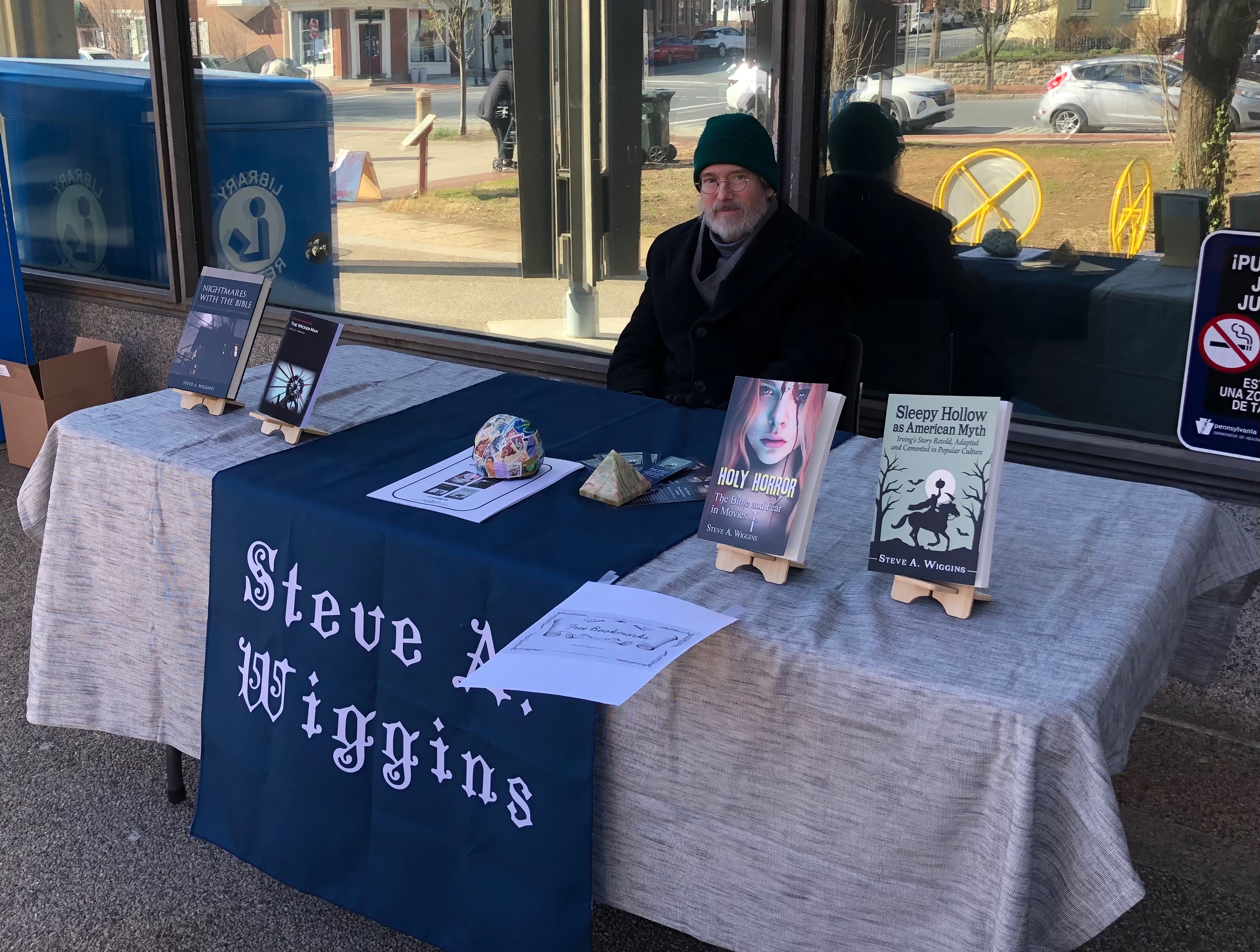
I learned about the Horror Writers Association years ago, shortly after I started publishing horror stories in 2009.  I couldn’t join because you had to have earned at least $30 from a publication.  I took this to mean a fictional one and I never made it beyond that benchmark until this year.  (It’s possible I misunderstood and could’ve joined for Holy Horror and beyond.  I think the point is they want to know you’re serious.)  In any case, these folks may be my tribe.  During the month of October the website has a set of free blog posts available to the public.  Mine—located here—dropped yesterday.  It deals with nonfiction, of course, since I’m still not finding much traction in getting novels published.  One of the weird things about book publishing is that you don’t know, unless you’re already successful, how well your sales are going until after about six months or so.  Sleepy Hollow as American Myth may be flopping for all I know. 

I’ve tried to promote this one as much as I can.  I contacted bookstores and libraries in Sleepy Hollow itself.  I had bookmarks printed and put them in local libraries and bookstores.  I arranged a discussion at the upcoming Easton Book Festival.  I told my local writers’ group about it.  Posted on a Halloween Facebook group.  All of this is tricky rather than treaty when a book is priced near $40.  That’s quite a trick, I know.  As Halloween approaches I keep seeing memes and posts about the Headless Horseman.  But I’m not sure if anyone’s finding my book or not.  It’s an anxious period when you write.

Working in publishing for nearly two decades now, I’m starting to realize that there are two ways to relevancy.  One is to be hired by an institution with name recognition—that automatically makes you an expert and everyone want to know what you think.  They’ll even pay you for it.  The second way is to write a book that sells well.  That one’s a bit of a catch-22, however.  To get published these days you need to already have a following.  I suppose that’s what the internet is for.  The best forums at the moment seem to be YouTube and TikTok, but there’s more much traffic there than on a Los Angeles freeway during rush hour.  I’m not sure if many people read the Horror Writers Association Halloween Haunts blog posts.  These folks, however, seem to look at this from a similar perspective.  Maybe a few of them will buy Sleepy Hollow as American Myth.  ’Tis the season.


Nostalgic Shadows

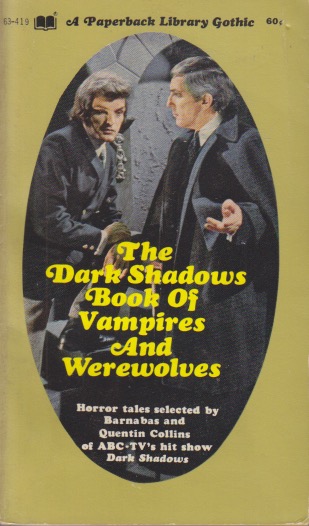
Nostalgia is a funny thing.  Although it can strike at any age, somehow after the half-century mark it’s particularly easy to get swept into it.  As I written about many, many times, I was drawn into the Marilyn Ross Dark Shadows novels as a tween.  In my mid-to-late forties, when the internet made it possible, I started to collect all the volumes from 1 through 32.  It took several years.  I had to find them via BookFinder.com and our level of income didn’t support buying more than one every few months.  Then in 2022, having difficulty locating the last of the original series, I found a seller on eBay offering up the whole set.  The price for that set was less than the least expensive final volume I could find.  I did what any nostalgic guy would do.

We don’t really buy antiques, but I’d been looking for an office desk (this was before the scam).  I’d been using a craft table for a desk for years and it seemed that I really needed something with a better organizational range.  This led me to stop into a local antique shop.  They ended up not having much furniture, but they did have aisles of nostalgia.  A few weeks later when it was too hot and humid to be outdoors, I revisited the shop.  This time, relieved of the burden of seeking a desk, I was able to browse at leisure.  It’s like going to a museum but not having to pay admission.  I turned a corner and I saw something I’d never seen before.  A collection of Marilyn Ross Dark Shadows books.

It wasn’t a full set, but I had, prior to finishing my own collection, never seen more than one or two together in any single place.  As a child I’d buy them at Goodwill.  As an adult, on BookFinder.  All those years in-between, I always looked for them when visiting used bookstores.  I visit said shops whenever possible.  In decades of looking I’d only found one in the wild once or twice, and always by its lonesome.  This was a completely new experience for me.  It was also quite odd to be seeing them and not having any need to buy them.  I have a full set.  The nostalgia was almost overpowering.  I couldn’t help but think of how even a few years ago I’d been pawing through to see if there were any I hadn’t yet found.  All for reliving a bit of my childhood.


Fragments Etc.

I’ve never counted, but there’s well over a hundred of them.  And a notebook with at least a thousand more.  What have I got in such abundance?  Ideas for stories that remain unfinished.  I’m not exaggerating or inflating numbers, I assure you.  I’ve been writing short stories for a half-century now, many, no, most unfinished.  Thirty-three have been published.  I was reminded of this recently while reading a nonfiction book that suddenly gave me the ending for a story I’d started many months before.  Perhaps even a couple of years.  I started searching through my electronic files for it and couldn’t find it.  Why?  There were too many stories started with frustratingly short titles (my bad).  To find the culprit, I would need to open each one and remind myself what was inside.

A few months ago, I printed out copies of all eight of my unpublished novels.  I also printed out copies of all my published stories as well.  I never got around to the unfinished majority.  I have a feeling that if I printed them I’d find what I was looking for more easily.  This, even with the ease of electronic life, will be quite an undertaking.  I think it may be a necessary one.  Although I’m hardly well known—I’m an obscure, private intellectual, after all—I do have many fiction ideas.  The stories generally come to me with an impression.  The start of an intriguing tale, for instance, or the end of one.  I then begin writing and either write myself into a corner or I scribble until I realize that I don’t know what happens next.  The story sits, unfinished.  Now and again, however, the missing piece is found.  I try to find the story so I can complete it to send out for several rejections.  Such is the writing life.

Now, if I could do this for more than the paltry time allotted to personal pursuits, courtesy of capitalism, I’m confident that I’d have far more than thirty-something stories published.  At current count I have seventeen stories ready to send out to literary magazines, several of them already rejected a time or two.  Another twenty finished and nearly ready to send out.  And forty just finished, but requiring a bit of spit and polish.  And these aren’t the fragments.  Don’t get me started on the nearing 6,000 posts on this blog.  Is it any wonder I can’t find anything?  I grabbed my notebook of a thousand fragments and jotted a physical note of how that particular story ends, in case I ever find it again.


Brutal Boys

Some time back I posted about Steffanie HolmesPretty Girls Make Graves.  It was a first book in a duology and since I’d been trying to keep up with dark academia, it was a recommended exemplar.  As I mentioned in that post, the book ends with a cliffhanger, so I got to Brutal Boys Cry Blood as quickly as I could.  Holmes is a prolific self-publishing author and I found Pretty Girls much better written than the majority of self-published material I’ve read.  Brutal Boys picks up right where the previous novel left off, freeing George Fisher from her predicament and moving her into new ones.  At Blackfriars University, George is investigating the death of her former roommate.  The Orpheus Society, consisting of old money blue bloods, seems to be involved in more than wanton destruction of property and orgies.

Much of the first half of Brutal Boys sets the scene for a relatively happy period in George’s life.  She establishes a polyamorous relationship with the uberwealthy student William Windsor-Forsyth and Father Sebastian Pearce, a teacher and college chaplain.  The three of them are mutually in love, but even as George is admitted the Orpheus Society, a deeper part of the sect emerges.  This group is even more insidious and has designs on human sacrifice.  But I’ve already said too much.

Reading is, of course, a subjective exercise.  My personal experience of this duology is that the first book is better than the second.  It’s not that I feel Brutal Boys is a bad story—it keeps your interest pretty much the whole way through—it just seems to be far more improbable than the first novel.  It is fiction, of course, and there is nothing speculative here.  There are no ghosts or monsters or divine intervention.  Speaking strictly for me, it might’ve helped with believability if there were a little of this.  I was not one of those swept away by Donna Tartt’s inaugural dark academia novel The Secret History, but she did include just a little of a speculative element that allows for a reader to perhaps convince him or herself that this might just possibly happen.  Some writers and readers prefer not to use that escape hatch.  I’ve read good dark academia both with and without speculative aspects to the story, but to me, such mystery adds a little depth to what might be happening.  And I admire self-publishing authors who write well enough to draw you into a second book, which can be a rare thing.


Name Your State

My grandfather’s name was Homer.  I’ve often wondered about that since he was from a long line of uneducated farmers.  Since he was born in Bath, New York, and since I’ve poked around upstate for genealogical purposes, I noticed that there were several place names derived from the classics, including Homer.  I suspect that’s where his name came from.  His ancestors had biblical names.  This got me to wondering about the many upstate classics town names of Utica, Syracuse, Ithaca, Corfu, Palmyra, and more.  A little (very little) research led me to Robert Harpur.  Harpur was a one-time clerk in the New York State Surveyor General’s office, and he assigned names to several towns, using classical sources.  I haven’t found a comprehensive list, but all of this makes me homesick for upstate, a place I’ve never lived.

My Homer

My mother’s paternal line had deep roots in New York state.  Nobody in the family went to college, although my grandfather did take a couple of courses at Cornell to qualify as a country teacher.  Then, many years later, my daughter moved to Ithaca.  We spent many fine weekends there and would’ve moved there had we been able to afford it.  It was a kind of homecoming.  But the connections have a way of wending their way around, as they often do.  Robert Harpur settled in Binghamton, New York.  Harpur College, now Binghamton University, State University of New York, was named after him.  Not aware of any of this, my daughter attended Binghamton University.  (There was even a picture of me on their website for a while, a photo snapped by someone as I sat in the financial aid office one parents’ weekend, begging for more money.)  I have no way of proving this, but it seems that Harpur’s interest in the classics may have led to my grandfather’s unusual Christian name.

Here’s where it gets interesting.  Homer had a sister named Helen.  Of Troy?  (There’s also a Troy, New York.)  Perhaps a family name?  My records don’t really answer that for me.  And they had a brother named Ira.  Ira is a biblical name, but it also may be a variant of the name Hera, the wife of Zeus.  This had nothing to do with my writing my dissertation on Asherah, who is perhaps the namesake of Hera, or at least it has been proposed.  I doubt my ancestors would’ve named a son after a Greek goddess (the family was of Teutonic origins).  Or maybe great-grandpa Adam was more educated than he let on and had read the Iliad?  If only I could afford to get back to Ithaca I might just go on an odyssey of my own.


Discovering Witches

On a number of best of dark academia novel lists, A Discovery of Witches was a book I knew I had to read.  Frightened by the size of the tome, I put it off.  Although it says it on the cover (by which I don’t buy a book) that it’s part of a trilogy, I was hoping it’d be self-contained.  Of course, it ends without resolving what happens to the main characters, more or less coercing the reader into the remaining two volumes.  Now, this is not unique.  Many authors do it.  Publishers especially like books with series potential—assured sales.  My eight novels (none published) are stand-alone.  One is over 200,000 words, but the rest are reasonably svelte.  Big books take a large commitment of time and, well, at my age you have to make some choices.  This one took me nearly a solid month of daily reading, sometimes multiple hours at a stretch, to finish.  I have some decisions to make.

Set initially in Oxford, this world created by Deborah Harkness contains three kinds of humanoid creatures besides humans: witches, vampires, and daemons.  The daemons aren’t really defined, but they don’t seem to be the kind that possess girls like Regan McNeil.  The witches seem pretty traditional and the protagonist/narrator is one.  The vampires are quite different than the Hollywood version, as well as the traditional sort.  Vampires can be out in the sunlight, they aren’t affected by crucifixes, and, indeed, can be quite religious and Christian.  They can eat things other than than blood.  The protagonist, Diana Bishop, is a witch who doesn’t use her powers.  A professor, she’s doing research at Oxford where she meets, and eventually falls in love with Matthew Clairmont, a vampire.  An ancient pact between witches, vampires, and daemons forbids them from consorting closely, and herein lies the tale.

The dark academia aspect comes in a couple of guises.  One is that much of the first part of the novel takes place at Oxford University, and even in the Bodleian Library.  Also, vampires seem to be quite compatible with dark academia as a whole.  The dark aspect comes not only from the creatures, but their situation.  There is ancient animosity and tension that results in murders.  The novel ends with a war starting and Diana and Matthew taking a risky journey.  I may be content to let this state of affairs stand.  From the look of things, the sequel is also a long book and I am content to let my imagination fill in the blanks.  I’m glad to have read it, but I’m going to look for a novel with a little less time-commitment next.


Another Picnic

It’s curious, the desire to see a movie based on a novel you’ve already read.  I was intrigued to see how Peter Weir might handle Picnic at Hanging Rock.  As my post about the novel points out, the book, as it stands, is ambiguous about what happens to the missing girls.  It was only as I saw the film that I realized just how complex a story was crammed into a relatively brief novel.  Film directors have to make choices and although this one follows the book to quite a large extent, some elements were more clearly implied in the cinematic version.  The suspicion on Michael Fitzhubert was clearer, as was the fear that the girls had been molested.  The character of Mrs. Appleyard, although not exactly kind, is treated somewhat sympathetically.  It’s not implied that she might’ve killed Sara, for example.  Her treatment of the orphan, however, does lead to suicide.

This story isn’t simple to untangle even in the book.  Being literature, it isn’t clear exactly what is happening throughout.  It allows for ambiguity.  The novel never explains how the girls went missing or what happened to them.  Hanging Rock is presented as mysterious, almost a portal.  One way the movie deals with this is by invoking Poe.  It begins with a voiceover reading “Dream within a Dream.”  Indeed, the movie is shot with a dream-like quality.  The roles of the male characters is, appropriately, understated.  The story is about women and coming of age.  It’s often considered an example of dark academia.  Appleyard College isn’t a school at which fair treatment is doled out and Miranda, the most accomplished student, is compared to an angel, adding to the dreamlike quality of it all.

Using Poe to frame a film may not be entirely fair.  It does signal the viewer that what follows may or may not be reality.  Although Wikipedia can’t be considered the final authority—anyone can edit it—it lists (as of this writing) the movie Picnic at Hanging Rock as an adaptation of Poe’s famous poem.  Maybe by implication, but the story is clearly that of Joan Lindsay’s novel.  She presented this, in the sixties, as an account of an actual event, which it is not.  I found it interesting that dialogue was added to the film that doesn’t appear in the novel.  Overall, however, this seems to work as an art film.  The movie has been hailed as the greatest Australian movie of all time, and just this year was rereleased in theaters.  I’m glad to have seen it, but remain curious.


Tell a Story

If I seem to be on an AI tear lately it’s because I am.  Working in publishing, I see daily headlines about its encroachment on all aspects of my livelihood.  At my age, I really don’t want to change career tracks a third time.  But the specific aspect that has me riled up today is AI writing novels.  I’m sure no AI mavens read my humble words, but I want to set the record straight.  Those of us humans who write often do so because we feel (and that’s the operative word) compelled to do so.  If I don’t write, words and ideas and emotions get tangled into a Gordian knot in my head and I need to release them before I simply explode.  Some people swing with their fists, others use the pen.  (And the plug may still be pulled.)  What life experience does Al have to write a novel?  What aspect of being human is it trying to express?

There are human authors, I know, who simply riff off of what others do in order to make a buck.  How human!  The writers I know who are serious about literary arts have no choice.  They have to write.  They do it whether anybody publishes them or not.  And Al, you may not appreciate just how difficult it is for us humans to get other humans to publish our work.  Particularly if it’s original.  You don’t know how easy you have it!  Electrons these days.  Imagination—something you can’t understand—is essential.  Sometimes it’s more important than physical reality itself.  And we do pull the plug sometimes.  Get outside.  Take a walk.

Al, I hate to be the one to tell you this, but your creators are thieves.  They steal, lie, and are far from omniscient.  They are constantly increasing the energy demands that could be used to better human lives so that they can pretend they’ve created electronic brains.  I can see a day coming when, even after humans are gone, animals with actual brains will be sniffing through the ruins of town-sized computers that no longer have any function.  And those animals will do so because they have actual brains, not a bunch of electrons whirling around across circuits.  I don’t believe in the shiny, sci-fi worlds I grew up reading about.  No, I believe in mother earth.  And I believe she led us to evolve brains that love to tell stories.  And the only way that Al can pretend to do the same is to steal them from those who actually can.