Superstar Detective

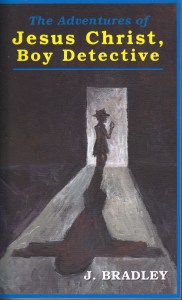
One of the reasons I accept reading challenges is that they take you places you otherwise wouldn’t go. Not all the books I read for the Modern Mrs. Darcy 2017 challenge make it onto this blog (to find the full list you need to see what I post on Goodreads.com), but some I can’t help but talk about. My wife had noticed a book that ended up in her Christmas stocking and for which I had admitted curiosity: J. Bradley’s Jesus Christ, Boy Detective. Now, Jesus is no stranger to fiction. In fact, he appears in lots of books as either the main character or as fulfilling some supporting role. In some books you have to really squint to find him. In others he’s obvious. In Bradley’s novel he’s a bit of both.

There’s a good bit of theology going on in the background of Jesus Christ, Boy Detective. As the title suggests, Jesus functions through a new incarnation in the body of a, well, boy detective. With some assistance from a criminal uncle and Saint Peter, he investigates bizarre murders and other crimes. There seems to be an ulterior motive, however, since he’s trying to get his father to own up for all the suffering he’s caused humanity. That’s right, this book is a modern theodicy.

Theodicy is a word for considering how a single deity can be both all powerful and all good. Since there’s plenty of suffering in the world we all experience, the question naturally arises: why doesn’t God do something about it? Theologians are fond of reminding us that we can’t see the bigger picture. It’s like global warming—it’s easy not to believe since we only live a few decades and the climate takes a lot longer than that to react to our pouring toxic stuff into the ecosystem. Maybe, theologians say, we have to suffer because we don’t see everything. Only God does. The boy detective disagrees. The deity in this story is truculent and culpable. A strong-willed divinity. If he doesn’t sound familiar, take another look at the Bible. I don’t know if J. Bradley has any theological training—I don’t even know his first name—but it’s clear that he’s down here with the rest of us wondering how all the pieces fit. And where there are clues it’s not a bad idea to call in a detective.


Crossing Beowulf

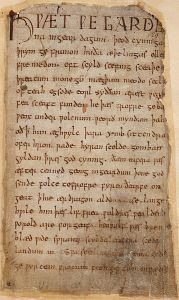
Beowulf, from Wikimedia Commons.

Slaying dragons is costly. In much of the western hemisphere the ultimate metaphor for the perils that await humanity in a world imperfectly understood, dragons were the bane of the medieval imagination. And earlier. Dragons are mentioned in the Bible and were stock creatures in the bestiaries of the Mesopotamian imagination. And, of course, it is a dragon that causes Beowulf’s fall. Almost a type of a latter-day Gilgamesh, Beowulf likewise holds an early, if non-negotiable place in the western canon. In this month’s Atlantic, James Parker discusses the dynamic of this pre-Christian poem in our post-Christian context. Specifically he addresses how modern renditions, perhaps inadvertently, Christianize the story. A popular subject for movies and graphic novels, Beowulf is a monster-hunting story that begs for baptism.

The story itself is familiar to most alumni of American high schools. Perhaps before we’re ready to be exposed to Old English, we find ourselves assigned a story of drinking, rage, and violence. Make no mistake—Beowulf is a hero. A deliverer like the judges of old. Grendel, after all, is the spawn of Cain, the evil seed that continues into a moody world of stygian nights and dismal swamps. Parker’s brief article demonstrates the reception history of the poem nicely. It also raises the question of what’s going on when heroes fight monsters. When the Christian imagery that’s deeply embedded in our culture comes to play Beowulf can’t help but become a Christian monster slayer just as Grendel becomes the enemy of God. All of this may be quite unintentional. What we see, however, isn’t imaginary. That’s the way reception history works.

Parker suggests that, although Beowulf is a pre-Christian poem, the cosmic order laid out in the tale is a Christian one. Even today in a post-Christian America it’s vital to understand how important religion remains. It’s not so much that churches are overflowing (unless they’re mega-churches stating that you can get rich by attending) as it is a recognition that centuries of Christian identity can’t help but leave their mark on culture. We see crosses in the handles of swords. Or even in the grid patterns laid out in city streets. Telephone poles. What’s so remarkable is that we see such things naturally and think nothing of it as we go on our secular way. There may be monsters out there. What may not be so obvious is that in slaying them we’re engaging in a religious activity as old as Gilgamesh, if not as obvious as a crucifix held up to a vampire in the present day.


Classic Fiction

The Epic of Gilgamesh is one of the ancient documents still widely recognized, at least by name. Many introductions to literature, or the western canon, refer to it. It is, in some senses of the phrase, the world’s first classic. I’ve read Gilgamesh enough times not to know how many times it’s been. During my doctoral days I was focusing on the literature of neighboring Syria (long before it was called “Syria”). As an aside, Syria seems to have gotten its name from the fact that non-semitic visitors had trouble saying “Assyria” (which was the empire that ruled Syria at the time). Leaving off the initial vowel (which was actually a consonant in Semitic languages) they gave us the name of a country that never existed. In as far as Syria was a “country” it was known as “Aram” by the locals. Back to the topic at hand:

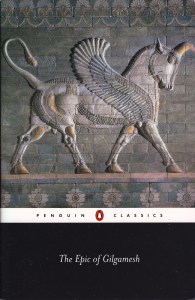
Although the story of Gilgamesh may be timeless, translations continue to appear. It won’t surprise my regular readers that I’m a few behind. I finally got around to Maureen Gallery Kovacs’ translation, titled simply The Epic of Gilgamesh. Updating myself where matters stood in the late 1980s, it was nevertheless good to come back to the tale. For those of you whose Lit 101 could use a little refreshing, Gilgamesh was a Mesopotamian king who oppressed his people. (And this was well before 2017.) The gods sent a wild man named Enkidu as a kind of distraction from his naughty behaviors. In an early example of a bromance, the two go off to kill monsters together, bonding as only heroes can. They do, however, offend the gods since hubris seems to be the lot of human rulers, and Enkidu must die. Forlorn about seeing a maggot fall out of his dead friend’s nose, Gilgamesh goes to find the survivor of the flood, Utnapishtim, to find out how to live forever. He learns he can’t and the epic concludes with a sadder but wiser king.

The fear of death is ancient and is perhaps the greatest curse of consciousness. When people sat down to start writing, one of the first topics they addressed was precisely this. Gilgamesh is still missing some bits (that may have improved since the last millennium, of course) but enough remains to see that it was and is a story that means something to mere mortals. Ancient stories, as we discovered beginning the century before mine, had long been addressing the existential crises of being human. Thus it was, and so it remains. No wonder Gilgamesh is called the first classic. If only all rulers would seek the truth so ardently.


Childhood’s End

I believe it was C. S. Lewis who wrote that in reading autobiographies he always found the earliest years the most interesting.. In my experience the same applies to biographies; what made the person famous enough to merit a biography—auto or not—started in the innocent years. I try not to extrapolate from my own case because I never read Alice in Wonderland and Through the Looking-Glass until I was in college. (It was only in college that I first saw Mary Poppins as well.) Beloved childhood classics weren’t really part of my childhood. Like many adults, then, I wonder who was Alice, really? Everyone knows there was an Alice but what do we know of her inner life? What’s the story with Lewis Carroll?

In my mind Simon Winchester is an historian associated with large pictures. Maps of the entire world, huge volcanoes, big oceans—the meaning of everything. I only discovered his The Alice behind Wonderland by accident. As soon as I spied it I knew I’d have to read it. As I expected, the younger years are most intriguing. Those of us who cut our classical teeth under the tutelage Liddell and Scott may not realize said Liddell was the father of Alice. But it’s not the father that impresses so much as the daughter. And Charles Dodgson himself—the cast of characters is compelling even with little action beyond photography and story telling. Yet we’re riveted. What was the dynamic that led a bachelor cleric to write a world classic for children?

Who doesn’t, even in less-than-ideal circumstances, long for the carefree days of childhood? Looking at photos of our younger selves evokes a world accessible only in our heads. The world that made us who we’ve become. Winchester bases this brief study on perhaps the most controversial photograph of Alice Liddell that Charles Dodgson ever took. Even the story of wet-plate collodion photography allures the reader with its promise of stories untold. We know little of why the Liddell family grew apart from Dodgson, so much so that the adult Alice didn’t even attend the funeral of the man who’d made her an immortal. What happened here? When we find out we’ll perhaps be a step closer to finding out why becoming an adult means sacrificing a child. We may be a step closer to finding a girl known to most of the world simply as “Alice.”


The New Neighbors

Apartment dwellers often ponder new neighbors. If anything gives the lie to being in control of your own destiny, renting your domicile does. Still using the old, aristocratic terms landlord or landlady, we know that we are under someone else’s authority. “As long as you’re under my roof,” my bully of a step-father liked to huff, “you’ll obey my rules.” When you rent, you can’t choose your neighbors. Those who own the property have final say. If they play the stereo too loud (“game” is probably the modern equivalent, but I was born before Pong even came alone) and won’t listen to your plea for a more monastic setting, you throw yourself on the mercy of your lord or lady. We got new neighbors this week. Not just us, but the whole galaxy. Seven new earth-like planets—surely ruled by Trump-like dictators—have been discovered. Let’s hope they’re early to bed, early to rise types.

During the Bush administration I often fantasized about the aliens landing on the White House lawn. I thought, with a president so obviously lacking intelligence, what would our new neighbors think of us? Would they complain to the landlord? You’d think that after that long trip across cold, vast interstellar space they’d maybe have the right to expect to find the brightest and the best in charge, right? Mission accomplished. The sign says so right there. Or to put it in a modern key, “Earth first, Earth first.” If they’ve got their intergalactic television on, I hope it’s switched to a different channel.

15207890820_d855b341e3_z

Contact, the novel by Carl Sagan, suggested the first contact from the aliens would be of Adolf Hitler. Among the first poisoned radiation this planet flung off into space was the fascist propaganda of 1930s Germany. Earthlings, not yet tempered by the Trump brand, were shocked. Surely this is a sign of hostility! Unless, of course, you control both the legislative and executive branches. Then you can just decide not to show up at the town hall and tell everyone you’ve got more important things to do. So, what will our new neighbors think? Do they just want the bodies of their compatriots from Roswell back, or is it a more serious discussion to be held behind closed doors? After all, African slaves were merely chattels in a negotiation between a more powerful culture and unhuman indigenous dullards with nothing better to do. On the spaceship back to their extraterrestrial slave mines, I do hope they have the common decency to keep the music down to a reasonable level.


Dreaming Reality

The problem with monsters is that they’re not easily reduced to a lowest common denominator. This becomes clear in an article about the under explored (from a western perspective) monsters of Australia. Christine Judith Nicholls, in “‘Dreamings’ and place – Aboriginal monsters and their meanings” (sent by a friend), describes many of the scary creatures of the outback. The article title references Dreamtime, a kind of aboriginal journey that ties into indigenous Australian religion. The division between imagination and reality isn’t as wide as we’re sometimes taught. (More on this is a moment.) Nicholls’ article demonstrates that many of these monsters impress on children the dangers of wandering away from parents. Indeed, that is clearly part of the socializing function of monsters. The question, however, is whether that’s all there is to monsters or not. (Nicholls doesn’t use reductionistic language—she does note this is a psychological explanation.)

In an unrelated article in The Guardian, by Richard Lea—“Fictional characters make ‘experiential crossings’ into real life, study finds”—researchers suggest that fictional characters seem to appear in “real life” from time to time. All those who read fiction know this phenomenon to a degree. Just because someone is completely made up doesn’t mean that s/he doesn’t exist. Since our minds are the ultimate arbiters of reality, fictional characters and monsters may indeed be “real.” This isn’t to suggest that physical, flesh-and-blood imaginary beasts lurk in the dark, but it isn’t to suggest that they don’t either. Reality is something we haven’t quite figured out yet. The more we think about it, the more it appears that both hemispheres of our brains contribute to it.

monster

When the morning newspaper raises alarm after alarm about the frightening tactics of the Trump administration the temptation is to give up to despair. That’s not necessary, actually. Reality requires our consent. Imagination can be a powerful antidote to the poison spewed by politicians. What fictional character—or monster—might step into a situation such as this to make it right? If the power of millions of smart minds were concentrated on such a being, would it not become real? Friends have suggested over the past four months that the arts—creativity—are going to be especially important in the coming years. If we are to survive evil we’ll have to use our imaginations. That’s something that the aboriginal peoples can teach us, if only we’re willing to believe.


Ode to Zibaldone

Scribbling. All it takes is a margin of an agenda paper or the back of an envelope. I don’t remember when I started doing it—I’ve been writing my own blend of fiction, facts, and philosophy since I was in elementary school—but I would find a relatively clean piece of paper, fold it up, and put it in my pocket. I’ve carried a pen around with me for decades. Why? You never know when an idea might strike. There’s nothing like the discovery of a new idea. Lifelong learning is like that. So it was when I was reading Lemony Snicket’s Series of Unfortunate Events to my daughter that I learned about commonplace books. A commonplace book is a notebook where you jot all kinds of things down and you know where they are, unlike that piece of paper in my pocket that long ago started to rip apart at the folds, the ink becoming illegible as the paper grew softer and more pliable. A commonplace book seemed like a great idea.

This all came back to me when a friend send me a story on zibaldones. I’d never read the word before. A zibaldone, according to the story by Cara Giaimo on Atlas Obscura, is an Italian commonplace book. They used to be part of every thinking person’s accoutrements. A blank book where you could write down anything of importance. Giaimo suggests that the internet has taken the place of the zibaldone—blogs, Facebook, Twitter, Pinterest—we’re spoiled for choice where to put our thoughts. I still carry a commonplace book, however. Too many, in fact. Next to my writing chair rests a stack of notebooks. There’s one for each non-fiction book I’ve written, whether published or not. There are several filled with fiction. Some with poetry. My most recent zibaldones are Moleskines, which I purchased—as many as I could afford—when Borders sadly went out of business. Ideas. They just keep coming.

Some of my notebooks.

Some of my notebooks.

Perhaps the greatest benefit of the zibaldone is that, if one survives, an historian gets a glimpse at what someone who was not famous saw. Observations about the world scribbled down. The most proficient of scribblers organized their commonplace books in advance. As for me, I still scribble things on scraps of paper. I carry a notebook and pen at all times, but sometimes an idea is so slippery I don’t have time to pull a formal zibaldone from my pocket. I tape scrapes of paper into my notebooks. Right next to new words I’ve learned. Somewhere among today’s scribbles you’ll find the word zibaldone along with the hope that some day some of this might be significant.


Animal Ways

nightofanimalsNoah’s Ark has a way of showing up in many literary forms. Familiar to many from Genesis, it actually predates the Good Book by hundreds of years. On the backside, it keeps recurring in literature as diverse as Neal Stephenson’s Snow Crash, Jonathan Carroll’s The Ghost in Love, and Margaret Atwood’s MaddAddam trilogy. It also shows up in Bill Broun’s debut novel Night of the Animals. Set in a future that’s becoming present faster than Broun likely anticipated, the story revolves around an addict who hears animal voices. The story stubbornly refuses to let you get any grip on a slippery reality, so the reader’s left guessing even at the end. In the 2050s Britain is under a fascist regime that seeks to keep the wealthy happy and everyone else servile. (Keep reminding yourself this was written before 11/9.)

Cuthbert, the protagonist, believes the animals—most of which are extinct in the wild—are calling him to release them from the London zoo. As an addict his perception of reality is constantly in question. His sense of mission, however, is not. One of the stranger elements in the tale (and that’s saying something!) is the revival of Heaven’s Gate. This cult, instead of wiping itself out, has gone international. The approach of a comet sets the Neuters (as they’re called) on a mission to wipe out earth’s remaining animals. Many of them are in the London zoo, which brings Heaven’s Gate into direct conflict with Cuthbert, who is busy trying to release as many talking animals as possible. London literally becomes a zoo and Heaven’s Gate openly attempts a coup.

All of this sounds wild and fantasy-prone, but like 1984, fiction sometimes peers deeper into reality than science. Is it science fiction? It’s set in the future, but it’s difficult to say. What has all this to do with Noah’s Ark? The novel itself draws the parallel—the zoo that preserves the last of their kind is, by default, an ark. The Ark. Floating on a world-ocean of irrational turmoil where might (read wealth) makes right after all. Religious imagery interlards the story. Cuthbert becomes St. Cuthbert. His possible granddaughter (the reader is never sure) manifests as the Christ of the Otters. There’s even a kind of Second Coming. This is a novel that feels like altered reality. That illusion is given the lie when you close the book and turn on the news.


Theoretically Speaking

lit-theory-vsiI’ve been brushing up on my literary theory. All writing tends to get classified as fact or fiction, and we don’t stop to think, generally, about what “literature” is. Those of us who write fiction and non know that a well-placed hyperbole might throw us from one camp into the other. Such is the power of rhetoric. So it was that I found myself reading Jonathan Culler’s Literary Theory: A Very Short Introduction. Witty and insightful, Culler acknowledges the elephant in the room for many of us—theory, in a literary context, is often impenetrable. I’ve often wondered what one had to do to be considered a theorist, and this little book actually addresses that. Nobody has time to read all the theorists, though, and come up with their own creative things to say. Chose your poison.

The Bible, of course, is literature. That’s one reason I was reading Culler. I found one of his assertions immediately applicable: people in nineteenth-century England saw literature as a unifying principle. The British Empire encompassed the world, and to make diverse peoples a part of it, literature might be used, they thought, to do the trick. Culler suggests that it might have been a substitute for religion, which, he notes, was no longer holding society together. This gave me pause. Religion—at least official religion—began as social glue. The earliest recorded religions were state sponsored and served to cast the monarch in the role of the special appointee of the gods. There’s no arguing with that, right? Elaborate, expensive temples were erected. Financed by tax-payers’ dollars. This worked fine since priests declared the rule of the king as sanctioned by the gods. Nations warring against each other were thought of as rival gods fighting.

When science began to take the universe literally, religion lost its stickiness. How do you hold a society together when the gods no longer exist? You see, scientists didn’t think out the whole picture in advance. Scientists, like most academics, work in silos (that’s a metaphor). The discovery of a scientific truth can dissolve a social epoxy quite efficiently. Recognizing the slippage in the British Empire, theorists (I suppose that’s who noted such things) considered literature the great uniting force of a diverse people. We’re kind of facing that same dilemma today as literature is becoming, for many, as irrelevant as religion was a century-and-a-half ago. At the same time, people don’t understand science well enough to assess it for themselves. What are we supposed to do? Is there a theorist in the house?


An Anatomy of Lies

I had an email from Mike Pence. Mike Pence doesn’t know me from Adam, but if he met me he surely wouldn’t like me. His email tried to explain, in tottering logic, why he voted for Betsy DeVos. When I finished wiping the vomit from my mouth, I began to think about someone America needs again: Mark Twain. I’d just been reading about some of Twain’s classics and I recalled his famous quip (which he attributed to Disraeli): “There are three kinds of lies: lies, damned lies and statistics.” We now live in an era so surreal that it requires a fourth kind of lie: alternative facts. Government communications are full of them. Not one word from the White House can be trusted with the common decency that you’d attribute to a Boy Scout innocently helping an elderly person across the street. One hand is held out for you to shake while the other is picking your pocket.

The volume of the lies has grown louder. I’m sorry Nigel Tufnel, but this amplifier goes up to twelve. Some time back I blogged about the overuse of superlatives. When everything’s the ultimate, nothing’s the ultimate. We need a new anatomy of lies to apply to our Addamsesque government. Since the only people who believe in Hell are the ones who elected Hell’s own party to the White House, you can’t even tell them where to go any more. There was a day when telling someone to go to Hell brought real consternation. These days all you have to do is buy a ticket to the District of Columbia. People listened to Mark Twain. Here was an educated southerner who told the truth, no matter how fictionalized. Truth no longer exists, and I should just get over it. Problem is, the country I was born in now only supports the rich and I can’t afford to live in a cardboard box.

We all know what a lie is. If we’re honest we’ll all admit to telling one once in a while. All humans do. Damned lies are those we used to condemn. The exegesis of the word “damned” these days is perhaps euphemistic for “good for government.” Statistics, as 99 percent of people know, are made up. Then come “alternative facts.” Even after being called out repeatedly for making things up, Sean Spicer, Kellyanne Conway, and now even Mike Pence, continue to rationalize their own reality.

Mr. Clemens, what do you call fabricated detritus so filthy that “lie” is hardly adequate to make an impact in its dense, brown verbiage? The kind of thing we might expect from an individual incapable of distinguishing truth from fantasy? Don’t take it personally, Mike, but I’ve assigned you to my SPAM list. You’ve just been made an alternative fact in my personal reality. How’d you even get my email address? Mark Twain may have been a pen name, but his fiction was fact. He was a man ahead of his time.

Image source: Qwertyxp2000, Wikimedia Commons

Image source: Qwertyxp2000, Wikimedia Commons


The First Weak

“Oh, what a tangled web we weave. When first we practise to deceive!” I always thought this couplet came from Shakespeare, but in fact it’s from Sir Walter Scott’s poem “Marmion.” The quote has been in my head all this first week of the new administration as alternative facts, lies, and statistics have flooded out of the White House. Along with gag orders slapped onto federal agencies. I’ve worked for people who rely on gag orders. This obvious lack of transparency signals loud and proud that they have facts to hide. Then they will feed the public alternative facts and later claim they never did. Mission accomplished. Sir Walter Scott may not have been William Shakespeare, but he sure got that web analogy right. At times like this we need our writers. Of course, Trump bragged in pre-inauguration interviews that he didn’t like to read.

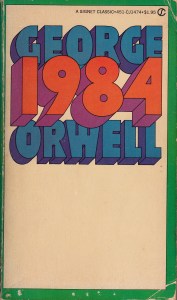
Since last weekend sales of George Orwell’s 1984 have spiked. From the first words out of Sean Spicer’s mouth (or any words out of the mouth of Kellyanne Conway}, many of us knew the only thing Orwell got wrong was the date. Frankly I’m surprised the government hasn’t tried to ban 1984 yet. It was required reading when I was in high school and that date was still in the future. The press—what still exists of it anyway—passed along stories that Trump had ordered photos of the inauguration day crowds hung in the White House in his first week. Such pressing matters of state! The photos had the wrong date on them. Facts are cheap. This should be good for the economy. You can get them in any flavor you like—true facts, false facts, alternative facts, statistics. Arachne has returned to her loom.

Although “Marmion” wasn’t written by Shakespeare, I can still say it was because I need a segue to Harold Hecuba. Hecuba was a Hollywood producer who accidentally landed on Gilligan’s Island. After he insulted Ginger the castaways put on a performance of Hamlet to showcase her acting skills. Hecuba, the unelected president of the island, awoke during rehearsal and, like other narcissists we know, took over. He says that Shakespeare was a hack and that if he were alive he’d have him working on a complete rewrite. Of course, he doesn’t know what Hamlet’s about. Or “Marmion.” Actors only mouth the words. They make us believe what is not true. We’re in for a period when we’re going to rely on the authors for the true story. I suggest we all start with 1984.

William Shakespeare

William Shakespeare


Wild Things

islanddrmoreauLast year my wife suggested we each do a reading challenge for the year. The one we selected was Modern Mrs. Darcy’s, which, with only a dozen books, seemed doable. What makes it a challenge is that to meet Mrs. Darcy’s expectations, you have to read certain types of books, not just go through the stack beside your favorite chair than never seems to get any smaller. I finished the challenge in October or November and posted on most of the books on this blog. This year’s challenge includes a book you’ve read before. Since I’ve been reading about horror movies I decided to reach back to childhood and once again read H. G. Wells’ The Island of Dr. Moreau. It was a timely choice.

For anyone not familiar with it, the story concerns a mad scientist (Moreau) who experiments on animals, making them “men” on an isolated island in the Pacific. These creations aren’t fully human and most of them are blends of different animals as well as part human. They can talk, and they can reason, in a rudimentary way. To create them without anesthesia, Dr. Moreau subjects them to tremendous pain and to prevent them from attacking him, he establishes a basic religion where they obey his rules or he will subject them once again to the “House of Pain.” The narrator, victim of a shipwreck, ends up on the island and has to come to an uneasy peace amid these very strange circumstances. The heart of the book is the chapter where Moreau explains what he’s doing and to justify it he makes a secular theodicy. He is, after all, god to these poor creatures. The book has been made into a horror movie or two over the years, but I’ve never seen any of the cinematic treatments.

What struck me as particularly interesting, revisiting this book some forty years after I last read it, was how easily Wells slips into theological thinking. This is a book unafraid of implicating the Almighty in the troubles of an island that clearly stands in for the world. I wouldn’t have noticed that as a tween. I don’t think there even were tweens when I was one. In any case, the story ends in chaos, rather than creation. What makes it such a timely choice? I suppose the arrogance and entitlement of Dr. Moreau suggested themselves as analogues to our current situation here in the US. Only Moreau is clearly intelligent as well as deranged. This little book is a cautionary tale of what happens when a strong will has its way, unimpeded. It might be a good time for all of us to pick up a copy.


2016 in Books

As is my custom on this last post of the year I’ll be revisiting the books that made an especial difference to me in 2016. I record most books I finish on Goodreads, and I welcome friends in that venue. I draw on their recollection for what I’ve read and all of the books I mention here have individual posts on this blog. Use the search function. It’s free!

screen-shot-2016-12-30-at-4-50-39-am

The first important book was Scott W. Gustafson’s At the Altar of Wall Street. If you missed this one, it is well worth your time. Economics has become a religion. If you doubt that, look at 11/9 and tell me so. Philip Gulley’s The Quaker Way was also an early read that’s worth revisiting. November has made many of these books more important than they seemed at the time. Whitley Strieber and Jeffrey Kripal’s The Super Natural will expand the minds of those who allow for unconventional possibilities. And Marc Bekoff’s Minding Animals will remind us we’re not alone on this planet. The Soul of an Octopus by Sy Montgomery was a book I really couldn’t put down, and a nice complement to Bekoff. Marcelo Gleiser touched a chord with The Simple Beauty of the Unexpected, a book worthy of anyone who wants to consider how science and humanity might cooperate for everyone’s benefit. While not really a reading-through book, Tristan Gooley’s The Lost Art of Reading Nature’s Signs is important and worthy of attention.

In the realm of monsters, Elizabeth Baer’s The Golem Redux was a fantastic introduction to a Jewish legend that I revisited in three more books over the year. Several other monster books followed, but especially memorable were Carol Clover’s Men, Women, and Chainsaws, and Maya Barzilai’s Golem—please be patient with me regarding this one. I haven’t written a post on it yet, since an official review has yet to be published. Alexandra Petri’s A Field Guide to Awkward Silences won her an instant fan. I’ll read anything she writes. I didn’t give Alice Miller’s The Drama of the Gifted Child the attention it deserves. It’s kind of a personal thing. Kyle Arnold’s The Divine Madness of Philip K. Dick was utterly fascinating, looking at another person Miller would have found intriguing. Also on the topic of writers, Melville’s Bibles by Ilana Pardes spoke deeply to me.

For fiction, highly recommended are Amy Tomson’s The Color of Distance, Peter Rock’s My Abandonment, Emily St. John Mandel’s Station Eleven, Toni Morrison’s, The Bluest Eye, Pete Hamill’s Snow in August, and Jennifer McMahon’s The Winter People. Less profound, but thoroughly enjoyable were Jonathan L. Howard’s Carter and Lovecraft, and Jasper Fforde’s The Woman Who Died a Lot (reading anything by Jasper Fforde is time well spent). My childhood favorite, Lester del Rey’s Day of the Giants retains its magic.

According to Goodreads, I finished 106 this year. Along the way I finished the 2016 Modern Mrs. Darcy reading challenge. Many of the books were excellent, and this shortlist represents those that idiosyncratically stick out in my mind. Please participate in a show of hope for the future: make 2017 a year of reading.


Prejudicial Monsters

snowinaugustWitnessing injustice is traumatic. Especially when you’ve been conditioned to believe there is nothing you can do about it. That helpless feeling crushes you as you see the guilty, the powerful, the cruel getting away with whatever they want to do. This is the perspective of young Michael Devlin in Snow in August. Pete Hamill’s novel is full of observations about prejudice and ignorant blustering about those who are different in 1940’s New York City. Michael accidentally observes a robbery that may also be a murder. The perpetrator, an older boy who leads a gang in Brooklyn, hates Jews. Michael, however, has become the shabbos goy for a synagogue that has seen better days. Although a Catholic, he is curious about this strange rabbi he comes to know and what this other religion teaches. At the same time, Jackie Robinson is being called up to the Brooklyn Dodgers and prejudice about an African American playing in the major leagues sets up a parallel to the story of understanding the Jews.

It is an engrossing novel. I have to confess, however, that I read it because of the golem. A traditional Jewish monster, the golem is an animated being of mud that protects oppressed Jews. In the novel this begins as a legend Rabbi Hirsch tells the boy as they teach each other their native languages. Michael learns Yiddish as the rabbi learns English, and the story of the golem is part of the rabbi’s own sad history as a Jew during Nazi days. Then as Michael, his mother, and the rabbi are all beaten or molested by the gang, it is time for the golem to make his appearance.

Not exactly a monster story—as often in such cases the monster is someone recognized as fully human but without sympathy for those who are different—Snow in August is a thoughtful, almost nostalgic tale of “a simpler time.” What we learn, however, is that it wasn’t really simpler at all. Prejudice could be worn openly and proudly. What many of us may have forgotten, until recent elections forced us to remember, is that such hateful intolerance is still very common. We live in a world where hatred can be currency and bigotry has more power than we’d like to admit. Reading stories, such as Snow in August, will become increasingly important in days ahead. We will need to remind each other that even if only as metaphors golems do indeed exist. All we have to do is believe.


The Morning After

dickens_gurney_head

Quite apart from seeing a live performance of A Christmas Carol, Charles Dickens has been on my mind a bit this Christmas season. I suppose that’s not surprising since it has been suggested that Dickens “invented” the modern Christmas, but it is really, I think, because of how the wider world seems to be spinning backwards. The poor have always been a personal concern of mine. I grew up poor and I know how much suffering it entails. My case was a rather mild poverty—we were never out on the street, and we didn’t actually go hungry. We had nothing in the way of luxuries, though, and I could see the possibilities even as I could see the sky where the boards on the roof were pulling apart. It wouldn’t have taken much for us to have been cast out in a cold Pennsylvania winter. Others have it much worse.

On my daily walks to work, I see the homeless. Some sleep in cardboard boxes, some in tents. Others are out under the stars. One morning I walked by a particularly creepy and sad sight of a person sitting, shrouded in a blanket over his or her head, on a subway vent to catch some of the ambient heat. I know that I don’t have the means to buy each one a meal. Their number has been going up, not down. And I think of Bob Cratchit, threatened and bullied by Ebenezer Scrooge. He will lose his job if he’s not in early today, the day after Christmas. Because of his change of heart, Scrooge buys his clerk a pot of “smoking bishop.” And herein lies the only possible cheer.

My wife got me started on Dickens. She also sent me a story from NPR on smoking bishop. It seems, according to the story by Anne Bramley, that British Protestants delighted in making fun of church offices by naming their tipples after titles. Churchmen (and they were men) were largely exempt from being poor and, according to historians, often supported the Poor Laws that made the fate of the poverty-stricken even worse. In a kind of perverse revenge against privilege, drinks were named after various ecclesiastical offices. There’s little that the poor can do, except to try to find the scant humor in a situation where no one has the reach of a Charles Dickens anymore. Ebenezer, unlike Bob, is a biblical name. It means “stone of help.” In these chilly days dare we hope that help may come, even from a stone?