Capital Carol

The idea of exchanging presents on a holiday emerges from the impenetrable veil of time. We don’t know when the practice began—the idea of copying the Zoroastrian wise men in Matthew is a bit of a stretch and the date of Christmas wasn’t settled until much later in time. However and whenever it started, giving gifts at this time of year has become one of the defining features of late capitalism—it’s almost as if Jesus of Nazareth was born for this. An economy that measures self-worth in terms of money is just the place to have God-incarnate celebrated by giving lavish gifts. Those of us who make no money off the holidays can’t deny that it feels good to give someone something. People like, in general, to make each other happy.

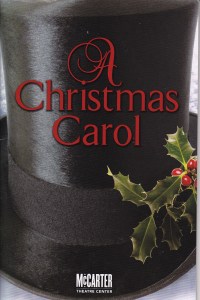
This year my wife asked for a non-material gift. We made our way to the McCarter Theater in Princeton to see their acclaimed performance of Charles Dickens’ A Christmas Carol. A gift of a memorable family time and a truly spectacular play. Seeing this story in 2016 felt especially important. Dickens was a famous advocate for the poor and was well aware of how they suffered at the hands of the wealthy. Indeed, those with too much money lose their humanity almost completely. The story is focused around Christmas, but the message is needed for every day, especially in over-long years such as this. Capitalism is a form of social evil. Anything that lowers humans to mere ciphers on a page is the very definition of sin.

christmas-carol

We all know how the story goes, but to see accomplished actors undergoing conversion is nevertheless a strangely hopeful experience. As the story makes abundantly clear, it requires so very little to make others happy. The point of having money, after all, is to use it for the good of others. Seeing one man facing his own mortality only to realize that he has isolated himself from the care of others is a powerful experience. As we move forward into the long and dark days ahead, there is a reminder here that we need to keep close to our hearts. There may be fewer presents under the tree this year, but we are all the richer for it. This is the kind of gift that we need to share with the entire world.


Bible Riots

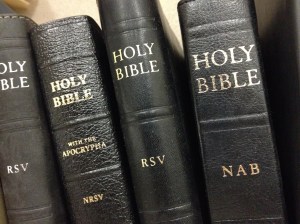
One of the more embarrassing questions I get asked is “What do you do?” This has been true throughout my career (if what I do can be called that). I should clarify—I don’t mind saying “I’m a professor,” or “I’m an editor”—it’s the follow-up question that’s difficult. “What do you teach/edit?” Mentioning the Bible is a conversation-stopper. In the silence that inevitably follows you can almost hear the electronic buzzing in the interlocutor’s brain as s/he tries to come up with something nice to say while backing away. In actual fact my degrees have been more in the history of religions rather than Bible per se, but those who’ve done the hiring haven’t tended to see it that way. This is not a nostalgic post, asking to go back to yesteryear (that’s happening politically without my help), but it is a reflection of what James Wallace Harris says on BookRiot—the Bible is a good book to read.

It’s easy to get swept away in the criticism of religion, and particularly Christianity. Those who profess it, historically, have a lot to answer for. What we’ve allowed religion to do to others is inexcusable. What we sometimes miss is that the motivation is one in which all people participate—learning the truth. This is more difficult than it might seem. If someone had discovered “the truth” we’d all know by now. The fact is we’re deeply divided about what that truth is and that alone proves no one has found it. We’ll recognize it when we see it. We just haven’t seen it yet. What sometimes gets forgotten along the way is that the Bible was, and is, a great milestone of humanity’s search. As I keep having to remind myself, there’s some really good stuff in there.

IMG_2634

Harris isn’t alone in suggesting that atheists should study the Bible. Some very prominent non-believers have declared the same thing from time to time. The Good Book is densely interwoven with western culture—even secular western culture. I’m currently at work on a book that explores one thread of that complex fabric, and it’s amazing to me how much we miss when we ignore holy writ. We shouldn’t throw out the baby with the bathwater, as the old saying goes. That’s not biblical, but it does hint at the truth, I think. Or maybe it’s just that I want to be able to answer that most basic of questions without having to make excuses for what otherwise looks like a series of poor life choices.


Evil That Men Do

the-demonicTheologians, for the most part, gave up studying demons a long while ago. With the advent of modern medical science, the descriptions of demonic possession in the New Testament seemed pretty clearly to be cases of epilepsy. Since people in antiquity had no means to study brains electro-chemically, there was no recourse for them to understand the sudden changes in behavior that often accompany seizures. They drew on what their culture knew—malevolent spirits—to explain this disturbing behavior. Ewan Fernie takes a different approach in The Demonic: Literature and Experience. As an English professor, he looks at both demons and the demonic in mostly English literature, often focusing on the adjective more than the noun. There is a great deal of insight in this study and characters the reader may or may not recognize seem to fit fairly easily into the category as described by the author. Indeed, God and the Devil appear much closer than many religious readers would feel comfortable seeing them.

Although I enjoy reading about literature, my favorite chapter in this book was the treatment of Martin Luther. Not having grown up Lutheran, I feel that I don’t know the great reformer well enough. The anniversary of his 95 Theses is coming up next year and there’s a lot of attention being paid to the former monk right now. Even despite this, he was a fascinating figure who firmly believed in diabolical activity in the world. Indeed, much of what science would eventually strip away he saw as evidence of the demonic. Other theologians who’ve followed him built on these same ideas. The Dark Ages were the high point of official demonology, after all.

Writers since Luther, many of them touting fiction, also latched onto the concept of the demonic as a great explanation for “the evil that men do.” Quite often Fernie traces them to Shakespeare, the anniversary of whose death is quickly drawing to a close. The Reformation would’ve been much closer to the Bard than it seems to us. Demons were still around and available for all varieties of nastiness against human beings. Fernie makes the point that the association of the demonic and sexuality became more pronounced over time. We see this even today in possession movies. The origins of the ideas, however, are more complex than they might seem. The Demonic will give the reader plenty to think about in this season of long nights and short days and the basic confusion running rampant over what is good and what is evil.


Protest Reading

In these days of bold ignorance, reading in public is an act of resistance. A world that follows the uninformed to perdition requires those who stand as witnesses. Those who read. As a cabinet of the wealthiest people in the country is being assembled we need to remind each other that wisdom and wealth aren’t the same thing. Not even close. We read to improve our minds and we find, in such reading, that wealth increases happiness only to a point. Excess wealth leads to misery, but like the addicted, those who have it just can’t stop. Stop, I say, and pick up a book. To help with this my wife sent along the Banned Book Advent calendar. That’s not to say we can read a book a day, but I believe the world would be a better place if we could. Especially if those books were banned.

You see, banned books cause us to think. That’s the payoff. I’ve read many, many banned books. Some of them I didn’t like very much, but that’s not the point. Liking what you read may lubricate the process, but it is the reading itself that stretches the mind. Makes use of mental muscles we didn’t know that we had. Those who ban books want prejudiced minds to prevail. Think about it: prejudice comes from the combination of the prefix for “already” and the root for “judging.” The prejudiced have already decided. Reading challenges. It has from the earliest days of myths on clay down to the era of ordered electrons on a flat screen. Reading makes you question. The thought police prefer mindless acquiescence. Want to show your true colors? Pull out a book and read.

IMG_0899

The season of Advent is one of anticipation. We all know what’s behind door 25, but the journey is the point. That journey is better when it’s literate. When I travel my carryon always has books. More than I can read on the trip, just in case. Books are banned because we fear knowledge. Once exposed to an idea we must deal with it. Far simpler to lock it away in some sealed room and continue to do things like it’s still the 1450s. Before Twitter started revolutions, books did. When we put down our books we are opening an invitation to ignorance. Last month showed what happens when that invitation is given. I won’t make it through a book a day this season, but I flip out my reading material whatever chance I get. And I believe a better future will result.


True to Nature

A friend recently sent me an article on Jack London from smithsonian.com. As the article by Kenneth Brandt makes clear, London is an author for our times. Someone who might truly be called a populist, London, like many of us born in the working class, had an epiphany. Perhaps his came earlier than many, but at the age of 18, while working laboring jobs, he noted that he “was scared into thinking.” He decided, before the idea of sending all kids to college had caught on, that he should acquire an education. In the words quoted by Brandt, he wanted to become a “brain merchant.” Certainly London’s works need no introduction from a guy like me. Robust and masculine, his stories are those of man pitted against a nature that is often out to crush, freeze, or starve him. Today we need to loosen up those pronouns a bit. Women, who’ve arguably had it tougher than men for all of biological history, have had to struggle for survival too. In the current political climate we all need to remind those who substitute testosterone for brains that we all share human rights.

455px-jack_london_young

The Religious Right, or “alt-right” as they seem to prefer these days, wasn’t always a fetus farm. It has been historically documented that it was Francis Schaeffer, erstwhile hippie and free thinker, who when he got abortion stuck in his craw, decided that men had to protect the unborn from women. He seemed to have forgotten whose gonads planted that seed in the first place. Prior to Schaeffer Christian saints tried to avoid sex all together. Among the original “abstinence only” crowd, some of the more zealous put their money where their testicles were and castrated themselves. Ah, men were real men in those days. Today masculinity means ganging up on women and grabbing them by the Call of the Wild, apparently.

Like London, I think we all need to be scared into thinking. We’ve let a wildly distorted view of humanity—one-sided and with dangling evidence of gender loyalty—to steal the White House from the woman who thoroughly won it from the vox populi. Where is Buck when we need him? London knew, as evolution repeatedly teaches, in Brandt’s words, “abusive alpha males never win out in the end.” I say that “swing states” should look carefully at that hanging chad. In the meantime, while the fat cats bicker and argue over the best way to suppress females to make themselves look bigger, I think we should all read again about what happens when Spitz meets Buck. If you haven’t read The Call of the Wild before, it’s time to do so now.


Bibliotherapy

This may sound strange, considering the source, but I fear I don’t read enough. An article by Sarah Begley in a recent issue of Time, reinforces what we’ve known all along—reading is incredibly good for you. Even fiction. Especially fiction. For the most part, as I’m commuting, I read non-fiction. There’s nothing wrong with this, of course, but it doesn’t always help with literacy issues that might call for a bibliotherapist. You see, literacy builds a kind of psychological strength that helps with real-world issues. Part of it is because many books go through a rigorous process of approval. Still, it’s important to realize that this kind of reading may not be the popular fiction that can be found in grocery stores and airports—although even that is fine—but the level of writing that really helps is somewhat mysteriously labeled “literary fiction.” The kind of book an author writes, rewrites, and rewrites. Deep thought and care go into such books, and they can be a help to their readers. Reading isn’t just fundamental, it is transformative.

img_2947

I remember my school years well. Kids are amazing in their level of energy. They crave activity and experience. Getting them to read can be difficult. You need to sit still. And concentrate. Concentration isn’t easy. You have to train a child to read, and, at least where I grew up, that was a struggle. The fact that it’s possible to graduate from high school and be functionally illiterate is one of the signs that learning to enjoy reading doesn’t always take hold. I knew guys in middle school who would rather do just about anything other than read. I often wondered what anyone could do to make them realize what they were missing. I read books and stories that took my breath away. There was something incredible going on between the covers—but how to convince others?

Recently a colleague pointed out to me that those of us in publishing are, statistically speaking, a very small number of people. We work in an industry that serves a small number of people. We are an odd lot. We read books, and some of us write books, and we do so for a small sector of society. Signs are hopeful that interest in reading is growing. Leading by example may help. At any one time I have at least one, generally two or more, fiction books going at the same time. On the bus I read through non-fiction at a faster rate. Maybe the mix is actually right. Fiction reading takes more time. It could be because I’m getting more out of it than I realize. I just wish I had more time to do it. More time for reading health. I may need to see a bibliotherapist.


Found in Translation

embassytownTraduttore, traditore—“translators are traitors”—is an Italian saying invested with a great deal of truth. Anyone who’s worked with the proliferation of languages in the world knows the truth of the adage. What is said in one language can’t be stated precisely in another language with all the depth and texture of the original. China Miéville’s Embassytown is a sprawling novel that addresses the question of how cultures evolved on widely separated world can ever understand one another. I can’t possibly go into a detailed summary of the story—it took me about 30 pages to begin to understand what was going on—but the book drew me in nevertheless and left me happy to have expanded my conceptual world.

The reason that I’m bringing this novel up in a forum where religion lurks in the background is that Miéville explicitly brings religion into his story. It may be impossible to explain precisely how he does this without the detailed summary that I’ve already begged off giving, but it is nevertheless noteworthy that in any sufficiently complex world religion emerges. We tend to think that religion is something that evolved from the slime and now that we’ve bathed in the light of pure reason it will eventually be washed into the gutter of discarded concepts. History demonstrates repeatedly that such is not the case. Religion is resilient and, dare I say it, inevitable. Human beings—perhaps also other conscious beings—know that there is something outside ourselves. That’s the foot in the door for higher beings or forces or worlds. In a word, religions.

Fiction writers frequently appeal to religions for verisimilitude. Are imaginary worlds believable without religions? It’s a long stretch. Star Wars has characters calling belief in the force a religion. Star Trek, in any number of episodes, dealt with gods. Anathem was based on the monastic ideal. Science fiction has trouble when it leaves religion completely out of the picture. A non-deistic universe is nearly incomprehensible to the human mind. Even great scientists and other rationalists occasionally lapse into thoughts about luck, fate, or fortune. Embassytown doesn’t focus on religion throughout, of course. It may be a minor subplot. But translating an alien world with a language that can’t be understood into a fiction of English is facilitated by putting a religion into the general mix. This is a smart and complex world, but when you read it you’ll find it believable because a religion naturally emerges. And that, I say, is realism.


History and Its Discontents

img_3081

I’m standing in the lobby of the Menger Hotel. Before history becomes too falsified to recognize, I want to soak up the fact that Theodore Roosevelt organized his Rough Riders in this very hotel, and that O Henry stayed here. There were other notables too: Ulysses S. Grant and Robert E. Lee among them. Southern and Northern supporters, Republicans and Democrats, writers and fighters. Once our country was big enough for everyone. I have a feeling that narrative history will be rewritten. I don’t think they make them like Teddy Roosevelt any more. A rich man who actually did care for the poor. There was a day when such things could be said without a wink and a nod. Before “In God We Trust” was inscribed on paper money, confusing forever deity and dollar. I breathe deeply. History weighs heavily upon me here.

Those of us who study ancient religions can’t help looking backwards. There is a consolation in it. Before progress also becomes a myth, I can stand here and gaze back into days when those who were presidents actually read. Theodore Roosevelt wrote books. He believed that the rich had serious social obligations. He had no words of complaint when his nephew Franklin Delano decided to join the Democratic party to become the president who saw this nation through the Great Depression. Today we stand on the cusp of an even greater depression. Or the Great Oppression. At least the incoming administration won’t need to stay in drafty old hotels. They’ll just built tasteless modern ones and say that they’ve always been there. Post-truth is the only truth now.

“The Gift of the Magi” tells the story of a doomed trade. A couple each sacrifices something they value to give the other a gift that they cannot use due to that very sacrifice. It’s kind of like electing a president out of spite. Like cutting off your hair when your Christmas present will be expensive brushes. Like believing that having money equates to intelligence. I hope there’s still something of Teddy Roosevelt left in this hotel. A sense of greatness that didn’t need a red cap to make itself appear as a lover of people. Roosevelt didn’t flinch from insults. He delivered a campaign speech after having been shot by a would-be assassin, bullet still lodged in his chest. He wasn’t a perfect man, but he believed sincerely in the obligations of the wealthy. I want to inhale that history before all of this becomes just another piece of fiction for an administration that doesn’t believe reading to be fundamental any more.


Are There Not Workhouses?

dickensworkhouseAs colder days settle in I add layers and sit in our under-heated apartment and think about the lot of the poor. I don’t think billionaires really understand the plight of those who, no matter how hard they work, just can’t get ahead in a society that values class above individual welfare. I’ve noticed the increasing number of homeless on New York City streets. Many are clearly those who’ve lost jobs and can’t afford to pay the rent of even a modest apartment in the city, let alone Trump Towers. Having lost jobs myself after a lifetime of hard work, my sympathies are with the street dwellers. Ruth Richardson’s Dickens and the Workhouse: Oliver Twist and the London Poor reminded me that this is not just an American phenomenon. The book begins as kind of a detective story to locate the workhouse that Dickens features, if fictionalized, in Oliver Twist. Richardson makes a strong case that this workhouse has been found and that relics of Dickens’ under-acknowledged London residence just a few doors down from it influenced much of his first-hand knowledge of the life of the poor.

In the case of London, poor laws were put in effect to punish those who couldn’t fend for themselves. Inmates at poor houses were kept on a legally mandated starvation diet (literally) with inadequate medical care. Instead of censuring this injustice, the Church of England stood behind it. The perverted thinking was that if anyone knew how bad it was in such places they would try doubly hard not to be poor. The funny thing about living in poverty (I have some experience of this) is that it isn’t a choice. I didn’t particularly get along with my step-father. I can say, however, that he was one of the hardest working men I ever knew. Long hours spent at work, sometimes the whole night through, to support a family of six on just above minimum wage. This was his daily existence. I must’ve looked soft in his eyes.

Richardson’s book, although fascinating, is also distressing. The idea that a society thinks the most humane way to deal with those who are struggling is to punish them further, for me, defines evil. One of the characteristics of our species, according to biologists, is that humans often show extraordinary care for other creatures, often of other species. For our own, however, we feel that if you’ve “earned” something by exploiting others it is your “right” to keep it and let them suffer. This economic system is rotten to the core. We may have come a long way since Dickens’ time. We don’t have such exploitative workhouses in Manhattan. Instead, we have so many people sleeping in the streets that a walk to work has become very Dickensian indeed. Somehow I don’t see the situation improving in the next four years.


Identity Crisis

womaninwhiteSince at least my middle school days I have been in search of the great Gothic novel. I can’t claim to have found it just yet, but I’ve read many notable samples along the way. Somehow Wilkie Collins’ The Woman in White remained completely unknown to me until earlier this year. The title was evocative enough to make me pick it up, daunting though its 600 pages might be. Like many novels of its period it was serialized, which likely accounts for its length. Honestly, it took a while to get into it fully. Once ensconced, however, it kept me reading for over a month. (I took some breaks for work and sleep.) I wouldn’t say it was my ideal of the great Gothic novel, but the character of Count Fosco is amazingly drawn and seriously compelling. As the huge man lets mice run over his massive body and treats birds with conscientious gentleness, he is plotting ruin to his fellow human beings to benefit himself. He is an accomplished egotist.

What makes the novel so profound to me is the question of identity. One of the characters in the novel, the eponymous woman in white, has a double in the love interest of the protagonist. Doubles are common in Gothic tales, but in this instance when the woman dies and others believe her double to be her the question of identity is raised. Who am I, really? In the day before DNA evidence, it was impressively difficult to prove you were who you said you were, if your appearance was altered. Emaciated, abused, and drugged, Laura doesn’t look like herself and even her own uncle doesn’t recognize her. In the end her identity is established by legal testimony alone, without benefit of any biological proof.

Identity has been on my mind lately. Especially on a national scale. Brexit and Trump were both movements fueled by distrust and distorted notions of national identity. In short, Britain and the United States, so the reasoning goes, should belong to white men. As Monty Burns famously said, “Well, for once the rich white man is in control!” I personally like a little color in my field of view. I value deeply those I’ve met whose experiences and skin tones don’t match my own pallor. I want our national identity to include more than just fifty shades of white where women are objects and men are some kind of noble studs. Back when I started to read this novel I had a grip on that view of reality. Now that I’ve finally finished it, I wonder who we really are.


A Dusty Return

dustreturnedThe fiction author who had the most influence over my formative years was Ray Bradbury. Wait—let me qualify that a bit. I read of number of series aimed at juvenile, male interest (Doc Savage, Dark Shadows, and such) but these weren’t really intended as “literature.” I also read quite a bit of Poe, and his influence may certainly have rivaled Bradbury. The thing was the latter was still alive and producing books, mostly of short stories that tickled my imagination. Despite my reluctance to let books go, there have been several periods in my life where I’ve had to sell off my collection (this is the mindset of the non-affluent) and all of these childhood collections went, except for Poe. Now that I’m a more reflective adult, so I’m told, I have found a renewed interest in some childhood classics, and Ray Bradbury books are seldom expensive. When I found From the Dust Returned in a used book shop for a steal, I said “why not?”

This particular book came from long after I’d sold my Bradbury collection. I had never seen nor heard of it before. As an adult, interestingly, Bradbury doesn’t seem scary at all. From the Dust Returned, like many other Bradbury collections, is a somewhat novelized set of stories. This one is set in a haunted house where, in his usual descriptive style the storyteller offers artful prose and painterly writing, but no real scares. As we are coming upon Banned Book Week, however, I did note one of Bradbury’s common themes—the lack of belief leads to the death of characters. I’d read some of his stories where this took place before. Still, this time he goes a bit further. Tapping into things just ahead of the rest of us, as he had a talent for doing, one of his characters laments the loss of belief in religion as well as creepy, Addams-esque characters. People are no longer believing and it causes ghosts pain.

Part of Bradbury’s appeal is clearly to the young imagination. I’ve promiscuously read hundreds of authors since my last Bradbury book. My tastes have evolved. I find the same is true when I go back to the Dark Shadows books that were so cheaply had at my neighborhood Goodwill. I still go back to these early writers, however, and there is a kind of innocence about them. These were stories I’d read before I’d learned that Poe was certainly not as macabre as real life could be. “Marilyn Ross,” “Kenneth Robeson,” Edgar Allan Poe, and Ray Bradbury may not feature of lists of banned authors. Some of them aren’t even whom they seem to be. They did instill a childlike belief in reading, in my case. Even if they’re now on the bargain shelf they will still receive my admiration for starting a lifetime of reading.


Banned Truth

bluesteyeBanned Book Week is one of my favorite holidays. Don’t worry—you haven’t missed it—it occurs the final week of this month. I’m not very good, however, at guessing how long it will take me to finish a fiction book, so I start early, just in case. My banned book of choice this year was Toni Morrison’s The Bluest Eye. It’s not easy to read a novel which is so close to the truth. As any writer of fiction knows, just because something didn’t happen precisely as described doesn’t mean that it’s false. Indeed, fiction is often factual. It’s not easy to read because the “race”—a dubious distinction at best—to which I belong has often throughout history victimized others. While I’ve never knowingly participated in this criminal action—and despite what politicians might say, it is criminal—it’s never comforting to hear from the victim’s perspective. The Bluest Eye is about African American experience in the land of the free. At least in name.

What becomes clear from the beginning is that the families around which this story revolves are pushed to their limits. In an affluent society they are forced to live with less than their “white” neighbors have. Slavery may have ended, but the superiority mindset that permitted it in the first place hasn’t. I grew up in poverty but I didn’t have the added burden of being treated badly because of my “race.” Stories that remind us of that reality are never comfortable places to be. We’d rather think that since slavery ended prejudice went away with it. In reality, however, it is still here. Interestingly, the culture portrayed so vividly by Morrison is deeply biblical. Indeed, surveys of Bible reading in North America show that African Americans tend to actually read the foundational book more than their oppressors. The biblical worldview spills easily across the page.

Although the Bible made it onto the list of top ten banned books last year, The Bluest Eye was challenged because of its sexuality. That’s another defining aspect of the novel. It’s a frank exploration of the human condition. The protagonists are not only African American, they are also all female. Their perception of sexuality is, in many ways, inherently that of victims. Not that love doesn’t enter it, but rather that poverty often leads to a state where sexual gratification is held up as one of the few positives in a life that includes regular mistreatment, poor pay, and jail time. It isn’t an easy story to read. Morrison’s deft hand, however, prevents the story from becoming gloomy. It is like spending a sunny day knowing there’s something you shouldn’t see in the basement. Banned Book Week may be some time away yet, but it is always the right season to read about the truth.


Zoo or Farm?

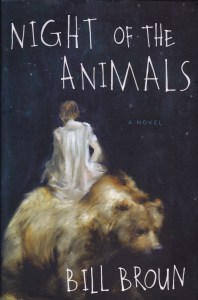
It comes as no surprise, I hope, that I read lots of fiction. While not every book I read makes it onto this blog, a good many of them do, along with some I haven’t read yet. Bill Broun’s Night of the Animals is one of the latter. A suspicion is itching way down deep telling me that I’ll probably end up a fan. Part of my suspicion comes from having read a story on NPR about the book. First of all: dystopia. Need I say more? I admire those who try to paint a future with a lighter palette, but I’ve been observing the way those in power behave and it kind of makes me think optimism about improvement is just a tad naive. People are too easily lulled into apathy by things like sports and the internet. The Romans used bread and circuses. Meanwhile those in power help themselves to a bit more until you can’t even get on an airplane without a total stranger seeing you sans briefs. If I can’t be trusted by those I elect, what cause do I have for hope? But enough about me. The book’s the thing.

DSCN1969

Night of the Animals, according to the NPR piece, is kind of a reverse ark. The animals in the London Zoo are understood by a man and they ask him to release them. I don’t know what happens, but I sure hope to find out. When interviewers ask Broun what it was like to spend fourteen years working on a novel, he responded in a way that, I suspect, many writers would understand. He said that it was a spiritual journey. Writing this book was his search for God. Many of us must nod our heads to that.

Concentration is becoming a dying art. I’ve written a number of books in my life—by far the greatest number remain unpublished—and I know there’s nothing like the intense concentration you experience when lost in such a world. Yes, it is spiritual. It is also a cry to be heard. As George Orwell well knew, we are the animals hoping to be heard. Zoos represent entrapment. Broun states that he wanted to explore how people are trapped in his novel. Looking at a system that rewards greed and keeps workers in unfulfilling jobs just so they can keep the system going while their CEOs buy another hotel chain or sports team and decide to run for office, I begin to hear the oinks, whinnies, and neighs all around me. And I haven’t even read the book yet.


Imagining Monsters

WideSargassoSeaAll fiction writing, it is often said, is borrowing. I’m not exactly sure that’s literally true, but the basic idea is that writers often trade with one another. They also borrow against their own experience and observations that others have made. When a character, or set of characters, an author develops become(s) wildly popular, fan fiction can result. There are websites dedicated to “fan fic” where characters from one writer are personalized in another writer’s imagination. Another form of borrowing is the parody. Pride, Prejudice, and Zombies takes Jane Austen far beyond her original scenario while using her novel as the basis of something somewhat new. These borrowings, as the saying suggests, have been around for a long time. I recently read Jean Rhys’ Wide Sargasso Sea. The novel from the 1960s is a “prequel” of sorts to Charlotte Brontë’s Jane Eyre. Although spoiler alerts for literature nearly a couple centuries old might seem like overkill, I’ll give one here anyway. You’ve been warned.

Jane Eyre includes quite a lot of gothic mystery. Thornfield has a mad woman, Bertha, the first wife of Mr. Rochester, living in the attic. Bertha is from the Caribbean, and Rhys, although Welsh, was born in Dominica. Taking an interest in the point of view of the neglected, insane Bertha, she decided to tell her story in Wide Sargasso Sea. I won’t sum up the plot here since you may decide to read it. The reason I brought the whole subject up in the first place is the glimpses given of the religions of the Caribbean. Clearly this was not Rhys’ main objective. The Creole of the various races from the slave trade and colonialism, however, did produce fascinating religious amalgams. The zombie, a figure that plays a small part in the imaginative aspects of the novel, is only the most familiar of the creatures.

The soucriant, or soucouyant, is a blood-sucker. A figure that combines elements of witches and vampires, the soucriant takes the form of an old woman by day and a blood-sucker by night. (Before you get the wrong idea, there are no zombie or soucriant characters in Wide Sargasso Sea—they are merely mentioned briefly in conversation.) This concept, while derived independently, relates to the succubus but also to the more modern chupacabra. These are all creatures that suck the vital essence from another, be the victim human or animal. The ubiquity of the idea is striking. In the context of the novel, however, such creatures merely haunt fevered imaginations. Our minds, however, are what make monsters real. Although Rhys declines to diagnose “Bertha” completely, it is clear that human mistreatment of one another creates, in its own ways, monsters. That’s an idea, I suspect, that I’ve borrowed.


Take Your Time

PleasuresOfReadingReading is fundamental. Those of us who grew up hearing that slogan have never forgotten it. The part that I wish had stuck better is just a touch shorter: reading is fun. Or it can be. Should be. Alan Jacobs’ little book The Pleasures of Reading in an Age of Distraction is like an extended essay on the subject. As a professor of literature, Jacobs has considerable experience encouraging people to read, and in his book he makes a case for reading what you want to read (reading on a Whim, he calls it). Wisely he recognizes that many would-be readers are discouraged by being instructed to read that which they don’t find appealing. I learned quite a lot from the suggestions contained herein, and I’ve been reading so long that I thought I knew pretty much what I needed to know about it. Perhaps the most fundamental issue (apart from reading itself) is that many of us expect to be told what to read. We second-guess our own judgment, feeling we need an expert to tell us how to do it. Like singing in public, it’s intimidating to come across someone better read than oneself. Jacobs advocates reading what gives you pleasure and not worrying about what others think.

Recognizing that readers are spoiled for choice, Jacobs addresses, among other topics, rereading. And taking notes. And reading slowly. I recall speed-reading courses advertised, ironically, on television. At college you could take courses in improving your quota of pages turned. There is a specific kind of reading, as Jacobs notes—reading for information—where this may be helpful. This is different than reading for pleasure, or even reading for understanding. In the case of the Bible (Jacobs taught at Wheaton before moving on to Baylor) many people, he suggests, read for information rather than for understanding. When reading for pleasure taking your time is a virtue. Getting to know a book requires rereading. We need to make time for what is important.

Jacobs makes the point that readers are a minority sect. There have always been fewer of us than there have been of those who don’t read. We are, in his words, a tribe. We can generally spot one another. Those of us who can’t walk past a bookstore will recognize ourselves in the pages of this meditation. Those who spend long hours with books become like them, in some respects. Familiar, layered, and requiring more and more attention. Like the reading that it advocates, this book itself is a delight to read. There is so much in this brief volume that it’s difficult to summarize in the short-form writing that I use on this blog. I found myself wishing for an index so that I might find my favorite passages again. Then I realized that perhaps this absence was intentional. Maybe I’ll have to reread it, taking notes as I go. What a wonderful thought.