
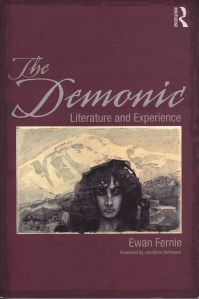
 Theologians, for the most part, gave up studying demons a long while ago. With the advent of modern medical science, the descriptions of demonic possession in the New Testament seemed pretty clearly to be cases of epilepsy. Since people in antiquity had no means to study brains electro-chemically, there was no recourse for them to understand the sudden changes in behavior that often accompany seizures. They drew on what their culture knew—malevolent spirits—to explain this disturbing behavior. Ewan Fernie takes a different approach in The Demonic: Literature and Experience. As an English professor, he looks at both demons and the demonic in mostly English literature, often focusing on the adjective more than the noun. There is a great deal of insight in this study and characters the reader may or may not recognize seem to fit fairly easily into the category as described by the author. Indeed, God and the Devil appear much closer than many religious readers would feel comfortable seeing them.
Although I enjoy reading about literature, my favorite chapter in this book was the treatment of Martin Luther. Not having grown up Lutheran, I feel that I don’t know the great reformer well enough. The anniversary of his 95 Theses is coming up next year and there’s a lot of attention being paid to the former monk right now. Even despite this, he was a fascinating figure who firmly believed in diabolical activity in the world. Indeed, much of what science would eventually strip away he saw as evidence of the demonic. Other theologians who’ve followed him built on these same ideas. The Dark Ages were the high point of official demonology, after all.
Writers since Luther, many of them touting fiction, also latched onto the concept of the demonic as a great explanation for “the evil that men do.” Quite often Fernie traces them to Shakespeare, the anniversary of whose death is quickly drawing to a close. The Reformation would’ve been much closer to the Bard than it seems to us. Demons were still around and available for all varieties of nastiness against human beings. Fernie makes the point that the association of the demonic and sexuality became more pronounced over time. We see this even today in possession movies. The origins of the ideas, however, are more complex than they might seem. The Demonic will give the reader plenty to think about in this season of long nights and short days and the basic confusion running rampant over what is good and what is evil.








 Steve A. Wiggins