Moving Day

So, it’s moving day.  Amid all the packing and sorting—outside the regular 9 to 5—I realized that this was the first move I’ve made outside the constraints of academia.  Well, maybe not strictly so, but I left Nashotah House in the summer, and I was unemployed when I moved to New Jersey to start in the publishing world, so there was no office work involved.  The move without changing a job is a tricky thing.  And exhausting.

I didn’t write about the process early on, in case it didn’t happen.  Buying a house is an exercise fraught with peril and it can collapse at several junctures over the three-or-so months it takes to finalize things.  Then there’s the move itself.  Back in January I found myself setting books aside that I thought I might not need again in the next few months.  We started hauling boxes down from the attic to pack those books in February and March.  We finally made an offer on a house in May, and now, seven months after the process began, we’re ready to move.  Or so I tell myself.

Our last move didn’t go exactly as planned.  Like Bartleby and Loki, we were moving from Wisconsin to New Jersey, perhaps seeking our destiny.  Who knows—maybe undoing the universe?  We hired Two Men and a Truck to move us.  My brother in New Jersey said he’d meet the truck since it was going to take us a little longer to get there.  On arrival day, no truck.  We called the company to find that the said Two Men had actually abandoned said Truck in a parking lot in Chicago.  Although embarrassed, the big Two Men upstairs made no offer of a discount on the move, even if it cost my brother an extra day of work.  We’re hoping for better things this time around.

International Van Lines didn’t call the night before, like they said they would.  After a somewhat restless night (should I stay or should I go?) my usual 3 a.m. internal alarm kicked in.  An email, like a thief in the middle of the night, told us when to expect the big guys and their vehicle.  Moving is kind of like prophecy in that regard.  In any case, for those accustomed to early posts, there will be a delay tomorrow since the internet people are finishing the virtual move around 11 a.m.  Church time on Sunday.  If we pull this move off, I might have to admit there are miracles after all.


Moving Books

One of my anxieties about moving is that commuting time was my reading time.  Enforced sitting for over three hours a day meant consuming book after book.  Now I have to carve out time to read.  Life has a way of filling the time you have.  I say the following fully aware that you’re on the internet now, but one of the biggest time drains is the worldwide web.  Humans are curious creatures and the web offers to answer any and all queries.  (It still hasn’t come up with a satisfactory answer to the meaning of life, however, IMHO.)  Even when I’m working on my current book, a simple fact-check can lead to surfing and before I know it, I’m out to sea.  That’s why books—paper books—are such a good option.  A footnoted source meant another trip to the library, and libraries led to more reading.

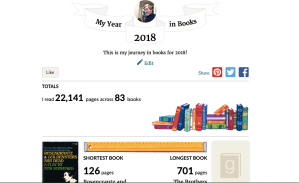
I’m a Goodreads author.  I like Goodreads quite a lot, and I actively accept new friends there.  In the past I set goals of reading 100+ books per year.  Aware back in January that a move might take place, I lowered my expectations.  I figured, even without commuting, that 65 books would be attainable in a year.  Of course, Goodreads doesn’t count the books you write, only those you read.  I had to tell even Amazon Author Central that Holy Horror was my book.  Moving, however, is a liminal time.  Every spare minute is spent packing.  And you still owe “the man” eight hours of your day.  That rumble that you feel is the moving truck growing closer.  Reading time has become scarce.  I fear I’m becoming illiterate.

And Goodreads makes me think of Twitter.  I’ll just click over there a while and wonder why I can’t seem to grow a following.  Ah, it turns out that you have to tweet often and incessantly, with erudite and trenchant things to say.  The birds chirping once a second outside my window can’t even keep up.  Problem is, I have a 9-to-5 job, and I’m trying to write Nightmares with the Bible.  And there’s just one more fact I have to check.  Wait, what’s the weather going to be like today?  Gosh, is that the time?  I have to get packing!  That moving van will be here only hours from now.  I need to calm down.  The way to do that, in my case, is to read a book.


Extra Baggage

So, I’m packing.  Have been, on and off, since January.  One of the most dreaded moments of packing is the closets.  You know how in horror movies the villain often hides in closets?  We have no danger of that.  Any monster foolish enough to try it would be suffocated under tons of stuff.  Some houses may have walk-in closets, but I am inclined to call a mining company whenever I need to find anything in ours.  Our closets have led full lives.  It’s almost 100 degrees outside and I’m excavating.  We’re at that stage of “absolutely need to keep?” instead of “do we want this?”  Then I came upon it.  The layer of SBL tote bags.  Like a paleontologist of ancient academia.

If you’ve been a member of the Society of Biblical Literature you know what I mean.  Every year the Society wants you to realize value for your money, and they give you a tote-bag to help you haul home the books you’re going to buy.  Long-time attendees know to pack an empty suitcase inside their regular one just to accommodate the books.  (That could also account for about ninety percent of my packing—we have more books than a small town public library.)  But it’s not the books that are the problem today, it’s the bags.  I’ve been attending SBL since 1991.  Do the math.  I seem to recall that they didn’t do tote bags back in Kansas City, but soon after they became part of the agenda.  And I have an impressive pile of them in my closet.

Too small for groceries—especially in the early editions, back when we could meet in smaller venues—and too impractical for anything other than books, they multiply in our closets.  What professor doesn’t have his or her iconic briefcase already?  Reduce, reuse, recycle they say.  At least half of my totes have never been reused.  Zippers?  Who thought of that?  Pulling handfuls out of the closet, I marvel at their colors.  I can’t remember everyone walking around with a red bag—what year was that?  (San Francisco, 2011.)  The black leather edition—remember that one?  (SBL, n.d.)  The bags aren’t really useful for packing, on a movers’ scale.  You can imagine the burly guys outside their truck scratching their heads at this impractical conveyance.  Like so much else in life they’ve become mere souvenirs.  From the French word for something like “remembrance,” souvenirs are meant to take us back to the place in vivid detail.  I fear that many past meetings have run together into a blend of biblical arcana.  I’m sure that’s just me.  Still, I’m responsible for this new discovery.  I’d I’ll need shortly to decide whether these totes go into the museum or back into the landfill that moving inevitably creates in a throw-away world.


Not Enceladus

I’m moving.  It turns out that transport companies don’t offer service to Enceladus, and inter-planetary moves are expensive, so we’re moving just one state over.  If, by chance, you know me from work you need not worry—my job will remain the same but the commute will become tele.  Over the past several weeks my wife and I have been sorting through the accumulated effects of thirty years of married life.  Our current apartment has an attic.  Uninsulated, there are few days when it’s not too hot or too cold to stand to be up there for very long—kind of like other planets, come to think of it.  Also neighbors don’t appreciate creaking floorboards over their heads the hours I’m awake.  Going through things that were hurriedly packed to get out of Nashotah House was quite poignant.  That’s the way fragments of past lives are, I guess.  You see, that was an unexpected move.  Life has a way of being complicated.

One of the more remarkable discoveries was how much we used to put on paper.  As a scholar of ancient documents, I have an inherent distrust of electronic media.  To be written means to appear on a permanent—as much as material things can be permanent—medium.  Back in my teaching days assignments were handed in on paper.  Grading was done on paper.  Teaching evaluations were distributed on paper.  Academic publications were done on paper.  In order to be a professor you needed a house.  I taught at five different schools over a span of nearly two decades.  There was a lot of paper to go through.

The academic mindset is seasonal.  I kept waiting for summer to come to have time to sort through everything.  Outside academia, I’m still learning, summer is just another series of work days.  Yes, you can cash in vacation time, but you’ll not have that entirely sensible canicule hiatus that allows you to examine what you’ve accumulated and determine if you’ll ever need it again.  It was like archaeology in the attic.  When volunteering at Tel Dor in the summer of 1987—summers were like that, as I said—I learned that by far the majority of pottery found at digs is discarded.  There are literally tons of it thrown away.  You can’t keep it all.  So the attic was a kind of triage of memories.  Not all of this was going to fit in the new house.  Decisions had to be made.  I guess I was thinking that if a company could take us to Enceladus they’d have figured out how to transport everything.  It turns out that to escape earth’s gravity, you have to get your ship as light as possible.  With over half a century of memories, however, there’s bound to be some weight to be left behind.


Breaking Day

When does the day start?  Years of awaking around 3 a.m. may have distorted my perceptions a bit, I suppose.  Here in the mid-Atlantic states, the sun is never up that early.  Year round I get out of bed when it’s still dark.  I’m not complaining—this is generally a peaceful time, a rarity in New Jersey.  If the bus didn’t come so early I’d get an awful lot done in a day.  But when does the day really begin?  I rise early to write.  Computers have changed my writing style quite a bit.  I used to write everything by hand.  Even as a kid with a second-hand typewriter, I preferred longhand first.  I still do, truth be told.  It’s slow, though, morning’d gone before I got too far.

So I get up and boot up.  I’m not sure that I’m crazy about my computer knowing so much about my personal life, but one thing it simply can’t understand is that I’m an early riser.  Many days my laptop will condescendingly ask me if I mind if it reboots—it’s been updating software when it thinks I’m asleep.  For the computer, day doesn’t begin this early.  Sometimes I worry that my blog doesn’t get readers because the new posts come up around 5 a.m., before I jump in the shower and head for the bus.  If things don’t appear in the feed at the top of the page, well, they’re old news.  I admit to being guilty of that myself; yet knowing when it’s day has consequences.  Maybe I should be posting a bit later?

For some reason my computer likes to send me notices.  Like I’m not already paying attention.  I’m sure there a setting someplace I could change, but I’m busy most of the time and figuring that sort of thing out takes longer than I have time for.  Birthday notices for complete strangers—maybe they’re connected on LinkedIn?—appear, at 9:00 a.m.  I’m at work already by then.  I think this is my devices’ way of letting me know that it’s a nine-to-five world.  As an erstwhile academic I never cottoned onto that.  I started getting out of bed at 4 a.m. when I was teaching so I would have time to write before daily chapel.  I also taught classes that ran from six-to-ten (p.m.) while at Rutgers.  When does the day start?  When does it end?  The decision’s not mine, as my laptop’s only too happy to remind me.


Moving Plans

I’m moving. I’m seriously considering Enceladus. Oh, you haven’t been? One of Saturn’s icy moons, Enceladus was discovered to have the basic elements of life as Cassini plunged to its death in Saturn’s shroud. But why Enceladus? I want to make space great again. You see, in my native country all sense of fair play has fled one of the political parties, of which there are unfortunately only two. There haven’t within my lifetime and many decades before, been any contested wins by Democratic candidates. There have been two by Republicans, among the last two elected, and yet they keep changing the rules about who can appoint Supreme Court justices. When I was a kid stacking the deck got you kicked out of the game. What’s fair’s fair.

I hear that on Enceladus they are open to actual intelligent life. You see, they’re evolving and they know it. Unlike my native planet, they believe representative government should be, well, representative. There should be some account taken of the majority. There are no Fundamentalists on Enceladus. See, there they realize that an outgoing president has the legal authority to appoint a judge, bypassing the senate. They believe, I hear, that the senate is controlled by a being called “the adversary.” One of their recruiters told me that the phrase translates, in Hebrew, to “the Satan.” They believe the adversary should not be able to change the rules every time. They’re not Fundamentalists, but they believe in Hell. They say it’s three planets from the sun, make a left at Lisbon.

Of course, they don’t see the sun much on Enceladus. They orbit Saturn, which doesn’t emit any light of its own, although it has the coolest set of rings in the solar system. It’s icy there for a reason. But the employment situation favors the workers. They believe in rationality there. They don’t put children in cages. Their scientists have studied the primates on our planet and have found that all species of them, except one, will reject leadership by individuals who bully the group. They have documented studies—for they believe in science there—that show chimpanzees will drive out an abuser of power because even they have a sense of fair play. Of course, chimpanzees don’t have a senate, but on Enceladus, some joke that it’s hard to tell the difference some times. They have a sense of humor there which, I think, goes a long way toward balancing out the chill. I’m moving, and Enceladus is firmly in the running.


Divisive Devices

In some kind of vague attempt at spring cleaning—yes, I know it’s late for that; I’m always running behind—I’ve been taking some old electronics for recycling. You know the pattern: you replace a piece of equipment and set the old one aside and next thing you know it’s become a handy horizontal surface upon which you can stack other things you don’t have time to deal with right now. House-cleaning day should be a national holiday in a country of inveterate consumers. In any case, this exercise in household archaeology has revealed quite a bit about just how much we owe to our technological overlords. I’m still of the mindset that anything over $20 is expensive. When it comes to any piece of electronic hardware, my wife and I have a serious tête-à-tête as to whether we really need it or not. I mean, we both grew up with pen and paper.

Everything’s electronic these days. During my vernal excavations I’ve come across more than one device that I can’t identify. “What this thing?” I ask. I don’t remember buying it, although there must have been some serious discussion first, and I’m not even sure what it does. At the time of purchase, I know, it felt pretty urgent. So we are led like sheep to the hardware. Is your house cluttered with old photos? Digitize them! Too many CDs? Thousands of MP3 files fit onto this device! But what about when devices clutter up your house? Who even uses an iPod anymore? Or a digital camera? We still have a few rolls of actual film sitting around, waiting to be developed.

My grandmother lived from the first heavier-than-air flight to Neil Armstrong stepping foot on the moon. As someone pointed out the other day, kids these days can’t figure out how to use a rotary-dial phone. I won’t find one of those tucked in the closet anyway, because they were owned by the phone company. I’m not sure who actually owned this dial-up modem in front of me—if that’s what it is, but chances are that Verizon won’t have any use for it anymore. These are strange days when you feel nostalgic for a wide-ruled tablet and a pencil freshly sharpened from a hand-cranked device bolted to the wall by the classroom door. And I think it’s still spring.


Dawn’s Early

Early to bed, early to rise, and people’ll think you’re weird. At least in my experience. Making an island into the place where hundreds of thousands have to commute to get to work may not’ve involved a great deal of foresight. My bus leaves early, and I don’t argue. On the days when I work from home I still rise early—I’m old enough that constantly shifting schedules is more effort than it’s worth, so I like to greet the sun with coffee in hand and say to it, “what took you so long?” This time of year I like to jog at first light when I don’t have to commute. As I do so, I notice where the lights are on. You get an idea who sleeps in and who doesn’t.

With all the political nonsense about lazy immigrants, I wonder what time congressional leaders get out of bed. I sometimes go jogging before 5 a.m. The lights I see on at that time of day are often those of the apartment complexes where immigrants tend to live. The affluent houses of the white are generally dark. If you have the luxury of driving to work in one of your cars, you can afford a little sleep, a little slumber, a little folding of the hands to rest. Immigrants often take the bus. In fact, the majority of early morning commuters, it seems, are not the privileged classes. It may have been Benjamin Franklin who said “Early to work, early to rise,” but it was the foreigners who saw the wisdom of his words.

It’s a sad nation that denigrates its hard workers. I realize I’m looking in the mirror as I write this, but sitting at a desk all day is not hard work. My first job, starting at 14, was physical labor. Most of the time it was light enough—such things as painting curbs, bus shelters, or fences. At other times it involved sledge hammers under the hot sun. The kinds of jobs few people enjoy, but which are necessary. Jobs that don’t pay well, but will keep you alive. Now I sit behind a desk and have to jog just to stay healthy. I see the monied in Midtown walking slowly to their expensive health clubs where they can sweat and let other people see. And I know that there are many out there—immigrants mostly—who are sweating from doing the jobs that likely pay less than the membership fee for this swank gym. And I wonder which is healthy and wise. The wealthy part is fairly obvious, even this early in the morning.


Evangelical Angst

Unless you know what it’s like to face life with no real prospects beyond making it to Heaven when you die, you can’t understand evangelical angst. That last phrase might seem odd to you. Aren’t evangelicals uber-smiley, happy people angry over the way society’s going? Yes and no. Many of them were raised (or converted into) a faith that holds out no hope for this world and that constantly reinforces the idea that what we like is bad. Having grown up in that world, I knew what it was like to be hoodwinked by an evangelist. I can’t remember the guy’s name, but he was famous. He came to my small town and packed a local Methodist Church. During his rambling, long sermon, he had us afraid for Hell burning under our feet. Grateful that we’d just managed to avoid it, he announced there would be three collections that night: the first was your normal tithe. The second time the plates came around you were to empty your pockets and purses of all change. The third time, you were to contribute to his private jet. If you gave over a thousand dollars your name would be inscribed on a plaque inside.

Almost as if nothing has changed in the decades since then, a Washington Post story expresses amazement that evangelist Jesse Duplantis is asking his followers for a fourth private jet. Uncomprehending, the world doesn’t show much curiosity as to why otherwise intelligent people would give to what is so obviously a scam. Or why such people would vote for Trump. The academic world doesn’t understand evangelical angst. As I sat in that audience that night, a poor kid from a poverty-level family, I fervently wished I had more money to give. Until he asked for his plane. My young doubts crept in, for I had more angst than most other evangelicals I knew. Was this really the Gospel?

Later I saw him on television. His personal mansion had literal streets of gold. Jesus, he said, wanted us to get ready for Heaven right here on earth. Did this turn his followers against him? Decidedly not. In fact, he may have believed it himself. You see, neuroscientists have learned that our brains have the evolved capacity to hold and dismiss reason simultaneously, for strong emotional stimuli. Sex, for example, or music. Or religion. These can motivate people beyond the realm of logic, and they often do. Evangelical angst says you’re not buying a scam artist a jet to spread the Gospel, it says your trying to avoid Hell. Rational or not. And that, it seems to me, is more than adequate ground for evangelical angst.


Sects on the Highway

Here in the east, it’s not unusual to see Amish buggy road caution signs. Well, not so much in New Jersey, but in my somewhat frequent trips into Pennsylvania and upstate New York. On a recent trip to western Pennsylvania I mentioned to my mother that I’d never seen any Amish along the infamous route 322, where such a sign resides. Driving down 322 on my way home from that trip my wife and I passed three Amish carriages and one baby stroller. Religion has a way of surprising you along the highway. Roadside sects are not uncommon. Apart from the many biblical billboards I’ve been seeing lately, there are any number of indications that once you get out the urban areas of the nation, religion is alive and well. While driving to Ithaca, New York recently my wife and I simultaneously spotted a sign we’d never seen before. We have made this trip to upstate many times, mostly along Interstate 81. The sign was for a tourist attraction called “Historic Priesthood Restoration Site.”

Being hopelessly mainstream, we assumed this meant Catholic priesthood. The problem was, what was either historic about this area north of Scranton, or what might be this restoration? Once we found wifi access again, I learned that the priesthood referenced was that of the Church of Jesus Christ of Latter-Day Saints. I have to keep reminding myself that Mormonism had its start in parts of upstate New York—an area so prone to religious flare ups that it was called the Burnt Over District back in the day. So Joseph Smith and Emma Hale had lived just over the border in the area of Susquehanna, Pennsylvania while Smith was working on the Book of Mormon.

A great deal of America’s religious history may be found on roadside markers. We are an inventive people when it comes to ways of exploring what we consider the divine world. Mormonism has been one of the more successful brands of American religion and although we tend to associate it with Utah now, it was a faith that grew up here in the green hills of the mid-Atlantic states. Being inveterate seekers, Homo sapiens go after new revelations with surprising aplomb. And we’re willing to change the constitution of old religions to fit new prejudices. Religion is anything but static. To test this theory simply get behind the wheel and drive out into rural America. You’ll be surprised how much you can see even at highway speeds, if you have eyes to see.


Excavating above Ground

It’s like a horror movie. You’re about to enter a place where the dead were laid to rest. You’re out in the remote Orkney Islands, and nobody knows you’re here. This cairn, although it has a modern entryway, is prehistoric, and to get to the burial chamber you have to descend the stone stairs into total darkness. There’s no towns anywhere nearby. The guidebook advices bringing a trustworthy flashlight. At the bottom of the stairs, as the daylight from the door fades, you face a tunnel lined with stone. You have to stoop to walk through it until you come to the burial chamber itself. Completely isolated from the rest of the world. It makes you stop and think.

While I was a student at Edinburgh, my wife and I made two trips to the Orkney Islands to explore the antiquities. The expense of getting to the islands north of the mainland is the most prohibitive part of such a journey. Once on the islands you find things relatively inexpensive, and safe. As the local at the car hire asked us, “It’s an island—where would a criminal go?” Nobody locked their doors. But the tombs. Orkney, being relatively unpopulated, hosts more available antiquities per square mile than just about anywhere else in Europe. Tramping through barren grasslands where you might encounter a few sheep, you can hike to a burial chamber that was built thousands of years ago and, after archaeologists tidied it up, has been left for you to explore on your own.

My wife sent me a link to Historic Environment Scotland’s Sketchfab page. Using photogrammetry, the site offers three-dimensional, manipulable images of the various cairns and soutterrains you can find on Orkney. You don’t need to crawl through the damp chambers on your hands and knees, or even bring a flashlight. The technology brings back memories, but I do wonder if something hasn’t been lost here. There was a reckless sense of discovery being a young couple in an isolated, underground chamber where no one, not even my doctoral advisor, knew where we were. No smartphones, this was off-the-grid living. Not once did we encounter anyone else in these Neolithic chambers. Gray skies and windswept cliffs. Puffins cowering in the lee of a North Sea gale. None of this can be experienced on this armchair odyssey, but it can certainly be recalled. And after exploring the exotic underground chambers, I know I have to make my way to a similarly windowless cubicle above the ground and have the audacity to state that this is the world of the living.


Rains and Bows

It’s raining and I’m here for an outdoor event. Here, in this case, is Ithaca, New York. The event is the parade that’s an integral part of the Ithaca Festival. As people have been laying out their chairs and blankets along the route since morning, it’s a fair guess that if we don’t stake out our few feet of available public space we’ll miss the parade. And yes, it will rain on my parade. The problem is waiting in the rain. With one hand holding an umbrella and water getting in anyway like a leaky roof, there’s only so much you can do. Reading a book—my default activity—is out of the question. I know very few people here and since I’m acting as a placeholder, there’s nobody to talk to. Tom Petty was right after all.

The parade itself turned out to be a celebration of diversity. Ithaca is what America could be. The various liberal organizations, eager to educate, marched by to cheers and bonhomie. There’s nobody judging here. This became clear in a particularly striking juxtaposition (for which I have no photos, because it was raining) in the parade lineup. A group of Mad Max-themed metal rockers went by in a gnarly truck decorated with torches protruding from fake human skulls. Dressed in future period costumes from the movie diegesis, they produced the guttural, primal roar that is an accusation against current society. Then, like Mel Gibson shifting to The Passion of the Christ, the group immediately behind was a Bible Baptist Church. Add water and mix.

For this I’d sat in the rain for a couple of hours. Forced to relax, I watched the water on the fabric over my head as beads crawled together, joined one another, and scurried, animal-like, from the umbrella to the ground. The drops may look uniform from a distance, but they’re diverse. They come in different sizes, and perhaps because of the distorting character of the nylon, they took different shapes. Placed together in one location, it was natural, it seemed, for them to come together for a common goal, which was the ground. There was a parable playing out here right over my head. While it didn’t seem to be the case at the time, it clearly was a lesson to be shared. Had it been sunny, I would’ve been reading a book. Sometimes it takes sitting in the rain to learn something that should be obvious no matter what the weather.


The Hardest Part

The waiting, Tom Petty suggested, is a most difficult portion (no copyright violations!). The late, great departed rocker had a point. When I was younger I thought waiting was a theological problem, but the fact is it’s an unavoidable part of life. Right now I’m in that holding pattern between having submitted my files for Holy Horror and awaiting anxiously the proofs. Anxiously because there’s so much going on right now that I’m not sure how I can carve out the time to read them. Time and tides, they say, wait for no one.

I suspect a big part of this is that I have high hopes for this book. Not that I’m being unrealistic. I’m hoping to break that 500 copies barrier that holds most academic books hostage. Holy Horror isn’t really academic—it’s not technical at all like my last two books were—it’s just that the premise is academic. What do horror movies tell us about the Bible? I take that question seriously. You see, I read about the Bible a lot. Whether we want to admit it or not, western culture is based on it both implicitly and explicitly. People who castigate it don’t seem to realize that our very way of thinking is based on it. If you doubt that, talk to someone raised in eastern Asia. Someone thoroughly Buddhist or Confucian in outlook. The way we frame our thinking is based on a biblical worldview over here. It’s smart to pay attention to things like that.

At the same time, we are believers in media. Looking out the bus window on the way home I’m always amazed at how many people on the Parkway are texting while they’re driving (yes, you can be seen from above!). We can’t live without our media. When it comes to the Good Book, most people rely on media to tell them what it says. Horror, although not popular with many people, always does well at the box office. And one of the things I explore in Holy Horror is just how often the Bible appears in such movies. It’s not ubiquitous, but it certainly isn’t rare either. We should take to heart what other people say about us. Not that they know the truth of the matter—they seldom do—but we are social animals and we make our reality based on interactions with others. Those who make horror movies know things about the Bible that scholars don’t. And they know that suspense—waiting, as it were—is the hardest part.


APB

It’s disconcerting. Being mistaken for somebody else. I suspect I’m not alone in having shown up somewhere I’ve never been before only to have people mistake me for a local. It’s happened to me a couple of times, and what with the recent Steve Wiggins incident in Tennessee, it’s enough to make me question my uniqueness. I’ve also had the unfortunate experience of undergoing identity theft some years back, and floating myself out here on the internet is something the wisdom of which I sometimes question. If I’ve got enough doppelgängers running around out there, perhaps I should be careful of revealing too much online. Such problems my grandparents never had.

A long time ago I turned off the warning alerts on my phone. It’s not that I don’t care, but rather it’s that I keep odd hours. Without revealing too much, I think I can say that I’m awoken somewhat often by those who don’t go to bed so early, or who don’t think about timezone changes before hitting “send.” We here in the American orient awake earlier than others. So I switched off my alerts. Then I started reading that other people were getting “Steve Wiggins alerts.” Was fame passing me by in the night? While this wasn’t the kind of fame I’d hoped to attain, a few stray visitors to this blog couldn’t hurt. When I searched Google for information on “Steve Wiggins” I found myself listed in the Google box on the right as “other.”

Some people who’ve written only two books are listed as “author” on Google. In my case it seems Google can’t figure out why anybody would be searching for me. “Other.” They say Google knows everything. It certainly knows how to flatter the self-seeker, at least most of the time. What does it mean to be an “other?” The unclassifiable? My work, indeed, falls into the “other” column, like that of many people who’ve made plans only to run into the cold reality that fate has laid out for them. Not being a professor any longer is a source of constant confusion to me. Books I read state that x or y knows about a subject because university z or w has hired them. There are those kinds of experts, then there are the “others.” And because of recent events, there are those instantly famous for killing another man and running away. Who am I? I’m not legend; I am other. What exactly that means I still haven’t sorted out.


A New Look

I beg the indulgence of my regular readers as I post a public service entry today. As I noted a few weeks back, I have filled the allotted free space on WordPress. That meant I had to move to a paid plan and what with all the extra space in here I hired a professional web-designer to help me spruce the place up a bit. This note is to let you know that within the next 24 hours the appearance of this website will change dramatically. Don’t worry, Sects and Violence in the Ancient World will still be part of it. I hope that, if you subscribe, you’ll be willing to move that subscription to the blog page because I’ll continue to use it. The new home page will allow me to attempt to bring my books to the attention of the world while continuing to do whatever it is I do on a daily basis here at the blog. Since you’ve been kind enough to read this far, I figured I could share a little of my thinking about the blog in an exercise in meta-narrative.

First of all, the title. Why do I call the blog “Sects and Violence in the Ancient World”? As much as I’d like to say it was an intentional quasi-anagram involving my initials and other key letters of my full name, that wasn’t actually it. This blog began as a summertime conversation with my extended family while on vacation. I hardly knew what a blog was then (and some would argue I clearly don’t know what one is even now!), but but brother-in-law suggested it as a place to do some podcasting. (I did, until I started working in New York City, which ate up virtually all of my free time during the week.) One of my nieces said “What would you call your blog?” Off the top of my head I said “Sects and Violence,” well, you know the rest. I originally had hopes that my career teaching ancient West Asian religions would continue some day. Indeed, I still post in that area, but my interests have shifted a bit since then. The main theme of the blog has remained religious studies, broadly conceived. I don’t limit myself to that, but I do use it as a personal pole-star.

Writing is its own reward. And besides, WordPress told me I’d run out of space. The next time you check in here, things will probably look a bit different. The blog will still be there, but there will be some other pages and features. Thanks for coming at least part way on the journey with me. And when I run out of space again, we’ll see where it goes from there.