Chaoskampf

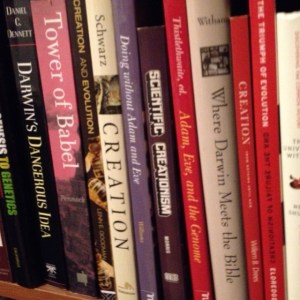
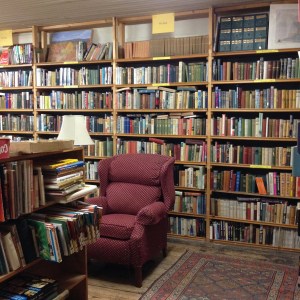
It’s a poignant thing to hold a dying book in your hands.  What was once, straight, flat, and dry, now dissolves into a pulpy mess that, if it ever recovers, will be warped and distorted out of shape forever.  The loss of dozens of books hit me hard.  I think one of the many reasons for this is that books represent, for me, order.  They stand at attention all in a row, many on shelves I built lovingly for them.  I remember where I purchased them, the thoughts and feelings of that time.  In a world that’s far too bumpy and lumpy, books represented the ultimate in orderly array.  Now The Golden Bough is melting in my palm, smearing my fingers royal blue.  The forecast for the week—more rain.

The story of creation in the Bible—more properly, stories, for there are many—is not creation out of nothing.  Creation is the making of order out of chaos.  Ancient people, including the Israelites, believed that water was chaos, if not an actual dragon, that constantly worked against order.  You can’t build on water, it attacks the shoreline, it drowns those who fall in.  Never a seafaring people, Israel equated big water with evil.  God, then, fought constantly this unruly foe.  Whether it was with word or sword, the Almighty vanquished that sloshing, thrashing element that tries to tear apart everything we build.  Read Genesis 1 closely; the water is already there when the creating starts.

Life has a way of getting out of control.  It’s not without irony, however.  A person buys a house to store their books, and before the books can be moved in, they’re destroyed.  It’s rather like a parable, don’t you think?  If that person unfortunately thinks of him or herself as a summation of the books s/he’s read then the loss is like losing a limb or two in that endless battle against the forces of confusion that attempt to overcome our world.  When this happens some of us turn to books for comfort.  The books, however, are disintegrating in our hands.  My Amazon account, it seems, is mocking me at the moment with it’s mover’s discount.  Why buy something that will only hurt me when the water gets in once again?  The people of ancient times knew that the waters of chaos had to be held in check constantly.  They look for any opportunity to get in and destroy.  Ancient writers knew that in order to defeat them, only the most powerful gods will do.  


False Memory

One of the reasons our recent loss of books hit me so hard is that each volume contains memories.  Among the more disturbing developments of memory studies in recent years is the fact that what we remember has a tendency to be unreliable.  In other words, our narratives about ourselves contains a good deal of fiction that we remember as fact.  Even if we write down our impressions shortly after an event, such scribbles are just that—impressions.  Lee Irby explores this dynamic in his novel Unreliable.  Now, since the narrator may be the most unreliable I’ve ever read, I don’t want to give away too much.  Irby knows what it’s like to be a professor (something that some of us share with him) and he has a good sense of Edgar Allan Poe.  It’s one of those books that touched on a number of things in my own life.  I think.

First of all, this was an impulse buy at Buffalo Street Books in Ithaca, New York.  I soon discovered why they stocked it.  Edwin Stith, the narrator, teaches at a fictional college in Ithaca.  The story, however, is set in Richmond, Virginia, where Prof. Stith has gone for his mother’s second wedding.  With characters compellingly drawn, he meets his new step-family, runs into an old-girlfriend, and tries to both avoid and hook up with a student of his that he’s dating, more or less.  He claims from the start, however, that we shouldn’t believe him.  The largest part of the story takes place over one feverish day following a very late arrival in town, with plenty of Poe references sprinkled throughout the tale.

Apart from the Ithaca and former professor connections, the book also mentioned, rather spookily, meeting a girl from Slippery Rock University—a rather obscure school from my old neighborhood.  I had dated a Slippery Rock co-ed who’d proved about as unreliable as our narrator, so this single, brief reference managed to jump-start some of my own memories, reliable or not.  Our pasts, along with the books we read, make us who we are.  I’ve lost track of how many times I’ve thought of a scene I’d supposed I’d forgotten from a book I’ve read years ago.  Just the other day I recalled, completely out of of the blue, apropos of nothing, a scene from a Doc Savage novella I’d read as a tween.  Was it a reliable memory?  I have no way to judge, I guess.  And that’s the scary part, as I’m sure Poe would’ve agreed.


Final Leg

Travel is a form of education.  You won’t get college credit for it (unless some administrative footwork is involved), but it is a means of learning.  One of the things you pick up flying coast-to-coast is how exhausting a day on a jet can be.  Quite apart from jet lag itself, the weariness of occupying your minuscule allotted space in a pressurized cabin can be intense.  And like ocean travel by ship, you have to dock at a distance to use smaller and smaller forms of transportation to reach your destination until at last you walk inside.  This was the first year that such a trip ended by returning to a house rather than somebody else’s rental unit.  It’s an odd feeling.

Work starts again tomorrow, and since I’ve been pretty much unplugged for an entire week, I know chaos awaits.  I also have the task of learning what has happened in this off-kilter world for the last week.  And then I have to make an inventory of the books that were ruined in our own personal Noah event just days before our flight.  The changing of scenes feels rather like a jump-cut in a movie.  Suddenly you find yourself somewhere different, with circumstances that have their own set of parameters.  Vacation time, in a sense, is like a dream sequence.  None of the episodes from back home can reach your sleep-addled mind.  And then you wake up.  Bills are due.  The lawn wants cutting.  The unpacking must continue.

For all that, it feels as if something transcendent happened.  Like Elijah being whisked away in his own personal whirlwind, I was on a plane that took me to a different plane of existence.  A place where no matter what decisions were made the outcome would be pleasant.  Coming home involves what theologians like to call “metanoia,” a sense of transformation—memories that give you strength to carry on the quotidian tasks that make up the vast bulk of our lives.  Lakes in the mountains are all fine and good, but society demands its pound of flesh, and the way they get it is through productive employment.  Tomorrow it’s back to work, a chance to test just how successful the metanoia might’ve been.  This is the reason we traveled on a Saturday, for the sabbath should be a day of rest.  No one knows where that whirlwind set Elijah down, but it’s virtually certain that he had plenty to do once he got there.


Lions, Bears, and Caribou

The place I’ve been spending this week is the habitat of grizzly bears, caribou, and mountain lions, none of which I’ve ever seen here.  Two of these species view us as potential, if troublesome, prey.  In actuality, even here in the wilderness we’ve made the human presence felt and wildlife sightings are somewhat rare.  I saw more deer in New Jersey than I’ve ever seen here.  Kind of makes you wonder about the human reputation among other creatures.  We like to look at them in zoos, but we don’t see them in their natural surroundings.  I like to think that it’s because they have so much space out here to wander—we see plenty of evidence of moose, for example, without an antler or dewlap making an appearance.

The environment, as created in our won image, has become somewhat sterile.  Kind of the angry, old white man’s view of government.  One color is all you need.  Variety is too challenging, and threatening.  We’ve driven the wolves to extinction around here, so you won’t see any of those.  Won’t hear their plaintive howls on a moonlit night.  You’ll see motorboats aplenty, and cars with fancy technology, and airplanes buzzing overhead.  This will have to do for wilderness, since other places are fast developing into surveillance states to protect the rich men’s money.  Wilderness means nothing to such people, unless it can be exploited for personal gain.  The thing is, once it’s gone for them, it’s gone for us all.  I found a sardine tin shining like silver in the silt on the bottom of our lake.  Our fingerprints are everywhere.

The problem isn’t new.  Even some monks in late antiquity found that when they headed into the desert for heroic feats of spirituality, they were followed by the curious.  Crowds would sometimes gather to watch them being holy.  Would that break a saint’s concentration?  Do I even need to ask?  The forest service asks us to stay on the trails.  The trails are well trod.  Out of sight, but never far from mind are the bears and cougars.  We’ve driven them out of our path and then congratulate ourselves on becoming the top predators.  Once the beasts are gone we turn our instincts on our fellow humans.  To flush them out into the open we must tame their wildness. And when it’s all gone the only rule will be, in this distorted vision, that of rich white men.  An angry grizzly bear would be far more congenial.


Hearing Nature’s Voice

Silence is a rare treat.  I enjoy music and witty repartee just as much as the next guy, but silence is revelatory.  At home and in hotels I sleep to the sound of a white noise generator.  You can’t predict the sounds of neighbors, and my hours are askew from those of the rest of the world.  Here at the lake, things are different.  I awake early, hoping to catch the sun as it trips over the mountain tops across the way, lighting successive peaks before it reaches the near horizon.  It is utterly still.  Perhaps it’s the interference of humans in the habitat, but crepuscular animals seldom wander past.  The stillness is divine.  For some the lake means loud jet skis and buzzing motorboats.  I come here seeking silence.

Our daily lives lack peace.  Even when things are good there are always more things to be done.  We cram as much as possible into days impossibly short, giving at least eight out of every twenty-four to those who deign to pay us for our efforts.  Sleep is troubled and interrupted.  There are noises in the night.  You can’t hear your soul.  As the first rays seep into the valleys across the lake the birds begin to greet it.  Their conversation may interrupt the silence, but it doesn’t break it.  Silence is finding one’s place in nature.  Taking time to be still.  To listen.

Thirty years ago I first came to the lake.  My wife had been coming here for years already before that.  There have been many changes even in my short time here.  I can, however, hear eternity in the silence, for forever is a whisper, not a shout.  As I watch the morning mist arise, skate, and dance over the surface of the water as still as the very mountains that cradle it, I strain my ears to catch any sound.  The twirling wraiths are as silent as they are ephemeral.  They spin away the last minutes before the whine of an early morning fisherman’s boat begins its sleepy journey to the deep water in the middle of the lake, herald of other daylight noises to come.  I will await tomorrow’s unction of silence, and although the baptism may be secular it’s redemptive after all.  Nature knows far more about the human soul than any measurements might reveal.  You only have to listen to hear it.


Traveling Unplugged

Those who pay close attention, or who have nothing better to do in July, may have noticed that I missed a day posting on this blog on Saturday.  That hasn’t happened for a few years now.  I think maybe I ‘m growing up.  Or learning to resist.  Saturday was a travel day—the first I had to make from Pennsylvania, back to Newark in order to fly to Washington state and drive a few hours to the lake.  All in all, it turned out to be a long day in which I didn’t even notice that I was unplugged.  I had a book that I read along the way.  Although it’s against my religion—(call it Moby)—(but I jest)—I even fell into a cat nap or two on the plane.  I didn’t have a window seat and strangers don’t like you staring in their direction for five hours at a time.

Upon awaking, eyes refusing at first to work in tandem, in the chill mountain air, I realized I’d spent the entire day off the internet.  We had to pull out at 2:30 a.m. to meet TSA requirements, and you have to pay for the privilege of connecting to the web in airports and on board jets.  I’ve become so accustomed to being wired that I feel I have to explain why I wasn’t able to post a few thoughts when circumstances were so adverse to getting tangled in the world-wide web.  Yes, it still has a few gaps where one might buzz through without being caught.

It was remarkably freeing to be unplugged.  I believe Morpheus may be correct that they want us to believe reality is otherwise.  I feel guilty for not checking email manically.  What if someone requires something right away?  Some sage response to a communique that just can’t wait until I’m back from vacation?  Some reason that I must ask to be inserted back into the matrix if just for a few moments, to hit the reply button?  We’ve perhaps been exposed to what The Incredibles 2 calls the Screenslaver, the force that draws our gaze from even the beauty of a mountain lake to the device in our hand, whining for attention.  We have wifi here, of course, for the fantasy of living raw is sustainable for only a few hours at a time.  Reality, as you know if you’re reading this, is electronic.  But until I have to reinsert myself at the cost of my soul, I think I’m going to take a dip in the lake.


High Places

I have gotten me away unto an high place.  No, that’s no biblical, but it sure sounds psalm-like.  Part of the anxiety I felt about the literary loss over the past few days is that it happened just before a long anticipated, and paid for, vacation.  As Thursday dawned, I knew I had only two days to try to rearrange the undamaged books and try to salvage what I could of those that were soaked.  And I had to do it quickly and then leave, only to see the results when I returned.  Not yet having met any neighbors, and not really being in a position to prevail upon their presumed good will, it was a test of personal endurance.  Our garage has an upper floor that remained dry.  I made well over an hundred trips up those stairs, book boxes in hand.  One cares for ones friends.

For now, however, I am at my favorite high place, in the mountains.  On a lake.  I’m having to reconcile myself with my old foe H2O, for here it is placid welcoming.  It stays outside the cabin and we remain friends.  And truth be told, there is a kind of idolatrous element involved in my visits to the lake.  You see, I covet peace.  Since childhood violence and bullies have led me to a quasi-monastic life—Paul Simon reflected that perfectly in his early song “I am a Rock.”  Even Superman had to have his fortress of solitude.  Some fear being alone with their thoughts.  Although I struggle with them, they are, like my books, who I am.

Dawn’s early light; and it only got worse as the day went on.

Prophets and deuteronomists railed against high places.  Such were locations where the God of Israel grew jealous of the attention lavished on other deities.  Perhaps religious promiscuity comes naturally to people, but we need our high places to regain perspective.  To breathe pine-scented air and feel the chill of a July morning at altitude.  Yes, even to reconcile with the splash of water that is here to make life possible rather than to destroy that which you have worked to acquire.  Ironically some of the destroyed books had been with me since college—theological classics such as Niebuhr, Gutiérrez, and Tillich, lying on the unmown grass beneath a healing sun.  Perhaps they were trying to warn me of the idolatry of such retreat.  But here I am, reflecting on loss and hope, and praying that somehow we might just all get along.


Prelude to Chaos

Liquids are the enemy.  Don’t let the cuteness of this little guy fool you—there’s collusion here.  For as well as creating life, and being necessary to sustain it, water destroys.  Creator, annihilator.  We moved during a time when neither of us had vacation and we told the over-tired movers that it was okay to put our boxes in the garage.  We planned to move them soon, but, you know, work.  Then the rains came.  Not just sprinkles, but downpours.  The garage isn’t water-tight.  Boxes were soaked.  Many books were damaged.  This wasn’t a flood that can be claimed on insurance, it was simply rain pooling where people usually park their (normally waterproof) cars.  In their place sat our books.

We both worked the day after the rains.  When we discovered the damage the next evening, it looked manageable.  I had to work the next day, of course, and a few breaks sufficed to get the many, many boxes of damaged books out into the sun.  It was carnage.  We don’t have much in the way of material goods; we spend a bit of money on books, however.  Now they’ve become the victims laid out on this altar of home ownership which, at the time, seemed like a good idea.  We needed a house for our books.  We needed time to move them from the garage to the house.  Yes, old friend Morpheus, “Time is always against us.”  

Job sat upon his ash-heap and pondered why he’d paid the movers so much only to have his moved goods destroyed.  And in a manner in which insurance assessors are trained to point to the fine print.  Those who store their goods in the garage reap the wrath of liquid.  You see, when water reaches cardboard, or paper, the wood pulp sucks it up.  Carefully dried, the paper remembers the compelling nature of water.  Too little, and you die.  Too much, and you die.  No wonder the ancients thought that water was a deity.  It claims all—tries to get in through your roof.  Lays insouciantly on your basement floor.  And the garage—yes, who thought of the garage when the immediate concern was to shut the windows to keep Leviathan out of the house?  I spent weeks carefully packing those books against shipping damage.  Used up my vacation days doing so.  Chaos has claimed them.  I would weep, but that would be collusion with the enemy, even if nobody sees.


Religion in the City

It’s 5 a.m., so what are all these people doing here?  On the highway.  It’s still dark and I’m on my way to the choice of public transit that will take me to New York City.  You see, telecommuting is never 100% city-free.  Somehow I’d been thinking that once we’d gotten away from New York things would be quieter.  Then I remembered that in two decades, if current trends and models continue, nearly half of the US population will live in just eight states.  New York and Pennsylvania are two of them.  Those of us who’ve moved here to get out of the rat race have made our own little mouse race, I guess.

Being in the city after an absence of almost three weeks was a shock to the system.  The first things I noticed were how loud and crowded it was.  In the summer Manhattan has, I was forcefully reminded, lots more tourists than the winter months when it feels like, as one comrade says, Leningrad.  As always when I’m in the masses on the streets, I think about how religious New York City is.  And how secular.  It is, I suspect, a cross-section of American (and international) beliefs.  People come here looking for something transcendent.  Otherwise, why leave home?  Tourism can be a sacred industry.  It brings people from different places together and, in the best of circumstances, forces them to get along with one another.

There are plenty who seek to convert those who are different.  On my way to Penn Station last night, as the light was beginning to fade in Herald Square, I woman had set up a portable mic and speakers.  She was preaching, ignored, to the evening crowds.  Among the strangers are those who believe differently.  Those who are ripe for conversion.  It’s all part of New York’s background hymn.  Then on the sidewalk I spied, scrawled in chalk, “Repent and obey Jesus — Heb 5:9;” the writing on the walk.  “And being made perfect, he became the author of eternal salvation unto all them that obey him” the selected verse reads.  We can overlook that it says nothing about repenting.  This is, after all, the melting pot where religions encounter, mingle, and blend.  Even the Fundamentalists must feel it from time to time.  The traffic home at 10:30 p.m. is quieter.  The day, I will learn, is not over yet.  Such is religion in the city.


Not Quite Eschatology

Realized eschatology, if you’ll pardon my French, is a term that describes the “already/not yet” aspect of the “end of the world.”  In other words, some theologians suggest that the eschaton—the end—has elements of both the present and the future in it.  The term came back to me yesterday as we returned to our old apartment to take care of things the movers left behind.  (And “left behind,” I realize, isn’t really a biblical eschatological concept at all.)  Joined by our daughter, I felt a bit resentful of her time being taken from our new home to spend in the old.  I felt an almost adulterous desire to leave the old and cleave to the new—hadn’t we already paid, and overpaid, for that apartment many times over?  The house, on the other hand, is new (to us) and still requires much attention.

As we organized the remaining items, broke down boxes we didn’t use this time around, and waited for the Got Junk guys to arrive and haul it away, I noticed our daughter gazing wistfully at the empty space that had once had our imprint all over it.  It dawned on me that she’d spent her teenage years here—after the Nashotah House debacle, this was the place she’d lived the longest.  This empty apartment was, for her, home.  I began to feel insensitive about my earlier anxiety to leave.  We all live between at least two worlds—our pasts make us who we are in the present.  The world of our teenage years is fraught with emotion and memory.  The world looked so different at that time, as I sometimes forget.

Moving is one of the most stressful situations human beings encounter.  We have a love/hate relationship with our past.  To me the apartment represented a place we occupied out of a kind of desperation.  Five states to the west, we had to move to New Jersey with little money and tons of boxes—one of them Pandora’s, with hope nestled inside.  We told ourselves the apartment was temporary—maybe a year—only until we could buy a house.  Twelve months turned into a decade, then more, with each year accreting memories in every crack and corner.  Part of us will always be in that apartment, for every place people have lived before is haunted.  On our way back to our new home at the end of the day, we were each lost in our thoughts.  Perhaps not so much realized eschatology as experienced reality, we’d spent a day in a present that will never fully arrive.


Awakening

Waking up for the first time in our new place, I felt a strange relief.   I hadn’t realized how much you feel owned when you have a landlord.  Slipping out of the bed while it’s still dark, vague shapes that eventually resolve into unpacked boxes lurk in the shadows.  They mean me no harm.  I go downstairs.  Downstairs!  Without revealing too much personal information here, I can say that I’ve always believed in sleeping upstairs.  In our several apartments my wife and I have lived on one floor.  Going to sleep meant walking down the hall into another room.  It lacked proper transition.  When we looked at houses it took some time before I could put my finger on it—we needed a two-story house.  You go “up to bed” for a reason.

The thing about writing is that it’s an activity of habit.  Not aware of the location of light switches yet, I shuffle slowly through my own personal towers of Babel.  Find the coffee maker.  Where do I go to write?  Not wanting to wake my wife, I decide it should be downstairs.  There’s the study, with its desk.  Seems pretty obvious.  Mug in hand, with no lights on, instinct drives me back to my usual chair in the living room.  Habits are seldom planned.  They happen.  I’ve become used to writing electronically, but as I wanted badly to explain to the movers, I grew up writing on paper.  Writers are readers and there are two things you don’t throw away—books and your old writings.  Carpenters don’t ditch saws and hammers just because they’re heavy and numerous.  There’s a kind of religious devotion here.

Don’t worry, I’ll soon be back to my more abstract topics on this blog.  Religion and all that.  Right now I’m in a transition and I’m wondering that if that means I’m now officially grown up.  If so, does that mean abandoning my childhood dream of being a writer and facing the fact that all these boxes were moved in vain?  Not having food in our new place, our first day we went to a Chinese restaurant for lunch.  The locals were talking.  Their concerns?  Lawn care and propane.  Everyday things.  Clean-cut and suntanned, they can tell at a glance that I’m a stranger with my unkempt hair and prophetic beard.  Is my writing fantasy just childhood gone to seed?  No.  Books and writings are my identity.  The movers may have mixed them in with saucepans and power tools, but I know at a glance which boxes contain books.  Soon they will be in every room of this house.  That will make anywhere feel like home, even if I can’t find the lights.  


Paranormal Pilgrimages

Although the Allegheny Mountains are hardly the Rockies—they’re much older and gentler on the eye—they harbor many tourist locations.  Even before my daughter attended Binghamton University, I’d been drawn to the natural beauty of upstate New York.  Prior to when college changed everything, we used to take two family car trips a year, predictably on Memorial and Labor day weekends, when the weather wasn’t extreme and you had a day off work to put on a few miles.  One year we decided to go to Sam’s Point Preserve (actually part of Minnewaska State Park) near Cragsmoor, New York.  It features panoramic views, a few ice caves, and, as we learned, huckleberries.  What my innocent family didn’t suspect is that I’d been inspired to this location suggestion by the proximity of Pine Bush.

A friend just pointed me to an article on Smithsonian.com by my colleague Joseph Laycock.  Titled “A Search for Mysteries and Monsters in Small Town America,” Laycock’s article discusses how monster pilgrimages share features with nascent religion.  People report strange encounters with all kinds of creatures and objects, and science routinely dismisses them.  Odd encounters, however, leave lasting impressions—you probably remember the weird things that have happened to you better than the ordinary—and many towns establish festivals or businesses associated with these paranormal events.  Laycock has a solid record of publishing academic books on such things and this article was a fun and thoughtful piece.  But what has it to do with Pine Bush?

Although it’s now been removed from the town’s Wikipedia page, in the mid 1980s through the ‘90s Pine Bush was one of the UFO hot spots of America.  Almost nightly sightings were recorded, and the paranormal pilgrims grew so intense that local police began enforcing parking violations on rural roads where people had come to see something extraordinary.  By the time we got to Pine Bush, however, the phenomena had faded.  There was still a UFO café, but no sign of the pilgrims.  I can’t stay up too late any more, so if something flew overhead that night, I wasn’t awake to see it.  Like Dr. Laycock, I travel to such places with a sense of wonder.  I may not see anything, but something strange passed this way and I want to be where it happened.  This is the dynamic of pilgrimage.  Nearly all religions recognize the validity of the practice.  It has long been my contention, frequently spelled out on this blog, that monsters are religious creatures.  They bring the supernatural back to a dull, capitalist, materialistic world.  And for that we should be grateful.   Even if it’s a little strange.


Unnatural Connections

The last time we moved internet service was just becoming an issue.  When we first came to our Somerville apartment we had dial-up.  Do you believe it?  Shortly after that FIOS came to town and we decided to give it a try, but at a fairly low speed.  We’ve always tried to be responsible with money and I naturally balk at paying for something as intangible and amorphous as “internet connectivity.”  I guess I’m a naive realist after all.  In any case, one of the top priorities in moving to our new place was getting internet set up.  Even before electricity or gas or water.  It has become THE utility.  The place to pay the bills for all the other utilities.  And since I’m now telecommuting, the umbilical cord that connects me to work.

I don’t mean to sound all grandpa-ish on you, but just twelve years ago we struggled for any connection at all.  We had one computer (and one work laptop) and only the desktop had internet access.  Many of the arcane pieces of hardware found in the attic were from attempts to get us onto the net more efficiently.  We even had to draw up a contract for who could use the computer and for how long since all of us wanted that magic window onto the virtual world.  Now, like most households, we have wifi and high speed access.  When we’re not at the computer, we have our smart phones at hand.  The strangest thing about all of this is that now that we’ve got constant connection, our nation has become as polarized as it has ever been.  Perhaps we see a little too much of each other?  Or too little?

The web has connected us to those we like.  Walking down the street it’s rare to find someone not staring at their phone, ignoring all living beings around him or her.  We’ve been able to filter out those we don’t like.  Those who have different points of view.  The net shows us that we aren’t alone, and even those with extreme views can find plenty of compatriots in cyberspace.  There’s a reason we used to be told not to discuss religion or politics.  Now we know everybody else’s business.

There was a time when moving meant going to where the jobs are.  Especially in academia.  Colleges and universities exist in set locations.  In space-time.  Telecommuting isn’t an option (although even that’s happening in some cases now).  Moving these days means weighing your internet access options.  Satellite is just too slow and unreliable.  Who would’ve imagined, for those of us born just after Sputnik went up, that now even space-based connections just aren’t advanced enough?  Cyberspace has become more infinite than outer space.  And I still prefer pencil and paper.


Blogday

Sects and Violence in the Ancient World is nine years old today.  Not that I’m keeping count.  Really, I’m not.  WordPress sent me a notice, and they ought to know, being the virtual womb whence my thoughts gestate.  The original plan for this blog was to take my abiding interest in the religions of antiquity and give them a more public face.  My brother-in-law, Neal Stephenson, thought I should do podcasts, because, at the time I spoke incessantly about ancient deities.  I can still hold forth about Asherah at great length, but ancient Near Eastern studies is, believe it or not, an evolving field.  You need access to a university library, or at least JSTOR, and a whole sabbatical’s worth of time to keep up with it.  Even though telecommuting, I’m a nine-to-five guy now, and my research involves mostly reading books.

So Sects and Violence began to evolve.  I realized after teaching biblical studies for over a decade-and-a-half that my real interest was in how the Bible was understood in culture.  Having a doctorate from a world-class university in the origins of the Good Book certainly should add credibility.  My own journey down that pathway began because of interpretations of Scripture that were strongly cultural in origin.  I first began reading with Dick and Jane but quickly moved on to Holy Writ.  It has shaped my life since before I was ten.  It’s only natural I should be curious.

Like most tweens, I discovered sects.  Why did so many people believe so many different things?  And many of them call themselves Christians.  And the Christians I knew said the others weren’t Christian at all.  And so the conversations went, excluding others left, right, and center.  As someone who wanted answers, this fascinated me.  The Bible was the basis for many belief systems of sects everywhere.  From Haiti to Ruby Ridge.  From New York City to Easter Island.  From Tierra del Fuego to Seoul.  And not just one Bible, but many scriptures.  And these beliefs led to behavior that could be called “strange” were it not so thoroughly pervasive.  Scientists and economists say we’ve outlived the need for religion.  By far the vast majority of people in the world disagree.  I couldn’t have articulated it that way nine years ago, but since losing my teaching platform, I’ve been giving away for free what over four decades of dedicated study—with bona fides, no less!—has revealed.  Happy blogday to Sects and Violence in the Ancient World.


The Moved Unmover

To say it was an easy move would be a lie.  I write this on a beautiful, cool, clear July morning.  Only I can’t even calculate the last time I slept.  Not new house syndrome, but that move!  Our personal account manager at International Van Lines was supposed to call us between 4 and 6 p.m. on Friday to confirm the time of the move.  She would also tell us how much money was needed, in cash, by the movers.  In cash?  She’d taken my deposit by credit card; why couldn’t the balance be paid that way?  She was supposed to call to clarify.  I suspect my tone makes it sufficiently clear that she didn’t.  I went to bed not knowing if we would be moved or not—I only reread her email after packing the last box (or so I thought) at 7 p.m.  The IVL offices were closed.

I awoke at 3:30 to an email saying they would be there between 9 and 11 a.m.  And they would be wanting an uncomfortably large amount of cash.  My wife went to get it, and three guys and a truck arrived at 9:15.  I could see their faces blanche at the walkthrough.  They’d been told it would be a ten-hour job.  It turned out to be seventeen.  Nothing makes you feel a cad quite like being thought a snake-oil salesman.  Our bill of lading was just a bit short of reality.  Packing the truck wasn’t finished until 9 p.m.  Unpacking until 2:30 a.m.  Our three guys were joined by two more for the unpacking.  Most everything went into the garage because, well, no stairs.

Twice during the day the amount of cash needed was upped by a significant amount.  This was one of those “we’re in it now” situations.  We paid what was requested.  The internet guy was arriving potentially by 8 a.m. this morning.  Who can sleep knowing the alarm is set for four hours from now?  And our labeling scheme was so arcane that, well, most everything ended up in the garage.  The movers themselves?  Absolutely fantastic!  I’m sure they’ll be talking about this move for months to come.  

Looking outside, the yard wants mowing.  The internet guy is coming.  Who needs sleep when my life of telecommuting begins tomorrow?  The good news is it took only half an hour and one trip to the garage to find the coffee filters.  I’m looking out at a beautiful, crisp morning.  Over an Everest of boxes.  But you won’t know any of this until the internet guy gets here.  Somehow I sense we just accomplished something quite extraordinary.