Scared Space

It was dark.  I often work in dim light since the computer screen backlights everything.  I’d strained my back the day before, and getting into a standing position took some time, with the first steps being necessarily ginger.  Out of the corner of my eye, I saw it in the shadows.  A wolf spider was on the arm of my chair, just inches away.  I could move neither fast nor fast enough.  By the time I’d hobbled to an empty peanut butter jar (we keep them for this purpose), it was gone.  But the fright remained.  It was several hours until I could think of sitting in that chair again, although the spider was last seen fleeing the site of the attack.  That got me to thinking about how spaces maintain the events that transpire in them.  It’s the early stage of haunting, I suppose.

Spiders were a childhood terror.  Just a week before the current spider incident, I was in the basement doing some repairs when a spricket jumped on my arm.  Sprickets, also known as camel crickets or cave crickets, live in damp places and they actually jump at their perceived enemies to frighten them away.  It works.  I was absolutely terrified by the thing.  It was large, and although it was on my arm only a second or two, I wanted to run screaming from the cellar and strip off my shirt and throw it in the washer.  I couldn’t go back into the basement the entire day.  It was the site of the fright, you see.  Spricket and spider were long gone, but their threat remained in the place I’d encountered them.

I often write about sacred space.  There is also such a thing as scared space.  I can see how this would’ve evolved from our primate ancestors.  Chimpanzees, for example, are frightened of large spiders.  They can climb trees right after you and they are impossibly fast.  I suspect in our encounter the spider was more frightened of me than I was of it.  I’m a giant in its multiple eyes and, were I not a believer in catch-and-release, could easily have killed it.  (Messy for the chair, but conceivable.)  Our ancient ancestors would likely remember—this is the place the spider bit Oog.  Must avoid.  So the idea remains, scarring the spaces we habitually sit.  Spiders outdoors, as long as I see them before they see me, are not such a source of fear.  But right now I think I’ll pick a new favorite chair, until my favorite becomes sacred again.


Eureka?

It’s weird to feel yourself becoming a curmudgeon.  Especially when it’s about technology.  Someone asked me the other day if I could send an audio file of something I’d recorded.  I stopped doing podcasts because I lost track of the server that had been hosting the files.  My “inbox was full” or some such nonsense—they’re just electrons, folks.  I’m already paying for the space to host this blog and one thing I know about audio files is they take up lots of space.  My laptop reminds me of that every time it wants to update.  Well, I recorded the requested audio file and wanted to send it along.  I couldn’t find it.  Now, I’m one of those people who started using Apple computers because they were intuitive.  You could easily guess, or reason out, where things were.  It’s not that way anymore.

I had to do a web search (use Ecosia!  They plant trees for your searches!) for where Macs store your audio recordings so that I could send it.  Buried deeply in a directory that has a nondescript name that you’d never possibly guess (it’s as if someone were to assign you Concluding Unscientific Postscript during a game of book-title charades), the helpful site said, you’ll find it.  It’s in your “Library.”  Well sir, Mac had decided that you no longer needed to navigate your way to your Library and that directory was hidden.  Another Ecosia search—more trees—and I learned that you could do a special preference tweaking (it only took four or five steps) so that your computer would display your own Library and you could find your renamed file that you’d created.

Back in the day (here’s the curmudgeon part) when you had to swap discs—floppies—and the computer had the memory capacity of a Republican senator, you knew which disc had your files.  To access them, you simply inserted the disc.  Later they were stored on the hard drive itself and the directory told you right where you’d find them.  Now who knows where your created content is stored—out there on a cloud somewhere, I hear.  That doesn’t help when a friend asks you to send a file.  I had no idea where it even was.  It’s job security for the tech sector, to be sure.  At least it helped me to plant some trees along the way.  Back in the day we used to say you can lose sight of the forest for the trees.  It works, it seems, the other way around as well.


In Black

When autumn rolls around my hankering for gothic literature ratchets up.  It’s really my gothic sensibilities that make me watch horror films, seeking some kind of transcendence.  Some time ago I heard about the movie The Woman in Black, but I’ve never seen it.  I learned about the novel by Susan Hill, on which it’s based, and decided to check out the written form.  (I almost always like the book better than the movie anyway.)  The story is indeed moody, set in, as these stories often are, a remote part of the coast of England.  A lonely house cut off by the tide.  A hidden past full of secrets.  The plot is one of a vengeful ghost, and therefore the whole is somewhat supernatural.

I couldn’t help comparing it to Andrew Michael Hurley’s The Loney, which is also set on the coast of England, and also features a house cut off by the tides.  The storylines are quite different beyond that, but it is often the setting that makes gothic tales so, well, gothic.  The Woman in Black builds up the story slowly, intimating that something is wrong near the start, but not really giving too much away until near the end.  It isn’t really the conclusion, however, that a gothic reader is after, as much as the feeling.  Being immersed in a spooky setting where you’re not sure what’s going on.  There’s a kind of release in that.

I’ve often tried to figure out why this type of story appeals to me.  It’s certainly something to do with my childhood.  We didn’t live in a very gothic place.  My hometown was working-class normal, it seemed to me.  When we moved into the first apartment I remember, the setting did become gothic to an extent.  It was an older building that still had gas jets jutting through the walls from the days before electricity.  One of the bedrooms was painted black.  There was a huge crack in the linoleum in the hall that had the potential to trip you if you weren’t paying attention.  It was there that I first became aware of liking gothic settings.  It was the place I discovered Dark Shadows and began to find it strangely homelike.  Many of us, even with less-than-ideal childhoods, often look back to them with a kind of happiness that we just can’t seem to attain as adults.  Mine included some gothic elements, and reading novels like The Woman in Black takes me back there, if only for a little while.


Horse Senses

Chief was a smart horse.  The horse camp instructor told us that horses sometimes distended their midsections when a rider was strapping on the billet because they knew the strap would be tight.  The billet goes underneath the horse and is essentially what holds the saddle on.  The instructor told us to be firm about this—we weren’t going to hurt the horse by tightening the strap as much as possible.  Now, this was United Methodist Church camp, and I am someone who tries hard not to hurt anyone.  Besides, I’m not one of the larger specimens of the species and Chief was quite a large horse.  I can swear he had a knowing, laughing look in his eye that day as I pulled the billet tight.  Or so I thought.

As a camp counselor in the Western Pennsylvania Conference, you were assigned to a set of camps with no say in the matter, and I had been assigned four weeks of horse camp.  I wasn’t a kid who grew up wanting to ride or own a pony.  I was just doing my job.  Sitting atop a horse, I felt like some combination of John Wesley and Edgar Allan Poe heading for the house of Usher.  It was the first day of the first week of camp and my first time riding.  It was going fine until the instructor told us to canter, the speed between a trot and a gallop.  It was then that I felt the saddle starting to slip and I knew that Chief had used the old horse trick of distending his middle while I’d tightened the strap.  I felt the saddle begin to slip to the right (the wrong side for mounting or dismounting).  So I fell off a cantering horse.

Although the instructor yelled at me for not putting the reins over the pommel before I hit the ground, what stayed with me was how smart that horse was.  Chief, knowing the disparity of our relative sizes and weights, once stepped on my foot.  He was an intimidating horse with an attitude.  After the end of four weeks I’d gone on to the point where we spent an overnight in tents with our horses curried and tethered outside for the night.  What those days taught me was just how intelligent animals are.  I was reassigned from Chief to a more gentle horse for the remaining three weeks when the instructor realized she was stuck with me for a while.  But the horses, they knew me even better.


Believing and Seeing

Our eyes locked for a moment.  He wasn’t ten feet away.  Of course, like all famous people he knew that his fans thought they knew him and hoped that he would know her or him.  This isn’t a particularly rare thing to happen in New York City, but the instance in my mind happened in Atlantic City after an Alice Cooper concert that I attended with my brother.  As kids we’d listened to Cooper with some avidity,  and even the concert itself was a somewhat intimate affair (we were both adults at the time).  An audience of hundreds instead of thousands, and many of the attendees about our age—that is to say, not young.  That meeting of the eyes, however, reinforced something I already knew.  Looking is more that your eyes receiving light particle-waves.  It is a connection.

Try this with your bestie—it can be your spouse, lover, or friend.  It especially works if you’ve known her or him for many years.  See how long you can go staring into each other’s eyes.  It’s not easy.  You start to feel that they can see your secrets: your fears and vulnerabilities.  You glance away.  Materialists claim that seeing is a simple matter of light entering our eyes and our brains interpreting it.  We all know, however, what it’s like to be stared at.  How uncomfortable it makes us feel.  We can often tell when someone’s staring at our backs.  I wonder if there’s more to seeing than appears?  Performers often crave the energy of being before thousands of eyes.  They know how it’s just not the same when you have to pretend.  I knew that well as a teacher.

Could seeing really go both ways?  Even animals don’t like to be stared at.  It’s an informal experiment I’ve tried while jogging.  If you break eye contact with a deer, cat, or rabbit, you can get fairly close.  If you stare, however, they dash away.  It doesn’t matter if you turn your head—it’s the eye contact.  I ponder how this relates to narcissists in power.  They crave the eyes on them.  The way to de-power them is to stop looking.  Alice Cooper, I’m certain, has no idea who I am.  He wouldn’t remember me if we ever met.  That night he was standing outside the door of the afterparty where those who’d paid extra could get to meet him.  We didn’t exchange a word, but we made a connection.  There’s more to seeing than meets the eye.


Large Projects

Now, where was I?  I suspect it’s the same with you.  We’ve got so many things going that it’s difficult to keep up with them all.  When one big project comes along—say reading book proofs for a deadline—everything else gets displaced.  After a week of intense concentration you emerge from a daze and try to remember where you left off with other projects.  What was so dreadfully important before the large project began?  I’m used to deadlines at work, but there aren’t too many in my personal life.  I have goals and targets, to be sure, but due dates slip and slide with the slings and arrows.  When the big project’s done there’s relief, but also a kind of reboot that has to take place.  I’m afraid to look at the news.

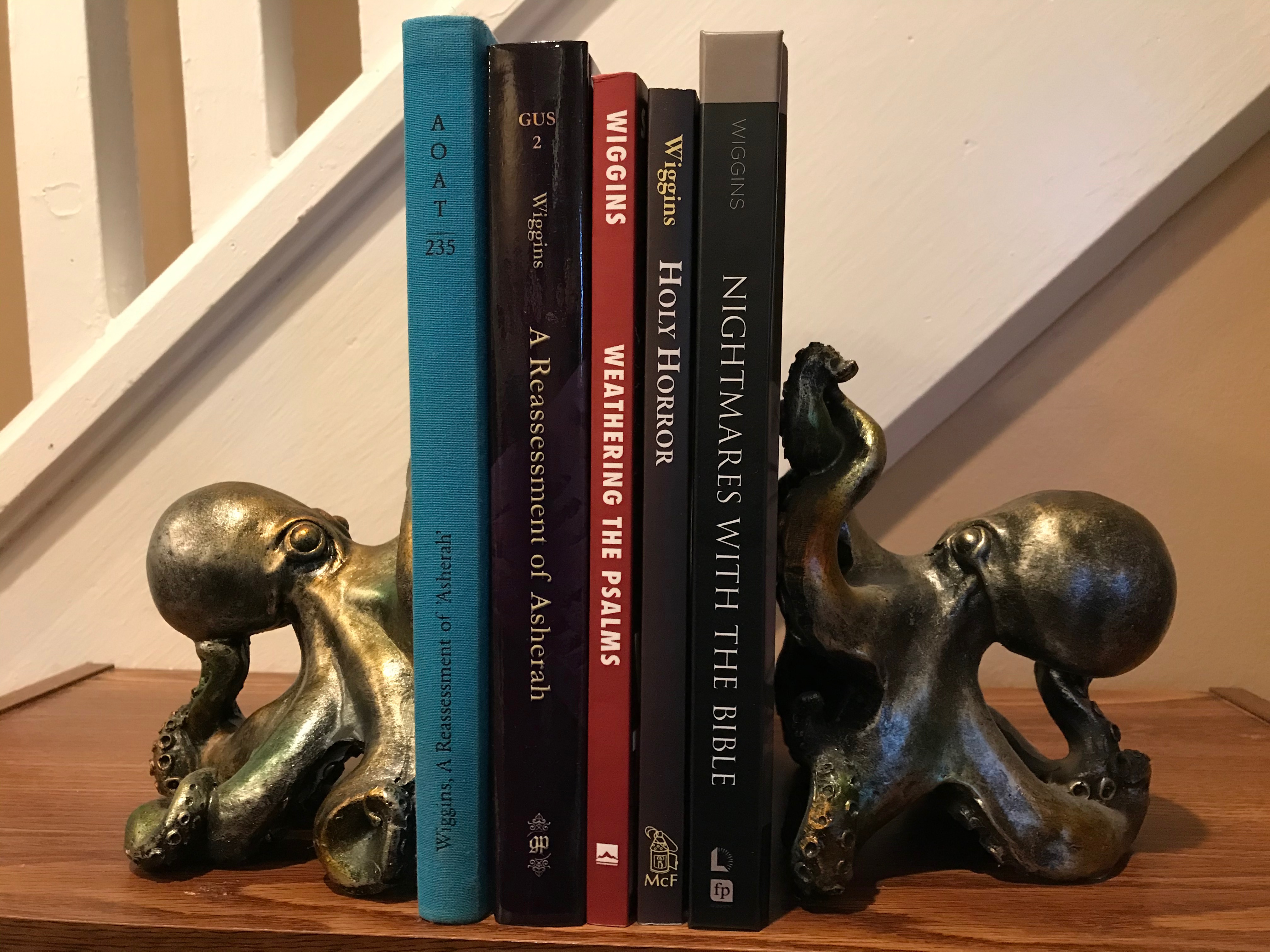
The corrected proofs of Nightmares with the Bible have been submitted, along with the index, and now all I can do on that front is wait.  Which of my many other projects, neglected for an entire week, should I take up now?  Part of the difficulty is knowing whether to work on fiction or non.  Given my work-life commitments, fiction is easier.  I enjoy writing it, but I have trouble getting published.  Nonfiction, on the other hand, is simpler to get published but brings in very little remuneration.  I know as an editor that we distinguish between academics (who already have a good paying job) and, say, journalists, who write nonfiction trying to earn a living.  What about an editor who isn’t paid like an academic, but has a regular job nevertheless?  (When talking to an independent, nonfiction publisher a few years back, I heard him respond to the question of if he was non-profit with, “Well, that’s not how I intended it…”)

I have two nonfiction books well along at this point.  I also have several fiction projects, including an eighth novel and a short story collection.  I also have some essays underway for sites beyond my own blog.  A week seems like a long time to put all these things aside and then to pick them up again.  That week wasn’t vacation either.  Nor did it suggest topics for me to address on my blog because if you want to know about Nightmares with the Bible you’ll read the book.  The evening I finished the proofs I had a dream that seemed to stretch through the entire night that I had come up with a complete college curriculum all by myself.  As much as my weary mind wanted to go on to other things it was fixated at that stage.  I awoke to wonder where I’d left off on real life projects, none of which are very near the finish line.  Now, where was I? 


Index Fingers

I’ve occasionally written about how authors obsess over indices, or indexes, for their books.  These days most things are looked up electronically, but this entire week my reading, writing, and relaxing time have been taken up with the index for Nightmares with the Bible.  Creating an index is an odious yet perversely enjoyable task.  Most publishers (at least among the academic crowd) foist this duty onto the author since a freelancer can easily add $4,000 or $5,000 to the book’s budget.  After preparing an index you can understand why.  At least I get to work with searchable PDFs, but I remember doing indexes on paper and having to sort through printed proofs and hoping that you’d catch every instance or a word or phrase.  The searchable PDF helps, but it depends on the material you’ve got to work with.

The Bible, for instance.  Not only are many book names short—Job, John, Mark, James—they are also common.  People have named their kids after biblical characters, or with biblical names, for millennia.  Not only that, but Job can be job.  Unless you put the quotes around it “Eve” will show up on just about every page, believe it or not.  The real strain on the eyes comes from those terms that are important and show up throughout the book.  Words like “Israel,” or “monster,” or “priest.”  I’m not one of those people who writes a book about demons and puts “demons” in the index, though.  Hey, if you know that’s what the book is about, why look in the index?  Just read it!

Meanwhile, the cover copy came this week for my approval.  I haven’t seen the cover proof yet, but last time I actually had time to check (several days ago now) other media outlets had picked up on the imminent arrival of a new book.  It wasn’t on Goodreads the last time I looked, but there’s time for that.  Right now there’s no time for anything, however, other than indexing.  It actually takes longer to do this than it does to read the proofs for the book.  And indexing helped me discover a spelling error that had gone past both me and the copyeditor.  So this is a valuable exercise, but there are many other things to do as the weather turns cooler and other projects are aching for attention.  Four days of intensive indexing and I’m only up to the “p”s.  I’ve been away from it too long, so I’d better mind my “q”s as well.


Propaganda

“[F]or the most part, thinking is inherently and irrepressibly liberal.”  As much as those who’ve drunk the Trump Kool-Aid (watered down, for sure) might want to deny it, these words by Jeff Kripal are true.  Thinking itself is nearly always a liberal activity.  This election has become one of propaganda versus thinking.  Propaganda is, according to Oxford Languages, “information, especially of a biased or misleading nature, used to promote or publicize a particular political cause or point of view.”  People who, I know for a fact, were taught about propaganda in high school (lots of little heads were nodding yes that they understood what propaganda was and then nodding no that they were never fall for it) have now jumped onto Trump’s propaganda bandwagon, claiming that facts are “liberal hoaxes.”  Thinking is liberal.  Thinking hoaxes, I guess.

Liberals, as I’ve stated repeatedly, don’t take anyone’s word for it.  We fact-check.  Herein lies the difference.  If Joe Biden were to state that Democrats couldn’t win without cheating in the election, liberals would be all over this, fact-checking.  Where did he get this idea?  Did he cite his sources?  Does science concur?  And then if he were to lie about having said it, liberals would point out the contradiction.  Trump’s followers, who have nearly four years of massive lies, well documented, taped, and public, to draw upon, simply deny he said them.  The “liberal hoax” they cite is propaganda, by definition.  It is not to be fact-checked because they might not like what fact-checking reveals.  In high school we were taught about Nazi propaganda.  We all understood.  Now we conveniently forget.

This election is about trying to bring a deeply divided nation back together again.  Trump’s lies from day one (biggest inauguration ever, although those of us actually there could see the lie clearly) have been about dividing and conquering.  Most Trump supporters have no idea what liberals are.  The very definition of liberal concerns broadening knowledge.  Higher education teaches us not to take anyone’s word for it.  Not only do Trump supporters accept his lies about liberal hoaxes, they simply dismiss the fact that liberals’ greatest critics are other liberals.  We don’t sit around coming up with hoaxes—we hardly agree with one another!  The most insidious thing about all of this propaganda is that Trump supporters distrust those who’ve seen behind the screen.  They won’t, however, look for themselves.  All the news from all the world lies, they say, if it doesn’t support Trump.  Thinking back to high school, I can imagine no better way to illustrate propaganda.  At least to those who were willing to pay attention to their teachers.  For those who refuse to learn, education itself is all a hoax.

Looks more like today, America under Trump…


Preorder Alert

Although you can buy most anything from Amazon, the book industry is particularly under its hegemony.  I have to admit that I enjoy browsing there, and often dream of the books on my wishlist.  I suppose that’s why I was pleased to see that Nightmares with the Bible is now available for preorder on Amazon.  I like to give updates for those interested, and the proofs have just arrived.  There’s kind of an inevitability to seeing your book on Amazon, a prophecy almost.  It now exists out there somewhere on the internet.  I do hope that it might stir some interest in Holy Horror, but like that book it will miss its sweet spot of a release before Halloween.  That means it also misses the fall catalogue.  The next one comes in spring, and who’s thinking of horror then?  Something all publishers of horror-themed books know is that minds turn toward these topics in September and October.  Just look at the seasonal sections of stores.

Horror films come out all year long, of course.  Halloween, however, serves as an economic lynch pin.  People spend money on being afraid in the early fall.  By mid-November thoughts have moved on to the holiday season and the bright cheer of Christmas.  Holy Horror arrived days after Christmas two years ago, and although I was delighted to see it, I knew we’d missed the boat for promotion and by the time it was nearing the backlist at the next Halloween it was old news.  That doesn’t dampen my enthusiasm for the books, of course.  It just means they won’t get the attention they might have had.

Nightmares with the Bible is about demons.  Primarily demons in movies, but also a bit of a history of how they develop.  There’s a lot of academic interest in the topic at this point in time, so hopefully it will get checked out of academic libraries that will make up its primary home.  According to Amazon you get five dollars off the exorbitant price if you order it there.  Although it’s standard practice in the industry, I’ve always disagreed with “library pricing.”  It comes from presses publishing too many books, I suspect.  Since few of them are pay dirt they have to recoup their costs by overcharging for the rest.  Nightmares with the Bible is reader friendly.  It’s non-technical and, I hope, fun to read.  Amazon seems excited about it (it’s an illusion, I know, but one for which those of us who do this kind of thing live), and is happy to take preorders.  Have your library order one, and if you do, be sure to check it out.


A Walk in the Park

About five years ago my wife and I took a drive along the infamous Shades of Death road in Warren County, New Jersey.  Urban legend has all kinds of creepiness associated with it.  It was a pleasant enough autumn drive for us, and we didn’t see any ominous signs.  History has moved on since the road had been named and, as is typical, the origins had been lost to time.  Something I’ve noticed in moving from east to midwest back to east and a little further west again is that names tend to travel with westward expansion.  I haven’t read enough local history to gain a good sense of this, but we noticed that if New Jersey has a “Devil’s Half Acre,” so does eastern Pennsylvania.  

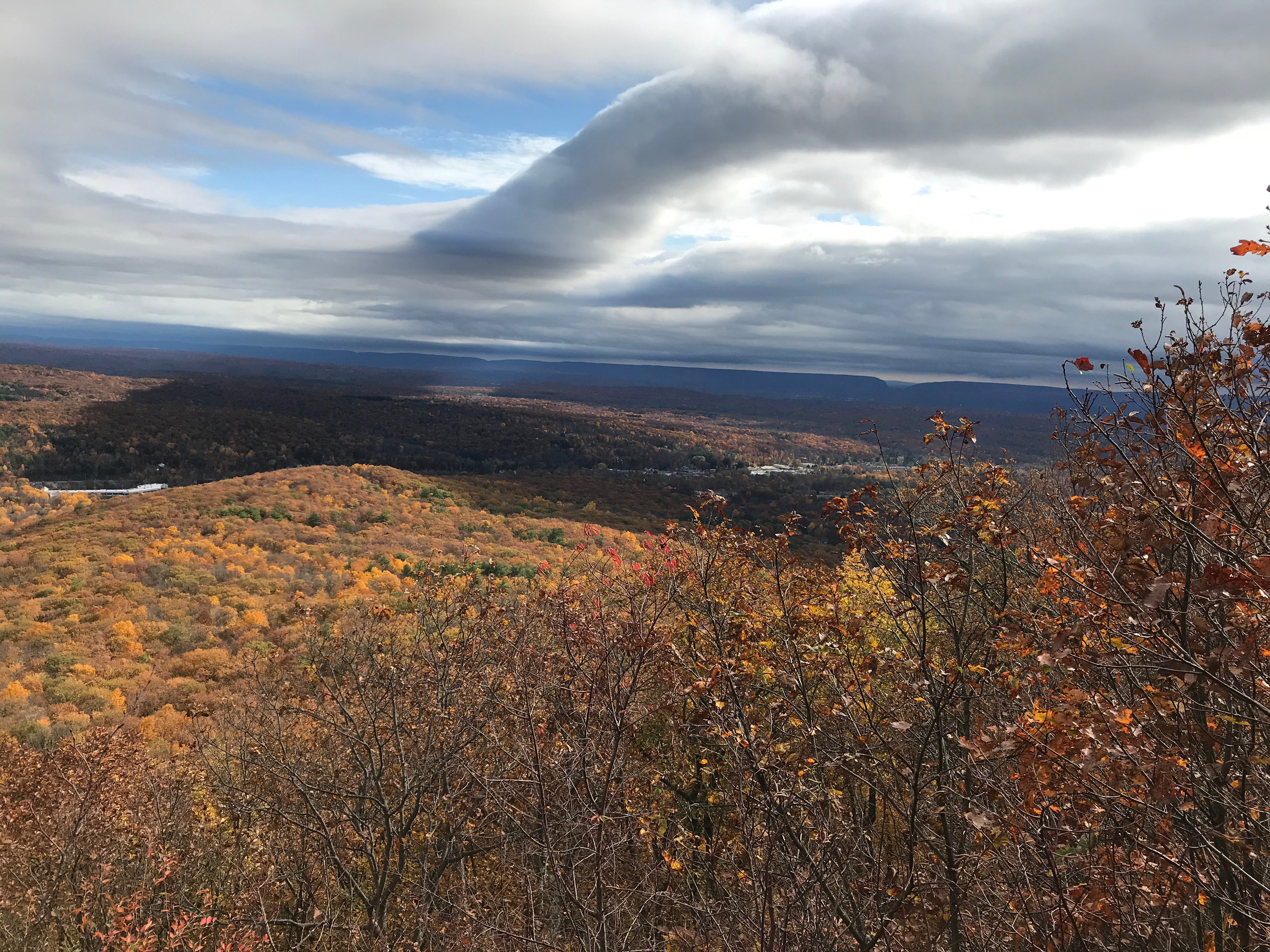
Yearning to get outdoors for a bit—it’s been rainy here and the pandemic limits options for seeing much of anything—we decided to visit Hickory Run State Park in Carbon County.  Not a bad drive from where we live, we decided to pick out a hiking trail before making the trip.  With over forty miles of trails, your choice of parking depends on which one you want.  We found that there was a Shades of Death trail.  The website tries to dispel the fear factor of the name, noting that early settlers referred to heavy woods and rocky terrain when they named the area.  It is some of the more challenging hiking offered in the park, with passages over small boulder fields and some slippery rocks.  It also turned out to have some wonderful scenery.  We’d arrived early enough to avoid the crowds that’ve made walks in the woods less pleasant in pandemic times.

Indeed, as we finished our hike near noon, families with kids excitedly shouting “Shades of Death” were making their way along the at times narrow path.  I couldn’t help but think how our lives have become so much easier, at least with physical challenges, than those of the original settlers who named these once treacherous places.  We find the names quaint and a little amusing.  Indeed, at the visitor center, the outdoor art emphasizes that particular trail, demonstrating its popularity.  Part of the draw of horror is, of course, reading or watching it from a safe location.  On a sunny morning with modern conveniences never far away, the name gives a little thrill even as it reminds us that a walk in the woods once held a peril difficult to imagine when you can drive right up to the trailhead for a walk in the park.


Walnuts

The walnuts are always the first to turn.  At least around here they are.  Their yellow leaves began to litter the bike path in August.  Their nuts can be quite a hazard to a jogger if it’s not quite light.  Still jacketed with their spherical rind, an unexpected foot landing on one can lead to a rolled ankle or even a fall on the pea gravel.  Such incidents led me to wait until it’s light enough to see clearly before going out for a jog.  You see, I like to exercise before starting work, so I jog at first light.  In June this can mean heading out even before five if the weather’s clear.  Since I start work around 6:30 this is a comfortable time to go.  Nobody else is on the bike path then.  And with Covid lurking, that’s a good thing.

The earliest sunrise comes about a week before the summer solstice.  By the time summer officially begins I already have to delay my jog slightly.  This is one of the great disappointments about Daylight Saving Time.  After winter’s long darkness, it starts to get light in the morning and I think to myself “I’ll soon be able to jog before work again,” but then we set the clocks back and set sunrise progress back by another month.  During the darkling months of the year I have to jog at lunchtime.  The changing walnuts always warn me that such a time is drawing near.  Already here in early September I’m getting back late for my usual work time since the sun is reluctant to throw its first crepuscular rays over the brow of the hill before six a.m.  The problem with this is that many more people are out on the bike trail at six than I ever see at five.  And often they don’t care to share.

There are a couple of older guys who walk abreast, taking up pretty much the whole trail every day now.  They hear me coming, look back, but like the marching band in “American Pie,” refuse to yield.  Single file for them is a sign of weakness.  I have to divert into the dew-soaked grass on chilly mornings to get around them with my now-wet feet.  I long for the days when I could easily jog before they even think of heading out to the trail.  The solitude of half-light.  The walnuts are the prophets of the tree world, however.  Their fruit is both nutritious and dangerous.  Scattered across the trail in the persistent dusk of a cloudy morning, they’re both a hazard and a warning.  And it’s a sign that the morning jog may already have to wait until mid-May to reappear.


Yellow Jackets

Deeply conflicted.  That’s how I feel about calling the exterminator.  The longer I’m alive the more eastern my thinking becomes.  What right do I have to kill other animals for doing just what they’ve evolved to do?  The yellow jackets who made a nest in our siding were doing just what nature directed them to do.  In what sense is our house natural?  When they started getting inside, though, memories of having been traumatized by stepping on a yellow jacket nest when I was younger came to too sharp a focus.  Terror is probably the right word.  We were catching and releasing five or six a day and summer doesn’t look to be about to give way to autumn very soon.  There’s nothing like being startled by an angry bee when you walk into a room in summer-weight clothes.  So the exterminator came.

As the yellow jackets fled into the house to escape the poison I pondered what right I had to deprive them of their lives (here’s the eastern thinking part).  How was my comfort, or my lack of terror, more important than their need for a home?  Couldn’t we peacefully coexist?  You see, I’m no fan of violence of any sort.  In my ideal world there would be no war and no meanness.  You might not be able to call yellow jackets cuddly, but they don’t seem the happiest of creatures with whom to interact.  They’re industrious, like business owners want their drones to be, but their people skills aren’t too good.  Maybe it’s just projecting, but when they swarm the only word that comes to mind is anger.  Even their evolved body armor reflects that.  Still, I didn’t want them killed.  I just wanted them not to misunderstand our human interactions while shut in during a pandemic.

Life is a gift to all creatures.  I became a vegan years ago because of humanitarian concern for our fellow creatures.  The mess our world’s in now because of our lack of care for anything but money plainly shows.  Bees, it could be argued, make more of a contribution to the well-being of the planet than I do.  Who am I to make any claim of superiority?  Still, I’m responsible to pay half my salary on a mortgage that will keep me in one location until the situation betters.  When I see that silhouette in the window a sting of terror from my childhood comes back as I grab an empty peanutbutter jar to catch and release, only to have another bee replace the first.  Childhood traumas are like that, of course.  But now I apologize for bringing on the death of fellow creatures and I walk through the rooms through which they had freely flown.


Permanently Changing

Classifying the world of thought into “eastern” and “western” is a gross oversimplification.  Nevertheless we require some handles by which to grip this unwieldy beast of mental life.  One of the first distinctions that we’re taught is that western thinking tends towards the default of permanency while eastern thought emphasizes change.  Change, of course, is the lack of permanence.  The older I get the more I see the wisdom in accepting change as the only thing that’s really permanent.  It’s a lesson you learn as a homeowner.  In my typical western way of thinking, I assume things will pretty much stay the same, but the myriad of small, external forces work constantly toward change.  The only way to keep a house well is with constant upkeep.

The other day I found a rotted windowsill that our inspector somehow missed.  That it hadn’t happened on our watch was clear by the fact that the previous owners had slapped a thick layer of paint over what was clearly a broken and decaying sill, in essence ignoring the problem.  Change, you see, is constant.  Things really get interesting when you start to apply this to religion.  Although the Bible only hints at it (for the view isn’t entirely consistent) God is considered unchanging.  The same yesterday, today, and forever.  Meanwhile everything down here is constantly in flux—changing, evolving, decaying, reproducing.  Religions of eastern Asia tend to embrace this change as a given.  Our frustration in life, as Buddhism recognizes, has its roots in attachment to permanence.  Things inevitably change.

On the one hand this is so obvious that it might appear simplistic.  But then think how we live our lives here in the western hemisphere.  Our employers hire “change management” teams.  We suppose things will return “back to normal” after this pandemic is over.  We’ve been living the cloistered life for nearly six months now and things have been changing.  Especially in the early days people could be heard lamenting how quickly information and circumstances shifted.  Change is permanent.  For the homeowner anxious about the ability to keep up with upkeep, the constant growth of the lawn and the aggression of weeds can be their own kind of trial.  At times it feels like you need to be paid just to take care of your home since it’s a full-time job.  It is overly simplistic to draw an arbitrary line from pole to pole, but it does seem that some cultures, tending toward the east of the birthplace of monotheism, have some basic insights from which we might learn.


Google Scholarship

The other day I had to check something on Google Scholar for work.  Since our computers now know who we are, mine asked if I would like to update my profile on the site.  I figured it couldn’t hurt.  I waited until after work, however, since my scholarship is strictly separated from my job.  When I went to complete the profile I learned that you can’t do it without a .edu extension on your email.  In other words, and independent scholar is no Google Scholar at all.  It’s not the first time I’ve run into this bias.  I have sat through many meetings where those with no institutional affiliation are spoken of with deep suspicion, as if the extreme shortage of academic jobs has left only the worthiest employed.  Classic blaming the victims.

Having once been a full-time academic, I have watched the job ads for nearly three decades now.  The number of positions has steadily decreased while the number of new Ph.D.s has readily increased.  There aren’t enough jobs to go around and those who don’t land one of the few available are considered inferior scholars.  Even Google says so.  The interesting thing about this is there is little outcry from academia itself.  You’d think that, given the protests that go on in other areas of perceived injustices that the educated would call for redress.  You’d think incorrectly.  As a society we distrust those who don’t have an institution backing them.  Unless they’re rich (for money is a kind of institution).  It’s a strange state of affairs.

In my line of work citations on Google Scholar don’t really matter.  In fact, many publishers are kind of embarrassed when their employees are published, or are even cited in the books they produce.  Scholarship, in other words, is institutionalized.  The thing is, life in our society isn’t so neatly categorized.  My first job, in a poverty-level family, was working as a janitor.  I was always surprised at how philosophical the discussions were among the cleaning staff at our local school district.  Many of these guys were deep thinkers behind a  broom.  In the schools where they worked the students tended to make fun of them.  You certainly won’t find their musings on Google Scholar.  I tend to think that our society might be more equitable if we’d recognize intelligence where it exists rather than sticking it behind the walls of academe.  But then, I’m no Google Scholar so you need not believe a thing I write.


The Birth of Nightmares

It’s often said that it takes a village to raise a child.  A similar idea lies behind the writing of a book.  Sure, the lion’s share of the research and writing are done by the author—the person who gets credit for the work—but publishing is an industry.  That means other people’s livelihoods are based on the end result as well.  The author often doesn’t know what’s going on when the book is in production.  It was a pleasant surprise, then, to find the publisher’s website for my book is up.  You can see it here.  My own site for the book has been up for months (here; go ahead and take a look, there’s not much traffic).  Those who only read these posts on Facebook, Goodreads, or Twitter may not realize there’s a whole website out here that addresses things like books and articles.  (I think the CV part requires updating, though.)

In a writer’s experience, seeing a book’s website—receiving an ISBN—is like the quickening of a baby.  You’ve known for some time that it’s there, but the proof is in knowing that other people can find out.  I only learned of this because a friend wanted a link to the book page.  If you google the title without quotation marks you’ll find lots of websites about Christians and nightmares.  (Who knew?)  People of my generation still often don’t realize that, much of the time, searches with quotations marks are increasing necessary on a very, very full internet.  I’m still not sure of a publication date for Nightmares with the Bible, but you can preorder it.  (Sorry about the price.)

Once a friend asked me why we do it.  Writers, I mean.  Unless you’re one of the few who are very successful you don’t make much money off the project that has taken years of your life to complete.  I’ve never earned enough in royalties even to pay for the books I had to purchase to research the topics on which I write.  It’s not an earning thing, although that would be nice.  For some it’s an expectation of their job.  For some of us where it’s not, writing books is perhaps best thought of as monument building, a long and intensive “Kilroy was here.”  You notice something you think other people might find interesting, and so you write it down.  Chances are the number of other interested people will be small.  Family (maybe) and a few dedicated friends will lay down the cash for an academic book.  But still, there’s a village behind it, and I need to thank them here.