A Slice of Childhood

Few names from childhood are as well known as Dr. Seuss.  When my wife and I read Theodor Seuss Geisel, in the Lives and Legacies series, we realized that neither one of us had learned to read with his books.  It’s not that they hadn’t been written and widely adopted yet (they had by the time we started school), but rather that our districts had gone with other fare.  I learned with the famous Dick and Jane series, and I think there must’ve been some Seuss thrown in here and there.  We didn’t own any of his books, but I remember my mother reading from library copies of Hop on Pop.  When our daughter was born we read to her daily and Dr. Seuss was a large part of our informal curriculum.  Before reading this book, however, I knew very little about who Theodor Geisel was.

The series Lives and Legacies features short books, so this is a quick and no-frills way to meet the man.  Although Geisel was born into a middle class family, he experienced (ironically) the trauma of being in a German family during the First World War.  What we would call hate crimes today were committed against German-Americans during the war, even though there were sizable populations of Teutonic Americans by that point (including my mother’s family).  Not only that, but Prohibition put his father’s brewing company out of business.  Still, Seuss was accepted at Dartmouth and, like many who make it to the Ivy League, his connections helped him to a successful career in advertising and then in writing children’s books.

Geisel was a successful man, but wasn’t driven by money.  He was an artist both with images and words, and as Pease makes clear he approached his craft seriously.  As he matured he began to address social and political issues in his larger formatted books.  He eventually became the most successful children’s book author in history.  Reading to my daughter when she was young we discovered that, unlike the often idealized times of the fifties (followed by the sixties into which I was born) there is a wealth of quality children’s literature available.  It’s easy for middle-class kids to be raised loving reading.  Dr. Seuss knew that the pretensions of adults often created the seriousness with which we face life.  Children enjoy fun and the ridiculous.  He never lost sight of that simple fact.  We live in times when it is readily to be wished that many of the adults in power would go back and read a little Seuss and perhaps, just perhaps, learn their lessons.


Zoom Game

Perhaps you’ve notice it too.  The technology blame-game, I mean.  Although it’s grown more acute since the pandemic, it has been around for as long as the tech disparity has existed.  A typical scenario goes like this: someone (often of a more senior generation) encounters a techical problem communicating with someone else (often of a more recent generation) and asks them what the problem is with their (the younger person’s technology).  I sent you the message, the narrative goes, there must be something wrong with your tech if you didn’t receive it.  Believe me, I understand how bewildering this can be.  We’ve sold seniors (one of which I am rapidly becoming) on the idea that this little device in your hand can do anything.  When it doesn’t work, it must be somebody else’s fault.  The young, however, often have the latest tech and fastest speeds and broadest bandwidth, so the problem is probably on the sending end.

I run into this quite a bit since I run a small program for some local folks that involves weekly Zoom meetings.  I’m no Zoom maven.  My wife trained me in it and I can do passably well at running a meeting.  Many of those older than me, however, often have problems.  They wonder what is wrong with my broadcasting rather than their receiving.  I’m not sure how to say ever so gently that we pay (through the nose) for high-speed connectivity.  We have to since I work from home as a matter of course.  Now my wife also works from home and the two of us use our bandwidth all day long with multiple simultaneous meetings without any issues.  The tech here seems good.  We have no way of checking the tech on the end of those who are having connectivity issues.

I’m not setting myself up as any kind of tech prophet.  If you read my blog you know that I am deeply ambivalent about this whole thing.  I’ve been thinking a lot about overpromising recently and I wonder if that’s not a major part of the problem.  Technology will not solve all of our problems.  The fact that you need a regular source of electricity for it to run shows its inherent weakness.  It is a tool like any other, and if the tool is bladed to be useful it must have a dull part onto which one might hold.  Our Zoom society is bound to have issues.  Once we can see each other face-to-face again, all we’ll have to worry about is whether the laptop will communicate with the projector, or if the microphone is on the fritz this morning.  So it always has been.


Back in the Zone

In general I’m a fan of reading the book before seeing the movie.  In some cases, however, the written version comes later.  A few months back I started to have a hankering for stories written by Rod Serling.  I’m aware that he mainly wrote scripts, but I also know he had a rare talent for doing so and most of the books I’d collected as a child were collections connected to Serling but not written by him.  He had, during his lifetime, “novelized” three volumes of Twilight Zone scripts into books of short stories.  The second of those books, More Stories from the Twilight Zone, is one I’d not read before.  I remembered some of tales from episodes I’d watched while others were new to me.  All that they have in common is that something isn’t as it “should be.”

This “oughtness” is an illusion, as we’ve learned over the past four years.  Each day has an incredible sameness even as everything changes radically, almost daily.  To me that’s one of the comforting aspects of the Twilight Zone in these days.  Not only does it take me back to my childhood, but it also prepares me for the unexpected.  Rod Serling was a great metaphorical writer.  Quite often on this blog I try my hand at it, writing posts that are apparently about one thing but that are really about something else.  I think most of us tend to be literalists when we read (thus the crisis literalism has wrought when it comes to the Good Book).  Unless we know to shift our focus we take things at face value.  These stories try to teach us otherwise.

Some of these stories anticipate Stephen King.  Others reflect Ray Bradbury.  They are eclectic but unified by a voice that was able to see that the world could actually stand some improvement.  People could treat each other better.  Without being preachy, they are often like morality plays.  Of course that is my experience of reading them.  Readers differ in their responses.  The Twilight Zone was an influential series in a world open to new experiences.  If the twentieth century has taught us nothing else it has shown us that we can take nothing for granted.  To go deeper than the surface, that’s as it should be.  What are the stories really about?  A large part of it will depend upon what the reader takes away from them.  All of this is very helpful, at least to this reader, in times like these.


Update on Nightmares

Progress continues on Nightmares with the Bible.  Despite pandemic conditions, I received a happy email last week telling me that the manuscript had been transmitted to production.  If you don’t work in publishing that probably sounds like a pretty simple step, but in reality it’s immensely complicated.  The job of many editorial assistants is often just making sure books get through the transition from author to publishing engines safely.  Since Lexington/Fortress Academic is short-staffed at the moment (publishing is a “non-essential” business), they ask authors to take on additional responsibilities.  One that they passed on to me was to find people to endorse my book.  Fortunately I’ve got star series editors who agreed to take on the task, sparing me from going to someone and saying, “Um, hi.  Would you like to say nice things about my book?”  I’m shy that way.

That doesn’t mean that I’m not excited about the book.  It came about in an odd way, but like any parent an author loves her or his books, even if they aren’t quite what you expected.  Getting a fourth book published is kind of a hallmark for me, especially since I spend a lot of time on the websites of successful academic colleagues older than me that haven’t reached that benchmark.  Publishing books, for me, is a kind of validation.  The original ideas of editors aren’t much valued, either in publishing or in society at large.  Who cares what an editor thinks?  Put that same person in a college and s/he’s a superstar, eh, Qohelet?  So I sit here like an expectant parent, wondering what the book will look like although I already know what I’ve put into it.

Nightmares was never meant to be a research book.  Indeed, Holy Horror was written with an eye toward trade publication.  I’ve been working on my next book project (which I’m keeping under wraps at the moment for fear that someone with more time might get to it first, since there’s no getting the genie back in the bottle).  Before too many weeks have passed I’ll need to brush off my indexing skills (in as far as I have any), and get proofs submitted.  I’m afraid I’ll miss the coveted Halloween launch yet again with this book.  “Scary topic” books always sell best in September/October, but if you miss it, the next year you’re old news.  Like an anxious parent I sit here and wait because at this point things are literally out of my hands.


Jacob’s Ladder

Jacob, it is said, was quite a dreamer.  While fleeing from his brother Esau he had a dream of a ladder, or stairway, to heaven.  Well, “Heaven” as we recognize it didn’t exist then, but you get the idea.  Angels were climbing up and down on it, I’m guessing to do roof repairs.  You see, neither my wife nor I are what you might call tall.  In fact, I’m a bit shorter than the average guy and we can’t reach the top shelf in our kitchen, let alone the ceiling.  Or, God forbid, the roof.  So when tropical storm Isaias (not to be confused with the prophet) dropped upwards of five inches of rain on us, some of it got inside.  Our roofer, vexed as I was, promised to get over the next week but there’s more rain in the forecast.  I had to get up there to do some temporary patching.  I needed a ladder.

Ours is an older house.  The roof is way higher than any ladder we have.  I have one that allows me to get as high as the ceiling, but being acrophobic I don’t use it much.  It doesn’t come halfway to the lowest roof.  The hardware stores have ladders, but delivery’s a problem.  A ladder twice as long as our car seems like a road hazard, strapped to the top.  I asked about delivery at the local Lowe’s.  It would cost a third of the price again of the ladder itself, and that’s only be if they could deliver it.  Their truck was, ironically, broken down.  Wasn’t this a DIY store?  Could nobody there fix a truck?  I put a face-mask and rubber gloves on for this?  The world isn’t easy for the vertically challenged.  I really don’t want to climb that high, but with the ceiling below already coming down I’ve got to do something.

I wonder if Jacob’s ladder is still lying about somewhere, unused.  We don’t live far from Bethlehem.  Maybe I can scoot over the Bethel and pick it up.  Then again, maybe angels deliver.  I hear they can be quite accommodating.  Of course, if they’d keep the rain off in the first place that would’ve been helpful.  I’m pretty sure that Plant and/or Page had a leaky roof.  When they went to get up there they’d found somebody had already purchased the ladder (I think they call it a stairway in England).  So I find myself with a leaky roof and no way to get to heaven.


Almost Ancestors

During the Covid-19 crisis, cemeteries seem to be safe places.  Not too many people are in them, at least not people that can spread the virus, and they always provide grounds for rumination.  Besides, being outdoor spaces they can get you someplace outside the same four walls you see all the time.  My wife and I both have an interest in genealogy.  We’ve worked on our family trees and even try to keep our Reunion software up-to-date.  This past weekend we visited a family burial plot in upstate New York.  My wife’s family has a more accomplished pedigree than mine does, and one of her ancestors here actually merited an obelisk and was written up in local histories as a noteworthy member of the community.  I also have ancestry in upstate, and we’ve traveled to some of their sites in the past, although their markers are usually harder to find.

Being in a cemetery, the logic of ancestor worship suggests itself.  Without these people history as we know it would’ve been different.  Without those who are our direct ancestors we wouldn’t even be here pondering our own insignificance.  We wish these headstones could talk, saying more than the names, vital dates, and perhaps a quote from the Bible.  We listen, hoping to gain knowledge of who they were.  It seems to me that cemetery histories would be a boon to genealogists.  For those of us whose predecessors were buried in small towns, such guides could be a real boon.  As it is, Find A Grave dot com is often a helpful resource, but who wouldn’t like to be written up in an actual book?  Network reception often isn’t great out here in rural America.

Graveyards are gateways to the past.  In a world that feels like it’s changing way too fast, it seems right to have these places—these sanctuaries—to stop and reflect.  They represent lives lived.  Peaceful after the trauma of day-to-day angst and struggle.  Unfortunately the pandemic is daily adding to the number of those who’ll be buried in cemeteries across the nation and around the world.  Although somewhat preventable, we have no national will to stop the tragedy.  So it is I find myself staring at a monument erected to someone I never knew, but without whom my life would’ve been vastly different.  It’s a sunny day and I’m outside amid a crowd that can cause me no harm, but who, at times like this, inspire me. 


Hurricane Isaias

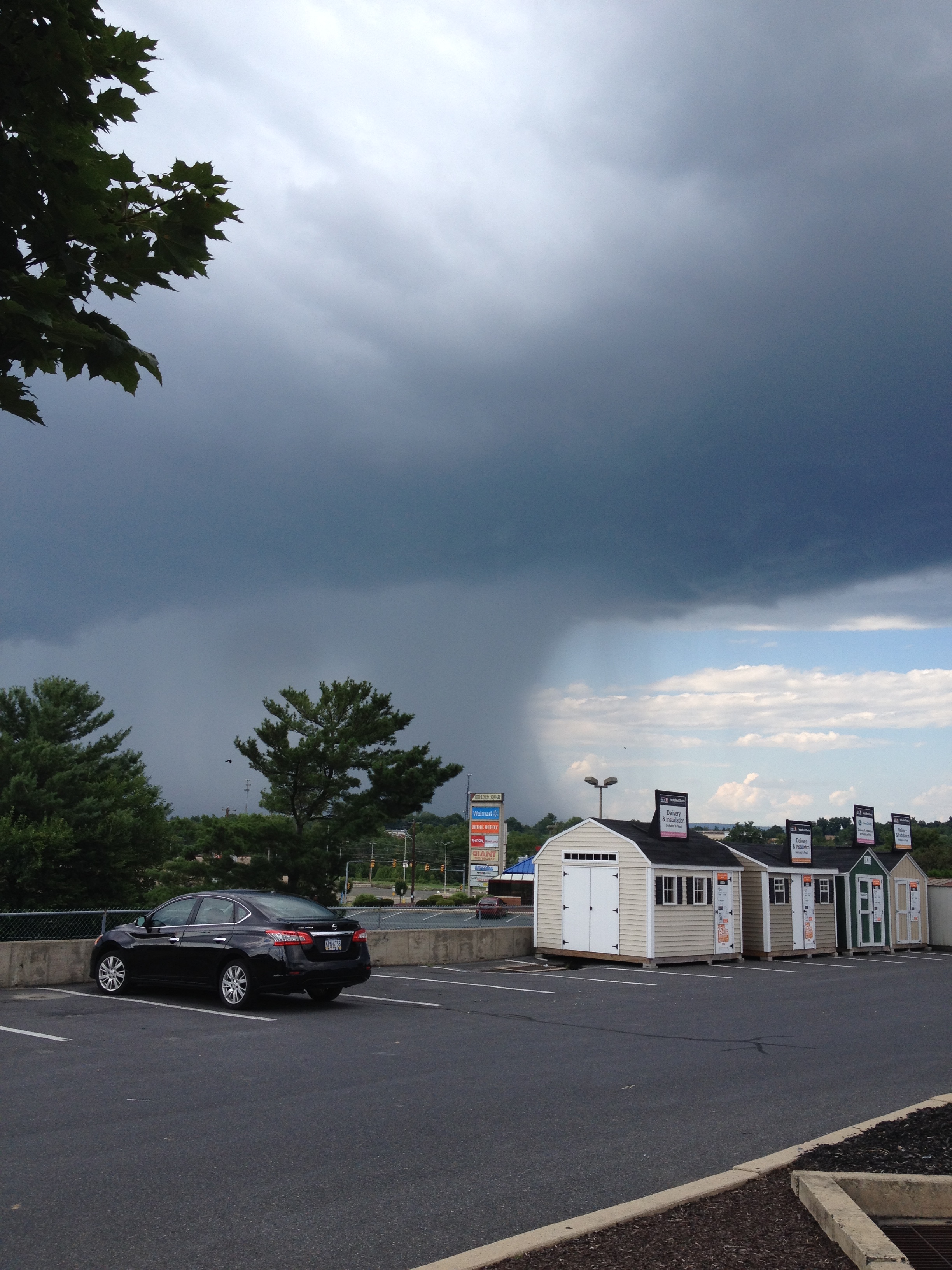
People have been debating how to pronounce Hurricane “Isaias,” an hispanic name based on Isaiah.  Pennsylvania, which has few distinguishing features, is generally well enough inland not to have too much hurricane damage.  Isaias, however you pronounce it, dumped over five inches of rain in the small town in which we live.  Multiple roof leaks sprang up in our house and a small part of the ceiling in one room came down.  Not exactly wrath of God level treatment, but unwelcome nevertheless.  The real problem was the short amount of time in which the rain fell.  Averaging about an inch per hour, the water simply overwhelmed the devices put in place to keep it outside.  Being of my particular disposition I can’t help but think of the prophet Isaiah.

Not a classical prophet of doom per se, Isaiah is the most quoted prophet in the New Testament.  He is remembered for “predictions” and soaring rhetoric that promises deliverance.  He’s also a prophet known for his woe declarations, as reflected in the Hebrew Bible.  This storm, I suspect, has delivered more of the woe than of the hope.  Streets were flooded as the local creek burst its banks.  Our own street was closed as I called our roofer who, I’m sure, had more than wanted popularity in one day.  Being a homeowner, I quickly discovered, is largely a matter of trying to keep the water out.  Our sump pump was working overtime and still the rain came.

My book Weathering the Psalms was intended to be the first in a series of volumes exploring meteorotheology in several books of the Bible.  The weather, you see, is a popular topic of discussion since in ancient times their meteorology was theology.  After the Psalms my exploration was intended to move toward the prophets.  There are dramatic events where these saintly folk were able to bring down rain, or withhold it.  Israel never experienced hurricanes because they don’t form in the Mediterranean.  Meteorological terms, however, shift over time just as by the time Isaias reached us it was a tropical storm.  The wind buffeted us a bit, but it was mainly a rain event.  I thought at first that I would look at weather terminology in Isaiah and see what I could find there.  I don’t know what my conclusions would have been since I was cut off before I could get that far.  Like those who cast their bread upon the waters, after many days it came back, ironically in the form of Isaias.


Narrow Passage

While on a rare family visit (it’s scary to get out too much) we visited Watkins Glen State Park in upstate New York.  My mother’s family has roots in this area, and we’ve visited it several times in the past.  There are always people there, but in manageable numbers.  The website declared it was mandatory to wear a mask (“New York tough”!) and to keep social distancing.  It perhaps didn’t help that we went during a heat wave when a walk along a waterfall-laced path seemed like a refreshing idea.  I guess I had in my head the modest crowds we’d encountered in our many past visits.  We were, however, not the only tourists (although somewhat local) with that particular plan.  Not by any metric I can conceive.

If you’ve never been to Watkins Glen, the park has a Civilian Conservation Corp-built stairway and trail (approximately 600 stairs) through a glacial and water-cut gorge.  The sedimentary layers are fascinating for anyone with an interest in geology and for those who like to ponder the millions of years required for the laying down and lifting up of multiple bedding planes.  The gorge itself has a curvilinear appeal that is almost mystical.  Waterfalls produce negative ions which, everyone knows, tend to make people happy.  I was, however, more on the terrified side of the spectrum.  It became clear even before we reached the gorge that there were hundreds of people already in the park.  Most of them unmasked.  Large crowds gathered around the more picturesque waterfalls, blocking the narrow walkways.  Tourists have no idea what “six feet” might possibly mean.  Stair-climbing is an aerobic exercise, and wearing a mask in such circumstances is the only smart thing to do.

While on the considerably less crowded trails of the Pennsylvania outdoors venues we more commonly frequent, I’m nervous when someone walks even more than six feet away in the opposite direction.  This felt like a nightmare to me.  Too many people paying too little heed to the mandated caution.  I’ll be quarantining myself for two weeks for sure.  Maybe more.  I don’t get out much in any case, but even though we were obstructing our view through cloudy glasses and trying to get adequate oxygen through made-to-specification cloth masks, there’s only so much that prophylactics can do.  I jog at first light to avoid other health nuts on the local trails.  I go to stores only for necessities.  Being in a canyon with the careless invincibles inspired less than confidence in this petrified pilgrim.  Knowing human nature, it seems closing popular state parks until people get smart may be the best way out of a tight squeeze.


Bonded

It happened this way.  When my daughter was young she was interested in dinosaurs.  Most kids are.  In fact, my wife and I went to a public lecture by a paleontologist in Edinburgh where he pointed out that the real experts on the subject in the audience were generally twelve or younger.  I took an interest in what my daughter found fascinating, and you can’t study dinosaurs without knowing a bit of geology.  Now, the professor’s lifestyle is a thing of wonder.  You may have a heavy teaching and publication load, but the freedom to spend your unstructured summer time pure learning was (still is) a huge draw.  I began studying geology.  I joined the Wisconsin Geological Society.  I was even made an officer.  My, a biblical studies professor.

At one point I bought a jeweler’s loupe.  Many geologists have them.  To get down to the level of the crystalline structure of most rocks you’ll need something more powerful, but for fieldwork (and I’ve got a garage full of rocks to prove it) your average loupe will do.  When Nashotah House decided I should no longer be a professor (and the rest of academe acquiesced) I seriously considered going back to school to study geology.  Time was against me, however.  I had to find a job with a family needing support, and so here I am in publishing instead.  And not only that, but I’m a Bibles editor.  Most people have no idea what that means.  Some days even I don’t.  But one thing I have learned is that you’ve got to know your leather.

This is a bit uncomfortable to me as a vegan, but I have learned that many people want their Bibles wrapped up in animal sacrifice.  I’ve also learned there are many different kinds of leather.  The typical leather Bible is pigskin.  Yes, that’s right.  In the trade you can call a Bible with any animal hide leather.  Bonded leather means that it’s pieces glued together.  The most expensive Good Books are “genuine leather.”  Cut from whole cloth, as it were.  I keep my jeweler’s loupe in my work desk.  Sometimes I need to look at something closely, off screen.  My loupe came in a leather case.  One of the sides peeled off during our move and I could see clearly what bonded leather means.  In fact, the “nded” part of “bonded” is clearly visible like a secret Bible code on the underlayer of my case.  Nothing, it seems, is ever wasted.


Virtual Bible Study

Like just about everybody else, I spend my days online during the pandemic.  Well, actually, I spent my days online before that since I’m a remote worker.  Even before that, when spending a considerable part of each day commuting to and from New York City, once I got there I’d sit in a cubicle and work online all day anyway.  To borrow a tagline, the truth is out there.  Somewhere on the internet, I think.  Probably on the deep web, but I understand that’s a scary place.  I’m not sure why it is that I started receiving email ads for something called Virtual Bible Study.  I suppose I spend enough time, and my computer eats enough cookies on Bible Gateway that the Virtual Bible Study people think I’m the typical customer.  

Having led many Bible studies in my life, and having taught biblical studies professionally, I’m aware that you can never learn it all.  Indeed, biblical study is the original never-ending story.  Stay with it long enough and you’ll earn plenty of enemies.  Recently my mother was telling me that she’s doing a Bible Study where you follow a schedule and read the “liner notes” that come with a particular curriculum.  She mentioned to me that she was having trouble with Deuteronomy 28.  It’s a chapter with which I’m quite familiar.  I remember reading it as a young person and being terror-struck by it (those who wonder what horror might have to do with the Good Book ought to read it.  Go ahead, I’ll wait.  You can find it on Bible Gateway.).  This is one of those places where God spells out the blessings (somewhat limited) for obedience and the curses (very many) for failure.  The list is long and terrible.  I’m not a chapter-and-verse citer, but from my very first read-through of the Bible I could tell you what was in Deuteronomy 28.  It was burned into my memory.

I do have to wonder about the efficacy of online Bible Study.  I sure do appreciate not having to look everything up in a print concordance any more.  That was quite a time-consuming activity and you needed to be very familiar with the particular version you were using to make it work.  I know I grouse a bit about technology on this blog, but given my vocation, and avocation, I sure like having Google on my side when I need to look up a verse that I can only partially recall.  I do have to wonder, however, since the truth is out there, whether anybody’s found a good way to comfort their elders who get stuck on the curses that essentially wrap up the covenant in good old Deuteronomy.

Virtually the Bible


Graphic Graphomania

You can spot them fairly easily.  Graphomaniacs.  Perhaps it’s a bit closer to the surface when you work in publishing, but the person who writes too much can run risks.  Some authors turn out a book every few months.  While this may be okay for potboilers, for academics it is seldom possible to do this well.  Research and reflection take a long time.  Those who churn out book after book sometimes wonder why their works don’t sell.  Graphomania has to be reined in.  Horses have to be held.  I’m sympathetic, actually.  If you write every single day you’ll soon end up with a surplus.  So much so that your computer will tell you to empty some stuff out or it’ll go on strike.  I had to order a new terabyte drive this week exactly for that reason.

To free up some additional space on my laptop I went through the many, many folders that have essays, book drafts (both nonfiction and novels), stories, blog posts, etc.  While I didn’t throw them away, I had to clear them off my working disc.  As I did so I realized that the great majority of these writings will never see the light of day.  There are really a lot of them.  Part of the problem is you never know what you’ll feel like writing when you get up in the morning.  Sometimes the best ideas come after a wretched night’s tossing and turning.  Well-rested you can get up to a brain so content that it doesn’t have much to say.  Or that story you started yesterday may seem dumb today.  That nonfiction book that burned with passion just last week may now seem lame.  My fear is that by moving them off my hard disc they’ll become forgotten.

The terabyte drive is a thing of wonder.  It can hold so much information.  I have to go back and hook it up to my laptop to find it, however.  Out of sight, out of mind.  I’ll move on to other things.  I honestly can’t count the number of projects I have going.  Graphomania can be a problem.  This blog is a daily outlet, and you, my faithful few readers, are saints for coming back.  In my attic, next to the brick wall of external hard drives, are folders full of handwritten material.  Many of them are stories that are complete, but that haven’t been transcribed.  Some writers suggest flooding the market with your stuff.  Others of us know that graphomaniacs are feared in some quarters, and so we keep our own counsel.

Photo credit: NASA


No Smoking

I have never smoked anything in my life.  As a kid with chronic bronchitis few things scared me as much as being unable to breathe.  I have not assassinated anyone or consorted with aliens—at least not that I know of.  Otherwise I think I understand the Smoking Man.  As far as my X-Files rewatching saga goes, I recently reached “The Musings of a Cigarette Smoking Man.”  I remember the first time I saw it I found it improbable that the assassinations of the 1960s were the work of a single man.  What hit me this time around, however, was the Smoking Man’s real frustration in life.  He wants to be a writer.  Having completed several novels myself, none published, I have received pin-head letters very much like those he does in this episode, only in greater quantities.  When he finally finds a publisher, he writes his resignation letter to whomever hires assassins and those who change the course of history.  I know just how he feels.

You’d think that by the logic of any reasonable system that those who work in an industry might have some inside tracks.  Some, no doubt, do.  Others of us in publishing are just like the average, uninformed person on the street.  Publishing is a cliquish place.  A friend with some success getting novels published advised me to look at the names of editors and editorial boards on the literary journals that get noticed.  “You’ll see the same ones coming up over and over,” he said.  It is, as the Smoking Man discovered, a kind of cabal, which is, I suspect, the point of making him out as a frustrated novelist.  He can set the course of history, but he can’t get a legitimate novel published.  Cue the X-Files theme. 

I know many academics who write fiction.  My second novel (depending how you count these things—this one was never finished) was a pet project while I worked at Nashotah House.  I knew I wouldn’t be able to publish it when I worked there.  In fact, my first fiction publication only came three years after being shoved out of the nest of academe.  I’ve completed seven novels now and I’ve managed to get some short stories published.  Then again, I don’t have clandestine knowledge from a lifetime of access to the truth about alien-human interaction.  I don’t shoot people for a living.  I’m not even a professor any more.  Still, I think I can begin to understand why someone might turn toward a more interesting career, given the situation when it comes to getting published.


Missing Markers

Something truly remarkable happened this week.  The Society of Biblical Literature, which, along with the American Academy of Religion, meets annually in November, has canceled its in-person meeting.  I’ve been attending this conference since 1991 (with a few years off for good behavior).  It always meets the weekend before Thanksgiving, stretching to the Tuesday prior.  Some academics use the meeting to have an exotic Thanksgiving break with their families, particularly when it congregates someplace warm.  (It was scheduled for Boston this year.)  So I’m ruminating what this will mean for a year of missing markers.  Some of you may recall I missed two years ago, electing to stay in Newark Airport instead, but this is different.  We’re all being changed by this virus.

Missing markers.  That’s what my wife calls it.  March 12 was the day that Covid-19 became a crisis.  In my extended family that’s in the middle of birthday season.  Travel plans had to be altered.  Trips to see loved ones had to be delayed.  Then cancelled.  Memorial Day came and went.  It was a long weekend, but for most of us it was a long weekend at home.  Our usual summer trip to the lake was also a victim.  A remote lake may be the safest place to be, but you have to get there.  Flying doesn’t seem safe and we don’t have enough vacation days to drive all the way out and back.  Here we are halfway through the summer and each day feels pretty much like the one before, even if it’s a day off work.  Time seems out of whack.  Back in April it was hard to believe it was still 2020, now it’s difficult to comprehend that the year’s more than half over and there will be no AAR/SBL in November.

Growing tired of the phrase “unprecedented times,” I prefer “missing markers.”  Yes, the weather’s still doing its time-keeping job.  This summer has been quite hot around here, for the most part.  I remember shivering in my study sometime not so long ago, bundled up in layers and thinking that when summer rolled around this coronavirus would be a bad memory.  If only there were something governments could do to keep people safe.  If only there were people in the White House who cared.  I had visions of professors, hundreds and hundreds of them, wearing masks with their tweed.  It was a vision of wonder.  They’d walk up to you, extending an elbow to bump, but you’d back off.  That’s actually too close.  And lecturing spreads germs very effectively.  Over time 2020 itself will become a marker.  I’m not sure anyone will miss it, however.


In the Zone

Since it lies somewhere between waking and sleeping, between youth and old age, the Twilight Zone is often where I find myself.  I’m hard pressed to say why the show made such an impression on a young and otherwise religious mind.  Maybe it was because religion itself deals with the Twilight Zone of human experience.  In any case, reading Rod Serling’s Stories from the Twilight Zone, as I continue to make my way through the books of my childhood, was a trip down memory lane.  While living in coronapocalypse, these short stories, novelized from Serling’s teleplays, take you back to a different time.  The late fifties and early sixties seem so very different from where we are now.  And reading about them, I’m not sure why some people want to go back there.

At the same time, reading the physical book takes me back.  My edition was printed in 1964.  It smells like an old book.  It has that unmistakable feel of pulp fiction.  Reading a book is so much more than scanning the words with your eyes.  It’s the lying on your back on a lumpy couch on a hot, humid summer day after being at work for endless hours.  It’s the foxing of the pages and the almost laughable cover design.  But more than that, it’s a signpost back to childhood.  This is a book I first held before leaving home.  It was a refuge from a tense life never knowing what might happen in a day.  Believing that escape was possible could save a soul from a ton of grief.  At the same time, those characters who do escape often learn why that isn’t the best option after all.

Some of these stories I remembered from the shows I watched, while others seemed unfamiliar.  There really are no surprises here.  You see, the Twilight Zone was long ago and the stories have entered our national consciousness.  Some have been borrowed, adapted, and parodied by others.  Others, such as “The Monsters Are Due on Maple Street,” were even part of anthologies we read and discussed in school.  Why are human beings so distrustful of others?  I remember us talking about that in class.  Serling’s version has a more grim ending, it seems, that the one I recollect as a youth.  Sitting here in coronapocalypse, however, I see it playing out around me every day.  We don’t know who might be infected.  And suddenly reading about the Twilight Zone seems like a most sensible thing to do in the circumstances.


Nightmares with Nightmares

Although some staff members are furloughed, Nightmares with the Bible is still going to press.  Unlike many authors, I realize that Covid-19 has had a stifling effect on publishing, starting with bottlenecking books at printing houses.  Printers (along with publishers) were non-essential businesses and since you have to be physically present to run a printing press, the virus literally, well, stopped the presses.  Many publishers could work remotely, so the projects began piling up before printing houses reopened.  All of this is preamble to saying I am gratified that work with Nightmares is continuing.  Yesterday, however, it led to a nightmare of its own.

One of the reasons I don’t fight awaking early is that it is uninterrupted writing time.  Most of the rest of your time zone is asleep at three a.m., so I can write in peace.  Yesterday, however, I had to divide my manuscript into chapter files and resend it to the publisher.  No problem, right?  Technology, however, has made this once simple task a burden.  I use a Mac, and so my word processor is Pages.  Not only that, but the constant systems upgrades require me to empty space on my hard drive—really, the only stuff I keep on here are my writings and those pictures I snap with my phone.  Still, I had to load my external drive to access the final file sent to the publisher two months back.  With Pages you can’t select material from page-to-page in the thumbnails.  No, you must “physically” go to the start of the chapter, click, scroll to the end of the chapter, and shift-click to highlight and then copy it.  Then you have to open a new file, select a template, and paste.  Save and export as a Word document.  The process took about two hours.


Now, I get up this early to write and do a little reading.  Yesterday I could do neither.  Instead I was cutting and pasting like a manic kindergartener, trying to get my manuscript printed before the second wave comes and shuts everything down again.  Talk about your nightmares!  Technology has made the industry much swifter, no doubt.  When I first began publishing articles you had to send physical printouts through the postal services and await either a rejection, or acceptance, through the mail.  Book manuscripts required large print jobs and keeping duplicates (at least we didn’t have to use carbon paper!).  All I lost was a morning of writing before the work bell rang.  Still, nightmares come in all sizes, some of them quite small.