Keep It Covered

I’ve seen it at last.  The cover concept for my book.  I’ve been manicly checking the Rowman and Littlefield (parent company of Lexington/Fortress Academic—a roadmap would be useful) webpage to see what it might look like.  I’ve “seen a sighting” at last.  Nightmares with the Bible seems to be actually happening.  As a writer there’s always some doubt involved with your book.  You wonder, will it really come out?  Will someone pull the plug at the last minute?  Is any of this real at all?  Those kinds of things.  I’ve mentioned before that waiting is a very large part of the process.  Publishing is a slow business and the world changes so fast.  I sincerely hope it doesn’t ever leave books behind.

My waiting hasn’t been idle, of course.  My next nonfiction book is well underway but I’m focusing on fiction at the moment.  I had two short stories published within the last month and I’m inclined to follow where some success shows itself.  Besides, fiction and nonfiction aren’t as far apart as is often claimed.  Seeing the cover of the book, however, nudges me back towards nonfiction a bit.  Since I’m no longer an academic it’s a toss-up.  A few colleagues like what I’m doing, but my fiction work is secret.  So the process continues, waffling back and forth.  It’s all in service of learning how the publishing industry works.  That’s one of the many things they don’t teach you in graduate school.

It’s October and I should be thinking about monsters.  Although I’ve gone through my closet of DVDs, there are many that bear watching again.  If only I could fabricate time!  One of the things I’ve noticed about this pandemic—and I know it’s not just me—is that time seems to have been swallowed up.  A simple walk down the local biking trail now requires masking up before and washing hands after.  Less than a minute of time, for sure, but it adds up.  And if you go after work there’s not enough light left to paint the porch by when you get back.  Such are the contradictions of this wonderful season.  You really can’t pin anything down.  The colorful trees put you into rapture then they’re bare.  The bright blue sky looms under relentless clouds.  You throw off your jacket one day and it snows the next.  And there might just be monsters lurking out there.  One of them, it’s said, will be released in November.  Given the nature of this season we’ll just have to wait and see.

October Reflections

The people are dressed in their finest.  The best food and drink available are spread on white tablecloths while rats scurry underfoot.  The feasters invite Lucy to join them.  “It’s the last supper,” they say, hoisting a glass, knowing that they will soon die of the plague.  This is one of the most powerful scenes in Werner Herzog’s Nosferatu the Vampyre.  It’s October and we’re in the midst of a plague.  The wealthy retain their fortunes while the poor die in the streets.  Do I really need to explain why someone so focused on religion and social justice finds horror films as able conversation partners?  My two books that relate to the topics don’t come outright and say it, but there are spiritual lessons to be learned here.

Genre is a convenient, perhaps even necessary, means of making sense of the vast creative output of humankind.  We write fiction, poems, and songs.  We film movies.  We produce these forms of entertainment at a stunning rate, especially when we consider the large number of pieces made that never find official publication.  Genre helps us sort through—this is like that, etc.  Still, some of my favorite pieces of literature, and movies, don’t really fit into neat genre divisions.  Take Herzog’s Nosferatu.  There are definitely horror elements here, but it is also an art film.  Some scenes, like that described above, are suffused with religious meaning.  When circumstances align correctly we can see it and say, “ah, now I understand.”  That was what came to me recently.  I haven’t seen the movie for years, but circumstances with Covid-19 brought it to mind.

October is a month of poetry and transitions.  We turned the furnace on only to find ourselves in the midst of a string of days reaching near 70.  The cerulean sky which looks so different this time of year suddenly disappeared with nearly a week of heavy cloud cover.  There’s beauty in the daytime and monsters in the night.  Outside lurks a plague.  Lacking the willpower to overcome it, people are growing weary of the restrictions.  We’re not used to being locked up.  The thing about the last supper is that life goes on even after it’s over.  Changed, yes, but October is all about change.  We’re anxious, wondering if it was indeed a vampire that bit us.  Meanwhile the leaves continue their journey from green to yellow, orange, and red, their litter becoming the food for next year’s growth.  Yes, there are spiritual lessons here.


Electricity

After the oven incident (see last Monday’s post), I took some time to examine the burned out bake element from the range.  Clearly a break in the piece led to some arcing like you might get in Frankenstein’s laboratory.  By the time I’d arrived on the scene (I always seem to be behind my time), the fire was snaking along the element itself and now that the piece is cooled and removed I was fascinated by the damage it caused.  I suspect this is why I leave any electrical repairs to experts.  This is dangerous stuff.  Interestingly, in the realm of monsters electricity is most frequently associated (in my mind, anyway) with Frankenstein’s creature.  Mary Shelley’s novel isn’t explicit about how galvanism resurrected the patchwork human, but it was clearly part of the tale.

Electricity retains a certain element of mystery for some of us.  If we stop and reflect on how recent our understanding and harnessing of it is, that further adds to the drama.  People have been thinking about and trying to understand religion for thousands of years.  Like early electricity, religion involves invisible forces.  Of course, lightning and sparks and arcing oven elements can be seen, but seeing isn’t the same as comprehending.  We are a curious species and we want to understand.  Being inside the situation, however, our understanding will never be complete.  We can get a pretty good grasp, a functional one even, but our brains will always limit just how much we can understand.

It should come as no surprise that those of us who chose to study religion are intrigued by mysteries.  The divine, the transcendent—no matter what you want to call it—can never be fully understood.  Thus the impatience with evangelicals and others who pretend they’ve got all the answers.  No, we’re all still attempting to get to the bottom (or top) of this mystery.  Like electricity, religion can do an enormous amount of damage.  Motivating those who have only a cursory understanding how it works has historically led to debacle after debacle.  It has generated wars and perpetuated human misery.  Like electricity, when used properly religion has done a tremendous amount of good in the world as well.  The thing is, as my bake element shows, we have all come to learn that electricity should be handled by those who know what they’re doing.  Ironically, religion has never gathered the same level of respect for the specialists.


Back to Tarrytown

The very name “Hollow” takes me there.  It’s a resonant geonym.  Near Franklin, Pennsylvania, my early hometown, runs a route called Deep Hollow Road.  For me, with its lush, thick trees and shadowed valley, it always exemplified what the term “Hollow” intended.  And of course, there was Sleepy Hollow.  Now that my article on various movies based on the Irving story has appeared in Horror Homeroom (it’s free), I’m again thinking about my dance with that particular story.  In fact, after I submitted the article I watched yet another version of the tale, Pierre Gang’s 1999 The Legend of Sleepy Hollow.  This film on Sci Fi (before it became SyFy) purports to follow the original closely.  It nevertheless has to pad out the story and does so with religion.

Religion—specifically the Bible—and the tale as represented in Fox’s four-season series Sleepy Hollow is what started me on the current leg of my journey.  I sent an article to the Journal of Religion and Popular Culture on the topic and when it was accepted I expanded the idea into the book Holy Horror.  So it is that I’ve tried to watch as many versions of the story as I can.  There have been many made-for-television renditions.  Some are available for free on the various services that draw from my pocket monthly.  Others cause me to debate whether I want to pay for seeing a sub-par effort for the sake of completeness.  The scholar’s heart still beats within me, I guess.  The Gang version expands the story with a church scene, not in the original tale.  To inculcate the Bible, however, Tim Burton’s film of the same year was necessary.

For me no story better encapsulates October.  Perhaps it’s the crucial role of the pumpkin.  Perhaps it’s the ambiguity of the headless horseman himself—is he a hoax or something more?  These kinds of questions are answered by various filmmakers but since the viewer ultimately decides the question is left up to us.  If I were still an academic my next book project would be clear.  Instead I’m trying to bask in the wonder that is October—the season of transition from bright blue skies and colorful leaves to long, chill nights and bare trees.  Our time outdoors becomes more focused so that we might get back to the warmth inside.  And if we’re looking for a tale to read that’s not really that scary, but which captures the ghosts of the American imagination, “The Legend of Sleepy Hollow” beckons.


Gothic Tales

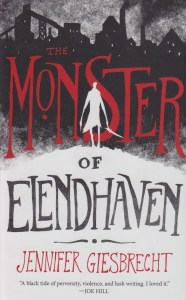
Each year when autumn worms its way into my consciousness, I begin looking for the ideal gothic book.  I can test this by looking at the Goodreads lists of best gothic novels and noting how many of them I’ve already read. The thing now, since I’ve already covered much of the canon, is to discover modern writers who can still evoke that feeling I seek.  This is all complicated by the subjective nature of what readers term “gothic.”  Many of the books on the lists don’t fit my own working connotation, so I keep looking.  One recommended title was Jennifer Giebrecht’s debut novel The Monster of Elendhaven.  I’m still trying to decide whether it is gothic or not.

It’s a little hard to classify, actually.  It certainly has some gothic elements, as well as some horror.  There are secrets and plagues and gruesome murders.  There is a monster from a polluted sea, but not quite your grandfather’s monster.  A human monster.  Or at least partially.  The tale is written with some tongue in some cheek.  There are funny elements and there are many serious moments.  There’s magic and mayhem.  If I were to try to characterize it the closest I might come would be a Tim Burton treatment of horror.  Like Burton, Giesbrecht creates a Halloween mood, but sometimes the humor undercuts it.  This makes it difficult to pin down the work as a whole and figure out if this is the gothic I’ve been seeking.

Set in a time difficult to define and in a fictional nation, it is the kind of novel that can be read without much consequence.  The references to the Allfather make comparison with Nordic regions natural, and there is perhaps a touch of Beowulf here.  In crafting the monster Giesbrecht has made a pretty unlikeable character.  He is a monster, after all.  But not a sympathetic one.  As in other modern treatments he is a stand-in for chaos.  There’s also an environmental sensitivity here.  The monster arises from a polluted sea that derives from, of all things, human greed.  So maybe there’s a parable here.  A short book, it doesn’t take too much of a time investment, but it may leave you wondering what exactly it is that you just read.  It is dark, and gritty, and fun.  A nice combination for an October night.  Is it gothic?  That one’s a little harder to answer.  It depends on how I’m defining it on any particular day.


Not Sleepy Yet

Over a recent weekend I watched four versions of “The Legend of Sleepy Hollow.”  (I have two excuses.  One is that it’s October, and the second is that I have an article on Sleepy Hollow coming out on Horror Homeroom.  For the second, read on.)  The story is one that made an impact on me as a child, probably because of Disney’s Adventures of Ichabod and Mr. Toad.  The cartoon version, which was one of the four I watched, is silly and scary both.  It leaves it to the imagination whether the headless horseman is real or not.  Before that I watched the silent 1922 Headless Horseman staring Will Rogers.  Clearly in that film the headless horseman is what we’d now call a liberal hoax.  It was Brom Bones scaring Ichabod Crane away from Katrina Van Tassel.

The canon of characters grows with Tim Burton’s 1999 film Sleepy Hollow.  Although Burton is hit or miss for me, this strikes me as one of the best October movies I’ve seen.  The headless horseman is quite real and the spiritual world intersects with the rational, crime and punishment world in the haunted western wood.  I didn’t have time for the 1980 television movie this time around, but I decided to watch the 2007 television movie Headless Horseman.  A rather puerile splatter film set in Missouri, it posits that this is the real headless horseman behind Washington Irving’s story.  It has a lot of religious imagery, which is often what I’m looking for in horror.  The writing is poor and the characters shallow, but it isn’t a total waste of time.

What all of these films demonstrate is that Washington Irving’s story, as simple as it is, really resonated with Americans.  How can you reason or plead mercy from a headless man?  Look closely, for there is a parable here.  The headless are merciless and they have the ability to frighten.  The story is generally set in the harvest season.  The 2007 movie makes the horseman’s appearance as a crucified scarecrow.  Although the original story had no such religious elements, they’ve become a standard part of its accrued cultural heritage.  The headless horseman has gone from secular to religious, for it is an American story.  Originally set in the period after the Revolutionary War, it was part of an unsettled nation’s frustrated attempt at normalcy.  This, I believe, remains.  When we can’t make sense of our surroundings, we look back to those stories that seem to have some insight into who we are.  Headless horsemen are quite useful in that regard.


Behind the Exorcist

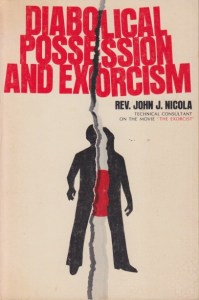
Some books from the 1970s are difficult to locate.  Since that was some half-century ago I suppose that’s not at all unusual.  One of those that I had been anxious to read since working on Nightmares with the Bible was Diabolical Possession and Exorcism, by John J. Nicola.  The main reason for my desire was that many people involved in the narrative about demons in the modern world are difficult to document, at least on the internet.  For academics, or even journalists, with budgets and release or research time, there’s the possibility of travel and interviews and archive searching.  I have none of those things, and I was curious about Nicola’s book since he wrote a forward to The Amityville Horror, vouching for its authenticity, and he was also technical advisor for The Exorcist.

I didn’t locate a copy of his book until after Nightmares was well into production, but research, even as I conduct it, is never-ending.  The book is kind of a memoir and kind of a “you should listen to your priest” lecture.  What’s fascinating about it is Nicola has no difficulty accepting both the paranormal and the standard Catholic teaching in matters of faith.  He does come across as somewhat credulous, and somewhat academic in this book.  His chapter on his role in The Exorcist is quite informative.  One of my main questions regarding both the man and his book was what his particular expertise is/was (even finding out if he’s still alive, via the web, is difficult; he is on the 2017 honor roll of giving for a Catholic charity).  The book provides a partial answer, but it also raises many questions.

This book is rare enough to have given rise to its own kind of mythology.  I would classify that in the same category as the various stories about The Exorcist production being plagued with curses and strange phenomena.  They’re all part of a culture of creating a belief structure that allows the supernatural back into an overly materialist worldview.  Kind of like Einstein’s “spooky action at a distance,” it causes pleasant shivers because it doesn’t really explain anything.  The book itself is though-provoking, but like the books of Gabriele Amorth, expends pages on the wonders of the Virgin Mary and building up a Catholic outlook on the spiritual world as the basis for combatting evil.  Nicola, correctly in my opinion, points to the (then impending) influence of The Exorcist movie.  This is a topic that I take up in Nightmares, for those interested in knowing more.


In Black

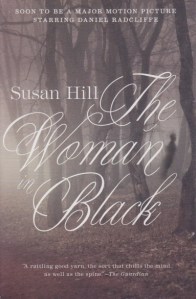
When autumn rolls around my hankering for gothic literature ratchets up.  It’s really my gothic sensibilities that make me watch horror films, seeking some kind of transcendence.  Some time ago I heard about the movie The Woman in Black, but I’ve never seen it.  I learned about the novel by Susan Hill, on which it’s based, and decided to check out the written form.  (I almost always like the book better than the movie anyway.)  The story is indeed moody, set in, as these stories often are, a remote part of the coast of England.  A lonely house cut off by the tide.  A hidden past full of secrets.  The plot is one of a vengeful ghost, and therefore the whole is somewhat supernatural.

I couldn’t help comparing it to Andrew Michael Hurley’s The Loney, which is also set on the coast of England, and also features a house cut off by the tides.  The storylines are quite different beyond that, but it is often the setting that makes gothic tales so, well, gothic.  The Woman in Black builds up the story slowly, intimating that something is wrong near the start, but not really giving too much away until near the end.  It isn’t really the conclusion, however, that a gothic reader is after, as much as the feeling.  Being immersed in a spooky setting where you’re not sure what’s going on.  There’s a kind of release in that.

I’ve often tried to figure out why this type of story appeals to me.  It’s certainly something to do with my childhood.  We didn’t live in a very gothic place.  My hometown was working-class normal, it seemed to me.  When we moved into the first apartment I remember, the setting did become gothic to an extent.  It was an older building that still had gas jets jutting through the walls from the days before electricity.  One of the bedrooms was painted black.  There was a huge crack in the linoleum in the hall that had the potential to trip you if you weren’t paying attention.  It was there that I first became aware of liking gothic settings.  It was the place I discovered Dark Shadows and began to find it strangely homelike.  Many of us, even with less-than-ideal childhoods, often look back to them with a kind of happiness that we just can’t seem to attain as adults.  Mine included some gothic elements, and reading novels like The Woman in Black takes me back there, if only for a little while.


Remaking King

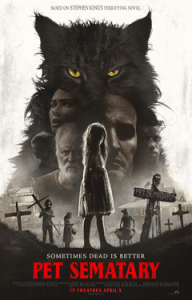
Pet Sematary is (or was), according to Stephen King, his most bleak book.  The first movie made from it (Mary Lambert, 1989) never reached the iconic status of The Shining or Carrie, but it nevertheless conveyed the dread of resurrection.  It also followed the novel pretty closely.  The new movie version, which came out last year, uses the more slick, modern horror style that just doesn’t have the same feel as the slow pace of dread.  The whole thing feels rushed to fit too much in.  It does add some nice touches, however.  Borrowing the creepy animal masks of The Wicker Man, it adds a religious procession of children to the eponymous cemetery right at the start and uses a mask to add menace at the end.  There will be spoilers here, so if you’re even slower than me at getting to movies, be warned.

The main source of fear, which is only shown a couple of times before the accident, is the speeding Orinco trucks along the road that kill people and pets.  Since horror is an “intertextual” genre there are several knowing nods toward the 1989 film, sometimes lulling the viewer into a false sense of security.  (Can you have security watching horror?)  King’s novel, and the original movie, point to the impending death of Gage, the young son of the family.  Faking out the viewer, the new film has the truck killing Ellie, Gage’s older sister, instead.  While this must’ve made Jeté Laurence’s role fun to play (for the dead child comes back—and when the monster is a fragile little boy of four or five it’s hard to believe) but it interferes with the explanation of death to her that makes up so much of the story.

Why the wendigo is brought in only to be dropped is a mystery.  The wendigo would make for a great movie monster, but trying to squeeze mention of it into an already crowded plot doesn’t really help.  The ending of the new movie is well set up, and the realization that she’s living dead on the part of Ellie is well played out.  Otherwise the film assumes the watcher already knows how it goes.  I suppose that’s a perennial problem with remakes.  The source of horror in the novel and in both films is the idea that the dead can come back.  It’s an ancient fear and one with which all of us eventually deal.  Now that the nights and early mornings are turning cooler and darker, movies like Pet Sematary come readily to mind and we know the horror season has begun.


Proof in the PDF

The proofs of Nightmares with the Bible are sitting right here on this laptop.  If I’ve seemed distracted, now you know why.  My life is unaccountably busy for a mere editor, and I’m afraid my September is being consumed by proofreading and index-making.  I had some fiction I wanted to submit this month, but proofs are a necessary part of writing and for those who take nobody’s word for it, reading them is important.  I have books on my shelves from very reputable publishers literally littered with typos.  I fear that.  I try to read proofs with as much concentration as a busy life will allow.  And yes, proofs come with hard and fast deadlines.  I only wish they’d been here in July.  Or June.  But still, Nightmares are on their way.

Since this was a “Halloween season” book, the goal was to have it out in September or October.  That won’t happen now, but there were a couple of things that transpired along the way: one was a pandemic.  The other was another paper shortage.  Strange as it may seem, both of my last two books came out in a time of paper shortages.  In 2018, the industry had supposed ebooks would wipe out print.  That didn’t happen, and when Michelle Obama’s Becoming took off, well, let’s just say academic books weren’t a priority.  Printing schedules across the industry got bumped and books from small publishers targeted for a specific date just didn’t match the demand.  This year the paper shortage is due to the Covid-19 outbreak.  Paper suppliers shut down for a while and, guess what?  Print came back!

In any case, hoping against hope that we can make the November publication date, I’m trying to read the proofs with record speed (and care).  That means other daily activities may suffer for a little bit.  Those of us who write think of our books as something like our children (not quite literally that high, but not far from it).  We want them to be launched into a world that will be receptive to them.  And so my morning writing (and reading) time has been dedicated to Nightmares with the Bible.  And indexing said book.  I’m not good at many things, but one talent I do have is concentration.  Until these proofs are submitted (hopefully ahead of deadline) there won’t be much else to which I can pay attention.  I’ll continue to post my daily thoughts, of course, and if you can click that “share” button on Amazon’s book page it’d be much appreciated.


Documentary

It all comes down to people and honesty.  Given the bald-faced lies that come from the White House these days, honesty is at a premium.  There are, however, always people involved.  And with people you never know.  This issue arises because I’ve been watching documentaries.  A documentary is classified as a nonfiction genre, but it will nevertheless have a point of view.  You need to question yourself about the motives of the writers and directors.  What are they trying to say?  Are they slanting the narrative a little too much in their own direction?  In cases like Ken Burns’ works, there’s little doubt everything is well researched and well funded.  They inspire confidence.  But I also watch more questionable films.

Recently I saw My Amityville Horror, a prolonged interview with Danny Lutz, the oldest child featured in the book and film.  In true documentary style, others are interviewed, some of them skeptics.  The film pointed notes that Lutz’s brother and sister declined to be part of it.  Lutz makes the case throughout that these things really did happen.  He’s obviously not a rich man—he drives truck for UPS—but he’s sincere.  Others interviewed cast doubts on the memories of over three decades’ fermentation.  The point of view here is one that seems to believe Lutz, who is a no-nonsense kind of guy.  At the very end when asked if he’d take a lie detector test, however, the subject seizes up.  It leaves the viewer wondering if we’ve all be taken down the garden path.  Is he an honest man or is he hoping to supplement his income?

A couple weeks later I watched Hostage to the Devil, a documentary on the life of Malachi Martin.  Martin was never a figure without controversy, and it seems that he enjoyed it.  Interviews with friends, and even the agent who did quite well from his book that shares the title of the documentary, argue for his sincerity.  The major players in the field, those who are still living, in any case, all make appearances.  The question that hangs in the air, although the documentary seems to lean towards his validation, is whether Martin was an honest man.  We always have to ask that question when money is involved.  Martin’s book, Hostage to the Devil, has sold over a million copies.  It made a living for an ex-Jesuit who then became part of the media circuit.  It leaves more questions than answers.  I wonder how Ken Burns would handle such topics.


Preorder Alert

Although you can buy most anything from Amazon, the book industry is particularly under its hegemony.  I have to admit that I enjoy browsing there, and often dream of the books on my wishlist.  I suppose that’s why I was pleased to see that Nightmares with the Bible is now available for preorder on Amazon.  I like to give updates for those interested, and the proofs have just arrived.  There’s kind of an inevitability to seeing your book on Amazon, a prophecy almost.  It now exists out there somewhere on the internet.  I do hope that it might stir some interest in Holy Horror, but like that book it will miss its sweet spot of a release before Halloween.  That means it also misses the fall catalogue.  The next one comes in spring, and who’s thinking of horror then?  Something all publishers of horror-themed books know is that minds turn toward these topics in September and October.  Just look at the seasonal sections of stores.

Horror films come out all year long, of course.  Halloween, however, serves as an economic lynch pin.  People spend money on being afraid in the early fall.  By mid-November thoughts have moved on to the holiday season and the bright cheer of Christmas.  Holy Horror arrived days after Christmas two years ago, and although I was delighted to see it, I knew we’d missed the boat for promotion and by the time it was nearing the backlist at the next Halloween it was old news.  That doesn’t dampen my enthusiasm for the books, of course.  It just means they won’t get the attention they might have had.

Nightmares with the Bible is about demons.  Primarily demons in movies, but also a bit of a history of how they develop.  There’s a lot of academic interest in the topic at this point in time, so hopefully it will get checked out of academic libraries that will make up its primary home.  According to Amazon you get five dollars off the exorbitant price if you order it there.  Although it’s standard practice in the industry, I’ve always disagreed with “library pricing.”  It comes from presses publishing too many books, I suspect.  Since few of them are pay dirt they have to recoup their costs by overcharging for the rest.  Nightmares with the Bible is reader friendly.  It’s non-technical and, I hope, fun to read.  Amazon seems excited about it (it’s an illusion, I know, but one for which those of us who do this kind of thing live), and is happy to take preorders.  Have your library order one, and if you do, be sure to check it out.


Nightmares’ Progress

Ironically for someone who works in academic publishing, I have my own issues of how books are priced.  I understand why, however, because I can see sales trends.  When it comes to authoring my own books I’ve learned how to write for general readers.  Not all publishers know how to price for that.  Already I’ve had one friend blanch at the price of Nightmares with the Bible and the hope is that it does well enough in the library market to earn a paperback.  I also know paperback sales seldom reach the level of hardcover sales from academic presses.  Much of it is driven by demand.  If people know about the book and ask their libraries to buy it, and this is key—check it out—that has a way of sometimes snowballing enough to convince a publisher that there’s an individual market.

Since I’m plotting the progress on Nightmares here on this blog, I’ll point out that the book has its own page on my website (located here).  Actually, all my books have their own page, but since my website is in the low-rent district of the internet not many readers venture here.  Yesterday I added the back-cover blurbs to the page.  I did so with fear and trembling.  Life has taught me not to take well to compliments.  They make me uncomfortable, like strangers entering my house without masks on.  Since I have no institution backing me, however, I need the praise of colleagues to convince others to buy this book.  In my long-term thinking on the topic, I’m hoping Nightmares gets reviewed and people will get interested in Holy Horror, which didn’t get reviews but which is half the price.

In the biz we call this “platform building.”  Those with healthier egos than mine hire their own publicists who boost their number of Twitter followers and get their names out there on the internet.  My own platform building has been of the budget kind.  I’m active on Goodreads to get followers.  I’ll engage with any comments I get on social media.  But I’m also a working stiff hoping desperately not to lose my job during this pandemic.  The blurbs on Nightmares are very nice, and they note that I write for non-specialists.  This blog is open to all comers, after all.  Likes, shares, and comments all help.  My thanks to my endorsers—you know who you are!—you made my day with your kind words.


The Birth of Nightmares

It’s often said that it takes a village to raise a child.  A similar idea lies behind the writing of a book.  Sure, the lion’s share of the research and writing are done by the author—the person who gets credit for the work—but publishing is an industry.  That means other people’s livelihoods are based on the end result as well.  The author often doesn’t know what’s going on when the book is in production.  It was a pleasant surprise, then, to find the publisher’s website for my book is up.  You can see it here.  My own site for the book has been up for months (here; go ahead and take a look, there’s not much traffic).  Those who only read these posts on Facebook, Goodreads, or Twitter may not realize there’s a whole website out here that addresses things like books and articles.  (I think the CV part requires updating, though.)

In a writer’s experience, seeing a book’s website—receiving an ISBN—is like the quickening of a baby.  You’ve known for some time that it’s there, but the proof is in knowing that other people can find out.  I only learned of this because a friend wanted a link to the book page.  If you google the title without quotation marks you’ll find lots of websites about Christians and nightmares.  (Who knew?)  People of my generation still often don’t realize that, much of the time, searches with quotations marks are increasing necessary on a very, very full internet.  I’m still not sure of a publication date for Nightmares with the Bible, but you can preorder it.  (Sorry about the price.)

Once a friend asked me why we do it.  Writers, I mean.  Unless you’re one of the few who are very successful you don’t make much money off the project that has taken years of your life to complete.  I’ve never earned enough in royalties even to pay for the books I had to purchase to research the topics on which I write.  It’s not an earning thing, although that would be nice.  For some it’s an expectation of their job.  For some of us where it’s not, writing books is perhaps best thought of as monument building, a long and intensive “Kilroy was here.”  You notice something you think other people might find interesting, and so you write it down.  Chances are the number of other interested people will be small.  Family (maybe) and a few dedicated friends will lay down the cash for an academic book.  But still, there’s a village behind it, and I need to thank them here.


Summer of Horror

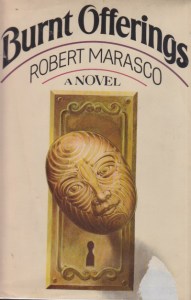
Summer vacation—or at least what used to be known as summer vacation—is winding down.  Unlike most years when the season is marked by a carefree sense of time off and travel, many of us spent it locked down while the Republicans have used revisionist history on the pandemic, claiming against all facts that America handled it best.  Is it any wonder some of us turned to horror to cope?  My latest piece in Horror Homeroom has just appeared (you can read it here).  It’s on the movie Burnt Offerings.  The movie is set in summer with its denouement coming just as vacation time ends.  I’ve written about it here before, so what I’d like to mull over just now is transitions.  The end of summer is traditionally when minds turn to hauntings.

Doing the various household repairs that summer affords the time and weather for, I was recently masked up and in Lowe’s.  Although it was only mid-August at the time, Halloween decorations were prominent.  Since this pandemic—which the GOP claims isn’t really happening—has tanked the economy, many are hoping that Halloween spending (which has been growing for years) will help.  My own guess is that plague doctor costumes will be popular this year.  Unlike the Christmas decorations that we’ll see beginning to appear in October (for we go from spending holiday to spending holiday) I don’t mind seeing Halloween baubles early.  There is a melancholy feel about the coming harvest and the months of chill and darkness that come with it.  Burnt Offerings isn’t the greatest horror film, but it captures transitions well.  (That’s not the focus of the Horror Homeroom piece.)

Many of us are wondering how it will all unfold.  Some schools have already opened only to close a week or two later.  Those in Republican districts are sacrificing their children (this is the point of the Burnt Offerings piece) in order to pretend that 45’s fantasy land is the reality.  The wheels of the capitalist economy have always been greased with the blood of workers.  (Is it any wonder I watch horror?)  As I step outside for my morning jog I catch a whiff of September in the air, for each season has its own distinct scent.  I also know that until the situation improves it will likely be the last I’ll be outdoors for the day.  It has been a summer of being cooped up and, thankfully, we’ve had movies like Midsommar and Burnt Offerings to help us get through.