Haunted State

Some few years back, when FYE was still a thing, I’d hunt for bargains at our local.  I came across a two-for-one DVD that seemed promising, but when I got it home I discovered it was a made-for-television combo, and movies of that ilk often fudge on many angles.  I watched them nevertheless.  These were the Discovery Channel’s first two specials in what would become a series titled “A Haunting.”  I have to admit A Haunting in Connecticut freaked me out so much that I decided to trade the disc back in—something I rarely do.  (The other feature, A Haunting in Georgia, I could barely remember.)  As is usual with things I get rid of, I grew curious once again—this time a decade later.  Fortunately both movies are included in Amazon Prime, so I was all set.  I just needed that rarest commodity of all, time.
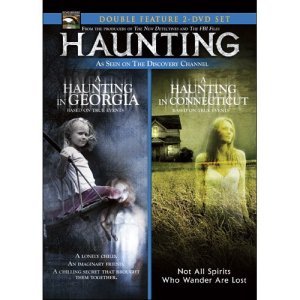
You might think that a guy who gets up at 4 a.m. on weekends would have plenty of extra time.  That’s not the case.  Nevertheless, I squeezed the clock to watch these shows again for research purposes.  Neither one was so scary as I recall—I’ve seen quite a few movies since then—but they did get October off to a moody start.  Of the two I recalled far less of the Georgia story.  Perhaps part of the reason is that it left so much unresolved.  The Wyrick family apparently experienced many ghosts and their investigator, William G. Roll, took their claims seriously.  While not an Ed and Lorraine Warren film, like its sibling, it follows the pattern of repeated, reported activity, investigation, and, well, not quite resolution.  The family attends a Pentecostal church, and, interestingly, the documentary treats it respectfully.

Unlike A Haunting in Connecticut, A Haunting in Georgia films some events in real time—notably the church service.  The pastor is interviewed and he, unlike Dr. Roll, believes the entity to be demonic.  The documentary treats him with the same gravitas as it does the Berkeley-trained psychologist.  There’s too much going on here to make a memorable narrative, though.  Stories, at least in the classical fictional sense, have some kind of resolution.  The Georgia narrative has too much complexity and too little sense that anything has been solved.  To me the amazing thing was that I had watched this film before and I remembered maybe only the first fifteen minutes.  Both films went on the bigger things, getting remade into theatrical features that I’ve never seen.  But then again, I barely have time for my own unresolved story.  Maybe FYE offers its own brand of local haunting.

Sleepy and Hollow

Call it nostalgia.  (“It’s nostalgia!”)  What with major expenses rolling in like the longer nights—a major plumbing job followed by the roofers back again to fix another leak—I try to accept my joys in inexpensive doses.  I’ve written before about how “The Legend of Sleepy Hollow” caught my childhood imagination.  My brothers and I, growing up in quite humble circumstances, were collectors.  Not having much money, the collecting tended to be of free stuff, much of which drove our mother crazy.  Bottle caps, believe it or not, could be had for free from the openers on vending machines that dispensed genuine glass bottles.  We had bags full and the aroma was wonderful.  We had baseball cards—which were cheap and would now be worth something had they been kept—by the boxful.  And we collected stamps because they came free in the mail.

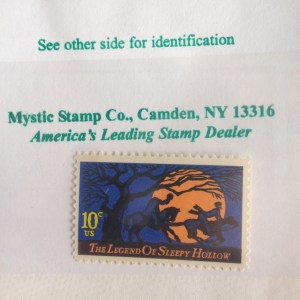
Yes, even bills used to have stamps.  The Legend of Sleepy Hollow stamp was released for Halloween in 1974.  I don’t recall how I heard about it, because there was no internet in those days.  I knew, however, that I fervently hoped one would come so that I could add it to my collection.  It never did.  In fact, I never actually saw the stamp itself.  When we moved house my childhood philatelic ambitions met an abrupt end as those endless childhood collections (which included metal slugs dropped from trucks rumbling out of the local steel mill and fossils found by the river under the bridge where those slugs pinged) were simply thrown out.  I would never see the coveted stamp, and now we use email.

It took many years—decades now—to occur to me that the stamp might be available online.  I guess I had pictures of the price tag of that upside-down airplane stamp in mind as I navigated to a vendor who was asking less than a dollar for a mint copy of a ten-cent Sleepy Hollow stamp.  Gritting my teeth between plumbing and roofing bills, I finally clicked “check out.”  With postage ironically costing more than the contents, still I felt giddy.  This was a piece of childhood on a simple slip of sticky paper.  I am not a stamp collector.  I will likely never be.  I do have vivid memories of bags full of aromatic bottle caps, and shoeboxes groaning with baseball cards, and cheap albums with common stamps.  They’re long gone.  But on my desk I now have a small piece of memory from many years ago, and  I have to wonder if I’m the pedagogue or his headless haunter.


Ambling through Amityville

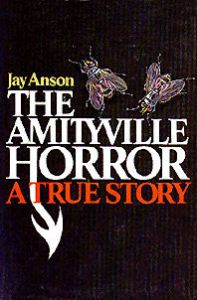
I may be a week too late for Friday the 13th, but I just finished rereading The Amityville Horror.  One of my current projects required my paying close attention to what was and was not claimed, and although it doesn’t count towards my Goodreads goal, I just had to do it.  I noticed, as also occurred to me when rereading Gerald Brittle’s The Demonologist earlier, that the second time through raises more questions than the first.  The book has been demoted from nonfiction to novel over the years, but it seems pretty clear that Jay Anson believed it to be based on actual events.  He could’ve been wrong, of course, but with a long list of documentary writing credits to his name one does have to wonder.  Anson died just a year after the film came out.

When the movie was released I was still in high school and what everyone was saying about how scary it was kept me out of theaters.  (That, and lack of funds.)  It’s hard to imagine now, but there weren’t even VHS options in those days, especially for those of humble circumstances.  As a result, I was well into adulthood before I saw the cinematic version.  Reading the book, however, is an attempt to pry open the question of what might’ve happened at one of the most famous “haunted houses” this side of the Atlantic.  I’d just read a headline that the house had been sold again, and such was the impact of this story that a simple property transaction is now considered news in some circles.

Controversy permeates this tale.  I suspect that’s because it made a lot of money.  The search for the truth is often compromised by lucre—just look at the White House and try to disagree.  The usual rendering is that the Lutz family, in financial trouble, concocted a story that would bring in big bucks.  Such accusations came, of course, once the story did indeed prove valuable.  The second highest grossing film of 1979, The Amityville Horror held records for the highest grossing independent film for a decade.  Add to that the estimated book sales of 10 million copies and you have a nice retirement account laid up.  Those levels of remuneration are enough to corrupt any narrative.  Still, it’s clear that many people wonder what really went on at the house on Ocean Avenue.  I sat down with the book again and I have to admit that I’m no wiser on the question for having read it again.


Fearing Hubris

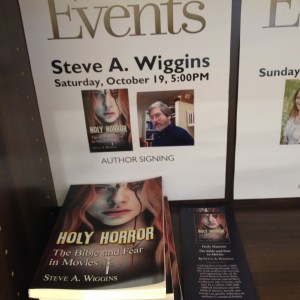
I’m afraid of hubris.  You see, my academic career was not exactly distinguished, and as an editor you’re encouraged to keep to the background.  Still, when you write a book you need to promote it a little, which is one of the things I learned as an editor.  I was equally parts embarrassed and pleased to see the bookstore display for my upcoming book signing in Bethlehem.  I mean, although I wrote Holy Horror for a general readership, the publisher tends more toward academic books and their pricing, so this is not an inexpensive purchase.  Those who write are nothing, however, without readers.  Those chosen for interviews are writers who’ve made a sales impact or who have a university behind them.  When it’s just me, it feels like maybe I’m trying to ascend Olympus on my own initiative.

I was in the Moravian Book Shop to purchase Neal Stephenson’s Fall; or, Dodge in Hell.  I’ve fallen a bit behind on Neal’s work, largely because Goodreads challenges are measured in numbers of tomes read.  I was pondering this, book in hand, when I noticed—there I was with my own display.  You see, Holy Horror was meant as a guilty pleasure read for those of us who like the scary time of year.  The book price is the scariest part about it, however.  I feel a profound gratitude when anyone actually buys it.  Since there are now copies available on sites such as eBay, I’m guessing some who’ve read it want to recoup a little of the cash outlaid.  While all of this is happening, however, I know that I have to learn the art of book promoting.  Still, it feels like that self-promoting I was warned against as a kid, an unseemly thing.

Writing is a form of conversation.  When I’m in a room with a bunch of other people unless I’m the teacher I have trouble making myself heard.  I’m soft-spoken by nature.  I suppose it’s obvious, then, why a book signing feels hubristic.  Perhaps it’s appropriate for a book about fear to engender this sense of discomfort.  Entering the conversation has always been difficult for me.  At the same time, as the beneficiary of so many books, I feel compelled to give something back.  My insights, if such there be, won’t rock the world.  As I think of myself signing books, I wonder what I could possibly say to someone who’s willing to pay that price for something I produced.  If you’re going to try to climb that mountain, you’d better think about what you’ll say when you meet the gods at the summit.


Unwished Inheritance

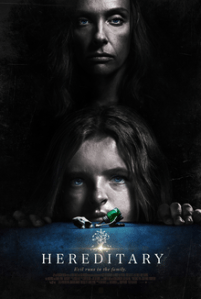
When I mentioned my book Holy Horror to someone recently, she asked “Have you seen Hereditary?”  I had to allow as I hadn’t.  I have to struggle to find time to watch movies, and I’m generally a couple of years behind.  Surprisingly, Hereditary was available for free on Amazon Prime, and I finally had the chance to terrify myself with it.  Perhaps it didn’t help that I’d been reading a book on schizophrenia at the time (as will be explained in due course).  Hereditary is one of those movies that is impossibly scary, up until the final moments when it suddenly seems unlikely.  In this respect it reminded me of Lovely Molly and Insidious.  All three also feature demons.  Using a child to accommodate the coming of a demon king brought in Rosemary’s Baby and the Paranormal Activity franchise.  (The genre is notoriously intertextual.)

While demons can make movies scary, what really worked in Hereditary was the sense of mental instability and the lack of a reliable character to believe.  The Graham family is deeply dysfunctional.  Mix in elements of the occult and dream sequences and you’re never certain what, or whom, to believe.  As with many of the films I examine in Holy Horror, the realms of religion and fear are interbred.   While the Bible plays no part in Hereditary, the matriarch’s “rituals” pervade the family following her death.  In a family of females, where a male demon seeks expression through possession, an obviously challenging dynamic is set up.  It works out through a series of disturbing images and manipulations.

Watching the family disintegrate becomes the basis of the horror.  Then possession comes into play.  As in most films concerning possession, deception and misdirection are used.  A demon named Paimon is seeking to take over the one male heir.  This ties the movie to The Last Exorcism, where the same demon under a different name seeks to propagate through Nell Sweetzer.  Unlike many possession movies, the suggestion that possession is actually involved comes late in the script.  This revelation underscores the the misdirection of attention that focuses on Annie Graham’s struggle to cope with reality.  Her sleepwalking and threats to her own children as well as the suggestion that they are but miniatures being manipulated by a larger, more powerful entity, keep the viewer off balance throughout the story.  Intelligent and provocative, Hereditary assures me that tying to analyze such films, while perhaps a fool’s errand, is an enterprise unlikely to be soon exhausted.


Book and Bell

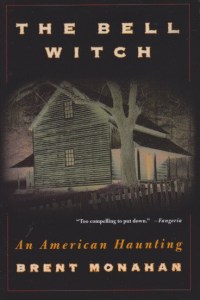
The Bell Witch: An American Haunting, by Brent Monahan, is a book I’ve read before.  The subtitle was used for a cinematic version.  I discovered the book, however, through what might be considered a chance encounter with the author.  He was teaching a course on offering distance education courses at Rutgers University, and, as an adjunct teaching over eight classes per year, I’d been selected for the distance education program.  (As life goes, of course, I was hired by Routledge for a full-time job before I could actually deliver the course.)  By a strange irony, I had watched An American Haunting just the weekend before the course, and I had no idea who would be teaching it.  Neurotically punctual, I was the first one there for the class, and as Dr. Monahan and I talked, I knew I’d need to read the book.  I posted on it back when I did, but this time I decided to pay better attention than one can on a bus.

Of course, when you watch the movie first, which I had, you know “the reveal” well before it comes late in the novel.  In case you’ve done neither, I won’t give it away.  The tale is based on an historical haunting, attested in sources from near the period.  And it is a strange kind of possession story.  The “witch” is actually a demon conjured by a trauma, and although book wraps things up nicely, it leaves a few questions at the end.  I suppose that’s appropriate for a scary book.  One of my current projects involves tracing the accounts behind fictionalized narratives to their originals.  The Bell Witch was well researched, and is a good example of how the line between fiction and fact can be effectively blurred.

The Bell Witch legend is credited with influencing several horror films, including The Blair Witch Project and others which tellingly have “Bell Witch” in their titles.  The story has a fairly incredible longevity, given that it was a localized legend from early in the nineteenth century.  Monahan’s novel is written as a “confession” from the schoolmaster, and historical personage Richard R. P. Powell.  This blurring of the lines makes for the kind of ambiguity that gives horror its particular ability to stand between fact and fiction.  The early versions of the lore, combined with elements intended to offer verisimilitude, leave plenty of queries at the end.  So much so that I’ve occasionally contacted the author for clarification.  What really happened?  It depends which side of the line you prefer.


Not so Hollow

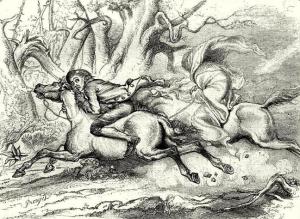
It is difficult to say how an idea might grab you.  I really have no idea why Washington Irving’s “The Legend of Sleepy Hollow” took my childhood imagination prisoner and has kept it stoutly locked up over all these years.  Perhaps it was the Disney version seen as a child that left me with shivers of wonder akin to a species of joy.  The autumnal setting, the implied ghost, the ambiguity of the final scene.  I used to be as avid a philatelist as one can be in a small town, and the Sleepy Hollow stamp of 1974 held me transfixed long before I ever encountered Tim Burton’s vision of the legend.  After having watched the silent Headless Horseman a couple of times, I went back to The Sketch Book of Geoffrey Crayon, Gent., and read the original again.  This time I followed it up with the appendix in my edition, written a decade or two after the story by an older Irving.

The 1922 movie runs fairly close to the literary original (for the most part), especially when you add the appendix.  The appendix (in the edition I have—The Modern Library, 2001) is an essay titled “Sleepy Hollow.”  It reflects on Irving’s recollections of what Sleepy Hollow was like in his youth (he returned to the area to settle later in life).  The village church, which features in “The Legend,” provides a source of much of his reverie and this is incorporated into the early cinematic version as well, in the Sunday morning scene.  I also noticed how frequently psalmody enters the original story.  The tale does not mention the Bible, but psalmody was an early form of church music, and “The Legend” has Ichabod use it when he’s afraid as well as for teaching students to sing, for a few shiny shillings.

Washington Irving is sometimes credited with the invention of the short story as a literary form.    His younger contemporary Edgar Allan Poe worked in that format, and the two of them contended with making a living (the former more successfully) purely as literary writers.  Irving’s spooky tales, however, often have something of the comic about them.  His story-telling style uses folksy, folkloric exaggeration and humor to prevent it from becoming too dark.  Poe would snuff the candle and let the fear be unhindered.  I knew of Sleepy Hollow before I discovered Poe, and this recent resurgence is perhaps a way of exploring my own literary roots.  It’s nearly half-way through September already, and Tarrytown beckons. 


Horseman Horror

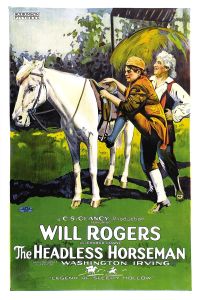
Yesterday was distinctly autumnal around here.  Cloudy and cool, the overcast was definitely moody although the equinox is still a couple weeks away.  Still, the mood was right for the Legend of Sleepy Hollow.  The earliest full cinematic adaptation of Washington Irving’s story is the 1922 silent feature The Headless Horseman, starring none other than Will Rogers.  Now, Irving’s story is fairly brief, and to get nearly a full seventy-five minutes out of it, the tale lends itself to some padding.  The film makes a great deal of Ichabod Crane knowing Cotton Mather’s A History of Witch-Craft, and even being accused of being in league with the Devil that leads to a  disturbing scene where he’s nearly tarred and feathered.  In reality Mather’s book was Wonders of the Invisible World, but the point of the film is better made with the fictional title.

Having watched Tim Burton’s 1999 version—Sleepy Hollow—many times, I was taken by the introduction of the Bible into the story.  The groundwork, however, was laid by Edward D. Venturini’s version.  True to the story, Ichabod teaches Psalmody in his role as schoolmaster.  Venturini’s film has a contrived scene in the church on Sunday that includes a lengthy sermon with everyone—even the usher—falling asleep.  The episode, which is lacking in Irving’s original rendition, introduces the Bible into the narrative.  The connection is thin, but nevertheless present.  Burton picked up on the religious element and built it firmly into the plot as Ichabod Crane’s backstory as a skeptic, raised by “a Bible-black tyrant.”

As someone interested in the integration of religion and horror, early examples, despite the comic aspect of Venturini’s version, are often instructive.  The comedic spirit is actually in the original; Irving’s tale gives a caricature description of Crane that gives the lie to the handsome protagonists beginning with Jeff Goldblum on through Johnny Depp and Tim Mison.  Will Rogers plays the homely image to its hilt, and although lighthearted, the movie has some classic horror elements.  To arouse his dozing parishioners, the minister yells “Fire!” When they awake asking where, he states “In Hell,” which sleeping churchgoers can expect.  Although the eponymous headless horseman is shown to be Brom Bones, a remarkably effective early scene presents a skeletal, ghostly rider that haunts at least the imagination.  The sun is out this morning, and the brooding skies of yesterday have passed.  They will be back, however, as the season for ghost tales is only just beginning.


Power of Parables

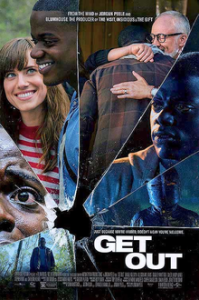
Parables come in all sizes and shapes, horror movie-shaped, some of them.  In my perpetual struggle to catch up, I finally got to see Get Out.  One of the raft of well-made, intelligent horror films that have been released recently, it’s been out long enough that I suspect my spoilers will be well known.  The Armitage family, resident in upstate New York, has been kidnapping and using African-Americans to make up for the perceived weaknesses of their family and friends.  One of their main means of obtaining victims is through their daughter Rose, who brings her boyfriends home for the weekend so they can be hypnotized by her psychiatrist mother and operated on by her neurosurgeon father.  The reveal comes slowly, but the discomfort begins early on.

Released early in the Trump White House tenure, the movie is a study in an intense xenophobia that nestles somewhere between Guess Who’s Coming to Dinner and The Stepford Wives.  It’s inherently uncomfortable watching Chris Washington, the protagonist, being treated as if his very presence requires constant comment in the world of white privilege.  He, of course, had misgivings before ever climbing into Rose’s car, but her convincing display of liberalism was enough to overcome his hesitation.  For me, watching the film made it clear that privilege is something assumed, even when it isn’t had in any explicit way.  The Armitage family and their friends are well-to-do but even if the setting were more mundane the message would still have worked—our culture imposes and reimposes its message of white superiority in subtle ways that the camera captures here.

Quite apart from its nature as a parable, Get Out is a demonstration of the social consciousness of horror.  Its reputation as a debased, low-brow appeal to all that’s unsavory to watch is misplaced at times.  While Get Out is uncomfortable it’s that way for a reason.  Were it not, it would lose its important message.  All privileged people need to be able to see through the eyes of those who are culturally disenfranchised, and although the “us versus them” mentality is problematic it has to be faced honestly and openly.  The very fact that a human construct like race could be used as the basis for a horror film in America raises questions that ought to make all of us squirm.  Setting the story in New York, where prejudice might be supposed not to remain only underscores how deeply its roots have grown.  Horror with a conscience is perhaps as much a vehicle for social change as it is a genre more honest than often supposed.  That’s how parables tend to be.


Gods, Monsters, and Publication

One of life’s great ironies is that those of us not born to wealth have to spend the years we’re young enough to enjoy ourselves stabilizing our situation until suddenly we realize we’re too old to do that kind of thing any more.  I know I’m being overly dramatic, but it often does feel like life operates backwards.  My professional career began where I’d hoped it would end, as a professor.  I taught and published for almost twenty years and really nobody paid much attention.  At least I had my teaching.  I also had a family to support, so I had to accept the shift to publishing when that came along with an offer of a full-time job.  Thus it has been for about a decade now.  Within the last decade colleagues have begun to approach me, asking me to contribute to academic volumes, or to be involved in pursuits that are more associated with professors than editors.  I could do with more irony in my diet.

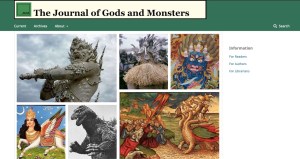
All of this is a long-winded invitation to check out the new Journal of Gods and Monsters.  I probably won’t be writing articles for it; lack of library and research time (both of which I had when invitation-free) assure that my scribbling will be non-technical and hopefully of the more general interest crowd.  Then why am I telling your about this journal, fresh from the box?  I’m on the Executive Advisory Committee and the first Call for Papers has been issued.  Now, this blog really has no way to include attachments that I know of, so if anyone wants in on the ground floor for this journal please contact me (the About page on this website says how).  I contributed to the first number of the first volume of the Journal of Ancient Near Eastern Religions and look where I am now!  You just never know.

In addition to the books on which I’ve been assiduously working, I’ve got a number of commitments to edited volumes and encyclopedias (these invitations waited until I was safely out of academe before rolling in).  The monster crowd is, I assure you, a welcoming one.  As we seem to have turned the corner into autumn a touch early this year, and I see leaves beginning to change before August is out, my mind turns toward the realm of the uncanny.  It may be less academic than ancient religions, but the world of monsters feels much more relevant these days.  If you’re a researcher in these realms I’ll be glad to send you a call for papers.


https://godsandmonsters-ojs-txstate.tdl.org/godsandmonsters/index.php/godsandmonsters


Horror Homeroom

With a happy coincidence I discovered a website called Horror Homeroom.  Featuring articles and podcasts and reviews on horror films, I felt its siren call.  Then I learned it is run by a professor at nearby Lehigh University, making it even closer than I initially supposed.  I wanted to be part of the conversation.  You see, after years and years of being a Bible scholar and having to fight to find any kind of interest whatsoever in what I had to say, I’ve found the horror community extremely welcoming.  Perhaps because we all know at some level that horror is considered transgressive—it isn’t unusual to find critics who still claim it’s debased—we find each other.  There’s an aesthetic to horror, and it isn’t about gore and violence.  Horror, when done well, is an excellent marker of what it means to be human.

Life always ends in death.  Many people spend as much time as possible trying to avoid thinking about it.  There is, however, great creativity in facing squarely what you cannot change.  Well, that’s a good sounding excuse anyway.  All of this is by way of announcing my guest blog post on Horror Homeroom.  A few weeks back I was quite taken with The Curse of La Llorona.  Not that it was a great movie, but it had a way of coming back to haunt me.  Part of it has to do with the poorly understood way that local customs blend with imperialistic religions.  Faith is a local phenomenon.  Once you switch off the televangelist, you’ll begin sharing beliefs of your neighbors.  There’s no such thing as a pure religion.  Pure religion is one of the most dangerous myths there is.

Those of us who study religion professionally have been taught to call the blending of religions “syncretism.”  I’ve stopped using that word for it because it assumes that there are pure forms of religion.  Religion always takes on an individual element.  We make it our own when it gets translated into our personal gray matter.  The idea that there is a pure form of any religion requires an arbiter of greater rank than any here on earth.  You can always say “but I think it means…”  Horror, I suspect, latched onto this truth long ago.  Without some hint of doubt about your own individualized belief system, it’s difficult to be afraid.  Horror need not be about blood and gore.  Often it isn’t.  Often it’s a matter of asking yourself what you believe.  And once you answer it, opening yourself to asking questions.


Fun and Fear

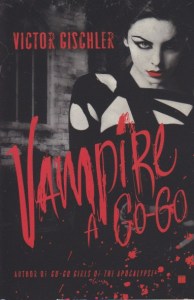
It’s curious the way people find books.  I sometimes see them advertised (the way publishers suppose people see them), but far more often I find them more serendipitously.  I’m active on Goodreads, and many times a book someone else has reviewed will catch my eye.  I like to read things that I notice in independent bookstores.  I’m always on the hunt for a bargain.  At work we have a used book rack where any volume is half-a-buck.  During lunch one day I spied Victor Gischler’s Vampire a Go-Go.  Now the title told me this wasn’t exactly a serious novel, but it had vampire in the title and when I write horror it often ends up on the funny side.  All in all it seemed like it would be worth the tiny investment, even if I don’t have a clear idea of what go-go really means.

While not laugh-out-loud funny, this is an enjoyable romp through monster land.  Kind of like Harry Potter with some adult themes thrown in.  The characters—which include ghosts, witches, wizards, a werewolf (sorry lycanthrope), a golem, and a vampire—are likable and strangely believable.  An unexpected twist came with the Battle Jesuits, a nice touch that shows yet again how close religion and horror can be.  I won’t try to summarize the action here, but I’ll simply note that there are twists and turns aplenty and smiles and splatter along the way.  It’s clear that Gischler researched the novel well, bringing interesting texture to the tale.

Like the last novel I read, also acquired in an inexpensive browsing situation, much of the story is set in Prague.  My wife and I visited Prague back when it was still in Czechoslovakia, and before it had become a tourist haven.  From reading these recent novels, apparently quite a lot has changed there.  Of course, in those days I hadn’t tapped into my love of monsters for many years.  Working on a doctorate has a way of doing that to you.  Now that I’m back, I’m enjoying the variety available in the genre these days.  I still have a soft spot for Stephen King novels, and Poe will always remain among my sacred texts, but I’m inclined to read these newer treatments as well.  There’s nothing really to scare you in Vampire a Go-Go, but there are remarkably moving moments.  And some of the monsters are quite a lot of fun.  It would restore my faith in the power of the accidental find, if it ever required resurrection.


Hidden Monsters

I don’t think much about having been born male.  I’m starting to realize that that’s because I don’t have to.  The same is true of being caucasian, although I’ve always objected to the labels of “white” and “black” as being polarizing and wildly inaccurate.  Although I grew up in poverty, my “social markers” put me in a place of privilege, even if others sharing my demographic have locked me out of the club.  These thoughts were raised by Mallory O’Meara’s excellent The Lady from the Black Lagoon: Hollywood Monsters and the Lost Legacy of Milicent Patrick.  As soon as I saw the book announced, I knew I had to read it.  As O’Meara would doubtlessly not find surprising, I had never heard of Milicent Patrick before.  I’m not surprised that a woman designed the Creature from the Black Lagoon, however, because woman create memorable monsters (can I get a “Frankenstein”?!).

The reason I don’t think about being male is because the crumbling society built by males assumes that it’s the default.  Men have always been shortsighted, I guess.  Having been raised by a “single mother” (she was technically not divorced because a male-made religion said it was sinful), I always believed women to be protectors, capable heads of families, and far more empathetic than the men I met.  I didn’t realize at the time that we lived so close to the brink because men devalue women.  Milicent Patrick grew up in a family where this was much more obvious.  A talented artist, she incurred her family’s lasting wrath by going to Hollywood and doing what was then movie makeup work.  That she designed the beloved Gill Man makes sense to me.

O’Meara’s book is sure to make thoughtful readers angry.  Not at the author, but at the behavior of men.  Perhaps due to my unbalanced upbringing, it has taken many years to see what others probably notice much more readily: women have to struggle for that which someone like myself can simply claim.  Bud Westmore, Patrick’s boss at Universal, claimed her creation as his own work.  There are monsters in this book, and I’ll give you one guess as to their gender.  Still, I’m glad to have read it for I know I’ve found another monster fan.  O’Meara’s clearly aware of how those of us who admit this odd passion are marginalized in a world that prefers super heroes and those good with finance over those who see monsters everywhere.  This is an important book; read it and you’ll see them too.


Summertime Boos

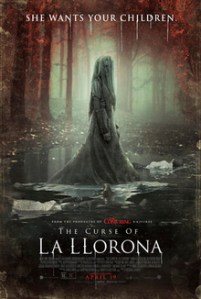
There are so many of them that it’s difficult to keep up.  Movies, I mean.  And they can be an expensive habit.  As some readers may know, I’ve followed The Conjuring franchise pretty much from the beginning.  That particular film was long anticipated (at least in certain circles), but still I waited until it was available for home viewing to see it.  I always feel kind of selfish going to the movies on my own since they are a kind of event—a form of social outing.  For me, however, horror movies are research, but that hasn’t taken away the thrill of seeing one on the big screen once in a while.  The Conjuring branched off into the Annabelle movies, and I caught the latest offering in the latter series in a theater.  I hadn’t realized that The Curse of La Llorona had been released a couple months earlier, and that it was being considered part of the diegesis.  It was back to the small screen to catch up.

La Llorona is based on a Mexican folktale and is tied to the other films in its universe by a character who recurs from Annabelle, Fr. Perez.  He’s not the protagonist, but he does introduce one way in which horror responds to the present insanity we call the US government—the character who defeats the fiend is hispanic.  In fact, most of the characters in the film are from hispanic families in Los Angeles.  They take down the ghost without the assistance of border guards or any kind of wall.  They don’t need the simpering help of the GOP.  Like most of the movies in this franchise, however, they do make use of religion.

When Fr. Perez can’t offer immediate help to the family beset by La Llorona (“the weeping woman”), he points them to a local shaman.  In this otherwise Catholic world, the truly amazing outcome is that the faith healer does possess the knowledge and ability to stop the evil.  While the backstory of the ghost is well known, the nature of the entity is a bit unclear.  Most Conjuring films feature a demonic presence, so it’s kind of a relief to have a garden variety ghost for a change.  You see, when Ed and Lorraine Warren challenge entities in these movies they do so with religious accoutrements which tend not to fail.  Ghosts, however, traditionally don’t require a religious banishment.  We’re entering new territory here, of course.  And I hadn’t even known about this film until after I’d seen its predecessor.  How can you hope to keep up with spirits?  It’s a full-time job. 


Good Monster

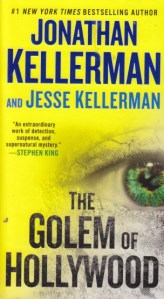
The little free library is a great idea.  Just after our move last year we contributed to our local many times as we discovered duplicates in the process of packing.  On one such venture, I discovered a book I wanted to read.  Not that I’d heard of it before, but any book with “golem” in the title catches my eye.  For the first (and so far only) time, I took a book.  Jonathan and Jesse Kellerman’s The Golem of Hollywood proved a fairly quick read for being over 600 pages.  I believe the industry term is “potboiler,” but it’s also a page-turner.  Nevertheless, it made me think.  The story follows a hard-bitten Jewish detective in Los Angeles.  Struggling with personal issues, he gets assigned to a bizarre homicide case that eventually takes him to Prague and Oxford, and then back to LA to clinch it.  And the killer is a golem.  (That’s not a spoiler, since it’s right there in the title.)

Parallel to the modern-day crime drama is the retelling of the biblical tale of the first days of humanity outside the Garden of Eden.  One of Adam and Eve’s daughters is headstrong and beautiful and when the tragedy between her brothers plays out she eventually takes her revenge on Cain.  Although not explicit about it, for violating the mark of Cain she witnesses the horrors that people will visit upon one another and her redemption is to become the soul that animates the golem of Prague.  Not your garden variety golem, she can transform into different shapes, and she stays loyal to the family of Rabbi Judah Loew ben Bezalel, the legendary first creator of the golem of Prague.

One of the frequent topics raised on this blog is how the Bible appears in everyday life, often unnoticed.  This novel is an example of that.  A further point, which is what stands behind my book Holy Horror, is that the Good Book is understood as mediated by popular culture.  Even those few biblical scholars who make it into the limelight can’t compete with the myriad representations of Scripture in the entertainment media.  Like The Golem of Hollywood, Holy Horror sees the Bible in the context of monsters.  Horror is an outsider genre.  Despite the many intelligent, thought-provoking exemplars extant, the default among the more refined is to see horror as something base and low.  It can also be a lot of fun.  Perhaps not great literature, The Golem of Hollywood is entertaining even as it underscores the continuing influence of the Good Book.