Movie v. Book

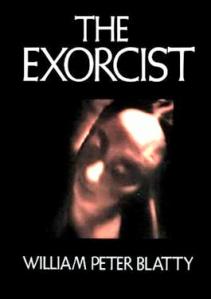
The debate is about as old as celluloid itself; which is better, the book or the movie? The response obviously depends on personal taste, and I suspect that many people base their answer on criteria that can’t exactly be quantified. Often it’s a matter of the specifics—which book? Which movie? In my own experience I’ve done it both ways, read the book first and watched the movie initially. I’ve even gone to movies not realizing there was a book and, of course, some movies aren’t based on books at all. You couldn’t grow up when I did, however, and not know that The Exorcist was a movie based on a book. I never saw the movie in a theater. There was a lot of buzz about it in my hometown, of course. I hadn’t been introduced to modern horror yet—still being a Fundamentalist at the time—and besides, it was rated “R” and I wasn’t.

I finally got around to reading the book. At this point in my life I’ve seen the movie several times, so I knew how the story was “supposed to go” beforehand. The fact that William Peter Blatty wrote the screenplay suggested it would be close to the novel, and indeed that’s the case. Novels, by their nature, tend to have more information about the storyline than is obvious from a film. The author can take time to explain things that don’t translate visually, including scenes where one character lectures another, like this blog. Since I’m writing a book about demons in movies, I paid careful attention to this. One of the themes from the novel that didn’t make it to the movie was witches.

That surprised me a bit. I had seen the movie first and it was plenty scary just as it was. I had to remind myself that my younger years coincided with the rebirth of the fear of witches. Literal ones. I’m not an astute enough sociologist to say whether the “witch hunts” of McCarthyism led to a hypostatized fear of real witches or not, but people were afraid in those days, as I recall. The Exorcist tapped into cultural fears in a way rare for a horror movie. It spoke to the fears of the era, but it didn’t mention witches. I couldn’t help but make the comparison with Rosemary’s Baby, which hit theaters shortly after The Exorcist. Rosemary believes the Satanists are witches. There’s a whole supernatural concoction of malevolent entities on the loose. Witches, ultimately in the novel, are simply one avenue the desperate Chris MacNeil explores to find out what’s wrong with Regan. The movie, wisely in my opinion, chose to leave it out. Demons are scary enough on their own, but of course even that’s debatable.

Watching Research

Now that Holy Horror’s been announced, I’m at work on my next book based on horror movies. Although some people might question the aesthetic of the horror genre, these films are sometimes remarkably intelligent and can indeed be good cinema. Having spent the better part of last weekend watching multiple flicks, however, I’ve come to realize that watching films for research is quite different than viewing them for fun. We all know the feeling of going to the theater to be exposed to the mythology of the present day; movies are the new mythology and are a common source of meaning and hope for individuals in a post-religion era. We go for the spectacle and the story. We leave, if the movie is good, with a renewed sense of purpose, or in a thoughtful state. That’s what mythology does.

In writing up my analyses of many films, I’ve noticed how little the detail is generally acknowledged in many synopses. They can make a flick seem banal. I’ve even had very intelligent people ask me why I think watching movies should be considered intellectual exercises. One reason for this, at least in my experience, is how often people rely on what they see in movies to inform them of important things. Historical events, for example. For the average person, an historical recreation on celluloid can provide recall better than a detail from some 400-page tome on the topic. Human beings are visually oriented by nature and evolution. It takes us years to learn how to read, and if we don’t keep up with the practice our ability to comprehend advanced writing atrophies. It’s easier to watch a film.

No doubt movie scripts are available for purchase. To get the message of a film, however, you need to watch. Immerse yourself in a kind of flickering light baptism. Research watching, however, involves multiple viewings. Taking notes. Watching again to make sure you got that detail correct. Some may doubt that this is an intellectual exercise at all. Still, one of the concerns that some scholars feel is that we’ve lost touch with what hoi polloi believe. People have turned to mythology from the beginning of time in the quest for meaning. Science tells us how the world works, but not why. For such questions we need our mythologies, ancient and modern. Since Nightmares with the Bible focuses on demons, I’ve had to construct a cinematic demonology that’s quite different from those of the Middle Ages. It requires, after all, a modern research method for a modern mythology. And movie watching. Lots of movie watching.


Exorcising Theology

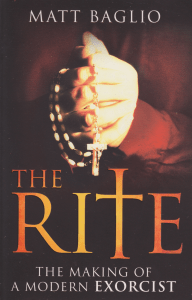
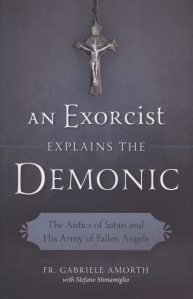
Among those curious about exorcism, the name Fr. Gabriele Amorth requires no introduction. As “the Vatican’s chief exorcist” (a claim the book makes), Fr. Amorth was known for conducting many deliverances and for teaching a new generation of exorcists. Looking for an entryway into his perspective, I read An Exorcist Explains the Demonic: The Antics of Satan and His Army of Fallen Angels. That a priest in Rome should be conservative was no surprise. What was truly astounding about this account was how unquestioningly the exorcist accepted nearly everything to do with Roman Catholicism. His reading of the Bible is quite literal. His understanding of the Virgin Mary as the Mother of God offers no nuance. Demons are fallen angels and, somewhat surprisingly, he uses “Devil” and “demon” interchangeably. For a hierarchy so thoroughly parsed, this was a bit unexpected. Encountering these explanations, much of what I’d recently read in Matt Baglio’s The Rite made sense. Baglio’s protagonist studied in Rome when Fr. Amorth was still active.

Much of the book felt like a lecture from the 1950s. Sex, drugs, and rock-n-roll can all lead to demonic possession. And it turns out to be quite pervasive. Many people, saints and sinners alike, are possessed and don’t even know it. This is truly, according to the priest, a “world with devils filled.” The book begins with a Catholic, if literal, interpretation of Jesus’ role in the salvation of humankind (although the masculine pronoun is preferred throughout). Not only that, there’s no question that women can or should be exorcists. This is something that priests alone can handle. And he even goes far as to point to Eve (who literally existed, one gets the impression) as an example of how women are more easily tempted than men. Reading this brief tractate was like stepping back into a world that even antedates that of the Republican Party. Not decrying science, however, Fr. Amorth suggests medical explanations can account for some of what sufferers deem as possession. Those who think they are in trouble with demons should first go to a psychiatrist. If the problem can’t be solved, it’s time to call in the men in black.

Another area of concern is his outlook on other religions. African and East and South Asian belief systems are coded as possibly satanic. This universe is a strictly Catholic one. Having noted that, a strong undercurrent of love pervades the book. It’s clear that Fr. Amorth was a priest motivated by care for others. His theology may have been hopelessly medieval, but his heart was in the right place. And, if the accounts are to be believed, he was quite good at expelling literal demons. Some of the metaphorical ones, however, seem to have remained firmly in place.


Updates

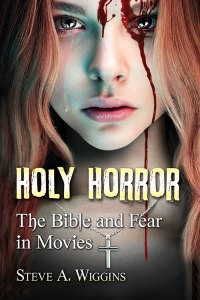
So, I’m getting ready to update this website. I’ll give you a warning before things change. Another update, however, is in order. I’ve been promising that I’d let you know when my forthcoming book with McFarland received its final title. Well, drum roll please! The final title is actually the first title I proposed—Holy Horror: The Bible and Fear in Movies. And it has an ISBN: 978-1-4766-7466-7. And a cover design too, but I can’t share that just yet. It is appropriately lurid, matching the subject. But in all seriousness, the book makes a case for the fact that many people understand their religion via popular media. Being a bad boy, I look at it through horror movies.

The title Holy Horror was a play on Douglas Cowan’s excellent book, Sacred Terror. I recall reading that book, starting the night I bought it as SBL, curled up in the swank conference hotel bed, turning pages until I couldn’t hold my eyes open any longer. It had honestly never occurred to me that religion scholars could get away with writing about horror movies. Cowan had the natural advantage of being a Canadian, something I’ve always longed to be. He also has a secure university post. I was, at the time, just a guy trying to feel secure in what seemed like (and turned out in reality to be) a threatening seminary position that was shortly to end.

It may be difficult to understand how horror can be consoling. It can. I’m a squeamish guy. I don’t like blood and gore. I hate being startled. Nevertheless, I took comfort in this genre as my career was falling apart. Holy Horror was a cathartic book for me to write. There’s more than a little metaphor in it. One thing that will become clear to readers is that the Bible is no stranger to horror movies. Ironically, many of them are strangely conservative—Carol J. Clover’s classic Men, Women, and Chainsaws (which I’ve reviewed on this blog) made that point clearly. Horror often has the same message as your typical Disney film, although it’s presently slightly differently. How so? Well, I can’t say very much here or you’ll have no reason to read my book. McFarland does a great job with publishing this kind of title. You won’t find it in Barnes and Noble, and not likely in your local indie either, but it’ll be available on Amazon and these days that’s enough. And before long these pages will change to reflect its coming.


Re-reading the Rite

I’ve written on The Rite before. My current book project, however, led me to reread this account after watching the movie based on it a couple of times. The film dramatizes, of course, the somewhat understated demonic activity in the book. The protagonist loses about 30 years in age and isn’t yet a priest. As is usual, the book is better than the movie. Matt Baglio’s story follows Fr. Gary Thomas from parish ministry in California to his discovery of possession and appointment as an exorcist. As part of the Vatican initiative to have an exorcist appointed in every diocese, Fr. Thomas was sent to Rome to take a course on exorcism. His experience was all academic until he began to attend actual exorcisms with an unconventional Capuchin monk. Very little described in the book is difficult to believe.

This time around the curses nabbed my attention. Among exorcists of the Roman Catholic stripe, there is a strong belief in the reality of curses. Not only the reality of curses, but the belief that curses can lead to demonic possession. Knowing that Catholicism has struggled with accusations of being unsophisticated and behind the times, the fact that this isn’t more widely known is pretty self-explanatory. Growing up Protestant, I was always taught that curses are make-believe. They don’t really have any influence on a person’s life. The world of demons, however, is a supernatural one and the concept of curses still holds sway in this universe, as the book shows.

Another arcane aspect that resurfaced when I reread this book is just how elaborate the Catholic backstory is. Many Catholics, it’s clear, distance themselves from such topics as the Devil and demons, but there’s no escaping the Virgin Mary and the drama of Jesus versus the powers of evil, as well as the intercession of saints. The problem is that many of the players are personified in the Bible. It’s pretty hard to say the Good Book got it wrong. That worldview lends itself to belief in supernatural impingement on this sphere. Not that that’s a bad thing. Many people, however, would rather believe in a materialist world with physical cause and effect being the main operating paradigm. Demons complicate all that. But then, so does the idea of Mary being a perpetual virgin, and even the patrilineal heritage of Jesus himself. The Rite brings to the light something many would perhaps prefer to be kept under a bushel. Strange things do happen in this world, and they do tend to respond to the backstory that’s been told. That makes such books difficult to classify, even with the backstory.


Woodland Creatures

Maybe I watch too many zombie movies, but the story of zombie raccoons was just too good to pass up. A story by Marwa Eltagouri in the Washington Post described a spate of recent “zombie raccoon” incidents in eastern Ohio, not far from where I grew up. While the likely explanation is distemper, one of the behaviors of these raccoons stands out—they walk on two feet. Since I also enjoy the occasional non-fiction book by Linda Godfrey—who’s made a name writing about anomalous animals in North America, particularly bipedal dogs, or wolves—I found this aspect of the raccoons particularly interesting. That’s the thing, you see. Bipedalism suggests other human-like traits. Think great apes. Or penguins. (Although birds are generally bipedal, they tend to be squat and more horizontally inclined than vertical. The penguin not only dresses for our most formal occasions, but waddles around like many of us do after having been a bit too generous at the dinner table.) But bipedal raccoons—now that’s scary.

As a species Homo sapiens seem to have a need to believe themselves unique. Over the centuries any number of traits have been claimed as unique to us. Bipedalism, the ability to speak, being relatively naked so that we have to wear clothing, being able text with our opposable thumbs—we’re not like other animals. We’re special. So when animals that normally go on all fours walk on two legs we instantly think they’re trying to be like us. They want to have all the rights and privileges of our species so they can elect alt-right leaders and destroy everything they’ve built. Uppity critters! We have trouble reconciling ourselves with our animal origins.

Other animals, it seems, are beginning to note the advantages of walking on their hind legs. I’ve watched enough zombie movies to know that it’s the intention that’s the real problem. They want to be like us. Notice the accounts of bipedal animals—witnesses say there’s something in their eyes. Global domination. Yes, they’ve been watching us and now they want the same things we want. They want to take over the world. I know enough about World War Z to know that you can’t save everyone. Hard choices will have to be made. And maybe I’ve watched too many movies, but I’ve noticed the bipeds are from red states: the dog-men of Michigan and Wisconsin, the raccoon-men of Ohio. If we can’t save everyone, we need to make wise choices. Why not let them have Washington, DC? They certainly can’t be any worse than what we’ve got there right now.


Personifying Evil

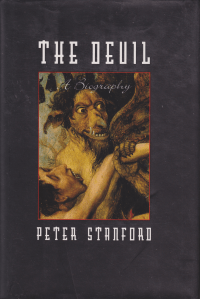
Biographies seldom cover millennia. Even if one were to try to uncover all the scant facts on old Methuselah at 969 years, it would still fall short of four digits. So Peter Stanford’s The Devil: A Biography takes the long view. Even with that lengthy perspective, there’s little that might be known about the prince of darkness. Even with a role in the Good Book his appearances are few and details are lacking. What Stanford does, of course, is outline, more or less, the history of Satan. This is no easy task since few ancient sources focus on trying to provide explanations for exactly who this might be.

As with most books by non-academics (and I don’t mean to sound snobbish here) there are some overstatements. Some of the details aren’t so finely parsed. It’s the big picture the author’s after and he does quite well when it comes to the modern era. Not only is there enormously more material from which to choose, there is also a great deal of literature and even headlines available to harvest. All writers that I’ve encountered on the subject make the point of demonstrating that news of what’s happening in the modern world suggests either the Devil exists or that something (or things) is doing a great job parodying such a character. When seeing evil in the highest reaches of the government it’s not so hard to believe.

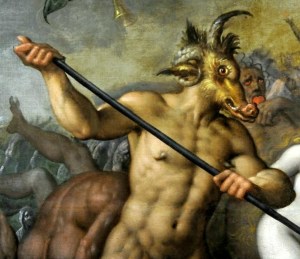
The thing about the Devil is that he almost died out. In the nineteenth century when the explanatory value of science was firmly kicking in, and industrialization was making our live both easier and harder, the dark lord went underground. Humans seemed capable of making and claiming their own evil, and even the professionals—the clergy and formal religionists—had admitted Satan was most likely a metaphor gone wild. The birth of Fundamentalism, a movement that became prominent only in the 1920s, necessarily resurrected the Devil. The Bible does mention Lucifer, so he had to be real. Since that day he’s learned a lot. Protean to the extreme, he bears many guises. No longer beholden to a demonic tail, cloven hooves, or a pointy beard, he most often appears clean shaven and wearing expensive business suits. Borrowing a phrase from the Good Book, it’s by his fruits that we know him. Stanford’s biography shows its age a little, but when you’re covering a couple thousand years of speculation, being outdated is only a venial sin.


Bearing Light

Jeffrey Burton Russell knows a devil of a lot about the Devil. I’ve just finished the third of his five books on the subject, Lucifer: The Devil in the Middle Ages, and I certainly learned a thing or two. As someone who considers himself an historian of religion, being exposed to a concept over several volumes has a way of making me feel humble. The theme of this series, at least so far, is that the Devil is a conceptual way of dealing with evil in the world. In the days of polytheism a single source of evil wasn’t needed, but no matter how you slice it, monotheism implicates God in the fact of evil in the world. The Devil is one way to try to lift some of that burden from the divine shoulders.

Lucifer is an interesting installment because ideas of the diabolical really took off in the Middle Ages. Russell’s previous volume, Satan, became heavily theological and there’s a bit of that here as well. While there’s no doubt some average people in the Dark Ages tried to figure out where Devil came from, the officials sponsored by the church were those whose ideas were written down and preserved. Those ideas, unsurprisingly, were theological and complex. Scholasticism, which began in the Middle Ages, launched what was to become known as systematic theology in the modern era. Among the many topics with which it concerned itself was the Devil, and evil. Ranks of angels, both fallen and un, peopled the atmosphere. Galileo’s perspective would eventually change this cosmology by making it both simpler and more complex at the same time. Lucifer, however, still survives.

One of the stranger developments of the Devil in this time period is as a form of light relief. The idea of plays (which had been around since classical times) also took off in the Medieval Period. In these plays Lucifer and his demons often took on a comical cast. Even when the tone was serious (and what morality play isn’t?) the Devil could be used for laughs. An incredibly rich mythology had been adopted by the church at the time—think Star Wars with more religious characters—that assured the laity that Satan’s doom was sure. Besides, we like to make fun of the things we fear. Think Washington, DC. Now that I’m halfway through Russell’s oeuvre on the subject, I’m curious where his next volume will go. No matter how much you think you might understand evil, as we’re daily finding out, there’s always so much more to learn.


Belief Matters

What you believe matters. This is shown clearly in the case of exorcism. Brian P. Levack admits to personal reasons for interest in this dark subject. His The Devil Within: Possession and Exorcism in the Christian West is a masterful treatment of a topic that it considers from many angles. As a form of Christian practice it goes all the way back to the beginning—Jesus’ initial fame was as an exorcist of sorts. He didn’t require any ritual or authority to expel demons, but he became a public figure largely because of his ability to do so. Levack’s study focuses mainly on the Middle Ages and the Early Modern period. The latter was the high-water mark of possessions until the resurgent interest of the post-Exorcist twentieth century.

An aspect of exorcism that had raised my curiosity more than once was its Catholic disposition. Many Protestants believe in demons, but only the Roman Church has the grand ritual to drive them out. There are Protestant exorcisms, but they have a different goal—they’re intended to eliminate sin. This leads Levack to a strong contrast between Catholicism and that most extreme of Protestant traditions, Calvinism. Few Calvinists suffered from possession. Those who did were not held blameless, as in Catholicism (if you were being controlled by a demon you could hardly be held responsible for your actions). Calvinists believed only the sinful could be possessed and since their God is Republican you can hardly count on any mercy. In fact, if you were possessed, chances were you would become a witch. And everyone in early modernity knew what the cure for that would be.

We tend to think that the Enlightenment drove such beliefs extinct. In fact, the height of both witch hunts and demonic possession came after the scientific paradigm took hold. Levack makes the point that this is a kind of theater—performance undeniably plays a part in exorcisms. Both science and Calvinism, taken neat, can leave a body feeling cold and in need of some emotion. As the book notes, you could generally find a Catholic priest who’d be glad to drive out your demons. It seems that the great forces of good and evil play themselves out not only in the spiritual realm, but in the varieties of religious experiences in the all-too-political world of the church. The Devil Within is a fascinating book with a plausible thesis written by an author who understands that ideas have consequences that aren’t always easy to expel.


Nightmares with

One of my greatest phobias is that people will think I’m arrogant. Those who know me realize that I’m highly self-critical, as befits a lapsed Fundamentalist. Self-image isn’t my strong suit. So it is with great trepidation that I celebrate a tiny bit at another book contract. Book number three (still not officially titled) now rests with McFarland Books. Shortly after I signed the contract for the book nameless here forevermore, Lexington and Fortress Academic announced a new series: Horror and Scripture. Maybe you know the feeling too. You’ve just done something you’re proud of and then you’re upstaged. My book deals with the Bible and horror films—what could be more Horror and Scripture than that?

The new Lexington/Fortress series has two editors. One of them is a friend of mine. (Monsters and horror don’t often mix with the Good Book, and those few of us interested in such things receive glances askew.) She asked me if I’d consider contributing to the series. This takes a lot of careful thought on my part. I have a sum total of about an hour a day to write, often less. I can read research-related material on the bus, if I can stay awake, but other than weekends—already quite busy catching up from not being home all week—I have very circumscribed writing time. Nevertheless, I do get up at 3:00 a.m. so that I can have that vital hour to write. Why not focus my efforts onto another book? Perhaps insanely, I submitted a proposal. This week a contract came.

In the short span of one year I’ve gone from being able to claim two books to four, almost like a parable. My untitled book is written and submitted. My contracted book is already half-drafted. After my McFarland book I’d already begun work on a sequel, you see. It lacked form and substance, but the proposal forced me to bring it together. Now, barring any unforeseen disaster, I should be able to submit this new book within a couple of years. By admitting this to you, dear readers, I fear I open myself to accusations of either arrogance, or at least greed. It is, actually, rather like this: my wife often tells me “we must cut the coat to fit the cloth.” I don’t have an academic position, but I’ve learned a lot about the publishing industry over the past decade. Research is a constant in my life, as it is with most credentialed people, no matter their jobs. So it is with fear and trembling that I announce my next book: Nightmares with the Bible. Watch this space for cryptic updates as the details unfold. And please don’t think less of me for it.


Exercising Exorcism

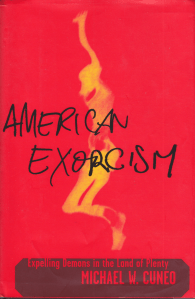
About the last people, ironically, that you’ll find researching demons are religion scholars. That’s perhaps a slight exaggeration, but there’s an embarrassment to the topic that serious academics just can’t shake. Nobody wants to be thought truly believing in that stuff. Michael W. Cuneo, who teaches sociology and anthropology at Fordham University, isn’t afraid to look. His American Exorcism: Expelling Demons in the Land of Plenty is a user-friendly, often witty look at what is an amazing phenomenon. Exorcism had pretty much gone extinct by the middle of the twentieth century. Then The Exorcist happened. Cuneo makes no bones about it—Hollywood wrote the script on what was to become a somewhat bustling business through the end of the millennium and beyond. And it wasn’t limited to Catholics. Protestants, mainly of Evangelical stripe, cottoned onto Deliverance ministry and joined the fray against the demonic.

American Exorcism reflects Cuneo’s personal account of attending exorcisms. As he puts it at the end, no fireworks occurred. In fact, he’s skeptical that demons exist and he strongly suspects exorcisms work in the same way that a placebo does. He’s well aware that the majority of people he met and talked with in the making of this book disagree on that point. Cuneo himself attended at least fifty exorcisms, both Catholic and Protestant, and shysters among the exorcists were rare. Most were sincere, devoted people who are helping others in distress for no fees, no glory, and no promotion. They see a need, believe they know the diabolical cause, and take the devil by the horns (metaphorically speaking).

There is a solid mistrust between academics with their studied skepticism and exorcists with their eyewitness accounts that defy belief. Cuneo suggests that even what they think they see may not really be happening in the real world. My question, coming down to the end of the fascinating book, revolves around what exactly this real world is. There can be no doubt that present day concepts of exorcism are largely based on “the movie.” Cuneo seems just a bit reluctant to say what I also declared in my forthcoming book—pop culture, the movies, dictate reality for many people. At least in the realm of religion. Sacred institutions have lost their authority to make ex cathedra pronouncements about what is real and what is not. Few bother to, or can, delve into the tedious work of reading academic studies on the subject. It’s far easier to let the unseen presences behind the camera take over. Isn’t that what possession is about, after all?


Who’s Hungry?

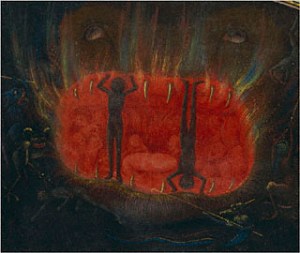
I flatter myself to think that some people enjoy my daily musings, although they’re sometimes grim. Religion often is. One curious example of this is the “Hell-Mouth.” Some time back a friend sent me a link to a British Library blog post “Highway to Hell.” The story is about illustrated medieval manuscripts depicting the Hell-Mouth—a monster with wide, gaping jaws and a gob crammed full of human souls bound for eternal torment. Not a pretty picture. The BL post reasonably suggests that the image originates in early Anglo-Saxon literature. We know the Teutonic penchant for the gothic, so all is fine and good. In fact, however, the image is far older than that.

In sorely neglected and almost forgotten Ugarit there is a fascinating mythological text. Known to ancient northwest semitic nerds as KTU 1.23, the text is strange even by Canaanite standards. El, the chief god whose name translates as, well, “god,” seduces two young goddesses (presumably). The young ladies give birth to monsters—devourers with one lip reaching to the heavens and the other to the underworld. Every living thing is swept in. What is this if not a Hell-Mouth? Indeed, if I might indulge in my past passion for Ras Shamra just a touch more, the deity Mot (whose name translates to “Death”) is portrayed with an equally voracious appetite. Everything gets gobbled up, even Baal.

These lurid images of all-consuming mouths, however, aren’t direct ancestors to the Hell-Mouth. Although some of the ideas from Ugarit survived in the culture that would eventually emerge as the Israelites, the city itself was destroyed for the last time before Moses picked up his chisel. The people of Ugarit were long gone before he licked his thumb and applied his quill-pen to Genesis. Ideas, however, may be the closest to eternity that humans can come. The Bible doesn’t describe any Hell-Mouths as such, but Revelation can come close. Ras Shamra was only rediscovered in the 1920s, so no Anglo-Saxon had access to its vivid images of the Hell-Mouth that existed even before Hell itself became a thing. Humans are endlessly inventive. Ideas go underground for centuries at a time only to reemerge when the moment’s propitious. The Middle Ages with their Black Deaths and highly stratified society and burgeoning witch hunts and inquisitions were such a time. Looking over the current landscape I have to wonder if the recent revival of the Hell-Mouth might not have something to do with the time in which it has gained renewed interest as well. Some appetites will never be satisfied.


After Darkness

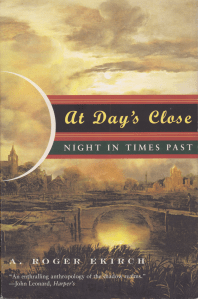
Some historians, I suspect, despair of the volumes already written on all periods, ancient and modern. History, however, can cover a variety of segments of time. A. Roger Ekirch, for example, thought to write a fascinating history of darkness. At Day’s Close: Night in Times Past is a thoughtful exploration of what night has historically meant. For those of us born in the era of constant light, the realities of what it was like after dark in the past are almost unimaginable. I’m sure Ekirch didn’t intend it to be so somber, but the reality of frequent crime in unlit regions made reading much of this book a sober experience. Confident of their ability to get away with it, many up until modern times took advantage of the night to commit all kinds of crimes. Makes you kind of want to check the door locks once again before turning in.

Much, but increasingly less, of our lives is spent in sleep. The advent of artificial light has led to changes in lifestyle that, according to biology, aren’t terribly healthy. The natural rhythms of sleep and wakefulness may be challenged by jobs or enticements to stay up late and surf the web or any number of other factors. Now that light has become so very portable in the form of smart phones and tablets, even less of darkness remains. Although it’s a bit repetitive and not laid out chronologically, At Day’s Close contains many provocative observations about the dark. There’s even a bit about monsters.

Night has always been symbolic. Death and fear were associated with night early on, and we still call the era of scientific progress the Enlightenment. Churchmen (for it was an age of such) tended to condemn night as evil, the Devil’s time. Not all agreed, for some considered the dark a creature of God and complained of the hubris of setting up lights at night. The religious symbolism of night is very rich and very ancient. Those of us used to artificial light have difficulty imagining what it took to navigate after dark in ages past. More than an annoyance, night could be a truly dangerous time. Dreams, once mainly the products of the night, also had religious significance before being rationally explained. The industry of banishing night also has, in some respects, the effect of banishing dreams. We should stop and think before we put night to flight. Half of our time is spent in darkness, and all of our time is highly symbolic.


Getting Medieval

Who doesn’t have a devil of a time keeping up with technology? My day is divided in almost Manichaean terms between having internet access and not. Once I climb on that New Jersey Transit bus—they don’t have restrooms, let alone wifi—I enter radio silence for God knows how long. Once safely ensconced at work, I once again have the net but I can only use it for work. The even longer commute home spells the end to internet access for the day, since supper and sleep await at the other end of the line. So when websites change in the course of a day or two, it’s difficult to keep up. The other day, for instance, I noticed on Wikipedia, in an article about the Devil, that the dark lord has a coat of arms. “That,” I thought, “would make an interesting blog post.”

That idea, like most of mine these days, had to be put on hold until after work. And between after work and getting ready for work again, the delay lasted a week. Maybe two. Then I went back to the page and the reference was gone. I can still remember that the coat of arms had three frogs on it—somewhat unfairly to amphibians, I felt—and I even recall precisely where on the page it was. When I finally had time to look it up, it was no longer there. Cached pages used to be easy to find, but who has time any more? There’s a reason that people of my generation still prefer print books. Yes, there are times when it’s difficult to remember where you read something, but at least the reference is still there when you open the cover again. It hasn’t vanished in a pique of editing enthusiasm. The strangeness of it all was worthy of comment—a coat of arms was a sign of medieval prestige. There’s no doubt that the Devil had his day in the Middle Ages.

I hear about people being bored in retirement. I’m so busy, though, that I’m going to have to request a desk in the afterlife. Not that retirement’s anywhere within sight, but I have so many projects going that I don’t know when I’ll ever have time to finish them all. Even a holiday weekend’s too short to make much of a dent. I don’t need another technologically driven mystery to occupy any more of my waking hours. Looking for a Wikipedia factoid that was deleted doesn’t make it any easier. They say the Devil’s in the details, but that presumes you can find the details where you left them. And if you happen find the reference, can you please also keep an eye out for my car keys?


Frankenfear

While re-reading Frankenstein the uncomfortable thought kept recurring that our tendency to save lives leads to undiscovered fears. I’m not suggesting that we should just let people die, but even from my own experience of doctors, the sense of personal agency has become somewhat eroded. You go to the doctor and s/he tells you, “You should have this done.” I’m still too busy trying to figure out what this box that’s attached to my TV should be called, so how am I qualified to assess a professional opinion about my health? We mend bodies with plastic and metals and chemicals. Some modifications, like fillings and glasses, seem no brainers. But what about plastic tubes and computers to regulate body functions? They’re all good, but have we thought this through, I can hear Mary Shelley asking.

Religion, which is now also eroding, was a traditional way of coping with the fact of our own mortality. Everyone dies. From the beginning of the world, with the possible exception of Elijah—and even he had to come back—everyone has died. Religion traditionally said that it wasn’t the last word. The body wears out, and in a materialist world there’s nothing that can be left. Technology can prolong life, but some may not want it to be prolonged beyond a certain point. I’m not being morbid; I just don’t like arguing with what can’t be changed. Religion, it’s easy to forget, is about finding peace. Some people misunderstand that, for sure, but that doesn’t change the facts.

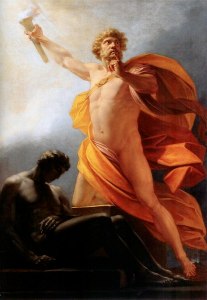
Did Prometheus overstep his bounds? Mary Shelley seemed to think so. In her recollections the story was intended to scare, not to predict. Victor Frankenstein creates the monster simply because he can. He does it alone, without thinking through the consequences even with a convenient Igor. Religion has often been cast as that annoying, moralizing sibling to science. (Philosophy could well join the ranks too, as some prefer it to religious thinking.) Without that sibling, however, how can we make informed decisions? Science, by its very definition, can’t tell us what should be done. The only values it knows are quantifiers. We live in a piecemeal world where some parts have been removed while others have been added. We don’t know if this is right or wrong since religion is one of the pieces excised without being replaced. Prometheus, ironically, translates to “forethought.” The problem with Frankenstein is precisely that Prometheus is missing.