Frightening Faith

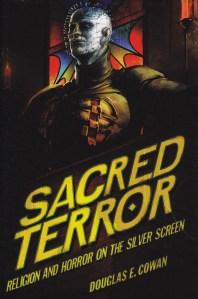
sacred-terrorBack when I first started this blog, I regretted that I had read Douglas E. Cowan’s Sacred Terror: Religion and Horror on the Silver Screen so long ago. You see, I try hard to post on a specific book only once—there’s really no rule about that, but I read a lot and don’t like to play favorites. Since it had been a year or two since I’d read it, my memory was a touch hazy about the details at the time. I did a post anyway. Now that we’re in the thick of fall, and my daily commute both begins and ends in darkness, I decided to read it again. This particular book is validating for a guy like me. Many scholars feel they need to apologize for such low brow peccadilloes as watching horror movies. I mean, don’t scholars read all the time? And when they’re not reading, surely they have better things to do with their time than watch cheesy exploitation films? My generation, however, has started to come to terms with this basic disconnect. A few of us have somehow made it past the bouncers.

Cowan’s book is the one I first read that dared make explicit what many of us feel—religion and horror are not so different. As a sociologist of religion Cowan brings a specific lens to the subject, and his book analyzes different societal fears (sociophobics) that these movies address. And even though he admits being a bit squeamish, he brings an impressive number of films to the table. The fears of hoi polloi, it turns out, are often the very same ones religion seeks to redress. After reading his book the first time, my list of must see DVDs grew. The same happened this time around.

It requires a certain maturity of character to both realize and admit that horror meets a deep need. We don’t like to feel vulnerable. More than once, armed with my Ph.D. and years of training my rational faculties, I’ve still ended up sleeping with the lights on. I can tell fact from fiction, but there’s an itch that horror scratches which other genres just can’t reach. As much as I enjoy science fiction on the screen, its debased little brother has fingernails just the right length. As Cowan points out, fear is one of the primal human emotions. The world we’ve constructed hasn’t eliminated fear—although I can’t recall the last time I saw a cougar or wolf in the wild—but has constructed it as more of our own making. In our own image, I might suggest. And since nobody likes to be alone during a scary movie, it gives me some comfort to know that Dr. Cowan is out there, somewhere, watching with me.
Big Dreams

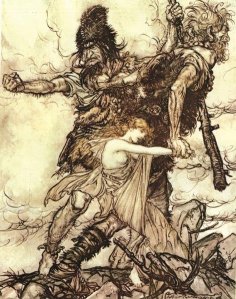
giants_and_freia

The giants are back! Or at least they were here. According to the internet, and we know that that never lies. Every now and again a story breaks that some discovery of giants has been found in some archaeological or paleontological context. A little poking around, maybe a visit to Snopes, and I go home disappointed. It’s the Cardiff Giant all over again. Still, the stories are fun. A friend sent me a piece from Ancient Code entitled “A GIANT footprint has been discovered in China.” The pictures look impressive until we get to the one where the footprint is as large as a fully grown man. We are back in the land of modern myth.

The idea of an era of giants is strangely compelling. The Bible isn’t the only ancient document to suggest this scenario. In fact, Holy Writ seems to have borrowed the idea. Fast forward just over a millennium and Geoffrey of Monmouth will tell us there were giants in Britain before the more civilized genus of our own arrived and treated the giants to a Brexit. Such tales permeate history with the fanciful period of really big guys from the past. We’re not half the men we used to be. Literally. Just don’t look too close at the Photoshopped evidence. We live in a world where “Photoshopped” is actually a word. A world where visual evidence is like a cow plop. It’s there, but what you want to make of it is up to you. I was never a big newspaper reader, but at least you knew if a reputable rag paid to have millions of copies printed the story had a good chance of being true. I wish there had been giants. Reading the news today, we seem very petty indeed.

Any number of explanations have been proffered for why ancients believed in giants. Perhaps they found fossilized dinosaur or mammoth bones. Admit it, except for to a biologist, a femur looks pretty much the same whether it comes from a giant reptile or a moderate-sided primate. Economics of scale. Or look at those Egyptian pyramids. Sure looks like they had a hand from a really big brother. But in our strangely less and more gullible age, lingering doubts remain. The Bible says there were giants on the earth in those days. The mechanics of gods mating with human women are blamed, no matter which laws of physics have to be broken. For the literalists way down along the Paluxy River in Texas we were walking with dinosaurs back in the day. Too bad no fossilized cameras have yet been discovered.


The Grammar of Evil

I stepped into a devil of a situation. Elevators are strange spaces. Given the choice, I’ll take the stairs any time. At work, however, as one of the many quirks of Manhattan, our elevators only stop on certain floors and we’re not able to use the stairs unless it’s an emergency. After a meeting on a floor where the only option was to elevate out, I stepped into a crowded elevator where a conversation was going. “You always capitalize Satan,” someone was saying. The usual questions among non-religion editorial staff ensued. Why is that? What about “devil”? “It’s never capitalized,” came the reply. My profile at work is about the same as it is on the streets of New York. Not many people know who I am or what I do. Although I’ve struggled with this very issue before, on a professional level, I kept silence and waited for my floor.

So, was the elevator authority right? “Satan” has become a name, rather along the lines of “Christ.” Both started out as titles. In the Hebrew Bible “satan” is “the satan.” The accuser, or the prosecuting attorney—something like that. As one of the council of gods, the satan’s job was to make sure the guilty were charged of their crimes. Diabolical work, but not evil. By the time of early Christianity, however, Satan had evolved into a name. It is therefore capitalized. It was specifically the name of another title, “the Devil.” Or is it “the devil?” Do we capitalize titles?

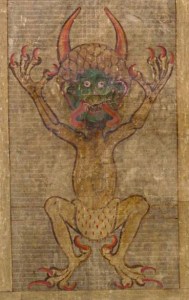
The Devil wears underpants.

The Devil wears underpants.

In seminary and college the received wisdom among those of my specialization was that there is only one Devil and the title should be capitalized. My elevator colleagues were discussing the number of devils when I stepped out. Traditional theology says there’s only one. Not that the Bible has much to say about the Devil—he’s surprisingly spare in sacred writ. Demons, however, are plentiful. Some people call demons devils, just as many believe that when good people die they become angels. The mythology behind demons seems to be pretty well developed in the biblical world, but again the Bible says little. Demons can be fallen angels or they can be malign spirits who cause illness. Either way they’re on the Devil’s side. But should we capitalize his title? The Oxford English Dictionary doesn’t help, giving examples of both minuscule and uncial. I suppose that’s the thing about the Devil; you never really know where you stand.


Twice Bitten

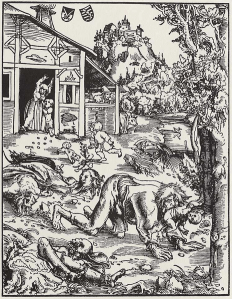
I should be aware of what happens next. I’ve seen it in movies often enough. Man gets bitten by a wolf, and he turns into a werewolf at the full moon. That gives me two days. And it wasn’t a wolf, but a pit bull. I fear what I might become. You have to understand that after a long commute—they’re doing construction along a stretch of a major artery where my route passes—and having been awake since 3:30 (a.m.) when I get off the bus I’m not always thinking clearly. I’ve done some calculating and it turns out that apart from work, commute, and sleep (or at least trying to sleep) I’m left with three and a half hours per day to do my own stuff, like write these blog posts, eat breakfast and supper, and pay bills. So when I get off the bus for my short walk home, my main concern is getting across a busy street where New Jersey drivers routinely ignore the state law that they must stop for pedestrians in a cross walk. But last night the dogs were out.

The sidewalks in my town are narrow. Nine days out of ten I meet no one on my way home. There’s one guy with a tiny dog that’s feisty and it is amusing how the little guy—just a puppy—growls and barks its tiny barks and strains to get at me. Dog owners around here pull their dogs off the sidewalk to let walkers pass. It’s a friendly town that way. Last night the young woman was no match for the two pit bulls she was walking. The street was unusually busy since two guys had just walked past me, one, commenting on the dogs, said “I don’t take my beasts out any more.” The woman pulled the dogs off the walk and they barked and snapped and as I walked past one lunged and bit me. Tore a good pair of pants. The woman they owned was aghast and offered to pay. I didn’t want her to know how cheap my clothes were. Besides, I couldn’t hear her over all the barking.

It’s been years since I’ve been bitten by a dog. This was really just a scratch and the frantic woman assured me the dogs had had their shots. But I’ve seen the movies. I know what happens next. Two nights from now I’ll be roaming the streets after dark, half human, half dog. The Hunter Moon (the official name for October’s full moon) comes on Sunday. I can’t blame the dog—it was only doing what aggressive dogs are bred to do. My commute, however, has a new hazard. Not only do we deal with construction zones, I now have to arouse myself to watch out for werewolves on the way home. It must be October.

Me, in two days.

Me, in two days.


Scary Thoughts

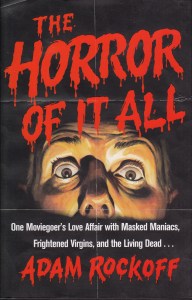
rockoffThose who know me personally—and not just through the internet—sometimes are surprised to learn that I watch horror movies. After all, I’m a pacifist, vegetarian, and a very caring person. Plus I’m squeamish and I eschew violence. Why, then, do I watch such things? I don’t have a good answer for that, but I might be a bit closer now that I’ve read Adam Rockoff’s The Horror of It All: One Moviegoer’s Love Affair with Masked Maniacs, Frightened Virgins, and the Living Dead. Now, I’ve never met Mr. Rockoff, but from reading his book I get the impression that he’s a descent human being and fun to hang out with. He’s also a family man and a sympathetic individual. The Horror of It All is an extended discussion of that troublesome question: why do some of us watch movies of this kind?

It’s pretty clear from this book that Rockoff is way ahead of me in the number of horror movies seen. I’m sure he doesn’t mention all of those he’s watched, but there are some I’ve seen that didn’t make this book and, in my own way, I hope, show that I’m no slouch when it comes to the genre. I’m not in the media like he is and those of us trying to be respectable ex-academics have to read weighty tomes to keep any street cred at all on campus. That having been said, it was fascinating to read how many of the same triggers are at work in not just Rockoff and myself, but in other horror watchers he’s known and interviewed. These films are, for the most part, not just degenerate trash. Many of them have redeeming value and an unexpected profundity. Academics and other society people don’t like to get caught watching what hoi polloi do, but just take a look at the box office take and you’ll see that horror sells. We are not alone.

Ultimately every horror viewer has to struggle with this monster him or herself. Why do we watch? While in grad school I had a sociology doctoral candidate interview me to explore just that question. Why? At the time, admittedly, I had seen only a fraction of the films that I’ve moved on to see since then. One thing I can definitively say—I’m looking for something. Life is plenty scary as it is. A world where a good job can be yanked away from you at will and the specter of a life on the streets leers, can be an intimidating place. In the horror movie you see how it could be even worse. So as my waking hours are increasingly spent in the dark, as if the sun itself is afraid, I see books like Rockoff’s as a kind of flashlight through this forest. If I run into monsters, I want to have prepared myself.


Silverbacks

kong33promo

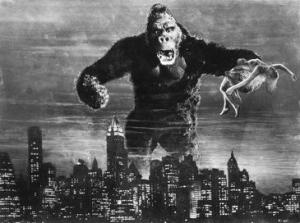
It’s been decades since I’ve seen the original King Kong. A none-too-subtle racist and sexist flick it may be, but it stands as one of the original “horror” films of the early thirties and it has had a profound influence on movies ever since. King Kong wasn’t very nice to Fay Wray, and had to be euthanized by biplane, if I recall correctly. I work one block from the Empire State Building, and sometimes I subtly glance up, looking for the giant ape. There are more fearful sorts in New York these days. I can see Trump Tower, for instance, from the pantry at work where I keep my lunch. But I digress. For its day, King Kong was a violent movie. Like many films, however, it is also a parable.

Recent studies have shown that some 98 percent of mass murderers are male. Men deal out, by far, more than their share of death to others. Some have suggested that when women experience failure they look internally, blaming themselves. Men, on the other hand, go postal. They seek someone else to blame. In our culture—maybe in all “western” cultures—man are acculturated to think of themselves in terms of success. Quite often this means business success—affluence and its discontents. Do you have more money than your neighbors? Good for you! You have succeeded, and, for some warped perspectives, God has blessed you. In reality, the system we’ve constructed has set many people up for failure. This is no excuse, but men who have no other way of measuring self-worth may find comfort in firearms. After all, it’s society that should take the blame. Right?

Gun lobbies claim that collecting firearms is a harmless hobby. Like collecting stamps, only a little louder. A bit of psychology might go a long way here. Might we not stop and think what happens when you give arsonists matches to play with? I suppose if we took away these toys, boys would use baseball bats, or rocks, to take out their aggression. I can’t help but wonder, however, if the problem might not be the system that measures a man by his money. Could there be a better way? There have been those throughout history who’ve made such a claim. They often die violent deaths. Once King Kong has begun his ascent with lust and violence in his eyes, we should all cast a wary eye on the Empire State Building and wonder what it all means.


Scary Pictures

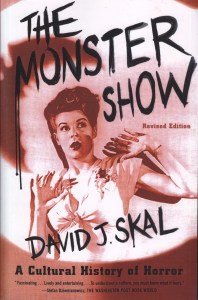
monstershowThroughout its history, until quite recently, one of the most serious natural enemies to the horror movie was the religious establishment. At times this antagonism seems well placed as horror films often take theological concepts and stand them on their heads. Within the last few years, however, thinkers of religious thoughts have come to an uneasy accord with some horror movies as vehicles for the kind of thinking promoted by traditional religions. The first half of this dynamic appears clearly in David J. Skal’s The Monster Show. Written before any kind of detente had been reached, his book chronicles skirmishes between the Production Code, religious groups, and even women’s collectives, against what was considered indecent and degrading. We have come to realize, however, that we are the monsters. We are the degraded. And seeing these films can lead to a strange sort of solidarity.

Most classic monsters, after all, have their origins in religions. Even the most recent of the lasting undead—Frankenstein’s monster and zombies—have origins in religious thought. Mary Shelley’s novel was subtitled The New Prometheus, a reference that anyone in the early nineteenth century would have understood. Zombies, on the other hand, are a product of vodou. Religion can’t get along very well without its monsters, and despite their less-than-stellar looks, their screen appeal is undeniable. Maybe it’s just we don’t like our dirty liturgical laundry being hung out where anyone might see it.

Skal’s treatment doesn’t stop at the cinema. He has a chapter on modern vampires, and Stephen King has earned his own chapter (or at least most of one) as the poet laureate of the novelistic form of the genre. More often than religion, Skal traces what’s happening in the monster world to the larger social issues of the day. Quite rightly so, as scary movies go nowhere without a receptive viewership. Looking around these days it’s easy to be scared. Even what was once a grand occasion of debate over higher principles as we ponder our next leader has become a farce in one of the parties that could make its own horror movie. Hitler, it is said, was a huge fan of King Kong. Large apes manhandling women never seem to go out of style. Some call it horror. Others try to get away with saying it’s politics. While the daily commute grows more and more dangerous, and the rhetoric grows even worse, is it any wonder we like to dim down the lights and watch monsters that we know really can’t get us at all?


My Fellow Americans

It’s important to keep the old gods happy. By now everyone probably knows that Stephen King composed a tweet suggesting that Donald Trump was Cthulhu. In response an angry tweet came from Cthulhu himself, since, as we know, he declared his intention to take over the world long before Trump. Cthulhu is no stranger to this blog, being the brainchild of H. P. Lovecraft. As I’ve suggested before, however, it is really the internet that gave life to the ancient one. His name is instantly recognizable to thousands, perhaps millions, who’ve never read Lovecraft or his disciples. In parody or in seriousness, the worship of Cthulhu is here to stay.

I’ve often wondered if the internet might participate in the birth of New Religious Movements. In an era when a completely unqualified plutocrat can run for president just because he has other people’s cash to burn, anything must be possible. Cthulhu, as we all know, lies dead but dreaming beneath the sea. His coming means doom for humankind, or, at the very least insanity. It seems that Stephen King might be right on this one. I’m getting old enough to recognize the signs; after all John F. Kennedy was president when I was born. I’ve seen the most powerful office in the world devolve into a dog-and-pony show where lack of any guiding principle besides accrual of personal wealth can lead a guy to the White House. At Cthulhu’s tweet indicates, reported on the Huffington Post, at least he’s honest. Unlike some political candidates, many people believe in Cthulhu.

img_2791

Perhaps the interest in Cthulhu is just a sophisticated joke. Long ago I suggested to a friend of mine in Edinburgh that perhaps the Ugaritians were writing funny stories (i.e., jokes) on their clay tablets, imagining what future generations would say when the myths were uncovered. Like Cthulhu, they were the old gods too. Like Cthulhu, there are people today who’ve reinstituted the cult of Baal and the other deities that would’ve led to a good, old-fashioned stoning back in biblical days. New Religious Movements are a sign that we’re still grasping for something. Our less tame, or perhaps too tame, deity who watches passively while charlatans and mountebanks dole out lucre for power must be dreaming as well. Of course, Lovecraft, the creator of Cthulhu, was famously an atheist. Belief is, after all, what one makes it out to be. At least Stephen King’s father reinvented his surname with some transparency. And those who make up gods may have the last laugh when the votes are all in.


Mysterium Tremendum

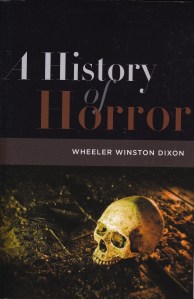
HistoryHorrorFor those of us accustomed to ancient things, horror movies are remarkably new. That doesn’t mean, however, that they are scarce or even easy to understand. While it is beginning to erode, the academic derision of popular culture has long avoided the decidedly low brow genre of horror. It doesn’t know what it’s been missing. Wheeler Winston Dixon’s A History of Horror is an insightful attempt to make some order out of a century of monsters and mayhem. Beginning at the stage when “horror film” was still just a demonic gleam in some vampire’s eye, Dixon points out that from the very earliest experiments with movies “horror” was a popular trope. It seems only natural that the idea of a full-length scary movie would be the expected development. What happened in Universal Studios in the 1930s is that business began making money out of monsters. Where there’s money, there be monsters.

Dixon takes us through the early days into the tired era in the 1950s when life was, apparently just so darned good that people weren’t really thinking about monsters. (Dixon’s analysis is a bit more sophisticated than that.) Horror films matured in the 1960’s and spun out of control in the ‘80s. His book continues up to the first decade of our current century. There’s obviously a lot that can be said about this, but what caught my attention, naturally, was how quickly religion entered the discussion. Those of us who approach horror with an open mind know that religion is its next-door neighbor. Indeed, one of the nihilistic aspects of the proliferation of horror movies since the 1980’s has been the lessening of this getting to know the neighbors. Horror, as Dixon notes, seems to have devolved to brutality and cruelty with no real message.

I’ve never been a fan of gore. I’ve watched my share of slashers, I suppose, but they’re not my favorites. Horror can—in the best of its offerings—be very profound. Indeed, it can even inspire thoughts not so terribly far from those generally classed as religious. For what is worship if not carefully managed horror? The concept of the holy as mysterium tremendum underscores this dynamic. Part of this connection is the appeal to emotion. Horror movies make you feel something, and that is a large part of their appeal. They can be more, however. A smart horror movie will feed your brain rather than just having zombies eat it. Academics, eventually, will catch up with it. Dixon starts to show the way.


Imagining Monsters

WideSargassoSeaAll fiction writing, it is often said, is borrowing. I’m not exactly sure that’s literally true, but the basic idea is that writers often trade with one another. They also borrow against their own experience and observations that others have made. When a character, or set of characters, an author develops become(s) wildly popular, fan fiction can result. There are websites dedicated to “fan fic” where characters from one writer are personalized in another writer’s imagination. Another form of borrowing is the parody. Pride, Prejudice, and Zombies takes Jane Austen far beyond her original scenario while using her novel as the basis of something somewhat new. These borrowings, as the saying suggests, have been around for a long time. I recently read Jean Rhys’ Wide Sargasso Sea. The novel from the 1960s is a “prequel” of sorts to Charlotte Brontë’s Jane Eyre. Although spoiler alerts for literature nearly a couple centuries old might seem like overkill, I’ll give one here anyway. You’ve been warned.

Jane Eyre includes quite a lot of gothic mystery. Thornfield has a mad woman, Bertha, the first wife of Mr. Rochester, living in the attic. Bertha is from the Caribbean, and Rhys, although Welsh, was born in Dominica. Taking an interest in the point of view of the neglected, insane Bertha, she decided to tell her story in Wide Sargasso Sea. I won’t sum up the plot here since you may decide to read it. The reason I brought the whole subject up in the first place is the glimpses given of the religions of the Caribbean. Clearly this was not Rhys’ main objective. The Creole of the various races from the slave trade and colonialism, however, did produce fascinating religious amalgams. The zombie, a figure that plays a small part in the imaginative aspects of the novel, is only the most familiar of the creatures.

The soucriant, or soucouyant, is a blood-sucker. A figure that combines elements of witches and vampires, the soucriant takes the form of an old woman by day and a blood-sucker by night. (Before you get the wrong idea, there are no zombie or soucriant characters in Wide Sargasso Sea—they are merely mentioned briefly in conversation.) This concept, while derived independently, relates to the succubus but also to the more modern chupacabra. These are all creatures that suck the vital essence from another, be the victim human or animal. The ubiquity of the idea is striking. In the context of the novel, however, such creatures merely haunt fevered imaginations. Our minds, however, are what make monsters real. Although Rhys declines to diagnose “Bertha” completely, it is clear that human mistreatment of one another creates, in its own ways, monsters. That’s an idea, I suspect, that I’ve borrowed.


Of the Night

August isn’t too early to start thinking about vampires. The nights are already noticeably longer than they were in June and some leaves are just beginning to change on the trees. I’m thinking of vampires because one of my readers sent me a link to some investigative reporting about the “Highgate Vampire.” I’ve posted about this before, but the brief story, if you don’t have time to browse through my “monster” category, is that beginning in the 1970s a group of people came to believe a vampire haunted London’s Highgate Cemetery. This led to the publication of written accounts of the hunt for the undead. On a trip to London in 2012 I visited the Highgate Cemetery as my host for the trip lived quite close by. Apart from being the resting place of many famous people, the cemetery is moody and Gothic and it’s easy to see how, in days when it was neglected, it could’ve spawned such tales. Thing is, we know vampires don’t exist. So we’re told.

IMG_0061

Back to the story. My reader pointed me to the website Vamped, and now I’m afraid my limited time has just grown more limited. More specifically, there is a story by Erin Chapman entitled “5 Reasons Why a Wampyr Didn’t Walk in Highgate Cemetery.” The article investigates claims made in Sean Manchester’s book on the subject (reviewed elsewhere on this blog), demonstrating that his locations, photographs, and narrative don’t add up. The piece on Vamped shows a meticulous level of detail, comparing notes and photos in a way some of us simply don’t have time to do. Now I’ll sleep more securely on my next visit to London. I hope. The conclusions are disputed.

At this point some may be asking why an educated, rational adult is even addressing such questions. Why worry about something that isn’t even real? This brings to mind the realm of religion. Archetypes, whether they have an objective existence or not, are part of our consciousness. Supernatural beings of many varieties inhabit our heads, no matter how much garlic or holy water we happen to have lying around. Ignoring them can lead to problems. Do I think there is/was a vampire in Highgate Cemetery? I don’t think so. Do some other people sincerely believe it? I have to think yes. No matter which religion people follow, there will be entities that other people don’t believe. That doesn’t mean that they should be ignored. The Highgate Vampire isn’t real for most people, but it is for others. And just in case, I’ll keep a bit of garlic around as the nights begin to grow longer.


Let Us Prey

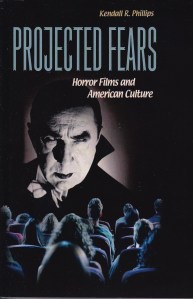
ProjectedFearsI grew up with horror films. Not that my mother encouraged or approved this behavior, but I was a kid with a lot of phobias. With no father around to protect us from what dangers might lurk out there, I tried to learn how to cope by watching others face monsters. That innocent childhood pass-time, like most simple pleasures, disappeared into the adult world of analyzing and being serious and making money. Then it came back. After a series of unsuccessful relationships the old rejection phobias led me back to my beloved monsters. I suspect that’s why I like reading about horror films so much—it’s an exercise in self-understanding. Kendall R. Phillips’ Projected Fears: Horror Films and American Culture is a pleasant Saturday afternoon’s viewing, but for adult monster boomers like myself. Phillips admits up front that academic respectability is hard to come by for horror movies, but that is starting to change. We are beginning to read the script.

Phillips walks the reader not only through the ten movies he’s selected, but also through what was happening in American culture at the time. The horror movie proper is not yet a century old, having begun with Universal’s 1931 monster pair of Dracula and Frankenstein. Phillips shows that what scares a culture changes over time. Indeed, one gets the sense that it is horror movies that lead us in our fears. Highlighting ten culturally significant films, this book guides us through the highs and lows of the last century. The last entry in the book dates from 1999, nicely encapsulating what made us afraid during a most remarkable and, if we’re honest, a most messed up century. Clearly those who purvey horror will have their own choices for significant entries. Phillips does an admirable job of justifying his choices: Dracula, The Thing from Another World, Psycho, Night of the Living Dead, The Exorcist, The Texas Chainsaw Massacre, Halloween, The Silence of the Lambs, Scream, and The Sixth Sense. Each reflects its age, and each impacted its culture.

It should come as no surprise that religious elements—both in culture and in the movies—are up for discussion here. Consciously or not, religion deals with our fears and frequently moves us into the realm of horror. Now that we’ve entered a new era—much has happened already this millennium—the nature of our fears has been changing. To assess cultural impact we need some distance. Books like this help us to understand ourselves, but only after sufficient time has passed. I am confident, however, that when future analysts look back on this insane time that they will find unexpected answers to questions we can only begin to utter. We stare at the monster in the room with us, paralyzed and unable to scream. Or even text. And they will note that religion played a role in our nightmares even as we expected technology to save us.


Gray Magic

Fashion. Okay, I’ll wait here while you check your URL to make sure you’re on the right webpage. Back? Okay. Fashion is something about which I care so little that it surprises even me that I’m addressing it. I can blame my wife, since she sent me the article. In The Guardian. Entitled “Salem style: why this is the season of the witch.” Now it all starts to add up, even if it doesn’t make sense. Witches are among my favorite topics. If I have to go through fabric swatches to get there, I will. So it seems that the fashion world has cast its eyes back on Salem this year. A number of recent, high-profile books have addressed witches, and a number of movies have backed them up. As Priya Elan points out in his article, the political situation helps too. We’ve got a witch-hunter as the GOP candidate and, like in the good old days, being a woman is enough to qualify you as as witch in the language of elephants. Could it be that the fashion industry is making social commentary?

DSCN0565

Why are witches so compelling? Perhaps the failure of true gender equality to take hold has spawned a backlash. Women are still paid less than men for the same work. White men line up at the white elephant sale to say how marginalized they are. How hard it is to exist in a world where you can’t even buy a slave or two any more. Unless you call them employees and then you have to pay them something. Primate society rebels against unfairness. This, pure and simple, is evolution. Biologically, we’re told, evolution has no goals. Where we are, however, is progress. We don’t live in the Dark Ages, after all. In the Dark Ages they believed in witches. Wait, what?

Our throwbacks to Salem should be telling us something. The Witch remains one of the most haunting movies of last year. In just a month the Blair Witch reboot opens in theaters. The Harry Potter series has come back from the dead. Like Rosemary opening the brown paper parcel, we realize witches are everywhere. We fear those with power over us. We call them evil and try to find legal ways to burn them at the stake. Or hang them. Or invoke the second amendment. I may not care for fashion, but I can still spot a prophecy some distance off. It doesn’t take a witch to see the future. Or perhaps it does.


Mature Monsters

When I first began this blog, generally focused on religion, I felt the need to justify posts about monsters. Now, some seven years and several books later, I have come to assume monsters and religion are close kin. Many scholars who explore monsters are those in that amorphous field of “religious studies” who’ve come to realize that terror and the sacred are not far apart. In fact, the Bible contains many stories that could be understood as horror, if taken literally. When my wife sent me a story in The Guardian, “Guillermo del Toro: ‘I love monsters the way people worship holy images’” I once again found the connection reinforced. In the article by Jordan Riefe, del Toro comes more than once to religious themes as he describes his fascination with the macabre. Here’s a guy about my age who’s not afraid to admit that he likes the scary stuff and has, indeed, become famous for it.

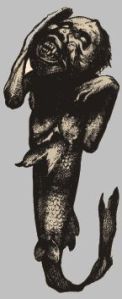
Feejee_mermaidI have to admit that Guillermo del Toro has a way of pressing my buttons. I’ve watched a number of his films and they can be scary even with subtitles to read. Perhaps the reason is that del Toro understands implicitly the tie between religious thinking and the monstrous. An invisible man of infinite power whose revealed will comes in contradictions is certainly a source of fear. So is a child who wears a burlap sack painted like a mask over his head. Known for his fear-inducing creatures, del Toro was raised a Mexican Catholic. He ties this upbringing with monsters in this story. Riefe records him as saying, “I felt there was a deep cleansing allowing for imperfection through the figure of a monster. Monsters are the patron saints of imperfection.” In a mythical world where perfection rests only with divinity and people are told to be perfect, monsters are certain to emerge.

Until quite recently horror was considered a lowbrow genre by academics. As such it wasn’t really worthy of exploration. Perhaps it isn’t surprising, then, that scholars of religion—the new lowbrow—were among the first to take their disfigured friends seriously. Science tells us there are no monsters. We live in a rational world with evolution taking logical steps—if unguided—to more efficient means of survival. That doesn’t stop us from lowering the shades as night draws on. The monsters may be in our heads, but we might also find them in our souls. When we’re informed that such souls are nothing more than imagination we have a very good reason to be afraid indeed.


Hollow, Sleepy Hollow

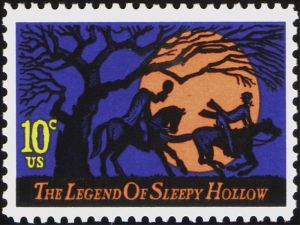
Legend_of_Sleepy_Hollow_U.S._Stamp

It was recently announced that Fox has renewed Sleepy Hollow for a fourth season. Please! No spoilers in the comments (as if)! I’m running a season behind so I want to protect my innocence. The announcement coincided with the happy news that my article on the Bible in Sleepy Hollow has been accepted for publication in the Journal of Religion and Popular Culture. I’m irrationally chuffed about this since my past publications have been primarily textual explorations of documents in languages nobody reads any more. Having something contemporary accepted for publication felt—dare I say it?—cool. As if I were part of the supernatural television crowd. It also affirmed my decision for which book to pursue next. When I say “pursue” I mean “write.”

You see, as a young scholar I struggled trying to decide what direction my research would take. After writing my book on Asherah, I was a bit sated with Ugaritic goddesses, although I started a book on Shapshu, goddess of the sun. The sun gave way to the weather and I wrote Weathering the Psalms. I lost my job in the midst of my revision of that project and it has taken a decade to find my way back to academic publishing. Research, however, takes on a vastly different form when you’re not hired to do it. Colleagues say, “I can get you access to my university library.” Such a kind thought, but my mind always says “when?” When would I have time to visit a library? I get up at 3:30 for my commute and get home in time to go to bed so that I can wake up again at 3:30 the next day. Research reading on the bus is dicey at best. Weekends are for getting the things done that are neglected all week long. Research has to be squeezed into the interstices.

That’s why I’m pleased about Sleepy Hollow. Watching television, even if on DVD, can be research. I’ve got decades of backlogged reading upon which to draw. When my tastes for light horror integrate with what I’m interested in researching it is a happy day. “The Legend of Sleepy Hollow” captured my imagination as a child. It was probably based on the Disney version, but even so, I never lost the fascination. Tim Burton’s Sleepy Hollow is still one of my favorite movies. Watching the episodes of the Fox series takes time, but now I know that time is not just simple relaxation. No, it’s research. Now to find the time to write that book that’s brewing in my head. Inspired, perhaps prophetically, by a Headless Horseman.