By Any Other Name

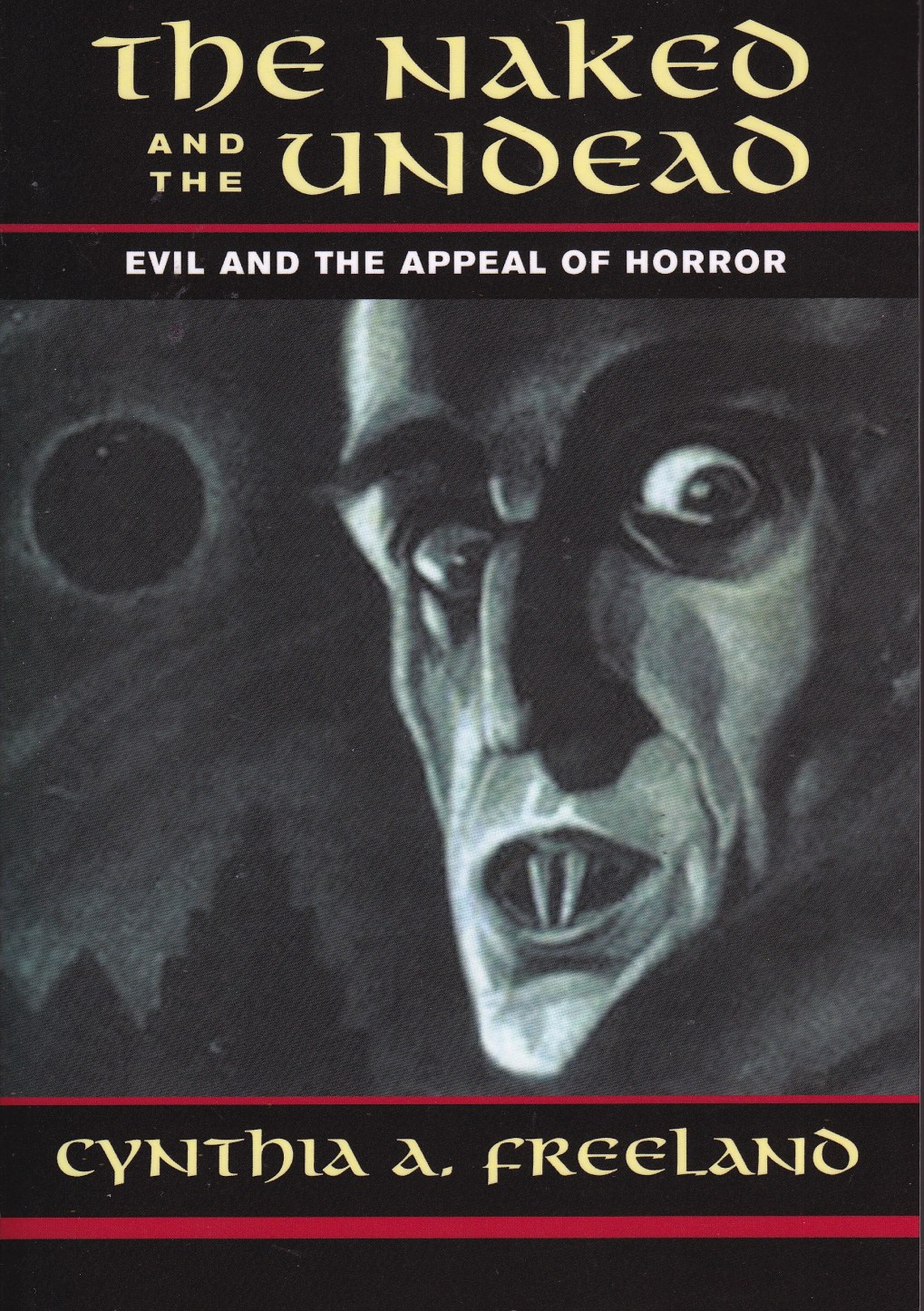
nakedundeadGood and evil. Well, mostly evil, actually. No, I’m not talking about Washington, DC, but about horror movies. Cynthia A. Freeland’s The Naked and the Undead: Evil and the Appeal of Horror is a study that brings a cognitivist approach to the dual themes of feminism and how horror presents evil. It’s not as simple as it sounds. Like many philosophers Freeland is aware that topics are seldom as straightforward as they appear. Feminists have approached horror films before, and other analysts have addressed the aspects of evil that the genre presents, but bringing them together into one place casts light on the subject from different angles. Freeland begins this process by dividing her material into three main sections: mad scientists and monstrous mothers (which allows for the Frankenstein angle), from vampires to slashers, and sublime spectacles of disaster. Already the reader can tell she’s a real fan.

One of the simplistic views of horror is that these kinds of movies—particularly slashers—are misogynistic by their very nature. Feminists, including Freeland, question that assumption. Horror is a genre with a decidedly checkered history. Some films do feature mostly female victims to male monsters. Not all do, however, and even those that do may be saying something other than the obvious. Looking for the locus of evil in these movies provides a lens that focuses the meaning somewhere other than the surface. This is one of the benefits of philosophy—probing questions may be asked and unexpected answers may result. Along the way you can have a lot of fun, too. Especially if you watch horror movies.

A large part of the criticism probably arises from the fact that film making was, for much of its earliest history, run by males. That’s not to say women couldn’t do the same thing men were doing, but the opportunities simply weren’t there. Most film makers, I expect, have trouble getting out of their heads to think about how someone of a different gender might perceive this kind of movie. Fear, we are told, is “coded” feminine. It seemed natural to such film makers to put the female in peril since both women and men would respond to it. Since then it has become clear that fear isn’t coded for gender. Indeed, one of the hallmarks of modern horror is that we all have cause to be afraid. Fear is no respecter of gender. Freeland’s analysis, now getting on in years, correctly looked ahead in many respects. Especially concerning the ongoing presence of evil.
Alternative Reality

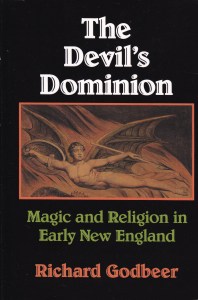
devilsdominionIt is a caution that may become increasingly necessary as Trump’s supporters of “alternate facts” begin to sink their insidious hooks into feeble American minds that magical belief is part of our culture. While most would deny it in any kind of direct way, from the earliest days we have been a credulous lot. Richard Godbeer explores this historical affinity in The Devil’s Dominion: Magic and Religion in Early New England. Mostly concentrating on the events that led up to the Salem Witch Trials, and some analysis of the trials themselves, he traces the origins to such belief back to the theology of Calvinistic Congregationalists who held undisputed sway in the earliest days. Without benefit of clergy who might urge them to look at the world as a good creation, people instead saw evil and the Devil lurking everywhere. Magic was a regular component of their intellectual diet.

Now, some three centuries later, it’s looking as if things haven’t changed much. Those closest to the highest office in the land—and more frightening still, the most powerful single office on earth—are claiming that facts can have alternatives (what used to be called “lies”) and that if a rich man feels offended reality must be rewritten to make him feel better about himself again. The rewriting of history and science and law is really a mere trifle if you can claim “alternative facts” whenever you please. I wonder what you might find in Alternative Facts on File? I had a chance to thumb through recently and here’s what I found:

Alternative fact 1: Donald Trump didn’t win the election after all! We got the wrong guy in the White House. It’s a fact. Alternative fact 2: the Electoral College was abolished on November 8, 2016. That means that the popular vote wins the White House and Hilary Clinton is, in fact, President of the United States. Go ahead and challenge me on any of this Sean and KellyAnn—for any of your facts I can offer alternatives and they are, by definition, equally valid. Who’s with me? As long as alternative facts are now official discourse supported by the White House, let’s use them to the advantage of the entire nation. Is there a lawyer in the house? Even a Jesuit would do. The one I feel sorry for, however, is Richard Godbeer. His fine book has had to play Devil’s second fiddle to the new reality of post-truth Washington. Maybe the White House really does believe you can shake the Devil’s hand and say you’re only kidding. Wake up, America—you’re being laughed at and mocked by your own government.


Looking for Light

The one problem with Halloween is that most people suppose that when it’s over we need to wait another year for the scary stuff to come around again. Since we tend to skip from holiday to commercialized holiday, we have a capitalism-induced mindset of Halloween—brief pause for Thanksgiving—Black Friday—Christmas, spending money all along the way. Halloween, however, is a marker that stands near the beginning of half the year. The half with short days and long nights. Traditionally the holiday associated with ghost stories was Christmas, which falls near the shortest day of the year. Once the light starts creeping back, however, we tend to find reason to be optimistic that the chill can’t last forever and light follows darkness just as surely as life ends in death. All of this is prologue to say that a friend recently sent me a story about Irish witches which got me to thinking about origins once again.

The story, a piece called “Witches of Ireland,” by James Slaven, tells a few tales of Hibernian lore involving witches. As I read the article I was thinking about the origin of witches. Some of the phenomena associated with witches parallels that associated with demon possession—contortion, spitting up needles and nails, even levitating. There is a complex of ideas here that revolves around unseen forces that are categorized as evil. We tend to think the Enlightenment opened the door and shed strong sunlight into the closet, but that’s only true for half the year. The other half we’re mostly in the dark.

Pondering origins, I wonder where these associations began. We have no “histories” to tell us whence these ideas arose. Witches and demons both had, in Christianity, associations with the Devil. That connection doesn’t apply in other religions which, I suspect, is where the origin of many tales of witchcraft lie. You see, the Christian god is a jealous fellow—it says so right there in the Good Book—and displays of power over nature that most good monotheists lack will always be suspect. Perhaps we need to pay more attention to our pagan forebears.

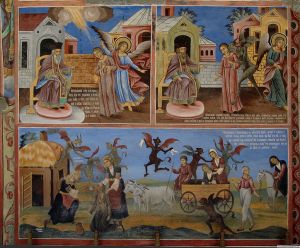
Source: www.imagesfrombulgaria.com; perspective- and color-adjusted by Martha Forsyth (Wikimedia Commons)

Source: http://www.imagesfrombulgaria.com; perspective- and color-adjusted by Martha Forsyth (Wikimedia Commons)

These are merely nighttime thoughts, written in the dark. Already I begin to see the sun rise as I reluctantly trudge eastward across the island of Manhattan. I welcome the longer days, but somehow I strangely miss the comfort of the longer nights of yesteryear.


Hopeful Horror

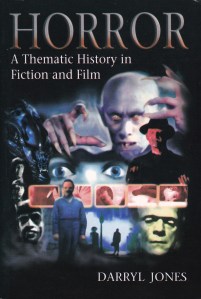
joneshorrorI don’t make New Year’s resolutions. To my way of thinking, if I’m aware I’m doing something wrong, I try to change it at that point, rather than waiting. Needless to say, then, I’m up to my old habits of reading about horror movies. Actually, Darryl Jones’ Horror: A Thematic History in Fiction and Film goes a bit broader than just the cinema. As the subtitle indicates, this charming book also addresses narrative fiction as well and the result is quite engaging. Divided thematically, Jones considers the various types of horror without delving into pretentious theorists to give him academic credibility. Here is a true fan who’s capable to sharing the excitement of the genre. Along the way, accompanying the usual observation that horror and religion share considerable conceptual space, he makes the point that in movies horror is one genre that makes use of academics as characters of authority. Sure, there are others, but in this realm to be educated is a benefit, whether the plan is to take over the world or to stop some evil force from doing the same.

I’ve been watching movies that can be broadly classified as horror since I was young. And I had admired—emulated to some extent—the professors and scientists I saw in those presentations. When a monster was on the loose, you went to find an expert to learn what to do. At the risk of contradicting myself, theorists have been suggesting that one of the problems with post-truth is the death of expertise. Anyone can be an expert these days. The question, “Why should I listen to you?” is on every self-appointed smarty’s lips. Earning a doctorate, the horror world tells us, gives you access to some kinds of knowledge that others don’t have. Problem is, zombies don’t respect such learning. They only want brains to consume.

It never seemed to me that watching horror was a means of learning. As a kid escapism is part of everyday life—taking things seriously is for adults. Growing up, however, I kept my love of scary movies in reserve. Little did I realize that it was a form of training. Now university-affiliated academics are finally able to begin admitting that they find monsters compelling. More than that, they actually learn something from them. Although not a resolution, I see myself reading further books about horror movies this year. It may be a naive hope, but it would be wonderful if they were all as insightful as this one has been.


Wild Things

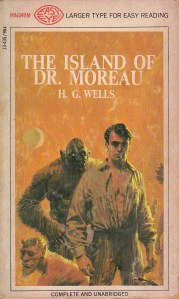
islanddrmoreauLast year my wife suggested we each do a reading challenge for the year. The one we selected was Modern Mrs. Darcy’s, which, with only a dozen books, seemed doable. What makes it a challenge is that to meet Mrs. Darcy’s expectations, you have to read certain types of books, not just go through the stack beside your favorite chair than never seems to get any smaller. I finished the challenge in October or November and posted on most of the books on this blog. This year’s challenge includes a book you’ve read before. Since I’ve been reading about horror movies I decided to reach back to childhood and once again read H. G. Wells’ The Island of Dr. Moreau. It was a timely choice.

For anyone not familiar with it, the story concerns a mad scientist (Moreau) who experiments on animals, making them “men” on an isolated island in the Pacific. These creations aren’t fully human and most of them are blends of different animals as well as part human. They can talk, and they can reason, in a rudimentary way. To create them without anesthesia, Dr. Moreau subjects them to tremendous pain and to prevent them from attacking him, he establishes a basic religion where they obey his rules or he will subject them once again to the “House of Pain.” The narrator, victim of a shipwreck, ends up on the island and has to come to an uneasy peace amid these very strange circumstances. The heart of the book is the chapter where Moreau explains what he’s doing and to justify it he makes a secular theodicy. He is, after all, god to these poor creatures. The book has been made into a horror movie or two over the years, but I’ve never seen any of the cinematic treatments.

What struck me as particularly interesting, revisiting this book some forty years after I last read it, was how easily Wells slips into theological thinking. This is a book unafraid of implicating the Almighty in the troubles of an island that clearly stands in for the world. I wouldn’t have noticed that as a tween. I don’t think there even were tweens when I was one. In any case, the story ends in chaos, rather than creation. What makes it such a timely choice? I suppose the arrogance and entitlement of Dr. Moreau suggested themselves as analogues to our current situation here in the US. Only Moreau is clearly intelligent as well as deranged. This little book is a cautionary tale of what happens when a strong will has its way, unimpeded. It might be a good time for all of us to pick up a copy.


Possessed by Work

Now that I’m safely ensconced back in the daily work routine, I spend some time thinking of the scary movies I had time to watch during my “free time.” Well, I actually thought about them then, too, but I had so many other thoughts to write about that I kept putting it off. That, and the fact that some of the movies were about demonic possession and the juxtaposition of holidays and demons just didn’t seem to fit, kept me from expounding. Why watch such movies at all? It’s a fair question. I tend to think of it as part of a larger thought experiment—wondering what such movies might tell us about being human.

stanthony

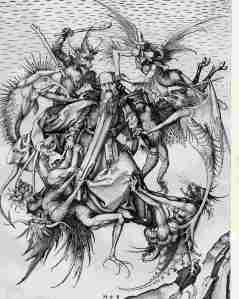
A few weeks back I wrote about The Exorcism of Emily Rose, based on the true tragic story of a young woman who died after a prolonged exorcism. After that I watched The Last Exorcism, The Rite, and The Possession. (I’m such a cheerful guy, as you can see, and this may be why I inhabit an isolated cubicle at work.) This array of movies, held together by the common chord of the reality of demonic possession, also brought together the standard sociological division of Protestant, Catholic, and Jew. The Last Exorcism is a Protestant-based treatment of what is generally considered to be a Catholic subject. That connection is affirmed in The Rite. The Possession, however, gives us a Jewish demon and a rare representation of a Jewish exorcism (acted by Matisyahu, no less!). What emerges from watching all of these films together is that demons are an inter-denominational problem, even in a scientific world. Carl Sagan wrote about the demon-haunted world, and it continues to exist, it seems.

But these are movies we’re talking about. Not reality. Nevertheless, The Rite and The Possession are also said to be based on true stories. We do live in a mysterious world. Evolution has developed reasoning as a practical way of dealing with life in a complex ecosystem. It is a survival mechanism. So is emotion. We sometimes forget that both thought and feeling are necessary for survival in our corner of the universe. Neither one is an end in itself. We can’t quite figure out how these two features of the human brain work together. There are, in other words, some dark corners left in our psyches. I suspect that’s why I find such movies so interesting. They’re not my favorites, but they do serve to remind us of just how little we know. And that’s a scary thought, given how we’ve learned to possess this planet.


Prejudicial Monsters

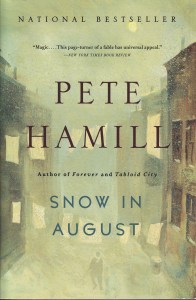
snowinaugustWitnessing injustice is traumatic. Especially when you’ve been conditioned to believe there is nothing you can do about it. That helpless feeling crushes you as you see the guilty, the powerful, the cruel getting away with whatever they want to do. This is the perspective of young Michael Devlin in Snow in August. Pete Hamill’s novel is full of observations about prejudice and ignorant blustering about those who are different in 1940’s New York City. Michael accidentally observes a robbery that may also be a murder. The perpetrator, an older boy who leads a gang in Brooklyn, hates Jews. Michael, however, has become the shabbos goy for a synagogue that has seen better days. Although a Catholic, he is curious about this strange rabbi he comes to know and what this other religion teaches. At the same time, Jackie Robinson is being called up to the Brooklyn Dodgers and prejudice about an African American playing in the major leagues sets up a parallel to the story of understanding the Jews.

It is an engrossing novel. I have to confess, however, that I read it because of the golem. A traditional Jewish monster, the golem is an animated being of mud that protects oppressed Jews. In the novel this begins as a legend Rabbi Hirsch tells the boy as they teach each other their native languages. Michael learns Yiddish as the rabbi learns English, and the story of the golem is part of the rabbi’s own sad history as a Jew during Nazi days. Then as Michael, his mother, and the rabbi are all beaten or molested by the gang, it is time for the golem to make his appearance.

Not exactly a monster story—as often in such cases the monster is someone recognized as fully human but without sympathy for those who are different—Snow in August is a thoughtful, almost nostalgic tale of “a simpler time.” What we learn, however, is that it wasn’t really simpler at all. Prejudice could be worn openly and proudly. What many of us may have forgotten, until recent elections forced us to remember, is that such hateful intolerance is still very common. We live in a world where hatred can be currency and bigotry has more power than we’d like to admit. Reading stories, such as Snow in August, will become increasingly important in days ahead. We will need to remind each other that even if only as metaphors golems do indeed exist. All we have to do is believe.


Evil That Men Do

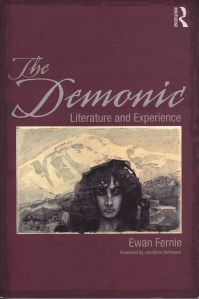
the-demonicTheologians, for the most part, gave up studying demons a long while ago. With the advent of modern medical science, the descriptions of demonic possession in the New Testament seemed pretty clearly to be cases of epilepsy. Since people in antiquity had no means to study brains electro-chemically, there was no recourse for them to understand the sudden changes in behavior that often accompany seizures. They drew on what their culture knew—malevolent spirits—to explain this disturbing behavior. Ewan Fernie takes a different approach in The Demonic: Literature and Experience. As an English professor, he looks at both demons and the demonic in mostly English literature, often focusing on the adjective more than the noun. There is a great deal of insight in this study and characters the reader may or may not recognize seem to fit fairly easily into the category as described by the author. Indeed, God and the Devil appear much closer than many religious readers would feel comfortable seeing them.

Although I enjoy reading about literature, my favorite chapter in this book was the treatment of Martin Luther. Not having grown up Lutheran, I feel that I don’t know the great reformer well enough. The anniversary of his 95 Theses is coming up next year and there’s a lot of attention being paid to the former monk right now. Even despite this, he was a fascinating figure who firmly believed in diabolical activity in the world. Indeed, much of what science would eventually strip away he saw as evidence of the demonic. Other theologians who’ve followed him built on these same ideas. The Dark Ages were the high point of official demonology, after all.

Writers since Luther, many of them touting fiction, also latched onto the concept of the demonic as a great explanation for “the evil that men do.” Quite often Fernie traces them to Shakespeare, the anniversary of whose death is quickly drawing to a close. The Reformation would’ve been much closer to the Bard than it seems to us. Demons were still around and available for all varieties of nastiness against human beings. Fernie makes the point that the association of the demonic and sexuality became more pronounced over time. We see this even today in possession movies. The origins of the ideas, however, are more complex than they might seem. The Demonic will give the reader plenty to think about in this season of long nights and short days and the basic confusion running rampant over what is good and what is evil.


American Possession

the_exorcism_of_emily_rose

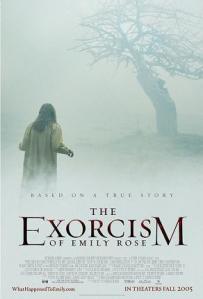
Exorcism seems an especially appropriate trope these days. Embedded evil has to be faced squarely and forced out before it kills its host. I recently rewatched The Exorcism of Emily Rose. This is a most unusual horror film in that the story is born by a courtroom drama over whether the priest overseeing the ritual was responsible for the death of Emily Rose. Famously based on a true story, the movie raises a more basic question than whether it “really happened”—what is the viewpoint through which we view the world? We see from the very beginning that the case is actually a contest between two powerful law firms. Each wants a lawyer that can shred the case of the other. The prosecutors engage Ethan Thomas, a very religious Methodist, against the defense’s Erin Bruner, an agnostic. Believing Emily’s case to be purely medical, Thomas asserts that had she stayed on her medication Emily would’ve remained alive with the prospects of a healthy life. Fearing a complete loss, Bruner takes a risky counter-approach: what is Emily really was possessed?

The obligatory scary scenes are shown, of course. They are flashbacks inserted into the course of the trial, but nevertheless disturbing for all their calm, rational framing. The real question, as the story plays out, is can a supernatural worldview be allowed in a court of law. Ironically, such a worldview is already present when a witness swears on the Bible. This particular movie doesn’t show those scenes, but it would’ve been a fair point for Ms. Bruner to make. Clearly the court can’t decide if demons are real, but it can allow that possibility. It’s a classic case of science versus religion. Nevertheless, both sides make use of science. The anthropologist on the stand is dismissed by the religious Mr. Thomas. He has no time for Catholic, or any other religions’, superstition.

Many strange choices were made for this particular cinematic piece, but the story works nevertheless. Those who believe in spiritual realities are allowed to live them out only to a point. The legal system decides if a religion has gone too far. I couldn’t help but wonder if, in a post-truth world, any clear standard of rationality can possibly hold. But questioning universally accepted truths and subverting them to personal preferences its almost if we’ve actually reached the stage of “all those in favor of general relativity say ‘aye.’” As I say, the film was more timely than anticipated. Demons, after all, often appear in the guise of an angel of light. Especially for those motivated by fear.


Monsters and Men

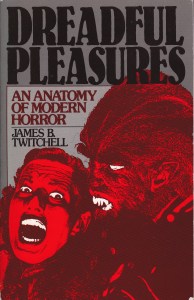
dreadful-pleasuresHorror films are something you either “get” or you don’t. I have no empirical evidence for that, but then again, “getting” is hardly a precise verb. In my recent desire to find some explanation for my own fascination with the genre, I turned to James B. Twitchell’s Dreadful Pleasures: An Anatomy of Modern Horror. This is a smart book. Twitchell, an English professor, knows to include Gothic novels in his accounting for this strange addiction. He has several insightful things to say about the differences between terror and horror. He gives a fairly complete analysis of the “big three”—vampires, Frankenstein monsters, and werewolves/wolf men/Jekyll and Hydes. Still, at the end, I have to wonder if he really “gets” the monsters he explores. Part of this is his early admission that he didn’t grow up with monsters, but that he was introduced to them academically. Another part of it is his sometimes dismissive style when talking about movies that meant a great deal to us monster boomers when they came out. Either you get it or you don’t.

Still, I recommend this book for those who want to make sense of some of the hidden dynamics of classic monsters. That the analysis is sexual should come as no surprise. Twitchell finds evidence for a sublimated incest in many of his creatures, but the true fan knows there is more to them than that. The monster does indeed cross boundaries—that’s what monsters do, after all—but that’s only scratching the surface with their claws. Of course, the book suffers from having been written perhaps a little too early. Although there is protest to the contrary, horror films have grown up considerably since the 1980s. Not all of them, of course. The same thing could be said of the kids I knew in high school.

Having a single theory to approach a phenomenon is respectable. So respectable that it’s called Occam’s Razor and everyone is expected to shave with it. I’ve never liked shaving. The more I reflect on reality, the more it seems to me that answers are more complex than single causation. Sometimes the simplest answer isn’t the most parsimonious. Sometimes there is far more going on than meets the cyclops’ eye. In my experience, limited though it may be, the horror movie has unexplored dimensions. One of them is the coping ability that they offer when evens such as 11/9 occur. There’s no simple way to understand monsters, but if we see them around enough, we might just be able to survive them.


December Demons

Conversations with friends, inevitably, turn to the fiasco this country faces with Donald Trump. My response, apart from attempting a measure of optimism and combativeness, often involves escapism. Regular readers know that I watch horror movies. They may not know that I watch such films to help me cope with the very real fears of living in what has all the signs of being an out-of-control autocracy. With this in mind, I’ve been reading about horror films to try to understand myself a bit more. Perhaps a roundabout way to psychological insight, but it is cheaper than seeing a therapist. Over the weekend I again watched The Exorcist. A classic of the horror genre, it is rare in having been nominated for Best Picture at the Academy Awards and having received mainstream critical acclaim. What made it particularly interesting at this particular viewing is the fact that demons are such poorly understood monsters.

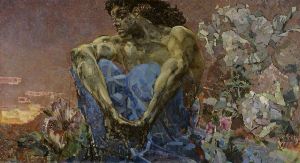
Mikhail Vrubel's demon, Wikimedia Commons

Mikhail Vrubel’s demon, Wikimedia Commons

One of the reasons for this is that no single entity known as “demon” fits all the ancient ideas about such spiritual beings. The earliest demons we know about, from ancient Mesopotamia, aren’t necessarily evil. They seem to be in control of natural forces that harm people, but that isn’t always intentional. From the human perspective this is bad, but from the point of view of the divine world, it’s neutral. Sumerians and those of the Babylonian and Assyrian empires did not believe in Hell. There was no Satan and therefore “fallen angels” intent on harming people weren’t part of their worldview. The Greeks, who gave us the word, referred to as “daimons” nature spirits that were generally benign. In the biblical world, influenced by Zoroastrianism, a dualistic understanding of the universe emerged and eventually demons came to be understood as angels that followed the Devil in revolt against God.

Complicating the picture, possession, in world religions, is not always a negative thing. In some cases it is a way of having a deity inhabit one’s body—something of a blessing. In the New Testament demons may have been an explanation for epilepsy. They were, however, understood in that day as possessing spirits of evil intent, in league with Satan. Thoroughly evil, they could evoke paranormal phenomena and could completely control a person unless expelled. In modern media, where reality television dictates the terms, demons are responsible for some hauntings. They are disembodied entities “that were never human” and they are always malevolent. One of the reasons they are so scary is that no one really knows what they are. And in cases where one has no idea what to expect, fear is a natural result.


Cinematic Reality

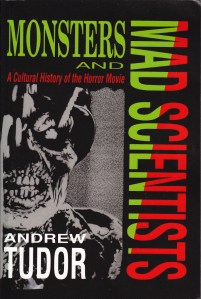
monstersmadEven without the results of the recent presidential election, I would be reading about horror movies. One of the reasons is that I wonder what the appeal might be—why do I put myself in a dark room with an uncertain future? Until recently academics had thought this was something only unreflective, uneducated people did. As is often the case, such as with the electoral college, the numbers tell a different story. Andrew Tudor’s Monsters and Mad Scientists: A Cultural History of the Horror Movie is an example of what happens when a sociologically oriented film critic explores the genre. Although not overwhelming, there are plenty of tables and charts, showing the various trends of horror films from the 1930s up through the mid 1980s. Tudor analyzes what makes us afraid and the main sources of that fear: science, supernatural, and psyche. Since these are all day-to-day things it seems that movies express the basic human condition.

Reading a book published in the ‘80s, however, makes you wonder what might have been missed. We’ve had more than three decades of further horror movies and although categories may be useful, and perhaps even stable, recent events unlock further fears. I suspect there will be a comeback of Nazis in scary movies over the next few years. Horror is, after all, a reflection of those who are willing to be honest about what scares them. There’s plenty of subject matter lying about the headlines of the past weeks.

What I found especially interesting is, at least in the 1980s, statistically the great majority of films featured a supernatural threat. Of these, Tudor notes, the vampire is by far the most popular. We’ve had a dalliance with zombies since then. And I’ve seen plenty of examples where extraterrestrials form the threat. Even ghosts have staged a somewhat unexpected comeback. And movies of demons have proliferated. The supernatural does indeed scare us. I’m not sure that we can quantify it as easily as we used to. Unlike earlier generations of scholars, I’m beginning to see the horror inherent in much of society. We’ve created a scary world with even more scary possibilities. The thing about monsters is they have no sympathy. They are cold, calculating, and all about meeting their own unnatural needs. All the rest of us are just, not to put too fine a point on it, their food. I have a feeling that we’ll be seeing much more of this in days to come.


United Hates of America

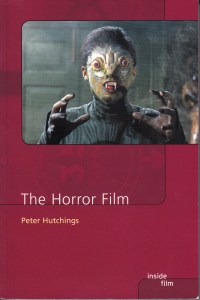
horrorfilmHorror comes in many forms. Some people may wonder why I watch horror movies and read scary stories. The election results tell the story. As we descend into four years of horror, I was reading Peter Hutchings’ The Horror Film. At least I feel somewhat prepared. Or course, I’m still in shock. So I turn to horror shows. One of the things I found in Hutchings’ book was the idea that this kind of movie is a collective nightmare. The thing about nightmares is that sometimes reality is even worse.

It’s difficult to think straight sometimes. When I was a child I was taught that hatred was evil. Hate itself was a bad word, close to, maybe even worse than, swearing. What horror shows us clearly is that hatred leads to results we’ll only regret. Being bullied because you’re a little guy, or because you’re female, or because your sexual orientation is different, is something far too common. It seems it may be institutionalized now. No wonder so many horror movies take place in insane asylums.

Don’t mind me, I barely slept. I woke up in a country I no longer recognize. Or maybe recognize a little too well. The thing is, I feel sorry for Peter Hutchings’ The Horror Film. It is a worthy little book. I learned a lot from reading it. In fact, some of what I learned may come in very handy in the next few years. Zombies, after all, are called the walking dead. And I can’t really see the future at all. Maybe I’m just waiting for the curtain to part. Maybe I’m still asleep. I’ve seen enough horror movies to know how that scenario ends.


Frozen Over

The_Blob_poster

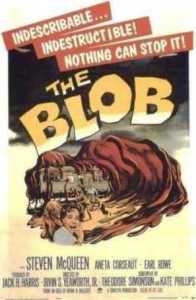
For reasons that may eventually become clear, I was watching The Blob. It seems that each generation’s fears are unique to its time—let the reader understand. For whatever reasons, star-appeal I expect, Steve McQueen was cast as the teenage Steve Andrews. A little unbelievable as a twenty-eight-year-old teen (Sissy Spacek was a more convincing teenage Carrie at twenty-six) Steve drives around his small town trying to find and stop the Blob. What is the Blob? Nobody really knows. Emerging from a meteorite, it seems to be an EBE (Extraterrestrial Biological Entity) that encompasses, dissolves, and assimilates animal life forms, getting bigger all the time. In a day when the Russians were actual enemies, this is hardly an intentional vision of capitalism but an apt description nevertheless. If it touches you, you’re dead. Since it can ooze through air vents, there aren’t too many places at hide. It forces itself upon you.

Steve’s love interest, Jane Martin, has a lisping little brother named Danny. While big sister is out on a date battling the jello-monster, Danny—a future NRA member—charges outside in his pajamas shooting at the thing with his cap gun. Can this be? One capitalist shooting at another? Don’t be fooled. This is the nature of the free market. Either the Blob ends up on a dinner plate, or Danny does. We know that prior to 1960s monsters seldom kill little children (but don’t get me started on Frankenstein), so it is the Blob that will succumb. As the town’s teens combat the goo with fire extinguishers, freezing it, Jane, Danny, and Steve escape to go hunting another day.

Those of you who’ve read my blog for any time know that subtext is often the point. I’m counting on you following along with me here—think of what day it is. The small town police chief, Dave, calls in the Feds. No wall will keep this alien out. It has to be deported. To some place that will never thaw. Like all good monsters, the Blob never really finally dies. It must be kept frozen to keep humanity safe. The final words Steve utters are indeed chilling, “As long as the Arctic stays cold.” Getting on sixty years later our “industriousness” has begun to melt the ice caps and the friends of the Blob deny global warming. I’ve seen The Thing from Outer Space too, and I know the last thing you want to do is thaw the Arctic. Remember what day it is, and do the right thing.


House of Unsure

DSCN0216

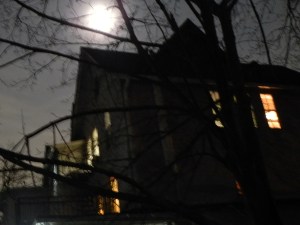
It’s that spooky time of year when nights have surpassed days and the chill in the air suggests an oncoming period of bleakness. Leaves are raining down off the trees and strange sounds fill the dark. So when a friend sent me an article on The Vintage News entitled “Website ‘Died in House’ can tell you how many people have died in your home & how” I had to look. At the story, I mean, not the actual website. You see, I’m not sure if I want to know too much about those who lived here before me—or died here before me. Like many people near a major city, we rent. I’ve never owned property (never had a job that paid well enough to do so) and as a renter you’re limited in what you know about your home. We’ve lived in our current situation a decade now. Of the four families in the two houses that make up the property, we’ve been here by far the longest. The house, however, has been here even longer. Has someone we’ve not met?

We live in a rational age, but we still fear ghosts. Belief in the lingering spirits of the departed goes back to the earliest written records and, we have every reason to suppose, far before that as well. We just can’t seem to shake that feeling, no matter what our rationality tells us. I didn’t go to the actual website, but Vintage News reports that it is a paid service. You want to check your address, you’re going to pay. And the results only go back to 1980. I don’t know about you, but to me it seems there’s a lot of years before that to wonder about. I mean, I was in high school in 1980 and there were lots of houses in my town that looked pretty old even then. If you’re going to pay to learn about ghosts, you want to be sure you’ve got the older periods covered as well.

I’ve lost track of the number of places I’ve lived. Some of them have been fairly old and some I have been curious about. Would I want to know if anyone had actually died there? I’m not so sure. One of the seminary houses I lived in had a spooky, neglected feel. I never saw anything that most people would characterize as a ghost, but I knew nothing of the history of the place when I moved in. It never occurred to me to ask. Now you can ask. A few keystrokes and a few dollars and you can learn if your house has “that kind” of history. The question is, with the increasing hours of darkness, and the wind whistling through the gaps around the windows, do you really want to know?