Frankenstein’s Monster

“We are about to unfold the story of Frankenstein, a man of science who sought to create a man after his own image without reckoning upon God. It is one of the strangest tales ever told. It deals with the two great mysteries of creation – life and death.” So begins Universal’s 1931 classic Frankenstein (a movie that my wife kindly indulged me with for Christmas). Watching the film as an adult highlights many nuances unnoticed by even many a childhood viewing. The theatrical introduction of creating a man “without reckoning upon God” was heady stuff in the pre-atomic world. It was a simpler time before men had embraced god-like power (I use “men” intentionally here; even the credits for the movie ironically cite the noted feminist author as “Mrs. Percy B. Shelley”), and audiences were indeed shocked in theatres just 80 years ago.

The now tame movie was originally subjected to heavy censorship. Even the liberal states of Massachusetts, New York, and Pennsylvania censored the line where Dr. Frankenstein cries out, “Now I know what it feels like to be God!” A divine thunderclap was dubbed over the words to obliterate the blasphemous line. In Kansas (perhaps not surprisingly, given recent political developments) 32 scenes were cut, paring the movie down to half of its original 70 minutes. I suppose all that would have been left would have been the scenes of dancing Germans; the Lederhosen would have been frightening enough. The accidental drowning scene was overwhelming for many sensibilities in a pre-concentration-camp footage world.

I read Mary Wollstonecraft’s novel long before I ever saw the movie, and I was struck at how sad the story was. Of all the classic monsters, Frankenstein’s creation easily garners the most sympathy. A creature that did not seek to be brought to life, forced into destitute and desperate circumstances by a population who could not, or would not try to understand, Frankenstein’s monster retains the potential to be any one of us. Although audiences today rarely blanch at blasphemous words, we still permit a society that creates Frankenstein’s monsters through crafty politics and tax breaks. Perhaps when taking authority public officials should add a line from the movie to their oaths of office, only it could be demurely obscured by a well-timed thunderclap.
Didymus Haunting

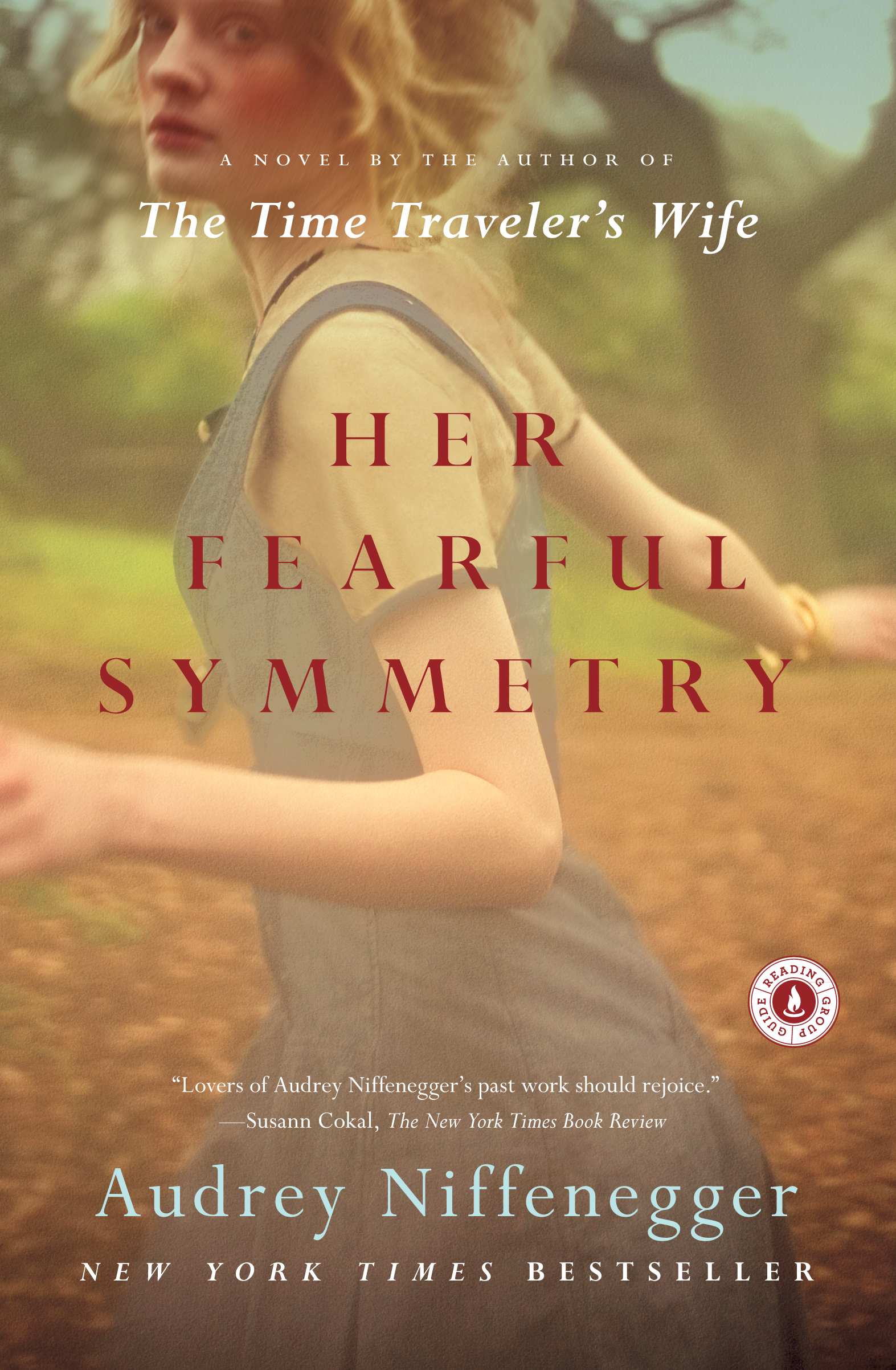
Now that winter is nearly here, the season of reading the autumn books is nearing its end. Each year, in my scant free-time, I seek the perfect book to capture the essence of the dying of the trees, the chill in the air, and the growing length of night. Autumn generates an emotion that is difficult to replicate or even describe. Many people respond by watching spooky movies and those of us old enough to appreciate printed literature turn toward moody books. One of my choices this year was Audrey Niffenegger’s Her Fearful Symmetry. At the constant urging of one of my former Gorgias Press colleagues, I’d read Niffenegger’s The Time Traveler’s Wife this summer. It was well crafted and left me with enough sadness to want to see if this New York Times bestseller might capture the feeling of the season. I was drawn into the book by reviews that mentioned it centered on Highgate Cemetery in London, the scene of a real-life vampire fracas back in the 1970s.

No vampires graced this novel, but ghosts abound. Often Niffenegger’s characters are either wealthy or have managed to obtain fulfilling jobs, features that make them inaccessible to me. Nevertheless, she is able to draw in the supernatural in a way that makes it seem normal and believable. By tingeing her novels with romance she is able to tap into an inexplicably huge readership, but her story development is intriguing even to those who read books with a paranormal slant. It took me a couple hundred pages to really feel much sympathy for many of the characters, but the ghosts eventually take over the story and it becomes very creepy indeed.

For those who’ve ever wondered about the secret lives of twins, Her Fearful Symmetry will provide hours of fascination. The title may be drawn from Blake, but the story is older than Esau and Jacob. The struggle of twins ranges far back in literature and raises questions of what a soul might actually be. Is it possible to share one? What happens when one twin predeceases another? What is the nature of individual identity? Even the Gospels take pains to inform us that Thomas is a twin. I finished the story last night feeling a twinge of autumn, but still hungry. Perhaps it is good that I completed this bedtime reading just in time to get ready for the more Dickensian ghosts of Christmas.


Where Are the Wolves?

Spend a leisurely hour at your local commercial bookstore and you won’t be able to avoid seeing vampires. Just yesterday I noticed that a neighborhood bookstore had an entire section entitled “Teen Paranormal.” Zombies also continue to grow in popularity, now having their own line of undead Christmas products. And where is the humble werewolf? Not gone, just lurking in the shadows.

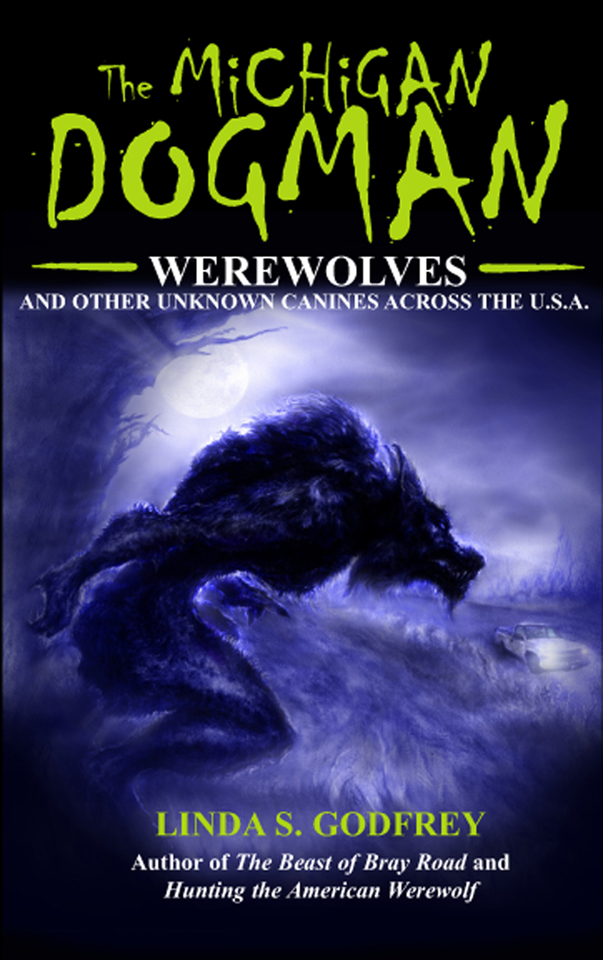
This weekend I finished the third werewolf book by my one-time co-Wisconsinist, Linda S. Godfrey. (She’s still there, but I’m not.) Lest any of my readers think I am casually lumping her work together with the fictional fantasy monsters, I must declare up front that The Michigan Dogman is not a work of fiction. Linda is a careful researcher, a former journalist, and a woman who possesses something many researchers lose over the years: an open mind. The problem with occasional phenomena is that they are almost impossible to test in any empirical kind of way. Since even before the Beast of Bray Road story broke in 1992 occasional reports of bipedal canines had stumbled into the news once in a while, causing headline-happy journalists to push the werewolf button. Underneath the current monster hype, however, is an intriguing question of origins.

Where do all these similar stories originate? While not even close to the number of reported Bigfoot sightings, the dogman/manwolf sightings that Linda has pulled together are impressive for their overall uniformity. Witnesses who’d never heard of the creature repeatedly report fine details that mesh with accounts of individuals otherwise unconnected. The standard answers of hoaxes and misidentifications just don’t cover the three volumes worth of material she had compiled. Few would stand by the assertion that these are shapeshifting humans, but for those with an open mind the werewolf trilogy gives pause (paws?).

The universe is large beyond human comprehension. Simply because we’ve evolved very complex brains doesn’t mean we’ve found all the answers. I’ve never seen a werewolf or any other popular cryptid. But having studied the strange world of religion all my life, I know better than to declare, ex cathedra, that very strange things cannot exist.


Hunting Vampires

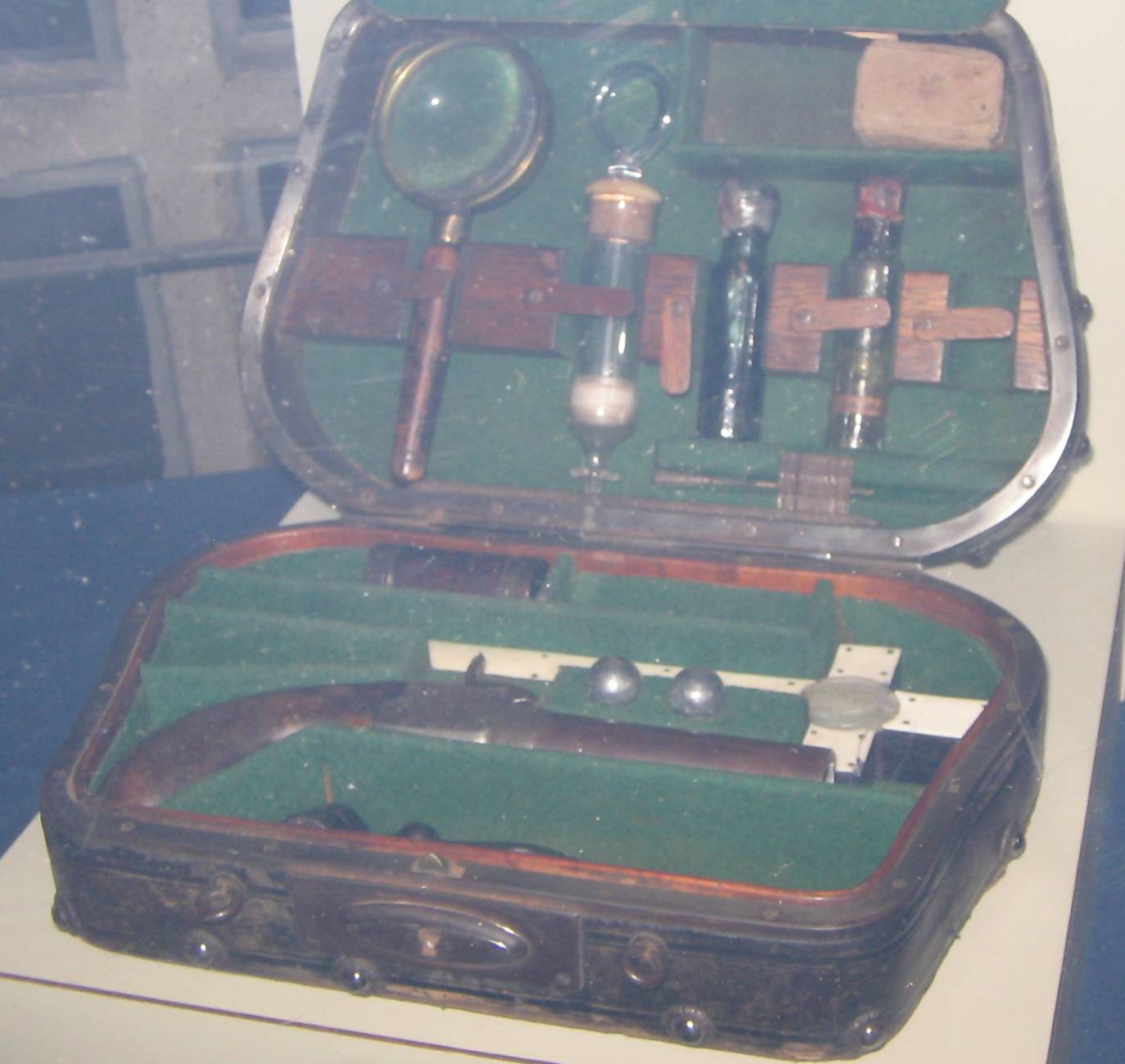
The Mercer Museum in Doylestown, Pennsylvania is a treasure trove of Americana from the turn of the last century. Henry Chapman Mercer, in addition to being wealthy, had the foresight to realize that society was rapidly changing, even back then. He undertook the collection of everyday artifacts from many human industries, poured himself another castle-like concrete building, and housed the baubles there. It is a fascinating walk through nineteenth-century America. And if you visit on a cold day it feels as well as looks like Currier and Ives have just passed through. My main draw, however, was a vampire hunting kit.

If only I had a polaroid lens...

Prominently displayed, the kit includes a Victorian Protestant’s tool chest for any blood-sucking eventuality. A cross (sans corpus), a pistol with “silver” bullets, glass vials with various apotropaic ingredients, even a little stake, all in custom-cut green velvet. Unfortunately, the kit is believed to be a forgery, although the items in it are from the Victorian era. The silver bullets are, for example, pewter. As the placard notes, vampires do not exist, but that doesn’t mean people didn’t believe they might have existed. The museum, naturally enough, hoped that the Victorian era kit might be authentic. Scientific analysis has revealed otherwise despite the fact that many people continue to believe in something that has no basis in reality.

Belief constitutes reality. Otherwise, how could it be that thousands, if not millions, of people don’t accept the fact of global warming? Brash barons of unhindered industrial progress insist that humans can’t harm the planet – it’s just too big. We can suck out all the resources that billions of years have deposited in intricate recesses and that nature has sprouted right on the surface. For, they say, God has given them to us. They believe that. If we held a mirror up to them, what would we see? Maybe we would be forced to change our minds and go after that vampire-hunting kit after all.


Holy Horror

Back in October, in the spirit of the season, I attended a local lecture by a ghost hunter at a nearby public library. This sincere young man struck me as perfectly normal, but haunted by his ghostly encounters. During the question session someone asked about TAPS (The Atlantic Paranormal Society, of “Ghost Hunters” fame). The lecturer indicated that TAPS is not above fabricating evidence for ratings, a disappointing but not unexpected factor when it comes to television. He even gave some evidence to back his assertions. Nevertheless, my wife’s whimsical six-month subscription to the TAPS Paramagazine has continued on well past its expiration date, and when the November/December issue arrived, I was interested to see a piece entitled “Sacramental Horror: What scary stories can tell us about what is real.” Well, this was too good to pass up.

The article, written by Presbyterian minister Jonathan Weyer, discusses the value of horror films. The juxtaposition of a clergyman and horror films is a little unexpected, but believable. After all, many horror films feature religious ideals clothed in monstrous form. Dividing horror films into Uncanny/Unsettling horror, gross-out horror, and torture porn, Weyer goes on to explain how uncanny or unsettling horror underscores the moral order of the universe and is therefore appropriate for Christian contemplation. He even draws the Nicene Creed into it. Gross-out horror serves the function of making the viewer contemplate death and perhaps even helps to make fun of it. This is a less noble, but still acceptable Christian enterprise. Torture porn, on the other hand, simply has no redeeming value. Sacramental horror really didn’t enter the discussion. Douglas Cowan’s Sacred Terror takes this issue on more directly.

I really don’t expect much insight from a fanzine that treats the reality of fairies and the prognostications of tarot cards next to the genuinely mysterious, such as ghosts. Finding morality in horror films is often a matter of eisegesis. The fear in such films often emerges from the sacred, either in pure or distorted form. Even if “the pure of heart or, often the virgin” survives while “Wrongdoers get put to the axe,” as Weyer states, seldom is that the intended point of the movie. John Carpenter denies that there was a moralizing message in his Halloween, often cited as the movie that established the “good girl survives” motif. The fact is that horror relates to the sacred in the element of fear. If people were not afraid, there would be little for religion or horror movies to accomplish.


All You Zombies

Not being a cable subscriber bears a burden all its own. Not only would paying the extra monthly fees for television prove a hardship, but the constant temptation to watch it would rate as a deadly sin. So on this “All Saints Day” I find myself wondering if the world is still out there after last night’s much-touted “The Walking Dead” premiere. The new AMC series has been written up in local papers and this week’s Time magazine. The latter calls it “a zombie apocalypse.” The fascination with zombie goes beyond holiday-fueled monsters. As James Poniewozik states in his Time article, zombies symbolize society’s insecurities: pandemics, terrorism, economic instability. The unrelenting undead remind us that death is perhaps not the worst thing to fear.

The religious side of this trend is fascinating. Revenants have no place in traditional Christian, Jewish, or Muslim theologies. Perhaps the closest semi-sanctioned version is the golem, a soulless protector of persecuted medieval Jewish communities. Traditional zombies are inextricably connected with magic, a means of manipulating the physical world through supernatural means. Like modern vampires, modern zombies have shifted from supernatural to biological, or at least scientific-sounding, explanations. Even Night of the Living Dead had an errant satellite to blame. The zombie has been reborn in a secular context, making it safe for religious believers to add it to their repertoire of fictional ghouls. And yet, the religious aspect has not completely vanished. The “apocalypse” that accompanies “The Walking Dead,” whether it is Armageddon, 2012, or Ragnarok, is a religious concept. Humans simply can’t face the end of the world without religious implications.

Audiences feeling a little let down after October’s terminal scare-fest, however, might find some cheer that Halloween is an end, but also a beginning. It is the start of the darkest time of year. Very soon not only do we drive home in the dark, but light will not have dawned by the time we start the car for work. In northern reaches of the globe, people can’t help but feel a little stress at finding our accustomed visual assessment of our world a little bit impaired for months at a time. And when we see that shoddy-clothed stranger straggling along in the half-dark, it may be time to remind ourselves that despite the naturalized zombie, there are still those who prey on their fellow humans. They may not be the undead. They may dress well and drive expensive cars and live off what they can legally draw from that stranger on the street. They may be the true harbingers of the apocalypse. They are the ones we should really fear.
Whose apocalypse?


Origin of Halloween

Perhaps the most misunderstood of holidays, Halloween has grown into a major commercial holiday. Outsold only by Christmas in the United States, Halloween now supports its own seasonal stores that cash in on the massive public interest. A few years ago a wrote a book explaining the holidays for teens/tweens. The book was never published, and I’ve been putting excerpts on this blog on appropriate occasions. For the full story of Halloween, please check out the Full Essays page (link above).

Accusations of a demonic origin may fit in with the popular creatures of the holiday, but they are far from the truth of the matter. A cross-quarter day, Halloween comes in the opposite side of the year from May Day (remember Walpurgis Night) when spirits make their way back into the mortal world. It represents the passing of fall into winter and the shades of death that accompany it. How much more religious can you get?

From ancient times people have been aware of how weak our control over our lives really is. We depend on the sun and the weather to cooperate for our crops. We fear the darkness when our eyes can’t compete with those of our predators. As the year descends into longer and longer nights, we secretly fear that eventually night will not end. The dark time of the year belonged to the spirits.

Just as all ancient people celebrated the vernal equinox (if you missed it, check out the Passover-Easter Complex for more), they marked the autumnal equinox with festivals. Although Halloween is six weeks after the equinox, it seems to have inherited some of the ancient associations of that season. One of the ancient feasts of the equinox was for Pomona, the Roman goddess associated with fruits and seeds. There is more of Thanksgiving than Halloween in this festival, however.

Halloween, as we have come to know it, is usually traced to the same people who gave us St. Patrick’s Day – the Celts. The Irish calendar was divided into four quarters, marked between the solstices and equinoxes by the cross-quarter days. The fall cross-quarter day was Samhain (in case you don’t speak Gaelic, this is pronounced “sow-win”). Samhain can be understood as “summer’s end” and it was the traditional marking of the onset of winter; it actually comes just a month before meteorological winter.

The Celts, as well as other ancient peoples, believed that spirits of the dead were active as the trees lost their leaves, the grass began to dry and, and the world itself seemed to be dying. Huge bonfires were lit to ward off evil spirits, and perhaps bloody sacrifices were made to ensure the safety of the living.

No matter what modern Halloween critics may say, the Celts did not worship Satan and the origins of the holiday are not satanic. Pagan, maybe, but who isn’t somebody else’s pagan? The idea was to fend off evil, not worship it. The shamans, or “medicine men” of the Celts were a class of priests called Druids. Samhain would have been one of the festivals overseen by the Druids. These guys were priests of a religion that focused on nature, not the Devil. They did play a little rough though. They seem to have practiced human sacrifice once in a while, but Samhain was more often about killing off livestock before the winter. Either you can keep your animals alive and they will eat the little food you have, or you can butcher them and add to the little food you have. After all, not much grows in winter.

[See Full Essays for the rest]


Zombie Walks

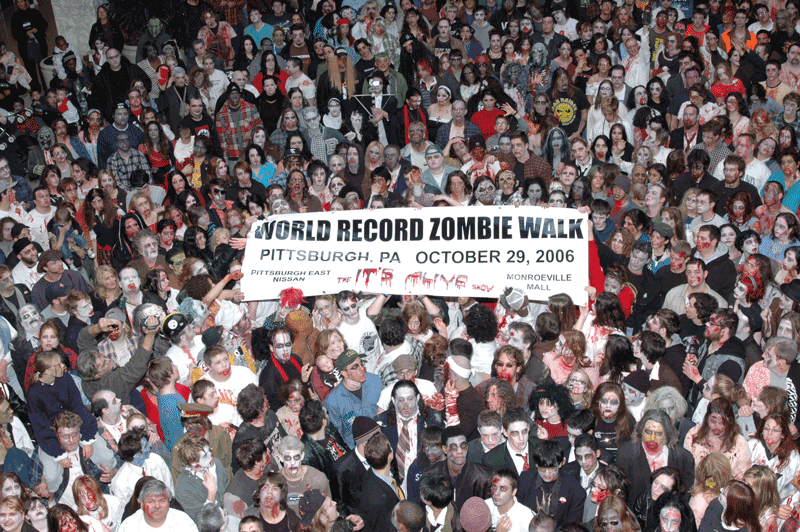
As October nears its creepy climax, signs of the macabre have become abundant. A trend that has reached new heights in recent years is the zombie walk. Various cities or regions host large groups of brainless, reanimated corpses in parade (rather like a Tea Party, I should imagine) to welcome in the darker half of the year. In a most unconventional display of cultural unity, groups of strangers meet for the purpose of sharing their fascination with the undead. Given the inherent potential for overly enthusiastic participation, these events are usually held during daylight hours and are becoming as accepted as trick-or-treating on Halloween.

Fear of death is sublimated in a conquest of the same with less definitiveness than traditional resurrection, but with a more gritty and graphic triumph of life. Organized religions have had difficulty maintaining numbers in much of the “developed world” while this new danse macabre has taken on a life of its own. Many find claims of divine authority in institutions that refuse to make clean breaks with sex scandals or threats of Quran burning somewhat disingenuous, while nobody questions the motives of zombies. They simply do what it takes to survive. An honest zombie stumbles toward eternal life.

Credibility is less easily commanded than it had been in former times. While many voices, such as Tea Partiers’, are claiming the need to erase the sixties and seventies and subsequent decades from the calendar so that the authoritarian Father can be returned to power, thinking people are asking what the plan might be. Is it time to break down that putative wall between church and state and declare America a plutocratic, evangelistic Republic? Never mind that inevitable conflicts will break out over who has the right to set doctrine and public policy – most citizens will be found out walking with their fellow zombies, welcoming in the darkening season.


Movie by Faith

Yesterday’s New Jersey Star-Ledger carried an article by film critic Stephen Whitty entitled, “Where script meets scripture: Recent films take a leap of faith.” The phenomenon he observes is that mainstream, big studio-backed film-makers are more and more turning to plots and scripts that emphasize faith. It is not always standard, revealed religion-type faith, but a belief that there is something else. Something beyond that with which our daily lives presents us. People are seeking, but traditional religions are having a hard time convincing them that they have the answers.

In a striking contrast, films that present a spiritual danger frequently revert to the stock image of a Catholic priest as the means of deliverance. When is the last time a Protestant exorcist took on a demon on the big screen? Torn though it is with its long and checkered history of imperialism, exploitation, and scandal, the Catholic Church with its obscure rituals is effective where the machinations of the Protestants are not. This too is a leap of faith, one that believes in the efficacy of ritual despite its origin or lack of scientific theory. Science provides a way of understanding the world that many people experience as cold and comfortless. Even many scientists choose simply to trust in what their spiritual guides teach them.

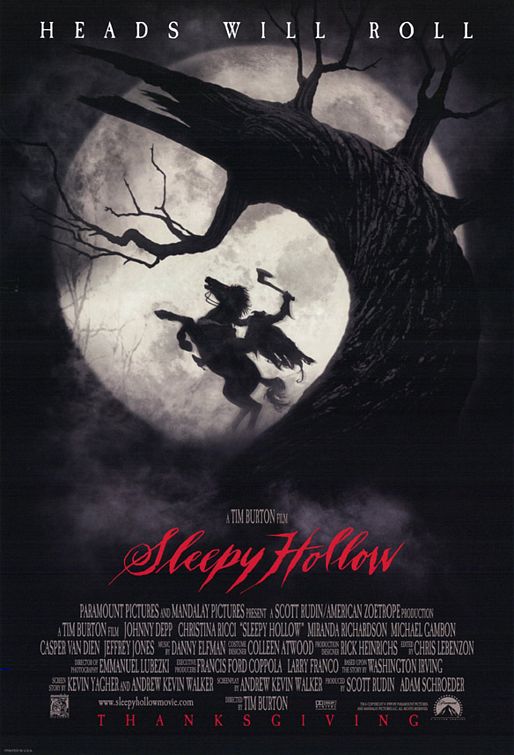
Over the weekend my wife and I watched Sleepy Hollow. It is an annual tradition; it is our October movie. In this film Tim Burton plays off the superstition of Sleepy Hollow – in fact real, in the movie – against the science of Ichabod Crane. In the end, Ichabod has to face the supernatural on its own terms in order to bring the world back to science. Having sent the headless horseman back to perdition, Crane once again returns to a New York City at the start of a new millennium, full of the optimism of science. It is the dilemma of the modern western world. People are tugged, torn even, in two diametrically opposed directions. Our experience leads us to believe in a “demon haunted world” while science placidly informs us that all can be explained. Movies do reflect the human outlook in many respects, and the end sequence has yet to be shot.


Fearsome Fish

It must be October. As I was looking up a word on Dictionary.com, I noted one of their “the hot word” features entitled, “Scientists discover a fish they name ‘dracula.’” The fish, which is native to the eastern part of Asia, was discovered in 2009 but is just now starting to draw attention. The name apparently derives from its fangs. Vampires, however, have their ancient origins in creatures that draw the life force from humans. In the ancient world the “life force” could take different forms: blood, breath, and even semen. Soon a whole array of life snatchers populated the ancient mind – incubi, succubae, Lilith, demons, and any of a number of other contenders for the human essence. The fear of being drained is a very ancient one indeed.

While in my adjunct office at Montclair yesterday I met a colleague. We discussed the visit of the exorcist to campus that I missed but he attended, and while discussing the mythology class we both teach he mentioned how vampire movies make use of mythic themes. I have been using this information from the beginning for my class, but I was fascinated that another part-time instructor would latch onto the same film motif as I did to illustrate modern myth. The vampire is such a part of our culture that people often forget its religious origins.

I attended a public performance of a two-man play at a local library this week. The play was a conversation between Edgar Allan Poe and Bram Stoker. Naturally, vampirism played a strong element in the single-act show. While Poe and Stoker were not contemporaries, they did both share an awareness of how religion tied in with the macabre. The Frank Ford Coppola movie Bram Stoker’s Dracula makes this connection explicit as an enraged Vlad Tepes stabs a cross in his chapel with his sword, starting a flow of blood that he greedily drinks.

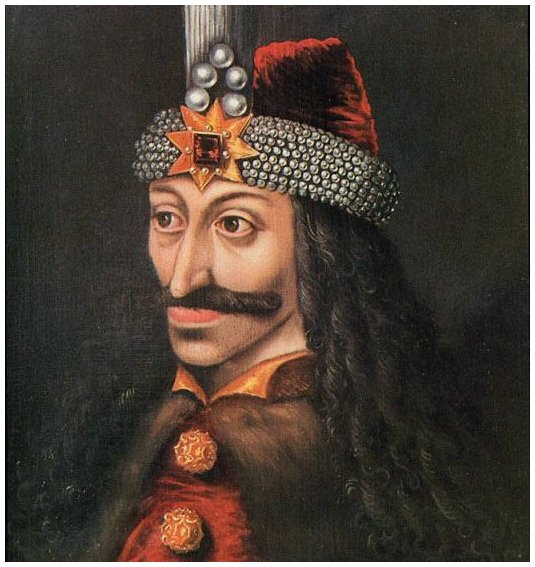
Vlad Tepes on a good day

We’ve just crossed into mid-October and I already find myself surrounded with vampires. It is characteristic of religion to deal with our deepest anxieties, and the more we reflect on vampires the deeper we find they reside in the religious sensibilities of both fish and phantom.


Jersey Devils

My trips to the DMV always seem to involve the paranormal. Admittedly, this is sometimes partially my own fault. Against my wife’s advice, I took The Lure of the Dark Side – a book I was reviewing – with its Satanic cover, when I went to renew my driver’s license a few weeks ago. Back when we first moved to New Jersey, and I had to sit for an excessive part of the day in that waiting room, I was reading a book on the Jersey Devil. I first heard of this exotic New World beastie when I was a ghost-story fixated teenager reading some Scholastic October special. Since I lived a state over, in the western end of Pennsylvania, I figured I didn’t have too much to worry about.

The Jersey Devil is an anomaly that involves two distinct aspects. One side of the story is pure folklore; Mrs. Leeds gave birth to a devil in south Jersey and the monstrous thing has been haunting the state ever since. The other side involves the sightings of an allegedly physical cryptid by reputable individuals, especially since the early twentieth century. An unlikely combination of horse-head, wings (often bat-like), and hooves make this one odd-looking creature, based on eyewitness accounts. I have to thank my friend Susan for pointing out the suggestion that this could be a hammerhead fruit bat, although how even a small population of the African rain-forest dwellers could survive in New Jersey without producing a single road-kill specimen would itself be beyond belief. The shape and size of the bats accounts for quite a bit, but the hooves just don’t fit. That, and the Jersey Devil seems to prefer chickens, ducks, and small dogs to the eponymous fruit of the hammerhead bat.

Whatever, if-ever, the real Jersey Devil might be, the story has all the makings of a Halloweenish blend of religion and monsters. There are several versions of the story, but the one most commonly told is that Mrs. Leeds, in labor with her thirteenth child, declared that this one had better be a devil. She got her wish. The child emerged, sprouted wings and flew up the chimney to terrorize south Jersey and Philadelphia over the next several decades. The beast gives the state’s hockey league an instant identity and even led to the breakdown of a priest in the sixth season of Seinfeld. The first season of the X-Files featured a Jersey Devil episode (although it turned out to be a very humanish kind of Bigfoot), and Bruce Springsteen recorded “A Night with the Jersey Devil” for his home-state fans back in October of 2008. Only the gullible take stories of cross-species (cross-metaphysical beings?) seriously, but the story, like the Jersey Devil itself, seems to be immortal.


Gods and Demons

In ancient times people were sometimes possessed by gods. They were called “prophets” and they gained a breed of knowledge hidden from most other people. Demons were believed to exist, but they did not possess people. Instead, demons were used as explanations for misfortune, whether malevolently premeditated or not. Demons reflect, in today’s society, the concept of pure evil. Fr. Vincent Lampert, one of America’s 24 official exorcists, visited Montclair State last night to discuss evil, and according to the New Jersey Star-Ledger, he believes evil is a reflex of how people treat one another more often than a “figure with the hooves and horns.” No doubt there is a public fascination with demons, but few people understand their religious pedigree or what other explanations may be used to categorize them. According to the paper, Italy claims 300 exorcists – demonstrating that demons show culturally determined characteristics.

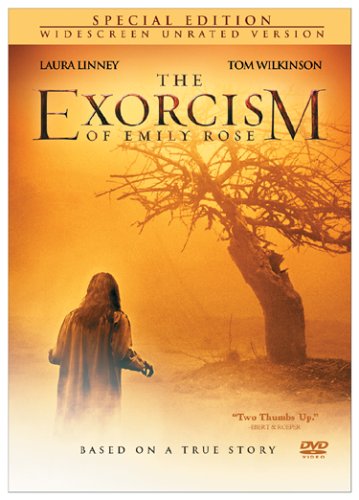
The 2005 movie The Exorcism of Emily Rose, lays out how science and religion differ on the issue of the demonic. Anneliese Michel, a young German woman, died in 1976 after being subjected to a prolonged treatment of exorcism. Her story was the “inspiration” for the film, and it raises the question of the reality of the demonic in the physical world. Fr. Lampert is more circumspect, noting that real life exorcisms are not as dramatic as those shown in the movies. He does, however, recall having seen a person levitate, but not during an exorcism. The human behavior he’s seen while on duty may all be readily explained by mundane physical and mental phenomena.

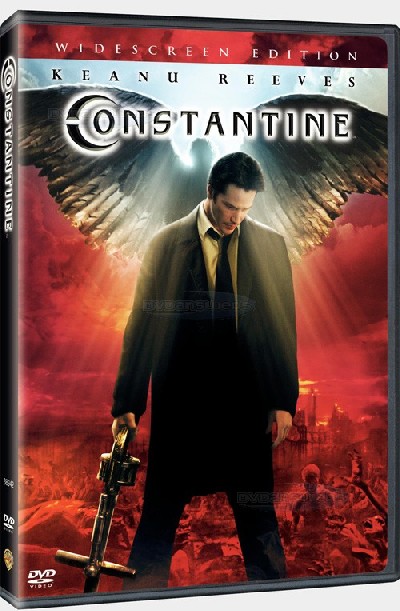
What does seem certain in all of this is that demons are not the behooved and behorned antagonists of films like Constantine or countless other graphic-novelesque portrayals of evil. Their Pan-based characteristics hearken back to the days when Christianity had to make plain its dismissal of foreign gods. In the ancient world hooves and horns were symbols of strength generally associated with powerful, if sometimes capricious, deities. In other words, what were one culture’s gods have become another culture’s demons. Movie makers understand the simultaneous revulsion and draw of the demonic character, but it seems that Fr. Lampert strives for a more balanced perspective. Evil has many faces, and most of them do not conform to Hollywood standards. Perhaps if all religions were respected demons would lose their power to torment and people would learn to get along with each other.


Where Wolves Dare

It’s the fall of the year when an old man’s thoughts turn to werewolves. Not that I’ve ever believed there were such creatures, but they do have a pedigree in ancient religious ideas, and even today skin-walkers play a role in some Native American traditions. While I lived in Wisconsin I found out about the Beast of Bray Road, a cryptid that is seen on occasion south of Nashotah, where I lived. Unfortunately I learned about the beastie too late to make any attempts to see it, but the documentation of the creature is in good hands with local author Linda Godfrey.

When I moved to New Jersey, scrabbling for a living tended to outweigh concerns about werewolves. Nevertheless, I did hear of an odd account in a south Jersey newspaper from 1925. According to the Woodbury Daily Times (now defunct), a farmer in Greenwich, south of Camden, shot an up-right hopping, dog-like creature that had twice raided his chicken coop early on a December morning in 1925. According to the paper, hundred of people went to view the unidentified animal and some even photographed it. Now, 85 years later, the story is barely remembered. Was this just another gun-toting Philadelphia suburbanite shooting an annoying dog, or had a “werewolf” passed through New Jersey all those many years ago? Periodically accounts of dogs running on hind legs are posted by late-night drivers in the Garden State, but no photographs or other evidence ever seems to be forthcoming.

Werewolves are less about monsters than they are about struggling with inner conflict, according to many psychologists. Our animal nature, deeply sublimated, sometimes makes a ferocious bid for freedom and otherwise sane individuals believe themselves to have turned into wolves. When I look at my crazy employment history, somehow I can relate. Some day I hope to transform into a fully employed academic or editor who has a steady income and an appreciative employer. My chances of seeing a werewolf, however, may be slightly better. I think I’ll head to Greenwich to poke around a bit, but I’m going to wait for a full moon, Friday the 13th, or a full-time job – whichever comes first.

Read Linda Godfrey's new book


The Problem with Demons

One of the perks to life among a university community is the special programs that come to campus. As an adjunct instructor with a schedule so confusing that even Escher would get lost, however, I do not often have the opportunity to take advantage of such programs. More’s the pity since next week Montclair State University is hosting an event called “The Real Exorcist.” One of the very few authorized exorcists of the Catholic Church will be speaking on campus. The event overlaps with a previously scheduled class at Rutgers.

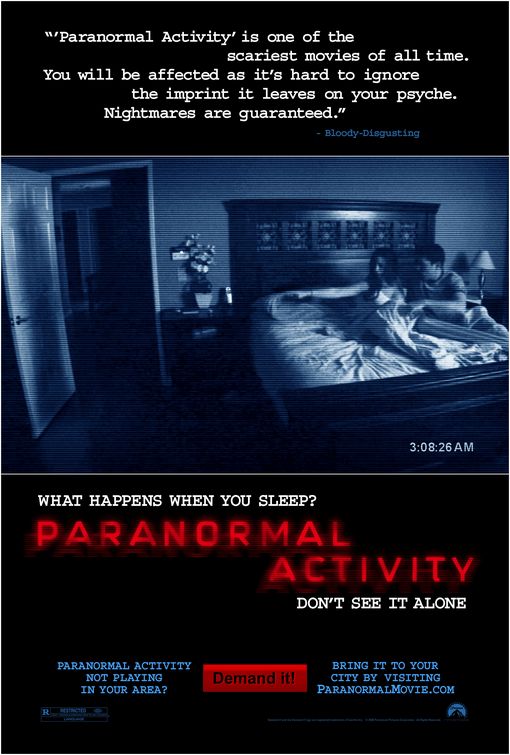
A little disappointed, last night I sat down to watch Paranormal Activity, the indie movie that made such a splash last year. Assuming it was a ghost story, I wasn’t too concerned about watching it alone on an October night. When I discovered it was a demon story, however, I wasn’t sure watching it alone was such a good idea. You see, in the hands of paranormal investigators the demon has undergone a transformation. Ancient Mesopotamians believed in a set of lesser gods who caused misfortune, although they don’t seem to have been pure evil and they didn’t call them demons. By the time we reach nascent Christianity, demons are cohorts of the Devil and are utterly malign and capable of possessing a person making them do the bidding of their dark lord. That’s where they remained on the divinity scale until modern day investigators using scientific equipment found them. I confess to having watched Ghost Hunters a time or two. Here the demon has morphed into a non-human disembodied entity – the very antagonist of Paranormal Activity.

Being aware of the origin of concepts is often a comforting place to be. When I realize that no special revelation has suddenly validated the existence of a baleful creature set to do me serious harm, a relief encompasses me. The problem with demons is that they don’t evaporate so easily. “Invented” by the Mesopotamians to explain misfortune, by the change of the era they had evolved into (largely) an explanation for epilepsy and mental illness. Now today they are back as haunting entities that have no human sympathy since they were never human. Paranormal investigators take them very seriously, despite their checkered theological pedigree. I guess I side with Shakespeare on this one: “there are more things in heaven and earth, Horatio…” After all, it is October and the nights are growing noticeably long.


Exorcists, Serpents, and Rainbows

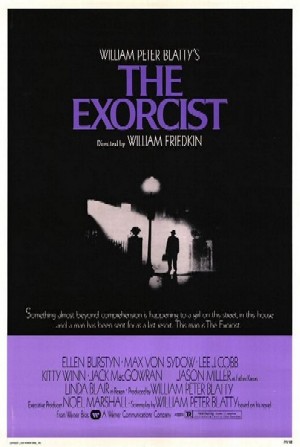
Tuesdays are release days for many new media products. I’m not sure why, but I accept it. This past Sunday’s paper ran a couple of stories by Stephen Whitty concerning the Blu-ray release of The Exorcist, counted by some critics as the scariest movie of all time. The press around the original release of the film in the early 1970s was enough to prevent me from seeing it until I was in my forties. I’m done using the word “release.” In an interview with Linda Blair, the iconic Regan MacNeil of the film, Whitty quotes her as noting that the rumors of “curses” on the filming of the movie were without basis. “But other people seemed to be trying to find something that didn’t exist,” she said. That sage statement could refer to considerable aspects of a society hungry for religious answers, but ill-educated on the religious facts-of-life.

Although sorely critiqued at the time by those whose religious sensibilities had been offended (Blatty is no theologian), Whitty nevertheless notes, “It may be a film full of gross obscenity. But in the end, ‘The Exorcist’ is a recruiting poster for that old-time religion.” He correctly observes that beliefs in possessing demons and that challenged social conventions will lead to evil permeate the movie. Traditional Catholicism wins out over that foreign Pazuzu every time. Even for those with more progressive beliefs, the film is difficult to watch. Religion, in addition to criticizing films, also provides some of the best plots.

Not to be counted among those best, but illustrative of the point, is Wes Craven’s The Serpent and the Rainbow. Ever since my days at the University of Wisconsin Oshkosh students have been after me to watch this film. Confused, dream-like, and at times difficult to follow, the movie opens with a claim to have been based on a true story. It isn’t the typical zombie movie either, although it features zombies. More of an attempted scientific thriller, the film explores the dangers of tetrodotoxin, “the zombie drug” when in the wrong hands. Understated in the movie, however, is the religious nature of Voodou. This is perhaps the most obvious failing point in the story. If the movie were to be really scary, the viewer has to believe that this is possible. The skepticism of science blocks the potential for unbridled religious expression. That is perhaps why The Exorcist has retained its power over all the years. Unlike more rational explorations of the world, it allows the audience to believe in personified evil that only old-time religion can cure.