Virtually Religious

“Which god would that be? The one who created you? Or the one who created me?” So asks SID 6.7, the virtual villain of Virtuosity.  I missed this movie when it came out 24 years ago (as did many others, at least to judge by its online scores).  Although prescient for its time it was eclipsed four years later by The Matrix, still one of my favs after all these years.  I finally got around to seeing Virtuosity over the holidays—I tend to allow myself to stay up a little later (although I don’t sleep in any later) to watch some movies.  I found SID’s question intriguing.  In case you’re one of those who hasn’t seen the film, briefly it goes like this: in the future (where they still drive 1990’s model cars) virtual reality is advanced to the point of giving computer-generated avatars sentience.  A rogue hacker has figured out how to make virtual creatures physical and SID gets himself “outside the box.”  He’s a combination of serial killers programmed to train police in the virtual world.  Parker Barnes, one of said police, has to track him down.

The reason the opening quote is so interesting is that it’s an issue we wouldn’t expect a programmer to, well, program.  Computer-generated characters are aware that they’ve been created.  The one who creates is God.  Ancient peoples allowed for non-creator deities as well, but monotheism hangs considerable weight on that hook.  When evolution first came to be known, the threat religion felt was to God the creator.  Specifically to the recipe book called Genesis.  Theistic evolutionists allowed for divinely-driven evolution, but the creator still had to be behind it.  Can any conscious being avoid the question of its origins?  When we’re children we begin to ask our parents that awkward question of where we came from.  Who doesn’t want to know?

Virtuosity plays on a number of themes, including white supremacy and the dangers of AI.  We still have no clear idea of what consciousness is, but it’s pretty obvious that it doesn’t fit easily with a materialistic paradigm.  SID is aware that he’s been simulated.  Would AI therefore have to comprehend that it had been created?  Wouldn’t it wonder about its own origins?  If it’s anything like human intelligence it would soon design myths to explain its own evolution.  It would, if it’s anything like us, invent its own religions.  And that, no matter what programmers might intend, would be both somewhat embarrassing and utterly fascinating.


Houses of Light

The Lighthouse is a movie we’ve been waiting a month to see.  Since its opening weekend my wife and I haven’t had two consecutive hours free during any weekend showtime.  Now that we finally managed it, I’ve been left in a reverie.  Robert Eggers, whose film The Witch opened to critical acclaim, has repeated the feat with this one.  His movies require a lot of historical homework and the end results have a verisimilitude that pays the viewer handsomely.  The details of the plot are ambiguous and the influence of King, Kubrick, Melville, Hitchcock, Poe, and Lovecraft are evident as two men in isolation grapple with insanity.  Also obvious is Greek mythology, with one reviewer suggesting Tom Wake is Proteus and Ephraim Winslow is Prometheus.  The end result is what happens when literate filmmakers take their talents behind a camera.

Naturally, the symbolism adds depth to the story.  The eponymous lighthouse is phallic enough, but the light itself—often a central metaphor of religions—is, like God, never explained.  Encountering the light changes a person, however, and the results can be dangerous, even as Rudolf Otto knew.  This light shines in the darkness so effectively that no ships approach the island.  The monkish existence of the keepers requires a certain comfort with the existential challenge of isolation, even if God is constantly watching.  The light never goes out, even when a reprieve would be appreciated.  Having reading Barbara Brown Taylor’s Learning to Walk in the Dark since the film opened, this makes some sense.  Horror movies lead the viewer into such territory when they’re thoughtfully made.

The concept of light is central to at least two similar forms of religion that have moved beyond doctrinal Christianity.  Both Quakerism and Unitarian Universalism emphasize the light as central to their outlooks.  Whether it be divine or symbolic, light is essential to spiritual growth.  In novels like Cormac McCarthy’s The Road the idea of an inner light keeps the father and son going.  In The Lighthouse the external light, when taken internally, leads to madness.  Since I watch horror with an eye toward religion—I do most things with an eye toward religion—I didn’t leave the theater disappointed.  I knew that, like The Witch, I would need to see it again but when it comes down to the price range of one ticket for repeated viewings.  Finding the time to get to the theater once was difficult enough, despite the payoff.  


Seventies

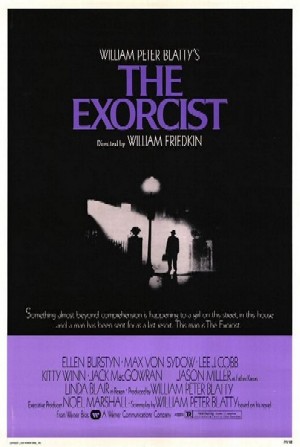
It’s pretty rare for me to be out on a week night.  Like a kid on a “school day” I’ve got to get up early the next morning.   And yawning a lot at work is bad form, even if nobody can see you.  I risked it recently, however, to meet with some colleagues from the Moravian orbit in Bethlehem.  As we talked, current projects came up, as they’ll do when doctorate-holders get together.  Demons are a conversation stopper, but I nevertheless asserted that our modern understanding of them derives directly from The Exorcist.  The insight isn’t mine—many people more knowledgable than yours truly have noted this.  One of my colleagues pointed out the parallel with The Godfather.  Before that movie the mafia was conceived by the public as a bunch of low-life thugs.  Afterward public perception shifted to classy, well-dressed connoisseurs who happen to be engaged in the business of violence and extortion.

The insight, should I ever claim as much, was that these films were both from the early seventies.  They both had a transformative cultural impact.  Movies since the seventies have, of course, influenced lots of things but the breadth of that influence has diminished.  I noticed the same thing about scholarship.  Anyone in ancient West Asian (or “Near Eastern”) studies knows the work of William Foxwell Albright.  Yes, he had prominent students but after Albright things began to fracture and it is no longer possible for one scholar to dominate the field in the same way he did.  Albright died in the early seventies.  Just as I was getting over the bewilderment of being born into a strange world, patterns were changing.  The era of individual influence was ending.  Has there been a true Star Wars moment since the seventies?  A new Apocalypse Now?

You see, I felt like I had to make the case that The Exorcist held influence unrivaled by other demon movies.  We’re still too close to the seventies (Watergate, anyone?) to analyze them properly.  Barbara Tuchman suggested at least a quarter-century has to go by for the fog to start clearing.  Today there are famous people who have immense internet fame.  Once you talk to people—some of them my age—who don’t surf the web you’ll see that internet fame stretches only so far.  It was true even in the eighties; the ability to be the influential voice was passing away into a miasma of partial attention.  The smaller the world gets, the more circumscribed our circles of influence.  And thus it was that an evening among some Moravians brought a bit of clarity to my muddled daily thinking.


Frozen Streams

I was walking in Ithaca, with my feet not far from Sagan.  Winter had settled in prematurely, as it often does in upstate.  I was wearing a hoodie and old fleece combo and I suppose I looked a bit tatty.  My wife and daughter had gone to see Harriet, but movies about how badly people have mistreated others, strangely for a guy who watches horror, really depress me.  Ithaca, until recently, supported three independent bookstores, so I figured I could pass the time easily enough.  It was growing dark and breezy, and I visit bookstores only with a list, otherwise it’s too dangerous.  Autumn Leaves, a used vendor, I’ve visited many times.  Their religion section is disappointingly small, but I tend to find offerings in other areas when I blow in.

Buffalo Street Books is the last remaining indie that handles new books, but I stopped by The Bookery, now closing, on my way.  This was saddening.  Ithaca houses both the ivy league Cornell and the highly regarded Ithaca College.  I suspect many of the street sweepers hold doctorates.  Has book culture entirely bent the knee to Amazon?  At the end of the last millennium, Ithaca housed 25 independent bookstores.  Today it’s evident that Buffalo Street (formerly The Bookery II) struggles to keep its hold.  I feel ethically obligated to buy something there, to take one for the team.  I had a short list and the shelves in The Bookery had been nearly bare.  It was just too depressing to stay there.  I found an inside bench and sat to read until the movie was over.

Or so I thought.  I ventured back outside and now it was fully dark, being six p.m., and I wandered back to the familiar Ithaca Commons.  I went into a couple of shops, but they looked at me as if I were homeless.  (I suppose I was, in a sense.)  I haven’t had a haircut in a while, and my beard is scruffy and white.  My hoodie and fleece don’t speak to affluence.  I had unconcealed books—I routinely refuse bags—and I suppose I could come across as a touch eccentric.  (I don’t have enough money to be authentically eccentric.)  I wondered how street people do it.  Outside the east wind was decidedly sharp and windbreaks on the pedestrian zone are few.  I came to the monument to Martin Luther King Junior.  I was walking in Ithaca but I really felt that books could make that dream come true.


Quiet Now

The funny thing about my movie watching is that it’s a reflection of my scattered lifestyle.  While I was teaching my career progression was linear with a goal of moving beyond Nashotah House to a college or university that shared my values better.  Publishing was a fallback, and I’ve learned a lot but I haven’t unlearned my academic leanings.  So, like the rest of my life, my movie watching is piecemeal.  I found a copy of A Quiet Place in a Halloween sale.  My wife bought it for me and on a weekend on my own I watched it.  I had no idea what it was about, but I’d read that it was an intelligent horror film, and that was good enough for me!  There may be spoilers here if you live in a cave, like I do (metaphorically), so be warned.

The backstory isn’t fully spelled out, but the monsters in this movie are blind and attracted to their victims by sound.  The focus is on a family in upstate New York that’s trying to survive without making any noise.  Since there are kids involved, you’ll see how tricky this could be.  John Krasinski’s film builds the suspense wonderfully.  Borrowing from M. Night Shyamalan at his best, and Alien and even Stranger Things, the movie has a odd effect.  When it’s over you don’t want to make any noise.  I watched it while my wife had to work over the weekend, and I put the DVD away as quietly as I could, and then went to bed.  Awaking alone the next morning, I continued the vigil.  Critics praised the movie for its silence, perhaps what we’re most afraid of in this noisy world.

I spend a lot of time saying nothing.  Editing is a quiet job.  Telecommuting is a quiet lifestyle.  At Nashotah House we had mandatory quiet days, which, if they weren’t mandatory I would’ve loved.  I’d seriously considered a monastic lifestyle when I was younger—there’s great value in being quiet.  A horror film that teaches that lesson, despite many obviously unanswered questions, is worth paying attention to.  Horror films have continued to grow more intelligent over the years.  This one is rated PG-13 and will have you on the edge of your seat (or under the bed) anyway.  And it’s got an important message.  For those of us who don’t say much (maybe that’s why I write all the time) a movie like this acts, if you will, as a loudspeaker.  Does anybody hear me?


Homemade Halloween

Halloween is a holiday that brings together many origins.  One of the more recent is the tradition of watching horror movies in October.  I don’t know if anyone has addressed when horror films became associated with the holiday, but Halloween hasn’t always been about startles and scares.  Histories usually trace it to the Celtic festival of Samhain.  Samhain was one of the four “cross-quarter days.”  Along with Beltane (May Day), its other post equinox cousin, it was considered a time of year when death and life could intermingle.  Spooky, yes.  Horror, not necessarily.  Many cultures have had a better relationship with their dead than we do.  We live in a death-denying culture and consequently lead lives of futile anxiety as if death can somehow be avoided.

As a holiday Halloween only became what it is now when it was transported from Celtic regions to North America.  Other seasonal traditions—some of English origin such as Beggars’ Night and Guy Fawkes Night—which fell around the same time added to the growth of trick-or-treating and wearing masks.  At its heart Halloween was the day before All Saints Day, which the Catholic Church transferred to November 1 in order to curb enthusiasm for Samhain.  As is usual in such circumstances, the holy days blended with the holidays and a hybrid—call it a monster—emerged.   When merchants learned that people would spend money to capture that spooky feeling, Halloween became a commercial enterprise.  Despite All Saints being a “day of obligation,” nobody gets off school just because it’s Halloween.

My October has been particularly busy this year.  One of the reasons is that Holy Horror, as a book dealing with scary movies, is seasonally themed.  As I was pondering this, weak and weary, upon the eve of a bleak November, I realized that home viewing of horror—which is now a big part of the holiday—is a fairly recent phenomenon.  Many of us still alive remember when VHS players became affordable and you could actually rent movies to watch whenever you wanted to!  Doesn’t that seem like ancient history now, like something maybe the Sumerians invented?  People watch movies on their wristwatches, for crying out loud.  I suspect that John Carpenter’s Halloween had a good deal to do with making the holiday and the horror franchise connection.  Horror films can be set in any season (Wicker Man, for instance, is about Beltane, and three guesses what season Midsommar references).  We’re so busy that we relegate them to this time of year, forgetting that we still have something of the wisdom of the Celts from which we might learn.


Book Festival

So it’s here.  The Easton Book Festival begins today.  The weather?  Partly sunny, temps in the mid-60s.  There’s no excuse not to go!  (Well, actually, there are plenty of reasons, but if you’re in the area please consider it!)  I have to admit that my involvement with it was opportunistic.  I contacted the organizer because I was looking to promote my autumnally themed book, Holy Horror, in the season for which it was written.  I understand delayed gratification.  What author isn’t delighted when her or his book arrives?  Thing is, mine came around Christmas time, and, while a wonderful gift, nobody was thinking about scary movies during the joyful winter season.  My observation is this: books are lenses to focus thoughts.  I enjoy Halloween, but I also enjoy Christmas.  One follows the other.  The Easton Book Festival just happens to be during the former rather than the latter.

It’s heeerrreee…

My own involvement with the festival doesn’t start until tomorrow.  Today’s a work day, after all.  Employers don’t give days off for self-promotion (or even for writing books) so festivals are extra-curricular activities.  I’ll be on a panel discussion tomorrow at the Sigal Museum and on Sunday afternoon I’ll be doing a presentation on my book, same venue.  Maybe I’ve got this backwards (nobody tells you these things), but I’m not doing this primarily to sell books.  I’m doing it to promote dialogue.  During my less-than-stellar book signing last week at the Morvarian Book Shop I had only one brief conversation of substance.  It was with a scientist who pointed out that science and religion had nothing to do with one another.  I guess my hopes for the events of the next two days are that folks might want to discuss the ideas in the book.  Or at least think about them.

Sunday morning I’ll be giving a church presentation on the book as well.  Being in the publishing biz I’ve learned the importance of authors getting out there to talk about their books.  Hands up, who’s read a McFarland catalogue lately?  Case in point.  The only problem with all of this is that I still have to get my weekend errands done.  My daily schedule doesn’t allow for trips to the grocery store or even putting gas in the car.  And no matter how much time I put into work, there’s always more to do.  Festivals, of course, are intended to be time set apart from regular pursuits.  So I’m going to put on respectable clothes and I’m going to speak about what’s on my mind this time of year.  If the Lehigh Valley’s in your orbit, I’d be glad to see you there.


Amityville Rehaunted

One of the problems with scarce resources is the desire not to squander any of them.  Time is so rare these days that I keep multiple writing projects going (and growing) and when they’re ripe I pluck them and take them to market.  One of my writing projects had me read Hans Holzer’s Murder in Amityville.  Why?  Fair question.  It was the “inspiration” behind Amityville II: The Possession.  I discuss this film in Nightmares with the Bible, and I’ve been going back and reading those period pieces from the 1970s that formed so much of our culture through the end of the last century.

In case you didn’t grow up with an interest in parapsychology, Hans Holzer was a pretty big name then.  I can assert that with some confidence because I grew up in a small town without access to big city resources (where fame is made) and I knew about him.  Holzer wrote well over 100 books, which might give you a hint regarding their quality.  He was an interesting person.  Like Ed and Lorraine Warren he made a living by investigating, writing, and lecturing.  (I can’t seem to break into that cycle—times have changed!)  A firm believer in ghosts and demons, Holzer was naturally drawn, like other moths around the candle, to Amityville.  Murder in Amityville is his summation of his investigation and all I can say is it’s a good thing he wasn’t a lawyer.  Apart from containing lengthy transcripts of Ronald DeFeo’s trial, the book also contains interviews conducted by Holzer.  Full of leading questions and lacking evidence, it fails to convince even a sympathetic reader.

Still, you’ve got to give Holzer credit for including interviews where his loaded questions get him nowhere.  In interviewing a town historian for Amityville, Holzer kept bringing up allegations about the house at 112 Ocean Avenue only to have the nonplussed historian tell him point blank that his (Holzer’s) allegations are incorrect.  His assertions of an “Indian burial ground” are taken for granted, although no historical records substantiate it.  His interview with DeFeo demonstrates Holzer’s irrepressible faith.  After being told by DeFeo that he’d heard no voices—something he made up for a failed insanity plea—Holzer keeps coming back to what the voices told him to do.  Not only that, when Holzer does stumble upon a good question he fails to follow up, chasing some other notion down another rabbit hole.  There was clearly enough material here to work into a horror movie, but for sorting out the troubled home life of the DeFeo family the critical reader finds her or himself being asked to take a lot on faith.


Local Hauntings

In my on-going research (as I think of it), I watched The Haunting in Connecticut.  I recently wrote about A Haunting in Connecticut, distinguished from the theatrical version by an indefinite article.  Both claim to be based on a true story and the story itself is disputed because it doesn’t fit into a materialist paradigm.  Ah, but that’s another can of worms.  Regarding the movie, it abandons the base story to add an entirely fictional subplot that drives the horror.  Or so the writers and director think.  The tale ends up jumbled and the confusion it generates is not the kind borne of intelligent planning.  The Campbell family, struggling to pay the bills against a case of childhood cancer is real horror.  In our healthcare system that is a true story.

According to the diegesis of the movie, Matt Campbell can see the dead because he’s close to death.  In case you don’t know the story—the family has to move to be closer to the hospital where Matt is receiving his treatment.  Once ensconced in their new house they learn it used to be a funeral home and hauntings ensue.  The writer of the original book claims to have made much of it up, while interviews with witnesses make the claim that much of it actually happened.  Matt ends up in a mental hospital.  In the movie a subplot of necromancy and a young boy medium are added.  Souls whose bodies have been bound are trapped in the house until Matt figures out how to break the spell with the help of the medium’s ghost.  Instead of Ed and Lorraine Warren investigating, a local minister is added.  Also suffering from cancer, he figures it out too, but too late to help the Campbell family.

In Holy Horror and Nightmares with the Bible I do not treat made-for-television movies.  A large part of the reason is that they often lack the cultural impact of a theatrical release.  (Although Game of Thrones and The Walking Dead may have reached a point of familiarity with numbers to rival big screen efforts.)  In the case of the cinematic treatment of the Snedeker (“Campbell”) family, however, the television treatment might well have been scarier than the big-budget studio effort.  Whether fictionalized or not, the Discovery Channel show stays closer to the book (In a Dark Place, by Ray Garton).  Using the Usher-like ending of destroying the house doesn’t seem to offer any release in the big-screen version.  Sometimes reality is scarier than the tales we tell after dark.


Spiritual Fear

There’s an old adage that if a headline asks a question the implied answer is “No.”  I’ve found that to be true, largely.  I hoped differently when I saw the article titled “Are Horror Films Secretly Spiritual?” by S. Rufus in Psychology Today.  Rufus, admittedly not a fan of horror, ponders whether it might not meet a spiritual need for some.  She would not count herself among that number, should the assertion prove to be the case.  Indeed, her post has more sentences ending in question marks regarding this assertion than it has straightforward declarative ones.  Rufus notes that ancient religions involved a kind of fear-based response appropriate to the lifestyle of those open to constant threat by the natural world.  She seems to believe that civilization has saved us from that.

Now one of the questions with which I constantly struggle is why I watch horror.  I do not like being afraid, and when people find out about my fascination with horror they tend to treat me as if there’s something wrong with me.  I guess maybe I think that civilization has not so much eliminated the sources of threat so much as changed them.  Those who grow up poor know fear.  Fear of want is extremely prevalent in our capitalist society.  I see the “street people” when I go into New York City.  They are not few.  Once you start to get away from affluent suburbs just about anywhere you start to see the run-down houses of those who can’t cope with the demands of a consumerist society.  Even those of us with an education are liable to joblessness and the very real terror that attends it.

Civilization, in other words, comes with its own costs.  Religions originally began—some of them at least—largely from the fear response.  Yes, people were afraid.  The gods, properly propitiated, stay the hand of disaster.  For now.  Some religions, such as those in the monotheistic family tree, tend to suggest higher principles like love can be the motivation.  These religions, however, quickly begin to make threats against those who are heterodox, and reintroduce fear into the formulation.  I suspect, from my own experience of all of this, that the answer to the question may actually be “yes”—horror films do offer something spiritual.  There is a catharsis, if I may borrow a term from psychology, in them.  The spiritual element may, however, run much deeper than that.  Until human society truly takes love and justice as its operating principles, we will have horror films to help us learn to cope.


Haunted State

Some few years back, when FYE was still a thing, I’d hunt for bargains at our local.  I came across a two-for-one DVD that seemed promising, but when I got it home I discovered it was a made-for-television combo, and movies of that ilk often fudge on many angles.  I watched them nevertheless.  These were the Discovery Channel’s first two specials in what would become a series titled “A Haunting.”  I have to admit A Haunting in Connecticut freaked me out so much that I decided to trade the disc back in—something I rarely do.  (The other feature, A Haunting in Georgia, I could barely remember.)  As is usual with things I get rid of, I grew curious once again—this time a decade later.  Fortunately both movies are included in Amazon Prime, so I was all set.  I just needed that rarest commodity of all, time.

You might think that a guy who gets up at 4 a.m. on weekends would have plenty of extra time.  That’s not the case.  Nevertheless, I squeezed the clock to watch these shows again for research purposes.  Neither one was so scary as I recall—I’ve seen quite a few movies since then—but they did get October off to a moody start.  Of the two I recalled far less of the Georgia story.  Perhaps part of the reason is that it left so much unresolved.  The Wyrick family apparently experienced many ghosts and their investigator, William G. Roll, took their claims seriously.  While not an Ed and Lorraine Warren film, like its sibling, it follows the pattern of repeated, reported activity, investigation, and, well, not quite resolution.  The family attends a Pentecostal church, and, interestingly, the documentary treats it respectfully.

Unlike A Haunting in Connecticut, A Haunting in Georgia films some events in real time—notably the church service.  The pastor is interviewed and he, unlike Dr. Roll, believes the entity to be demonic.  The documentary treats him with the same gravitas as it does the Berkeley-trained psychologist.  There’s too much going on here to make a memorable narrative, though.  Stories, at least in the classical fictional sense, have some kind of resolution.  The Georgia narrative has too much complexity and too little sense that anything has been solved.  To me the amazing thing was that I had watched this film before and I remembered maybe only the first fifteen minutes.  Both films went on the bigger things, getting remade into theatrical features that I’ve never seen.  But then again, I barely have time for my own unresolved story.  Maybe FYE offers its own brand of local haunting.


Book Signing

Okay, so I’ve got a book signing for Holy Horror coming up at the Moravian Book Shop in Bethlehem.  And they’ve advertised it in the local paper.  I’m humbled and honored by this, especially since I have no local following.  When I go to the website of the newspaper, The Morning Call, ads pop up on the top, bottom, and center of the page, obscuring the event.  I take this as kind of symbolic.  Life is crowded.  We seem to have turned the corner to autumn around here with nights being distinctly chilly.   After the languorous heat of summer when even thinking about winterizing seemed to add another layer of insulation over already too warm body, now we suddenly have to try to fit it in among an already crowded schedule.  At least I don’t have to commute too much any more.

I’m trying to get ready for the book signing, but I don’t really know what to do.  Perhaps I should try to get some business cards printed up.  Maybe I should think of some catch-phrase to use if anyone actually buys a high-priced book.  What should I wear?  Working at home can make you feel like a recluse sometimes.  I don’t have enough money to be considered eccentric, but I don’t get out among hoi polloi much either.  If most people have as much trouble as I do clicking off the ads to get to the event underneath, those who swing by the table are likely to be few.  Still, I’m looking forward to meeting local horror film fans.  They are, in general, a surprisingly cordial bunch.

After Nightmares with the Bible I’m going to focus on trying to find more mainstream publishers.  The reason is simple: academic publishers tend to be overpriced.  I’ve worked in publishing long enough to be able to decode pricing schemes.  There is a logic to them, even if at times it feels like you’re being overshadowed by pop-up windows.  To get a wide readership you need a pretty big platform, and getting a following on any form of social media takes the one thing I don’t have enough of.  Time.  You see, just the other day it was summer and we felt like we were baking.  Now the equinox has plunged us into the days of getting the furnace cleaned and operational and looking at the prices of insulation and shaking our heads.  Somewhere under all of these pop-ups are ideas waiting to be written down.


Ambling through Amityville

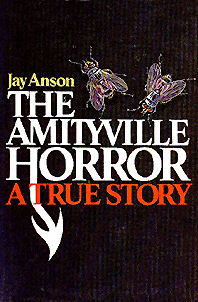
I may be a week too late for Friday the 13th, but I just finished rereading The Amityville Horror.  One of my current projects required my paying close attention to what was and was not claimed, and although it doesn’t count towards my Goodreads goal, I just had to do it.  I noticed, as also occurred to me when rereading Gerald Brittle’s The Demonologist earlier, that the second time through raises more questions than the first.  The book has been demoted from nonfiction to novel over the years, but it seems pretty clear that Jay Anson believed it to be based on actual events.  He could’ve been wrong, of course, but with a long list of documentary writing credits to his name one does have to wonder.  Anson died just a year after the film came out.

When the movie was released I was still in high school and what everyone was saying about how scary it was kept me out of theaters.  (That, and lack of funds.)  It’s hard to imagine now, but there weren’t even VHS options in those days, especially for those of humble circumstances.  As a result, I was well into adulthood before I saw the cinematic version.  Reading the book, however, is an attempt to pry open the question of what might’ve happened at one of the most famous “haunted houses” this side of the Atlantic.  I’d just read a headline that the house had been sold again, and such was the impact of this story that a simple property transaction is now considered news in some circles.

Controversy permeates this tale.  I suspect that’s because it made a lot of money.  The search for the truth is often compromised by lucre—just look at the White House and try to disagree.  The usual rendering is that the Lutz family, in financial trouble, concocted a story that would bring in big bucks.  Such accusations came, of course, once the story did indeed prove valuable.  The second highest grossing film of 1979, The Amityville Horror held records for the highest grossing independent film for a decade.  Add to that the estimated book sales of 10 million copies and you have a nice retirement account laid up.  Those levels of remuneration are enough to corrupt any narrative.  Still, it’s clear that many people wonder what really went on at the house on Ocean Avenue.  I sat down with the book again and I have to admit that I’m no wiser on the question for having read it again.


Fearing Hubris

I’m afraid of hubris.  You see, my academic career was not exactly distinguished, and as an editor you’re encouraged to keep to the background.  Still, when you write a book you need to promote it a little, which is one of the things I learned as an editor.  I was equally parts embarrassed and pleased to see the bookstore display for my upcoming book signing in Bethlehem.  I mean, although I wrote Holy Horror for a general readership, the publisher tends more toward academic books and their pricing, so this is not an inexpensive purchase.  Those who write are nothing, however, without readers.  Those chosen for interviews are writers who’ve made a sales impact or who have a university behind them.  When it’s just me, it feels like maybe I’m trying to ascend Olympus on my own initiative.

I was in the Moravian Book Shop to purchase Neal Stephenson’s Fall; or, Dodge in Hell.  I’ve fallen a bit behind on Neal’s work, largely because Goodreads challenges are measured in numbers of tomes read.  I was pondering this, book in hand, when I noticed—there I was with my own display.  You see, Holy Horror was meant as a guilty pleasure read for those of us who like the scary time of year.  The book price is the scariest part about it, however.  I feel a profound gratitude when anyone actually buys it.  Since there are now copies available on sites such as eBay, I’m guessing some who’ve read it want to recoup a little of the cash outlaid.  While all of this is happening, however, I know that I have to learn the art of book promoting.  Still, it feels like that self-promoting I was warned against as a kid, an unseemly thing.

Writing is a form of conversation.  When I’m in a room with a bunch of other people unless I’m the teacher I have trouble making myself heard.  I’m soft-spoken by nature.  I suppose it’s obvious, then, why a book signing feels hubristic.  Perhaps it’s appropriate for a book about fear to engender this sense of discomfort.  Entering the conversation has always been difficult for me.  At the same time, as the beneficiary of so many books, I feel compelled to give something back.  My insights, if such there be, won’t rock the world.  As I think of myself signing books, I wonder what I could possibly say to someone who’s willing to pay that price for something I produced.  If you’re going to try to climb that mountain, you’d better think about what you’ll say when you meet the gods at the summit.


Unwished Inheritance

When I mentioned my book Holy Horror to someone recently, she asked “Have you seen Hereditary?”  I had to allow as I hadn’t.  I have to struggle to find time to watch movies, and I’m generally a couple of years behind.  Surprisingly, Hereditary was available for free on Amazon Prime, and I finally had the chance to terrify myself with it.  Perhaps it didn’t help that I’d been reading a book on schizophrenia at the time (as will be explained in due course).  Hereditary is one of those movies that is impossibly scary, up until the final moments when it suddenly seems unlikely.  In this respect it reminded me of Lovely Molly and Insidious.  All three also feature demons.  Using a child to accommodate the coming of a demon king brought in Rosemary’s Baby and the Paranormal Activity franchise.  (The genre is notoriously intertextual.)

While demons can make movies scary, what really worked in Hereditary was the sense of mental instability and the lack of a reliable character to believe.  The Graham family is deeply dysfunctional.  Mix in elements of the occult and dream sequences and you’re never certain what, or whom, to believe.  As with many of the films I examine in Holy Horror, the realms of religion and fear are interbred.   While the Bible plays no part in Hereditary, the matriarch’s “rituals” pervade the family following her death.  In a family of females, where a male demon seeks expression through possession, an obviously challenging dynamic is set up.  It works out through a series of disturbing images and manipulations.

Watching the family disintegrate becomes the basis of the horror.  Then possession comes into play.  As in most films concerning possession, deception and misdirection are used.  A demon named Paimon is seeking to take over the one male heir.  This ties the movie to The Last Exorcism, where the same demon under a different name seeks to propagate through Nell Sweetzer.  Unlike many possession movies, the suggestion that possession is actually involved comes late in the script.  This revelation underscores the the misdirection of attention that focuses on Annie Graham’s struggle to cope with reality.  Her sleepwalking and threats to her own children as well as the suggestion that they are but miniatures being manipulated by a larger, more powerful entity, keep the viewer off balance throughout the story.  Intelligent and provocative, Hereditary assures me that tying to analyze such films, while perhaps a fool’s errand, is an enterprise unlikely to be soon exhausted.