Targeted by Technology

We get along in life, I believe, by routinely ignoring the rather constant dangers that surround us.  Oh, we’ve taken care of the larger faunal predators, but we’ve replaced them with ourselves.  Our success as a species leads us to places we might not be comfortable being.  I was recently exposed to the documentary National Bird.  It’s about drones.  Not the friendly ones from Amazon that we hear will soon be delivering books to our doorstep, but the military grade kind.  I first became aware of how pervasive the military use of drones is while reading Wired for War (on which I posted here some years back).  The difference between that academic knowledge and watching the documentary is the human element.  Drones are assassination machines with high explosives and they are subject to no regulation.

Many of us feel, occasionally, some level of discomfort with how much information “they” have on us.  We don’t even know who “they” are or what they want.  Using the internet, we give them our information.  Caving to our desire for instant communication, we carry around smart phones that know where we are constantly.  Martin Luther once said you couldn’t stop birds from flying over your head, but you can prevent them from making a nest in your hair.  It’s becoming harder to shoo them away.  The nest is well established.  Our houses are easily found on Google maps, and drones can keep constant watch, like weaponized guardian angels.  Only they’re not our guardians.  As National Bird makes clear, drones kill civilians.  Women and children.  The conversations of the operators reveal how much they’ve bought into the jingoism of the “war on terror.”  The film also deals with the human cost of those who operate drones.

Technology stands to make life better, for some.  Watching people who have very little, who live in what would be considered poverty in this part of the world, being bombed by people remotely, is disturbing.  The operators, trained as if they’re playing a game, kill and then have to deal with it.  The use of tech to try to sanitize brutality was dealt with decades ago on a particularly famous episode of Star Trek appropriately called “A Taste of Armageddon.”  Rather than try to resolve conflict we, like those of Eminiar 7, readily accept it if it’s kept at a distance.  Only drones aren’t science fiction.  We’ve been using them for over a decade now, and we prefer not to think about it.  This isn’t an option, unfortunately, for those who’ve been targeted by technology.  The predators are still out there after all.


Leggo My Lego

Given my proclivity to seek the profound in what is often considered the banal, I have been mulling over The Lego Movie.  Before you cast the first brick, yes, I know this movie is five years old and I know that it has sophisticated intertextuality with other movies and sly humor.  I use banal in the sense that Legos are, quite literally, plastic and they don’t work well in conveying the human form.  Our overactive psyches help here, and we give the characters their necessary humanity, but this is a movie for kids, even with its Trump-like President Business forecast some two years before the last election.  With all of that being said, and the word “forecast” already being used, my “Bible radar” zeroed in on the prophet in the movie, Vitruvius.

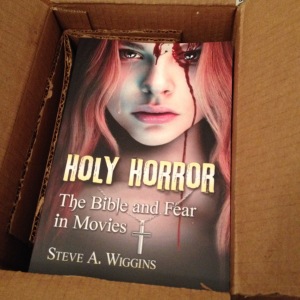
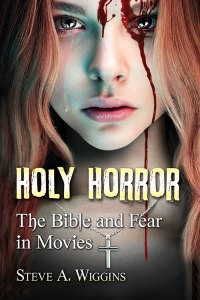
Vitruvius is based on a combination of Tiresias, the blind prophet, and any number of biblical characters who forecast the future.  Dressed like Moses, but named after a Roman author and architect, Vitruvius utters the prophecy at the beginning of the film and returns as a character that combines Obi-Wan Kenobi and the prophet Samuel.  (I said there was sophisticated intertextuality.)  Whether any of this is intentional is difficult to say—well the Obi-Wan part is pretty obvious—but it plays into the common view of prophets.  One of the points I make in Holy Horror (which deals with a different genre of movie) is that people understand biblical ideas through the lens of pop culture.  Prophets, through that lens, tell the future.  In the Bible itself they don’t do that very much, but since the New Testament reads itself into the Hebrew Bible (more intertextuality) the idea became pretty fixed that prophets told the future all day long.

Ironically, Vitruvius—a name that sounds like “virtue”—was famous for describing perfect proportions.  Indeed, Leonardo da Vinci’s “Vitruvian Man” sketch is based on this idea.  As ideas go, this is a false one against which many of us struggle our entire lives.  There is no perfect, Platonic human body.  Yes, certain people are attractive, but genetics and circumstances make us who we are.  And some of us grew up without Legos, but despite that deficiency we came to know the product.  The Lego characters aren’t in any sense of Vitruvian proportions.  Witty and intertextual, they’re made of plastic and they encourage us to buy for our children.  And one wonders whether Vitruvius is a prophet or a hidden symbol of that word’s homonym.  Let the building begin.


Night of the Living

The New Yorker view of the world, so the joke goes, sees the five boroughs in great details, then a very thin New Jersey across the Hudson with a vague California somewhere out west.  Having worked in New York City for nearly a decade now, I know that such a view is exaggerated, but has a small glimmer of the truth.  We can only pay attention to so much and things are constantly coming at you in Gotham.  I sometimes forget, now that I’m in Pennsylvania again, just how diverse my home state is.  I’m not from old Pennsylvania stock—neither of my parents were born here and neither of my mother’s parents were born in the same state she was.  Still, when you’re born in a place it’s natural to feel that’s where you belong.  You inherit the outlook.  I inherited Pennsylvania.

Pennsylvania is a bit unusual in being a commonwealth divided in two by a mountain range.  Laid out with an horizontal orientation, it’s about 280 miles across, and once you’re over the Appalachians, you’re into a different subculture.  On our way into Pittsburgh, signs for Evans City reminded me that among its many contributions to American culture, the Steel City also gave us zombies.  Now from a history of religions point of view, zombies came from Caribbean religions that fused indigenous African beliefs with Catholicism.  A religion that arose among people commodified as slaves.  A zombie was a body with no will.  It took George Romero, living in Pittsburgh, to give us the movie zombie with The Night of the Living Dead.  Pittsburgh, among some, is glad to claim the title of zombie capital of the world.  Its zombie walk is a thing of legend.

Ironically, the western end of the state, beyond the mountains, tends to be more conservative than the side closer to the seaboard.  (Pennsylvania is the only of the original thirteen colonies not to have direct Atlantic Ocean water frontage.)  Yet it has adopted the most egalitarian of monsters—the living dead.  Romero tapped into the universal fear of unsettled death to make what were later to appear as “zombies” the unnamed monsters of his most famous film.  Everyone has to die, and no matter our religious outlook (or lack thereof) the question of what comes after is asked on both sides of the Appalachians.  And even by those across the Hudson in New York City.  There may be even something between the two.


Theofantastique Interview

Two times.  In my “professional” life I’ve been interviewed only twice (not counting, of course, far too many job interviews).  The first time was as a talking head for Nashotah House.  This was in the days before the internet really caught on, so it was done in DVD format.  If you come over to visit I’ll dig it out and we can have a good laugh.  The second occasion was much more fun.  Although I write about horror a lot, I don’t mention Theofantastique nearly enough.  Back in the days when I started blogging, I discovered this site that featured all kinds of interesting stuff on religion and horror (and actually on all kinds of genre pop culture).  I always enjoyed the insights and got more than a few books for my own research and reading from tips I found there.

When I finally got brave enough to contact John W. Morehead, the curator of the blog, we both quickly realized we had some things in common.  John very kindly offered to post an interview with me on Theofantastique about Holy Horror.  It’s live now and it was really fun to talk to an actual person about my book.  You see, I work alone.  I knew that, leaving the classroom, I was departing my chosen career.  On those high school aptitude tests they told me that I should be an entertainer.  What professor isn’t?  I pity their students if they’re not.  I’ve been posting videos on YouTube for a few weeks now.  It’s immediately obvious how much having a live audience helps.

Unfortunately, Holy Horror isn’t exactly priced to move.  In fact, local bookstores have turned me down for free presentations based on the price alone.  It is, however, a fun book to read.  At least I intended it that way.  When life give you horror, make Bloody Marys, I guess.  By the way, John has been coming out with some interesting books also.  I posted on his The Paranormal and Popular Culture recently.  Theofantastique is often the place where I first learn of new horror films (I don’t get out much) and new books that I should read.  Of these two things there’s never a shortage—horror is a thriving genre—and talking about why you wrote a book helps to clarify things a bit.  Horror may seem a disreputable genre to many, but it has redeeming values.  To hear about them, please watch the interview.


Suddenly Spring

Maybe it’s just a sign of passing years, but spring seems much more sudden to me now.  One day I’m wearing multiple layers and shivering in the mornings and the next day I need to take a machete to the lawn for its first mowing.  Those weeds along the fence, which weren’t there a day ago—I swear!—are now two feet tall and aching for an appointment with the weed whacker.  I mean, the snow shovel’s still on the porch.  When did this happen?  How did we go from brown grass to sprouting trees of heaven just overnight?  I haven’t had time to build up my calluses yet for pushing the lawn mower (we have the environmentally friendly kind, powered by naught but human effort).  Morpheus was right, I guess.

This past week was so unexpectedly busy that I haven’t had time to stop and muse over some important happenings.  My current project, Nightmares with the Bible, involves trying to sort out The Conjuring universe, and I wanted to reflect on the passing of Lorraine Warren.  Her obituary in the New York Times  by Neil Genzlinger was surprisingly respectful.  Whether or not she was really onto something, people in general seem to believe she and Ed were sincere in their convictions.  There are those who claim they were charlatans, but those who perpetrate hoaxes tend to leave telltale signs.  Those who claim they couldn’t have experienced the paranormal because there’s no supernatural to experience are entitled to their opinions, of course.  Being tolerant of those who see differently, however, has never been more important.

The natural cycles of the earth never fail to surprise me.  Supernatural or not, the explosion of life following one warm, wet week is nothing shy of astounding.  I walked around to the seldom visited north side of the house to find a veritable jungle that wasn’t there just the week before.  Staring at the flowers and weeds, I can’t help but think of the hackneyed phrase “pushing up daisies.”  Much happened this past week.  The mower was oiled up and played the grim reaper to the grasses and other plants of my neglected yard.  Life, as Jurassic Park (which my lawn resembles) teaches, is persistent.  I never met or in any way corresponded with the Warrens, but I feel that in some sense I have gotten to know them.  And just yesterday it still felt like winter.


Rise Again

Resurrection, as I argue elsewhere, is a scary thing.  Since today’s Easter, at least in the western Christian world, people are—or should be—thinking about resurrection.  In the case of Jesus, a young man who died “before his time,” resurrection seems only fair.  Indeed, in the earliest biblical hints of the concept it applied to people in precisely that category.  The story’s different for older folk who are beginning to wear out and are ready to go to a better place.  Christianity made the idea of resurrection more palatable by stating that you get a new and better body next time around.  The creeds say, after all, “the resurrection of the body.”  Heaven, it seems, is an embodied location.  Resurrection is necessary to get there.

Horror writers and film makers have used revenants to great effect.  When they do, pop culture latches on.  Think about the vampire craze of the early 2000s.  Or the ongoing fascination with zombies.  Even your basic garden-variety ghost.  They’re all revenants that attract and repel us.  We’re not quite sure what to make of life after death.  It’s okay if it’s played out beyond human senses, but as much as we want life to go on we don’t want to witness it here.  Horror films like to play on this ambiguity.  They’re closely related to religious ideas.  I’m occasionally asked why I watch horror; it’s essentially the same question as why I study religion.  Sometimes you just need to look closely enough to find the connection.  Resurrection, as I discuss in Holy Horror, is tied to some of humanity’s most basic fears.

Just two days prior to Easter, Good Friday in fact, Lorraine Warren passed away.  A fervent believer in resurrection, she was half of the dynamic paranormal investigating couple of Ed and Lorraine, about whom I’ve posted from time to time.  This coincidental occurrence illustrates once again the connection between resurrection and horror.  The Warrens were fond of declaring that haunting spirits of the human kind were those that had not passed over into the next world.  Revenants were confused spirits (not to be mistaken as demons, which were something completely different).  Resurrection, presumably, awaits just the other side of the veil.  Clearly religion shares this roadmap with horror.  Just as the Warrens will be resurrected as characters in this summer’s forthcoming Annabelle Comes Home, such returns to life may take many forms.  It’s Easter for some of us, and it can integrate horror and hope, if viewed a particular, perhaps peculiar, way.


Which Shaman?

It’s a strange kind of vindication when you see someone argue your ideas independently.  Even if they understand those ideas in a different way.  I suppose it’s necessary to say that in academia those who have university posts are assumed to be more authoritative than those of us who don’t. That’s not sour grapes, it’s simply a fact.  Some years ago, after having first seen Christopher Nolan’s The Dark Knight, I wrote a post on this blog suggesting that the Joker functioned as a shaman in that movie.  Being a blog by a non-university academic, the post had a few readers, but it is not peer-reviewed and therefore, officially just a matter of opinion.  I have studied religion professionally for decades now, however, and I would still stand by my assessment.

Recently I came across an article that argued Batman was a shamanic figure in that same movie.  It was affirming that another academic had come to a similar conclusion, however, we differ in our interpretation of who bears shamanistic characteristics.  It doesn’t help, I suspect, that shamanism isn’t well understood, and even the name is a bit of a misnomer.  We don’t really have a word for non-major religious practitioners of indigenous populations who may have little in common, so we call them shamans.  Their religious systems are too specific—“granular” is the favored business word these days—to categorize them easily.  And the reason for this is that we think of religions in the light of the large, organized conglomerations that arose in western Asia a couple millennia ago.  It’s difficult to make room for smaller exemplars.

Something larger religions have done is distorted the idea of religion as a local phenomenon.  Communities used to reflect the religious experience those who lived in them knew.  Catholicism divided the world into parishes and even tolerated some differences between them.  Protestantism gave Europeans (and their New World descendants) a set of choices, and towns in America often sport many steeples not because religion draws a community together but rather because it generally tears it apart.  Hierarchical religions are about as opposite of shamanism as Batman is different from the Joker.  They may have similar ends in mind, but their methods are quite different.  The shaman is a figure that leads to spiritual wholeness for the community.  Their methods seem questionable to larger, highly structured religions.  And the unaffiliated trickster may accomplish more than an establishment figure in a local setting.


Croce’s Lament

So how much time is there?  I mean all together.  I suppose there’s no way to know that because we have no idea what came before the Big Bang.  Those who invent technology, however, seem not to have received the memo.  New tech requires more time and most of us don’t have enough seconds as it is.  Perhaps in the height of folly (for if you read me you know I admit to that possibility) I’ve begun uploading material to my YouTube channel  (I hope I got that link right!). These are cut-rate productions; when you’re a single-person operation you can’t fire the help.  I figured if those who don’t like reading prefer watching perhaps I could generate a little interest in Holy Horror visually.  (I like my other books too, but I know they’re not likely to sell.)

The question, as always, is where to find the time for this.  My nights are generally less than eight hours, but work is generally more.  What else is necessary in life, since there are still, averaged out, eight more left?  Writing has its reserved slot daily.  And reading.  Then there are the things you must do: pay taxes, get physical exercise, perhaps prepare a meal or two.  Soon, mow the lawn.  It may be foolishness to enter into yet another form of social media when I can’t keep up with those I already have.  What you have to do to drive interest in books these days!  I think of it as taking one for the tribe.  Readers trying to get the attention of watchers.

There’s an old academic trick I tried a time or two: double-dipping.  It works like this: you write an article, and another one, and another one.  Then you make them into a book.  I did pre-publish one chapter of a book once, but getting permission to republish convinced me that all my work should be original.  That applies to reviews on Goodreads—they’re never the same as my reviews on this blog—as well as to my YouTube videos.  There’ll be some overlap, sure.  But the content is new each time around.  So you can see why I’m wondering about time.  Who has some to spare?  Brother, can you spare some time?  I’ve been shooting footage (which really involves only electrons instead of actual linear imperial measures) for some time now.  I’ve got three pieces posted and more are planned to follow.  If only I can find the time.


Bookmark This

I haven’t forgotten about horror.  In fact, this past late winter my list of must see movies has continued to grow.  I don’t subject you, my kind readers, to endless barrages about Holy Horror since I believe the idea behind the book is novel in its own right and can stand on its own.  The other day I even ordered bookmarks to be made, for free distribution.  Thing is, days are getting longer, and warmer, and people are thinking the opposite of horror just as spring is the equinoctial opposite of fall.  Like a good monster I’m biding my time.  And doing so on an editor’s budget.  (The pay scale’s not the same as that of a professor; believe me, I know.)  Horror’s funny that way—it is seasonal, at least in most people’s minds.

I make the point in the book that fear serves a useful function.  It occurs in other genres quite frequently, although they bear the outcast label less overtly than horror.  Perhaps this gets to the root of my fascination.  Having grown up as part of the pariah social class of the poor, my sympathies are with the genre that often fails to find respectability.  Many of those who criticize horror do not watch it.  Some of these films are quite sophisticated, and the genre blends into other “speculative” categories such as science-fiction and some action, as well as into the more naturalistic thriller.  And thrillers are merely dramas with an elevated pulse rate.  This difficulty of distinguishing genres sharply is one reason Holy Horror addresses some films that aren’t strictly horror.

Work continues apace on Nightmares with the Bible.  Again, the ex-professorate never receives sabbaticals during which concentrated work might be done on books.  In the pre-dawn hours, however, I steadily make progress.  Very shortly an article I wrote for Horizons in Biblical Theology on the topic will appear.  Safely during the spring.  As the days grow longer more of my weekend time is demanded by the outdoors aspect of home ownership, cleaning up after the freezing and thawing of a long winter when infelicities were safely covered under snow.  Sometimes I fear for the progress made on my next book—it is the first advance contract I have ever had—but then I remind myself that fear does serve useful functions.  It’s not called a deadline for nothing.  So even as the darkness fades I prepare for the next round to begin.


Double the Magic

Since The Prestige came out over a decade ago I’m not going to worry too much about spoilers below.  This post also comes with another caveat: if you watch this film you’ll be left scratching your head and finding yourself strongly tempted to punch the replay button immediately.  Like most Christopher Nolan films, the movie is complex and intelligent.  It also plays on an age-old horror theme of the doppelgänger.  There be spoilers here!  

Following the rivalry of two stage magicians seeking the ultimate illusion, there’s a great deal of sleight of hand in the way this movie manipulates its viewers.  You are in the audience of a magic show and you’ve volunteered to go up on stage.  I watched this film on the recommendation of a friend without even checking the genre.  That can be a disorienting experience in itself.  One of the first questions we bring to movies as well as to texts is “what kind is it?”  I had the assurance that it was “the good kind” and that was about all.  That assessment was right.  While the credits rolled—it was already late at night, for me—I was strongly tempted to start it all over.  Sometimes people ask me why I watch horror films (and no, this is not horror) and I think the answer is related to what I find here.  Like most people I want the advice of others on what to do should things go wrong.  And in The Prestige they do go wrong.  Spoilers follow.

The crux of the film involves actual doppelgängers that result from Nikola Tesla’s experiments.  Tesla was a mysterious person in real life, and without knowing the genre you can watch this film and find it believable.  There’s a kind of faith involved in movie-going, after all.  One of the early exploiters of the doppelgänger was Edgar Allan Poe.  In “William Wilson” he narrates a tale of a double that might indeed be the real William Wilson.  The Prestige plays the same card.  Most of us live knowing that daily our senses can be fooled.  We actually enjoy it once in a while.  Stage magicians stake their livelihoods on it.  Nolan is a master of bringing complex twists to the silver screen.  In Holy Horror I briefly discuss his Memento.  I have a suspicion that I might’ve had more to say about it had I watched this film earlier, with a copy of Poe in hand.


Long Journey

Although it may be only a venial sin, overwriting is nevertheless an offense.  As a professor I read many papers from students who had great difficulty clarifying what they were thinking only to disguise it with too many words.  I have finally finished Andrea Perron’s House of Darkness, House of Light.  Because academics too often dismiss personal testimony, I feel compelled to consider it.  Now over 1,300 pages later, I have discharged my duty.  Ed and Lorraine Warren, despite being famous, are difficult to assess in book form.  Yes, they (ghost-)wrote ten books, but they never had permission to include the Perron story that stands behind The Conjuring.  The eldest daughter took on the task herself and even seems to be aware of (in the acknowledgements) a dubious talent for overwriting.  What the Warrens saw as demons, she sees as ghosts.  Who has the right to decide?

I wish the author well in her writing career—those of us who write tend to be natural boosters of others—but it would’ve been nice to have had a more condensed version focusing on the events in the Harrisville house.  One interesting thing caught my attention here: according to Perron the Warrens called by phone after the Perrons moved from the offending house and tried to talk Carolyn, the mother, into a book deal.  Offering a healthy income from the proposition, they gave a hint of what other writers have claimed—they had the business angle firmly in mind.  I’ve read enough from people who actually knew the Warrens to believe they sincerely believed they were helping people.  They also had to make a living, and ghost stories tend to sell well.  Some use that as evidence that they were only trying to make money.  I’d remove the only, without dismissing the financial incentive.

It’s nearly impossible to read a very long book and feel that you haven’t come to know the author.  Also, it’s difficult to dismiss material written, even if overwritten, so sincerely.  We live in a world that we don’t understand nearly as well as we think we do.  Call it old school on my part, but I believe in extending the benefit of the doubt to eyewitnesses, particularly when there are several of them and they have a decade to observe closely what many others never get a chance to see.  This set of three books is a window into a realm over which the drapes are usually drawn.  For those willing to do some hard mining, there’s something of value here.


Frankly

Even in the 1960s, if I recall, Dracula and Frankenstein really weren’t that scary.  I mean this in the sense of the 1931 Universal movies that began the entire trend of “horror” films.  They were, nevertheless, monarchs among those of us who claim the sobriquet “monster boomers.”  (I’ve never considered myself as part of any generation, but there’s so many people that you’ve got to sort us somehow.)  Recently I talked my wife into watching/re-watching these two films with me.   The pacing makes it seem like everything in the 1930s was stuck in slow motion.  The frights are difficult to feel, given what we’ve seen in movies since then.  And they are both, it occurs upon reflection, movies in which religion is the norm against which we measure monsters.  God is assumed.

Dracula, of course, fears the crucifix.  His chosen home in England is a ruined abbey.  Although the source of his monstrosity is never discussed, he is intended to be an embodiment of evil, draining the life of innocents.  Renfield craves flies and spiders in order to ingest their life.  Christianity can’t tolerate such evil and Dracula must be staked (off screen).  Frankenstein’s monster is much more obviously theological.  Opening with a warning to the audience that the film may shock due not only to its frights, but also because of Henry’s desire to create life, the film has philosophical discussions between Henry and his associates, and ends with the moral dilemma of what to do with an evil created by human hands, yet clearly alive like other people.

Metaphorically speaking, these first two horror films set the stage for later developments in the genre.  It isn’t so much fear and startles that define the genre as it is a deep dread of offending the powers that be.  Childhood was so long ago that I can no longer recall just which movies I saw on Saturday afternoons, but these two were among them.  Even as I was beginning the spiritual journey that would assure my job was never far from the Bible, I recalled with fondness the frissons of watching Dracula and Frankenstein—and then the host of other Universal monsters such as The Wolf-Man, The Invisible Man, and The Creature from the Black Lagoon (the last being scary in the classical sense).  The world in which they operated was deeply religious, for even the gill-man was an implicit condemnation of evolution.  These monsters were informing a religious outlook that would last a lifetime.  Going back to Dracula and Frankenstein is like turning back to the first page of Genesis and beginning again.


Weaponized Scripture

One of the many questions that haunt evangelical Christians is whether it is okay to watch horror films or not.  The same applies to whether it’s okay to listen to rock-n-roll (even as it’s reaching its senior years).  Cultural accommodation is often seen as evil and evangelicalism, as a movement, is frequently offered as a culture all its own.  I recently rewatched Brian Dannelly’s Saved!, a coming-of-age comedy about a group of teenagers at American Eagle Christian High School.  Gently satirical, it portrays well how evangelicals try to redefine “cool” in a Christian mode.  Taking tropes from pop culture and “baptizing” them, Pastor Skip—the principal—assures the young people that they’re every bit as cool as secular culture icons, only the Christians are going to heaven.

The film came out when I was teaching at Nashotah House.  That seminary also had problems with secular culture, but in a completely different way.  Its method was basically to ignore that culture.  Isolated, Anglo-Catholic, one might even say “Medieval” but for the sanitation, it was likely not a safe place for a professor to be watching such films.  Evangelicalism and right-wing Catholicism were beginning to find each other.  Once the cats and dogs of the theological world, they were becoming more like goldfish in their bowl, watching a strange and unnerving world just outside the glass.  A world in which they couldn’t survive.  Now, Saved! is only a cinematic version of this, but it has a few profound moments.  Mary, the protagonist, comes to see the hypocrisy of both the school and her former friends when she supports a boyfriend who is gay.

At one point her friends attempt an intervention.  They try to exorcize Mary, and when that fails one of them throws a Bible at her.  Picking it up, Mary says “This is not a weapon.”  Since this movie isn’t by any stretch of the imagination horror, I didn’t address it in Holy Horror.  As I rewatched it in the light of that book, however, I recognized a motif I did discuss in it.  The use of the Bible in movies is extremely common.  That applies to films that don’t have an overt Christian setting such as this one does.  The iconic Bible is a protean book.  Despite what Mary says it can indeed be a weapon.  It often is.  Many of us have been harmed by it.  Christian separatist culture has its own dark side, even if it’s carefully hidden, its adherents think, from the secular world outside the fishbowl.


Terror Text

Dystopia reading and/or watching may be more practical than it seems.  History often reveals authors who may be accused of pessimism more as prophets than mere anxious antagonists.  Two books, according to the media, took off after November 2016.  One was George Orwell’s 1984,  and the other was Margaret Atwood’s The Handmaid’s Tale.  I’d read both long before I started this blog, but I recently asked my wife if she’d be interested in seeing the movie of the latter.  While teaching at Rutgers, I had a 4-hour intensive course and to give students a break from my lecturing I’d have us discuss Bible scenes from secular movies.  The Handmaid’s Tale was one of them.  Watching it again last night, I realized the problematic nature of Holy Writ.

The Handmaid’s Tale is a movie (and novel) that involves what I call “Bible abuse” in Holy Horror.  That is to say, the Bible can be used to oppress rather than to liberate.  To cause human suffering instead of eliminating it.  Sure, to make Atwood’s dystopia work a future catastrophe of fertility has to occur, but the military state, the assumed superiority, and the will to control on the part of men are all too real.  We’ve witnessed this in the United States government over the past two years.  A lot more has been revealed than personal greed—that side of human nature that quotes the Good Book while doing the bad thing.  In the movie it’s literally so, while our “leaders” are only a metaphoric step away from it.  Although it’s not horror, it’s a terrifying movie.  I still have trouble watching The Stepford Wives.  Why is equality so easy in the abstract, but so difficult when it comes to actual life?

Aggression is not a social value.  This is perhaps the most ironic aspect of using Scripture to enforce oppressive regimes.  The whole point of the New Testament is self-denial for the sake of others.  That may be why the only Bible reading in the movie comes from the Hebrew Bible, the story of Jacob and Rachel.  Although this isn’t one of the traditional “texts of terror,” to borrow Phyllis Trible’s phrase, it nevertheless illustrates the point well.  A culture that values women only for their reproductive capacities is dystopian to its very core.  When a book, no matter how holy, is divorced from its context it becomes a deadly weapon of blunt force.  Atwood moves beyond Orwell here—the government that sees itself as biblical can be far more insidious that one that only weighs evil on the secular scale.  Not only the Bible ends up being abused.


Turnabout

Fair play, so the adage dictates, includes turnabout.  Well, that may be overstating it a bit, but after reading Joe Nickell I decided to give the other side a shot.  Guy Lyon Playfair’s account, This House Is Haunted: The Amazing Inside Story of the Enfield Poltergeist, was originally written in the aftermath of the truly bizarre happenings at that location in the late 1970s.  My reason for reading the book, as maybe you’ve guessed, is that Ed and Lorraine Warren had a hand in the story.  Or at least a finger.  The movie The Conjuring 2 was based on the Enfield case and it placed the Warrens front and center in its resolution.  This is Hollywood, however, and since I’m working on a book on demons I need to try to dig beneath the surface a bit, into regions where tenure-seeking academics often fear to tread.

Interestingly, the Warrens are not even mentioned in Playfair’s book.  The edition I read was updated in 2011.  Playfair himself was one of the two primary investigators from the Society for Psychical Research.  The other was Maurice Grosse (who features in the movie).  Before eyeballs start rolling, it’s worth noting that the Society for Psychical Research is actually a respectable academic association.  As Playfair makes clear in his book, many of the members are skeptical and few believed that the evidence gathered by Grosse and Playfair indicated anything paranormal at all.  The book isn’t shy about dropping the names of the many investigators who dropped in—some uninvited—to either study or debunk the infamous poltergeist.  The incident, however, went on to inspire the movie Poltergeist by giving it free license to change almost all of the details.  Of the many investigators the Warrens remain unmentioned.

On this blog I’ve been chronicling the on-going struggle of trying to figure out what Ed and Lorraine Warren were up to.  Those who met and interviewed them invariably state that they were/are sincere.  They didn’t accept payment for their investigations, and often seem to have been genuinely interested in helping the people plagued by what mainstream science claims simply can’t exist.  Nevertheless, they had and have detractors even amid the parapsychology crowd.  Playfair’s account is quite interesting.  Called in early after the onset of strangeness on Wood Lane, Playfair recorded and recounted what he saw.  He caught some trickery and wasn’t shy about pointing it out.  At the end of the episode, however, he remained convinced that something unexplained had happened there.  Nickell dismisses it all with a sentence or two.  In the interest of fair play it would seem only right to hear the other side of the story.