Religi-Religi-Religi-Religulous, That’s All Folks!

Tell me where is fancy bred,
Or in the heart or in the head? (Shakespeare, The Merchant of Venice)

Every great once in a while, a must-see movie comes out even for religion specialists. We have to lay aside our Biblia Hebraica Stuttgartensias for a while, stare at one of the talkies and scratch our heads. Last year my students asked me what I thought of Bill Maher’s Religulous, but I didn’t have a chance to see it (couldn’t afford it on the big screen, and who has time during the school year anyway?). So I finally got together with a friend to watch it on the small screen.

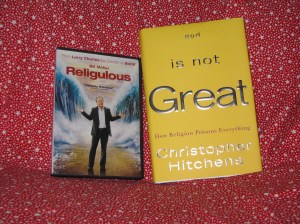
First off, the film is funny — hey, it was written by a comedian, so it’d better be funny! As Maher ticked off point after point after point where religion falls short of the mark, I felt as though I were watching Christopher Hitchens’ God is Not Great on the television.
Let's be friends

Let's be friends

Maher scores some big points for having done his homework on mythology and pointing out the mythical elements in mainstream Christian thinking, but I was left with some very basic questions: what about those who hold to religion for good reasons? What about those who don’t strap bombs on in the name of religion? What about those who promote humanitarianism for religious purposes? Can they be classed together with dangerous folk who use religion for nefarious rationales to get back at their enemies (generally anyone they don’t know)? The scenes of religion-inspired violence were extremely disturbing, but I was curious about the benign varieties of religion. Do they do any more harm than taking a toke, as Maher does a time or two in the film?

It occurred to me that religions offer a way out from what can be a very humdrum world. Evolution is certainly fact, but the long, slow process of evolving into something better fit for its environment doesn’t spur on the emotions like the Battle Hymn of the Republic. But isn’t that it in a nutshell? Religions show their flashier colors when they are in conflict, like peacocks competing for the affections of a peahen. Even those interviewed by Maher tended towards the more flamboyant practitioners of their faiths. What should really be on the docket is hatred. Religions may aid and abet those looking for excuses to harm those different from themselves, but religion is often the catalyst, not the cause. As religion goes through the long, tedious, and often painful process of evolution, it is sure to breed virulent strains that are nasty and evil, but once in a while the panda’s thumb emerges and humanity is ready for its next painful step forward.


The Dark Light

Like many Americans, last year I was fascinated by Christopher Nolan’s gripping and gritty Batman film, The Dark Knight. Admittedly, the untimely death of Heath Ledger added to the poignancy of the film, but his unfaltering performance as the Joker was no laughing matter. I was transfixed. Not only was this vision of the character previously immortalized by Cesar Romero and Jack Nicholson a sea-change, it was also an epiphany.

In attempting to understand ancient religion, you can’t get far without having to address priests and prophets. Priests appear at the dawn of civilization, the establishment’s religious functionaries. They had (have) a vested interest in the continuation of the reigning power structures. Priests make their living from a population settled enough to tax. Prophets, however, have a far older pedigree. Israel recognized prophets as we all know from the Hebrew Bible, but other ancient religions also had their prophets too. Prophets were religious functionaries from outside the established power structures — they challenged conventions, demanded radical changes, and caused migraines for more than one priest. The prophet seems to have evolved from the shaman.

Not a Joker! An Amazonian shaman

Not a Joker! An Amazonian shaman

The shaman was what anthropologist call a “liminal character,” an outsider. They simply do not play by society’s rules, but they are feared and respected by society. The shaman may see or hear things that are beyond the perception of your average citizen. The shaman may be dangerous. This is what I saw in Heath Ledger’s Joker. A disturbing character who challenges and yet at the same time brings focus and resolution to a fractured society. A wounded healer. He represents a fossil, a shaman in twenty-first century Gotham. The other Jokers, Romero and Nicholson, didn’t quite attain this level of spiritual catharsis. Although I knew Batman was the good-guy, the Joker, laughing when he should have been crying, the agent of chaos, was the most religious character in the movie. He was the Dark Light to Batman’s Dark Knight.


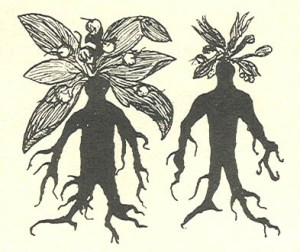
Man and Womandrakes

With the recent release of Harry Potter and the Half-Blood Prince in theaters, young minds (or at least juvenile ones!) turn once again toward things magical. Anthropologists find difficulty in distinguishing between magic and religion, and many kids have been introduced to religious themes through this series of books and movies. I admit to having read the books and even having seen some of the films, and one of the memorable mythical sub-supporting characters that captured my attention was the mandrake. My first exposure to this herbological wonder was, naturally, the Bible. (Well, after Mandrake the Magician, of course.)

The tale of Reuben’s mandrakes in Genesis 30 shows a hint of that old white magic. Rachel bargains sex for mandrakes and the next time she is mentioned she becomes pregnant. Mandrake roots are often claimed to have anthropomorphic qualities – just how anthropomorphic depends on the imagination and how many the viewer has ingested. In the Middle Ages, the roots were classified as mandrake and womandrake!

Womandrake and Mandrake from a 12th-century manuscript

Womandrake and Mandrake from a 12th-century manuscript

Even in ancient times they were revered as aphrodisiacs. The Bible has plenty of these quasi-magical moments, often explained away as “folk beliefs” by literalists with a nervous laugh. To me they are part of the charm of a Bible unashamed of its roots.

The mandrake (mandragora officinarum) is a Mediterranean plant that had medicinal, and likely “religious” usages in the ancient world. A natural narcotic, the plant is poisonous in sufficient dosages, and it was used as an ancient kind of anesthetic, having been available long before whiskey. When a mandrake was uprooted, its humanesque tuber was thought to emit such a horrendous cry so as to drop the uprooter dead. Dogs were therefore tied to mandrake roots and prodded or urged to run, extracting the plant and dying in the process. Before calling the good folks at PETA, please note that no dogs were harmed in the writing of this post! Although this legend has a distinctly medieval bouquet, it is a method of mandrake hunting actually cited as long ago as Josephus. The mandrake has long arrested the human imagination. From Rachel to Pomona Sprout, the mandrake has not lost its potency for mystical mischief.
"Man"drake, 'nuff said (from Sibthorpe's Flora Graeca, 1808)


Origins of the Undead

With all the talk of organ harvesting in New Jersey (see any Jersey paper over the past couple of days — you can’t miss it), my mind naturally turns to zombies. I have to confess to having enjoyed Pride and Prejudice and Zombies (Jane Austen and Seth Grahame-Smith, Quirk Books, 2009) very much, particularly when the Bennett girls form the “Pentagram of Death” at a ball. Like most creatures representing humanity’s deepest fears, however, the undead have religious origins.

The evils of the slave trade and missionary work concocted a dangerous brew in the West Indies. Shamanistic “voodoo priests” claimed to have the ability to arrest a person’s soul, making that person an unthinking mercenary of their bidding. (The mind again turns to missionaries!) A similar idea enlivened the golem in medieval Jewish lore, only dirt was used to construct a golem rather than an already occupied fleshy apartment. The concept of the inculpable perpetrator of revenge in West Indian religion was first introduced into popular consciousness by the writing of William Seabrook, a noted traveler and author. Seabrook spent some time in Haiti and his account of zombies in The Magic Island captured the public imagination.

The undead aspect of zombies is largely due to the unexpected success of George Romero’s 1968 cult hit film, Night of the Living Dead. In an interview Romero noted that the zombie idea had been applied to the film rather than having been its driving plot device. The undead are called “creatures” at several points but never “zombies.” The zombie connection nevertheless took off from the movie and landed the undead directly into the supernatural monster pantheon. As people continue to struggle with death and all its implications — one of the largest psychological roles of religion — it may seem difficult to believe that zombies have only been with us since the 1960s. William Seabrook committed suicide after having committed himself to an asylum in his later years. In one of his travelogues, Jungle Ways, he describes in detail the experience of eating human rump roast while in West Africa. Perhaps he was well on his way to becoming a zombie (or at least a New Jersey public servant!)?