Holy May Days

The first few weeks of May are peppered with holidays, some religious, some secular. As my regular readers know, I’ve been working on a book about holidays for kids, so I showcase a few pieces on this blog, on occasion. Instead of providing several posts on May’s holidays, I’m combining the first three special days into a holiday compendium for early May.

May Day (May 1) is, in origin, a religious holiday. It is an ancient, pre-Christian Celtic holiday called Beltane, it celebrates fertility, and it is a day that workers throughout the world fight for fair treatment. Sometimes it is associated with Communism. So, where do we begin to unpack all that? To start with, May Day is a cross-quarter day (Groundhog Day and Halloween are two others). Cross-quarter days fall halfway between the solstices and equinoxes – the days that mark the change of seasons. Ancient Europeans believed that cross-quarter days allowed spirits of the dead and other supernatural beings into the human world, as can be seen in the Germanic Walpurgis Night (April 30-May 1). Although named after a saint (Walburga, d. Feb. 25, 779) Walpurgis Night has deep pre-Christian roots in northern Europe. It celebrates the coming of May, or summer, with huge bonfires lit at night. It Germany it was also called Witches’ Night (Hexennacht) because it was believed that witches gathered on Brocken mountain to await the coming of May. The Celtic May 1 is Beltane. For the Celts Beltane marked the start of summer and it was one of their two major holidays (the other comes around Halloween). Like the Germanic tribes, the Celts lit bonfires on Beltane. Druids would light two fires to purify those who would pass between them. In Ireland people would dress their windows and doors with May Boughs and would set up May Bushes. These were signs of the returning fertility of the earth. This tradition survives in parts of the United States in the form of the May Basket. May Baskets are filled with treats and are left at someone’s door. The tradition is to knock and run, but if you get caught, the gift recipient gets to kiss you! These days, however, an unexpected basket at the door is more likely to result in a call to the bomb squad, so let your sweetie know ahead of time if you plan to give a May Basket!

Today is Cinco de Mayo, and like most things Hispanic, it is misunderstood by many Angelos. Frequently Cinco de Mayo is represented as Mexico’s day of independence. What it actually commemorates, however, is a historic battle. Napoleon III’s French Army was in Mexico in 1862. These guys were in the state of Puebla where an outnumbered Mexican force under 33 year-old General Ignacio Zargoza actually beat them on May 5. In the States, Cinco de Mayo is becoming a day to showcase Mexican culture, kind of like St. Patrick’s Day is for Irish culture. The Battle of Puebla is not Mexico’s independence day – that falls on September 16 and often escapes notice in the United States.

And, of course, Sunday is Mother’s Day. People around the world celebrate their mothers at various times of the year, but many don’t realize that this holiday goes back to the ancient Near East. Cybele was an ancient goddess associated with all things motherly. Originally from the Levant, the Greeks and Romans believed her to have been from Turkey (Phrygia). She had a festival day at the vernal equinox. Although there is no direct connection with the date or form of our Mother’s Day, it is possible that this annual recognition of an exceptional mother gave people the idea for Mother’s Day. Whatever it ancient origins may have been, Mother’s Day as we know it started in the United States as a protest against the Civil War. Many women believed war to be wrong. During the Civil War Anna Jarvis organized Mothers’ Work Days (as if they didn’t already have enough to do!) to improve sanitation for both armies. Julia Ward Howe wrote the Mother’s Day Proclamation, which was a document calling for the end of the war. The idea was to unite women in protest and bring the conflict to a close. After the war ended Anna Jarvis’ daughter (who had the same name as her mother) campaigned for a memorial day for women. Because of her efforts, a Mother’s Day was celebrated in Grafton, West Virginia in 1908. After that various states began to observe Mother’s Day, and President Woodrow Wilson made it a national holiday in 1914, ironically the year the First World War began. It is celebrated on the second Sunday in May.

For whatever spirits, political ideals, or goddesses you admire, May is the appropriate time to celebrate.


Popes and Props

Something to believe in?

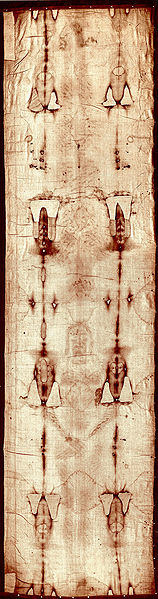
Like the pain from an old sports injury (or Sarah Palin), the Shroud of Turin just won’t go away. Decades after radio-carbon dating demonstrated what many had suspected all along – the shroud is a medieval devotional replica – true believers are still trying to find ways to prove that the cloth is physical evidence of the resurrection. Never one to shy from controversy, Pope Benedict XVI has endorsed the authenticity of the forged artifact. No matter how far science goes, it seems, it just can’t pry the hands of a needy faith off that piece of fabric.

The Shroud of Turin first appears in the historical record only in the sixteenth century. Prior to that a back-story has been composed that takes it all the way to the first century in Jerusalem. Hungry for proof of the truth of their conviction, thousands of Christians fervently believe this sheet is the tangible evidence of resurrection. What seems to have been forgotten in this whole debate is the Bible itself. Not one of the four divergent Gospel accounts of the resurrection (some of the most wildly disparate material in the whole of Sacred Writ) mentions the miraculous capture of a resurrection photograph. The Gospel writers, never shy about flashing miracles across their narratives, do not tout an artifact as proving the resurrection. The force of apostolic conviction was enough for the first century crowd.

Believers in the modern world lack such conviction. Too many forces in the natural world conspire against the supernatural. A faith shaken by science and the competition of hundreds of other religions desperately needs a sky-hook on which to hang certitude. Yet the Bible itself speaks to this very issue. “Now faith is the substance of things hoped for, the evidence of things not seen,” the writer of Hebrews declares. It seems, however, that true believers throughout history feel a little more comfortable with something palpable, just in case faith is not enough.


LOL Cat Bible Commentary, Part 1

It was bound to happen. Here is the first installment of the LOL Cat Bible Commentary.

Genesis 1.1 Oh hai! In teh beginning Ceiling Cat maded teh skys an teh Urfs, but he no eated them.

In teh beginnin
In teh beginnin ub teh dai — Ceiling Cat nawt wurk at nite, cuz datz wen
Basement Cat come owt to do ebil stuffz.
Ceiling Cat
Ceiling Cat writed da Bible. He’z the mos smartess an strongess kitteh ever. An him reely good — he no eat other kittehs fud, an he nebber jumpz on another kitteh in da middul ub teh nite (but for hoomuns dis ok).
maded teh skys
But first him taked a nap. Den Ceiling Cat maded teh skiez so him had place to liv. An den him putted a hole in da ceilin so him kood peep down on teh Urfs. Wait, him nawt maek teh Urfs yet! Ai sowwy, plz to furgive? Kthx.
an teh Urfs
K, nao Ceiling Cat maek teh Urfs. Urfs is where the hoomuns howse iz.
Ceiling Cat no maek teh udder Urfs, jus da wun wif da howse.
but he no eated them
Ceiling Cat can has a hunger after awl taht wurk, Aifinkso! But him no eated teh skiez, cuz den him fall owt, an den dere no moar kittehz to wurk on da Urfs. An him no eated teh Urfs howse, either. Him wanted to maek teh birdiez an teh moal an teh fishiez. An him also want to maek teh hoomuns for to maek his fud.

1.2 Teh Urfs has no shayps an has darwk fase, an Ceiling Cat roed invisible bike ovah teh wawters

Teh Urfs has no shayps
Cuz Ceiling Cat nawt evur maded a Urfs befoar. Him not no wut Urfs shayp iz!
an has darwk fase
Ceiling Cat can to seez in teh darwk, but dere nawt eny shayps to seez. The Urfs has dawrk fase liek teh howse wif no elec…elek…elekt…wif no lytes.
roed invisible bike
Liek him wuz dreemin. Invisible bike is hawrd to be finded in teh dawrk, but Ceiling Cat maded it an him finded it.
ovah teh wawters
Ceiling Cat nawt liek to get him feetz wet, so him no rided teh bike thru taht wawter. Wawters has see monsturs an stuffs.

1.3 At furst, has no lyte. An Ceiling Cat sez, “I can has lite?” An lite was.

At furst, has no lyte
Ceiling Cat nawt need lyte, but him noes taht hoomuns will to need lyte for to maek noms.
An Ceiling Cat sez
Ceiling Cat has to tawk to himself cuz of monokittehism. No udder kittehs arownd yet, not ebben Basement Cat.
I can has lite?
Ceiling Cat reely wanted a cheezburger. But him needed a hoomun for to maek cheezburger. So him has to maek teh lyte for to get noms.
An lite was.
Nao him can to see howse an da Urfs he maded. Den him maded lolz an udder stuffz, but first him taek moar napz.

(Translated into LOL Speek by the world’s greatest CATS! Fan Kthx)


I See You, This Time

With the advent of Avatar on DVD, I finally had the opportunity to see the movie. This time there was no booming bass and overly active 3-D, and I didn’t end up feeling nauseous for days after. On a small screen it lacked the compelling sense of being in each scene that the first ten minutes of my theatrical experience of the movie had, before I had to seal my eyes tight for the rest of the film or be carried out on a stretcher. Nevertheless, I was able to follow the story this time.

I have posted several times on my affinity for old science fiction films; a large part of my boyhood was spent watching hours of improbable adventure on the black-and-white. Perhaps counter-intuitively, I ended up studying religion instead of science, or even literature. Religion, however, is deeply embedded in science fiction, probably because it is deeply embedded in people. And Avatar was no different. Early commentators noted the similarities of Pandora to Eden. Two trees in the garden (Hometree and the Tree of Souls) were easily borrowed from Genesis. The idea of nearly naked natives living in harmony with the world around them, the soft, graceful curves of the forest contrasted sharply with the angular, obtrusive construction vehicles intent on raping paradise. I’m a sucker for archetypes, I guess. The concept of Eywa as “All Mother,” a nurturing goddess rather than a frowning father deity, only enhanced the sense that Pardora’s box should not be violently wrenched open. Even the hideout of the protagonists was nestled among floating rocks called the Hallelujah Mountains – presumably the name given by earthlings.

Yes, the writing was at times trite, and the characters were caricatures of themselves, but in the tragic light of the Gulf of Mexico Oil Spill, Avatar’s world was pristine, uncomplicated by greed and corruption. The Na‘vi, like zealous Christians, are born twice; the metaphor of foolishly maintaining hope in the harsh light of uncaring entrepreneurs might lead to a limited salvation even for this tired old planet. I am an unrepentant tree-hugger. And if there is a film that, despite its limitations, says it is alright, even noble, to hug trees, then I say it is religious in the deepest possible sense.

All Mother is watching


Friday’s Wednesday

The ultimate stag party?

Mythology never ends. Many people live by it today under its name “religion,” and many in the ancient world endlessly recycled their gods until they ended up looking rather unrecognizable from their earlier forms. I was, therefore, intrigued when a friend asked me about Herne the Hunter. Herne is a mythological character about whom I had not heard. The earliest reference to the stag-antlered deity comes from William Shakespeare, and he has been co-opted by the Wiccan community, nicely tying together many of this week’s posts. So, whence Herne?

Shakespeare seldom invented ex nihilo, but rather adapted. Herne, already an established character, was a wrongly accused poacher who was hanged from a great oak in King Richard II’s England. He had been magically revived after a near-death experience earlier in life and had been crowned with fantastic antlers at that time. The horned head has reminded some Celtic mythologists of Cernunnos, a horned chthonian god attested in mainland Europe but not found in the British Isles. Yet others, by virtue of his being hanged on a tree and the similarity of his name to the epithet Einherjar, suggest Herne may have evolved from Wotan, or Odin himself. Woden was involved in the “Wild Hunt” episode of northern and central European mythology, and since Herne is a hunter, well, isn’t the connection obvious?

Such tales as this are instructive of the way that religions evolve. We know very little of the true origins of the story, but later versions become canonical. The present-day version is perceived to be “historical” and all others are merely coincidence or happenstance. Today Herne is a typical ghost story of Windsor Forest, and those who report seeing him say he still wears his supernatural horns. Those who want to discover his origins are left with a handful of books by publishers of the occult and hundreds of unanswered questions.


Zoroastrian Odyssey

Clinton's Red Mill

Clinton’s Red Mill is a popular New Jersey attraction, but numerous reports of paranormal activity have thrown an additional lifeline to the museum in the form of much-needed revenue in the form of seasonal ghost tours. Last year about this time my family and I participated in one. Touring the old grounds at night can certainly lead to spooky experiences, even for those of us who sit on the fence about ghosts. We discovered that The Atlantic Paranormal Society, the “TAPS” of Ghost Hunters fame, had investigated the Mill the previous year. We watched several episodes of the popular show, and for a lark, my wife bought me a subscription to TAPS Paramagazine for my birthday. All in good fun. I always thumb through when it arrives, but it is hard to take much of it seriously.

The last issue (volume vi, issue 2), however, contained an article about Demonology. Now, I thought I had graduated from The Exorcist and the Exorcism of Emily Rose to a healthy skepticism, but I could not resist reading this article. The first statement declares, “A demon is a fallen Angel that rebelled against God along with Satan, refusing to be humble before, and serve, God” (Adam Blai). While I never make light of things I don’t understand, I did consider the fact that the concept of demons, which derives from a Judeo-Christian mythology, presupposes a mythic war between the powers of good and evil. At the same time, I have been reading up on the Zoroastrians, one of the oldest continuously practiced religions in the world. There can be no serious doubt that the Judeo-Christian tradition borrowed the concept of the demonic from their Iranian neighbors of the ancient Persian Empire.

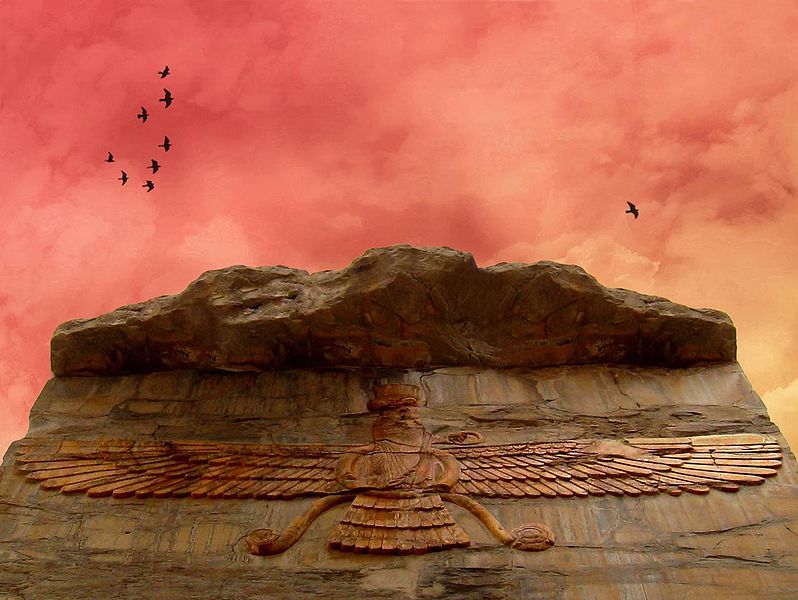
A Zoroastrian fravashi

The implications of the Zoroastrian connection are profound. If the ancient sage and Afghani priest Zarathustra was correct about the dualistic conflict of good and evil, was he not also right about Mithra and the Amesha Spentas as well? Zoroastrianism gave the Judeo-Christian tradition its base concept of Heaven and Hell, but the divinity of fire they did not accept. By picking and choosing what fit best into its experience, Judaism developed into a religion that allowed for Christian demons and angels and all the invisible hosts of the ethereal realms. Today many Christians accept demons as literal beings (less so jinns, although Clash of the Titans (2010) allowed for them). What does this say about the remainder of Zoroastrianism? Perhaps Ghost Hunters should begin with the Gathas and move on to the Avesta? As for me, I’ll be over here, sitting on the fence.


Militant Evangelists

It is not often that the military gets to rebuke an evangelical, no matter how much the evangelist may deserve it. In the world of Christian crusaders few come close to the stature of Billy Graham, a man who has had more than half a century of undue influence on American culture. At a library book sale a couple weekends ago a middle aged-couple hovering over the religion books (where I have professional obligations to hover) were discussing how they’d read all of Billy Graham’s books. When the family business passed to Franklin Graham, however, the scepter failed to be firmly grasped by the blushing co-regent. At the center of controversy since his comments about Islam beginning in 2001, Graham the younger was recently stricken from the (apparently) prestigious Pentagon prayer service roster.

I have to admit that I was surprised to learn that the Pentagon has a regular prayer service. My image of the military is one of beefy guys (and some gals) with ultimate confidence in their weapons and more than enough brashness to go around. They don’t project the down-on-your-knees-before-the-almighty image. “Guided by the beauty of our weapons,” as Leonard Cohen once sagaciously quipped, the military gets first crack at technological advances and heavy metals. The basic components of carnage and devastation. Yet they pray.

The old adage that there are no atheists in fox-holes glosses military service with a divine prerogative, so when these tough guys rebuff a famous evangelist there must be a story behind it. The military’s refusal to dis Islam displays a sensitivity uncharacteristic of most evangelical rhetoric and theology. The Religious Right’s revisionist claims that America was founded as a Christian nation are impotent without their WMD. Even so, the program should continue. “I don’t think it’s quite fair to condemn a whole program because of a single slip-up,” do you?

When Enola Gay comes to play


Trite Lite

Fresh out of that improbable world called Nashotah House, I was introduced to a jarring concept while in Oshkosh: a Hasidic rapper called Matisyahu. The strange image brewed in my head did not match the reality of this persona, but the very concept of a religious conservative engaging in protest music just didn’t seem to fit. I make no claims to musical expertise, but I did grow up in the 60’s and 70’s, and I know authentic protest when I hear it. Rap began as a countercultural rebellion, and I knew age had its gray fingers wrapped around me when a friend in grad school claimed that rap was “the end of civilization as we know it.” Civilization didn’t end, it simply evolved.

Rap started to become mainstream, as happens to all radical movements when they become “cool” and the aging performers join their aged fans. Then along comes Hi-Caliber, the pathetic Republican attempt to appeal to the hip, the young, the impressionable. The Tea Party rapper (Zac the Rapper?) inveighs his tired message that progress is bad, privileging the wealthy is good, for the Bible tells me so. And the public sips it in. As a person who can’t help but overthink things, it alarms me how trite answers are easily accepted by so many people. If a person stops to think about the implications of issues, the simple solutions proffered by Tea Partiers simply don’t solve anything, no matter how many rappers, twitterers, or ravers they get on their side. Rather than exercise mental rigor, most voters see the shiny glitz and pull the voting booth curtain. Perhaps my friend was right after all.

I have to face the fact that I’m aging into a guy who casts a nostalgic, longing glance back to the sixties of my youth with a sentimental eye. The cardboard-cutout world of the 1950s seems that it was insubstantial, staged even, compared to the psychedelic colors I first saw through childhood’s wondering gaze. I heard protesters on the radio and saw them on television while being raised in a conservative environment. And even though I never personally rebelled, being the Bible-reading type, I secretly admired those who had the courage to challenge the social evils of the day and damn the consequences. Now I switch on the radio and hear conservative fat-cats clipping out pithy rhymes upholding the man. Where is the authenticity? It all makes me want to turn on, tune in, and drop out.

Authentic Republican wrapper


Bibles and Dolls

To celebrate my wife’s birthday, yesterday we drove to the historic Bucks County Playhouse in New Hope, Pennsylvania to see a show. The Playhouse has an illustrious history, having hosted performances including such players as Kitty Carlisle, Lillian Gish, Bert Lahr, and Robert Redford. We went to see a production of Guys and Dolls, the musical based on characters and situations penned by Damon Runyon. (My first introduction to Runyon, I must admit, was in the Alice Cooper anthem, Department of Youth.) Although we attended a performance of the musical back in the Edinburgh Fringe Festival a couple of decades ago, I’d forgotten how much the Bible moves the plot along.

Naturally, any love story that involves a Salvation Army cadet will have its religious conflicts, but it is Sky Masterson’s knowledge of the Bible that drives Sarah Brown to first give him serious attention. Without the arresting power of the Holy Bible, the love interest would never have sparked. As I frequently tell my students, without some knowledge of the Bible, American society just can’t be understood. Even Sky Masterson’s real name is Obadiah (“servant of Yahweh”).

Damon Runyon was anything but a saint. His lifestyle was diametrically apposed to that envisioned by his fictionally pure Sarah Brown – a heavy drinker, smoker, and perhaps womanizer, he was a friend of crime bosses and a noted gambler. But Runyon, like most Jazz Age Americans, knew his Bible. One of his famous phrases derives from the book of Ecclesiastes: “The race is not always to the swift, nor the battle to the strong, but that’s how the smart money bets.” From the quiet streets of an artsy hamlet in Pennsylvania to the glitzy lights of Broadway, the Bible still makes itself known. The smart money is on the one who learns to spot it.

An unorthodox sort of prophet


The Cross in my Pocket

A local woman, whom I can only assume carries a prosperity cross, has won a 211 million dollar New Jersey lottery jackpot. As I had written some months back, when I received my prosperity cross, I tried my hand at the lottery with no rewards. Having had a dream of riches a few weeks back, I again attempted the lotto, with the added ethical motivation of assisting our state’s beleaguered educational system. Still no prosperity. It seems that the divine attention was focused a few miles north and a few days late. The happy winner has gone on record (in the New Jersey Star-Ledger) as saying, “I give God all the glory for this blessing that he has given me… He has seen and knows the highs and lows of my life, and knows the good I have done, and the good I can accomplish in his name.”

This innocent statement, no doubt whipped to a froth by prosperity gospelers, reveals all the difficulty of the weekend warrior prayers for good weather. Tweaking the world in one corner, as chaos theory demonstrates, leads to disaster in another. Not that our thankful lottery winner will unleash untold evil on the world, but it is time that people of all religions stop to consider the implications of the divine bursting in upon the mundane. In my experience, when such people are asked why God chose them and not someone else, they wax mysterious and intimate that only God knows. It is part of a great cosmic secret, only cryptically hinted at in the Holy Bible.

Call it sour grapes, or the grapes of wrath, or any other viticultural metaphor, but God does not direct the lottery. Too many truly good people suffer far too much for such easy answers. Those who promote the prosperity gospel are not among the paragons of human achievement or selfless nobility. Rather they are the idols of the self-important and acquisitive entrepreneurs. I wish our New Jersey lotto winner well – I hope she will steer clear of the prosperity gospel and actually put her money to good use.


Not My Cup of Tea

The cutesy and puckish title of “Tea Party” is intended to sound whimsical among a group of political activists who lack imagination and creativity. They wear biblical-sized blinders that block out all enlightenment, trying to appear trendy and radical when what they really want is a return to the Dark Ages. Trying to make turning the clock back on progress chic and sexy, they stand for old-fashioned selfishness and the preservation of privilege for those who deserve preferential treatment – others just like them.

They grab headlines and limelight. So diametrically opposed to the progress that the real Tea Party (in Boston, 1773) strove for – progress against the privileged and mighty holding down those at disadvantage, the Tea Party movement seems to have convinced the media that it is worthy of their absconded moniker. Once again the Bible finds itself slave to an outlook. Ironically, Christians who look to the Bible as an unchanging anchor in modern society have no desire to return to the dietary restrictions and apparel requirements of yesteryear. They do not comprehend the vast gulf in morality outlooks that separate flat-earthers from space-age technocrats. A disconnect that would short-circuit the most robust processor drives their fantasy-world desire for a yesterday than never really existed.

What can a concerned biblical scholar do? Is it possible to force a conscientiously willful party that disregards facts and history to face reality? Perhaps the response should be that of the eighteenth-century Bostonians: board their ships of privilege and jettison their valued cargo utilized to create and uphold a system of abuse. Should that happen, we would soon see front-page pictures of Boston Harbor bobbing with saturated Bibles.

Mutiny on the Bountiful?


I Have a Daydream

I don’t often comment directly on politics because I don’t like to get beaten up. I’m not a poly-sci major who has statistically verified evidence to present, and many of the issues are simply too complex for a guy like me. I’m left scratching my head like a confused ape. Nevertheless, I’ve just finished covering Micah in my Prophets class, and the eighth century prophets have a way of firing up even the most passive of souls on the issue of social justice. Also, newspaper stories continue to demonstrate that most elected officials, living in their world of privilege and power, have lost touch with the average citizen. After reading the prophets and dreaming of a better world, I have a proposal to end oligarchy and institute democracy.

No person who earns more than $100,000 a year should be eligible to run for public office. Now I live in New Jersey where the cost of living is high. I have survived here for over three years with an income far less than half of that figure, so I know it can be done. Observing the abusive tactics of bishops first-hand, I had suggested a similar measure for the church some years ago. To become a bishop an individual should be forced to take a pay-cut, bringing their income below that of those they serve. Politicians are “public servants” who’ve grown fat on the generous salaries they devise for themselves alongside their perks, kick-backs, and expense accounts. The same also applies to politicians in higher education. You want a really excellent university president? Reduce the funding for the post. Only those truly committed to the ideals of education would be willing to take on the job. Posers and playboys would have to step down.

Corporate-style greed has a strangle-hold on democracy. Most people are content to let the wealthy rule as long as they are left alone – freedom in exchange for accepting the demands of the self-indulgent. My daydream is of a world where people can free themselves from the never-ending greed of the corporate climber. And my system would not exclude anyone for seeking office. All the wealthy would have to do is be willing to live on a middle-class or lower salary for a few years. Politicians have forgotten (if they ever even knew) what is like to struggle, worry, and fear that any month, week, or day you might not be able to meet your obligations. They don’t personally watch the prices increasing at the pump or at the grocery store or on the electric bill. Their Olympian existence is beyond human suffering. It is once more time to ask, “what would Micah do?”


Alaska’s Temblors

There are rumblings under Alaska. Some people are just a bit nervous after last week’s earthquakes in Mexico – could it be our turn next? Mount Redoubt, remote from human population zones, has been sputtering and steaming and making itself look large. It is preparing for something big.

In apocalyptic literature we see a similar image: the small horn that boasts and makes itself out to be the greatest of the ten that speckle the head of the great beast from the sea. The little horn called Antiochus, so enamored of his own abilities that he surnamed himself Epiphanes, “the manifestation.” And uncritical people, taken in by his bravado, followed him until he started torturing and killing those who didn’t agree with his religion. Those who would not bow to his own personal Zeus would be martyred in nasty ways.

Now an active volcano is sputtering in Alaska. Could it be the sign of the end times? I doubt it. The end does not come ushered in by mere movements in the earth’s crust. According to Revelation there has to be a harlot on the back of a hideous beast. And that’s only if you believe Revelation is predicting something that hasn’t already happened. No, I believe Mount Redoubt is just doing what volcanoes always do – threatening, making noise, and occasionally erupting. They may blanket their surroundings with ash and magma, but these are often only temporary postures on the part of nature. Those who have ears to hear, let them hear.

More than just a redoubtable mountain?


Clash of the Titans

Over the weekend I joined the thousands flocking to theaters to see Clash of the Titans. I first met Perseus in fifth grade and have been intrigued by classical mythology ever since. I tried not to believe that it was nearly three decades ago that I sat in the single screen theater back in Oil City, Pennsylvania watching a film with the same title and Ray Harryhausen’s famous stop-motion animated creatures. I was anticipating great things. While the new Clash is visually stunning at several points, the post-modern story line primarily demanded my attention. While there are gods galore in the film, the message is maybe not atheistic, but, to coin a word, anolatric – denying worship to the gods. Time and again Perseus refuses the help of the gods and when he finally meets Zeus, his absentee father, he shows him anything but respect.

Who let the trogs out?

The Greeks, like all ancient peoples, primarily feared the gods. Not offending deities was a societal expectation since an infraction on the part of any citizen might lead to divine repercussions. Dictys, Perseus’ adopted father, rails against the gods for allowing the degeneration of society, a trait that Perseus takes to extremes in the movie. In battling the monsters, Perseus is storming Olympus itself. In a nod to the Easter weekend crowds, Perseus defeats death himself by banishing Hades to an incongruously fiery underworld. I left the theater slightly stunned; here had been a hero standing before the very gods but refusing to worship. Clash of the Titans indeed.

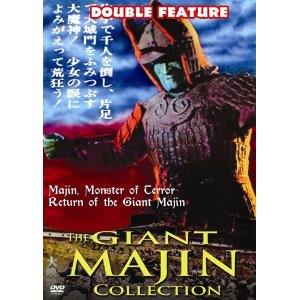
While my family was off winning the Connecticut Regional First Robotics competition in Hartford (go Team 102!), I had consoled myself the night before seeing Clash by watching the cheesy 1968 Japanese giant monster classic, Wrath of Daimajin (also known as Return of the Giant Majin). I had seen the original Giant Majin some time ago, but here was a “monster” movie where the destructive colossus was himself a god. The Giant Majin is a protective mountain deity who, when injustice grows unchecked, breaks free of his rocky home and destroys the wicked. The Wrath of Daimajin included startling biblical imagery: as the Majin stomps through the sea the waters part as if Moses were on the god’s shoulder. The faithful female protagonist is being executed on a cross (burned at the stake, but tied to a cross), and the Majin breaks the gibbet and holds her aloft, the very tableau of the evil-banishing crucifix. As always, the Giant Majin vanishes at the end, leaving the oppressed to build their own, better future.

I dream of Majin with a dark green face

Such movies are benchmarks of public theology. Made by laypersons trying to express their ideas about the divine world, I find them a crucial measure for any teacher of religion to watch, mark and inwardly digest. In just 24 hours I saw a Shinto god go Christian and a Greek polytheist lose his faith. The world just can’t figure out if the gods are for us or against us.


The Passover-Easter Complex

Some years back I completed an unpublished book for young readers on the holidays. This project was undertaken because most holidays have a religious origin and because I could find no comparable source for kids to learn this information from a reliable source. Unfortunately publishers have showed little interest. Rather than waste the effort it took to write the book, I have been installing segments here, on the Full Essays page of my blog. Since it is Easter for many Christians today, I have added the next installment: the Passover-Easter Complex. It begins like this:

No doubt the most complicated set of holidays are those that surround the changing of the seasons – the solstices and equinoxes. Among even those holidays, the Passover (Jewish) and Easter (Christian) complexes are especially complex. Like most major holidays these celebrations have very interesting roots. Problem is, it is hard to know where to begin! We’ve already started with Mardi Gras, but that is kind of a festival on its own. To really get started, we have to turn back to the calendar (again?).

Easter, like Passover, is a “moveable feast.” That doesn’t mean playing musical chairs while you eat! It means that the dates change depending on the moon, so to figure out the date you have to (you guessed it) look at the sky. (Actually, these days you can look on the web or in many books used by churches to figure it out. But work with me here, let’s pretend it is, gasp, before these things were invented!) Two days of the year have an equal amount of day and night all around the world, when the earth stands up straight on its axis. Marking the beginning of spring and fall they are called the vernal and autumnal equinoxes. (“Equinox” means “equal-night,” “vernal” means “green” or spring, and “autumnal,” duh, “in autumn.”) Back when people had no TV, this was a big thing! Not only was it cool to have equal day and night, in the spring it meant days were finally getting longer and warmer. For ancient people it meant that light was winning the struggle with darkness.

Read more…