Jersey Vampires

Subscribers to the New Jersey Star-Ledger receive a periodic local-interest magazine called Inside Jersey. Since I’m already inside Jersey and have too much to read as it is, I generally ignore the freebie unless a story catches my eye. Anyone who has followed this blog for long knows of my contention that what truly frightens us is related to religion, or lack thereof, including fictional movie monsters such as vampires and werewolves. Despite the claims that such interests are juvenile and immature, this month’s Inside Jersey features a story reflecting just how serious such issues can be. When my wife showed me the cover, I knew it was blog-worthy.
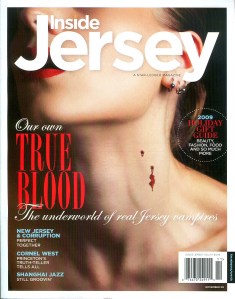
VampireJ

There are vampires among us. Not Bela Lugosi or Christopher Lee-type Draculas, but actual blood-imbibing vampires. Only those who have shunned bookstores like a crucifix will not be aware that the Twilight series of teen romances have dominated middle and high school female reading lists for the last few years. The vampires in this magazine story, however, are not conflicted teens, but conventional young adults. The story covers what religionists call a New Religious Movement, or NRM. It is a religion, growing in the larger New York City area (as well as in other parts of the country), where consenting adults don artificial fangs and sip blood from willing donors. According to the story these groups, which include professional people who join under pseudonyms, engage seriously in religious rituals not unlike traditional Christianity’s sacramental rites. Now before snatching up your holy water and fresh hawthorn stakes, consider for a moment that adherents to this sub-culture are actually exercising their religious freedom.

Older, established religions are often quick to judge newer religious rivals. The fact is, however, that every religion on the planet was once a new religion. Believers often attribute the origin of their species of religion to the divine: special revelation, enlightenment, or a growing-up of humanity. All other religions, therefore, must be false. The difficulty here is that there are no final arbiters who can stand outside human religious institutions to tell us which is the right one. Lessing’s three rings have reached mass production and still there is no Ragnarok so that one religion might brag “told you so” to all the others. While I’m no vampire — I’ve been a vegetarian for over a decade — I have to accept the claims of those who are that this is their religion. The article ends with a revealing quote from a member of a local Court, so I give the final say to an actual interview with a vampire: “So many people think being into a certain lifestyle, you cut yourself off from the divine. It’s quite the contrary. To me, when you become more attuned to yourself, who you are uniquely, it brings you closer to God.”

Clothes Make the God

What is it with gods and clothes? Today’s news announces that Rob Halford, the Metal God, vocalist of Judas Priest, has just revealed his own Metal God Apparel line. Now, I try to be equitable, but isn’t metal all about sticking it to the establishment? Isn’t designing your own line of clothing the most establishment-worthy enterprise ever? Where have the rebels gone?

Whip not included

Whip not included

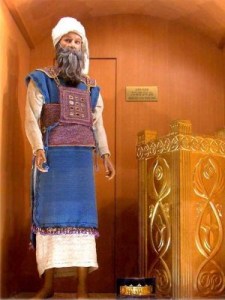
No sooner are people getting the hang of things in Eden than God marks designer clothes first on their list of accessories. Gods seem to be impressed with dressing the part. The Bible details what priests, and especially the high priest, will wear in the temple/tabernacle. Such location-specific wear indicates a very deep awareness of sacred space that pervades most religions. More than that, however, the clothes themselves are highly symbolic. Although modern readers may not be able to come to any consensus on the “symbology” (oh that word!) of each and every ephod and tinkling bell, we can be assured that nothing about the priestly garb was accidental. Indeed, Exodus informs us that God selected the fabrics himself.

Judas Priest, meet High Priest

Judas Priest, meet High Priest

So I’m not so shocked that the Metal God has made his preference known in the line of apparel appropriate to wear to the worship of this particular deity. As I watched a motorcycle club in their well-worn leather roar past me in my timid mini-van this weekend, I was reminded of the power of clothes. We may not be born with the body we want, but if we dress it up right, others might be made to believe that we’re gods too.


God and the Boss

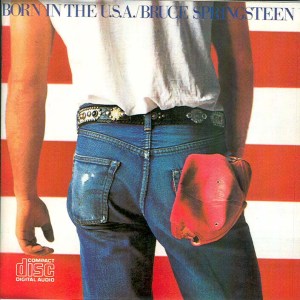
I seldom gush, nor am I given to great displays of emotion. Although I appreciate great accomplishments in others, I have never considered a living person a hero. Only Bruce Springsteen. An article in the newspaper yesterday described the first academic conference on the Boss’s music, held right where it all began — New Jersey. Unfortunately unable to attend, I relish the fact that others see in Springsteen what must be something like I see.

Last year at the Society of Biblical Literature Annual Meeting in Boston, I picked up a copy of a new book, The Gospel according to Bruce Springsteen, by Jeffrey Symynkywicz (Westminster John Knox, 2008). I am not a fan of “Gospel according to —” books, but there is a trenchant depth of struggle with religion embedded in Bruce’s songs that transfixes me almost as much as Melville’s Moby Dick. Now, this is deeply personal with me. I don’t discuss my amazement that borders on worship of Springsteen with anyone. Coming from a decidedly blue-collar background, and having wrestled against circumstance for everything I’ve earned, including my degrees, I hear resonances of empathy throbbing through what Bruce sings. He is not an icon; he is an authentic human being. And his music is a gospel.

Boss

I haven’t read Symynkywicz’s book yet. Whenever I’ve tried to read the popular bios of the Boss I soon become frustrated at how trite they all make it sound. Having survived (barely) the Reagan-Bush era with its utter lack of sympathy for the condition of most Americans, sometimes I just need to crawl into the corner alone, slip on the headphones, and listen to Nebraska over and over again.


Harry Potter and the Evangelical Emperor

There’s a chill in the air this morning that warns of impending winter and the visceral melancholy of autumn’s graceful death. As I try to warm up like a lizard awaiting the ascending sun, I think that maybe I’d better write this post before everyone forgets Harry Potter completely. It is the beginning of the witching season as sometime late tonight fall officially begins and people in temperate climes are permitted to show their fears as the barrier between seasons becomes effaced and the darkness slinks in. A few Harry Potter novels ago, a local town in Wisconsin sponsored a downtown release party for the book with a street-fair sporting a feel of general bonhomme. While sauntering down the incongruously sun-lit streets, enjoying the sense of people just having fun, I spotted this man with a placard across the street.

No caption necessary!

No caption necessary!

The truly scary part of this scenario is that I knew exactly where this fellow was coming from: the Bible says it, I believe it, that settles it. Black and white. Right and wrong. Good and evil. Strangely enough, there was no such dividing line for fact and fiction. Yes, I knew that the Bible condemns witchcraft, but I also knew that J. K. Rowling was a fiction writer. I had read the Bible enough times to know that it contains no commandments about what genre of fiction is permissible and to know that some biblical heroes were deeply flawed characters. Jonah and his big fish. David and the giant monkey on his back. Hezekiah and his doubts. I can’t pretend not to know the searing sting of needing a clear answer, and yet I had already discovered the infinite shades of gray that reside between pure white and absolute black. Bible covers should all be gray.

That very year a conservative evangelical administration had axed a highly praised job of over a decade’s duration, believing it to be in the name of righteousness. A conservative evangelical president was unleashing hellish terror on a country that had the misfortune of being the victim of a bloodthirsty dictator. And this man with a placard felt he had to underscore that even a flight of fantasy on a broomstick over a quidditch field of imagination was evil incarnate. Once again my mind turned to Molech, the perhaps fictional Canaanite deity who is never satisfied. In the Bible it was enough simply to believe that people were sacrificing their children to the fiery Molech. “White and black,” I could almost hear the tremulous author whispering as he penned his horrid fiction. History tends to paint a different picture, but then, historians make liberal use of the myriad shades of gray.


Devil Went Down to Jersey

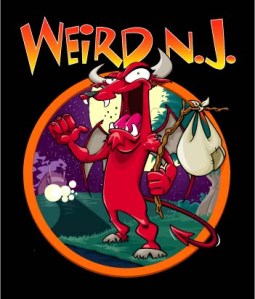
I have to confess to being a fan of Weird NJ. For those of you not fortunate enough to live in New Jersey, Weird NJ is an unconventional travel-guide published twice a year, celebrating the strangeness of the state. Ironically, I discovered Weird NJ while living in Wisconsin. I was attending the 150th birthday celebration of a couple of friends (combined ages, not paranormal!) where one of the gifts was the then recently published Weird Wisconsin. After the original magazine had caught on, books about individual states were commissioned and this was the first one I’d encountered. My wife knows that look in my eye, so on my birthday that year I had my own copy. Even though it is written for a decidedly non-academic readership, I learned more from it than most textbooks I’ve read. When New Jersey loomed large in our future, I added the book version of Weird New Jersey to my growing collection and soon came to rely on it as a repository of local folklore and interesting places to visit.

Thanks to Matt for permission to use his art, see Matt Can Draw for more!

(Thanks to Matt for permission to use his art, see Matt Can Draw for more!)
This short flight of fancy relates to religion in a very decided way. Within the pages of these publications many locations (popular with teenagers, I’m guessing) bear the moniker, “Devil’s —“ where the space may be filled by any number of nouns: Footprint, Kitchen, Pit, Pathway, Tree, or even Tea Table. This decided interest in naming places after the dark lord seems whelming, even for New Jersey, home of the infamous Jersey Devil. The need to have an evil entity to explain the darkness in our lives is very powerful. Certainly it is not limited to New Jersey as the well-known examples of Devil’s Tower, Devil’s Lake, and Devil’s Postpile attest (although mistranslation may frequently be responsible). Those cultures bound by a monotheistic outlook mark their fears with the Devil.

A relative latecomer to the Bible, the Devil had not been available for earlier attributions of evil. Thinkers of the pre-diabolical period reached widely varied conclusions as to who or what caused the troubles they experienced. Some blamed God while others simply accepted the vicissitudes of circumstance. (Then again, they didn’t have New Jersey as a frame of reference.) Once the Devil entered the picture, the problem of good and evil took on a sharper focus. That sharp distinction, however, frequently belies human experience where issues and situations are seldom as clean cut as they seem.


Go and Dust No More

Finally getting around to reading Philip Pullman’s The Golden Compass (I hate to admit that it took the movie ads to prod me into reading the book), I have been surprised by the depth of the story. Spoiler warning! From the very first chapter I have been pondering what dust might be, and I have just discovered that it is Pullman’s metaphor for original sin. In the chapter where this is finally revealed to the protagonist, Lyra, her father reads an explanatory passage from Genesis 3 (somewhat altered). Indeed, dust drives the plot of the story.

With apologies to the magisterium

With apologies to the magisterium

Pullman’s treatment of the topic once again throws into relief a popular, but mistaken, concept. “Original sin” is simply not a biblical idea. Nowhere in either the Hebrew Bible or the Christian Scriptures does the text suggest that people are born with the taint of a physical liability passed on from the first human coupling, as Augustine hypothesized. In fact, the Bible hosts several potential explanations for the origins of human troubles. One solution that it never reaches is a genetic passing on of an original sin.

Tradition often makes Scripture into its own image. Ideas are inevitably read back into the story and a chimera of hazy concepts emerges. Pullman’s treatment of the human condition is to be applauded, and to his credit he does not attribute the concept of original sin directly to the Bible. Although he alters the text a bit he doesn’t add this most damaging concept to it. The belief that people are inherently defective has allowed for some of the worst crimes imaginable against our species. As a concept original sin is dust in the wind.


Edoc Elbib Eht

A number of 40-year commemorations of the Manson Family murders have brought these gruesome events of my childhood years back to memory. I was really too young to understand what all the fuss was about then, and now that I am old enough, I’m not sure I want to. Nevertheless, I have committed myself to exploring sects and violence in a religious setting, and the Manson murders have prongs of both phenomena. While recently refreshing my memory on these horrific events on a gray and rainy day, I noticed something I had not seen before.

Looks like someone's been on the yellow submarine a little too long

Looks like someone's been on the yellow submarine a little too long

Charles Manson was (probably still is) a believer in hidden codes. He allegedly cracked a code in the Beatles’ White Album that led him to the belief in an apocalyptic battle that he was determined to begin. I wondered why the Manson Family tends not to be listed among other apocalyptic groups such as the Branch Davidians or Heaven’s Gate. They all share several traits, and although Manson’s revelations came from the Fab Four rather than the Holy Trinity, a revelation from on high spurred him into actions that had a tragic outcome, just as David Koresh or Marshall Applewhite.

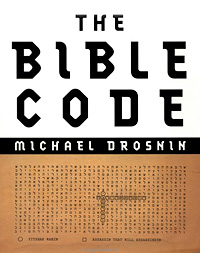
The whole Helter Skelter code also reminded me of another, equally bogus pawning of randomness as divine messages: Michael Drosnin’s The Bible Code. When I read this bestselling bit of intellectual dry rot a few years ago, I was amazed that anyone could possibly take it seriously. God writing hidden messages in a holy book like some hormone enraged high schooler? And figuring out that a singular genius would figure it out just before the apocalyptic end without realizing that it is possible to read messages back into any media after they occur? It seemed all too much for a rational mind to take. In one of my courses at the University of Wisconsin Oshkosh I gave students the option of reading it for a secondary project. To my chagrin, when I had the papers in one particularly tear-stained paper wailed (seriously) that the writer wished she had been warned sooner! This book changed her life! Everyone must know! Unfortunately I left Oshkosh without finding out what became of her.

God may not play dice, but apparently he likes crosswords!

God may not play dice, but apparently he likes crosswords!

I felt bad for introducing an undergrad to such “academic” sleight of hand; some college students just haven’t developed the critical facilities to see through the remarks of Balaam’s various sidekicks. Come to think of it, Manson’s followers accepted his revelations uncritically as well. Maybe the real lesson in all of this is that we must examine very closely those who claim special revelation, whether it be from Lenin, McCarthy, Starr, and Harrington, or just from God Almighty.


Animal Alarm

Where was Moses when the lights went out?

Where was Moses when the lights went out?

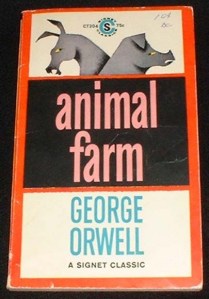
After undergoing a bout of oral surgery earlier this week, even before the nitrous oxide wore completely off, I pulled George Orwell’s Animal Farm off the shelf for a re-read. I hadn’t read it since at least 1984. It was even more disturbing reading it this time just off the Bush-Cheney years, and I realized that the Napoleons and Squealers are still with us. As a prophet Orwell may not have always got the dates right, but he was clever at spotting trends.

In this reading of Animal Farm a minor character leaped out at me. Among the tame, but non-domesticated animals was the raven Moses. Moses is the special favorite of farmer Jones and tells the animals of Sugarcandy Mountain vaguely up in the sky, where conformist animals go when they die. When the rebellion takes place, Moses flies off and remains absent until near the end of the story when the situation has deteriorated. Once again he is back to tell the others about Sugarcandy Mountain. The connection between Moses and Mount Sinai is transparent, although the heavenly connection is slightly misplaced.

The Hebrew Bible (certainly in the period of Moses) does not recognize what will become the Christian concept of Heaven. Like many ancient West Asians, they supposed that Yahweh lived “up there” at times (at other times he lived in the temple, or on the world at large, or atop some mountain). The “heaven” they knew of had no place for dead humans; the afterlife was a concept that developed very slowly. Moses’ motivation for the ancient Israelites, however, also resonates in Animal Farm, even as it does in the startlingly similar film Chicken Run — freedom. Freedom is the pipe-dream of many religions, but even as early as Moses those dreams run into regulations. Religions have laws long before they have heavens. Perhaps Orwell was onto something after all.


This Fair’s for the Goats

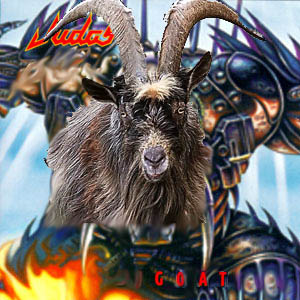
“County fair, county fair, Everybody in town’ll be there, So come on, hey we’re goin’ down there …” Thus begins the chorus of Bruce Springsteen’s little-known song “County Fair.” (It is one of the bonus tracks on The Essential Bruce Springsteen.) The haunting melody of what might otherwise be a carefree summer song is enhanced by the fact that my wife has been staffing a couple of 4-H County Fair booths over the past weeks and I don’t get to see much of her with the long hours. While at a recent fair she pointed something out to me that, not having much experience on a farm, I had never known. Abattoirs employ goats in a specialized animal herding role. The animals in a stockyard, usually sheep or cattle, get familiar with the goat and learn to follow it. The goat is trained to lead them to their deaths while it is spared. The industry term for this animal is a Judas Goat.

It's a goat's life

Slaughter House Rock

Although the origin of the name is obvious, the practice strikes me as insidious, if justifiably biblical. Training an ignorant animal to lead more gullible animals to their premature demise — it sounds a little too much like Pat Robertson to me! Is this sending in a goat to do a man’s job? Then to saddle the poor creature with the title of Judas, as if the poor thing planned it! Yet another reason to be glad I’m a vegetarian!

The Bible is pervasive in and paradigmatic for our culture. I might even term it endemic. As many children grow up without the biblical force-feeding that many of those in my generation had, these images and metaphors may eventually go extinct. Or perhaps there will always be a goat to lead them back to a Bibliophile culture. The county fair itself might be instructive. Originally instituted in Roman times as periods of relaxation from labor (rather pointless for those of us not gainfully employed), fairs evolved into opportunities for individuals and companies to display their wares and goods. From a practical point of view there is little you can see at the fair that you can’t find quicker or cleaner on the internet. But the internet lacks that human element. Perhaps we are really all just glad to go with the crowd sometimes without even asking where the goat is leading us.


Cenobites and Angels

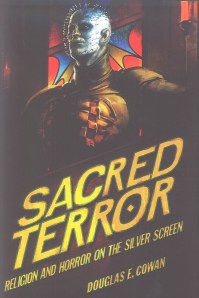
I recently became aware of Hellraiser. Actually, I’d seen images of Pinhead around for years, but never realized that he was a Cenobite until reading Douglas Cowan’s Sacred Terror (see my post on Vampires, Mummies and the Holy Ghost). In fact, Pinhead is featured on the dust jacket of the book and comprises a large part of Cowan’s evidence. Curious enough to watch the movie, I steeled myself for the macabre and terror, but although there were gory scenes it was no more disturbing than the Republican National Convention.

Pinhead for president?

Pinhead for president?

This movie draws its lifeblood from religious, particularly Christian, imagery. Cenobite, of course, is an old word for “monk” and in the movie Cenobites are interdimensional beings known as “demons to some, angels to others.” In a strange convergence of themes, I had recently viewed Dogma again after a gap of a few years. Here Loki and Bartleby are fallen angels, who, rather like myself, move from Wisconsin to New Jersey. Both of these films are pervaded with a healthy ambivalence towards those beings who have the potential for so much good but who opt for what most of us would consider evil.

Angels have a long pedigree in ancient religions, probably originally being gods who only ever achieved supporting roles. Not all gods were created equal. At Ugarit we find a whole class of deities below the power and dignity of reigning gods. Besides, in a non-scientific worldview, angels, especially fallen ones, had great explanatory value. When things unexpectedly go wrong and you’ve made all the proper sacrifices to appease the resident deity, bad angels might just be the cause. Theirs was a world of naive realism; what the eye observes is pure reality and what the eye doesn’t see is divine. Today we know this to be overly simplistic — reality is so complex that even our brightest can’t completely comprehend it. Yet when we have trouble explaining things, even in a scientific world, many are ready to point to the angels in the wings.


Religi-Religi-Religi-Religulous, That’s All Folks!

Tell me where is fancy bred,
Or in the heart or in the head? (Shakespeare, The Merchant of Venice)

Every great once in a while, a must-see movie comes out even for religion specialists. We have to lay aside our Biblia Hebraica Stuttgartensias for a while, stare at one of the talkies and scratch our heads. Last year my students asked me what I thought of Bill Maher’s Religulous, but I didn’t have a chance to see it (couldn’t afford it on the big screen, and who has time during the school year anyway?). So I finally got together with a friend to watch it on the small screen.

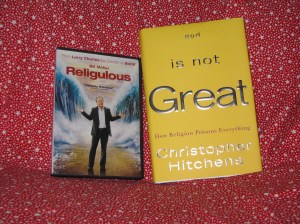
First off, the film is funny — hey, it was written by a comedian, so it’d better be funny! As Maher ticked off point after point after point where religion falls short of the mark, I felt as though I were watching Christopher Hitchens’ God is Not Great on the television.

Let's be friends

Let's be friends

Maher scores some big points for having done his homework on mythology and pointing out the mythical elements in mainstream Christian thinking, but I was left with some very basic questions: what about those who hold to religion for good reasons? What about those who don’t strap bombs on in the name of religion? What about those who promote humanitarianism for religious purposes? Can they be classed together with dangerous folk who use religion for nefarious rationales to get back at their enemies (generally anyone they don’t know)? The scenes of religion-inspired violence were extremely disturbing, but I was curious about the benign varieties of religion. Do they do any more harm than taking a toke, as Maher does a time or two in the film?

It occurred to me that religions offer a way out from what can be a very humdrum world. Evolution is certainly fact, but the long, slow process of evolving into something better fit for its environment doesn’t spur on the emotions like the Battle Hymn of the Republic. But isn’t that it in a nutshell? Religions show their flashier colors when they are in conflict, like peacocks competing for the affections of a peahen. Even those interviewed by Maher tended towards the more flamboyant practitioners of their faiths. What should really be on the docket is hatred. Religions may aid and abet those looking for excuses to harm those different from themselves, but religion is often the catalyst, not the cause. As religion goes through the long, tedious, and often painful process of evolution, it is sure to breed virulent strains that are nasty and evil, but once in a while the panda’s thumb emerges and humanity is ready for its next painful step forward.


Profit Priest and the King

As a staid academic with the internal passion of a Bruce Springsteen or Lou Reed, if I had any musical ability I’d have opted for a life on the stage. As I struggle to forge my passion into words on paper (or in electrons) I consider those who should have perhaps considered other options as well. I have never really been a fan of Christian Rock. The whole rebelliousness and sense of sticking it to the man lose something when you bow your head in submission the Sunday after and ask some ordained member of the establishment for forgiveness. It tastes even worse than Light Rock, the talc of real rock world. Nevertheless, there have emerged in the strange history of Christian Rock a few true innovators who have not only challenged Christian convention, but who have taken music itself in new directions.

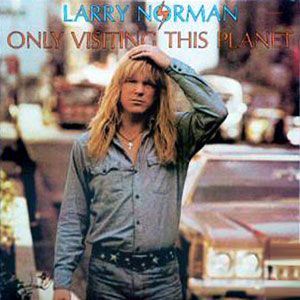
Norman's Iconic Look

Norman\’s Iconic Look

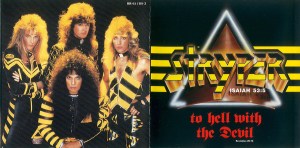
My favorite among the innovators has always been Larry Norman. The original “Jesus Freak,” Norman appeared on the San Francisco rock scene only to be rebuffed by Christian artists who held Pat Boone as a kind of icon, and rejected by mainstream rock as being some kind of Christian fanatic (he was). Norman’s music, however, was a strange blend of tradition and visionary foresight. When they saw there was money to be made, along came other artists trying hard to match Norman’s footsteps, most of them falling far short. Daniel Amos, probably one of the most unusual Christian groups ever, proved themselves way ahead of the curve, and if they’d had a good publicist might have made secular airtime based on their forays into retro and punk before they were trendy. Stryper, a hair band of heavy metal stripe, threw Bibles into the crowd at concerts.

Yes, they're dudes, Father forgive them!

Yes, they\’re dudes, Father forgive them!

They later disbanded because of their concern with hypocrisy, something a true rock-n-roller would never feel compelled to do. Meanwhile, mainstream Christian Rock rendered itself into treacle that would easily wash off with a shower of pure intentions.

Rock addresses head-on those gritty, messy, and even dangerous elements of human life — our emotions. After some 4000-plus years of organized religion we still have difficulty addressing or accounting for their insatiable pull on us. Staring out over the lecture theater and toting up the number of ipods present, I would have to guess that music still meets a need that religion might have missed.

A few years back, in a wave of nostalgia, I went to see Larry Norman in concert. I’d grown beyond any real enjoyment in the genre, but here was a true innovator, one whose name very few Christian Rock aficionados even recognized. The concert was held at a Christian college where there were maybe forty folding chairs arrayed in a depressingly small space in the gym. Norman could still rock, his acoustic guitar and spare band providing all the support he needed. I even had the chance to chat with him after the show; no security guards need apply. As I later reflected, perhaps this is what my life would have been like if I’d had some ability and taken to the stage instead of rocking the glamorous adjunct professor gig. While having my eardrums taken through their paces at an Alice Cooper concert last fall along with a bunch of other fat, balding, wannabe rebels I experienced a kind of secular epiphany. Alice had converted to Christianity some years back — seen chumming with none other than Pat Boone himself — and his music at the time suffered. Now that he’s returned to his macabre fantasy world, his ability to churn out compelling music has returned. Outside, away from the cannabis fumes and liquor-enhanced air, although I didn’t personally participate in their consumption, for a moment it felt like I’d lived my rebellious dream.


The Dark Light

Like many Americans, last year I was fascinated by Christopher Nolan’s gripping and gritty Batman film, The Dark Knight. Admittedly, the untimely death of Heath Ledger added to the poignancy of the film, but his unfaltering performance as the Joker was no laughing matter. I was transfixed. Not only was this vision of the character previously immortalized by Cesar Romero and Jack Nicholson a sea-change, it was also an epiphany.

In attempting to understand ancient religion, you can’t get far without having to address priests and prophets. Priests appear at the dawn of civilization, the establishment’s religious functionaries. They had (have) a vested interest in the continuation of the reigning power structures. Priests make their living from a population settled enough to tax. Prophets, however, have a far older pedigree. Israel recognized prophets as we all know from the Hebrew Bible, but other ancient religions also had their prophets too. Prophets were religious functionaries from outside the established power structures — they challenged conventions, demanded radical changes, and caused migraines for more than one priest. The prophet seems to have evolved from the shaman.

Not a Joker! An Amazonian shaman

Not a Joker! An Amazonian shaman

The shaman was what anthropologist call a “liminal character,” an outsider. They simply do not play by society’s rules, but they are feared and respected by society. The shaman may see or hear things that are beyond the perception of your average citizen. The shaman may be dangerous. This is what I saw in Heath Ledger’s Joker. A disturbing character who challenges and yet at the same time brings focus and resolution to a fractured society. A wounded healer. He represents a fossil, a shaman in twenty-first century Gotham. The other Jokers, Romero and Nicholson, didn’t quite attain this level of spiritual catharsis. Although I knew Batman was the good-guy, the Joker, laughing when he should have been crying, the agent of chaos, was the most religious character in the movie. He was the Dark Light to Batman’s Dark Knight.


Everlasting Cats

“The mystical divinity of unashamed felinity, round the cathedral rang ‘Vivat!’ Life to the Everlasting Cat!” I’m not sure if this is T. S. Eliot, Andrew Lloyd Webber, or a chimeric mix of the two, but it is an interesting bit of mythology. My daughter is the consummate Cats fan and has been asking me to write a post on Cats and religion. When I read (or hear) the above lines of poetry, I must confess, my mind wanders to Xenophanes who stated that if horses could draw they would draw their gods like horses. Ditto for cats.

Everlasting cats, however, have their roots deep in religions of the ancient world. Although the word “cat” never occurs in the Bible (“dog” is there plenty of times, with even a “bitch” or two) cats are certainly within the biblical culture. Eternal Egypt knew of an everlasting cat — Bastet, the “cat goddess.”

Bast to see this as an everlasting cat

Bast to see this as an everlasting cat

Hailing from Bubastis, Bastet (I just can’t call her Bast, since it sounds like slathering meat with some kind of ambiguous liquid, something I can’t stomach as a vegetarian) seems likely to have some connection with the sun. Regarding yesterday’s post, the ancient Egyptians had a plethora, a veritable superabundance even, of solar deities. Bastet was called the Eye of Ra. She was also associated with war, appropriate enough to anyone who’s read Erin Hunter’s Warrior series. As a goddess, Bastet qualifies as an everlasting cat.
Little Bastie doesn't seem so playful any more

Little Bastie doesn't seem so playful any more


So do the numerous cat mummies from ancient Egypt. Preservation of the body was an aspect of realizing life beyond life for the Egyptians. It would also obviously help to keep the mice out of heaven. T. S. Eliot was C. of E. (Church of England, not Copt of Egypt) and had a savvy sense of wit. Ignoring the biblical snubbing of cats, he named the wisest and most respected of Old Possum’s Practical Cats with a biblical name — Old Deuteronomy. Although I am not a cat owner (is anybody really a cat owner?), I do have great respect for felines, mystical or not. And I am not alone as long as the ancient Egyptians kept a mummy or two around and an Eye of Ra to keep that solar barque on its course.