Horseman Horror

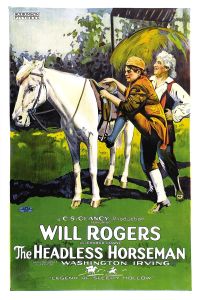
Yesterday was distinctly autumnal around here.  Cloudy and cool, the overcast was definitely moody although the equinox is still a couple weeks away.  Still, the mood was right for the Legend of Sleepy Hollow.  The earliest full cinematic adaptation of Washington Irving’s story is the 1922 silent feature The Headless Horseman, starring none other than Will Rogers.  Now, Irving’s story is fairly brief, and to get nearly a full seventy-five minutes out of it, the tale lends itself to some padding.  The film makes a great deal of Ichabod Crane knowing Cotton Mather’s A History of Witch-Craft, and even being accused of being in league with the Devil that leads to a  disturbing scene where he’s nearly tarred and feathered.  In reality Mather’s book was Wonders of the Invisible World, but the point of the film is better made with the fictional title.

Having watched Tim Burton’s 1999 version—Sleepy Hollow—many times, I was taken by the introduction of the Bible into the story.  The groundwork, however, was laid by Edward D. Venturini’s version.  True to the story, Ichabod teaches Psalmody in his role as schoolmaster.  Venturini’s film has a contrived scene in the church on Sunday that includes a lengthy sermon with everyone—even the usher—falling asleep.  The episode, which is lacking in Irving’s original rendition, introduces the Bible into the narrative.  The connection is thin, but nevertheless present.  Burton picked up on the religious element and built it firmly into the plot as Ichabod Crane’s backstory as a skeptic, raised by “a Bible-black tyrant.”

As someone interested in the integration of religion and horror, early examples, despite the comic aspect of Venturini’s version, are often instructive.  The comedic spirit is actually in the original; Irving’s tale gives a caricature description of Crane that gives the lie to the handsome protagonists beginning with Jeff Goldblum on through Johnny Depp and Tim Mison.  Will Rogers plays the homely image to its hilt, and although lighthearted, the movie has some classic horror elements.  To arouse his dozing parishioners, the minister yells “Fire!” When they awake asking where, he states “In Hell,” which sleeping churchgoers can expect.  Although the eponymous headless horseman is shown to be Brom Bones, a remarkably effective early scene presents a skeletal, ghostly rider that haunts at least the imagination.  The sun is out this morning, and the brooding skies of yesterday have passed.  They will be back, however, as the season for ghost tales is only just beginning.

Power of Parables

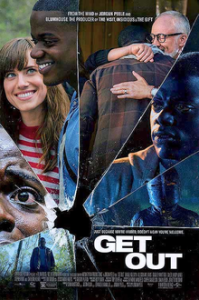
Parables come in all sizes and shapes, horror movie-shaped, some of them.  In my perpetual struggle to catch up, I finally got to see Get Out.  One of the raft of well-made, intelligent horror films that have been released recently, it’s been out long enough that I suspect my spoilers will be well known.  The Armitage family, resident in upstate New York, has been kidnapping and using African-Americans to make up for the perceived weaknesses of their family and friends.  One of their main means of obtaining victims is through their daughter Rose, who brings her boyfriends home for the weekend so they can be hypnotized by her psychiatrist mother and operated on by her neurosurgeon father.  The reveal comes slowly, but the discomfort begins early on.

Released early in the Trump White House tenure, the movie is a study in an intense xenophobia that nestles somewhere between Guess Who’s Coming to Dinner and The Stepford Wives.  It’s inherently uncomfortable watching Chris Washington, the protagonist, being treated as if his very presence requires constant comment in the world of white privilege.  He, of course, had misgivings before ever climbing into Rose’s car, but her convincing display of liberalism was enough to overcome his hesitation.  For me, watching the film made it clear that privilege is something assumed, even when it isn’t had in any explicit way.  The Armitage family and their friends are well-to-do but even if the setting were more mundane the message would still have worked—our culture imposes and reimposes its message of white superiority in subtle ways that the camera captures here.

Quite apart from its nature as a parable, Get Out is a demonstration of the social consciousness of horror.  Its reputation as a debased, low-brow appeal to all that’s unsavory to watch is misplaced at times.  While Get Out is uncomfortable it’s that way for a reason.  Were it not, it would lose its important message.  All privileged people need to be able to see through the eyes of those who are culturally disenfranchised, and although the “us versus them” mentality is problematic it has to be faced honestly and openly.  The very fact that a human construct like race could be used as the basis for a horror film in America raises questions that ought to make all of us squirm.  Setting the story in New York, where prejudice might be supposed not to remain only underscores how deeply its roots have grown.  Horror with a conscience is perhaps as much a vehicle for social change as it is a genre more honest than often supposed.  That’s how parables tend to be.


Masked Reality

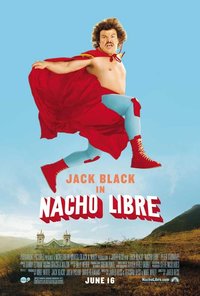
Before I make my confession you need to consider that I spent much of my professional life as a seminary professor.   Never ordained, I nevertheless donned the cassock and taught future priests what they’d be assumed to know (the Bible) while trying to earn an academic reputation through my publications.  It was a double life in which one half involved the church.  Shortly after that job ended I saw trailers for Nacho Libre, a movie in which Jack Black plays a monk who moonlights as a luchador, a Mexican professional wrestler.  I never saw the film, but I had been raised on a white trash diet of World Wrestling Federation fandom, back in the day when that involved gathering around the television to watch grown men posturing and preening while knowing that none of it was really real.  I secretly wanted to see Nacho Libre.

Recently I visited friends who had the movie.  They warned me that it was corny, but I had already supposed that.  What I didn’t realize until after it was over (for movie viewing is now followed by internet viewing) is that it is based on a true story.  “Based on a true story” doesn’t mean, of course, that a movie accurately portrays events, but I had no idea that a Mexican priest had actually supported an orphanage for over two decades as a masked wrestler under the name of Fray Tormenta.  I followed up the movie with a little web research because the film was remarkably respectful of the church.  The character of Ignacio never criticizes Catholicism, and he clearly cares for the orphans for whom he serves as the cook.  His wrestling winnings go toward purchasing better food for them.

Earlier in the day we watched the movie I’d talked to one of my friends about how religious life, no matter how seriously it’s taken, involves acting.  People generally put on masks before going to church (or any other function in which they interact with others).  Religion requires a level of piety impossible to sustain in the real world.  Early in the history of Christianities it became clear that the church would hire some religious specialists to try to take on the lifestyle toward which all faithful should aspire.  I’ve trained many priests.  I’ve seen them when they’re in mufti.  I know that in the vestibule, at the altar, or in the pulpit they’re wearing masks.  Many of them have the heart of Nacho Libre, but outside the church doors they still have bills to pay and family and friends who know them as they really are.  As we slipped the DVD in I didn’t know what the movie might be like, but it was based on a true story in more ways than one.


Significant Places

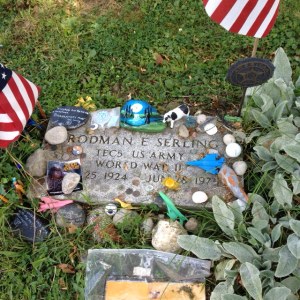
Upstate New York may not get the attention that the state’s largest city does, but it is a place of wonder.  One of those sources of significance is the unique blend of individuals who’ve impacted both American culture, and, in turn, my life, that called this region home.  It’s difficult to describe what I’m feeling as I’m standing next to Rod Serling’s grave.  This is a man who held a profound influence over my outlook by letting his imagination go where it would.  It’s more than the Twilight Zone—although its theme is one of the ringtones on my phone—it’s the sense that I somehow knew this man I never met.  It’s also the sense that his gravesite is so humble, in a rural area outside a small town, the kind that often featured in the stories he wrote and presented.  It’s the sense of connection.

As I young person I practiced writing short stories based on the mood set by the Twilight Zone, with a dash of Ray Bradbury thrown in.  From a small town myself, imagination was my means of enlarging my world.  We didn’t have the money to go many places but the magic box in our living room could take me to weird places alive with transcendence.  The results were beyond price and there was something deep and liberating here, even for a kid whose religion said it was all nonsense.  Even religion requires escaping sometimes.  I know the publishing world has moved beyond what was fashionable in the sixties and seventies, but that can’t dislodge the shard in my chest right now.  If there are spirits in cemeteries, they are here.

Some time ago I began, as I had time, uploading my photos of famous writers’ graves (along with those of other recognized names) on Pinterest.  On the way to Interlaken, I wondered aloud why nobody seemed to show an interest.  I find cemeteries peaceful places, and sacred spaces are those where people significant to us have been, in some form, at some time.  I know Rod Serling loved upstate New York.  It was his escape from the busy life of a writer whose cachet was marketable back in the days when anything seemed possible.  Retreats are those places we go to restore ourselves when work simply won’t allow creative people to have unstructured time.  I wasn’t expecting a huge mausoleum or towering monument here.  Others have found their way to this place nevertheless.  I am in a sacred place and the quiet here is kind of a prayer.


Reading Railroad

Rereading books takes time.  When I was a professor my reading time was largely limited to the summer and winter breaks.  Those who haven’t experienced the academic lifestyle firsthand may not realize just how incredibly busy you are during term time.  Class prep, grading, delivering lectures, leading seminars, committee meetings, office hours—it really is much more than a nine-to-five job.  Time to sit down and read through books is limited, and since those books are heady, academic tomes, they take considerable time.  (I’m reading an academic book at the moment and I can only get through a finger-full of pages at a sitting.)  All of this means I’m generally reluctant to reread books.  Not that I’m a traditional academic anymore, but because I have a huge and growing stack of books I haven’t read yet.

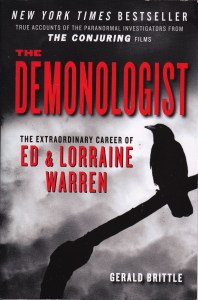
Nevertheless, a project on which I’m working required rereading Gerald Brittle’s The Demonologist.  I read this about two years ago, while commuting.  The thing about reading on a bus is that the quality of reading time is strained.  Recall isn’t the same as when you’re in a comfy, stationary chair, and no stranger’s head is lopping onto your shoulder as they doze.  (Yes, that happens, and frequently for those of us on the first bus of the day.)  In any case, my copy of this book doesn’t have an index and I couldn’t remember if some specific instances were discussed.  The only thing for it, then, was to read it again.  My second reading was done with more skepticism than I could conjure on a bus ride, but still my original sense remains: we willfully cut out much of human experience if we stop our ears completely.  At least in principle.

Ed and Lorraine Warren were self-taught ghost-hunters.  More often than not, their cases turned into what they believed were demonic cases.  Since academics tend not to publish much about such things, the self-taught are pretty much free to declare themselves experts—just switch on reality TV and check me on this.  Experts are those with experience who are willing to share it.  The other day I met someone who, like me, used to live the commuting life.  We both agreed that telecommuting was a more authentic way to exist—your otherwise mandated three or four daily hours traveling can be more sanely used at home.  Still, we had to agree, bus time could be used for activities like reading, and once you stop commuting you have to carve time out for it.  In such a situation rereading a book is at times necessary.  When I was a professor, I reread frequently.  But then, it was mostly articles or books that I wouldn’t take on in their entirety.  In the reading life there’s never enough time.


Horror Homeroom

With a happy coincidence I discovered a website called Horror Homeroom.  Featuring articles and podcasts and reviews on horror films, I felt its siren call.  Then I learned it is run by a professor at nearby Lehigh University, making it even closer than I initially supposed.  I wanted to be part of the conversation.  You see, after years and years of being a Bible scholar and having to fight to find any kind of interest whatsoever in what I had to say, I’ve found the horror community extremely welcoming.  Perhaps because we all know at some level that horror is considered transgressive—it isn’t unusual to find critics who still claim it’s debased—we find each other.  There’s an aesthetic to horror, and it isn’t about gore and violence.  Horror, when done well, is an excellent marker of what it means to be human.

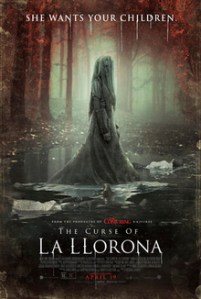
Life always ends in death.  Many people spend as much time as possible trying to avoid thinking about it.  There is, however, great creativity in facing squarely what you cannot change.  Well, that’s a good sounding excuse anyway.  All of this is by way of announcing my guest blog post on Horror Homeroom.  A few weeks back I was quite taken with The Curse of La Llorona.  Not that it was a great movie, but it had a way of coming back to haunt me.  Part of it has to do with the poorly understood way that local customs blend with imperialistic religions.  Faith is a local phenomenon.  Once you switch off the televangelist, you’ll begin sharing beliefs of your neighbors.  There’s no such thing as a pure religion.  Pure religion is one of the most dangerous myths there is.

Those of us who study religion professionally have been taught to call the blending of religions “syncretism.”  I’ve stopped using that word for it because it assumes that there are pure forms of religion.  Religion always takes on an individual element.  We make it our own when it gets translated into our personal gray matter.  The idea that there is a pure form of any religion requires an arbiter of greater rank than any here on earth.  You can always say “but I think it means…”  Horror, I suspect, latched onto this truth long ago.  Without some hint of doubt about your own individualized belief system, it’s difficult to be afraid.  Horror need not be about blood and gore.  Often it isn’t.  Often it’s a matter of asking yourself what you believe.  And once you answer it, opening yourself to asking questions.


Whether or Weather

It was a self-inflicted double feature.  I’d been pondering movies about the weather.  Tons of movies have the weather in them, sometimes even as a significant plot element.  Few films, however, take the weather as their central thesis.  These movies verge on horror as the weather is something much larger than we are and which is deadly.  Let’s face it, a film about sunny skies and light breezes doesn’t have much of a hook.  I began by watching The Perfect Storm.  I’d seen it before, of course.  Not much like its book, which is nonfiction, it follows the loss of the sword boat Andrea Gail in the eponymous storm of 1991.  Not all members of the crew get a backstory, and since nobody knows what really happened, it was a chance for special effects to drive the story just as massive waves drive the boat.  The weather, while central, is seldom commented upon.  The characters are motivated by trying to make a living but there’s not enough time to give all six of them adequate stories.  Add to that another boat with no backstory and the movie become disjointed and smoky.

The next feature was The Day after Tomorrow.  Again, I’d seen it before, but you know how one thing leads to another.  Like The Perfect Storm, The Day after Tomorrow introduces more subplots than the movie can handle, even bringing a Russian freighter up Fifth Avenue in order to have a wolf-chase scene that is simply dropped after it’s discovered that wolves can’t climb ladders.  Still, the latter story has an environmental message.  Aware that human activity does lead to global warming, it tries to picture what would happen if it were speeded up into a matter of weeks rather than years.  No  matter how long it takes, the weather will get you.

As I’ve contended before, the sheer scope of the weather practically makes it divine.  Although we live in different climatic zones we’re all tied together under a single, volatile, powerful atmosphere.  Early humans realized that their survival depended on the weather.  Drought kills as readily as sudden ice ages.  The key, it seems, is balance.  Nature isn’t kind to species who assert too much dominance.  One of the means of nature’s control is the weather.  Until the development of meteorology, and even after its first tentative steps, the weather was considered a divine bailiwick.  We may proclaim it entirely natural, but it still commands its share of awe and majesty.  And it can easily claim a few weekend hours searching the skies for some kind of meaning.


Fun and Fear

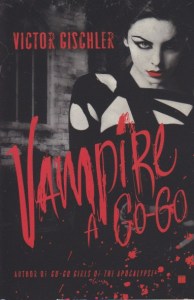
It’s curious the way people find books.  I sometimes see them advertised (the way publishers suppose people see them), but far more often I find them more serendipitously.  I’m active on Goodreads, and many times a book someone else has reviewed will catch my eye.  I like to read things that I notice in independent bookstores.  I’m always on the hunt for a bargain.  At work we have a used book rack where any volume is half-a-buck.  During lunch one day I spied Victor Gischler’s Vampire a Go-Go.  Now the title told me this wasn’t exactly a serious novel, but it had vampire in the title and when I write horror it often ends up on the funny side.  All in all it seemed like it would be worth the tiny investment, even if I don’t have a clear idea of what go-go really means.

While not laugh-out-loud funny, this is an enjoyable romp through monster land.  Kind of like Harry Potter with some adult themes thrown in.  The characters—which include ghosts, witches, wizards, a werewolf (sorry lycanthrope), a golem, and a vampire—are likable and strangely believable.  An unexpected twist came with the Battle Jesuits, a nice touch that shows yet again how close religion and horror can be.  I won’t try to summarize the action here, but I’ll simply note that there are twists and turns aplenty and smiles and splatter along the way.  It’s clear that Gischler researched the novel well, bringing interesting texture to the tale.

Like the last novel I read, also acquired in an inexpensive browsing situation, much of the story is set in Prague.  My wife and I visited Prague back when it was still in Czechoslovakia, and before it had become a tourist haven.  From reading these recent novels, apparently quite a lot has changed there.  Of course, in those days I hadn’t tapped into my love of monsters for many years.  Working on a doctorate has a way of doing that to you.  Now that I’m back, I’m enjoying the variety available in the genre these days.  I still have a soft spot for Stephen King novels, and Poe will always remain among my sacred texts, but I’m inclined to read these newer treatments as well.  There’s nothing really to scare you in Vampire a Go-Go, but there are remarkably moving moments.  And some of the monsters are quite a lot of fun.  It would restore my faith in the power of the accidental find, if it ever required resurrection.


Turin Turnabout

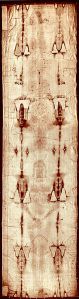
Turn about, they say, is fair play.  Turin, on the other hand, is a city in Italy.  Its claim to fame is a shroud housed there that is believed by many to be Jesus’ burial cloth.  Tests have been done over the years, most authoritatively a carbon-dating done by three independent laboratories, with the results suggesting a medieval origin to the cloth itself.  In case your chronology is a little hazy, the medieval period comes centuries after the time Jesus lived.  Now, some thirty years after the definitive study, some scientists are questioning the results.  They’re being skeptical of the skeptics.  Turn about.  According to a story in The Catholic Register, a Freedom of Information Act request, honored only by one of the three labs (the one at Oxford University) has revealed that the bits of the shroud subjected to analysis were the worst possible parts of the cloth to test.  Herein lies the rub: scientists like to poke holes in credulousness—what do you do when your science is itself the subject of skepticism?

The Shroud of Turin, like Donald Trump, is one of those utterly arcane artifacts that unites Catholics and Evangelicals.  When I was growing up these two groups were the cats and dogs of the theological world.  They united under the umbrella of conservative social causes during the Bush years and have been sleeping together ever since (while both convinced that the other is going straight to Hell when it’s all over).  You see, the Shroud is a Catholic possession and allegedly bears wounds that support the Catholic narrative.  (The Vatican has never declared it an authentic relic, however.)  Evangelicals see it as proof positive that Jesus was resurrected, and so they tend to go further than the Catholics in citing it as proof.  We live in odd times when believers successfully out-skeptic the skeptics.

Since the other two laboratories (the University of Arizona and the Swiss Federal Institute of Technology) haven’t released the raw data, the grounds for a conspiracy theory grow fertile.  When information is kept secret, that’s a natural enough response.  The conspiracy-prone mind asks why the data isn’t being made public.  They do have a point.  The claims of religion are often hoisted on the petard of “no evidence” and when evidence (such as the lab results) exists but isn’t shown, that suggests somebody’s hiding something.  I have no vested interest in the authenticity of the shroud, but we all should have such an interest in getting at the truth.  The turnabout in this case, however, was completely unexpected.


Hidden Monsters

I don’t think much about having been born male.  I’m starting to realize that that’s because I don’t have to.  The same is true of being caucasian, although I’ve always objected to the labels of “white” and “black” as being polarizing and wildly inaccurate.  Although I grew up in poverty, my “social markers” put me in a place of privilege, even if others sharing my demographic have locked me out of the club.  These thoughts were raised by Mallory O’Meara’s excellent The Lady from the Black Lagoon: Hollywood Monsters and the Lost Legacy of Milicent Patrick.  As soon as I saw the book announced, I knew I had to read it.  As O’Meara would doubtlessly not find surprising, I had never heard of Milicent Patrick before.  I’m not surprised that a woman designed the Creature from the Black Lagoon, however, because woman create memorable monsters (can I get a “Frankenstein”?!).

The reason I don’t think about being male is because the crumbling society built by males assumes that it’s the default.  Men have always been shortsighted, I guess.  Having been raised by a “single mother” (she was technically not divorced because a male-made religion said it was sinful), I always believed women to be protectors, capable heads of families, and far more empathetic than the men I met.  I didn’t realize at the time that we lived so close to the brink because men devalue women.  Milicent Patrick grew up in a family where this was much more obvious.  A talented artist, she incurred her family’s lasting wrath by going to Hollywood and doing what was then movie makeup work.  That she designed the beloved Gill Man makes sense to me.

O’Meara’s book is sure to make thoughtful readers angry.  Not at the author, but at the behavior of men.  Perhaps due to my unbalanced upbringing, it has taken many years to see what others probably notice much more readily: women have to struggle for that which someone like myself can simply claim.  Bud Westmore, Patrick’s boss at Universal, claimed her creation as his own work.  There are monsters in this book, and I’ll give you one guess as to their gender.  Still, I’m glad to have read it for I know I’ve found another monster fan.  O’Meara’s clearly aware of how those of us who admit this odd passion are marginalized in a world that prefers super heroes and those good with finance over those who see monsters everywhere.  This is an important book; read it and you’ll see them too.


Summertime Boos

There are so many of them that it’s difficult to keep up.  Movies, I mean.  And they can be an expensive habit.  As some readers may know, I’ve followed The Conjuring franchise pretty much from the beginning.  That particular film was long anticipated (at least in certain circles), but still I waited until it was available for home viewing to see it.  I always feel kind of selfish going to the movies on my own since they are a kind of event—a form of social outing.  For me, however, horror movies are research, but that hasn’t taken away the thrill of seeing one on the big screen once in a while.  The Conjuring branched off into the Annabelle movies, and I caught the latest offering in the latter series in a theater.  I hadn’t realized that The Curse of La Llorona had been released a couple months earlier, and that it was being considered part of the diegesis.  It was back to the small screen to catch up.

La Llorona is based on a Mexican folktale and is tied to the other films in its universe by a character who recurs from Annabelle, Fr. Perez.  He’s not the protagonist, but he does introduce one way in which horror responds to the present insanity we call the US government—the character who defeats the fiend is hispanic.  In fact, most of the characters in the film are from hispanic families in Los Angeles.  They take down the ghost without the assistance of border guards or any kind of wall.  They don’t need the simpering help of the GOP.  Like most of the movies in this franchise, however, they do make use of religion.

When Fr. Perez can’t offer immediate help to the family beset by La Llorona (“the weeping woman”), he points them to a local shaman.  In this otherwise Catholic world, the truly amazing outcome is that the faith healer does possess the knowledge and ability to stop the evil.  While the backstory of the ghost is well known, the nature of the entity is a bit unclear.  Most Conjuring films feature a demonic presence, so it’s kind of a relief to have a garden variety ghost for a change.  You see, when Ed and Lorraine Warren challenge entities in these movies they do so with religious accoutrements which tend not to fail.  Ghosts, however, traditionally don’t require a religious banishment.  We’re entering new territory here, of course.  And I hadn’t even known about this film until after I’d seen its predecessor.  How can you hope to keep up with spirits?  It’s a full-time job. 


Good Monster

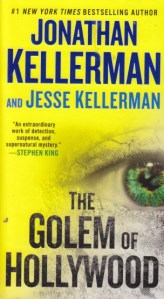
The little free library is a great idea.  Just after our move last year we contributed to our local many times as we discovered duplicates in the process of packing.  On one such venture, I discovered a book I wanted to read.  Not that I’d heard of it before, but any book with “golem” in the title catches my eye.  For the first (and so far only) time, I took a book.  Jonathan and Jesse Kellerman’s The Golem of Hollywood proved a fairly quick read for being over 600 pages.  I believe the industry term is “potboiler,” but it’s also a page-turner.  Nevertheless, it made me think.  The story follows a hard-bitten Jewish detective in Los Angeles.  Struggling with personal issues, he gets assigned to a bizarre homicide case that eventually takes him to Prague and Oxford, and then back to LA to clinch it.  And the killer is a golem.  (That’s not a spoiler, since it’s right there in the title.)

Parallel to the modern-day crime drama is the retelling of the biblical tale of the first days of humanity outside the Garden of Eden.  One of Adam and Eve’s daughters is headstrong and beautiful and when the tragedy between her brothers plays out she eventually takes her revenge on Cain.  Although not explicit about it, for violating the mark of Cain she witnesses the horrors that people will visit upon one another and her redemption is to become the soul that animates the golem of Prague.  Not your garden variety golem, she can transform into different shapes, and she stays loyal to the family of Rabbi Judah Loew ben Bezalel, the legendary first creator of the golem of Prague.

One of the frequent topics raised on this blog is how the Bible appears in everyday life, often unnoticed.  This novel is an example of that.  A further point, which is what stands behind my book Holy Horror, is that the Good Book is understood as mediated by popular culture.  Even those few biblical scholars who make it into the limelight can’t compete with the myriad representations of Scripture in the entertainment media.  Like The Golem of Hollywood, Holy Horror sees the Bible in the context of monsters.  Horror is an outsider genre.  Despite the many intelligent, thought-provoking exemplars extant, the default among the more refined is to see horror as something base and low.  It can also be a lot of fun.  Perhaps not great literature, The Golem of Hollywood is entertaining even as it underscores the continuing influence of the Good Book. 


Conjuring Success

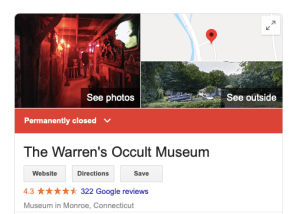
I wonder if it’s one of the consequences of success.  While writing up some thoughts on The Conjuring diegesis, I got to wondering how accurate the movies’ portrayal of the occult museum of Ed and Lorraine Warren is.  The museum set appears in multiple films, and in Annabelle Comes Home it serves up a smorgasbord of horror.  Some of these artifacts, such as Annabelle, really do hold places of infamy in the establishment and some are clearly used in the cinematic version to set up spinoffs to keep the franchise alive forever.  Curiosity drove me to the open web—website owners of spaces of reputation now distrust this “open web,” what with its money grubbing and lack of peer review—to peruse some actual photos.  That’s how I learned the museum is permanently closed.  The reason given: zoning issues.  (I presume they don’t refer to the Twilight Zone issues.)

That The Conjuring franchise has proven remarkably successful hardly requires footnoting.  With The Conjuring 3 due out next year, a total of eight films will have been produced over seven years, currently and it currently stands as the second most profitable horror franchise in history.  For anyone wondering why I wrote Holy Horror, such numbers may help explain.  Now what of these zoning issues?  I wonder if it’s not the number of visitors drawn by the films that have created a problem.  (Those with questions aren’t purchasing Holy Horror, that’s for sure!)  Since the Warrens have now both passed away, the New England Society of Psychic Research runs the museum and is seeking a new place for it.  (We have space in my garage, just sayin’.)  And hey, Gettysburg isn’t too long a drive from here!

Success, I suspect, does come with its price tag.  People are drawn to those who’ve captured the interest of the big screen, and what with everyone dying death is a growth industry.  I suspect part of horror’s appeal is just that.  We all have to face it some day and while many run from it screaming some use this opportunity to prepare.  But I’ve also got to wonder if it can maintain its level of fear.  I recently watched the current iteration of It and found little that was even frightening about it.  But then again, clowns have never bothered me that much.  The bullies are the scariest thing in the film and Washington DC’s full of them.  Talk about success and its consequences.


The Sound of Musik

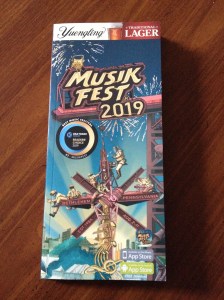
“Why is there so much people here?”  The words aren’t mine, but those of a random stranger I heard in Herald Square.  Not only was it grammatically offensive, I always find “much people” in Manhattan, but this was the occasion of the Pope’s visit a few years ago, so more of us were crowded into that area than normal.  It was a feeling that returned last night as my wife and I wandered around Musikfest.  If you’re not from around here, Musikfest is the largest free music festival in the United States, and it takes place in Bethlehem each summer.  Ten days of free, live music and tents hawking wares and all kinds of comestibles, as well as that strangely satisfying feeling of being lost in a crowd.  We ended up there more or less accidentally.

I was an experimental subject.  Those of you who know me will probably not find this odd, and you may well come up with many reasons to find me in the psychology department, some involving locked doors.  This was, however, a voluntary research project that required participants and it had been literally decades since I’d volunteered to be one of the “much people” who was not not part of the university crowd.  It felt good to be on a campus again.  The Lehigh Valley hosts several colleges and universities, and that draw is perhaps related to why Musikfest is held here.  When we got to town my wife realized we might have trouble parking.  Sections of downtown Bethlehem are closed to traffic and there are people everywhere.  I finished my experiment and we became part of the crowd again.

Music and religion, I’ve noted before, hang out in the same crowd.  They both have the ability to be transcendent and people seek out such experiences.  Since we hadn’t planned on attending—accidental musicologists we—we had no groups as targeted hearing while we wandered.  Mostly we marveled at the size of the event.  The city of steel transformed to the city of music.  And the religious feelings music brings.  As I walked from the college back to downtown, a couple strangers accosted me.  “Hi, brother,” they said.  “Heading to Musikfest?”  This, I realized was a congregation.  I was an unknown brother.  Music brings peace.  Dona nobis pacem, sisters and brothers.  Like those crowds a few years back hoping for a glimpse of the pontiff, an entire city had kicked off its shoes for a Friday night of potential transcendence.  Why is there so much people here?  Simply listen and you’ll have your answer.


The Zone

My youth—who am I kidding?—my life has been a search for father figures.  Since I grew up with television, many of them came from the tube.  The professor from Gilligan’s Island, Mr. Rogers, Barnabas Collins, and Rod Serling.  Serling was like the father I couldn’t remember in that he was always smoking.  But unlike my father, Serling had an imagination in sync with mine.  The Twilight Zone was in reruns by the time I caught up, but it gave me an odd kind of happiness.  The sort that you had as a kid after the bath was over and you were wrapped up snuggly and warm in a bathrobe, and you got to watch one of your favorite shows before going to bed.  I discovered Serling as a writer when I was in Junior High School.  He was right up there next to Ray Bradbury, in my book.

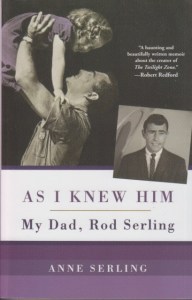
I have to admit to feeling anxious as I read Anne Serling’s As I Knew Him: My Dad, Rod Serling.  You see, she actually was his child and I’m afraid of learning too much about those I put on my personal pedestals.  Her book, however, didn’t disappoint.  Serling lived a writer’s life, something I’ve coveted since I was a kid.  If I couldn’t have a father, at least I could write about life as I saw it.  I still write fiction inspired by, among others, Rod Serling.  Spending much of my time in Binghamton and Ithaca for my own family reasons, I was only obliquely aware of how much I was traversing the region Serling considered home.  As I read his daughter’s autobiography—or is it a biography?  Who can tell the difference?—I was inexorably drawn in.  Fathers and daughters can be the best of friends.

Sometimes I wonder if those who know writers the best are their true fans.  I don’t mean groupies or the like, but rather those whose lives have been transformed by their words.  I’m reminded of Evermore, written by a relative of Edgar Allan Poe.  Family, it is true, see a side of a person that the reader does not.  But who are we, really?  Those of us who write may be saying more in our fiction than we care to admit even to those who know us well.  Rod Serling recognized dimensions well, I suspect.  A writer’s life requires sacrifice and keeping things hidden.  Anne Serling’s book is a gift to those who write, even if it is about someone else’s father.