Not Sleepy Yet

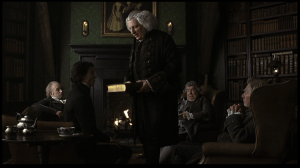
Over a recent weekend I watched four versions of “The Legend of Sleepy Hollow.”  (I have two excuses.  One is that it’s October, and the second is that I have an article on Sleepy Hollow coming out on Horror Homeroom.  For the second, read on.)  The story is one that made an impact on me as a child, probably because of Disney’s Adventures of Ichabod and Mr. Toad.  The cartoon version, which was one of the four I watched, is silly and scary both.  It leaves it to the imagination whether the headless horseman is real or not.  Before that I watched the silent 1922 Headless Horseman staring Will Rogers.  Clearly in that film the headless horseman is what we’d now call a liberal hoax.  It was Brom Bones scaring Ichabod Crane away from Katrina Van Tassel.

The canon of characters grows with Tim Burton’s 1999 film Sleepy Hollow.  Although Burton is hit or miss for me, this strikes me as one of the best October movies I’ve seen.  The headless horseman is quite real and the spiritual world intersects with the rational, crime and punishment world in the haunted western wood.  I didn’t have time for the 1980 television movie this time around, but I decided to watch the 2007 television movie Headless Horseman.  A rather puerile splatter film set in Missouri, it posits that this is the real headless horseman behind Washington Irving’s story.  It has a lot of religious imagery, which is often what I’m looking for in horror.  The writing is poor and the characters shallow, but it isn’t a total waste of time.

What all of these films demonstrate is that Washington Irving’s story, as simple as it is, really resonated with Americans.  How can you reason or plead mercy from a headless man?  Look closely, for there is a parable here.  The headless are merciless and they have the ability to frighten.  The story is generally set in the harvest season.  The 2007 movie makes the horseman’s appearance as a crucified scarecrow.  Although the original story had no such religious elements, they’ve become a standard part of its accrued cultural heritage.  The headless horseman has gone from secular to religious, for it is an American story.  Originally set in the period after the Revolutionary War, it was part of an unsettled nation’s frustrated attempt at normalcy.  This, I believe, remains.  When we can’t make sense of our surroundings, we look back to those stories that seem to have some insight into who we are.  Headless horsemen are quite useful in that regard.

Keep Cool

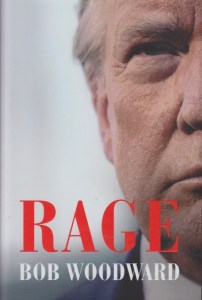
I know national secrets.  You can too!  Bob Woodward’s Rage contains them because Trump is willing to talk about anything that aggrandizes himself.  The real takeaway, and in many ways the point of Woodward’s book, is that Trump knew about and decided to downplay Covid-19.  And not because he didn’t think it was serious, but because he didn’t want to hurt his chances of reelection.  Although Woodward had no way of knowing in the middle of the summer, when the book went into production, that 45 would be infecting his senior staff mere months later, he would likely have been able to predict the results.  With the best medical attention in the world, Trump would recover and immediately downplay the virus that has now killed over 210,000 Americans.  Why?  He wants to win the election.

Many of us knew in November 2016 that this wasn’t just another Republican nominee with questionable intellect.  We knew that Trump had a long, long track record of caring for nobody but himself and that isn’t the kind of person who can lead a nation.  He had seventeen interviews with Woodward as he was writing Rage, and, as we might guess before opening the book, those interviews indicate that being president, for some, is all about bragging rights.  Knowing how serious the coronavirus is, he decided to ignore it for political expediency.  Now we see his own party’s leaders daily falling into the epidemiological pattern of the science they disbelieve.  Early on wearing masks was politicized and now we’re being told a deadly disease is a walk in the park (if you’ve got the best healthcare in the world).

I’m reluctant to write about politics.  I find it boring and intellectually stultifying.  But even under George W. Bush I believed that the president had what he believed to be the best interest of America at heart.  All that has changed in the last four years.  The Republican Party has sold its soul to the cult of Trump and those of us who’d rather just watch horror movies and write books and stories have had to become political activists simply to try to save democracy from the slide into a fascist narcissism that is intended to prop up one man’s ego.  Woodward’s book is more than a series of interviews with a dangerous man, it is a condemnation of political leaders who’ve failed their country repeatedly, without recrimination.  Of course, it is only intended for those who read, or maybe I’m just angry.


Dangers of Experience

I’m so used to being behind everyone else that when I turn out to be ahead of the curve it occasions genuine surprise.  That’s the way it appears when I think about the dominance of the far right in American politics.  As an editor I get to read proposals for other editors on the board.  Political scientists are trying to analyze how we’ve come to be a nation of religious far-righters when we seemed so progressive that we put a smart phone in everyone’s pocket and Alexa in everyone’s voice range.  I grew up as a far-righter when it certainly felt alienating.  Apart from people we met at church I didn’t know any others outside my family.  People we knew were, well, just different.  Back in those days we didn’t judge them.  We accepted them for who they were.

One of the aspects of my life to which I’ve grown accustomed is being ignored.  I’m not a big person, nor am I a loud one.  It isn’t unusual for me to be overlooked at work and even at religious gatherings (a field in which I’m a bona fide expert).  Nevertheless, I have a wealth of experience among the far-righters and I think it might help to understand our political climate.  I think I have a pretty good grip on what motivates this crowd.  Since I grew up (serious study will do that to you) and am no longer arrested at that stage, I’ve blended into the crowd as someone just as perplexed as everyone else.  I do, however, have an idea of what they’re after.  Our particular sect didn’t push this—we seemed more worried about our own souls staying out of Hell—but many fundamentalists wanted to take over the nation.  In fact, they have.

The fact that 45 isn’t one of them is immaterial.  Power is the thing.  Power to make others conform or suffer.  This particular faith is built on fear, not love.  It’s as if their New Testament lacks the gospel of John.  You see, I was ahead of the curve.  I was part of it before it took over congress, the White House and the supreme court.  Things move so far these days that thinkers just don’t have time to think about everything.  Work days are long and covid still complicates everything.  Who has the time to seek out those who grew out of the very source that now endangers our democracy?  I think I prefer running a little behind, don’t you, Cassie?


What Smells

One of the stories I recently read had a character commenting on the smell of a place.  Although humans can’t rival many other mammals and some birds for sense of scent, smell is a keen reminder of location.  It is also one of the more personal aspects of the senses.  We get nervous when people start talking about smells.  We all know, however, that places have their own fragrances.  Home smells a certain way.  You always notice it going home from college, where the dorms have their own smell.  When I was visiting campuses as part of my editorial expectations, I returned to Boston University School of Theology.  Apart from the main corridor of 745 Commonwealth avenue appearing smaller than I remembered, the smell was so familiar as to be overpowering.  I hadn’t been there for at least a couple of decades, but my brain remembered it well.

I trust science.  I also think science can’t explain everything, particularly in the life of emotions.  One of the natural limitations of science is the data with which we have to work.  We have limited input.  I remember in chemistry class in high school we worked with chemicals that replicated scents.  The particular ethyls used to reproduce fruit scents were similar only by suggestion.  I remember thinking the banana combination only smelled like bananas because it was suggested to me that it did.  Smell is a complex world, and we know many animals do it better than we do.  Dogs, bears, even mice, know more of the world through their noses.  I suspect Fido knows home primarily by its smellscape.  We, the “masters” tend to miss a lot.  And that makes me wonder what science might be missing by our limited sense of smell.

If there is a supernatural world, I wonder what it might smell like.  We’ve all known someone whose dog wouldn’t go into a certain room, or who reacted to something we couldn’t see.  Perhaps Fido couldn’t see anything that we couldn’t but could smell it.  I often think that when dogs are tested humans try to understand their visual acuity because that’s how we experience our world.  Dogs, however, experience their world through scent.  We could stand to learn quite a lot about this planet we inhabit if we could somehow access the smells that we simply lack the capacity to reach and analyze.  We are only beginning to scratch the surface.


Ghosts, of a Sort

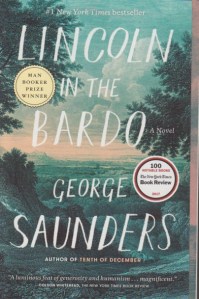
What happens when we die?  That question is perhaps THE question that drives just about everything we do.  Evangelicalism, masked behind love of Jesus, is really the desperate attempt to avoid Hell.  That idea is powerful and insidious.  The question of what happens, however, has also inspired a tremendous amount of literature.  Lincoln in the Bardo, by George Saunders, is a recent example of how diverse such views may be.  Written mostly epitaphicly, it is a conversation among the spirits in the cemetery the night Willie Lincoln arrives among them.  Fearing what is beyond, these ghosts don’t admit they’re dead, but rather think themselves sick, awaiting recovery.  When the profoundly bereft Abraham Lincoln arrives to mourn his son, things begin to change.  

All through my reading of this book I found myself wondering about the many ways we conscious creatures reassure ourselves about death.  Materialists say it’s like the turning off of a lightbulb.  All goes dark and there is no soul to remember anything.  Many of them claim science for proof, although science has no way to measure the non-physical.  Various religious sentiments of the eastern hemisphere posit reincarnation until one’s soul reaches the point of no longer having to cycle through all of this again.  Here in the western world, influenced by a Zoroastrian-inspired Christianity, we posit a Heaven and Hell.  Some include various shades of Purgatory, which, to the classic Greek, would’ve sounded familiar.  Those who’ve undergone Near Death Experiences often suggest a more dream-like reality of acceptance.

There are many more shades and nuances, of course.  We’ve entered the shadowy half of the year.  Those of us in temperate regions spend half of our lives with nights longer than the days.  Death, however, is generally a shunned topic.  We try to avoid talking about it since we really don’t know what comes after.  We have beliefs.  We have hopes.  We really just don’t know.  We often look to literature to help us explore these topics.  Lincoln in the Bardo does so with some humor, some sadness, and some soul-searching.  Those of us drawn to ghost stories naturally think about them as we wait later for the morning sky to lighten, and find it dark before we turn in for the night.  A great many options await us, some with a kind of historical anchor, and others that are completely made up for our edification.  The one thing they all have in common is they force us to think of that which we really don’t know.


The Hardest Part of Nightmares

In the process of writing a book, there comes the long time between when everything’s submitted and you hear nothing.  In fact, writing a book is often about waiting.  You spend years pounding your thoughts through a keyboard, send them off to some editor (guilty, as charged) who takes months to read and think about it.  If they like it they’ll send you instructions on how to change it and you start banging the keys again.  When it’s finally ready you submit it and wait while it gets transferred to production.  This handover is a complicated process and can itself take a month, easily.  Then the manuscript has to be copyedited.  I’m at the post-copyedited phase of Nightmares with the Bible, and this is, it seems, the longest wait.

There were only a few changes to the proofs I received.  These days your Word files (converted from Pages files for Mac users) get loaded directly into the production software.  What you see is your own words, in a different format.  You type your corrections directly onto the proofs.  Hit submit.  Then wait.  In my head I know that my book is one of many waiting in a queue to be printed.  I’m also a realist so I know the initial printing will likely be about 150 copies.  (When I first started in the publishing world academic books routinely sold 300 copies, but those days are long gone.)  At some point before then I’ll receive an email telling me the cover’s ready.  That’s what I’m waiting for at the moment.

We’re constantly told, in the business, that electronic books are what people want.  I can’t speak for others who write, but when I think of a book I think of a physical object.  Not some electrons sharing a screen promiscuously with any number of other books.  I haven’t published until I hold the printed object in my hands.  That’s still at least a weeks away.  Unless your book is anticipated to be a big seller, this is a period of absolute silence.  You just wait, nervously checking the publisher’s website every other day to see if your page has been updated, all the while working on your next tome.  Although it is priced expensively, I’m hoping Nightmares with the Bible will do reasonably well because of the subject.  Maybe some people will even get curious about Holy Horror, which was the precursor for it.  But for now, I sitting here with Tom Petty, waiting.


Unintentional Patterns

Time, they say, is what prevents everything from happening at once.  I’ve noticed something about my reading life (is there any other kind of life?).  One of my favorite topics on this blog is books.  Both reading and writing them.  When I wake up and try to clear the cobwebs of sleep from my head to think about the day’s post, I always feel relieved when I have a book I’ve just finished because that’s an eager and ready topic.  When I’m in the middle of a large book, it seems like a long time until I’ll be able to jot down some thoughts on it, and the ideas don’t always flow.  It’s here that I’ve noticed a strange kind of pattern and it has to do with the way I read.  Interestingly, it isn’t intentional.  It goes back to my post-commuting literary lifestyle.

I read nonfiction in the mornings.  I awake early and after about an hour of writing I try to get in an hour of reading before thoughts turn to work and its unraveling effect on the fabric I’ve been weaving before the sun rises.  The nonfiction I read depends, to a large extent, on my writing projects.  Not exactly the kind of research that time and libraries afford academics, but still, research in my own way.  Often these nonfiction books are large—400 pagers seem to be the trend.  I’m a slow reader, so they take some weeks to finish.  At night (or actually evening, for I retire early) I read fiction.  It isn’t unusual for my fiction choices to be briefer than the nonfiction books of the morning.  It always seems, however, that I finish two books very near the same time.  Then I have two book posts in a week and many days without any.

Since we married over thirty years ago, my wife and I read to each other.  Usually she reads while I wash dishes.  Those reading choices are by mutual consent.  They sometimes make their way into my research, but more often they show up in my fiction writing.  In any case, they also seem to fit this same pattern.  When I finish a large nonfiction book in the morning, the same day, or the next day, I generally finish my fiction book.  Shortly after that our dishes-reading book finishes.  I’ve noticed this happening over the past couple of years and I always wonder about unexpected patterns that I find.  It doesn’t always happen this way, but it does often enough to make me wonder.  If I intentionally set out to do this it would be understandable, but as it is, it simply happens.  As they say, things tend to occur in threes.


Belief and its Discontents

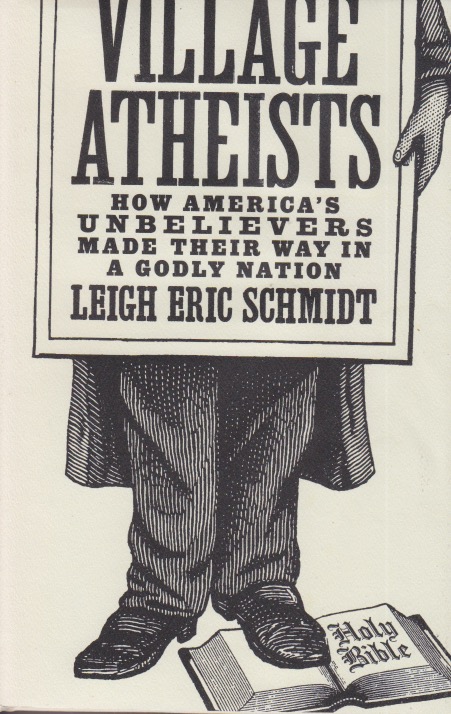
In this day of self-driving cars and instant, world-wide video conferencing, it is difficult to believe we still prejudice belief in God.  Village Atheists: How America’s Unbelievers Made Their Way in a Godly Nation isn’t exactly what I thought it would be.  Leigh Eric Schmidt is an historian, so this is an historical treatment.  Specifically focusing on four characters from the nineteenth (to early twentieth) century (Samuel Porter Putnam, Watson Heston, Charles B. Reynolds, and Elmina Drake Slenker), Schmidt focuses on a term I’d seldom heard before his book, “the village atheists.”  These men and women objected to the preferential treatment accorded to Christian believers in a nation founded on religious equality.  In the epilogue Schmidt shows that we are still not a nation committed to fairness.

The only crime these people committed (and two of them were clergy) was honesty in their search for the truth.  This was an actionable offense into last century.  Such was the hold of biblical religion in America that holding public office, being on a jury, or even protection under the law was disallowed for those who questioned the existence of the Almighty.  For sure Schmidt has picked out some colorful characters to sketch, but their common theme was that they were simply following where reason led.  In America this was a crime.  Secularists today who claim it’s not still haven’t come to terms with the power of religious ideology.  A deep distrust of the unbeliever remains, even after the four horsemen of earlier this millennium.

For me the question comes down to honesty.  Belief shifts over life, depending on your circumstances and your outlook.  Most people unreflectively stay with the religion into which they’re born.  Those who study it learn to ask questions and the result is belief that may shift over time.  Making what you believe a measure of your integrity is therefore a temporary thing.  This is well illustrated in Village Atheists; some of these people began as fervent ministers.  They, however, were honest about their thought process and were counted criminals.  You have to wonder about a religion that punishes honesty.  Perhaps it’s no wonder that evangelicals have no trouble with Trump’s incessant lying.  To be honest is to be vulnerable.  The people profiled in this study, tried for things we would have trouble believing count as a crime (consider what 45 has been able to get away with), came out of their trials with integrity.  It would be great if the same thing could have been said about their accusers.


Scared Space

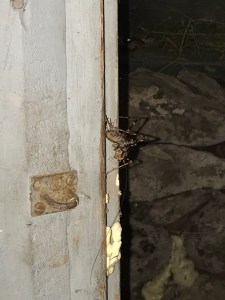
It was dark.  I often work in dim light since the computer screen backlights everything.  I’d strained my back the day before, and getting into a standing position took some time, with the first steps being necessarily ginger.  Out of the corner of my eye, I saw it in the shadows.  A wolf spider was on the arm of my chair, just inches away.  I could move neither fast nor fast enough.  By the time I’d hobbled to an empty peanut butter jar (we keep them for this purpose), it was gone.  But the fright remained.  It was several hours until I could think of sitting in that chair again, although the spider was last seen fleeing the site of the attack.  That got me to thinking about how spaces maintain the events that transpire in them.  It’s the early stage of haunting, I suppose.

Spiders were a childhood terror.  Just a week before the current spider incident, I was in the basement doing some repairs when a spricket jumped on my arm.  Sprickets, also known as camel crickets or cave crickets, live in damp places and they actually jump at their perceived enemies to frighten them away.  It works.  I was absolutely terrified by the thing.  It was large, and although it was on my arm only a second or two, I wanted to run screaming from the cellar and strip off my shirt and throw it in the washer.  I couldn’t go back into the basement the entire day.  It was the site of the fright, you see.  Spricket and spider were long gone, but their threat remained in the place I’d encountered them.

I often write about sacred space.  There is also such a thing as scared space.  I can see how this would’ve evolved from our primate ancestors.  Chimpanzees, for example, are frightened of large spiders.  They can climb trees right after you and they are impossibly fast.  I suspect in our encounter the spider was more frightened of me than I was of it.  I’m a giant in its multiple eyes and, were I not a believer in catch-and-release, could easily have killed it.  (Messy for the chair, but conceivable.)  Our ancient ancestors would likely remember—this is the place the spider bit Oog.  Must avoid.  So the idea remains, scarring the spaces we habitually sit.  Spiders outdoors, as long as I see them before they see me, are not such a source of fear.  But right now I think I’ll pick a new favorite chair, until my favorite becomes sacred again.


Behind the Exorcist

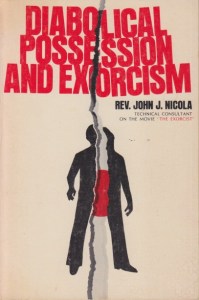
Some books from the 1970s are difficult to locate.  Since that was some half-century ago I suppose that’s not at all unusual.  One of those that I had been anxious to read since working on Nightmares with the Bible was Diabolical Possession and Exorcism, by John J. Nicola.  The main reason for my desire was that many people involved in the narrative about demons in the modern world are difficult to document, at least on the internet.  For academics, or even journalists, with budgets and release or research time, there’s the possibility of travel and interviews and archive searching.  I have none of those things, and I was curious about Nicola’s book since he wrote a forward to The Amityville Horror, vouching for its authenticity, and he was also technical advisor for The Exorcist.

I didn’t locate a copy of his book until after Nightmares was well into production, but research, even as I conduct it, is never-ending.  The book is kind of a memoir and kind of a “you should listen to your priest” lecture.  What’s fascinating about it is Nicola has no difficulty accepting both the paranormal and the standard Catholic teaching in matters of faith.  He does come across as somewhat credulous, and somewhat academic in this book.  His chapter on his role in The Exorcist is quite informative.  One of my main questions regarding both the man and his book was what his particular expertise is/was (even finding out if he’s still alive, via the web, is difficult; he is on the 2017 honor roll of giving for a Catholic charity).  The book provides a partial answer, but it also raises many questions.

This book is rare enough to have given rise to its own kind of mythology.  I would classify that in the same category as the various stories about The Exorcist production being plagued with curses and strange phenomena.  They’re all part of a culture of creating a belief structure that allows the supernatural back into an overly materialist worldview.  Kind of like Einstein’s “spooky action at a distance,” it causes pleasant shivers because it doesn’t really explain anything.  The book itself is though-provoking, but like the books of Gabriele Amorth, expends pages on the wonders of the Virgin Mary and building up a Catholic outlook on the spiritual world as the basis for combatting evil.  Nicola, correctly in my opinion, points to the (then impending) influence of The Exorcist movie.  This is a topic that I take up in Nightmares, for those interested in knowing more.


BBW

It’s a measure of how busy I am when Banned Book Week has started before I realize it.  Most years I make it a point to read a banned book at this time, but my reading schedule is so crowded that I seem to have missed the opportunity this year—I didn’t see it coming.   I’ve read a great number of the top 100 banned books over the years, and I’m sure I’ll read more.  I’ve recently been reading about America’s troubled history with free expression.  Probably due to a strong dose of Calvinism combined with Catholicism, many of the books challenged and banned, as well as prevented from ever seeing the light of day, have to do with bodily functions.  Sex, especially.  In American society, as freely as this is discussed, we still have a real problem when someone writes about it.

Why might that be so?  Many religions recognize the privacy aspect of sexuality without condemning the phenomenon itself.  The Bible (which is on the list of Banned Books) talks of the subject pretty openly and fairly often.  Our hangups about it must be post-biblical, then.  Much of it, I suspect, goes to Augustine of Hippo.  Although he had a wild youth, Augustine decided that nobody else should be able to do so guilt free, and gave us the doctrine of original sin.  Add to that the legalistic interpretation of Paul and his school, and soon the topic itself becomes difficult to address.  Victorian values, obviously, played into this as well.  Literature, which explores every aspect of being human, is naturally drawn to what is a universal human drive.

Banned Books also treat race—another topic that haunts America—or use coarse language.  Some challenge religious holy grails, such as special creation or Christian superiority.  It seems we fear our children being exposed to ideas.  The wisdom of such banning is suspect.  The publishing industry has many safeguards in place to create age-appropriate literature.  Banning tends only to increase interest by casting the “forbidden” pall over something that is, in all likelihood, not news to our children.  American self-righteousness tends to show itself in many ways, making much of the rest of the world wonder at us.  We seem so advanced, but we fear a great number of rather innocuous books.  The reasons are similar to those behind why we can support tax-cheating, womanizing, narcissists as leaders: our faith blinds us.  I may be late in getting to my banned book this year, so I guess I’ll just have to read two next time.


Mother of Life

Homeostasis is, if I recall correctly, the state of equilibrium that entities and systems seek.  When we’re too warm we seek someplace cooler and when we’re hungry we look for something to eat.  It’s a great process of evening things out because we live in a world of extremes.  Well, relative extremes for a planet that suited to life.  Autumn came in with a chill this year, at least around here.  We had a couple of nights with frost before apple-picking season even began.  Over in Denver they went from a heat wave to inches of snow overnight.  I often wonder, if our species manages to survive long enough, what life will be like once everything evens out.  Until then, because of human climate degradation, we’ll be facing more extremes.  That’s the way the GOP likes it.

Meanwhile, there may be evidence that life exists on Venus.  Or at least in the atmosphere of the hottest planet in the solar system.  Up through my college years I toyed with the idea of being an astronomer.  I’d learned in high school (for we were a Sputnik-era school in rural Pennsylvania that had a working planetarium) that it was mostly about math.  I’m afraid I have no head for such things.  Still, I remain fascinated by other planets and their potential.  I’m in the market, you might say.  Venus had captured my young imagination not only because Ray Bradbury and C. S. Lewis wrote stories about living there, but because of the images from the Russian Venera (blush, giggle) probe program.  I knew in high school (planetarium, remember?) that Russia had landed probes on the rocky surface of Venus that had only functioned for a couple of hours at most before breaking down in the extreme conditions.  Extremes, again.

Venus could, it was thought, never have supported life.  The new evidence, however, stands to show us just how little we understand life.  It exists in the most inhospitable environments on our planet.  When life was found near black smokers on the ocean floor it was considered a fluke.  Maybe life is the norm instead of the rarity our exaggerated sense of self-importance suggests.  Venus, after the sun and moon, is the brightest natural object regularly visible in our skies.  Both the morning and evening star, it beckons to us.  Although not definitive, we’ve found evidence of life on both Venus and Mars.  And yet many of us prefer science deniers to lead our nation.  So I think of homeostasis as I look at Venus out my early morning window.


Up in the Sky

Superman stands for truth, justice, and the American way.  Or least he did when I was a kid.  One out of three ain’t bad.  Considering the many exposés that have come out about Trump in the last few weeks, many of them by intimate family or very close friends he’s recently betrayed, are a pretty amazing example of a liberal hoax, I guess.  Witness after witness after witness comes out saying that truth, justice, and the American way simply aren’t important to 45, and yet the evangelical bloc insists differently.  They can’t seem to see that those who like Superman don’t object to your garden variety Republican (although we prefer the other alternative), we object to Duperman saying he’s Superman.  When in history have we had several party members advocating that people not vote for their own party’s candidate?  And yet the true follower can’t accept the witness of closest friends and fixers that they’ve been lied to for four years.

Like many people I would rather not be political.  When it becomes an issue of destroying democracy, however, it suddenly seems like I have to add yet another thing to my already full plate.  For four years now I haven’t been able to trust the government to do its job.  Trump admits that he ignored how serious he knew the Covid-19 crisis to be back in the spring.  Six months later and we’re all still confined to our houses and businesses are suffering, and his supporters say he read this one just right.  Over 200,000 of our fellow Americans have died from a virus that our “president” won’t admit is a problem, even as the White House has taken over writing guidelines for the CDC.  Boy, are we ever great hoaxers over here on the left!

I recall Superman flying around Metropolis actually fighting crime.  Ensuring that the truth was upheld.  Justice was essential.  People adored him.  What happened on the way from Super to Duper?  We’ve come to praise a man who is a sworn enemy to justice unless there’s something in it for him.  Whose number of documented lies by any measure staggers the imagination, and yet whom “true Christians” support.  The Superman of the New Testament had quite a bit to say about truth and justice (the American way was a bit beyond his experience).  Those who lived in lies were considered friends of the Devil.  But times have changed since then.  Heck, they’ve changed since I was a kid.  We used to look up to Superman in those days.  Now we apparently prefer lies, injustice and what is apparently becoming the American way.


Eureka?

It’s weird to feel yourself becoming a curmudgeon.  Especially when it’s about technology.  Someone asked me the other day if I could send an audio file of something I’d recorded.  I stopped doing podcasts because I lost track of the server that had been hosting the files.  My “inbox was full” or some such nonsense—they’re just electrons, folks.  I’m already paying for the space to host this blog and one thing I know about audio files is they take up lots of space.  My laptop reminds me of that every time it wants to update.  Well, I recorded the requested audio file and wanted to send it along.  I couldn’t find it.  Now, I’m one of those people who started using Apple computers because they were intuitive.  You could easily guess, or reason out, where things were.  It’s not that way anymore.

I had to do a web search (use Ecosia!  They plant trees for your searches!) for where Macs store your audio recordings so that I could send it.  Buried deeply in a directory that has a nondescript name that you’d never possibly guess (it’s as if someone were to assign you Concluding Unscientific Postscript during a game of book-title charades), the helpful site said, you’ll find it.  It’s in your “Library.”  Well sir, Mac had decided that you no longer needed to navigate your way to your Library and that directory was hidden.  Another Ecosia search—more trees—and I learned that you could do a special preference tweaking (it only took four or five steps) so that your computer would display your own Library and you could find your renamed file that you’d created.

Back in the day (here’s the curmudgeon part) when you had to swap discs—floppies—and the computer had the memory capacity of a Republican senator, you knew which disc had your files.  To access them, you simply inserted the disc.  Later they were stored on the hard drive itself and the directory told you right where you’d find them.  Now who knows where your created content is stored—out there on a cloud somewhere, I hear.  That doesn’t help when a friend asks you to send a file.  I had no idea where it even was.  It’s job security for the tech sector, to be sure.  At least it helped me to plant some trees along the way.  Back in the day we used to say you can lose sight of the forest for the trees.  It works, it seems, the other way around as well.


In Black

When autumn rolls around my hankering for gothic literature ratchets up.  It’s really my gothic sensibilities that make me watch horror films, seeking some kind of transcendence.  Some time ago I heard about the movie The Woman in Black, but I’ve never seen it.  I learned about the novel by Susan Hill, on which it’s based, and decided to check out the written form.  (I almost always like the book better than the movie anyway.)  The story is indeed moody, set in, as these stories often are, a remote part of the coast of England.  A lonely house cut off by the tide.  A hidden past full of secrets.  The plot is one of a vengeful ghost, and therefore the whole is somewhat supernatural.

I couldn’t help comparing it to Andrew Michael Hurley’s The Loney, which is also set on the coast of England, and also features a house cut off by the tides.  The storylines are quite different beyond that, but it is often the setting that makes gothic tales so, well, gothic.  The Woman in Black builds up the story slowly, intimating that something is wrong near the start, but not really giving too much away until near the end.  It isn’t really the conclusion, however, that a gothic reader is after, as much as the feeling.  Being immersed in a spooky setting where you’re not sure what’s going on.  There’s a kind of release in that.

I’ve often tried to figure out why this type of story appeals to me.  It’s certainly something to do with my childhood.  We didn’t live in a very gothic place.  My hometown was working-class normal, it seemed to me.  When we moved into the first apartment I remember, the setting did become gothic to an extent.  It was an older building that still had gas jets jutting through the walls from the days before electricity.  One of the bedrooms was painted black.  There was a huge crack in the linoleum in the hall that had the potential to trip you if you weren’t paying attention.  It was there that I first became aware of liking gothic settings.  It was the place I discovered Dark Shadows and began to find it strangely homelike.  Many of us, even with less-than-ideal childhoods, often look back to them with a kind of happiness that we just can’t seem to attain as adults.  Mine included some gothic elements, and reading novels like The Woman in Black takes me back there, if only for a little while.