Winter Blossoms

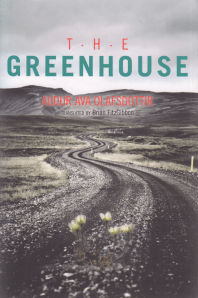
Audur Ava Olafsdottir is a remarkable novelist. Iceland, of course, is held to be the most literate country in the world. I began reading Icelandic fiction of a considerably earlier period while living in Scotland. There was still a trace of Scandinavian heritage from Viking days discernible there, particularly in the Orkney Islands. I started taking on reading challenges three years ago. Given that I spend many hours a week sitting on a bus, it seemed natural enough to put my time toward a specific goal. The Modern Mrs. Darcy’s reading challenge encourages me to move beyond the bounds of my usual fare. One of the categories for this year’s challenge is a translated book. I enjoyed Olafsdottir’s Butterflies in November so much last year that I selected The Greenhouse for this year’s translated offering.

The story of two young people who accidentally have a child together, the tale makes effective use of religious imagery in reflective ways. The young man takes a job in a monastery rose garden in a remote country. When his one-night stand visits him to have him watch his daughter while she finishes her thesis, everyone notices how miraculous the child is. She even bears a striking resemblance to baby Jesus in the painting in the chapel. The narrative is gentle and reflective. The monks are drawn out of their scriptorium by the beauty of the roses and the child that is so intimately tied up with them. There’s nothing preachy, or even overtly religious here. It’s a simple reflection that religion pervades life, even in secular Europe.

One of the saddest realities of the present is that religion has made itself so odious to so many. Human beings are naturally inclined toward religious thoughts and behaviors. When any form of orthodoxy enters the picture, though, it begins to fall apart. The young couple, unmarried—not even girlfriend and boyfriend really—transform the town they’re in, making it a more habitable and humane place. They’re not condemned for “living in sin.” Even a priest admits things can get pretty complicated where relationships are concerned. A coming of age novel, The Greenhouse has Icelandic magic that comes through even in translation. Olafsdottir is a novelist who doesn’t feel the need to apologize for describing what is plainly obvious to those who pay attention: religion is all around us, and it need not be something to condemn. In fact, if cultivated without the acidic soil of orthodoxy it might even make the world a better place.

Becoming Biblical

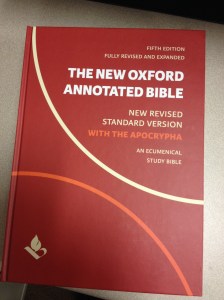
The average reader has difficulty sorting out what’s biblical or not. For example, when Cyrus Scofield began putting 4004 BC [sic] as the date of creation in his annotated Bibles, people thought the date was biblical. It was, literally, “in the Bible.” I used to tell my students that there’s a cultural belief that everything bound between the covers of a Bible is biblical. If so, I’ve just become biblical myself. I must say, it comes with mixed feelings. For the many people with whom I’ve worked on the New Oxford Annotated Bible, having their names inside is an expectation. Employees, however, sometimes make it in, too, in a prefatory way. I was touched to see my moniker there, on Bible paper, amid Holy Writ. Almost life-changing. A little scary.

Imagine a post-apocalyptic world. (I know, it’s easier now than it was just a few short months ago.) What if all books were wiped out except a copy of the book fondly abbreviated NOAB? Some Leibowitzian monk might come across it, and, recognizing that it’s sacred dare to open it, not comprehending the language but eager to begin again. Am I ready to be in such a book? Nobody reads prefaces, I know, but this is the widest circulation my humble family name has ever achieved. In there with Joseph, Job, and Jesus. It’s heady stuff. I’ll be on the shelves of used bookstores from now on. For a guy who’s books have been printed only in the 300 run range, this is dizzying. And not too bad for being only an administrator. None of my deans ever made it into the Good Book.

Surely there’s some grim responsibility that accompanies becoming biblical? Some consummation devoutly to be wished? Looking around at my fellow biblical characters, I’m not so sure. Many cases of men behaving badly surround me. None of them, I expect, had intended to be biblical either. Time and circumstance led to their elevated status. Modern biblical people tend to be famous only among their own guild. Some gain wider recognition, to be sure, but none share the name recognition of those recalled by the unknown recorders of sacred scripture. I’ve written books of my own, and been acknowledged as a scholar and editor in other peoples’ books, but never before have I found myself in such exalted, if accidental company. Where does one go from here? A Herostratus of Holy Writ? I can’t help but wondering if Jeremiah started off working in a cubicle.


Parks and Wreck

It was a bit of a shock to see Bethel Park on the list. I make no bones about being a Democrat. I’ve supported progressive causes on an evolving journey since high school. When I saw the news that Conor Lamb is a worthy contender for the 39th district seat in my native western Pennsylvania, and that this area is “deep red,” I had to look it up. A special election’s coming up and the district is leaning a little blue. Historically, until 2010, it had been Democrat territory. But Bethel Park has other associations for me. My wife will pardon me, I hope, for saying it was the home of my first girlfriend.

As a naive and thoroughly Pauline Fundamentalist, I always believed marriage was against God’s will. The Bible says as much. Still, Paul magnanimously allows for marriage to those who “burn.” I’d felt the heat once or twice as a boy becoming a man, but I’d adequately stifled it with Scripture and the comparative fires of Hell. I was strong. I would never marry, I told myself. College up to that point had involved a cenobitic separation of the sexes in an all-male dorm on a campus where the rule was to sit with a Bible’s width between a guy and his girl. I met her at church summer camp where we were counselors together. She was from the city—Bethel Park is a suburb of Pittsburgh—and I was a kid from what she called “Roosterville” (the town of 900 souls was actually technically “Rouseville”). The ways of love, I was learning, were liberal.

To a point. That relationship limped along for a couple of years. I got on with my life, attended seminary and met my wife there. Bethel Park, I knew, had been named from the Bible. Bethel was the place of Jacob’s dream, the original stairway to Heaven. My first lady friend was impressed with my biblical knowledge—it was really about all I had to offer. Things improved after meeting the woman I would marry. Boston would remain a blue city while Bethel Park would degenerate from purple to red. When did this happen? The working class boy from Roosterville believes in equal rights for all. And now District 39 has a decision to make. Will the stairway to Heaven be limited to those who can afford those swank suburban houses? Or will the district remember its heritage that was blue from 1969 until we had our first African American president? “This,” Jacob muttered “is none other than the gate of Heaven.” Or, it could be, just another brick in the wall.


Frankenstein and Co.

Authors, I expect, don’t anticipate that their work will be annotated. Since I deal with annotated Bibles on a daily basis, I often ponder that the anonymous writers—we know of few biblical writers with any degree of certainty—had no idea that they were writing the Bible. Nor did they realize that some day many people would make their livelihood from interpreting that book. Among the interpreters are annotators. When my wife gave me Mary Shelley’s Frankenstein for Christmas I was at first puzzled. I have a copy of Frankenstein already. In fact, I read it again just last year. Then I realized it was an annotated edition: Annotated for Scientists, Engineers, and Creators of All Kinds. Edited by David H. Guston, Ed Finn, and Jason Scott Robert, the book contains the original text and an introduction, as well as the said annotations. Like a typical study Bible, it also contains essays. The editors joke that it’s kind of like a Frankenstein monster itself.

The “value added” material isn’t all about science. In fact, quite a lot of it has to do with human relationships, and particularly women’s rights. Mary Shelley was an early feminist and her novel shows what goes wrong when men try to reproduce without women. Another recurring theme that, amazingly, had never dawned on me while reading Frankenstein was the Adam and Eve story. Victor Frankenstein, like God, creates a man. Then he creates a woman. Well, almost. Afraid what might happen should his creature find a companion too companionable, he destroys the second creature before she’s finished. The biblical parallels are nevertheless there.

Originally subtitled The Modern Prometheus, the novel was based on pre-Christian myth as much as on Holy Writ. Nevertheless, the Bible suffused British culture in the nineteenth century just as it has continued to overwhelm American culture to the present day. We ignore it at our peril. Morality in science is a major focus of the essays in this volume, but I wondered how many scientists might be enticed to read a piece of feminist fiction in order to learn some ethics. The largest ethical conundrum we face in the United States is that so few people read for personal growth. Spending time with a book is a sacred activity for those committed to the principles of literacy. Frankenstein isn’t a prefect novel; the pacing is pretty slow even for a gothic masterpiece. There are loose ends left hanging. The protagonist is often insufferable. Still, as the editors and annotators have demonstrated, there’s much to learn from this old story. All it takes is the willingness to read and deeply reflect. And perhaps read the annotations.


My Bee’s Keeper

I’m not proud of it. In fact, truth be told, I tear up a little bit when I think about it. It happened so long ago, but it was a casual act of violence that made me feel big at the time. It wracks me with guilt even today. I killed a bee. For no reason. It was a summer’s day and I was following after my step-father, who’d just taken us for a haircut. Step-dad always wore a crew-cut and disliked hair on boys and men. I’ve always hated haircuts and when I saw a honey bee on a clover flower after leaving the barber shop shorn I stomped on it. I was maybe twelve. That act of senseless violence has never left me.

I’d been stung, you see. Many times, in fact. One incident was particularly dramatic. My mother had driven my brothers and me out to the woods to play with our dog. We made up a game, the way kids will, where my brothers would throw a stick and I’d race our dog to try to fetch it first. I was actually in the lead this time and stepped on a rotting stump to keep my marginal edge. The stump was home to a colony of yellow-jackets and they swarmed out, just like in the cartoons I used to watch. Before I realized what was happening I fell to the ground with multiple stingers burrowing into my bare legs. Our dog was covered with bees and we weren’t sure he’d even survive. At home Mom had me soak in a hot bath because there was a prayer meeting that night at church that we couldn’t miss. I was allowed to take a pillow to sit on over the plain wooden pew.

That incident was in my mind as I stepped on the innocent bee, gathering nectar that summer day. Immediately I regretted what I’d done. Its little body lay twitching in the grass. It had no idea who had killed it or why. My reason for doing so was lame, and long gone. All creatures on this planet are interconnected. We are killing off bees at unprecedented rates. Insect populations the world over are falling at truly alarming speed. We need our bees. We’ve tampered with nature to make it more productive and have ended up with killer bees instead. We’re now warming our globe so they can spread even as we kill off their more docile siblings. That summer sun of memory beats down on me as I consider what I’ve done, and I sincerely repent.

Photo credit: Jon Sullivan, Wikimedia Commons


A Concept

Pardon me for being perplexed in public. You see, things aren’t as clear cut as they used to be. In the world in which I grew up Evangelicalism was good and Satanism was bad. Very bad. It still has the ability to scare people straight. A recent NBC story my wife sent me titled “Satanic Temple challenges Missouri’s abortion law on religious grounds,” by Corky Siemaszko, shows how the GOP has turned the tables on this equation. The Christian Right has utterly aligned itself with the pro-life camp. Most people would agree, I suspect, that abortion shouldn’t be the first choice of birth control options, but life comes with many unpredictable circumstances. There are times abortion is the most humane option and the burden falls almost entirely upon women. It’s not an issue on which men are competent to decide.

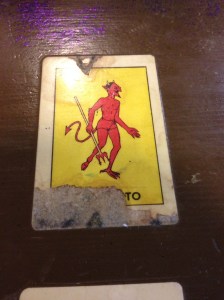
The evangelical posturing on the issue—which has, by the way, changed in recent years—has placed the weight fully on women. A rutting male, like a bull elephant in musth, can hardly be responsible, so the thinking goes. Or, to put it more politely, boys will be boys. Women suffer on the tusks of this tautology; it’s no wonder Satan has horns. Only women conceive, so men can make the laws and feel empowered by a male god who, you know, understands where they’re coming from. Missouri Satanists are striking back. The problem is the state requires women to be presented with indoctrination that says life begins at conception before electing for an abortion. Does life begin at conception? The Bible says “no.”

Biblical science was primitive. Ancients understood there was a connection between sex and pregnancy, but infant mortality rates ran very high. Life, in the biblical view, started at first breath. Spirit, breath—the very word for “soul” in the Bible—was the marker of life’s origin. The Bible may not advocate abortion, but in a world where few children made it past five, there was a shortage of surviving progeny. So it turns out that in Missouri Satanists are actually advocating the biblical view while the Evangelicals are violating the constitution by misreading it. Life begins at conception isn’t a scientific premise, it’s a theological one. A theological one on which Christians disagree. And Satanists. In their efforts to keep men on top of women, the Christian Right has no support from the Good Book on the matter of conception. Of course, why read the Bible when you can get what you want by quoting only your favorite verses? After all, God, they say, is a “he.”


Emulating Icarus

According to a story by Sarah Kaplan in the Washington Post, NASA is preparing to send a probe closer to the sun than any human-made object has been before. If you’re like me, this might conjure those childhood fascinations of being blasted by impossible heat—maybe in a science fiction story of a colony on Venus, or a crew hurtling out of control in a capsule being pulled inexorably toward the inferno of the heavens—on a hot summer’s day. The Post story makes an inevitable reference to Icarus, the character from Greek mythology who flew too close to the sun. The tale has long been a parable for human overreach, but this time it seems that scientists are taking it literally. The technology used to shield the craft from Old Sol is incredibly impenetrable, and it may have applications as we try to figure out how to escape this planet we seem bent on ruining completely.

Earth flies around its personal star in what’s become known as the Goldilocks Zone—that place where it’s neither too hot nor too cold for life. But don’t wander outside in the northern hemisphere in February without a coat. The weather down here can be fatal. We live on that teeter-totter of the extremes in which our frail bodies can survive. Temperatures range from -88 degrees at Oymyakon, Siberia (at this point whether Celsius or Fahrenheit hardly matters, but for the record, it’s -126 F) to 136 in the Libyan Desert. In this incredible range of 262 degrees people can be found at all shades between. Stepping out my front door one January in Nashotah, Wisconsin the thermometer read -42. That was without wind chill. It was the kind of cold you could feel immediately through all the layers. Humans can’t survive it without artificial means of heat. And yet we have a star overhead where temperatures reach 27 million degrees in its core. Out beyond Pluto our universe reaches near absolute zero, at -459 and change, on the Fahrenheit scale.

It’s a universe of extremes. That friendly sun in the sky was recognized as a deity from earliest times. Even the Bible retains hints of clandestine solar worship. Icarus, however, lost his fear of extremism. There was nothing too outrageous to try. As long as wings of wax can hold you aloft, why not attempt to reach all those zeroes? Millions sound great until they’re exceeded by billions. At that point even the sun isn’t hot enough for some.


Good News Shipping

“And all the ships at sea,” was the closing of Walter Winchell’s radio broadcast introduction. The phrase has a certain poignancy about it—a cross between Melville and Edmund Fitzgerald. The idea of being isolated at sea is foreign to most people, but it is truly as far from others as you can get on this planet. In ancient times the sea was considered evil. It was well-nigh unsurvivable and chaos monsters dwelt in its depths. In the book of Revelation, in God’s kingdom “the sea shall be no more.” But the economic fact is, it’s still cheaper to ship by sea than to fly things from here to there. Amazon seems to have made us forget just how complex delivery is. I was forcefully reminded of this the other day when I received an email saying that the Bibles were at sea. Literally. They’re on a boat in the middle of the Pacific, along with who knows what else.

This is only a parable

The vastness of the ocean makes humans painfully aware of our smallness. As does the Bible. I remember thinking, as a child, that those offering printed salvation did so from the goodness of their hearts. That may be part of the story, for sure, but Bibles are big business. Not as big as they used to be, but still not inconsequential. This was captured well by the character of Big Dan Teague in O Brother, Where Art Thou? “It all about the money, boys!” he shouts as he robs Everett and Delmar. Yes, that evangelist giving away Bibles may have your soul in mind, but your pocketbook too. Like those Bibles snuggled against crates of condoms and smart phones, it’s just business. You’ve got to keep the bottom line in mind.

Bibles can be a lucrative business. The Bible is, however, a large book—expensive to print and bind because it requires special paper thin enough to hold all that text. Such specialized work done domestically would drive the price of the Good Book out of comfortable profit margins. So the word of God is printed overseas and sent across the ocean by boat. There’s a parable deep within this hidden life of Scripture. The romance of the high seas—being completely isolated from land and its comforts. “Here be dragons,” the Hunt-Lenox Globe famously proclaimed, and that’s a parable too. That Bible in your hands comes with considerable cost. Even in a world where drones for personal delivery are not far off, the sea still surrounds us.


Heal and Farewell

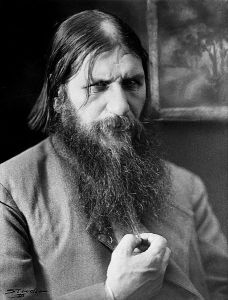
What could Aimee Semple McPherson have in common with the devious Russian monk Rasputin? Apart from being contemporaries for a couple decades, they were both faith healers. Well documented cases exist for both of them, and the medical profession has started to come around to the idea that belief can, and does, heal. The stories of Sister Aimee’s healings, witnessed by thousands, make me fear being thought gullible just for bringing it up. That doesn’t mean it didn’t happen. Cases exist even today where healing inexplicably takes place before scientific eyes. Often it occurs in response to religious stimulus. We may have proof that it happens, but we tend not to believe. This is a curious state of affairs. We trust in reason to the point that it may prevent us from being healed by faith.

Some object, of course, to the theological element. It’s pretty tricky to believe God has healed you if you don’t believe in God. The thing about faith healing, though, is that it seems to work no matter the religion of the person healed. This, it would seem, suggests we should be applying our rational minds to understanding belief. Instead we use it to find new ways to make money or to build smarter weapons to kill one another more efficiently. The more we come to understand the physical world around us, the less we know. As our research institutions take on the shape of the businesses that increasingly fund them, interest in this phenomenon shrinks. Medicine, in all its forms, is big money. Living in central New Jersey you can’t help but notice the palatial campuses of the pharmaceutical companies, nor ignore the mansions on the hill they have built. If only we could believe.

Faith healing was this aspect of her ministry that propelled Sister Aimee to fame. She constantly underplayed it, not wanting to be considered a healer of bodies so much as a healer of souls. Rasputin, of course, had political motives. Both lived—not so long ago—when faith was taken very seriously. Judging from the posturing around the least religious president in decades, whatever faith is left has been sorely effaced. Maybe it’s our minds that have the capacity to heal, but even that well seems to have been drained with the leaky bucket of rhetoric. History can teach us so much, if we’re willing to invest in it. How does faith healing work? I have no idea. Nor, it seems, does anybody else. So it will remain until it becomes commodified.


Breakfast of Champions

In my efforts to become vegan, I’m finding dairy to be the hardest element to replace. I’m reminded of this every morning since the day begins with cereal. Most people don’t realize that cereal for breakfast is largely of religious motivation. The original Kelloggs were Seventh-Day Adventists, and therefore vegetarian. To promote both health and animal-free diets, they gave a big push to the idea the day should start with cereal. It’s a touch dry, however, and water on your flakes leads directly to paste. So I’ve been experimenting with alternate milks. Often I use soy milk, but it has to be the right brand. Some of the offerings on the market have that oily aftertaste characteristic of soy beans. Not sure of the legality of hemp milk these days, I recently tried oat. Oat milk should taste like oats, i.e., it shouldn’t have much taste at all.

The moral crisis came as I poured it into my oatmeal. You see, there’s a biblical injunction to cooking a calf in its mother’s milk. This is the reason meat and dairy can’t be mixed in kosher settings. Scholars debate the basic concept behind this regulation. Like eating a bird and its eggs, some suggest, this depletes nature and should be avoided. At least one generation should have a chance to avoid exploitation. At least until it grows up. But what of the oats and their oat milk? Have I gone too far? What hidden principle am I violating, however unintentional, here? This is the problem with any religious thinking—taken to extremes it begins to break down. Some of the earliest gods, after all, were agricultural deities.

Agribusiness is huge. People gotta eat, right? And it is one of the most massive environmental hazards humans have ever concocted. Industrial farming is the largest producer of methane and the largest user of potable water, by far. Keeping animals for our food is literally destroying our planet. Religions, interestingly, quite often concern themselves with eating habits. It’s strange how most of them in this country are silent regarding what is obviously an ethical issue. After all, we adapted to the cereal for breakfast lifestyle because of religious conviction. It’s difficult to change eating habits. That’s my current struggle. I could pour the oat milk over corn flakes, I suppose. But then again, the Bible forbids mixing fabrics from different plants. What’s an aspiring vegan to do?


Christian Sister

Difficult to believe as it may be, some of the biggest superstars in America’s history have been clergy. The case has been firmly made that George Whitefield, the evangelist, was the first to hold “rock star” status in these United States. He drew stadium-sized crowds before there were stadiums and was, perhaps, the most famous man in the country. Fast forward a number of years and we find a name that may not ring so many bells today. Aimee Semple McPherson, however, was more famous than Hollywood actors and most political figures of her day. The founder of the Foursquare Gospel church was, in the roaring ‘20s, one of the most recognizable names in America. It may not count for much, but even in rural Pennsylvania we learned about her in American History class in high school four decades after her time.

I read quite a lot about American religion, and Aimee Semple McPherson frequently comes up. I knew little about her, however, until reading Daniel Mark Epstein’s Sister Aimee: The Life of Aimee Semple McPherson. While it has its faults as a biography, it does convey a fair image of who this fascinating woman was. An evangelist when few women preachers existed, she was creative, crowd pleasing, and remarkably broad-minded for a Fundamentalist. Her personal life was full of drama—three marriages and at least one kidnapping episode—wealth, and want. She trusted Jesus implicitly and often suffered alone in silence. Secretly she befriended Charlie Chaplin, a man drawn to her stage presence but not her religion. It’s difficult not to like this woman who insisted on doing things her own way, and who ended up alienating her family (apart from her son) by doing so.

There can be no doubt that Aimee Semple McPherson believed what she said she did. Although she didn’t approve of theater she brought theatrics into church via her famous “illustrated sermons.” She pioneered radio evangelism, which subsequently grew into a hackneyed soapbox for lesser thinkers. She was a faith healer, a world traveler, and a woman who genuinely cared for the poor. Epstein’s book tells the story with heart and a touch of hagiography, but it is an entryway into one of the lives that shaped Jazz Age America, even if it is now largely forgotten behind flappers and Fitzgerald. It’s hard to believe that some of the most famous people in American history were religious leaders of their time, especially when we see what’s on offer in that arena today.


Fool’s Paradise

What with all the Bible-trumping going on these days among the desiccated religions right, I thought it might be helpful to turn back to the Good Book itself. Since we have a self-proclaimed stable genius in house there should be nothing to be concerned about. What, me worry? Right, Alfred? One part of the Bible frequently cited by fundies and others who want to appear chic is the “Wisdom literature.” Although the category itself has come under scrutiny these days it’s still safe to say that Job, Proverbs, and Ecclesiastes have quite a bit in common with each other. Proverbs is a repository of pithy aphorisms. Indeed, it can sound downright modern in many respects (but hopelessly patriarchal and chauvinistic in others, unfortunately). One of the things Proverbs does is condemn fools. The sages of antiquity had no time for stupidity. Remember, we’ve got a stable genius—don’t worry.

Like Laplanders and their many words for “snow,” the book of Proverbs uses several terms for fools. There is, for instance, the innocent fool. This is the person who simply doesn’t know any better. Often it’s because of inexperience. This kind of fool can learn from failures and may go on to better things. Far more insidious is the willful fool. This is the person proud of his or her ignorance. Proverbs goes beyond calling such a thing unfortunate—this kind of foolishness is actually a sin. Not only is the arrogant fool culpable, they will be judged by God for their love of stupidity. As a nuclear super-power it’s a good thing we have a stable genius with the access codes. Otherwise those who thump the Bible for Trump might have a bona fide sin on their hands.

Image credit: Pamela Coleman Smith, Wikimedia Commons

The only kind of fool that’s tolerable in the world of Proverbs is the one that’s able and willing to learn. This means, in the first instance, being humble. Refusing to admit mistakes, forever posturing and preening, this is a certain recipe for incurring divine wrath in the biblical taxonomy of fools. According to biblical wisdom literature, such people get what they deserve. The modern evangelical often has little time for such books. Aside from a misogynistic slur or two, there’s nothing worth quoting from Proverbs that you can’t find in Benjamin Franklin or even in ancient Egyptian records. When you stop to think, however, that the Bible’s said to be inerrant, you’ve must take Proverbs and what it says about fools into account. But then again, what Fundamentalist ever really reads the Bible?


Augustine’s Secret Sin

I’m curious: what do you think of Augustine? Augustine of Hippo was an odd blend of saint and sinner. I don’t mean “saint” in the sense of being so designated by the Roman Catholic Church, but in the sense of having reputable and progressive ideas. For example, Augustine argued that science, such as it existed in his day, had to be taken into account when understanding Christianity. If the Bible’s account of creation didn’t match what we knew of the world, then literalism had to go—that kind of thing. This was quite liberal for someone in the fourth-to-fifth centuries. He believed in reason, to an extent. The sinner side of the equation goes beyond his Manichean days, however. The sins I’m referring to are his dangerous and long-lasting theological assumptions that’ve helped to hold back civilization throughout history.

It was Augustine, for example, who gave us the idea of original sin being involved in sexual reproduction. The church has always been cagey on why we should reproduce when the second coming is right around the corner, but Augustine declared that from our very conception (which he couldn’t understand scientifically) we were tainted with sin. But that’s not the particular sin to which I’m referring. Augustine also spread the persistent idea that curiosity itself was a sin. Christianity, in his view, was a “need to know” religion, and curiosity about the natural world could lead to uncomfortable answers. He held this in tension with his belief that we should accept what science teaches, but there were many questions, he decided, we simply shouldn’t ask.

Religions have often come to this crux. Science has a strong explanatory track record. Religion is frequently based on old texts, written in an age when science was but an infant. As the power of rationality grew, the role of miracles shrank. Over time the proof of theological structures began to crumble. And since life was all about correct theology, those edifices had to be shored up against the onslaughts of reason. If this sounds hopelessly outdated, I’ll have to confess that many of my students at Nashotah House believed reason was tainted by original sin. Augustine had the answers they believed; somehow rationality had stopped with him. Human curiosity, Augustine felt, was a sin. All questions should’ve ended with his arguments. It’s this kind of theological bravado that gets us into the mess we find ourselves in today. Voting blocs that never question what their religious leader tells them. Never curious enough to ask “Why?” Augustine was a brilliant man, in many respects. He was also a sinner of the highest degree.


Noah’s Phone

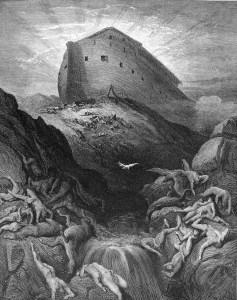
The world-wide flood is a great story. We find it in many cultures, so the idea obviously captured the attention of ancients as well as moderns. What’s strange is that, with the development of human knowledge so many people continue to accept it literally. The only science that can be bent enough to make it work is one where God breaks all the laws of physics and biology to kill everyone, just to make a point. Why bother to make it rain 40 or 150 days? Why not just create the requisite water instantaneously? It would be just as believable. Nevertheless, literalists look for explanations for how this might’ve happened. It’s not to convince God, of course. The goal is to convert unbelievers by showing that the myths of Genesis are literally true.

When I came across a story on Mysterious Universe by Paul Seaburn titled “Academic Claims Noah had Cell Phones, Drones and Nuclear Power,” I was hooked. The academic is a Turkish professor of marine sciences. Using modern technology—rather like the detritus seen scattered in the background of Darren Aronofsky’s recent movie version—he postulates that this could’ve happened. The real issue is why. Not why the flood; the Bible answers that. Why would a scientist feel the need to prove a myth scientifically? Biblical scholars call the flood story an etiology. An etiology is a story to explain the origins of things. That’s its purpose.

Noah’s flood explains why it rains. It also explains why this dome that covers our flat earth doesn’t fill all the way up anymore. It explains why animals are sacrificed and why rainbows occasionally appear to grace the sky after it rains. We also know that the story borrows from an even earlier Mesopotamian myth where the god who causes the flood isn’t even Yahweh. The people of Israel were conquered by the Assyrians and Babylonians and they told flood stories about their gods. The Bible counters with two stories (yes, just like the creation accounts) mixed together in this snow-globe universe of Genesis. Is it easier to believe this or to claim that Noah had access to Verizon, steel manufacturing, Einsteinian physics, remote-control flying machines, and artificial insemination (to help the animals recover)? It’s like when someone suggests natural explanations for the plagues of Egypt. Such special pleading doesn’t prove miracles, but rather it demonstrates that all this could happen without any gods involved. And you’re still going to have to mop up all that water when it’s over. I’m sure it will make for a great story some day.


Devil of the Time

There can be little doubt that evil prospers. We’ve suffered through a year of an evil administration and we’ve seen the government increase the suffering of its own people in deference to the wealthy. And ours is only a mild case of evil. Jeffrey Burton Russell, over the course of some years, wrote three sequential books about evil. The first, The Devil, I reviewed last year. Having just finished the second, Satan: The Early Christian Tradition, it has to be said that the concept definitely evolves. The period between the New Testament and the fifth century was a rich one for diabolism. The writers of this period became increasingly theological in their efforts to make sense of what is obviously an unjust situation created by a theologically good God. These were inventive writers, if somehow less than convincing.

Russell is a careful explainer. He summarizes the views of the “church fathers,” pointing out where their logic fails. This isn’t some liberal trying to dis the Devil, however. Russell acknowledges that he believes a Devil of some kind must exist. Reason, however, must also be applied. It’s difficult to believe that people in the early Christian centuries were willing to take such leaps of logic. Of course, they didn’t have many options for opting out. God was the great explanation for so much of their world. Fitting an all-powerful deity into logic when there’s abundant suffering in the world requires a certain flair for casuistry. No matter how the equations work out, an all-powerful God can’t be all good, not in this universe. Speculation about the Devil, or Satan, ran logic through its courses. Who was this being, and how did he get to be the way he is?

The theologians argued without any glint of irony. This was serious stuff. The Bible, famously, has little to say on the matter. Early thinkers such as Tertullian, Origen, and Augustine had volumes to say on the subject. None of them came up with a workable solution. Logic and the Devil just don’t fit. Theology is always a struggle since it deals with intangibles. Laws of logic sometimes simply don’t apply. If the feeble human imagination can conjure a good world without needless suffering, one has to wonder, why can’t an almighty deity do the same? Is this a god of limited imagination or, as the classic theological chestnut puts it, one who sees more than humans do? You can ask, but you won’t receive an answer. The Devil, it seems, really is in the details.