‘S No Day in New York

“You’re waiting for a train. A train that’ll take you far away. You know where you hope this train will take you. But you can’t know for sure.” Yet you’ve been standing on the windy platform in Newark for twenty minutes and they’ve announced the next train to New York will be an hour late.  A man you don’t know says the PATH train will take you to New York, but New York is a big city, and you only go there to work.  It must be a snow day.  Well, almost.  I work for a company that only closes when New York City Public Schools close for weather.  Today, kids, school’s open; but all is not lost—field trips are cancelled.  And so, the constellation of companies who take their cue from NYPS truck (sometimes literally) their New Jersey-based employees across or under the river, into a city where slush half a foot deep awaits them on every street corner, and that doesn’t slow those muck-flinging cabs down at all. 

With the weather we’ve been experiencing this year, I hear a lot of people saying that Mother Nature is still in charge.  Allow me to differ.  You see, I’ve been researching the weather and the Bible for years now and I’ve come to a slightly different conclusion.  In the Psalms, anyway, it is clear that God is in charge of the weather.  Given that New York is such a sinful place, I guess none of us should be surprised.  Still, I’m not sure the Bible has got this one quite right either.  After all, I’ve walked through ice-crusted snow up to my knees for a good part of my walk to the station, and I have my coat open so the cold breeze will cool me down a little bit before I have to walk into work with crazy hair and a scowl frozen on my face.  Didn’t some great theologian once say “sin boldly?”  No, it is not Mother Nature in charge.  It is not even the deity.  It is something far more powerful than God—money.  Can’t lose a red cent when there are human resources to be utilized.

I’ve never been on a Port Authority Trans-Hudson train before, and I’m not sure where this one stops.  I heard someone say 33rd Street, and that sounds encouraging, so when the train stops I follow him across the platform.  Sheep, as any shepherd knows, will follow a random person who looks confident enough.  I emerge from the dark underground, not quite sure where I am, and I just can’t find a Psalm in my heart at the moment, unless it’s an imprecatory one.  I stepped out of my front door into freezing rain three hours ago.  My trousers are wet to the knees, and I’m a little sick from facing the wrong way on the PATH train for a lengthy ride.  The cars, I notice, are shaped like Krell.  Yes, this is a forbidden planet and I don’t know where I might end up.  Excuse me, Mr. Mayor, but I think you got it wrong.  Field trips are not cancelled after all.  And I’m not sure I’m even worshipping the right god.
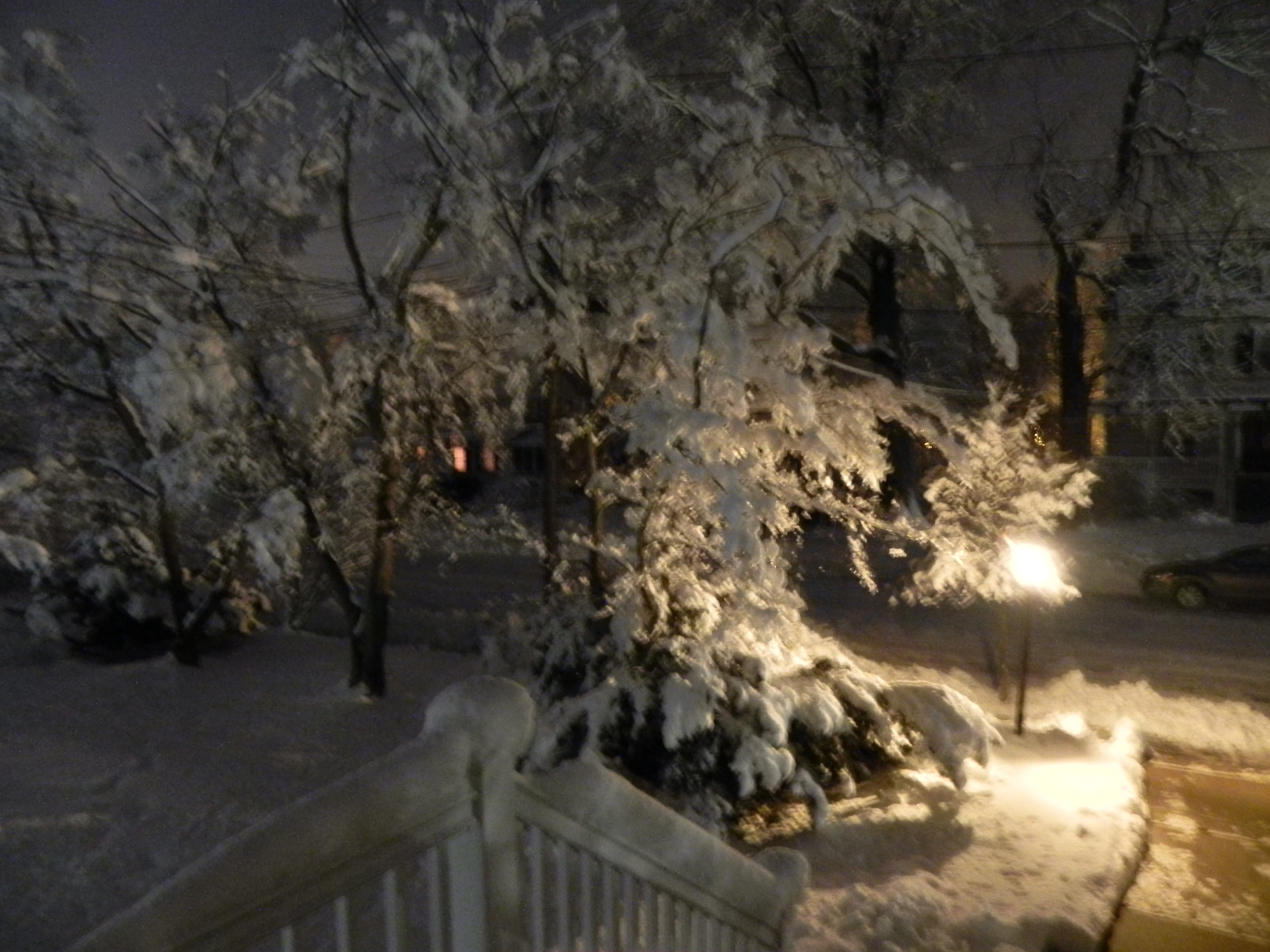
Deceptively peaceful
Deceptively peaceful


Engineering Meaning

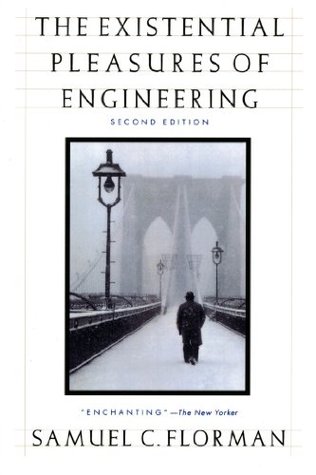
ExistentialPleasuresofEngineeringEngineers have been a part of my life in many ways. My mother’s father was an engineer. Although she did not know it, my grandmother’s grandfather was also an engineer. My wife’s father is an engineer, and grandparents on both sides of her family were either scientists or engineers. My daughter is studying engineering, and other relatives have made it their profession. In fact, had the peril of my everlasting soul not caught my early concern, I would likely have headed into the sciences myself. Not that I would have made it in the profession, but the interest is certainly there. Many years ago my wife bought me a copy of Samuel C. Florman’s The Existential Pleasures of Engineering. Unlike my claims about engineering, I can boldly declare myself an existentialist. The moment I found out what existentialism was, I knew it was my outlook. Now that I am firmly settled in a profession about as far from science and engineering as I can be, I decided to read the book.

Quite surprisingly, I found Florman turning to religion from time to time. Existentialism isn’t inherently religious, but engineering is inherently empirical. Florman notes that the New Testament, with its spiritual values over the physical, often presents serious problems to engineers, enmeshed, as they are, in this universe. That made sense, even if it surprised me a little. A few pages later, however, I was astonished that Florman praises the “Old Testament” for its more earthy viewpoint that has a great appreciation for the physical world its god has created. Perhaps there was a reason my life took this track after all. Although I’m not Jewish, I always felt an attraction to the Hebraic outlook. Maybe I should’ve been an engineer.

Toward the end of his extended essay, Florman once again turns his thoughts toward the spiritual. Noting that massive works of engineering tend to evoke the divine—the most obvious, but by no means only, example being cathedrals—we glimpse a sense of the sublimity in the greatest of human edifices, sacred or secular. The engineer still has recourse to the spirit which is, to a frustrated scientist, a cause for great hope. When I pulled a book on engineering off the shelf, I certainly did not expect to find any religion in it at all. Of course, the book was written before science and religion had become entrenched in such a shrill standoff as they seem to be today. There is balance here, and an appreciation of beauty. And when the engineer does the impossible, it is indeed a work of human divinity.


Ham on Nye

Bill Nye, the Science Guy, comprised a good part of my thirties. My daughter was young and we were living in a religious environment sometimes openly hostile to science. Nye is funny and fastidious, and completely devoted to the empirical worldview. His videos (yes, it was that long ago) were fairly inexpensive in VHS format, and even as parents we learned a thing or two. When Bill Nye came to the New Jersey Green initiative conference (I don’t recall what it was called) we were in the audience to see him live. It was rather like an epiphany. Despite his wit and charm, many of his colleagues are now advising him that he’s made a wrong turn. According to NBC, he is set to debate Ken Ham of Answers in Genesis in a no-win debate, that of creation versus evolution. Some of the top lights of science have been bloodied by lower profile conflicts because—and this is the crucial point—religion and science do not agree on basic ground rules. It’s a schoolyard scrap, and those who try to adhere to laws of reason are often ill equipped.

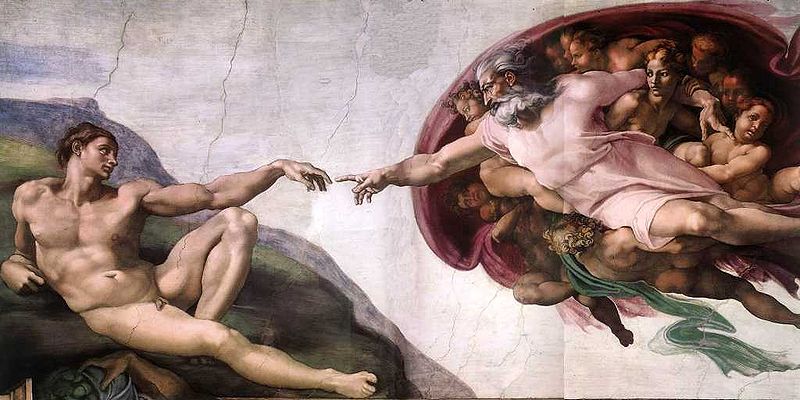
800px-The_Creation_of_Adam

The debate isn’t really over the question of how we got here. The real prize is power. Creationists cannot win on purely scientific grounds; anyone who’s tried to read Henry Morris’s books knows that you can’t get very far without a curious hand raking your head. The science is flawed but the conviction is solid. Truth, the creationists know, is not open for debate. His scientific colleagues fear for the intrepid science guy, noting that this is just another instance to give creationism faux credibility in what is really a public relations scam. Ham’s creationist museum has dinosaurs on the ark, which, in an unrelated story on NBC, is drawing righteous ire from the self-same Ham. (I’ve posted on the round ark before, and likely will again.)

If I understand the first article correctly, the debate will be taking place tonight. If I understand science at all, the world will continue to evolve tomorrow. Creationism has a curious relationship to the world, viewing it through a Bible-shaped lens. A close look at the Bible reveals that it does not support the creationist viewpoint in any literal way. Too many dragons and contradictions make implausible any but a heavily harmonized version of Genesis 1. Biblical scholars, however, are among the worst of sinners, according to the creationist camp. We might be the very ones exposing their children to Bill Nye and other questionable truths such as television and electricity that don’t even exist in the Bible. I’ve got my fingers crossed for Bill Nye, but then, superstition has nothing to do with it.


Devil’s Advocate

At fives and sixes, the Pope who gave us the devil's advocate.

At fives and sixes, the Pope who gave us the devil’s advocate.

When two people in completely isolated incidents tell me the origins of the term “Devil’s advocate” within a week, I figure it’s time to do a post about it. We’re all familiar with the term, and we know that it means taking the point of view of the “bad guy,” just for argument’s sake. In fact, the Devil’s advocate may not believe his (usually it is a he) own arguments, presents them to make sure the results are correct. The Devil’s advocate was an official office in Roman Catholicism beginning in the late 16th century. The actual title was Promoter of the Faith and the reason such an office was necessary was that so many people had been put forth as potential saints that the church experienced an embarrassment of riches. Canonization, the process of becoming a saint, has a number of hurdles to clear for the would-be paragon. Claims, often extraordinary, were made for miracles associated with the favored ones and the Devil’s advocate was intended to research and present contrary evidence. This made it more difficult to achieve sainthood, but in theory, at least, kept the number of candidates down to only the most deserving. There was no literal devil involved.

Those of us who grew up Protestant often had recourse to only faulty knowledge of Catholicism. We were sometimes taught that it was based on magic, what with the priest speaking in Latin and making mysterious motions with his hands. That meant, for some, that Catholics seemed particularly gullible and would believe things the rest of us wouldn’t. The Catholic Church, however, has often providing its own policing. Not as eager as Pentecostals to accept mundane miracles, when a pareidolia-inspired leakage of water or an anomalous burning of toast occurs, the Catholic Church is quick to debunk claims of miracles just because an underpass stain or a bit of bread looks like a famous religious figure. If you squint enough. The Devil’s advocate was a similar safeguard.

On the opposite side of the equation, I’ve often heard sermons among some evangelical groups claiming that we’re all saints. (Their membership, that is.) Who shouldn’t claim the name when they walk the walk? Many of these saints fail to inspire in the way of those of yore. Some of the beloved cultural heroes that keep coming back in various forms have saintly origins: Santa Claus and Saint Valentine are two that come to mind at this time of year. Some Protestants who may not have been perfect, however, should somehow qualify. Martin Luther King, Jr., another figure of the winter season, by his contributions to justice issues, might be one who would qualify. I’m sure there are many others. The fact is that making a principled stand against the wickedness that sometimes passes for the status quo is difficult and leaves one open to criticism and resentment. A Devil’s advocate might be just what society needs when looking to make saints out of mere mortals.


Porcine Prognostication

Punxsutawney Phil phled his shadow this morning, leaving many despairing another six weeks of winter, which meteorology seems to dictate anyway. I used to tell my students that Phil is a most peculiar prophet, in that he is, presumably, neither Christian nor Jew, but rather of the rodent religion (whatever that may be). People pretend the little guy has powers beyond those of the average mammal when it comes to predicting vast, chaotic systems. If a groundhog flaps his eyelids in Pennsylvania, prepare for plows and shovels and more thermal underwear. Playing into this annual phenomenon is the provocative persistence of the idea that prophecy is prediction. As much as scholars attempt to expunge the idea that foretelling wasn’t what prophets were ever really about, the populace likely wouldn’t have paid them any attention, had the possibility not presented itself that these preachers knew something the rest of people didn’t.

Prophecy is a strange phenomenon. We claim that we would like to know the future, but I’m not sure that we really would. Knowing that we’ve set ourselves on many tracks that inevitably lead to tears, do we really want to know? After taking my daughter back to college, we sat in a fast-food place to grab a bite on the way home. It had been snowing again, as it will do in the winter, and the television in the corner was blaring on about another apocalyptic band of snow. A bearded and burly Pennsylvanian at the next table turned to me, attracted, I supposed by my own facial hair, and said, “What about this global warming?” I nodded politely, not being very burly myself, but I thought of the fact that global warming does mean more severe winters in some places and warmer conditions in others. It is marked, scientists predict, by erratic weather, not a constant sauna in those regions accustomed to snow.

Although a Pennsylvanian by birth, I have noticed that my ancestral New Jersey does not receive much snow. Until this year. We’ve had the white stuff on the ground for over two weeks in a row. Yes, it snows in winter, but not usually here. I shiver and think of global warming. It is a chilling thought. Punxsutawney Phil may live far enough inland not to have to worry about learning to swim, but the same can’t be said of the inhabitants of most of the major cities of this country. We know it is coming, but we turn a blind eye. Progress in the name of unbridled big business interests brighten a future otherwise a bit more gloomy than we might prefer. Phil ducks back into his burrow and the rest of us clutch our coats a little tighter around us. Prophecy is a mixed blessing indeed. We already know the outcome before the groundhog awakes.

An agnostic groundhog ponders the inevitable (photo credit: I. EIC)

An agnostic groundhog ponders the inevitable (photo credit: I. EIC)


TechnoFrazzle

Hebrew can be an obstinate language. And computer software companies can be immature. In a biblically inspired pulling out of the hair and rending of mine cloak, I am trying to submit an old manuscript for publication. You see, I have been a loyal Apple user from the beginning; Moses himself was one of my original teachers. This was back in the day when the processor took up proportionately about 90 percent of the space, and the screen was about the size of, say, an iPad. Monitors were black-and-white then, kids, and you had to save everything on devices called “floppy disks.” In any case, Macs died and Macs resurrected—actually, they never really die, as an attic full of aging, but document-rich Macs attests. Operating systems evolved at a frightening rate, and the document I want to submit was originally written *gasp!* about eight years ago. The Dark Ages. Before OSX. Before Keurig individual serving machines. When fax was still used.

The publisher made a simple request: send us a Word document. The problem, you see, is that Apple no longer runs software based on Microsoft platforms (Bill and Steve, play nice!). That means instead of Word I now use Pages. That’s mostly fine, but then Hebrew can be an obstinate language. It is written backwards. The vowels are above and below the consonants. It has letters that English doesn’t and most English speakers can’t even pronounce. So geeky font-makers came to the rescue and devised clever fonts to fill the gaps. In Word. I convert my old file into Pages so I can open it on a laptop that actually connects to the internet (the laptop on which it was written never could quite manage that) and guess what? Pages can’t display the fonts. I convert them, but like stubborn infidels, they remain the same on my screen. It is like driving through a blizzard with windshield wipers that don’t work. I can’t be sure what a PC reader, using that antique software, Microsoft Word, will see on the screen. I’m not sure what I’m writing.

I remember the rejoicing in heaven the day Apple announced that you could open a PC file in Word on a Mac. My life was easier, except for the fact that I was unfortunately working at Nashotah House—but that is a different story of archaic woes, for I could slip in a floppy disc (consult your dictionary) and share it with a less-sophisticated PC user. Now Mac OSX no longer supports Microsoftware and I can’t read my own fonts. I decide to copy the file onto a flash drive and submit it unchanged. My old laptop scratches its metaphorical head at this strange device I’m inserting into it and tells me this wondrous USB-deity is beyond its capacity to fathom. My Hebrew is stuck in the past. Along with my head, which, as you’ve been given to understand, is now bereft of hair.

In the beginning was Word...

In the beginning was Word…


NC-17

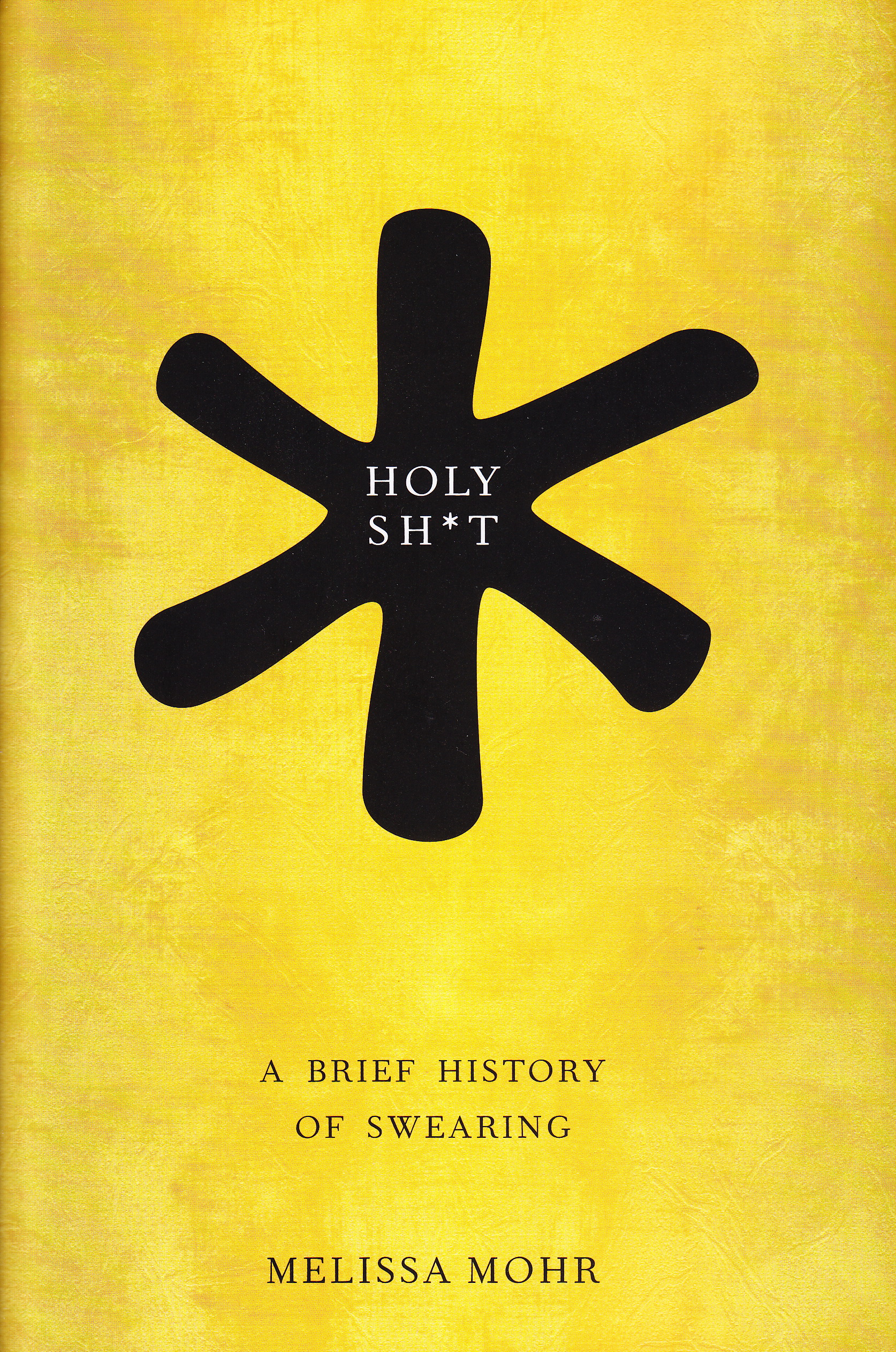
HolySh*tHoly Shit (in the philosophical mention sense, not the use sense), by Melissa Mohr, is a book I had intended to write. I’m glad Dr. Mohr beat me to it, however, since her treatment would be difficult to top. Few ideas are so arresting as the forbidden topics, and Mohr shows us that swearing occupies a compartment of the brain separate from regular speech, and it may even have therapeutic qualities. A Brief History of Swearing, to use the less offensive subtitle, is not an easy book to read in public. Since most of my reading time is spent in densely packed transit vehicles or waiting areas, I always wonder who might be reading over my shoulder. As a short guy that’s always an issue. Nevertheless, Mohr’s book is fun and informative, and I suspect I will read it again for all the information packed into it.

You see, Mohr uses both words of the title in a literal sense. Beginning with the Romans, but then stepping back to the Bible, clearly swearing has religious origins. While the Bible doesn’t prohibit coarse language in any direct sense, it does believe in oaths. Swearing oaths was serious business, and that seriousness led directly to the concept of swearing. Combine that with the idea of cursing (which the ancients also believed effective—ask Saint Peter) and you get the spectrum covered by the concept of “bad words.” (At least up until modern times.) Although I’ve studied religion my whole life, I was surprised how much I had to learn about the more earthy aspects of spoken sacred language.

As Mohr amply demonstrates, what counts as swearing changes with time. Giving the case of the Lindisfarne Gospels, she illustrates how a glossing priest causally dropped the equivalent of a medieval f-bomb right there on the pages of the holy Gospel. It wasn’t considered swearing at that historical moment in time (and besides, a fair amount of it goes on in the Bible). How far we’ve come. I recall one of my Nashotah House students telling me how he had to take a rather freely expressive classmate aside and tell him he was pretty sure that the f-word was an inappropriate adjective to use when referring to the Trinity. But now I see the wisdom of the ages at play. People use their most powerful words for what moves them most deeply. I doubt Mohr had quite that in mind, but if you read her delightful study you can find out what I may be full of after all.


Retire Me This…

We’re all getting older.  My daily, grudging glimpse in the mirror reminds me that my beard wasn’t always gray, and there was a time *gasp* when no beard grew at all.  One of the realities of the brave new world we inhabit is that career stability has become a myth.  My father, in the brief time I knew him, worked as a house painter.  My stepfather worked in a sewage plant for a small town and drove a snowplow in winter to make ends meet.  These utilitarian jobs seemed never to end.  I made the mistake of going into higher education, not realizing that the risks were much higher and that I would make more money working in a sewage plant than I have ever made in my professional career, PhD in hand.  So it rankles me when I hear professors complaining about being too busy in retirement.  Retirement: what a concept.  When the guy who has custodianship of my minuscule retirement account from Nashotah House, after his gentle awaking from the defibrillator, looks at my records he always informs me, “you’re not well placed for retirement.”  Talking to my big brother we agree—our retirement plan is to die on the job.  So, when someone asks you to write another book, remember maybe it is some guy your own age who is trying not to starve.

As a society we’re aging.  Those who managed not to be fired by Fundamentalists have had a secure, tenure-ridden ride through the occupation that some of the rest of us were denied.  Busy in retirement?  Some of us will never have that privilege.  Funny thing is, it’s not funny.  I sometimes lean back in my editorial chair and realize, if this hadn’t happened to me, I would probably look at it the same way.  I would have published that second, third, and fourth book, and people would actually think my opinion mattered.  I would’ve become a resource to be tapped rather than a dancing monkey who hopes for anything shiny.  Is that another gray hair?

I don’t belittle the hard work of higher education—it’s not an easy profession. But writing books? That’s the fun part! Privilege induces blindness. How rare an opportunity it is to teach! While we as a nation devalue it, in many parts of the world those who shape future minds are revered. Yet elsewhere in the world there are those who are far worse off even than an editor—those for whom life is constant suffering and surviving another day is not reasonably assured. How easily I forget this as I neglect to balance my checkbook for fear of what I might find. We shouldn’t complain when someone asks us to give back, even in retirement. Those of us capable of writing books sometimes lack only the bona fide of a college or university position to do so. Otherwise I might hope to retire as well some day.

"Photo by Chalmers Butterfield"

“Photo by Chalmers Butterfield”


Who Loves You?

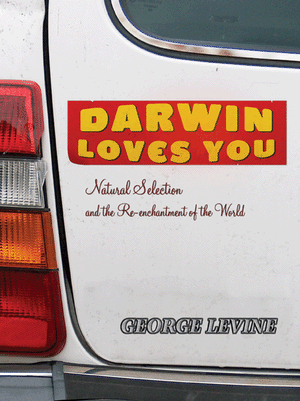
DarwinLovesYouWonder is too easily lost in a reductionistic world. Even when we get to the level of quantum mechanics we’re told, “it’s just physics.” How depressing. Such ideas seem to have been in the mind of George Levine as he wrote Darwin Loves You: Natural Selection and the Re-Enchantment of the World. Don’t get me wrong, Levine does not back away from the secular starkness of biology. What he does, however, is ask whether or not evolution by natural selection shouldn’t create a kind of secular enchantment. Almost from page one Levine has to address religion, the tyrannosaurus in the room. Religion, for all its shortcomings, has provided people with a sense of purpose, even enchantment, from days long before any temples or priests existed. The materialist response of “buck up, there’s nothing more than biology going on here,” has proved to be of little consolation to the vast majority of people on the planet. One of the reasons, and I speak only for myself here, is that it just doesn’t feel true.

Truth is a slippery concept. In origin the word seems to derive from something like “to have good faith.” In terms of factuality it also has the meaning of conforming to reality. Reality, however, is equally perilous when it comes to authoritative definitions. Reality means nothing if it is not perceived. Perception may actually bring something to the table, if particle physics are to be believed. Empirical method is pragmatic—I believe that every time I grudgingly climb aboard an airplane, or turn on a computer. At the same time I sense that there may be more to it than that. No matter how much science I read, that perception simply won’t go away. The professors of materialism have learned to quash that still, small voice. The hollow feeling with which it leaves me, however, may be significant.

Evolution and religion are inextricably interwoven. Religion, although poorly defined, has to do with finding meaning in a world that is often harsh and cruel. No doubt such feelings evolved, and some of our animal kin may share them with us. When molecules break down into atoms, they generally lose the characteristics of the molecule. We now know that we can keep breaking even the invisible apart until we’re left with only theory as to what might be below. This may be true. At the same time, the wonder with which we might stand before a cyclotron or a little robot rolling around the surface of Mars, the question of truth emerges like a rock that wasn’t there just a few days before. A gnawing sense that we don’t have the full picture. A sense that no matter how far we tear apart, the total will always be far more than the sum of parts. Levine is right; evolution can induce wonder. And truth, at its very heart, is a matter of faith.


Weather or Not

The internet’s nothing if not self-referential. A post by Fred Clark over on Patheos, pointed out to me by my brother-in-law, has received 235 comments (at the time of this writing) for a topic I’ve addressed repeatedly, to no avail. I know my place. In any case, the topic which brought such furor was that severe weather is caused by divine displeasure, something I’ve addressed a time or two. In fact, I’ve written a book about it. Never mind, some of us revel in obscurity. Fred is writing about the remarks of former Tory David Silvester that the UK has been suffering unusually severe weather because of homosexual marriage. That’s really old news to those of us over here in the colonies; Pat Robertson told us as much after Katrina (although he didn’t limit the sins to homosexuality). Sex tends to stir up storms of its own, regardless of divine voyeurism, while we ignore the obvious culprit—global warming. (Culprit of unusually severe weather, not of sex.)

Global warming, as a recent conversation with a very smart undergraduate confirmed, is a poor name choice. Those of us on the northeastern coastal corridor have been shivering a lot this winter, and snow has remained on the sidewalks of Manhattan for more than a single day at a time. You call this global warming? Yes. The science behind climatology tells us that warming the overall temperatures of the globe will result in erratic weather, including uncharacteristically cold and freezing in some locations, dampness in others, while yet others experience, yes, warming. We know it is real, we know it is happening. We just don’t know what to call it. Some choose to call it God’s wrath. Others choose to name it more properly human shortsightedness. After we hunted the last mammoth down, we decided to start building bigger fires to warm the ice age up a bit. Those fires have been burning ever since.

IMG_3659

My book on the weather, by the way, suggests that divine control of the elements is an essential part of the biblical mindset. To ancient folk this was a no-brainer. God is in (his) heaven and messing with the HVAC system is one of the ways (he) passes the time. Down here we may shiver, become parched, or get washed away. It’s all a matter of the divine thermostat. As Fred Clark points out, the divine temperament sets the temperature based on human activity. Sin leads to unusual weather. Unwittingly, however, David Silvester may have gotten it right. There is a sin involved, and that sin is called global warming. No deity need be involved. We have shown that humans are quite capable of messing with the thermostat on our own. And the day I get 235 comments on anything it will be a very cold day in a place famed for its heat.


A Girl Named Cthulhu

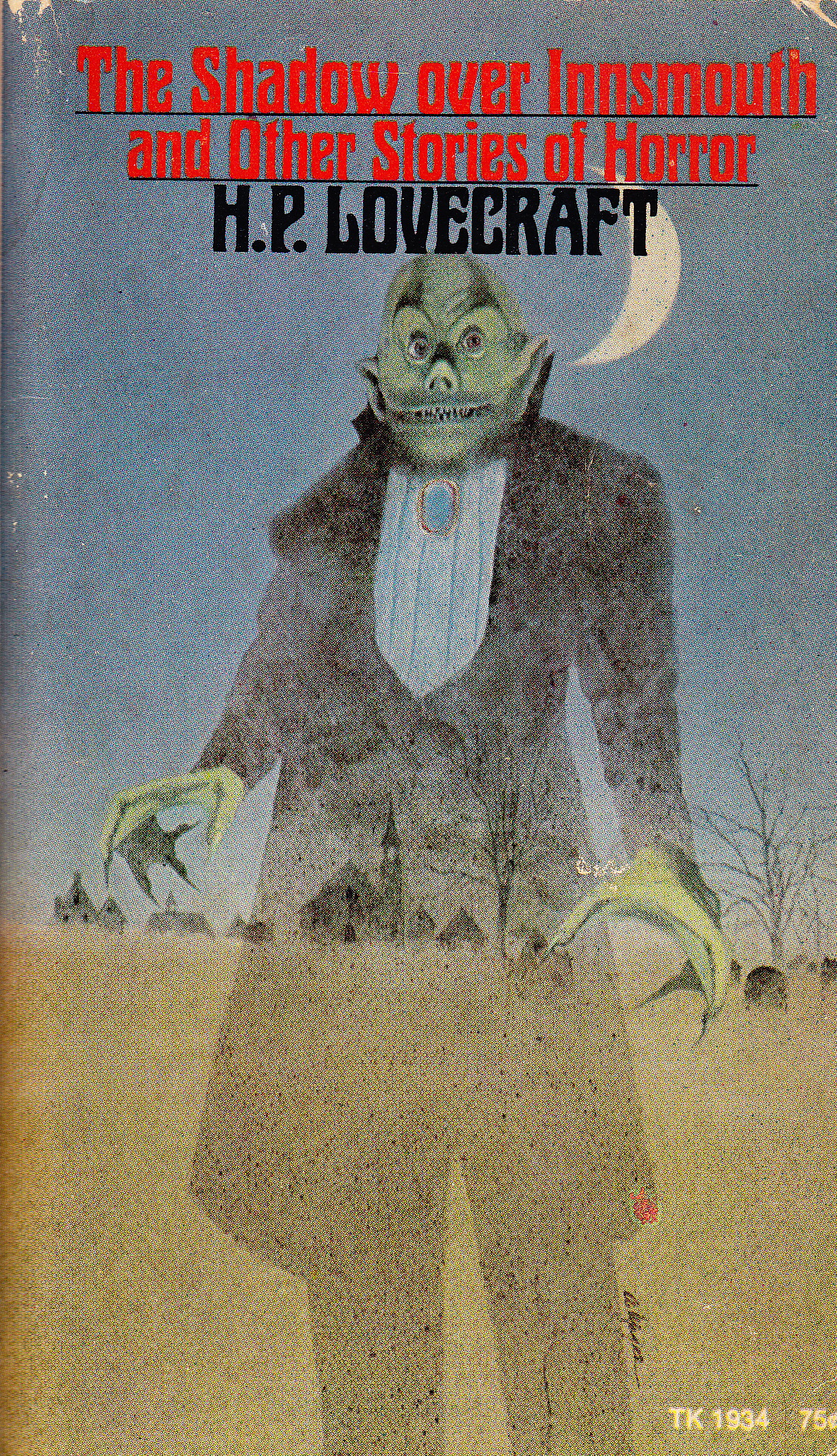
It was only a 25-word blurb in last week’s Time magazine. A Canadian couple decided to let the internet community name their daughter. As of the time of writing the third most popular suggestion was Cthulhu. WWLD? The internet has brought Lovecraft’s sleeping deity to life. Ironically this evil, belligerent, and fearsome god tends to have more fans than some of the more loving, cuddling varieties of deity around which western culture arose. Children are a parent’s ultimate investment (or should be) and the name we bestow will influence their view of life. I still recall the scandal of when I first showed my Mom a baseball card where the player was named Jesus (Spanish pronunciation, please!). I innocently asked if that was allowed since we’d been taught that although other biblical figures were fair game, the name of God was a retired number. There was only one Jesus, and this baseball card a monument to sinful arrogance.

Cthulhu

Of course, we lacked the biblical training to know that Jesus is only the Greek form of Joshua, a name of fair game to any young lad. Naming after a deity was otherwise verboten. Of course, that has all changed now. Names are up for grabs, and it is getting harder to find unique ones. H. P. Lovecraft, who died in relative obscurity, could find publication only in pulp fiction magazines—the lowbrow literature of his day. The divine fruit of his fertile imagination has now taken on the dimensions of true divinity. How many potential names are out there on the internet? Lovecraft alone gave us many gods. All the Dianas, Thors, Carmans and Dylans out there are in good company. Why not name a child after a god?

Names do effect a child’s view of life. Growing up in a biblically literate family, I often thought of the Stephen of the New Testament. The first Christian martyr, he died with a vision of heaven in his eyes, earning the meaning of his name, “crowned.” I aspired to live a selfless life, in as far as such a thing was possible in the twentieth century. It was my name—it was my destiny. There are no other “Steves” in my family, and when I was old enough to comprehend that many children bear family names, I asked my Mom whence mine had come. It turns out that I was named not after a family member or even a saint, but after a cartoon character. Touché, Cthulhu! Long may those of us with unorthodox namesakes stick together. The world is our myth.


Material Goods

Few ideas are as insidious as the reductionistic materialism touted by some of the New Atheists. Atheism and materialism need not walk down the same garden path, but the idea that we are determined by the thoughtless playing out of particle physics can only be achieved by sweeping the vast majority of human experience off the table to attempt a sterile analysis that applies, it seems, only in a vacuum. I often ponder this dilemma since those who think through the implications seriously soon find themselves locked out of the room. Materialists want nothing to do with those who challenge a system that is a little too neat, while ardent believers in religion have trouble letting go of what are obviously the mythological underpinnings of belief structures. The rest of us, trying to be intellectually honest, know that strange things happen and that materialism’s strong arm is powerless to uphold a system that is simplistic.

Indeed, scientists have moved away from utility as the sole criterion for explaining the universe. Beauty, or elegance, is frequently considered to be key to a Grand Unified Theory. It may be a gut-level reaction, but it speaks to something deeply human; we need to make sense of our world. We can do that, however, only if we’re willing to be honest. I’m not sure we can be honest without acknowledging that our minds range far beyond the sum of all the electro-chemical activity within an individual brain. If they didn’t, religion, for one, just couldn’t survive. Beauty, as a qualifier, is said to be in the eye of the beholder. Philosophers, however, maintain that aesthetics, the study of beauty, constitutes a branch of philosophy that requires hard thinking and specialized training. Beauty is a driving force for many aspects of life. Otherwise we wouldn’t hire architects to design since buildings on university campuses. A pile of bricks sufficiently mortared will do.

450x230_q75

The issue is trenchant because a generation is growing up with this idea firmly in place. Scientific studies, if scientists are to be believed, demonstrate that a strict materialism erodes empathy, the sense that what others experience matters. The logical conclusion to a reductionistic world is a kind of cold solipsism where the only spark of consciousness that matters is the one that takes place inside this head. All the rest are just formulas and equations. And yet, don’t even materialists enjoy a good novel, movie, or fine meal? The world is a complex place, and we haven’t even taken the first adult steps to begin exploring the rest of the universe with the five basic senses we acknowledge. Even down here, however, there is much that reductionistic materialism can’t explain. I wouldn’t stick a god in that gap, but a dose of humble wonder, I suggest, wouldn’t hurt.


Stealing God Blind

Photo credit: Raul 654, Wiki Commons

Photo credit: Raul 654, Wiki Commons

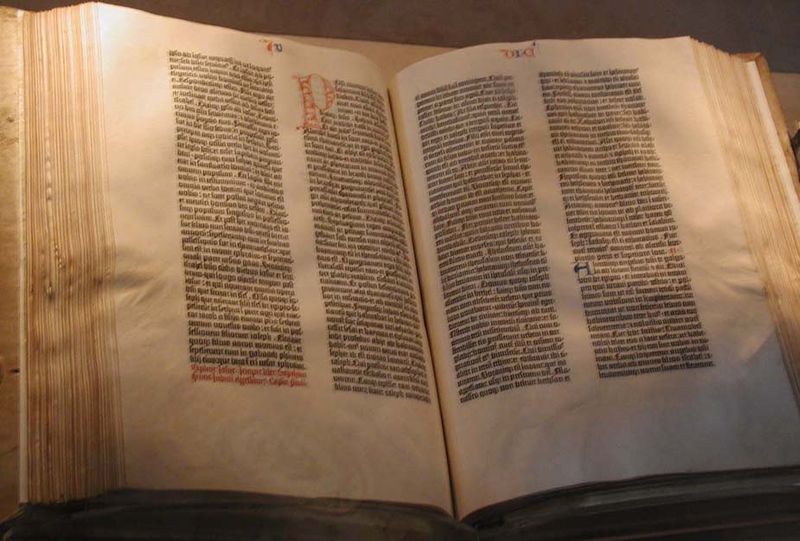
A friend who also works in the book trade recently revealed that the section in one of the few remaining brick-and-mortar book stores most liable to theft is Bibles. I’m not really surprised, I guess. Faith can do strange things to people, giving them justifications for thievery in the name of a higher authority. What it really doesn’t reflect, however, is just what a financial liability a Bible can be. My friend speculated that people believe that the Bible should be free, and, in a sense they have a point. If it is the word of God, as they likely believe, then it should be in the public domain. The problem is, the Bible’s not as simple as all that. The problem begins with the fact that “the Bible” does not exist in any definitive form. Every single one of the original manuscripts has long been lost and we have copies of copies of copies, etc., of those putative manuscripts. And they are in foreign languages—technically dead languages, at that. (Although Greek and Hebrew are still spoken, the biblical forms of those languages died out long ago.) So, are the Hebrew and Greek texts in the public domain?

Maybe, but. The texts from which translators make English (or other modern language) Bibles are based on compilations of various documents that have come to represent the accepted, textually correct ancient language versions of the Bible. These are protected by copyright since they are relatively modern editions. Some of the older ones are available in the public domain, but they are outdated. Even skipping all that, when we get to English Bibles, such as the King James Version (but not the New King James Version, where the “new” modifies “version,” presumably, and not “King James”), the text is in the public domain but the printed book still costs money to manufacture. One of the problems with Bible mythology is that some think this implies that Bibles just drop down from God. In actuality, they have to be edited, typeset, printed, shipped, and stocked, and the people who do this work have to be paid. In short, free text is not free.

I work for a major (but by no means the biggest) producer of Bibles. Even in my short time at the press, I have come to realize that Bible publishing is complex and expensive. Sure, you can print cheap editions and give them away like the Gideons do, but they have financial backing to buy and distribute cheap words of the Lord. There’s a sense of entitlement here: if God spoke, wasn’t it to all people? What about the Quran? The Book of Mormon? Science and Health? Some may castigate the Bible, but it is a genre-defining true original. And although one of the ten commandments declares stealing is wrong, some wonder how this can possibly apply to Bibles. It’s the middle-men and women. Stealing a Bible is cheating someone from a bit of their livelihood. Even if the Almighty turns a blind eye.


Sidekick

I have moved from the territory of Sharon to that of Laura. New York City is a conglomeration of smaller neighborhoods, and even Midtown Manhattan hosts hundreds of smaller sub-divisions. Although I’ve never intentionally consulted a psychic, I do tend to notice them. Once while on a visit to Galena, Illinois during the summer, we stumbled on a psychic booth where the proprietor was giving free readings. With some trepidation, we let her give our daughter a reading, just for fun. I don’t recall what she said, or even what her name might have been. There’s just enough fear of the unknown left in me to compel me ever want to visit a psychic, even if it is for entertainment purposes only. Clearly, however, there is a market. Where the market makes a hole someone will fill it. So I pondered Laura the psychic.

IMG_1178

The other day I passed her sign. Like most psychic ads I see, Laura’s sign makes use of religious symbols; the cross, bird, crescent and star, all thrown together amid an interfaith openness from which most religions might learn a lesson. Are psychics religious? I suppose that’s a personal question. The phenomenon of psi, if it does exist, and if it does involve spooky influence at a distance, tends to be classed with the supernatural. A few brave universities have from time to time explored the phenomenon, whether or not commercial psychics have it, scientifically. They set up controlled experiments and have even obtained statistically significant results. I’m more inclined to doubt statistics than the outcomes. Statistics are the tools of markets, and markets, well, make me shiver.

IMG_1183

Then I passed another sign. This one, just a block or two from Laura, seemed to suggest that witchcraft might unleash my potential and power. That sounds like a good thing. But then I noticed the FOX logo at the bottom. Another quality program, it seems, has fallen to the spell of witchcraft. It did confirm, however, that it is all about money. One size does not fit all. Religion adapts to fit a free market economy. Totalitarian states either attempt to disband religion completely and/or build up a national mythology that supplements traditional teachings. It doesn’t take a psychic to see that coming. As long as there’s money to be made, who’s complaining?


In Saecula Saeculorum

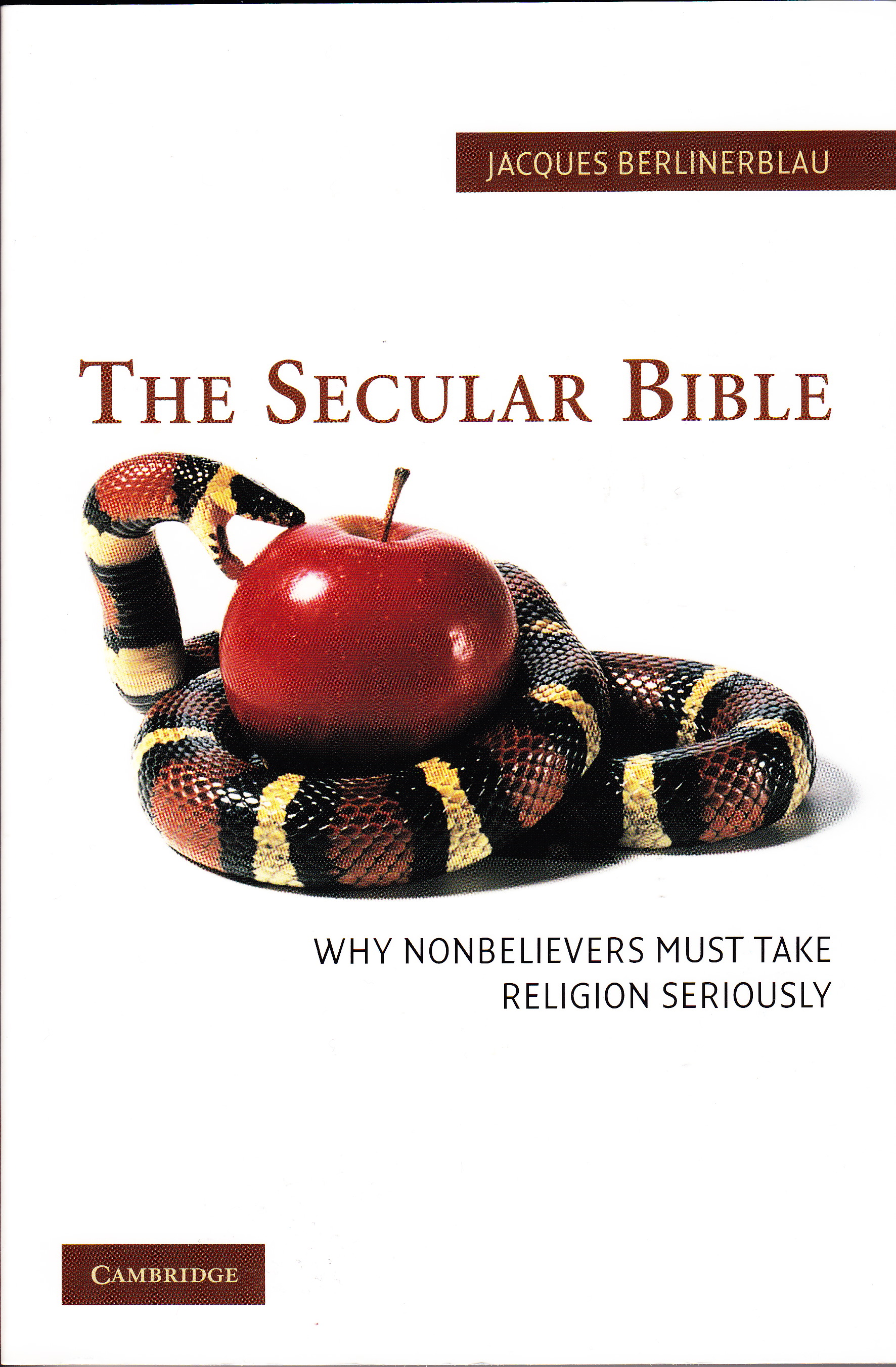
SecularBible“The Hebrew Bible is a misreading waiting to happen.” Jacques Berlinerblau’s The Secular Bible is a book containing much wisdom. My only real concern is that by having published it with a university press Berlinerblau may have inadvertently ensured that it would be read only by biblical scholars. Although yours truly was once such a credentialed scholar, I read The Secular Bible with its intriguing subtitle, Why Nonbelievers Must Take Religion Seriously, looming in my mind like a great raptor. This is an important book. With so very much of our lives heavily influenced by the Bible, eloquently argued by Berlinerblau, we have secularists who don’t know the Bible fighting the impossible battle to subvert it. The rationalizing, leveling influence, for the past two centuries, has come from the much castigated and discarded biblical scholar. Can I get an “Amen”?

Berlinerblau demonstrates unequivocally that we need Bible scholars and Qur’an scholars who know how to speak to their own traditions. Instead we have secularists who belittle and then wonder why the religious strike out. The pattern has repeated itself so many times that it defies reason that intelligent people would delude themselves that religion is a passing fancy. The Secular Bible argues what I’ve said time and again: if we want to avoid the dangers religion can bring, we must spend the resources to understand it. Instead we close departments and force those who know the field credibly well into unemployment. And we wonder why there’s a reaction.

“Self-critical religious intellectuals have never been much appreciated.” Instead we put the extremists on television so we can laugh at them or gape at their ability to do the unthinkable in the name of religion. Ironically, there are thousands of trained experts in the field, many of them languishing in un- or under-employment while towers crumble and mobs burst into violence. I do wonder what future generations will think of us. We have the resources handy, indeed, many of them willing to serve for a fraction of the cost of a business professor or basketball coach, but we choose to ignore them. As Berlinerblau states emphatically, we in the western world have the Bible so deeply ingrained that we can no longer even exegete all the ways in which it plays out in our society. If such influences were at work in a human body, we’d pay a doctor well to understand. Instead, we let the most foundational text in our society be used for duplicitous purposes while the simple reading of a book like The Secular Bible could save us all an eon of grief.